
Summary
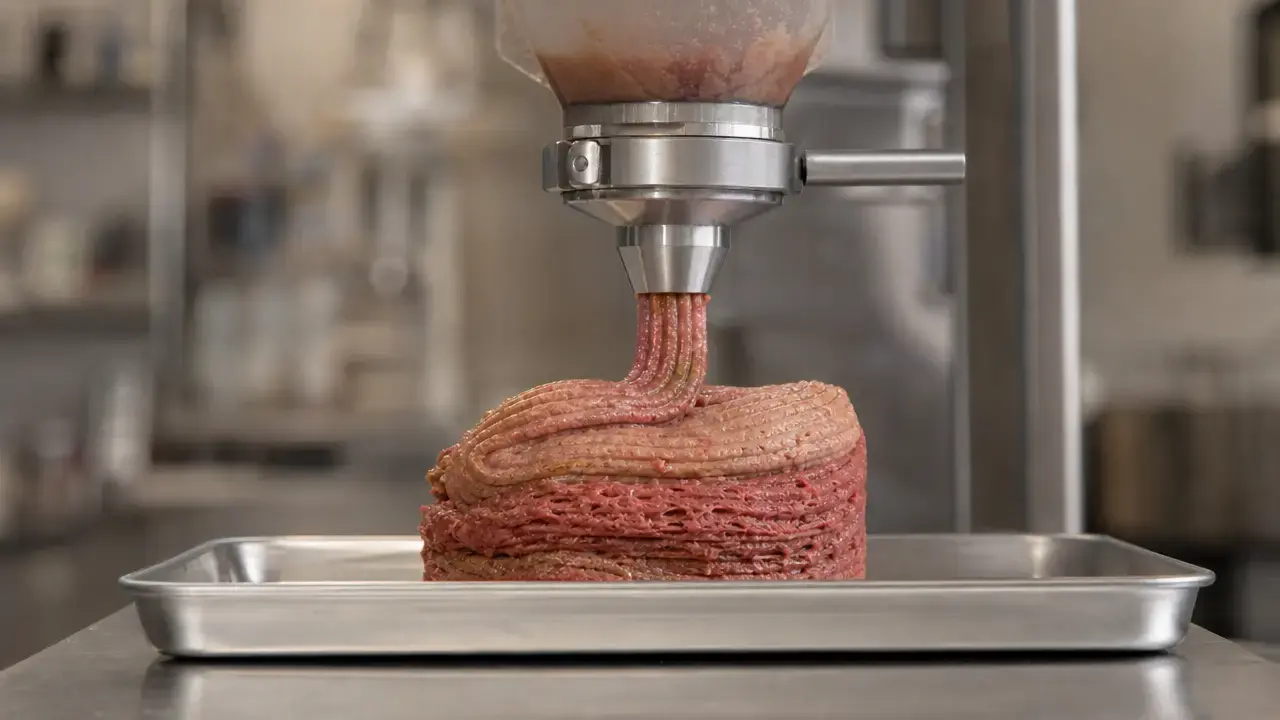
For anyone asking how is 3d printed meat made, the first step is to separate three products often grouped under one label. A plant-based printed analogue deposits an edible mixture of plant proteins, fats, binders and water into a meat-like form; it contains no animal cells. Conventional animal-meat paste printing shapes minced, ground or otherwise processed meat into a new geometry. Cultivated-meat bioprinting places living animal cells and supporting materials in designed locations, then requires culture and maturation for tissue development. These routes may share layer-by-layer deposition, but their ingredients, biology and post-print processing differ fundamentally. Extrusion-based deposition is widely described as the most common approach in 3D food-printing research. [3] [10] [14]
A food ink is the edible formulation fed into a printer. It must flow during deposition and retain a useful shape afterward. In this article, bioink means a printable formulation containing living cells at the time of printing. ISO/ASTM defines additive manufacturing as building physical 3D geometries through successive material addition; it is not a food-safety or food-printability standard. [1]
What “3D Printed Meat” Means (and a Minimal, Sourced Origin Snapshot)
“3D printed meat” is public-facing shorthand, not a single manufacturing method or ingredient category. It may refer to a printed plant-based analogue, a reshaped conventional meat paste, or a cultivated construct organized for further development. Similar-looking deposited layers can therefore represent very different foods and production systems. A layered pattern alone does not establish whole-muscle fibres, marbling, cooking behaviour or steak-equivalent sensory performance. [3] [7] [14]
Food printing developed around the controlled placement of edible pastes and structured formulations. A machine that dispenses a viscous food material is not automatically capable of producing a whole-muscle cut from ordinary ingredients. In vocabulary terms, additive manufacturing describes successive material addition from 3D model data; it does not determine whether the deposited material is meat, a meat analogue, printable, safe to eat or biologically mature. [1] [2]
- 2007: A food-printing review identifies Fab@Home-era work as an early example of using a multi-material printer with liquid food materials. [2]
- ISO/ASTM 52900:2021: Provides additive-manufacturing vocabulary for building 3D geometries through successive material addition. [1]
- Meat printing research: 3D printing of meat documents conventional meat formulations as a distinct food-processing and structuring topic. [7]
- March 7, 2019, and November 16, 2022: USDA and FDA announced their formal agreement on cell-cultured food oversight, and FDA completed its first pre-market consultation for human food made from cultured animal cells. [11] [10]
How 3D Printed Meat Is Made: Three Production Routes
Across all three routes, a digital design guides material placement along programmed paths, usually through a nozzle. What follows deposition depends on the material: a plant formulation may be set and cooked; a meat paste may be restructured and cooked under validated controls; and a cultivated construct requires controlled culture and maturation. [3] [7] [14]
Plant-based 3D printed meat (food inks)
Plant-based 3D printed meat begins with a food ink made from ingredients such as protein, water, fats and structure-building components. The formulation is tuned to flow under printing pressure while retaining sufficient structure after deposition to prevent strands and layers from spreading or collapsing. It is extruded into the intended geometry and may be chilled, heated, dried or otherwise set before cooking or finishing. One research study used soy, wheat and rice protein pastes to make printed meat analogues; these are examples, not a universal recipe. [6]
Ingredient systems vary widely and are often proprietary. Proteins contribute structure, fats can affect lubrication and mouthfeel, and hydrocolloids or other binders can help maintain shape. As a product-specific example, one commercial printed analogue lists water, pea protein, sunflower oil and seaweed extract among its ingredients. Not all plant-based meat is 3D printed; many products are mixed, extruded, moulded or formed through other food-processing methods. [24] [3]
Printing conventional animal-meat formulations (restructuring/food shaping)
Conventional meat printing uses ground, minced, puréed or otherwise processed animal meat as a printable formulation. It is best understood as 3D food printing applied to meat pastes: a structuring or restructuring approach, not a separate regulated consumer category. Depositing parallel strands does not recreate continuous muscle fibres. Water and fat affect flow and cohesion, while the disrupted structure of processed meat can make shape retention difficult. [7]
Hydrocolloids and other formulation aids may improve extrusion, recovery after deposition, stability and post-processing behaviour. Their role is formulation-specific, so there is no universal additive percentage or print setting. Raw-meat formulations also raise sanitation, time-temperature and cross-contamination concerns. This route belongs within professionally managed food-production controls with validated handling and cooking procedures, rather than a do-it-yourself raw-meat printing workflow. [8] [7]
Cultivated meat 3D bioprinting (cells + scaffolds + maturation)
Cultivated meat begins with animal cells grown in controlled conditions, rather than a plant paste or pre-existing processed meat mixture. Bioprinting is one possible structuring method: it can place cells and edible supporting materials in patterns intended to support later tissue development. Not all cultivated meat is bioprinted, and a printed cell-containing structure is not necessarily finished food immediately after deposition. [10] [14]
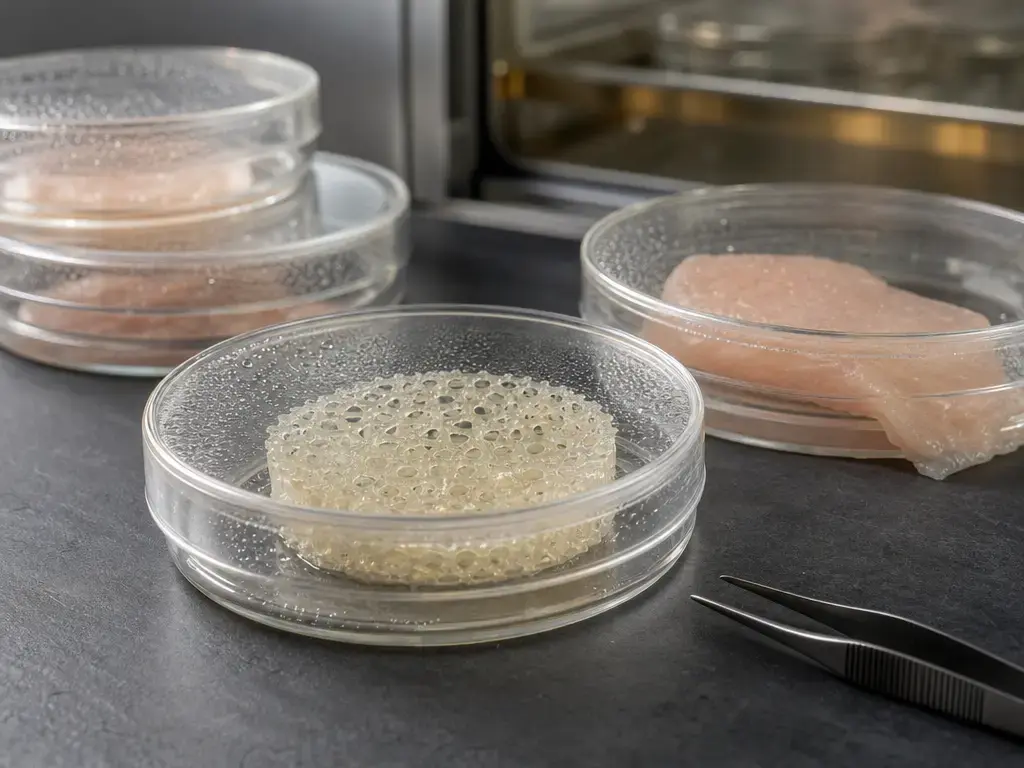
Several high-level pathways are possible. An acellular scaffold can be printed first and seeded with cells afterward. Alternatively, a cell-laden bioink can be deposited and then cultured so cells proliferate or differentiate. Another approach places cell aggregates or spheroids within a surrounding matrix. The appropriate sequence depends on cell type, intended tissue, matrix compatibility, nutrient transport and the required final structure; there is no universal rule that cells must be printed before or after differentiation. [14]
After printing, post-processing commonly includes controlled culture and maturation. Conditions must support cell survival and development while maintaining the intended geometry and providing adequate access to nutrients and oxygen. No universal maturation time applies, because it depends on the cells, scaffold or matrix, construct dimensions and desired tissue properties. [14]
Comparison Table: What Changes Between the Routes
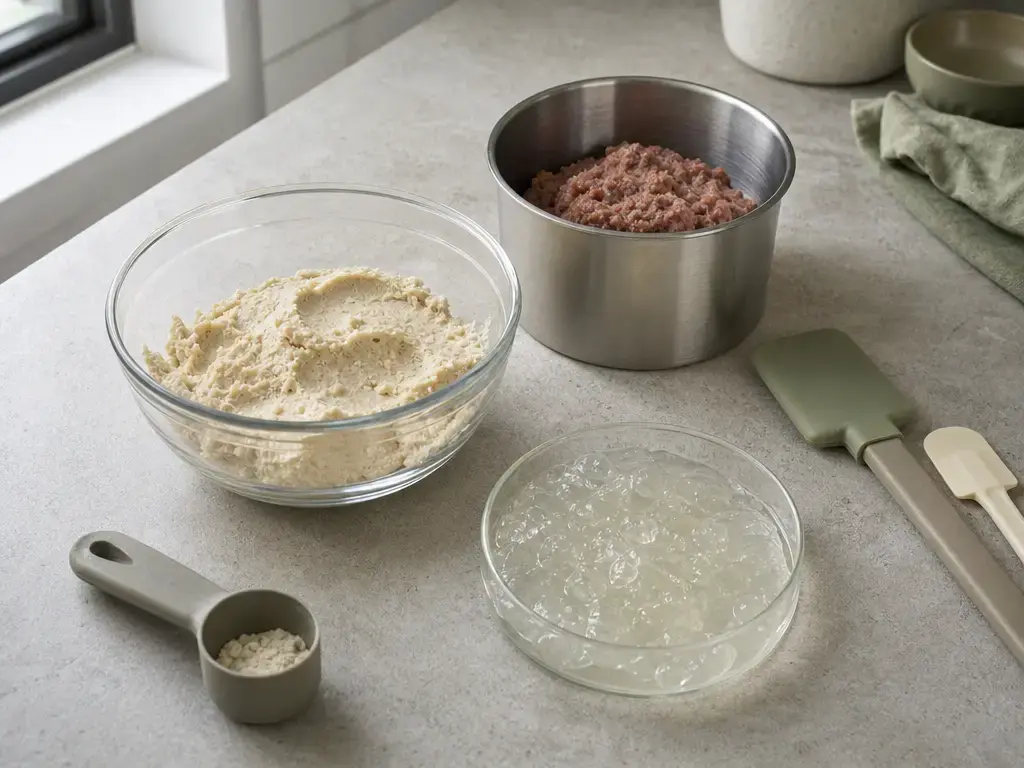
The printer hardware may appear similar across routes, but the printable material and post-print work differ. The table distinguishes shaping an edible mixture from arranging living cells and materials for later tissue development. [3] [7]
| Product route | Primary printable material | What the printer does | What happens after printing |
|---|---|---|---|
| Plant-based meat analogue | Plant-protein food ink with fats, binders, seasonings | Shapes/places edible paste | Setting, cooking, finishing |
| Conventional-meat formulation | Processed meat mixture, often with binders | Restructures meat paste into geometry | Cooking + validated handling controls |
| Cultivated-meat bioprinting | Animal cells plus bioink and/or edible scaffold | Places cells/materials in designed locations | Culture, maturation, processing |
| Hybrid cultivated product | Cultivated cells + animal-free scaffold/ingredients | Structures multiple components | Culture, as applicable, + final processing |
This is an editorial taxonomy synthesized from sources, not a legal or regulatory classification. Real products can overlap by combining ingredients, structural materials and processing stages. Here, “hybrid” describes cultivated animal cells combined with animal-free scaffold materials or ingredients; it is not a formal product class. [3] [7] [10] [19]
Materials and Terminology: Food Ink vs Bioink vs Scaffold
A food ink is an edible formulation designed to pass through a printing system and retain a useful form after deposition. Its printability depends on rheological behaviour, including yield stress, shear-thinning flow, viscoelasticity, structural recovery and temperature dependence. In this article, bioink is reserved for a printable formulation containing living cells at the time of printing. Literature usage varies, so this distinction is an editorial convention intended to separate food formulations from cell-containing materials. [4]
A scaffold is a structure that supports cells. A hydrogel is a water-rich polymer network that may serve as a scaffold or surrounding matrix. A cell carrier is a material that carries cells, while a microcarrier is a small particle used to support cell growth. An extracellular-matrix analogue is designed to mimic selected biological or structural functions of natural extracellular matrix. These terms are not interchangeable, and no single material is required across cultivated-meat systems. [14]
Material roles in a printable formulation
- Protein or structure former: Provides body and helps a deposited strand retain shape.
- Water phase: Hydrates ingredients and strongly influences flow.
- Lipid phase: Contributes lubrication, richness and fat-like texture.
- Binder or hydrocolloid: Supports setting, cohesion and structural integrity.
- Texture modifier: Fibres or particulates can alter bite and internal texture.
- Colour and flavour system: Provides the intended appearance and taste.
- Cultivated only: Living cells plus a scaffold or matrix material support placement and later culture. [4] [6] [8] [14]
The 3D Printed Meat Production Process
The shared logic is digital design followed by controlled deposition, but the material and final objective vary by route. Extrusion is widely used because it can dispense viscous food pastes and compatible cell-containing formulations. The challenge is not simply depositing fine lines: the material must flow during printing, retain shape afterward, and still perform properly during cooking or culture. [3] [4]
- Define geometry and target eating texture.
- Formulate and test the material in its relevant print-plus-cook or print-plus-culture context.
- Load the route-specific paste or bioink.
- Deposit material along a programmed path.
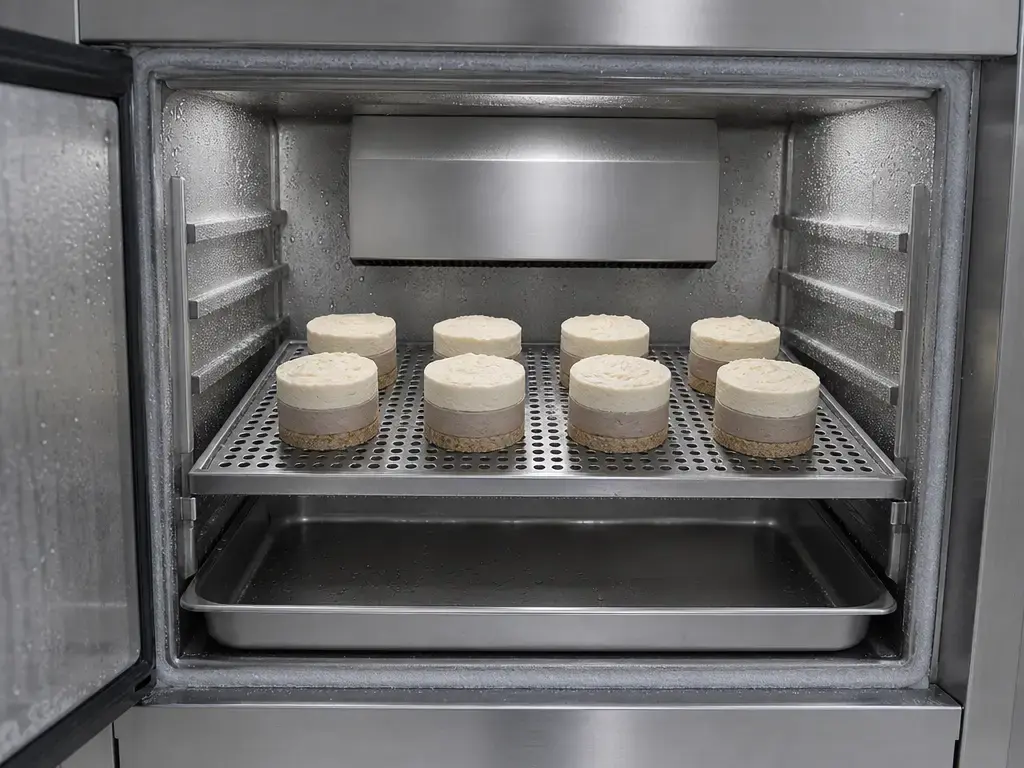
- Stabilize, set, crosslink or cook, as appropriate.
- For cultivated products only, culture and mature under controlled conditions.
- Finish through cooking where applicable, packaging, quality assurance and safety controls.
For plant-based and conventional meat-paste products, stabilization may involve chilling, heating, drying or formulation-driven structural changes before final cooking and packaging. For cultivated products, maturation occurs before retail packaging because cells need controlled conditions to develop the intended tissue characteristics. Setting a cell-containing material can preserve geometry, but it does not replace cellular growth or differentiation. [14]
Performance Metrics That Matter More Than “Printer Resolution”
Printer resolution is only one process attribute. A smaller nozzle or thinner deposited line can increase detail, but it can also change pressure requirements, shear exposure, clogging risk and the tendency of a deposited strand to collapse. Final food quality depends on the interaction among formulation, deposition conditions, setting, cooking, storage and, for cultivated systems, biological performance. [4] [5]
Metrics you should not collapse into one number
- Printer/process metrics: Nozzle diameter, extrusion rate, line width, layer height, speed, pressure or other actuation limits, all reported with operating conditions.
- Ink/formulation metrics: Flow curve, yield-stress reporting, viscoelastic moduli, thixotropy or structural recovery, and temperature dependence with the stated test setup.
- Post-processing/final-food metrics: Dimensional deviation or collapse after setting or cooking, moisture loss, texture-profile analysis under a stated cooking protocol, and sensory findings labelled as study-specific.
- Cell/tissue metrics for cultivated products: Cell-viability assay and time point, high-level differentiation markers, and the mass-transfer or perfusion strategy used for the construct.
Results need context to be interpretable. Rheology should report temperature, shear-rate range and measurement geometry; shape fidelity should define its deviation or collapse criterion; texture measurements need a stated cooking endpoint; and viability needs an assay and time point. One review reports cell viability of 40%–80% as a limitation associated with extrusion bioprinting, but that range depends on the cells, ink, nozzle or shear conditions, assay and measurement timing. It is not an expected benchmark for every construct. [4] [5] [16]
Why Structured Cultivated Meat Is Harder Than Printing a Burger Shape
A simpler, more uniform geometry has different demands from a thicker, tissue-like cultivated construct. The scaffold or matrix must support cell attachment and development, be edible or compatible with the intended final food, contribute acceptable texture, retain sufficient mechanical integrity and remain feasible to manufacture. These goals can conflict: a material that prints sharply may not provide the most favourable environment for cells, while a softer cell-friendly material may deform after deposition. [14] [15]
Oxygen and nutrient transport become increasingly important as constructs become thicker. In tissue-engineering contexts, diffusion-based supply is often described as limited to roughly 200 µm from the nearest capillary when no vascular network is present. This is not a universal maximum thickness for cultivated food. Finished food does not need literal blood vessels, but growing cells still need adequate oxygen, nutrients and waste removal during culture. [15]
Extrusion creates another trade-off: cells can experience shear during deposition, while the matrix must still maintain shape after printing. The review-reported 40%–80% viability limitation range for extrusion bioprinting is process-dependent rather than universal. It reflects the interaction of cell type, bioink, nozzle geometry, shear conditions, assay and time point. Post-print maturation must therefore balance structural fidelity with cell survival, growth and differentiation. [16] [14]
Limitations, Food Safety, and Regulation (U.S.-Qualified)
Printer precision is not a safety guarantee. Food-contact surfaces, nozzles, reservoirs and transfer equipment require sanitation and cleaning procedures appropriate to the process. Producers must also manage ingredient controls, cross-contamination, storage conditions, shelf life and other product-specific hazards. U.S. sanitation requirements for inspected meat and poultry establishments include cleanable, sanitary equipment and utensils, while the FDA Food Code provides a model framework for hygienic food handling and food-contact practices. [20] [21]
Raw animal-meat formulations raise the stakes for sanitation, time-temperature control and cross-contamination. Food-printing equipment can add reservoirs, nozzles and internal paths that must be addressed in cleaning and validation programs. Conventional raw-meat paste printing should therefore be treated as a professionally managed food-production activity, not as a home-printing tutorial. [20] [21]
In the United States, FDA oversees cell collection, banking, growth and differentiation for food made from cultured animal cells. For species covered by the Federal Meat Inspection Act or Poultry Products Inspection Act, regulatory oversight transitions to USDA-FSIS at harvest. Other species, including most seafood, remain under FDA jurisdiction for processing and food oversight. FDA completed its first pre-market consultation for human food made from cultured animal cells on November 16, 2022, but the consultation was product-specific rather than blanket approval for all cultivated-food products. Regulatory requirements vary by country and product category. [10]
Research and Application Context
The most realistic applications are those where geometry adds value: customized portions, tailored shapes, texture-modified foods, research prototypes and plant-based cuts with deliberate placement of protein and fat-like phases. Research on plant-based printing focuses on formulation, printability and the relationship between deposited structure and final texture. That does not mean printing is the preferred manufacturing method for every meat analogue. [3]
Cultivated-meat bioprinting remains focused on tissue structuring, scaffold design, cell-compatible processing, nutrient transport and scale-up after deposition. There is no single cross-industry metric for cost, throughput, texture or cultivated-cell percentage because materials, process boundaries and measurement methods differ. When a product is described as hybrid, its composition should specify what is combined, such as cultivated animal cells with a plant-, fungal- or polymer-derived scaffold. [14] [15] [19]
Quick Recap
How is 3D printed meat made? A digital design guides layer-by-layer deposition, but the printable material may be a plant-based food paste, a conventional meat paste used for restructuring, or a cell-containing bioink that requires later culture and maturation. The key distinction is not only what the printer deposits, but also the ingredients, biological steps and post-processing that follow. [3] [7] [10] [14]
FAQ
Is 3D printed meat plant based or cultivated?
It can be plant based, cultivated or made from conventional processed meat. Plant-based printed products use edible formulations such as proteins, fats and binders. Cultivated-meat bioprinting uses animal cells and supporting materials, then requires culture and maturation. The label “3D printed meat” does not identify one ingredient source or one production route. [3] [10] [14]
What materials are used in 3D printed meat?
Materials depend on the route. Plant analogues may use protein ingredients, water, fats, hydrocolloids, flavours and colour systems; soy, wheat and rice protein pastes are one study-specific example. Conventional meat printing uses processed meat mixtures, often with binders. Cultivated systems can combine animal cells with scaffolds, hydrogels or other matrix materials. [6] [7] [14]
Is printing conventional meat paste the same as cultivated meat?
No. Conventional meat-paste printing reshapes meat that has already been ground, minced or otherwise processed. Cultivated meat begins with animal cells grown under controlled conditions, and bioprinting may organize those cells and support materials before further culture. Both routes can use extrusion, but their ingredients, biology and processing controls differ. [7] [10] [14]
In cultivated-meat bioprinting, are cells printed before or after differentiation?
Either sequence may be used, depending on the cell type, printable matrix and target structure. Cells may be printed in a less differentiated state and cultured afterward, or cells at a more differentiated stage may be incorporated into a printable system. There is no mandatory order because survival, maturation and structural needs vary by process. [14]
What limits the thickness of structured cultivated meat? Do you need blood vessels?
Oxygen and nutrient transport, waste removal, cell survival and matrix structure can constrain thicker constructs during culture. The roughly 200 µm diffusion framing comes from tissue-engineering context and is not a universal food-thickness limit. Finished food does not require literal blood vessels, but cultured cells still need workable transport conditions while growing. [15]
How is cultivated meat regulated in the U.S., and does USDA-FSIS oversight apply to all species?
FDA oversees cell collection, banking, growth and differentiation. Oversight transitions to USDA-FSIS at harvest for species covered by the Federal Meat Inspection Act or Poultry Products Inspection Act. USDA-FSIS does not oversee every species in this way: most other seafood remains under FDA jurisdiction for processing and food oversight. [10]
Sources
- ISO/ASTM 52900:2021 Additive manufacturing — General principles — Fundamentals and vocabulary
- 3D printing technologies applied for food design: Status and prospects
- Plant-Based Meat Analogues and Consumer Interest in 3D-Printed Products: A Mini-Review
- Extrusion-based 3D printing of food biopolymers: A highlight on the important rheological parameters to reach printability
- Elaboration of dimensional quality in 3D-printed food: Key factors in process steps
- Construction of 3D printed meat analogs from plant-based proteins
- 3D printing of meat
- The role of hydrocolloids on the 3D printability of meat products
- 3D printing based on meat materials: Challenges and opportunities
- Human Food Made with Cultured Animal Cells