
Summary
A 3D printing conference can be a research meeting, trade exhibition, user forum, standards workshop, or a hybrid of these formats. The right choice depends on the decision you need to advance: mapping a process route, comparing post-processing options, understanding material constraints, investigating qualification questions, or finding people who can address a defined technical issue.
Choose the event around that decision. Prepare questions and evidence criteria, treat talks and demonstrations as bounded evidence, document observations, and follow up with the contacts who can help resolve the remaining questions.
Why terminology and evidence matter at AM events
Conference language can obscure whether two speakers are describing the same process boundary, material condition, or test method. ASTM F2792-09, approved in 2009, was a terminology standard intended to standardize language for additive manufacturing technologies. [6] Consistent terms do not make claims comparable by themselves, but they help attendees recognize differences in process definitions, material states, and measurement bases.
ISO/ASTM 52900:2015 was withdrawn and replaced by ISO/ASTM 52900:2021, Edition 2, published in November 2021 and last reviewed and confirmed in 2025. [1] Research-focused meetings may address standards directly: NIST’s AM Bench 2025 included an embedded additive-manufacturing standards workshop on November 20, 2025. [15] Check the edition cited in slides or handouts before relying on terminology or process categories.
What “additive manufacturing” means and why events use both terms
In standards terminology, additive manufacturing is a process of joining materials to make parts from three-dimensional model data, usually layer by layer. ISO/ASTM 52900 also describes the additive shaping principle as building physical three-dimensional geometries through successive addition of material. [1] [2]
“3D printing” is common in event titles, exhibitor language, and general discussion, while “additive manufacturing” is more common in industrial and standards contexts. The label alone does not establish a process’s capability, intended application, material condition, or evidence level. What matters is how the speaker defines the process in context.
How a 3D printing conference works: program, expo, and networking
Most events combine keynotes, technical sessions, panels, workshops, posters, an exhibitor hall, demonstrations, and informal networking. The conference program can provide context on processes, applications, materials, software, standards, and measurement. The expo can bring machines, feedstocks, inspection equipment, and post-processing systems into one place. Conversations with users, researchers, and technical staff may also reveal which questions remain unresolved.
These elements support discovery, not automatic validation. A presentation can identify a relevant process route; a booth discussion can clarify a supplier’s stated capability; and a live demonstration can show an interface, handling sequence, or workflow stage. None alone establishes that a process will meet production requirements for a particular part. Application-specific validation still requires a defined material condition, geometry, process configuration, post-processing route, inspection method, repeated results, and stated limits.
Agenda filtering is often more useful than attending sessions in programme order. RAPID + TCT’s 2026 conference, for example, organized content into nine tracks, allowing visitors to shortlist sessions by application or development topic. The 2026 event information was accessed November 10, 2026. Recheck before publication. [8] Program-versus-expo balance therefore matters more than an event’s label or reputation.
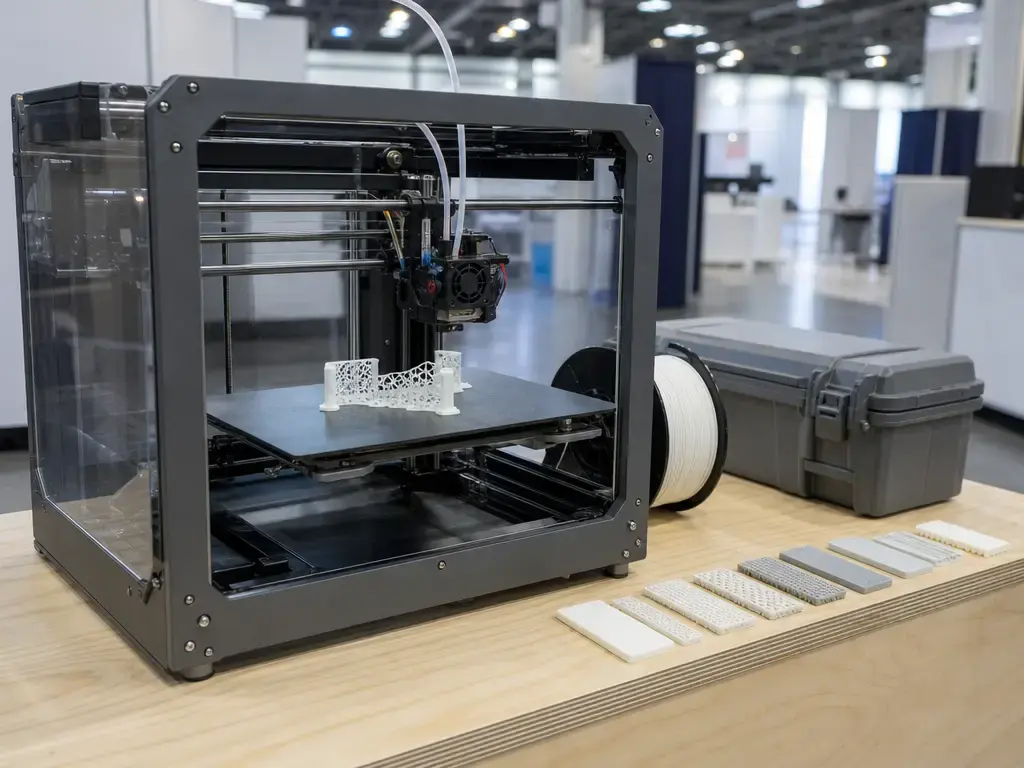
Types of additive manufacturing conference and what each is good for
Four recurring formats serve different practical questions. An industrial expo-and-conference hybrid combines technical content, suppliers, and demonstrations; it is useful for mapping process routes and workflow components. A user-group conference centers on experience from installed systems and operating practice. Research, standards, and qualification meetings emphasize methods, measurement, process understanding, and evidence for controlled adoption. Medical or hospital-focused events concentrate on clinical workflows, institutional handoffs, and the boundaries of healthcare implementation.
Hybrids are common, so labels are not enough. Inspect agenda depth, attendee eligibility, exhibitor mix, and the route from a stated claim to supporting evidence. RAPID + TCT 2026, held April 13–16 in Boston, was a past expo-and-conference hybrid example; its organizer listed nine tracks and 160+ technical presentations. AMUG’s planned 2027 conference combines a four-day conference with a three-night AMUGexpo and advertises 100+ technical sessions, while its attendance rules limit eligibility. ICAM’s scope extends from research to industrial deployment and standards, whereas IC3DTH focuses on clinical 3D technologies and their integration into clinical practice. Event information was accessed November 10, 2026. Recheck before publication. [7] [8] [12] [13] [14] [16]
Event formats at a glance
| Event format | Typical emphasis | Evidence a visitor should seek | Best fit |
|---|---|---|---|
| Industrial expo + conference hybrid | Technologies, suppliers, applications, workflow tools | Process-specific data, sample provenance, measurement method, operating constraints | Scoping a technical landscape |
| User-group conference | Practical experience among machine users | Comparable use case, configuration, material, and post-processing details | Understanding operational questions |
| Research, standards, or qualification meeting | Test methods, benchmarks, standards, lifecycle controls | Referenced methods, uncertainty, repeatability, and stated limits | Evaluating technical evidence |
| Medical or hospital-focused event | Point-of-care workflows and clinical integration | Clinical role, governance, traceability, and implementation boundaries | Exploring healthcare use cases |
How to choose the right additive manufacturing conference
How to choose the right additive manufacturing conference starts with six questions. What decision must the visit inform? Is the scope a process, application, material, workflow, or market? Is the goal discovery, technical learning, or peer discussion? Who must you meet: users, researchers, suppliers, clinicians, or standards participants? What evidence would make a session or meeting useful? Finally, what all-in cost and opportunity cost are acceptable relative to the decision?
Event size is a weak proxy for fit. Formnext’s organizer reported final 2025 figures of 38,282 visitors, 804 exhibitors, and about 50,000 m² of gross exhibition space. Its 2026 expo page separately stated, prospectively, that more than 800 exhibitors and 38,000 visitors would meet. These are different event years and different types of figures, so neither indicates whether the programme will answer a specific technical question. The 2025 final report and 2026 prospective information were accessed November 10, 2026. Recheck before publication. [10] [11]
Eligibility can determine fit before programme quality does. AMUG’s registration information limits attendance to individuals from organizations with direct ownership of commercially available AM equipment used professionally. AMUG’s 2027 eligibility information was accessed November 10, 2026. Recheck before publication. [13] Also inspect session depth, workshop detail, exhibitor lists, and tools for arranging meetings or filtering a floor plan.
Signals an event is likely to fit your purpose
- Agenda tracks and session depth match the process, material, application, or workflow in scope.
- The exhibitor list covers relevant workflow stages, not only machines.
- Workshops describe methods or practical activities rather than broad themes alone.
- User eligibility matches your organization and role.
- Standards or qualification participation is visible where controlled adoption is the question.
- The event discloses an application focus relevant to your decision.
- Meeting tools, such as floor-plan filters or matchmaking, are available when they would help.
How to prepare for a 3D printing conference
Knowing how to prepare for a 3D printing conference turns a broad programme into a focused evidence-gathering exercise. Start with a decision brief rather than a general wish list. Identify one application or part family, its intended operating context, and the decision the visit could help advance.
Then define three high-priority unknowns, such as a process limitation, material question, or inspection issue. Build a prioritized session and supplier shortlist around them. Request meetings when a specific technical discussion is needed, state the evidence sought, and assign note owners so observations are not scattered across individual conversations. A shared template should distinguish the source, configuration, material condition, claimed result, measurement basis, limitations, and next action.
Pre-show briefing checklist
- [ ] Write a short application description, including part function and intended operating context.
- [ ] Record the current manufacturing route and its main pain point.
- [ ] List material, size, tolerance, surface, and certification constraints.
- [ ] Prepare supplier questions spanning machine, material, software, post-processing, and inspection.
- [ ] Specify the desired evidence: documented parameters, comparable geometry, test method, measurement results, process limits, or user references.
- [ ] Prioritize sessions, exhibitors, demonstrations, and meetings against the three unknowns.
- [ ] Send meeting requests that explain the application and evidence sought.
- [ ] Assign note owners for programme sessions, exhibitor discussions, demonstrations, and follow-up actions.
- [ ] Create a calendar plan with essential sessions, meetings, review intervals, and time for unexpected findings.
What to expect at a 3D printing conference: evaluate demos and claims
Knowing what to expect at a 3D printing conference means recognizing a mix of technical communication, sales communication, and peer exchange. Each can be useful when its limits are clear.
A peer-reviewed session may explain methods, data treatment, and limitations in detail, but still concern a narrow experimental setting. A user-led talk can reveal operational trade-offs that formal papers omit, although results may depend on a particular machine configuration and production context. Vendor- or sponsor-led presentations can efficiently explain a workflow or product capability, but they should prompt questions about the comparison basis and boundary conditions. Ask what application and geometry were studied, what comparison was made, how many parts or builds informed the result, what failures occurred, and what was not measured.
Apply the same discipline to live demonstrations and display samples. Identify the feedstock and material condition, relevant process parameters, build orientation, and whether the part represents the intended application. Ask how supports were removed, which post-processing occurred, how the result was inspected, whether the outcome was repeated, and what yield or failure information is available. A polished part can demonstrate a workflow stage without demonstrating stable, application-specific production capability.
Observation is not qualification or production-capability evidence. ISO/ASTM 52920:2023 specifies criteria for industrial AM processes and production sites, including quality-relevant factors and activities across an AM production site. [3] ISO/ASTM 52902:2023 addresses benchmarking test artefacts and quantitative and qualitative measurements for AM-system capability evaluation and calibration. [4] These standards do not certify a booth sample; they help explain why evidence must be documented and tied to relevant process conditions.
Metric translation: avoid marketing traps
Tolerance is the allowable variation around a nominal dimension on a drawing or specification. Accuracy concerns closeness to a reference under a stated measurement method. Precision concerns agreement among results. Repeatability is meaningful only when operating conditions and sample basis are stated. Resolution and layer height are not the same as dimensional accuracy or demonstrated capability; they may also involve trade-offs with build time and post-processing. ISO 5725-1 frames measurement accuracy through trueness and precision. [5]
Translate broad claims into questions suitable for the part or workflow under review. “Fine resolution,” for example, should prompt questions about the feature measured, orientation, surface condition, measurement method, and variation across repeated builds.
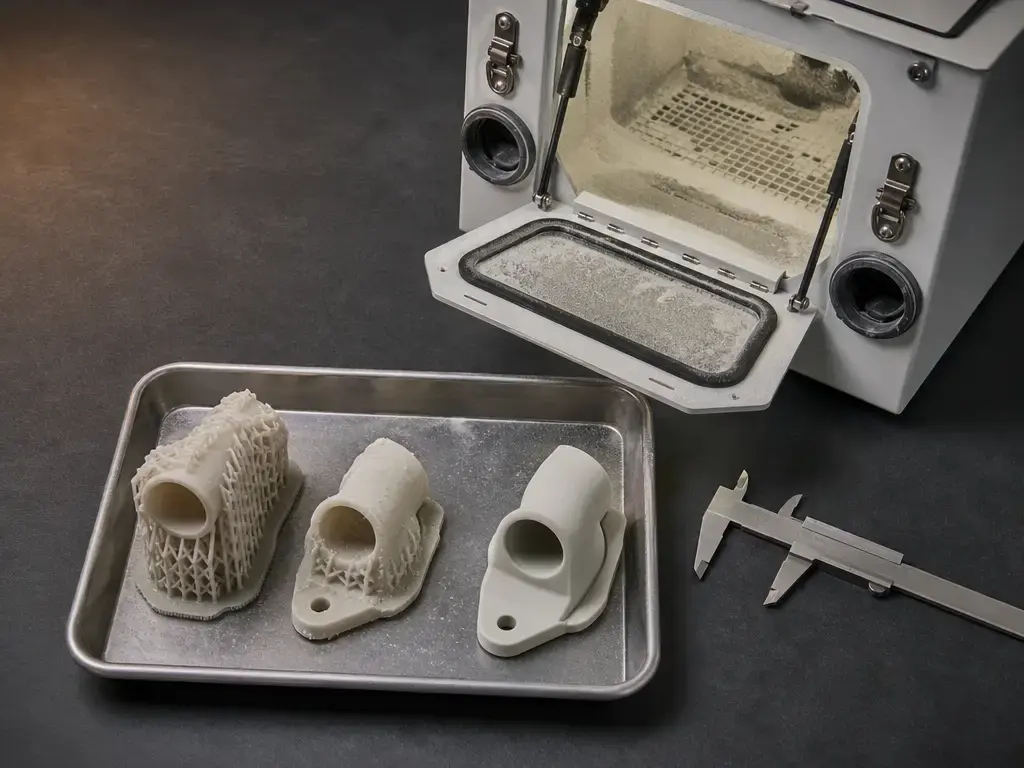
Medical and hospital-focused conferences: choose by workflow and evidence boundaries
A medical 3D printing conference is most useful when the question concerns clinical workflow integration rather than a machine specification alone. Relevant discussions may include imaging data, design review, manufacturing, post-processing, clinical use, record handling, and multidisciplinary coordination. Privacy, traceability, local governance, validation evidence, and point-of-care constraints can determine whether a technically feasible workflow is workable in a specific institution.
IC3DTH is positioned around clinicians, engineers, researchers, and industry experts discussing clinical 3D technologies and their integration into clinical practice. [16] Requirements vary by jurisdiction, intended use, device category, and care setting; this article does not provide medical or regulatory advice. FDA’s December 2017 final guidance on additive manufactured medical devices addresses technical considerations across design, manufacturing, and device testing, and is an example of an official U.S. reference for further review with appropriate local specialists. [18]
After the event: follow-up workflow and internal scorecard
Within 7–14 days, consolidate notes while the context of each discussion remains clear. Treat that window as a practical working suggestion, not a benchmark. Send agreed follow-ups, request the specific evidence promised, and assign an internal owner to every next step. Separate observations from decisions: a useful discussion may justify further investigation without establishing technical fit.
There is no reliable universal ROI figure for attending a 3D printing conference because value depends on the original decision, application scope, internal effort, and evidence obtained afterward. Use a non-standard internal scorecard instead.
Qualified meeting: a meeting where you captured (a) your application context, (b) the supplier/user claim, (c) evidence type offered, (d) constraints/assumptions, (e) next step + owner + due date.
Application-relevant supplier: can plausibly support your in-scope material/process/part constraints and can provide a documented next step (datasheet, case context, test plan, referral).
Documented technical claim: any performance/cost/quality statement logged with source, conditions, and what would falsify/confirm it.
Conference ROI scorecard (internal, non-benchmark)
| Inputs | Outcomes within a chosen follow-up window |
|---|---|
| Total trip cost, if tracked; planned versus attended priority sessions; qualified meetings completed; documented claims requiring follow-up; peer references obtained | Trials authorized; documents received, such as specification sheets or test reports; claims closed or disproven; decisions advanced |
Use the scorecard as a review tool rather than a financial-return calculation. Close an item when evidence arrives, an assumption is disproved, or the decision is deliberately deferred. Preserve notes and source material so later project teams can understand the boundary conditions behind a conclusion.
Are 3D printing trade shows worth attending?
Are 3D printing trade shows worth attending? They can be worthwhile when you have a defined question, a relevant density of sessions or contacts, an evidence plan, and capacity to follow up. The value is not the number of badges scanned or samples collected; it is whether the visit reduces a specific uncertainty or establishes a defensible next step.
Do not attend simply to “see what is new” when no application, question, or internal owner exists. A focused meeting, published research, or direct evidence request may be more appropriate for a narrow process or part constraint. The best industrial 3D printing event is the one that advances the next decision with usable evidence.
FAQ
How do I prepare for a 3D printing conference?
Start with one application or part family and identify three unknowns the event might clarify. Build a shortlist of sessions and contacts, request focused meetings, define the evidence sought, and assign note owners. A shared note template makes later comparison and follow-up more reliable.
What should I expect at a 3D printing conference?
Expect formal talks, supplier exhibits, demonstrations, workshops, and informal technical conversations. Talks can provide context, demonstrations can reveal parts of a workflow, and peer discussions can expose constraints. None of these alone establishes that a process will perform reliably for your application.
How do I choose the right additive manufacturing conference?
Choose against a decision rather than reputation or scale. Check whether the agenda addresses your process, material, application, or workflow question; whether the people you need to meet are likely to attend; and whether the format can provide useful evidence.
Are 3D printing trade shows worth attending?
They are useful when direct comparison, technical discussion, or discovery across several workflow stages supports a defined decision. They are less useful without a scoped application, evidence plan, and follow-up owner. Judge the visit by usable evidence and decisions advanced, not activity observed.
Expert: What evidence should I ask for to judge whether an AM process is production-ready for my part?
Ask for application-specific, documented evidence: material condition, machine and process configuration, geometry, post-processing, inspection method, repeated results, and stated limits. A displayed part or successful demo is insufficient. Qualification also concerns controlled industrial processes and production-site activities. [3]
Expert: How should I interpret accuracy, precision, and repeatability claims from demos or sample parts?
Ask for the reference basis, measurement method, conditions, sample quantity, and variation. Accuracy concerns closeness to a reference, while precision concerns agreement among results. Repeatability needs defined conditions and an adequate sample basis. A result can be consistent without being close to the target. [5]
What is different about a medical 3D printing conference?
Medical-focused events place greater emphasis on clinical workflow integration, imaging and design handoffs, governance, privacy, traceability, point-of-care constraints, and multidisciplinary coordination. Requirements vary by jurisdiction and intended use, so this article is not regulatory advice; official sources and responsible institutional teams should guide local decisions. [16] [18]
Sources
- ISO/ASTM 52900:2021 — Additive manufacturing terminology
- SIST preview — EN ISO/ASTM 52900 terminology definition
- ISO/ASTM 52920:2023 — Qualification principles for additive manufacturing
- ISO/ASTM 52902:2023 — Geometric capability assessment
- ISO 5725-1:2023 — Accuracy, trueness and precision
- ASTM F2792-09 — Standard Terminology for Additive Manufacturing Technologies
- RAPID + TCT 2026 Event Overview
- RAPID + TCT 2026 Conference Overview
- Formnext 2026 opening hours
- Formnext 2026 Expo and Convention