

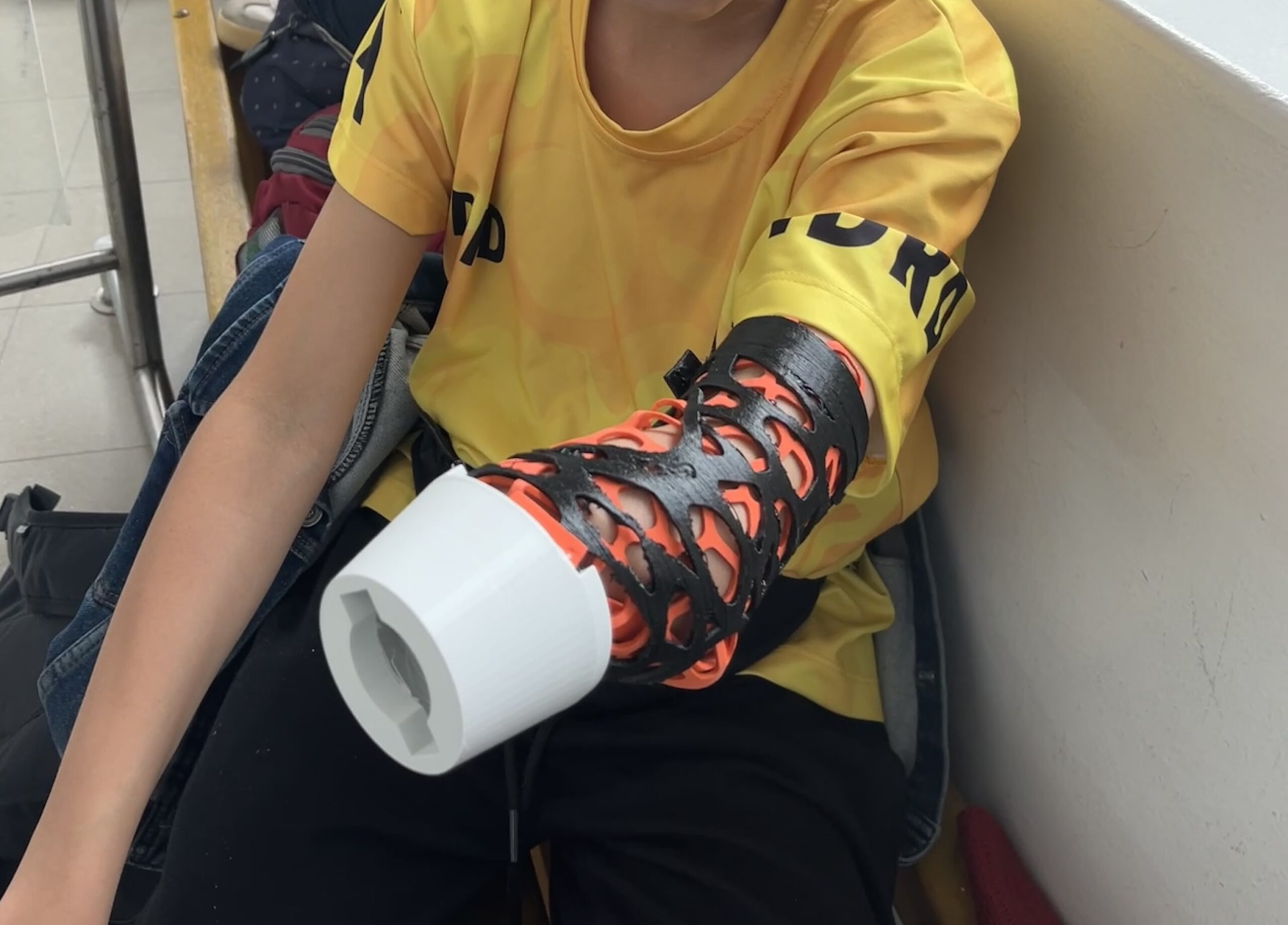
Laura Echeverri Giraldo, a design student from Pereira, has won the Colombian edition of the 2026 James Dyson Award with Encaja, a system for producing custom sockets for upper-limb prostheses.
Using smartphone 3D scanning and generative design, she managed to produce a digital file that a local workshop could turn into a socket using 3D printing and laser cutting.
The idea began with a girl born without an arm who wanted to learn the piano. As Giraldo’s research widened, she found the problem was far broader: most everyday objects and tools are designed for two hands. That’s why she came up with a new kind of prosthetic socket.
Given that fit usually decides how comfortable a prosthetic is to wear (and customization can take hours of work from a certified prosthetist) Giraldo decided to innovate at the interface between body and medical device instead.

How was 3D scanning used?
To create her prosthetic socket, Giraldo’s workflow requires users to apply stickers to anatomical landmarks and sensitive areas of the residual limb. This is 3D scanned with a smartphone. An algorithm built in Grasshopper for Rhino then reads that data and generates a socket shaped to the limb, which relieves pressure on the marked areas.
Designed for transradial, or below-the-elbow, limb loss, the socket pairs a 3D printed shell with a removable, laser-cut foam liner. The liner was added after early prototypes proved uncomfortable against bare skin. A universal connector at the end accepts interchangeable attachments, such as a fork or bicycle handle.
According to Giraldo, the digital workflow cuts design time from around eight hours of manual work to just one. She tested the algorithm on five different limb scans before a prosthetic user and a certified prosthetist evaluated the complete system. Their feedback shaped revisions to the connector, liner and scanning interface.
What happens next?
As national winner, Encaja moves on to the international stage, competing with entries from 28 countries and regions for one of 20 finalist places. Global winners will be announced on November 4, 2026.
Giraldo’s next steps are to build a web application around the generative-design algorithm, run larger clinical trials with users and partner organizations. Her longer-term goal is an open, scalable platform that rehabilitation centers and nonprofits in other countries could adopt.
That brings the project back to the question that started it: how to make the objects around us usable for people with upper-limb loss. The answer? Beginning where people’s bodies and prosthetics interact.
Professional 3D scanning for healthcare
Clinics that need repeatable, high-accuracy data tend to rely on dedicated handheld devices. Artec 3D scanners for prosthetics capture a residual limb in seconds without plaster casting.
In the past, Quorum Prosthetics has used them to create 3D printed prosthetics, while researchers at Thomas More University in Belgium have paired Artec scans with an AI model that automates socket corrections, an aim close to Giraldo’s own.
Kinesiology students at California State University, San Bernardino have also used smartphones and Artec Studio Lite to design prosthetics and orthoses. For more, see 3D Mag’s guides to human body scanning, photogrammetry and Artec Spider II for prosthetics and orthotics.