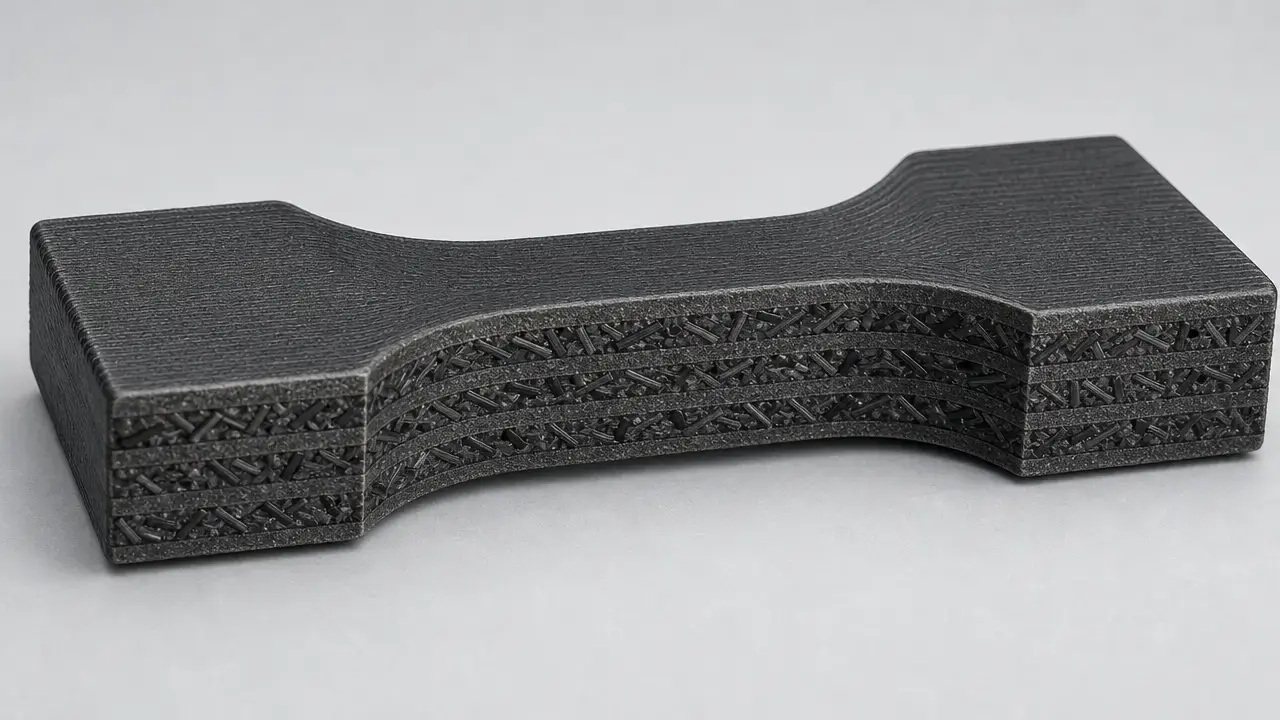

Summary: What Is the Strongest 3D Printer Filament?
The strongest 3d printer filament is not a single material. In material extrusion, the better answer depends on which property you mean and how the part is printed, because printed-part strength is highly process-sensitive. ISO/ASTM 52900 defines material extrusion as an additive manufacturing process in which material is selectively dispensed through a nozzle or orifice, and NIST notes that raster angle, air gap, filament width, layer height, and build orientation can all shift the result. [1] [5]
For a practical desktop answer, polycarbonate is a strong unfilled option, nylon is a tough and ductile option, and CF-filled engineering filaments often trade some toughness for higher stiffness and better shape control. Manufacturer-reported data for PPA-CF, PAHT-CF, PPS-CF, ASA, and PC show that the best answer changes with the metric: stiffness, heat resistance, moisture stability, UV exposure, or simply whether the machine can print the material reliably. PEEK, PEKK, and PEI-class materials belong in a separate industrial category. [11] [12] [13] [14] [16] [17] [19]
Best by metric
- Highest stiffness: CF-reinforced engineering polymers, especially PPA-CF- or PPS-CF-class materials. [11] [13]
- Strong unfilled option: Polycarbonate. [17]
- Tough/fatigue-tolerant option: Nylon. [16]
- Outdoor option: ASA or ASA-CF, depending on whether impact or stiffness matters more. [14] [15] [22]
- Industrial option: PEEK, PEKK, and PEI-class high-temperature systems, including CF-reinforced variants. [19]
Historical Background: From Prototyping Plastics to Engineering Filaments
No reliable chronology found for a single turning point in filament development, but the broader shift is clear. Material extrusion moved from prototype-oriented thermoplastics toward engineering polymers, chopped-fiber composites, and more tightly controlled industrial systems. That fits the larger lesson from ISO/ASTM 52900 and NIST guidance: process matters as much as polymer, so the search for the strongest 3d printing material is really a search for the best material-process combination for a given load, temperature, and print setup. Current examples range from chopped-carbon nylon systems to PEEK-class printed parts reported under tightly specified conditions. [1] [5] [7] [19]
Why “Strongest” Is Not One Property
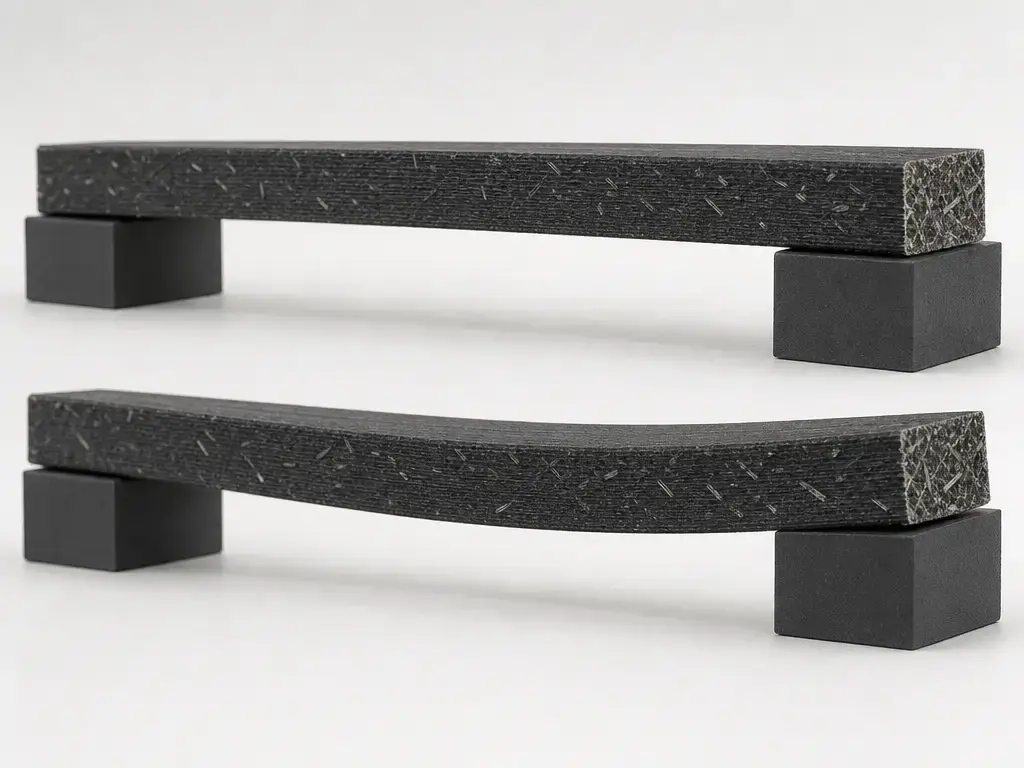
“Strongest” can mean several different things. A filament may have high tensile strength, high flexural strength, high impact resistance, or high stiffness, and those do not always rise together. Tensile strength is resistance to pulling, flexural strength is resistance to bending, impact strength is resistance to a sudden blow, and stiffness or modulus is resistance to elastic deformation. Toughness describes energy absorption before failure, layer adhesion is the bond between deposited roads and layers, fatigue resistance is how well a part survives repeated loading, and heat-deflection behavior is how well it keeps shape as temperature rises. [2] [3] [4]
| Metric | What it measures | Why it matters | Standard / common test context |
|---|---|---|---|
| Tensile strength | Resistance to being pulled apart | Helps estimate how a tie rod, bracket, or strap may fail under straight pull | ASTM D638, for reinforced and unreinforced plastics up to 14 mm thick. [2] |
| Flexural strength | Resistance to bending | Useful for beams, arms, clips, and shell-dominated parts | ASTM D790, with a 5.0% strain-limit caveat for some materials. [3] |
| Impact strength | Resistance to sudden blow or notch sensitivity | Important for drops, shocks, and snap events | ASTM D256, a pendulum impact test that measures the energy to break a specimen in one swing. [4] |
| Stiffness / modulus | Resistance to elastic deflection | Helps parts hold shape under load | Commonly reported in manufacturer datasheets and engineering guides. [3] [5] |
ASTM boundaries matter because they show what a number does, and does not, mean. ASTM D638 covers tensile properties in a defined specimen range, ASTM D790 can become hard to interpret for ductile materials that do not break or yield within its strain limit, and ASTM D256 is a pendulum impact test, not a complete measure of real-world durability. For printed polymers, the test result is only part of the story because orientation and print parameters can dominate the failure mode. [2] [3] [4] [5]
Material Extrusion Basics: Why Printed Parts Are Anisotropic
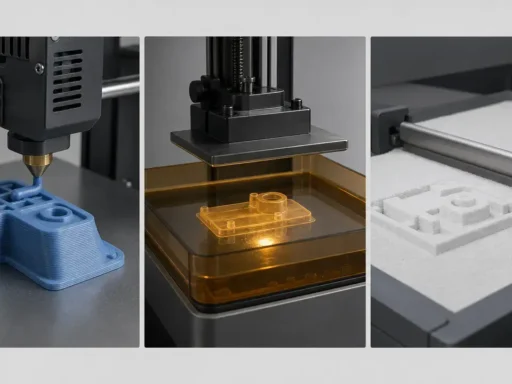
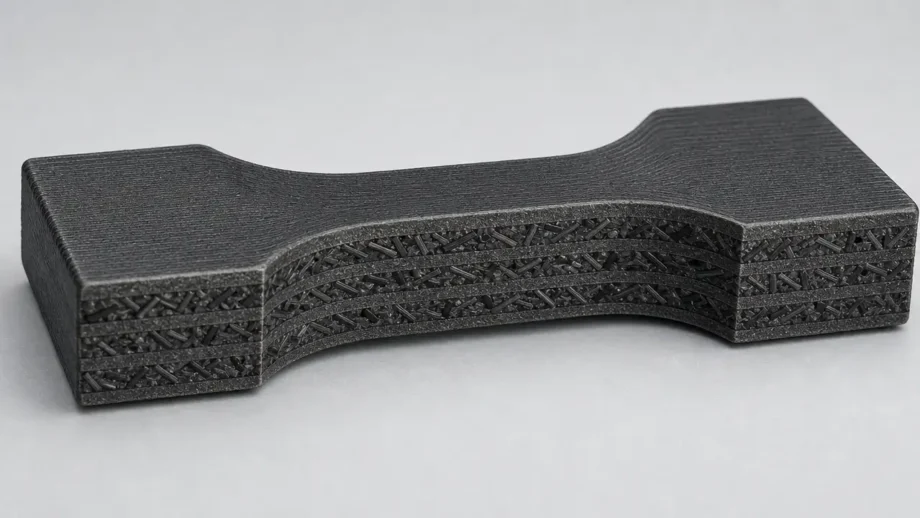
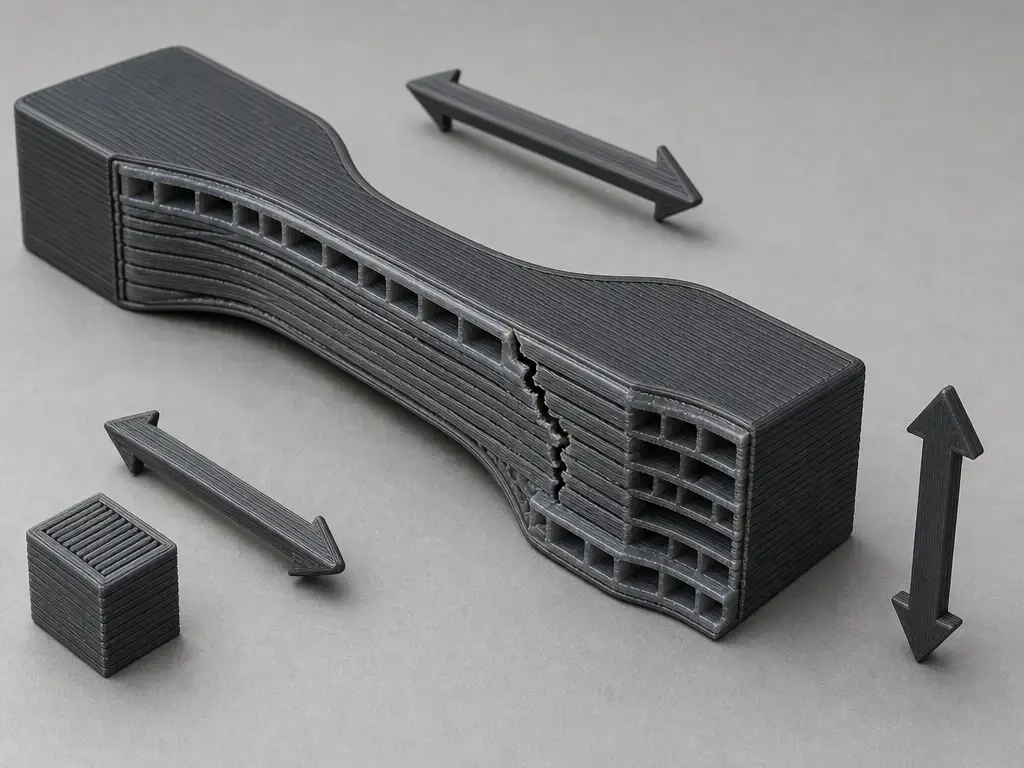
In material extrusion, often called FFF or FDM in hobby and prosumer contexts, roads of molten polymer are laid down in sequence and fused together as they cool. That makes printed parts anisotropic: properties can differ along the roads, across the roads, and through the layers. A part printed with a favorable road direction can be much stronger in one axis than in another, even when it uses the same filament spool. That is why the strongest filament on paper is not automatically the strongest part on the build plate. [1] [5]
Orientation, raster direction, wall thickness, infill percentage, and void content all shape the final part. More walls often matter more than chasing extreme infill, especially in bending or shell-dominated geometry, because the outer perimeters carry much of the load. Interlayer diffusion and nozzle temperature influence bonding, while cooling, moisture, and enclosure conditions can make the difference between a clean load path and a weak split along layer lines. In practice, part strength is a material-plus-process problem, not a simple spool ranking. [5]
Strongest 3D Printer Filament by Material Family
A useful comparison is by material family and by the kind of strength that matters, not by a universal leaderboard. Polycarbonate is often the strongest accessible unfilled desktop or prosumer choice when heat and tensile or flexural performance matter. Nylon is usually the tougher and more forgiving choice when ductility and fatigue tolerance matter more. PA-CF, PPA-CF, and related CF-filled engineering polymers tend to be the stiffness-forward options. ASA and ASA-CF matter when weather exposure is part of the problem. Industrial high-temperature polymers sit in a separate class because they require tighter process control and often a different printer class altogether. [11] [13] [16] [17] [19] [20] [22]
| Material family | Best strength meaning | Main weakness | Typical printer class |
|---|---|---|---|
| Polycarbonate | Strong unfilled tensile and flexural option | Warping and enclosure needs | Capable desktop / prosumer |
| Nylon / PA | Toughness and fatigue tolerance | Moisture sensitivity and weaker Z performance | Prosumer and enclosed desktop |
| PA-CF / PPA-CF | High stiffness and better shape control under load | Can lose impact tolerance and Z-axis robustness | Enclosed prosumer / engineering desktop |
| ASA / ASA-CF | Outdoor durability with usable mechanical strength | ASA-CF sacrifices impact for stiffness | Enclosed desktop |
| Industrial high-temp polymers (PEEK / PEKK / PEI family) | Heat, chemical stability, and high-performance printed parts | Demanding hardware and narrow process window | Industrial high-temp system |
Manufacturer-reported data show why these rows stay separate. UltiMaker reports polycarbonate tensile stress at yield of 68.8 MPa in XY and flexural strength of 109.7 MPa in XY, while nylon’s appeal is not peak stiffness but ductility and elongation. Bambu Lab’s PPA-CF page provides a stiffness-forward example with bending modulus of 9860 MPa and bending strength of 208 MPa in dry XY testing. PPS-CF broadens the meaning of “strongest” again, with dry and wet XY bending strength both listed at 142 MPa, HDT at 264°C, and saturated water absorption at 0.05%. [17] [16] [11] [13]
Desktop / Prosumer Contenders
For a capable desktop machine, the shortlist usually starts with polycarbonate, nylon, PA-CF or PPA-CF, and, when the part lives outdoors, ASA or ASA-CF. In practical nylon vs polycarbonate filament strength terms, PC is the better unfilled choice when a stronger and hotter-running part is needed, while nylon is better when toughness and ductility matter more. PAHT-CF and PPA-CF become attractive when stiffness, dimensional stability, and wet-strength retention matter more than shock absorption. PPS-CF pushes further toward heat and moisture stability, but it also pushes the printer harder. [11] [12] [13] [16] [17] [21] [22]
Industrial Boundary: High-Temperature Polymers and Continuous Fiber
Continuous-fiber systems are a different class from ordinary filament prints. Markforged’s composite documentation describes a two-extrusion architecture in which continuous fiber is laid into a composite base material, rather than a single-nozzle chopped-fiber spool. In that system, manufacturer data report continuous carbon fiber test plaques with 540 MPa flexural strength and 60 GPa tensile modulus. Solvay’s PEEK AM and PEEK AM CF examples likewise belong to an industrial branch with explicit print conditions, not to an ordinary desktop filament leaderboard. These systems should not be ranked directly against chopped-fiber or unfilled single-material prints. [9] [10] [19]
Carbon Fiber Reinforced Filament Strength: What It Really Improves
Carbon fiber reinforced filament strength is usually more about stiffness, dimensional stability, and creep reduction than about a universal increase in every strength metric. A clear chopped-fiber example is Stratasys Nylon 12CF, which is listed as 35% by weight chopped carbon fiber in a Nylon 12 base polymer. In practice, chopped CF often improves stiffness and dimensional stability more reliably than impact toughness or Z-axis strength. Stratasys’ Nylon 12CF datasheet shows why: strength at break is 83.5 MPa in XZ but 32.7 MPa in ZX, flexural strength is 153 MPa in XZ but 62.4 MPa in ZX, and notched impact is 106 J/m in XZ but 24 J/m in ZX. A separate manufacturer example from 3DXTECH makes the same point differently: its comparison of PC versus PC+CF shows tensile strength rising from 62 MPa to 73 MPa, while tensile modulus jumps from 2410 MPa to 6980 MPa. That is mainly a stiffness gain, not a universal toughness win. [7] [8] [21]
The data also show why chopped fiber and continuous fiber must be kept separate. Markforged’s Onyx base material, a micro-carbon-filled nylon, is reported at 37 MPa tensile stress at break, 71 MPa flexural strength, and 330 J/m notched Izod impact, which makes it useful and impact-capable without making it the highest tensile option. Continuous carbon fiber, by contrast, is a different reinforcement architecture entirely, with long fibers added in-layer through a separate system. Abrasive fillers are also a hardware issue: official composite-material guidance recommends hardened nozzles for carbon-, glass-, and kevlar-filled filaments. [9] [10] [23]
Nylon vs Polycarbonate Filament Strength
If you are deciding between nylon vs polycarbonate filament strength, the short version is that nylon is usually the tougher, more fatigue-tolerant path, while polycarbonate is usually the stronger unfilled path. UltiMaker’s nylon data show why nylon is appealing in service: tensile stress at break is 40.4 MPa in XY and 42.3 MPa in YZ, with elongation at break above 120% in XY and above 130% in YZ. But nylon is still layer-limited, with tensile stress at break falling to 23.0 MPa in Z and elongation at break to 1.7% in Z. Moisture control matters here, and PAHT-CF versus normal PA-CF manufacturer data show how much wet-state retention can differ across nylon-family composites. [12] [16]
Polycarbonate, by contrast, tends to be the better unfilled choice when the part must hold shape under heat and bending. UltiMaker reports PC tensile stress at yield of 68.8 MPa in XY and 73.23 MPa in YZ, tensile stress at break of 59.3 MPa in XY and 34.5 MPa in Z, and flexural strength of 109.7 MPa in XY and 85.8 MPa in Z. PC usually demands better thermal control during printing and is more prone to warping than easier materials, so enclosure use often becomes part of the strength discussion. CF-filled derivatives can add stiffness, but that should not be mistaken for a universal toughness gain. [17] [21]
Strongest 3D Printer Filament for Outdoor Use
The strongest 3d printer filament for outdoor use is not the one with the highest tensile number. UV resistance, heat resistance, water absorption, and creep matter as much as peak strength. Prusa describes ASA as suitable for outdoor use because of its UV and temperature resistance, with temperature resistance up to 93°C. [22]
ASA-CF can increase stiffness, but it changes the tradeoff. Bambu Lab’s ASA data list impact at 41.0 kJ/m², bending strength at 65 MPa, bending modulus at 1920 MPa, and HDT at 100°C. Its ASA-CF data raise bending modulus to 3740 MPa and bending strength to 72 MPa, but reduce XY impact to 14.0 kJ/m² and list layer-adhesion impact in Z at 9.4 kJ/m². PPS-CF is a useful stability-oriented example because Bambu’s data list dry and wet XY bending strength at the same 142 MPa, alongside very low water absorption, but outdoor weathering should not be inferred beyond the supplier’s stated claims. [13] [14] [15]
How to Print Stronger Parts With Any Filament
Material choice only gets you part of the way. NIST’s additive-manufacturing testing guidance makes clear that process variables such as raster angle, air gap, filament width, layer height, and build orientation can change measured strength substantially. ASTM D638, D790, and D256 are useful because they remind you that strength is test-specific, not a vague property pulled from a product page. [2] [3] [4] [5]
Strength-oriented slicer and printer settings
- Align roads with load direction.
- Increase wall and perimeter count before relying on infill.
- Use sufficient nozzle temperature for bonding.
- Reduce excessive cooling for engineering polymers.
- Dry hygroscopic materials.
- Use enclosure or chamber heating when required.
- Prefer larger bonded cross-sections for load-bearing parts.
For engineering polymers, nozzle temperature, bed temperature, and chamber temperature all matter because they influence bonding and shrinkage control. Wall thickness and infill percentage matter too, but they work best when the load path is already aligned with the print strategy. High-end printed-part data are often tied to explicit conditions. Solvay’s guide, for example, reports PEEK-class test data under conditions such as 100% infill, 3 shells, and 18 mm/s print speed. Annealing can materially shift final properties for some composites, so it should be treated as part of the process rather than an afterthought. Abrasive composite filaments usually require hardened nozzles, not soft brass nozzles. [18] [19] [23]
Test coupons are the safest way to confirm that a material and print setup actually carry the intended load. Compare like with like, keep conditioning state consistent, and do not assume that one dramatic datasheet number will survive a different orientation, shell count, moisture state, or post-process. [2] [3] [5]
Applications: Where Strong Filaments Make Sense
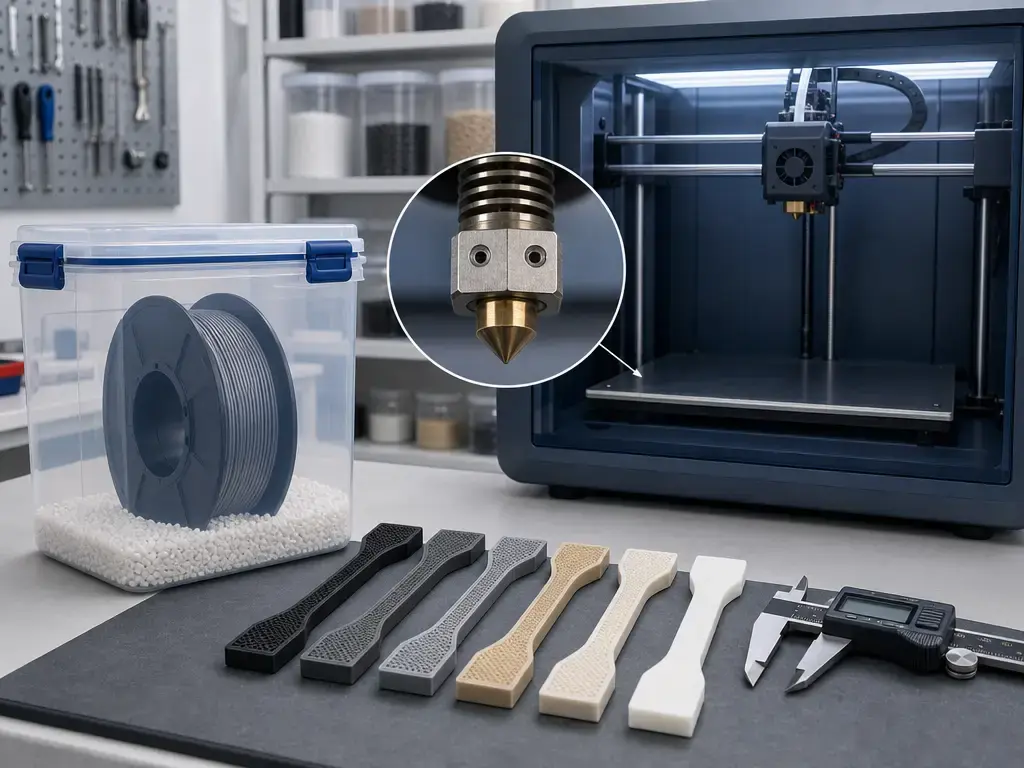
Strong filaments make sense in jigs, fixtures, brackets, drone frames, RC parts, tooling, protective housings, outdoor mounts, and machine guards. The common thread is not “unbreakable plastic,” but a part that benefits from better stiffness, better impact tolerance, or better shape retention than entry-level materials usually provide. Load-bearing production parts still need application-specific validation, and safety-critical uses such as lifting, pressure, automotive safety, aerospace, or medical parts should not be assumed safe without professional engineering review.
Limitations and Failure Modes
A common failure mode in printed parts is layer splitting rather than bulk polymer failure. If the load crosses layer lines, the part can fail long before it reaches the best in-plane values shown on a datasheet. NIST’s warning about process sensitivity applies directly here: raster angle and build orientation can dominate the result, and anisotropy can make one direction look excellent while another is weak. [5]
Moisture, creep, and UV exposure are the next limits. Nylon-family materials are especially sensitive to water content, and manufacturer data can show large dry-versus-wet differences. ASA is a practical outdoor baseline because official documentation explicitly frames it for UV and temperature exposure, but even outdoor-oriented materials still need design margin when they will carry load for long periods. ASA-CF can also shift the balance toward higher stiffness and lower impact tolerance than plain ASA. [12] [14] [15] [22]
Abrasive nozzle wear is another practical limit. Carbon-, glass-, and kevlar-filled filaments are hard on nozzles, so brass nozzles wear quickly with abrasive fillers and hardened nozzles are usually required. Some engineering polymers also release unpleasant fumes or odors during printing, so ventilation or filtered enclosure use matters in practice. Finally, do not trust cross-brand datasheet comparisons too literally. Different brands can use different orientations, conditioning states, shell counts, and print conditions, so a CF-filled material may look “stronger” mainly because it is much stiffer, not because it is tougher in every direction. [14] [16] [17] [21] [23]
Current Research and Market Context
The market is moving toward engineering polymers, composite filaments, and tighter process control rather than toward one universally strongest filament. That trend is visible in chopped-fiber nylon products, in high-temperature CF nylons and PPA-class materials, and in industrial PEEK workflows that depend on explicit print windows. The design lesson is simple: load path and process control matter as much as material name. [5] [7] [19] [20]
ASTM F3529 is useful here because it frames polymer material extrusion as a design-and-process problem, not just a slicer-preset problem. At a high level, that means designers should think about where the load travels, how layers are stacked, and whether the geometry supports the chosen print direction. That approach fits current AM practice better than asking for a single strongest 3d printing material and expecting one answer to fit every geometry, printer, and environment. [5] [6]
Final Recommendation: Choosing the Strongest 3D Printer Filament for Your Use Case
If you want the strongest 3d printer filament for a real part, choose by job and printer class. For an accessible all-round engineering choice, polycarbonate is often the best unfilled option, while PA-CF or PPA-CF is attractive when stiffness and dimensional stability matter more than shock absorption. If wet-state retention matters in a nylon-family composite, PAHT-CF is more relevant than a generic “carbon nylon” label. If you need toughness and ductility, nylon remains the better path. For outdoor parts, ASA or ASA-CF is the practical branch because UV and temperature behavior matter as much as raw strength. For industrial work, PEEK, PEKK, and PEI-class systems, along with CF-reinforced high-temperature materials, belong in their own category. [11] [12] [14] [15] [16] [17] [19] [20] [22]
So, what is the strongest 3D printer filament? There is no universal winner, only the strongest choice for a specific use case, printer, and load path. [5] [6] [17]
FAQ
What is the strongest 3D printer filament?
There is no single universal winner. For many desktop and prosumer users, polycarbonate or a CF-filled engineering polymer is the practical answer, but the best choice depends on whether you care most about tensile strength, stiffness, impact resistance, heat, or outdoor durability. PEEK, PEKK, and PEI-class materials belong to a separate industrial category. [11] [13] [17] [19]
What is the toughest 3D printing filament?
Toughness means energy absorption and crack resistance, not just high strength. Nylon is often the toughest common engineering choice because it is ductile and fatigue-tolerant in service, though moisture and layer direction still matter. Very flexible materials can also be tough, but they solve a different design problem. [16]
Is carbon fiber reinforced filament stronger than nylon or polycarbonate?
Not always. Carbon fiber reinforced filament strength often shows up as higher stiffness and better dimensional stability more than as higher impact resistance or elongation. A chopped-CF material may be stiffer than nylon or PC, but that does not mean it is tougher or better across layers. Continuous-fiber reinforcement is a separate class again. [8] [10] [21]
Nylon vs polycarbonate filament strength: which is better?
It depends on the failure mode. Nylon is usually better when you need toughness, fatigue tolerance, and ductility. Polycarbonate is usually better when you want a stronger unfilled engineering part with higher heat capability and better flexural performance. Moisture control matters for nylon, while print thermal control matters more for PC. [12] [16] [17]
What is the strongest 3D printer filament for outdoor use?
For outdoor use, UV resistance, heat resistance, water absorption, and creep matter as much as peak strength. ASA is the practical baseline, and ASA-CF can be useful when stiffness is the priority. Other engineering polymers may be better in some sheltered hot environments, but weathering claims should be supported by supplier data. [14] [15] [22]
How do print orientation and raster angle change measured strength?
They can change the failure mode completely. Parts are usually stronger along deposited roads than across layer lines, so the same material can look excellent in one orientation and weak in another. NIST specifically identifies raster angle and build orientation as major variables in polymer material extrusion strength. [5] [8]
Are PEEK, PEKK, and PEI realistic on a prosumer machine?
Usually not. These materials generally need much tighter control of nozzle temperature, bed temperature, chamber conditions, drying, and print speed than routine desktop machines provide. Their published printed-part values should be read in that industrial context, not as plug-and-play desktop upgrades. [19]
Sources
-
ISO/ASTM 52900:2021. Additive manufacturing vocabulary. https://www.iso.org/obp/ui#iso:std:iso-astm:52900:ed-2:v1:en
-
ASTM D638-22. Standard Test Method for Tensile Properties of Plastics. https://store.astm.org/d0638-22.html
-
ASTM D790-25. Standard Test Methods for Flexural Properties of Unreinforced and Reinforced Plastics and Electrical Insulating Materials. https://store.astm.org/d0790-25.html
-
ASTM D256-26. Standard Test Methods for Determining the Izod Pendulum Impact Resistance of Plastics. https://store.astm.org/d0256-26.html
-
NIST IR 8059. Materials Testing Standards for Additive Manufacturing of Polymer Materials: State of the Art and Standards Applicability. https://www.nist.gov/publications/materials-testing-standards-additive-manufacturing-polymer-materials-state-art-and-0
-
ASTM F3529-21. Guide for Additive Manufacturing Design Material Extrusion of Polymers. https://store.astm.org/f3529-21.html
-
Stratasys Nylon 12CF material page. https://www.stratasys.com/en/materials/materials-catalog/fdm-materials/nylon-12cf
-
Stratasys Nylon 12CF datasheet. https://www.stratasys.com/siteassets/materials/materials-catalog/fdm-materials/nylon-12cf/material.datasheet-fdm-nylon-12cf.pdf?v=490354
-
Markforged Composite Datasheet v4.0. https://web-objects.markforged.com/craft/materials/Markforged-Composite-Datasheet-V4.0.pdf
-
Markforged Continuous Carbon Fiber material page. https://markforged.com/materials/continuous-fibers/continuous-carbon-fiber
-
Bambu Lab PPA-CF product page. https://us.store.bambulab.com/products/ppa-cf
-
Bambu Lab PAHT-CF product page. https://us.store.bambulab.com/en/products/paht-cf?id=41009510711432
-
Bambu Lab PPS-CF product page. https://us.store.bambulab.com/products/pps-cf/
-
Bambu Lab ASA product page. https://us.store.bambulab.com/products/asa-filament
-
Bambu Lab ASA-CF product page. https://us.store.bambulab.com/products/asa-cf
-
UltiMaker Nylon TDS v5.00. https://um-support-files.ultimaker.com/materials/2.85mm/tds/NYLON/Ultimaker-Nylon-TDS-v5.00.pdf
-
UltiMaker PC TDS v5.00. https://um-support-files.ultimaker.com/materials/2.85mm/tds/PC/Ultimaker-PC-TRS-TDS-v5.00.pdf
-
UltiMaker Nylon CF Slide TDS v1.00. https://um-support-files.ultimaker.com/materials/2.85mm/tds/NYLON-CF/Nylon_CF_Slide-TDS-English-v1.00.pdf
-
Solvay Additive Manufacturing Filaments Processing Guide v1.1. https://www.solvay.com/sites/g/files/srpend616/files/2018-11/Additive-Manufacturing-Filaments-Processing-Guide_EN-v1.1_0.pdf
-
3DXTECH CarbonX HTN+CF product page. https://www.3dxtech.com/products/carbonx-htn-cf
-
3DXTECH reinforcement geometry article. https://www.3dxtech.com/blogs/featured/the-role-of-reinforcement-geometry-in-boosting-3d-printed-part-performance
-
Prusa ASA guide. https://help.prusa3d.com/article/asa_1809
-
Prusa composite materials guide. https://help.prusa3d.com/article/composite-materials-filled-with-carbon-kevlar-or-glass_167387