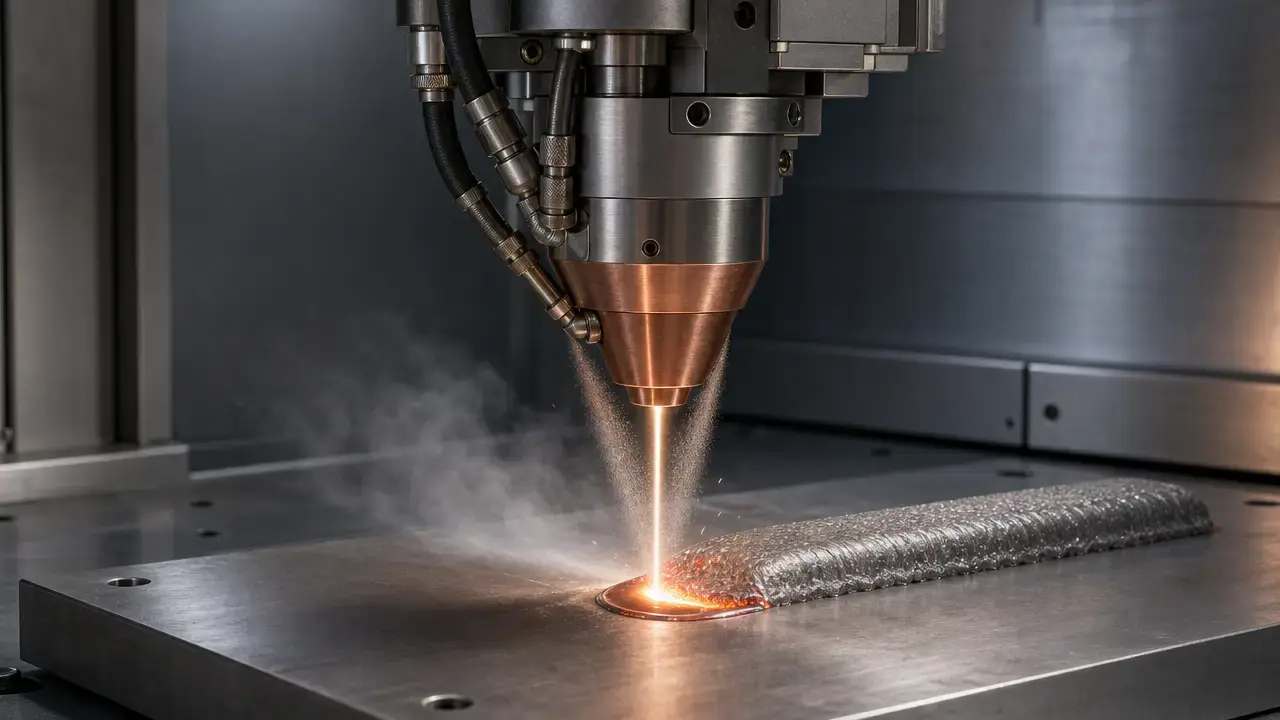

Summary
Directed energy deposition is a metal additive manufacturing process in which focused thermal energy fuses material by melting it as it is being deposited onto a target surface. In standards terms, DED is a process family, not a single machine type, and it is distinct from powder bed fusion because PBF selectively fuses regions of a powder bed. [1] [2]
In practice, DED 3D printing includes laser powder DED, laser wire DED, wire arc additive manufacturing (WAAM), and electron-beam wire DED. It is especially useful for repair, cladding, adding features to existing parts, and making large near-net-shape structures that can be machined afterward. That makes it a different selection problem from PBF: DED is usually a better fit when the part is large, already exists, or only needs material added locally, while PBF is usually a better fit when smaller layers, finer features, and powder-bed-driven geometry matter more. [2] [6]
Directed Energy Deposition (DED): Definition and Taxonomy
Directed Energy Deposition (DED) is the ISO/ASTM vocabulary term for additive manufacturing in which focused thermal energy fuses material by melting it as it is being deposited. ISO/ASTM 52900:2021, Edition 2, published in November 2021 and confirmed in August 2025, is the canonical vocabulary reference. That matters because DED is a standards-defined process family, not a catch-all label for any metal printer with a nozzle. [1] [2]
| Term | What it is | Typical energy + feedstock | Notes / pitfalls |
|---|---|---|---|
| DED | Umbrella AM process family | Laser, electron beam, or plasma/arc; powder or wire | Family term, not a single hardware layout. [2] [3] |
| Laser powder DED | DED subfamily | Laser + blown powder | Common in repair, cladding, and feature addition. [6] |
| Laser wire DED | DED subfamily | Laser + wire | Wire changes bead geometry and material-use behavior relative to powder-fed systems. [3] [6] |
| WAAM (DED-Arc) | DED subfamily | Arc + wire | WAAM is DED using wire and arc, not a separate ISO process category. [9] |
| Electron-beam wire DED | DED subfamily | Electron beam + wire | Typically runs in vacuum. [3] [18] |
| LMD | Industry label / implementation name | Usually laser + powder | Not a separate ISO category. [6] [19] |
| LENS | Historic implementation name | Usually laser + powder | Important historically, but still a laser DED implementation. [12] |
| Laser cladding | Application label | Usually laser + powder or wire | Often done with laser DED, but not all DED is cladding. [19] |
Industry naming is messier than the standards vocabulary. NIST explicitly notes that DED naming conventions do not map cleanly, which is why classification by energy source plus feedstock is usually clearer than relying on marketing labels alone. In practice, “laser powder DED,” “laser wire DED,” “DED-Arc/WAAM,” and “electron-beam wire DED” are more informative than treating LMD, LENS, or similar labels as separate process categories. [6]
That same distinction keeps the boundary with PBF clear. PBF is defined by selectively fusing regions of a powder bed, while DED melts material as it arrives at the part. So laser cladding, WAAM, and wire-feed electron-beam deposition all sit under DED even though their machine layouts, atmospheres, and use cases differ sharply. [2] [3]
Historical Background
DED grew out of welding, cladding, and near-net-shape metalworking, then added digital toolpath control and layer-wise build logic. Sandia’s 1998 description of Laser Engineered Net Shaping (LENS) already shows the core pattern: powder delivered into a focused laser, a molten pool on the substrate, and consecutive layers building a 3D metal part. That is recognizably early laser powder DED. [12]
The historical use case was not only making new parts. Sandia’s 2001 technology-transfer coverage described LENS as using metal powder in argon gas and highlighted modifying or repairing existing hardware as a practical application. Repair and remanufacturing were part of DED’s value early on, not later marketing additions. No single inventor attribution is especially reliable across the sources used here, so the better historical view is convergence: welding and cladding practice, laser processing, and digital part-building came together into the DED family. [13]
How DED 3D Printing Works
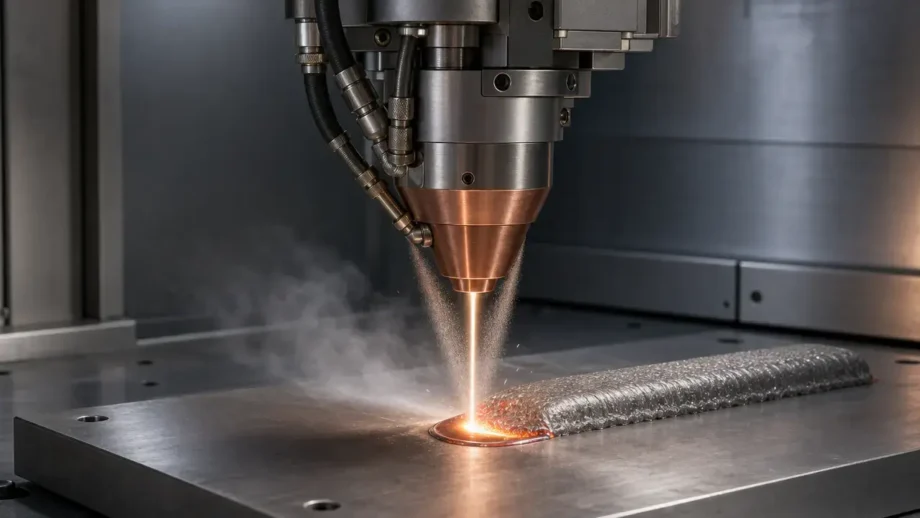
In DED 3D printing, a deposition head moves over a substrate or existing part while feedstock is delivered into a focused heat source. Depending on the variant, that heat source can be a laser, an electron beam, or an arc. NIST describes DED in plain language as a layer-by-layer process in which material is deposited onto a target and melted by a directed energy beam, then cools into a solid deposit. [3] [5]
The key feature is the melt pool: a localized liquid region where incoming material and the part surface fuse together. A single pass forms a bead or track, overlapping tracks fill a layer, and stacked layers build the part or repair volume. Thermal history matters as much as geometry. Heat flows into the substrate and previously deposited material, which affects grain structure, residual stress, distortion, and the consistency of later passes. Shielding matters as well because DED systems typically operate with inert gas or, for electron-beam systems, in vacuum. [3] [6]
Two practical terms come up often. Dilution is the amount of substrate material mixed into the deposit, which helps bonding but can change local chemistry near the interface. HAZ, or heat-affected zone, is the region altered by heat without full melting. Because as-deposited surfaces are usually rough and geometry can drift as heat accumulates, DED often produces a near-net shape that is later machined and inspected rather than a finished part straight from the machine. [6]
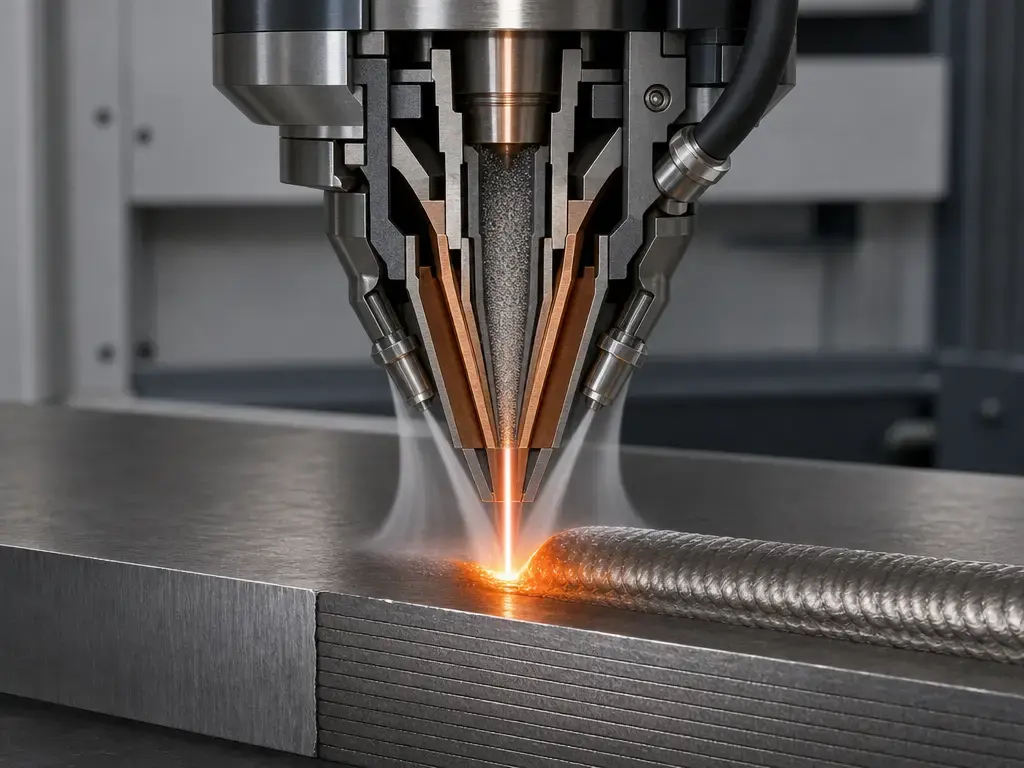
The DED Process Stack — What Variables Actually Define a System
A DED system is best understood as a stack of coupled decisions rather than one fixed machine formula. ASTM F3187 describes the family across laser beam, electron beam, and arc-plasma systems, using either powder or wire feedstock and operating under inert gas or vacuum depending on the process. So “DED capability” is never just about one print head; it depends on the full combination of energy source, feedstock, motion, atmosphere, and control. [3]
Those choices directly change the result. Feedstock form influences capture efficiency and bead shape. Motion strategy determines whether the system mainly builds simple layers or deposits onto complex existing geometry. Atmosphere affects oxidation risk and process stability. Control strategy determines how well the machine can respond as heat builds up and conditions drift. In that sense, a DED toolpath is closer to a welding or machining process plan than to a consumer slicer export. [3] [6]
- Energy source — laser, electron beam, or arc plasma; this sets heat concentration and process constraints. [3]
- Feedstock form — powder or wire; this affects delivery, bead geometry, and material-use behavior. [3] [6]
- Motion system — gantry, robot, turntable, or other multi-axis arrangement; this shapes access and reachable geometry. [6]
- Shielding environment — inert gas or vacuum, depending on the setup. [3] [18]
- Sensing/control strategy — monitoring of feedstock, melt pool, and geometry, with or without closed-loop correction. [6]
Workflow for a DED Build or Repair
DED is a manufacturing route, not a one-click print mode. Planning has to account for thermal input, nozzle access, layer strategy, fixturing, and sometimes robot or multi-axis motion. In repair and remanufacturing, the job starts with an existing part, which adds inspection, contamination control, and damage mapping before deposition begins. [6] [15]
Monitoring is central to consistency. NIST identifies feedstock, melt pool, and layer or part geometry as the main in-process monitoring targets because inconsistent deposition can cause porosity, cracks, geometric deviation, and undesirable microstructures. Practical DED workflows therefore include parameter checks, interpass decisions, and post-process machining or inspection instead of assuming the first toolpath will hold shape on its own. [6]
- CAD/CAM planning — define the build or repair zone, access, tool orientation, and deposition strategy. [4]
- Substrate or part preparation — clean, inspect, fixture, and, for repair, map the damaged region. [15]
- Parameter validation — confirm energy input, feedstock delivery, travel speed, and shielding conditions before production. [3]
- Deposition — add material in tracks and layers while watching melt-pool behavior and deposited geometry. [5] [6]
- Interpass strategy — manage pauses, temperature buildup, overlap, and layer timing as the part grows. [6]
- Stress relief or heat treatment if needed — apply when the alloy, geometry, or repair condition requires it. [15]
- Machining — recover final geometry and surface condition from the near-net deposit. [14] [15]
- NDE or final inspection — verify geometry, soundness, and fit before release. [6]
Types of Directed Energy Deposition
The most useful split is by energy source and feedstock. Laser DED can be powder-fed or wire-fed. Arc DED is typically wire-fed and is usually discussed as WAAM. Electron-beam DED is usually wire-fed and vacuum-based. All of these sit within the same standards umbrella because the defining feature is melting material as it is deposited, not using a powder bed. [2] [3]
- Laser powder DED — blown powder enters a laser-generated melt pool, which is why this branch overlaps heavily with laser cladding and repair workflows. [6] [19]
- Laser wire DED — a laser melts incoming wire, changing deposition geometry and typically improving material utilization relative to powder-fed systems. [3] [6]
- WAAM / DED-Arc — DED using wire and arc; ISO/ASTM 52943-2:2024 covers aerospace use with MIG/MAG/GMAW, TIG/GTAW, and PAW examples. [9]
- Electron-beam wire DED — a wire-fed DED branch that operates in vacuum; the review literature reports typical wire diameters around 0.5 mm to 3.0 mm. [18]
- HS-LMD / EHLA — a high-speed laser metal deposition branch presented by TRUMPF as coating-oriented, with thin-layer, high-speed characteristics rather than as a generic replacement for all DED. [20]
The practical choice is not just “laser or arc.” It also depends on whether the job is a build, a repair, or a coating task, whether the feedstock is powder or wire, and whether vacuum, local shielding, or large robotic access is acceptable. That is why WAAM is usually discussed for larger wire-fed structures, while laser powder DED is more often used for repair, cladding, and localized feature control. [6] [9]
Performance Metrics
Before comparing numbers, it helps to separate terms that are often mixed together. [11]
- Accuracy — closeness of a measured value to a true value. [11]
- Precision — closeness of agreement among replicate measurements under specified conditions. [11]
- Repeatability — precision under short-time repeatability conditions using the same procedure, setup, and operator. [11]
- Minimum feature size — the smallest stable wall, bead, or geometric detail a setup can reliably form. [10]
- Layer height — the vertical increment between deposited layers. [8]
- Bead width — the width of a deposited track. [6]
- Surface finish / waviness / as-deposited texture — related but different descriptions of the surface state before machining or polishing. [8]
- Dilution — mixing of substrate material into the deposited metal near the interface. [15]
- HAZ — the heat-affected zone next to the melt region. [15]
- Deposition rate — mass, volume, or coated area per unit time, so units must be read carefully. [6] [20]
Numbers in DED only make sense when the process context is explicit. Powder-fed laser DED, wire-laser DED, WAAM, and electron-beam wire DED do not share one geometry scale, one surface condition, or one throughput envelope. NIST’s high-level ranges show why: typical DED feedstock spans about 10–200 µm for powder and 0.75–3.2 mm for wire, and that difference alone pushes the processes toward different bead sizes and feature limits. [6]
Typical ranges (illustrative, not universal)
- Laser powder DED — NIST reports that DED powder is generally in the 10–200 µm range, with 50–150 µm as a typical rule of thumb, and emphasizes that the powder is blown rather than spread as a bed. Powder efficiency is process-dependent and can range from about 30% to 90%. [6]
- Laser wire DED — NIST reports typical wire feedstock around 0.75–3.2 mm and notes that wire-feed DED geometry is generally about 10× less accurate than LPBF in that comparison context. [6]
- WAAM / DED-Arc — the WAAM literature commonly describes millimeter-scale layers and coarser surface waviness than laser powder DED. Williams et al. report layer height normally around 1–2 mm and roughly 500 µm waviness for single-track deposits as a process-context example, not a universal WAAM rule. [8]
- Electron-beam wire DED — the independent review places it in the wire-fed, vacuum-process class, while Sciaky’s product sheet gives a vendor-specific example of 7–20 lb/h, or about 3–9 kg/h, for EBAM. [18] [21]
- HS-LMD — TRUMPF’s manufacturer flyer reports coating-oriented example values such as process speed above 100 m/min, coating thickness of 50–500 µm, surface roughness around Rz 10–20 µm, and HAZ below about 10–50 µm. These are manufacturer data for a specific coating-focused branch, not generic DED capability. [20]
- Vendor laser DED examples — Optomec’s LENS FAQ gives manufacturer-only deposition examples of about 100 g/h at 500 W, 200 g/h at 1 kW, and 1 kg/h at 3 kW. FormAlloy lists up to 7 kg/h and “resolution” of 0.5–8 mm, but because that term is vendor-defined rather than standards-defined, it should not be treated as a universal minimum-feature metric. [23] [24]
- Large-scale capability — NIST states that DED is readily capable of large-scale AM, including parts above 1 m³ or with a longest dimension above about 1–2 m, with coarser feature resolution as the tradeoff. [6]
No reliable universal tolerance figure found; it varies by variant, machine, setup, and post-machining. A better way to think about DED capability is to use measured test artefacts and process-qualified geometry data for a specific machine-plus-parameter set rather than repeating one tolerance number out of context. [6] [10]
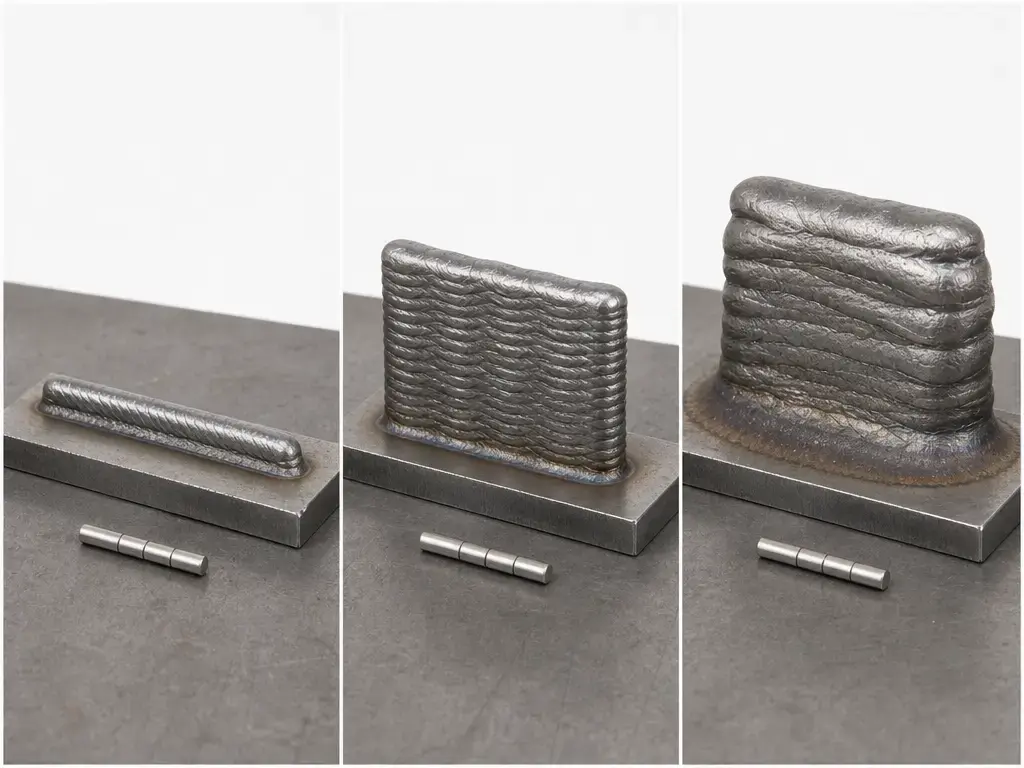
Materials for Directed Energy Deposition
Material compatibility in DED is less about a simple yes-or-no alloy list than about how an alloy behaves in a moving melt pool. Across the DED literature, steels, nickel alloys, titanium alloys, and cobalt-based alloys are commonly reported families, while aluminum and copper are active but more demanding cases in many laser-based setups. That does not mean the first group is easy and the second impossible; it means the process windows are not equally forgiving. [7] [16] [17]
The practical constraints are mostly physical and metallurgical. Feedstock form changes how energy couples into the melt pool. Shielding quality matters because reactive alloys are sensitive to oxidation. Aluminum is a well-documented difficult case in laser DED because high thermal conductivity, high laser reflectivity, oxidation sensitivity, and related powder or process factors hurt printability. Copper follows a similar pattern from a different direction: laser DED of copper is feasible, but the research literature describes process-window development rather than trivial deposition. So “can process” does not mean equal maturity, equal quality, or equal ease across DED variants. [16] [17]
Applications — Repair, Cladding, Hybrid Manufacturing, and Large Parts
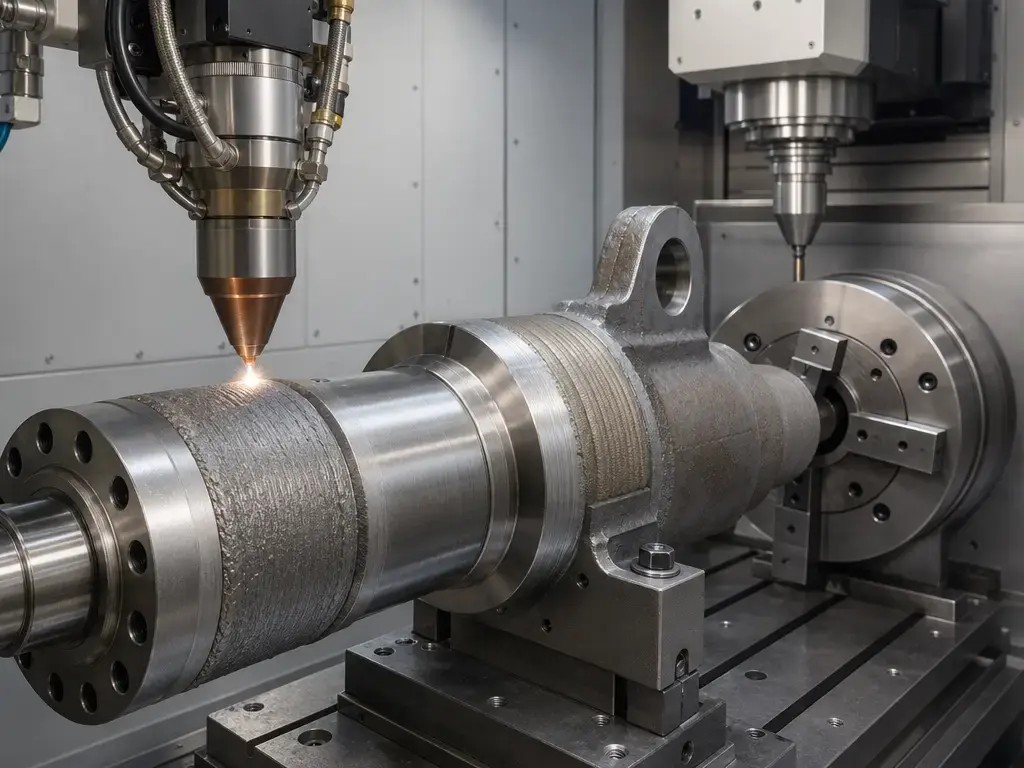
One of DED’s clearest application spaces is repair and remanufacturing. Because material is added directly to an existing substrate, the process can rebuild worn edges, restore local diameters, or add stock where a high-value part has been damaged. That role is historically consistent with early LENS use, which already included modifying or repairing existing hardware. [13]
Laser cladding is the application label most often associated with that repair workflow. In a typical chain, material is deposited onto the worn region, then machined back to the final geometry and surface condition. The same deposition logic also supports coatings and feature addition: a boss, rib, or local wear layer can be added without remaking the entire component. Hybrid additive-subtractive systems exist largely because DED often needs that kind of follow-up work. Dezaki and coauthors point to poor surface finish, long cycle time, and adhesion-related issues as reasons to combine deposition with machining in one process chain. [14] [15]
DED also matters for large near-net-shape structures. NIST notes that the process can readily reach parts above 1 m³ or with longest dimensions above about 1–2 m, accepting coarser feature resolution as the tradeoff. That is a major reason DED appears in oversized preforms, structural buildup, and repair tasks that do not fit well inside a powder-bed envelope. [6]
Directed Energy Deposition vs Powder Bed Fusion
DED and PBF are both metal AM routes, but they begin from different physical setups. ISO/ASTM defines PBF as selective fusion of regions of a powder bed, while DED melts material as it is being deposited. That definition boundary explains most of the downstream differences in scale, feedstock handling, repair capability, and geometry control. [2]
| Criterion | Directed energy deposition | Powder bed fusion | Practical implication |
|---|---|---|---|
| Feedstock handling | Powder or wire is delivered directly to the melt zone. [3] [6] | Powder is spread into a bed, then selectively fused. [2] | DED is suited to adding material only where needed; PBF is suited to growing the whole part from a bed. |
| Atmosphere/environment | Often inert gas; electron-beam systems typically use vacuum. [3] | L-PBF typically uses inert gas, while EB-PBF uses vacuum. [6] | Both need environmental control, but the machine architecture is different. |
| Build scale | Readily reaches parts above 1 m³ or beyond about 1–2 m longest dimension. [6] | Usually optimized for smaller build chambers and smaller parts. [6] | DED is stronger for large structures and local rebuilds. |
| Feature size drivers | Bead width, feedstock size, melt-pool behavior, and access dominate. [6] | Smaller layers of about 20–150 µm and melt pools around 100 µm support finer features. [6] | PBF usually wins on finer detail. |
| Surface finish / waviness | Rougher and more wavy as deposited. [6] [8] | Finer as-built surfaces are more typical. [6] | DED more often needs machining. |
| Deposition-rate framing | Material can be added only where required; powder efficiency can vary from about 30% to 90%. [6] | Productivity is tied to scanning whole powder layers. [6] | The rate comparison depends on job type, not one headline number. |
| Repair on existing part | Can add material directly onto an existing component. [13] [15] | Generally not the natural route for arbitrary build-on-part repair. [2] | DED is the practical repair/remanufacturing choice. |
| Supports | Often less support-driven than PBF, though access and overhangs still matter. [4] | Supports are commonly needed for many metal PBF geometries. [6] | DED can simplify repair fixturing; PBF is better for enclosed complexity. |
| Post-processing | Machining and inspection are common because near-net shape is typical. [14] [15] | Post-processing is still common, but the starting geometry is often finer. [6] | DED trades finish for scale and build-on-part flexibility. |
Powder handling is another production difference. NIST notes that powder reuse can improve overall material efficiency, but it also adds qualification and certification complexity. That issue belongs more directly to powder-based workflows, while wire-fed DED avoids loose-powder bed handling altogether. At the same time, NIST’s warning that wire-feed DED geometry is generally about 10× less accurate than LPBF is a reminder that DED is not a substitute for PBF when small features and tight as-built geometry are the priority. [6]
Wire Arc Additive Manufacturing vs Laser Directed Energy Deposition
WAAM sits inside the DED family as the wire-and-arc branch. ISO/ASTM 52943-2:2024 defines its aerospace scope around wire feedstock and arc processes such as MIG/MAG/GMAW, TIG/GTAW, and PAW. Laser DED, by contrast, can be powder-fed or wire-fed. That difference in heat source and feedstock usually means WAAM runs with thicker beads, higher total heat input per deposited path, and coarser as-built surfaces, while laser DED usually offers tighter local control, especially in repair and coating work. [8] [9]
The comparison has to stay process-specific. WAAM literature often emphasizes large structures and high throughput, but those numbers should not be merged directly with laser powder DED data because the geometry scale is different from the start. A vendor example makes the point on the laser-wire side: Meltio’s M600 page lists a 300 × 400 × 600 mm envelope, 9 direct diode lasers, 450 nm wavelength, 1000 W total power, and 0.8–1.2 mm wire. That is a manufacturer-specific architecture example, not a definition of laser wire DED as a whole. [22]
Limitations, Failure Modes, and Defect Control
DED failures are usually understandable thermal and deposition problems rather than mysterious one-offs. NIST states that if the right amount of material is not deposited in the right place consistently, likely defect outcomes include porosity, cracks, deviation from the part geometry, and undesirable microstructures. Residual stress and distortion also follow naturally from localized heating and cooling, especially in larger builds or repairs where the substrate constrains shrinkage. [6]
The main causes are equally practical: feedstock delivery drift, unstable melt-pool behavior, poor shielding, excessive or uneven heat input, and changing thermal history as the part gets larger. Because DED is a track-by-track, bead-by-bead process, settings that work early in the build can behave differently later when the local heat balance changes. [6]
That is why monitoring is a process-control tool, not an accessory. NIST highlights feedstock, melt pool, and layer or part geometry as the essential monitoring targets for a consistent process. Post-machining, heat treatment where needed, and nondestructive evaluation then act as final controls on geometry and soundness. For that reason, broad claims about “the tolerance of DED” are usually less useful than machine- and job-specific qualification data. [6] [10]
Current Research Directions
Current DED research is centered less on headline speed claims and more on process observability and control. NIST identifies feedstock, melt pool, and layer or part geometry as the core monitoring targets, so many research efforts focus on optical, thermal, acoustic, and geometric measurements that can feed back into process control before defects are locked into the build. [6]
A second major direction is hybrid manufacturing and qualification. The hybrid literature ties that interest to familiar DED pain points such as poor surface finish, long cycle time, and adhesion-related concerns, while standards work on geometric capability assessment pushes the field toward measured artefacts and calibration instead of vague capability claims. In practice, the research direction is about making DED more controllable, measurable, and manufacturable, not about claiming it can replace every other metal AM process. [10] [14]
Where Directed Energy Deposition Fits
Directed energy deposition is strongest when the task is large-scale, local, or repair-oriented. It fits well when material must be added to an existing part, when cladding or feature addition is the real job, or when a near-net structure can be machined afterward. NIST’s large-scale guidance and the repair literature point in the same direction: DED is especially useful when direct build-on-part capability matters more than fine as-built detail. [6] [15]
Powder bed fusion is usually the better fit when the part is being built from scratch and the priority is fine detail, smaller layers, and stronger control of as-built geometry. A simple heuristic is this: choose DED when the part is large, already exists, or can accept later machining; choose PBF when powder-bed architecture and finer feature control are the deciding factors. [2] [6]
FAQ
What is directed energy deposition?
Directed energy deposition is an additive manufacturing process in which focused thermal energy melts material as it is being deposited. In the standards vocabulary, DED is a process family that includes multiple machine types rather than one specific hardware design. The key distinction from PBF is that DED deposits and melts material at the part instead of fusing regions of a pre-spread powder bed. [1] [2]
How does DED 3D printing work?
A DED system feeds powder or wire into a localized melt pool created by a laser, electron beam, or arc source. The deposit grows bead by bead and layer by layer on a substrate or existing component. Because heat buildup, bead geometry, and shielding conditions all affect the outcome, DED commonly produces a near-net shape that still needs inspection and often machining afterward. [3] [5] [6]
Is DED the same as WAAM, LMD, LENS, or laser cladding?
No. WAAM is a wire-and-arc subfamily inside DED. LMD and LENS are common industry or historical names associated with laser-based DED implementations. Laser cladding is usually an application label for coating or repair work that often uses laser DED, but it is not a separate ISO process category. Using energy source plus feedstock is the clearest way to avoid confusion. [6] [9] [19]
What is powder-fed metal deposition, and how does it differ from powder bed fusion?
Powder-fed metal deposition is a DED approach in which powder is blown into the melt pool as the process runs. That differs fundamentally from powder bed fusion, where powder is first spread into a bed and then selectively fused. NIST notes that typical DED powder is often around 50–150 µm and is delivered by blowing rather than by layer spreading. [2] [6]
Directed energy deposition vs powder bed fusion: which should I choose? (Expert)
Choose DED when the job involves a large part, an existing component, local material addition, or a workflow that can include later machining. Choose PBF when finer geometry, smaller layers, and powder-bed-driven complexity matter more. NIST’s comparison context is blunt: wire-feed DED geometry is generally about 10× less accurate than LPBF, but DED is much better suited to repair and large-scale buildup. [2] [6]
Wire arc additive manufacturing vs laser directed energy deposition: what changes in heat input, finish, and rate? (Expert)
WAAM uses wire plus an arc, so it usually comes with thicker beads, higher total heat input per path, and rougher as-built surfaces than laser DED. Laser DED can use powder or wire and usually gives tighter local control, especially for repair and coating tasks. WAAM is often preferred for larger structures and throughput-oriented builds, while laser DED is preferred when feature control is more important. [8] [9]
Does DED need machining after printing — and what drives geometry deviation?
Often, yes. DED is commonly a near-net-shape process, especially in repair and cladding. Geometry deviation is driven by bead size, thermal accumulation, residual stress, feedstock variation, and surface roughness in the as-deposited state. That is why repair chains and hybrid workflows frequently include machining after deposition to recover final shape, fit, and finish. [6] [14] [15]
Sources
- ISO/ASTM 52900:2021 — Additive manufacturing — General principles — Fundamentals and vocabulary
- ISO/ASTM 52900:2021 public excerpt PDF
- ASTM F3187-16R23 — Standard Guide for Directed Energy Deposition of Metals
- ASTM F3413-19 — Guide for Additive Manufacturing — Design — Directed Energy Deposition
- NIST — Directed Energy Deposition technology page
- NIST IR 8538 (2024) — In-process monitoring and non-destructive evaluation for metal AM processes
- Ahn (2021) — Directed Energy Deposition (DED) Process: State of the Art
- Williams et al. (2016) — Wire + Arc Additive Manufacturing
- ISO/ASTM 52943-2:2024 — Additive manufacturing for aerospace — Process characteristics and performance — Part 2: DED using wire and arc
- ISO/ASTM 52902:2023 — Test artefacts — Geometric capability assessment of AM systems
- JCGM 200:2012 (VIM3 corrected) — International Vocabulary of Metrology
- Sandia — Laser Engineered Net Shaping (LENS): A Tool for Direct Fabrication of Metal Parts
- Sandia Technology Transfer magazine (Fall 2001) — The LENS Success Story
- Dezaki et al. (2022) — A review on additive/subtractive hybrid manufacturing of directed energy deposition process
- Liu et al. (2024) — Key techniques in parts repair and remanufacturing based on laser cladding: A review
- Liu et al. (2024) — Review on laser directed energy deposited aluminum alloys
- Yadav et al. (2020) — Laser Directed Energy Deposition based Additive Manufacturing of Copper: Process Development and Material Characterizations
- Osipovich et al. (2023) — Wire-Feed Electron Beam Additive Manufacturing: A Review
- TRUMPF — Laser Metal Deposition application page
- TRUMPF — High-speed laser metal deposition flyer
- Sciaky — EBAM Technology product sheet
- Meltio — M600 datasheet
- FormAlloy — Manufacturing Solutions
- Optomec — LENS Printed Metal FAQs