
Summary
Direct drive favors a short, constrained filament path; Bowden moves the feeder off the carriage to reduce moving mass; neither alone guarantees print quality or speed. In a direct drive vs Bowden comparison, the useful question is how the filament path and motion system behave together. “FDM” and related terms are Stratasys trademarks, so FFF or material extrusion is often preferable as generic terminology. [2]
Direct drive often reduces tuning risk with flexible filament because the path is shorter and easier to contain. Bowden can reduce the feeder mass carried by the toolhead. The result depends on the complete transport path, hotend, material, printer structure, and tuning.
Terminology: what direct drive and Bowden actually describe
ISO/ASTM 52900:2021 provides a formal vocabulary anchor for additive manufacturing. Material extrusion and fused filament fabrication, or FFF, are practical generic terms for this printer family. [1]
The feed mechanism grips and advances filament. The hotend melts and deposits it through the nozzle. Hobby users sometimes call the whole moving assembly an “extruder,” but separating the feed mechanism from the hotend makes troubleshooting more precise.
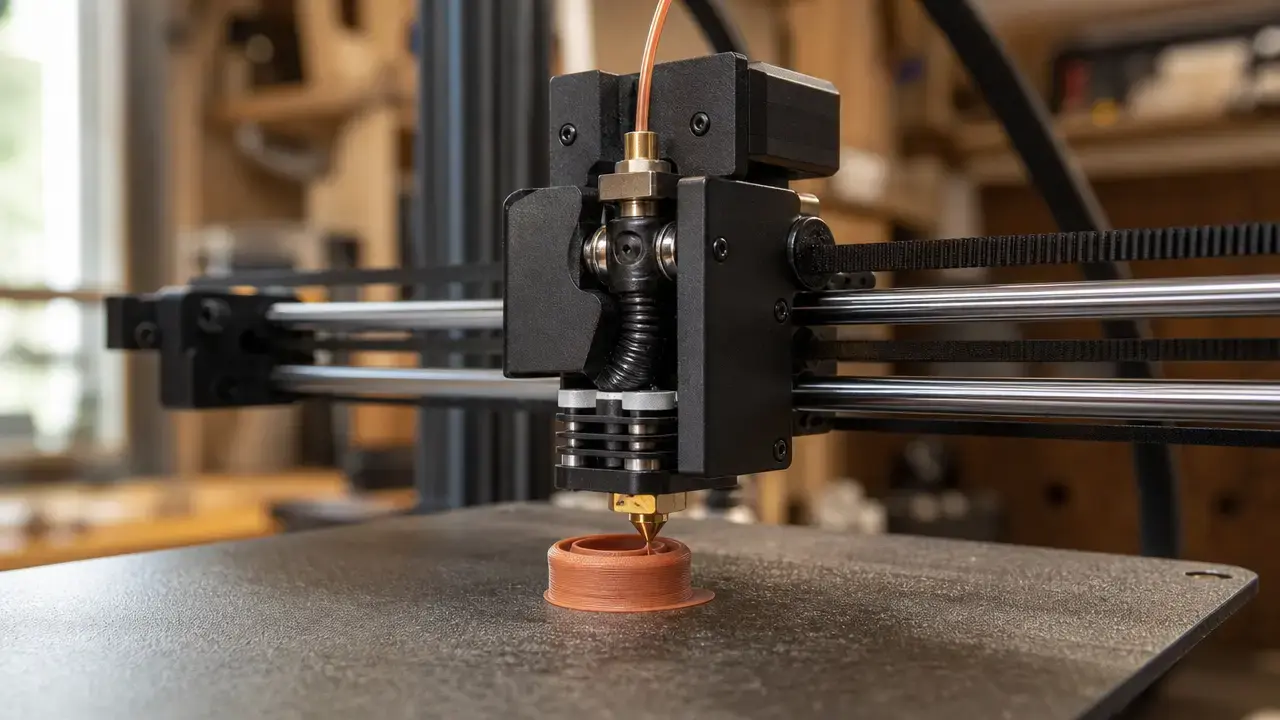
Direct drive and Bowden describe feeder placement relative to the hotend, not motor type, gear reduction, nozzle, or motion system. A direct-drive layout places the feed mechanism on or close to the moving printhead. A Bowden layout separates the feeder and hotend with a flexible guide tube. Hybrid arrangements also exist, so product labels should not replace inspection of the actual filament path. [13]
What the architecture alone does not tell you
- Hotend volumetric-flow capacity.
- Nozzle condition.
- Cooling arrangement.
- Filament dryness.
- Drive-gear design.
- Printer kinematics and frame stiffness.
- Firmware features.
- Tube-end gaps.
Why Bowden layouts exist: a documented design rationale
Bowden layouts move the feeder away from the printhead to reduce moving mass. In introducing the Ultimaker S5, UltiMaker described its Bowden system as keeping the printhead “ultra-light” for its own fastest-performance positioning. That is a documented manufacturer rationale, not proof that every remote-feeder machine will print faster or better. [10]
Historical Prusa documentation also described Bowden systems as less accommodating of flexible materials, illustrating the trade-off created by a remote filament path. [12]
Filament-path compliance: the real variable behind most direct vs Bowden debates
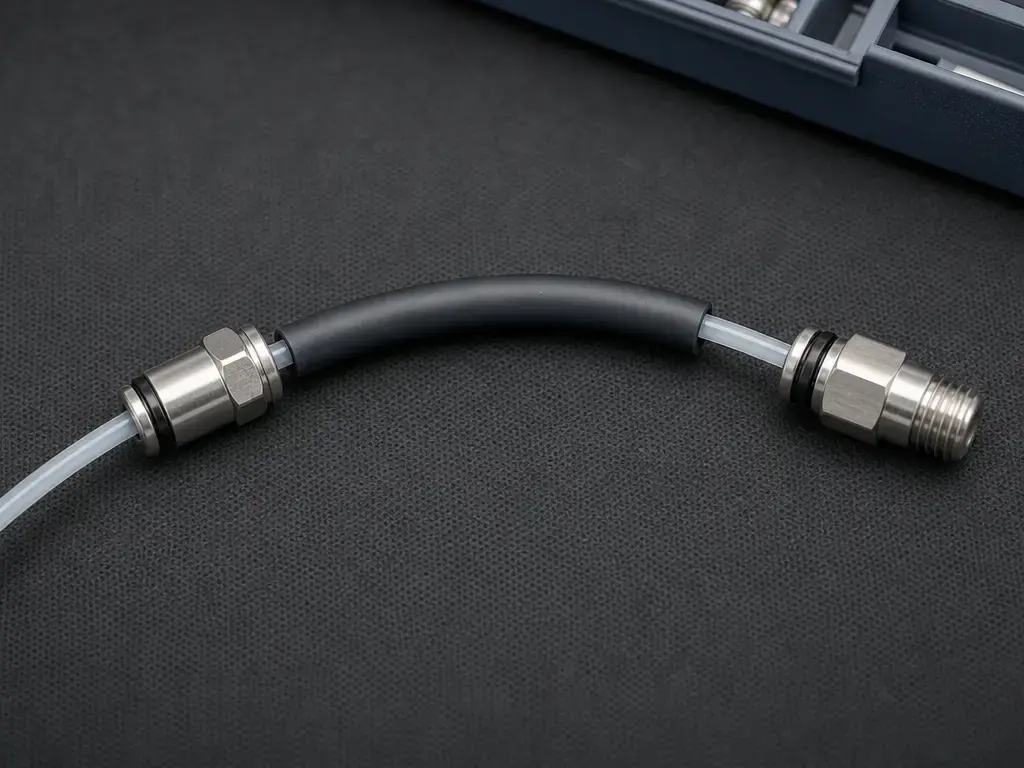
Filament-path compliance is the combined elastic, geometric, and frictional behavior of the complete transport chain. It is not simply tube length. It includes filament compression or stretch, clearance around the filament, guide-tube movement, gaps at tube ends, friction, feeder grip, mounting flex, and resistance at the melt zone. Duet identifies filament clearance, filament compressibility, and spring-like behavior in the stepper system as contributors to extrusion-system elasticity. [7]
When extrusion demand changes, feeder movement, melt-pressure development, and nozzle output do not necessarily change at the same instant. A more compliant path can temporarily absorb commanded motion before it becomes nozzle pressure. This can affect corners, starts and stops, and seams, producing corner bulges, inconsistent line starts, or uneven seam behavior. Research on FFF filament transport likewise treats pressure, compression, and slippage as interacting system variables rather than isolated tube properties. [13]
Soft flexible filaments can compress, stretch, or buckle when feed resistance rises. A remote path with gaps or poor containment can therefore be more difficult to tune, though it is not inherently unusable for TPU or other elastic materials. In the cited elastic-filament study, direct extrusion reduced under-extrusion and buckling tendencies under the tested conditions, while Bowden printing remained possible. [14]
What increases or decreases compliance in real printers
- Unsupported distance between the drive mechanism and hotend.
- Tube inner diameter and filament clearance.
- Tube-end gaps.
- Bend radius along the filament route.
- Friction at guides, tubes, and contact surfaces.
- Filament stiffness.
- Melt resistance and back-pressure.
- Drive tension and stepper-mounting flex.
Tuning controls: retraction vs pressure compensation vs flow calibration
A useful diagnostic order begins with mechanics: inspect the filament path, feeder grip, tube interfaces, nozzle condition, and filament condition. Next, verify that commanded feeder movement corresponds to actual feeder movement. Then adjust flow or extrusion multiplier for the material and process, followed by retraction and pressure compensation.
Using the wrong control can obscure the cause. Retraction primarily reduces ooze during non-printing travel, so it is not the first correction for corner bulges during deposited paths. Pressure advance or Linear Advance targets changing extrusion response as demand rises or falls, rather than wet-filament stringing. [4] [5] Commanded-motion calibration and flow adjustment should not conceal a slipping drive, obstruction, damaged nozzle, or inconsistent material supply. [8]
Compensation can reduce symptoms in a mechanically consistent system, but it cannot repair poor path containment, a clog, feeder slip, or moisture-contaminated filament. [7]
What each setting is for and what it is not for
| Control | Primary job | Not the primary fix for | Check before changing it |
|---|---|---|---|
| Commanded filament-motion calibration (E-steps / rotation distance) | Match requested feeder motion to actual feeder motion | Nozzle clogging or travel ooze | Drive grip, filament path, and measurement method |
| Flow / extrusion multiplier | Match deposited material quantity to the material and process | Feeder-motion error or slipping | Filament-motion calibration and nozzle condition |
| Retraction (travel ooze) | Reduce ooze while the nozzle travels | Corner bulges or general under-extrusion | Filament dryness, nozzle condition, and travel behavior |
| Pressure advance / Linear Advance (transient flow response) | Compensate for delayed pressure response during changing demand | Wet-filament stringing or a mechanical blockage | Mechanical transport consistency and flow behavior |
Retraction, stringing, and direct drive vs Bowden print artifacts
Filament-path length and compliance can change the retraction response needed to reduce travel ooze. The layout name alone does not determine the setting; the whole transport path matters. Prusa provides a machine-specific illustration: its direct-drive MK2.5/S and MK3/S/+ profiles specify a maximum retraction of 2 mm, while its Bowden MINI/MINI+ presets use a 3.2 mm default. These are profile-specific examples, not universal limits for direct-drive or Bowden printers. [4]
Stringing also depends on temperature, moisture, travel pathing, wipe or coast behavior, nozzle condition, and part geometry. Retraction can reduce material left behind during travel, but it cannot correct every source of ooze.
Flexible filament adds another variable: it can stretch while being pulled back, so movement at the nozzle may not match the feeder’s reverse motion as directly as with a stiff filament. Prusa notes that flexible materials often need longer retractions for this reason, but the suitable value remains printer- and material-specific. [4]
Pressure advance and Linear Advance: one physical goal, different firmware implementations
Pressure advance and Linear Advance share a physical goal: compensating for pressure and elasticity effects so deposited flow responds more closely to changing extrusion demand. They target transient behavior during changes in extrusion rate, not every cause of inconsistent extrusion.
For Klipper, typical pressure_advance values are documented between 0.050 and 1.000, with the higher end usually associated with Bowden extruders. Klipper defines the value in millimeters per millimeter per second. Its tuning examples use a FACTOR of .005 for direct-drive arrangements and .020 for a long Bowden path. These are Klipper-specific tuning examples, not transferable presets. [5] [6]
Duet and Marlin use separate implementations and scales. Duet states that Bowden length is a predominant factor and gives a 1 m Bowden example that may approach M572 S values of 1.0 or 2.0, while its Titan Aero direct-drive example is about S 0.05. [7] Marlin gives a K example around 0.22 for 3 mm PLA in a direct-drive arrangement with approximately 6.5 cm between drive gear and heatbreak, and notes that flexible filament or greater distance can require a larger K. [8]
Do not copy numeric values between Klipper pressure_advance, Marlin K, and Duet M572 S — they are firmware-specific and not directly comparable.
Motion-system trade-offs: moving mass, acceleration, input shaping, and speed
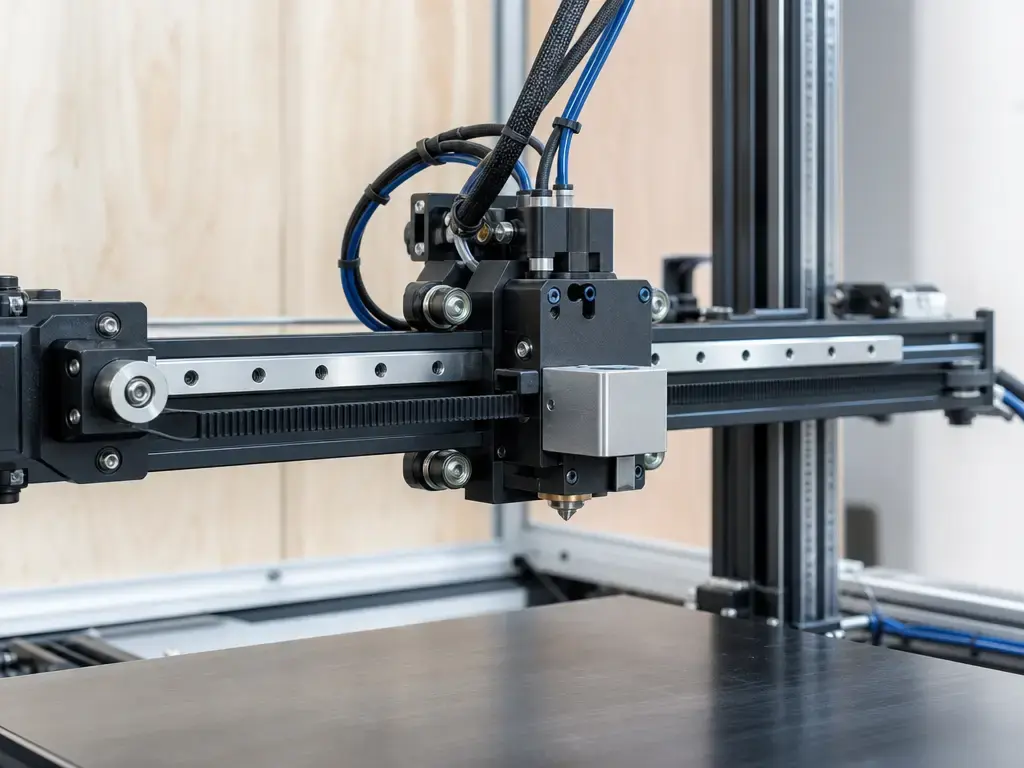
A feeder mounted on the moving printhead adds inertial load to the carriage. Its consequences depend on kinematics, carriage design, structural stiffness, resonant behavior, and selected acceleration. UltiMaker’s “ultra-light” printhead claim for its Bowden S5 is a useful manufacturer example of this design rationale, not a universal performance result. [10]
Ringing, also called ghosting, is a visible surface artifact caused by vibration after changes in motion. Accelerating masses can excite resonances in the machine’s motion system and structure. Input shaping modifies commanded motion to reduce excitation at measured resonant frequencies. [15]
Neither input shaping nor a lighter toolhead increases hotend volumetric-flow capacity. A machine may tolerate a motion setting mechanically while its hotend cannot melt and deliver enough material for the requested line width, layer height, and print speed.
When someone says “faster,” ask which one
- Travel speed.
- Commanded print speed.
- Acceleration.
- Usable speed at an acceptable ringing or surface-quality threshold.
- Volumetric-flow capacity.
Materials and use cases: which layout is lower-risk for your goals?
PLA and PETG can be printed with either layout when the filament path, hotend, filament condition, and tuning are appropriate. Neither material creates an architecture-only preference.
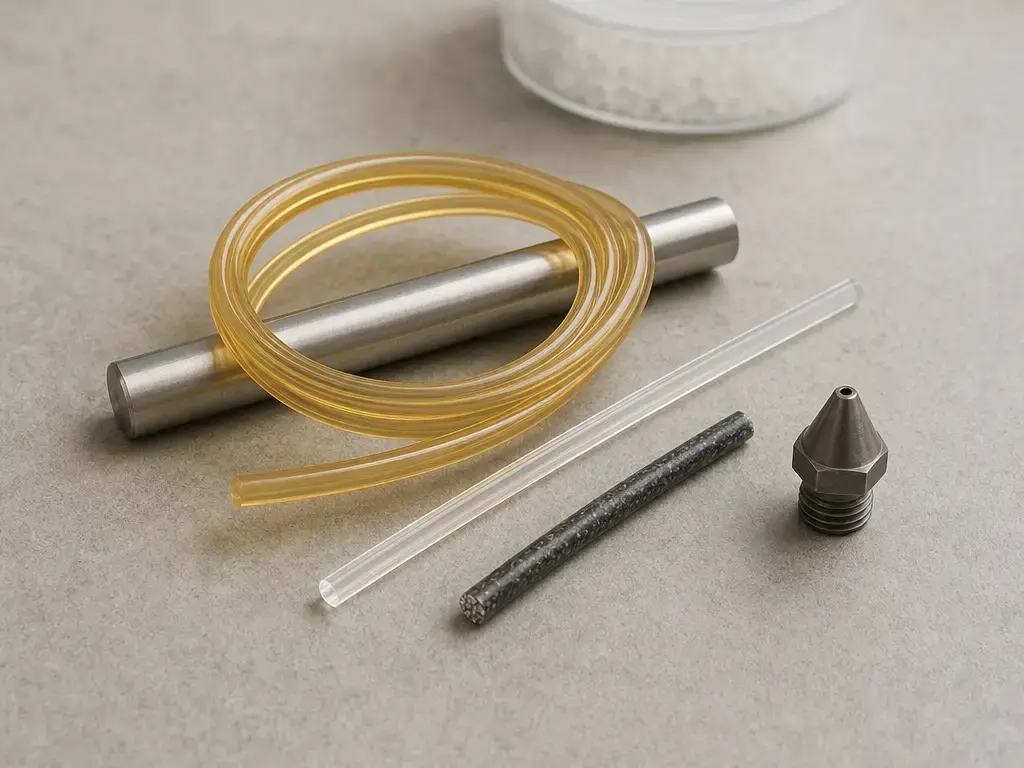
For TPU and TPE, direct drive is often the lower-risk arrangement because a short, contained route gives soft filament fewer opportunities to deform, enter a gap, or buckle under resistance. Tight-path Bowden systems can still work, but tube clearance, tube-end gaps, bends, friction, filament hardness, and moisture become more consequential. Manufacturer guidance and experimental work support this conditional framing. [9] [10] [11] [12] [14] Formlabs includes direct drive, controllable feed, cooling, a heated bed, and extruder capability around 220 °C among its flexible-printing hardware-selection heuristics; its TPC example calls for at least 230 °C of extruder-temperature capability. Those figures are material-specific guidance, not universal TPU requirements. [9]
For filled or abrasive filament, nozzle wear, melt resistance, filament brittleness, and compatible nozzle and hotend hardware are central considerations. No architecture-only conclusion is supported here: direct drive is not automatically required, and Bowden is not automatically unsuitable.
Direct drive vs Bowden: which should you choose or convert to?
The direct drive vs Bowden decision is conditional rather than a ranking. Choose based on the materials you expect to use, the actual filament path, hotend behavior, and motion-system limits. For soft flexibles, a short, well-contained route often reduces transport risk. For a machine whose carriage is particularly sensitive to added mass, Bowden or direct drive becomes a motion-system question as well as an extrusion question. [10] [11] [14]
A conversion is not a drop-in identity change. After moving the feeder, recalibrate commanded filament motion and flow, then retune retraction, pressure compensation, and acceleration or input-shaping behavior. These settings address different effects: pressure compensation concerns transient material delivery, while input shaping concerns motion-induced vibration. [7] [15]
These are tendencies, not ratings; the outcome changes with the full filament path, hotend, material, and motion system.
| Criterion | Direct drive tendency | Bowden tendency | What changes the result |
|---|---|---|---|
| Filament-path response | Shorter path; typically lower compliance | Longer path; more path-dependent compliance | Tube length and clearance, bends, gaps, filament stiffness, melt resistance |
| Flexible-filament handling | Often easier to constrain | More sensitive to buckling and compression | Path containment, gaps, speed, retraction, filament hardness |
| Retraction tuning | Often shorter | Often longer | Hotend geometry, temperature, travel strategy, filament condition |
| Toolhead dynamics | More mass on moving head | Less feeder mass on moving head | Kinematics, structure, resonance, acceleration, input shaping |
How to compare two setups fairly
A fair comparison controls material and process conditions while allowing each setup its own calibration. There is no useful universal winner if one machine uses untuned flow, retraction, or pressure compensation. Evaluate named artifacts separately: stringing, corner bulges, seam artifacts, under-extrusion, and ringing reflect different parts of the extrusion and motion systems. Pressure-advance tuning is setup-specific, while ringing depends on the interaction of accelerating mass, structure, and motion behavior. [5] [7] [15]
- Use the same spool of filament.
- Use the same nozzle.
- Hold temperature and layer height constant.
- Print the same test model.
- Apply comparable acceleration limits.
- Calibrate commanded filament motion and flow independently.
- Tune pressure compensation independently.
- Use a comparable travel strategy.
- Evaluate stringing, corner bulges, seams, under-extrusion, and ringing separately.
FAQ
The answers below describe system tendencies rather than universal settings. Layout is only one part of filament transport, melting, and motion behavior.
Direct drive vs Bowden: which is better?
Neither is universally better. Direct drive shortens the filament path, while Bowden removes feeder mass from the moving head. The suitable choice depends on material behavior, path containment, hotend capacity, and motion-system response. [10] [11]
Is direct drive better than Bowden for TPU?
Direct drive is often lower-risk for TPU because the short path can better constrain soft filament. A tightly contained Bowden path can also work, but buckling and under-extrusion become more sensitive to gaps, resistance, bends, and filament deformation. [14]
Does Bowden reduce print quality versus direct drive?
Not inherently. Stringing, corner bulges, seam artifacts, under-extrusion, and ringing have different causes. They can reflect temperature, moisture, transient pressure response, filament-path mechanics, or motion vibration rather than the layout name alone. [4] [15]
Do direct-drive extruders need less retraction?
Often, but not always. Prusa’s profiles illustrate the tendency with a 2 mm maximum for specified direct-drive machines and a 3.2 mm default for its Bowden MINI/MINI+ profiles. Those are machine- and profile-specific values, not general retraction rules. [4]
Can pressure advance or Linear Advance fully compensate for a long Bowden tube?
No. It can improve transient flow response, but it cannot correct wet filament, a clog, tube-end gaps, or poor filament containment. Klipper pressure_advance, Marlin K, and Duet M572 S are not numerically transferable across firmware implementations. [5] [7] [8]
What mechanical changes most improve TPU reliability on a Bowden system?
Improve path containment: minimize tube-end gaps and unsupported distance, avoid restrictive bends, and reduce unnecessary friction along the route. These changes reduce opportunities for soft filament to compress or buckle before reaching the hotend. [10] [14]
Sources
This article draws on a standards record, firmware documentation, manufacturer documentation, and scientific papers on filament-transport mechanisms. Source 16 is included only as industry and search-intent context, not as technical evidence.
-
ISO. ISO/ASTM 52900:2021 standard record. Standard record; 2021, confirmed 2025. Accessed October 30, 2026.
-
Stratasys. FDM for End-Use Parts. Manufacturer documentation; 2015. Accessed October 30, 2026.
-
Stratasys. 3D Printing With FDM. Manufacturer documentation; 2018. Accessed October 30, 2026.
-
Prusa Knowledge Base. Stringing and oozing. Official documentation; no date shown. Accessed October 30, 2026.
-
Klipper. Pressure advance. Official documentation; no date shown. Accessed October 30, 2026.
-
Klipper. Configuration reference. Official documentation; no date shown. Accessed October 30, 2026.
-
Duet3D. Pressure advance (M572). Official documentation; no date shown. Accessed October 30, 2026.
-
Marlin Firmware. Extruder settings. Official documentation; no date shown. Accessed October 30, 2026.
-
Formlabs. Flexible 3D Printing Guide: Compare Processes, Materials, and Applications. Manufacturer documentation; no date shown. Accessed October 30, 2026.
-
UltiMaker. The Ultimaker S5 is here. Manufacturer documentation; 2018. Accessed October 30, 2026.
-
UltiMaker. Factor 4 Feature Highlight: Direct Drive & Flexibles. Manufacturer documentation; December 5, 2024. Accessed October 30, 2026.
-
Prusa Blog. Original Prusa i3 MK2 Multi Material Upgrade Release. Manufacturer documentation; September 27, 2016. Accessed October 30, 2026.
-
Materials (Basel) via PMC. Filament Transport Control for Enhancing Mechanical Properties of Parts Realised by Fused Filament Fabrication. Scientific paper; 2022. Accessed October 30, 2026.
-
Progress in Additive Manufacturing. Under-extrusion challenges for elastic filaments: the influence of moisture on additive manufacturing. Scientific paper; 2022. Accessed October 30, 2026.
-
Marlin Firmware. Input Shaping. Official documentation; no date shown. Accessed October 30, 2026.
-
All3DP. Direct Drive vs Bowden Extruder: The Differences. Industry context only; updated April 2, 2024. Accessed October 30, 2026.