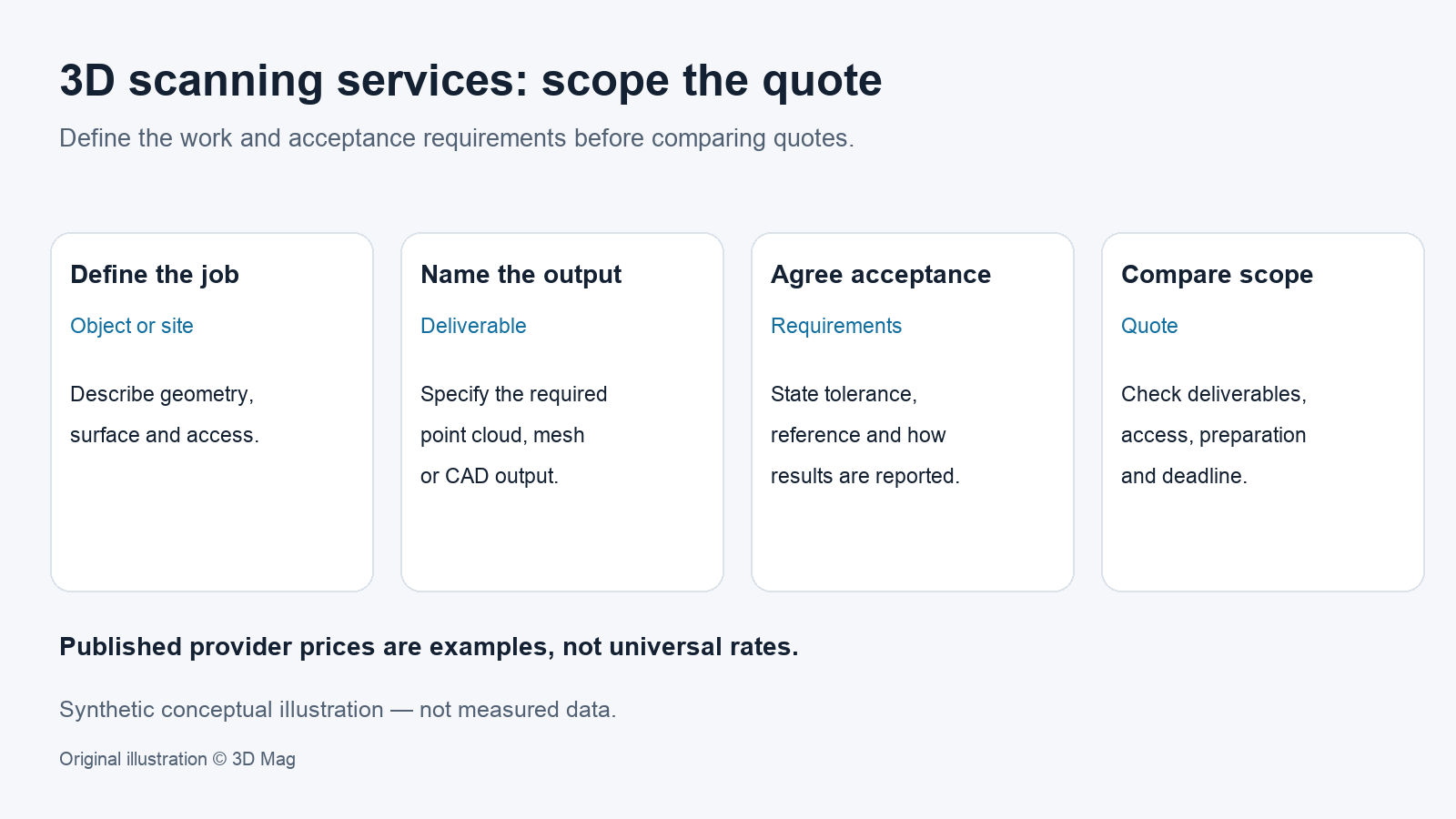

There is no universal rate for 3D scanning services. Your quote depends on four things:
- what you will do with the data
- the deliverable that use requires
- the size of the object or site, and how easy it is to access
- how fast you need the result
One US provider, Arrival 3D, says on its pricing page that the two biggest cost drivers are deliverable type and then facility size and complexity.
A note on the evidence: every source here is published by a company that sells scanning services, and two of them also sell scanning hardware. Their statements are attributed to them as provider claims, not independent measurements.
Start with the job: what you will do with the data
A point cloud, a mesh and a CAD model are different products. Digitize Designs is a US provider that describes itself as an authorized Artec and SCANOLOGY reseller. It states that these three outputs are not interchangeable, and that choosing the wrong one is the most common and most expensive mistake in the process.
Decide the downstream use first. It might be reference geometry for in-house modelling, a printable or measurable surface, an editable CAD model, or 2D drawings or a BIM model at a stated level of detail (LOD). Then ask for that output by name. A point-cloud-only deliverable assumes your team can turn it into whatever comes next.
Deliverable and acceptance tolerances: write them into the request
Providers often group accuracy into price tiers. Arrival 3D describes a “Standard Accuracy” tier of ±5mm to ±10mm as cost-effective for general documentation. The page does not state the measurement conditions, the reference or the confidence basis. Treat the tier as a pricing category rather than a metrology specification.
The required accuracy also depends on the job, not just the scanner. Digitize Designs says that size, material, surface finish and the accuracy you need decide which instrument it uses. It adds that accuracy falls as the scanned volume grows, which is why instrument choice matters.
Write the tolerance into your request and the contract. State three things:
- the tolerance required for each relevant feature
- the reference the deliverable will be checked against
- how deviations will be reported
Without these, two quotes that both promise “high accuracy” may describe different work.
Site, object, access and preparation scope
| Scope item | What to state in the request | Why it can move the quote (provider statement) |
|---|---|---|
| Size and geometry | Overall dimensions, number of levels or parts, and complex features | Central Scanning (UK; also sells Artec and ZEISS scanners on its site): larger objects and complex geometries require more scans and time, which increases the cost |
| Material and finish | Shiny, dark or transparent surfaces, and whether surface treatment is permitted | Digitize Designs: dark or shiny surfaces may need spray, though it says most of its scanners need no treatment except on transparent surfaces such as glass |
| Access | Hard-to-reach areas, safety requirements, logistics | Arrival 3D: hard-to-reach locations cost more because of safety measures and logistical complexity |
| Live operations and deliverable | Whether the facility is active during scanning; deliverable format and LOD | Arrival 3D asks for both to prepare a quote |
| Turnaround | Deadline and whether rush delivery is needed | Arrival 3D: rush delivery carries a 25–50% premium |
If a surface may need treatment, agree in writing whether coatings may be applied and how they will be removed. A provider’s description of a spray is not a safety or material-compatibility clearance for your part or site. Likewise, the hard-to-reach examples come from a pricing list. They do not show that any scanner or provider is suitable or certified for hazardous environments, so confirm that separately.
What drives the price
Each provider names its own cost drivers:
- Deliverable, size and complexity. Arrival 3D (US) ranks deliverable type first and facility size and complexity second.
- Part size, finish, accuracy and travel. Digitize Designs (US) prices per project rather than per hour because part size, surface finish, required accuracy and travel all move the number.
- Object size and geometry. Central Scanning (UK, post dated 11 August 2024) says larger and geometrically complex objects need more scans and time, which raises cost.
- Turnaround. Arrival 3D’s rush premium is shown in the table above.
Dated example: one US provider’s published ranges
The only published price figures in this evidence come from one US provider. Read them as that company’s own estimates, not market rates. Arrival 3D describes its project-type prices as all-in estimates that include field scan, processing and final deliverable (page labelled 2026; accessed 7 October 2026). It does not state tax treatment.
| Arrival 3D project type (USD) | Deliverable | Published range |
|---|---|---|
| Small commercial / retail, under 10,000 sq ft | 2D floor plans + point cloud | $1,500–$4,000 (accessed 7 Oct 2026) |
| Mid-size office building, 10,000–80,000 sq ft (provider table) | As-built CAD plans | $4,000–$14,000 (accessed 7 Oct 2026) |
Arrival 3D gives conflicting mid-size scopes on the same page: its table lists a mid-size office building at 10,000–80,000 sq ft with as-built CAD plans, while its FAQ describes a mid-size commercial building at 10,000–100,000 sq ft with as-built documentation. Both state $4,000–$14,000 (accessed 7 Oct 2026). These are the provider’s differing area and deliverable descriptions, not interchangeable quote scopes. Confirm with the provider which area band and deliverable apply to your site.
The cited Central Scanning page lists cost factors but gives no GBP figures, so no dated UK example is given here. The US figures should not be converted or applied to other regions.
Arrival 3D‘s figures are service fees for capture, processing and a deliverable, not equipment prices. For hardware, see our background article on 3D laser scanner for buildings price.
Hire, or not: a decision checklist
This checklist is editorial guidance, not the result of a test.
Hiring tends to make sense when:
- you scan occasionally
- you can name the deliverable but lack the software or skills to produce it
- access constraints are better planned by a provider
In-house work is worth evaluating when:
- you scan often
- your team already models from point clouds
- your tolerance requirements are stable and well understood
Either way, the deciding question is whether you can specify the output precisely enough to compare quotes.
Questions to ask and how to validate the handover
Central Scanning states that the job details a customer supplies influence the cost estimate.
Suggested scoping and acceptance workflow (editorial guidance; not performed or tested by 3D Mag)
- Define the downstream use, then choose the deliverable: point cloud, mesh, 2D CAD or BIM at a stated LOD.
- State the acceptance tolerance, the reference used for checking, and the report format required.
- Describe the object or site: size, material and finish, access, live operations, travel, and whether surface treatment is permitted.
- Send photos, dimensions and the deadline. Ask for a fixed scope that lists capture, processing, deliverable, file formats, turnaround premium and travel.
- Before signing, confirm data ownership and delivery of the raw files.
- At handover, check the deliverable against the agreed reference measurements and confirm the formats open in your software. Record any deviations against the contract.
Data ownership varies by provider, so ask. Digitize Designs states that customers receive the raw and processed data and that it retains no rights over it. That is one provider’s published term, not a general rule.
Reader questions
Is a scanner’s accuracy the same as the accuracy of my deliverable? No. Digitize Designs says that size, material, surface finish and the required accuracy determine its instrument choice, and that accuracy falls as scanned volume grows. This is the provider’s statement, not an independently measured rule. State the tolerance you need, and how it will be verified, in the contract.
Is hiring a service the same cost as buying a scanner? No. A service fee covers a defined scope of capture, processing and deliverable. Buying hardware is a separate decision.
What should I send to get an accurate quote? Include:
- the purpose of the data
- the deliverable format and LOD
- the size and location
- the material and finish
- access and live-operation constraints
- the deadline
- photos
Sources
This explainer is based on cited published sources; 3D Mag did not conduct hands-on testing. Publisher sponsorship.