
Summary
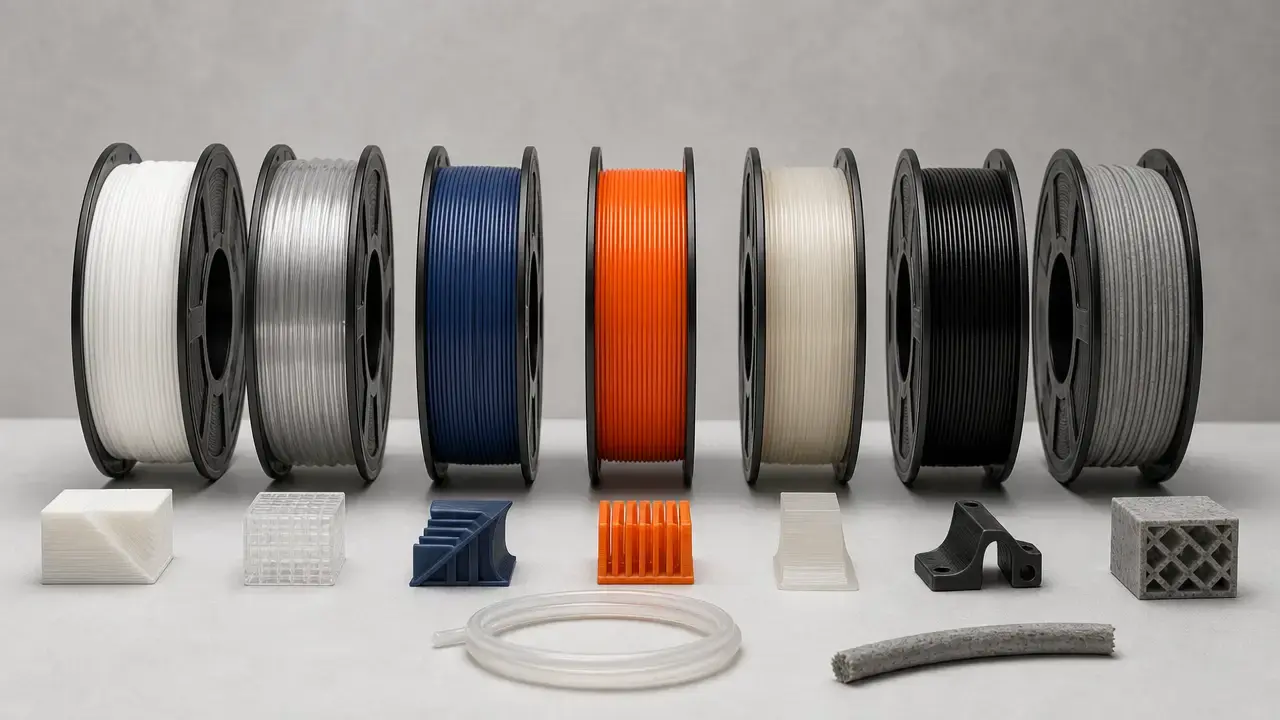
Choosing among 3D printer filament types and uses starts with the part’s environment, likely failure mode, and the printer’s ability to process the material. Industry guides often narrow the field to six basic polymers, but this guide also includes support materials and common composites. [25]
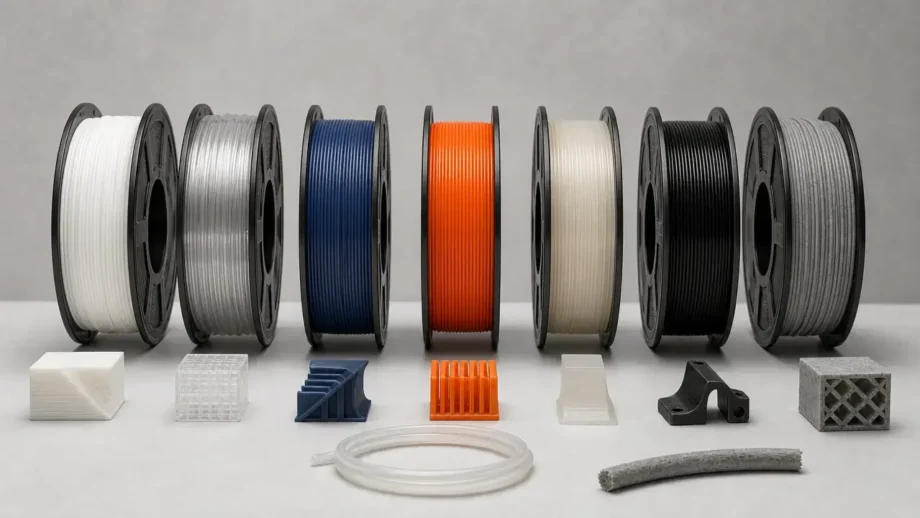
There is no single best filament for all prints. PLA is often chosen for ease of use, while ABS, PETG, ASA, TPU, nylon, PC, and filled materials each trade off stiffness, toughness, heat response, flexibility, or surface finish in different ways. The sections that follow compare common options against those decision filters, so you can match material choice to indoor use, outdoor exposure, moving parts, supports, or stronger functional parts.
Quick filament comparison chart
This 3D printing filament comparison is qualitative, not a datasheet replacement. Use it to narrow the types of filament before checking the manufacturer’s product sheet for exact temperatures, tolerances, and drying rules.
| Filament | Best for | Avoid when | Print difficulty |
|---|---|---|---|
| PLA | Visual prototypes, fit checks, classroom parts | High-heat service or long outdoor exposure | Easy |
| PETG | General-purpose parts, moderate toughness, some moisture tolerance | Very crisp fine detail or very high heat | Easy to Moderate |
| ABS | Functional parts that need better heat resistance | Open printers with poor draft control | Moderate |
| ASA | Outdoor parts and UV-exposed enclosures | You cannot provide enclosure-like draft control and ventilation | Moderate to Demanding |
| TPU | Flexible grips, vibration damping, seals | Rigid load-bearing parts | Moderate |
| PA/nylon family | Wear parts, low-friction components, functional prototypes | Humid storage or printers without material control | Demanding |
| PC | Strong functional parts and higher-temperature uses | Entry-level printers with limited thermal control | Demanding |
| PVA / BVOH | Water-soluble supports for complex geometries | Single-material workflows or poor dry storage | Demanding |
| CF / GF / aramid-filled | Stiffer parts, reduced warp in some designs | Standard brass nozzles and casual hardware setups | Demanding |
Common choices follow the part’s need, not the label on the spool: PLA for simplicity, PETG for a balanced default, ABS or ASA for more demanding service conditions, TPU for flexibility, PA/nylon for higher-performance parts, and soluble supports only when the workflow supports them. Composite-filled materials increase hardware demands, and soluble supports are a process choice rather than a simple material swap. [16] [21]
- Choose PLA if you want the easiest starting point.
- Choose PETG if you need a general-purpose step up in toughness.
- Choose ABS if the part will live in a warmer environment and your printer is enclosed or draft-controlled.
- Choose ASA if the part will be outdoors and you can manage enclosure-like conditions and ventilation. [13]
- Choose TPU for parts that must bend instead of crack.
- Choose PA/nylon if wear resistance matters more than easy printing.
- Choose PC if you need a stronger, more heat-tolerant engineering polymer.
- Choose composite-filled filament only if your nozzle and wear parts are built for it.
- Choose PVA or BVOH only when the support workflow justifies the extra drying and handling.
Numeric values vary; see product-specific examples table below.
How to choose a filament
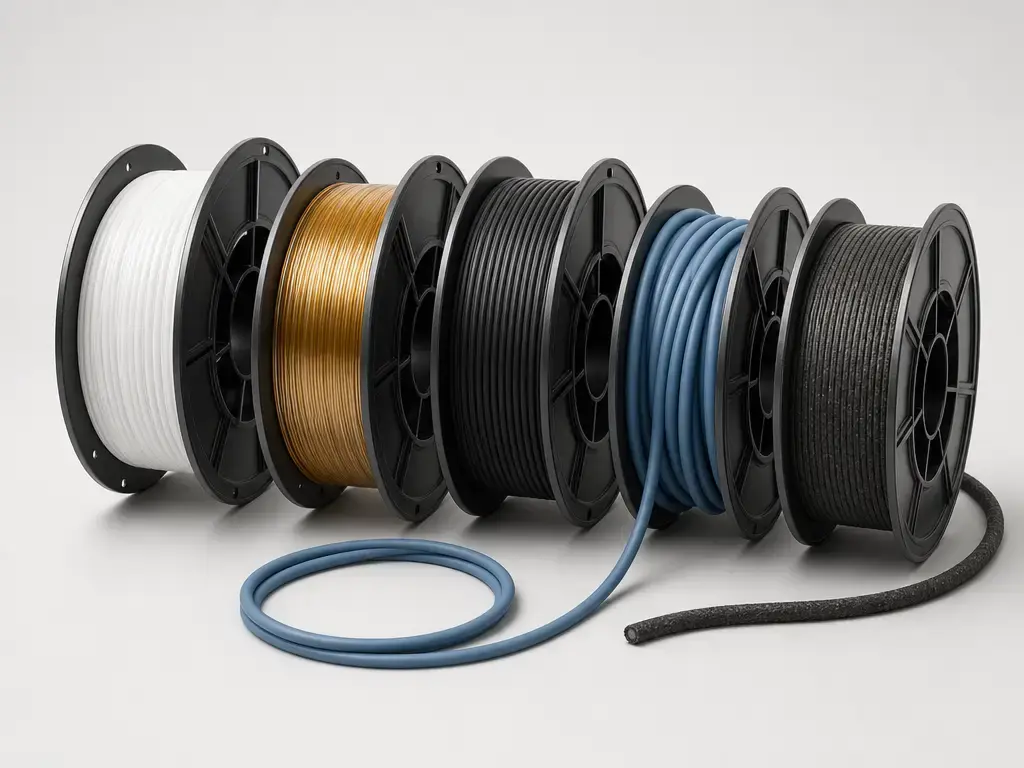
A useful filament choice starts with the part’s environment, then the failure mode you care about, then the printer and workflow you can actually support. First ask whether the part will see heat, sunlight, or moisture. Then decide whether it must resist impact, flex repeatedly, or stay dimensionally stiff. Finally, check whether your printer can handle enclosure needs, drying, abrasives, or soluble supports. That order is usually more reliable than comparing brand names alone. [25]
“Strongest” is incomplete unless you name the failure mode, orientation, and service temperature. A part can be stiff without being impact-tough, and the reverse is also true. PLA is a clear example: one data sheet reports Young’s modulus of 3250 ± 119 MPa in XY, yet notched Charpy impact strength of 3.9 ± 0.4 kJ/m², so stiffness and toughness are not the same property. [7]
Before you decide, answer these 5 questions:
- How hot will the part get?
- Will it see UV or weather?
- Do you need impact resistance, stiffness, or both?
- How will the filament handle moisture during storage and printing?
- Do you need supports, and what postprocessing is acceptable?
Terminology: material extrusion, FFF, and FDM
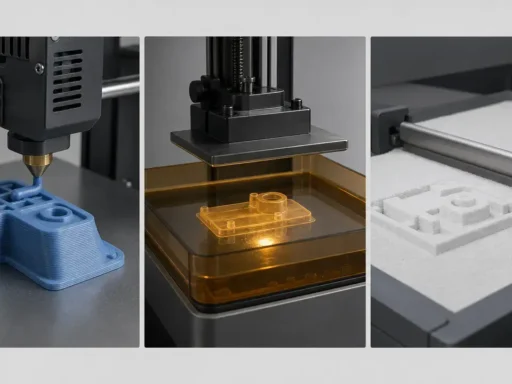
In this article, material extrusion is the standards-family term and FFF is the generic term for consumer filament printing. ISO/ASTM 52900:2021 is the baseline vocabulary reference for additive manufacturing process-family terminology. [1]
FDM is a trademark, not the neutral standards term, so this article avoids using it as a generic synonym. [2]
Methods disclaimer: why filament numbers do not transfer cleanly to your part
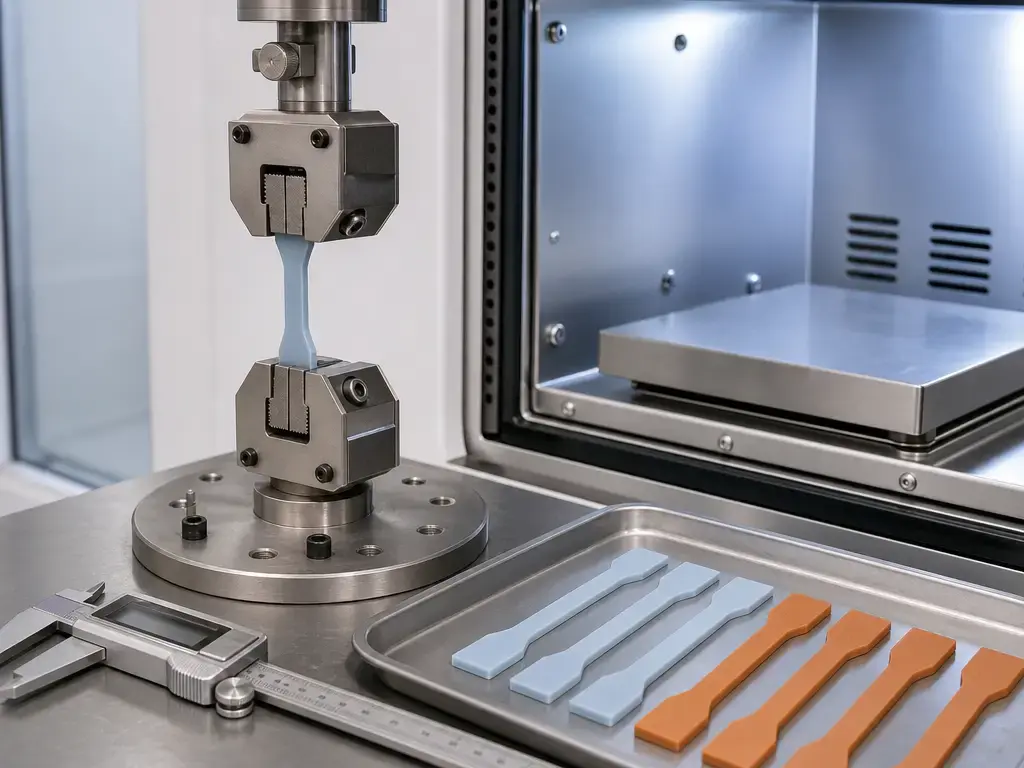
Manufacturer data sheets often report values from printed specimens under stated conditions, not from raw resin. For example, the UltiMaker PLA technical data sheet notes that all samples were 3D printed, so the numbers describe a test build, not an unprinted pellet or a universal part property. [7] Layer height, infill, cooling, conditioning, and test geometry can all shift measured properties, so one brand’s published result should not be treated as a direct substitute for another’s without context.
That context includes anisotropy, meaning printed parts behave differently by direction. The weak link is often the Z direction, where interlayer bonding can be much less ductile than in-plane behavior. UltiMaker’s nylon data show this clearly: elongation at break is listed as >120% in XY, >130% in YZ, and 1.7 ± 0.2% in Z. [15] That is why a filament can look strong on paper yet fail early between layers once geometry, orientation, and loading mode change.
Heat metrics that get confused
Heat resistance is often summarized with HDT, or heat deflection temperature, but the test load matters. HDT/DTUL is the temperature at which a test bar deflects a specified amount while under load, and common loads are 0.45 MPa and 1.80 MPa. ISO 75-2 also defines multiple methods with different stresses: Method A uses 1.80 MPa, Method B uses 0.45 MPa, and Method C uses 8.00 MPa. Do not compare a 0.45 MPa HDT to a 1.8 MPa HDT as if they are equivalent. [4] [3]
Vicat is a separate softening-related test concept, covered by ISO 306:2022, and it should not be treated as the same number as HDT. Glass transition temperature, or Tg, is another measure; it is determined through DSC-related standards rather than serving as a direct substitute for HDT or Vicat. These metrics describe related aspects of thermal behavior, but they answer different questions about when a polymer starts to soften, deform, or change state. [6] [26]
Strength, stiffness, toughness, moisture, and weather: the comparison guardrails
Strength, stiffness, and toughness are different properties. Stiffness is resistance to bending, strength is resistance to failure, and toughness is the ability to absorb energy before fracturing or cracking. A rigid material can still be weak in impact loading: UltiMaker’s PLA data show a Young’s modulus of 3250 ± 119 MPa in XY, but a notched Charpy impact value of 3.9 ± 0.4 kJ/m². [7]
Moisture sensitivity is not the same as water exposure in service. Some polymers absorb water during storage, drying, and printing, which can change extrusion behavior and part quality before the part ever goes into use. Evonik notes that PA12 has lower water absorption than PA6 and PA66, which is why PA/nylon family comparisons often focus on drying and conditioning as much as final part performance. [18]
UV resistance is also separate from raw heat numbers. A material may look acceptable on a thermal metric yet still age poorly outdoors; UltiMaker notes that ABS can be negatively affected by long-term UV exposure. [11] For outdoor use, weathering, sunlight, and moisture need to be considered together rather than reduced to one “heat resistant” label.
Product-specific examples table
The numbers below are examples from specific products, not universal properties of the whole material family. Use them to compare products under their stated test loads, not to assume every PLA, PETG, ABS, ASA, or PC behaves the same way.
Product-specific examples (do not treat as universal properties)
| Material family | Example product | HDT @0.45/0.455 MPa | HDT @1.8 MPa | Tg/Vicat | Notes |
|---|---|---|---|---|---|
| PLA | UltiMaker PLA | 58.8 ± 0.4 °C @ 0.455 MPa | — | Tg 59.1 °C | Printed specimen. [7] |
| PETG | UltiMaker PETG | 76.2 ± 0.8 °C @ 0.455 MPa | — | — | Printed specimen. [8] |
| PETG | Polymaker PETG | 69 °C @ 0.45 MPa | 65 °C @ 1.8 MPa | Vicat 75 °C; Tg 71.24 °C | Load label changes the number. [9] |
| ABS | UltiMaker ABS | 86.6 ± 0.4 °C @ 0.455 MPa | — | Tg 100.5 °C | Printed specimen. [11] |
| ASA | Polymaker ASA | 103 °C @ 0.45 MPa | 100 °C @ 1.8 MPa | Tg 98 °C; Vicat 105 °C | Load-sensitive product data. [12] |
| PC | UltiMaker PC | 104.5 ± 0.7 °C @ 0.455 MPa | — | Tg 107.7 °C; Vicat 114.7 ± 0.4 °C | Printed specimen. [19] |
| PC | Prusament PC Blend | 113 °C @ 0.45 MPa | 93 °C @ 1.80 MPa | — | Larger gap between loads. [20] |
These examples show why a 3D printer filament types comparison chart must be read with the test load attached. The same family can shift noticeably between 0.45 MPa and 1.8 MPa, and vendor data can differ because formulations and test setups differ. [9] [12]
PLA filament: easiest material for models and prototypes
PLA is usually the easiest starting point among common filament types. It suits visual models, classroom prints, fit checks, and prototypes that will stay away from heat. Its relatively high stiffness makes it useful when a part needs to hold shape without much flex, and it is often the first choice when predictable printing matters more than service performance. [7] [25]
Its limits show up in heat and impact-specific conditions. UltiMaker reports PLA with HDT of 58.8 ± 0.4 °C at 0.455 MPa and Tg of 59.1 °C, which places it below many engineering thermoplastics for warm environments. The same sheet also reports Young’s modulus of 3250 ± 119 MPa in XY, but notched Charpy impact strength of 3.9 ± 0.4 kJ/m², so PLA can be stiff without being especially impact-tolerant. Snap-fit parts and hot-service parts need more caution than casual prototypes. [7]
PETG filament: the everyday functional compromise
PETG is often the everyday functional compromise in a 3D printing filament comparison. It is commonly chosen for brackets, housings, and general-use parts that need more toughness than PLA without moving all the way into engineering-polymer printing. One UltiMaker PETG data sheet reports HDT of 76.2 ± 0.8 °C at 0.455 MPa, while Polymaker reports 69 °C at 0.45 MPa and 65 °C at 1.8 MPa for its PETG, which shows that both product formulation and test load matter. [8] [9]
The trade-offs are mostly workflow-related. PETG can string more than PLA, and support removal is not always as clean, so the material may be right even if the print process is less tidy. It is also worth drying and handling with some care: Prusament lists moisture absorption of 0.07% after 24 h at 24 °C and 22% RH, and Prusa’s drying guidance gives 55 °C for 6 h as a reference condition. [10] [23]
ABS vs ASA: heat, fumes, and outdoor use
When people compare PLA vs ABS vs PETG filament, ABS is usually harder to print than PLA or PETG, while ASA is the more weather-oriented option. UltiMaker reports ABS with HDT of 86.6 ± 0.4 °C at 0.455 MPa and Tg of 100.5 °C, so it can handle more heat than PLA, but UltiMaker also notes that long-term UV exposure can negatively affect ABS properties. [11] ASA is typically the better choice for outdoor use: Polymaker lists Tg 98 °C, Vicat 105 °C, and HDT 103 °C at 0.45 MPa and 100 °C at 1.8 MPa. [12]
ASA is not a casual swap. Prusa notes a 260 °C nozzle, a 105 °C first-layer bed and 110 °C for other layers, a well-ventilated area, and enclosure-style conditions for reliable printing. [13] In other words, “outdoor-capable” does not mean easy on any open printer.
TPU and flexible filaments
TPU sits in the flexible-filament category, where the useful property is bendability rather than stiffness. Shore hardness gives a quick sense of feel and compliance, so a softer TPU will deform more readily under load than a rigid filament. UltiMaker’s TPU 95A data show Shore A 96 and elongation at break above 560% in XY and above 700% in YZ, which is why TPU is used for grips, bumpers, seals, and vibration-damping parts rather than rigid structural brackets. [14]
The workflow burden is real. Flexible filament can be sensitive to feed-path setup, and it also benefits from drying: Prusa lists 60 °C for 4-6 h as a reference condition. [23] TPU is flexible by design, but not automatically simple to print or suitable for parts that must stay dimensionally rigid.
PA/nylon family and engineering filaments
The PA/nylon family is not one fixed material. It includes PA6, PA12, PA11, and long-chain copolymers, and those grades can differ in stiffness, moisture response, and printing behavior. That is why PA/nylon is better treated as a family than as a single filament type. For wear-prone parts and low-friction components, it can be useful, but grade choice matters as much as the name on the spool. [18]
Moisture handling and print orientation are central to real printed behavior. Evonik notes that PA12 has lower water absorption than PA6 and PA66, while UltiMaker’s nylon data show HDT of 89.2 ± 5.6 °C at 0.455 MPa and elongation at break above 120% in XY, above 130% in YZ, but only 1.7 ± 0.2% in Z. [18] [15] That spread is a reminder that PA/nylon can be ductile in one direction and much less forgiving between layers, especially when moisture and processing conditions are not controlled.
Polycarbonate (PC) and PC blends
PC sits in the higher-heat, higher-stiffness part of the mainstream filament set. UltiMaker’s PC data show HDT of 104.5 ± 0.7 °C at 0.455 MPa, Vicat of 114.7 ± 0.4 °C, and Tg of 107.7 °C, which is why PC is often considered when a part must stay more stable under heat than PLA, PETG, or many general-purpose plastics. [19]
The process window is narrower than for everyday filaments. Prusament’s PC Blend lists HDT of 113 °C at 0.45 MPa and 93 °C at 1.80 MPa, plus a nozzle temperature of 275 ± 10 °C and a bed temperature of 110 ± 10 °C. [20] It also gives a drying reference of 85 °C for 5 h. [23] In practice, PC and PC blends usually need a printer that can reach and hold those temperatures consistently, not just a hotter nozzle. Higher-performance polymers exist beyond this scope, such as PEEK and PEI, but they typically require specialized printers and are outside this article’s decision set.
Support materials: breakaway vs soluble
Support choice is part of the whole printing workflow, not just a material decision. Soluble supports matter when geometry is hard to clean mechanically, but they usually require a multi-material upgrade or a dual nozzle/extruder setup, dry storage, and enough time for the support to dissolve. Prusa notes that dissolving can take several hours, so soluble support is a process choice, not a simple spool substitution. [21]
PVA and BVOH are the common water-soluble options, while HIPS is a different route that relies on solvents instead of water. Prusa lists HIPS with a 225-255 °C nozzle and a 100-110 °C bed, and notes that it dissolves in limonene or acetone, with compatibility constraints depending on the model material and workflow. [22] The support material has to match both the printer and the part; there is no universal support filament that works cleanly with every model polymer.
Composites and aesthetic filaments
Most consumer carbon fiber filament and glass fiber filament products are short-fiber-filled thermoplastics, not continuous-fiber composites. The base polymer still matters first, because the fiber addition changes print behavior on top of the underlying PLA, PETG, PA/nylon, or PC family. In practice, carbon, glass, and aramid-style fillers are used to tune stiffness or warpage behavior, but they also change the tooling requirements. Prusa notes that carbon, glass, and kevlar-filled materials are highly abrasive and need a hardened nozzle. [16]
Short fibers can also shift the mechanical trade-off in ways that are not always intuitive. A 2025 review reports literature showing that short-fiber reinforcement can increase anisotropy and that carbon fibers can reduce interlayer bonding strength in some printed systems, so filled filaments are not automatically stronger in every direction or failure mode. [17] The same caution applies to aesthetic filaments such as wood, metal, glow, silk, and matte variants; they can change surface finish and feel, but they should not be assumed to have the same mechanics as the base polymer or as each other.
Printer capability checklist
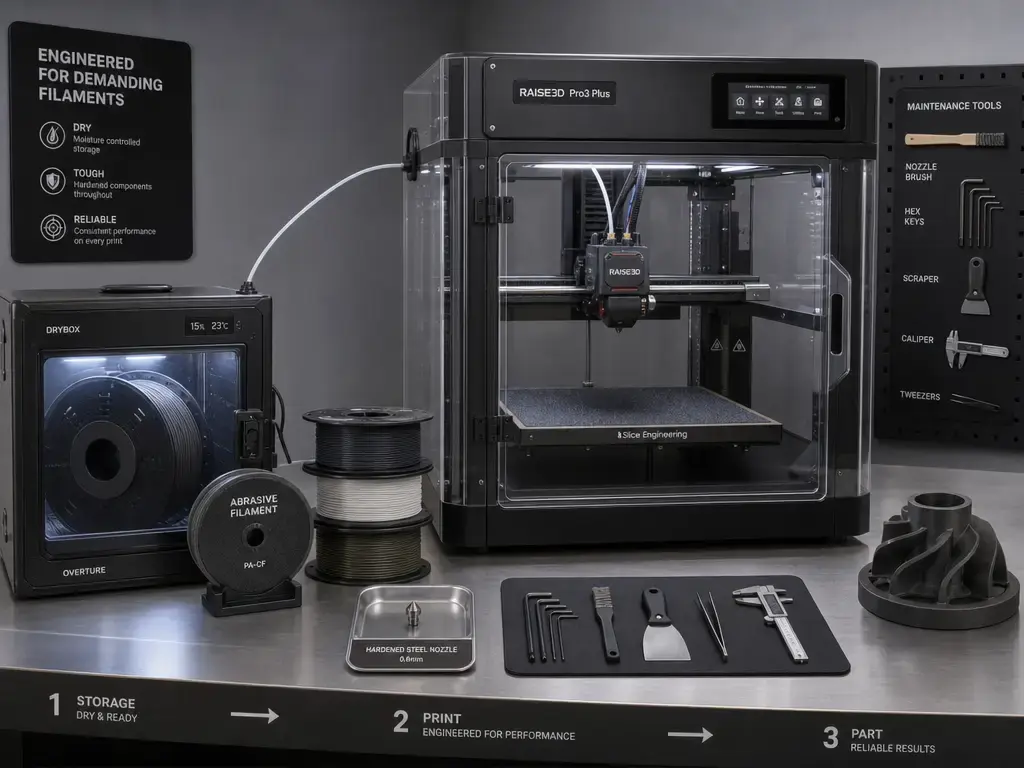
Material choice is filtered by the machine and workspace as much as by the polymer itself. Before comparing brands or chasing the highest heat number, check whether your printer and room can support the required temperature, drying, support, and airflow conditions. A filament that is mechanically suitable can still be the wrong choice if the hotend, bed, enclosure, or ventilation setup cannot handle it. [23] [24]
- Enclosure or draft control: needed for materials that warp easily or prefer stable chamber conditions.
- Hotend temperature: confirm the printer can actually reach the nozzle temperature the filament needs.
- Heated bed temperature: check whether the bed can reach and hold the stated setting.
- Bed adhesion strategy: use the surface and adhesion method that fit the material, not just the printer default.
- Drying or drybox: some filaments need active moisture control before and during printing. Prusa’s drying references include PETG 55 °C / 6 h, TPU 60 °C / 4-6 h, ASA 80 °C / 4 h, PC Blend 85 °C / 5 h, and PA11 CF 90 °C / 6 h. [23]
- Abrasive nozzle hardware: carbon, glass, and kevlar-filled filaments require a hardened nozzle. [16]
- Multi-material support setup: soluble supports may require a multi-material upgrade or dual nozzle/extruder, plus dry storage. [21]
- Ventilation and filtration: treat these as risk reduction, not a guarantee. NIOSH highlights emissions concerns and recommends engineering controls. [24]
- Warping risk: confirm the printer can manage shrinkage and corner lift for the chosen material.
- Postprocessing tolerance: some parts need support removal, smoothing, or solvent handling, which changes the workflow.
Choosing filament by application
The best filament depends on the environment and the failure mode, not forum folklore. If the part is a visual model, prototype, bracket, housing, outdoor item, wear component, or flexible seal, the same question applies: what will actually break first, and under what temperature, load, or exposure? That is the most reliable way to compare filament choices across common 3D printer filament types and uses. [25]
Outdoor enclosures and weather exposure
For outdoor parts, ASA is usually the default recommendation, but it still needs enclosure-style draft control and ventilation. Prusa notes those process conditions explicitly, so outdoor-capable does not mean open-printer-friendly. [13] ABS can be used for functional parts, but UltiMaker warns that long-term UV exposure can negatively affect ABS properties, so it is not the safe default for weather exposure. [11] If the part will live outside, think about UV, rain, temperature cycling, and fastener or support-material compatibility together rather than relying on a single “weatherproof” label.
Car interior parts
Car interiors can exceed the temperatures that challenge many common filaments. CDC reports parked vehicles reaching 131-172 °F, or 55-78 °C, when outside temperatures are 80-100 °F. [5] That means the part needs temperature margin, especially if it sits behind glass or on a dark dashboard surface. PLA is often too limited, PETG can be borderline depending on the part and vehicle, and higher-heat engineering options become more relevant only when the printer and workflow can support them.
Wear-prone / moving parts
For wear-prone parts, low-friction inserts, bushings, guides, or sliding features, the choice is bounded by mating material, lubrication, load, speed, temperature, and print orientation. PA/nylon can be useful here, but the family varies by grade; Evonik notes PA12 has lower water absorption than PA6 and PA66, so moisture behavior and dimensional stability matter as much as the nominal nylon label. [18] Filled materials can help in some geometries, but they do not remove the need to check contact conditions and layer orientation.
Flexible seals, grips, bumpers
Flexible parts belong in the TPU category when bendability matters more than stiffness. UltiMaker’s TPU 95A data show Shore A 96 with elongation at break above 560% in XY and above 700% in YZ, which is the kind of behavior used for grips, bumpers, seals, and vibration-damping features. [14] These parts are selected for elastomeric behavior, not rigid strength, so they should be treated as functionally different from structural brackets or hard mounts.
Limitations and safety considerations
3D-printer emissions are a real occupational-health topic, not a solved detail. The NIOSH bulletin says there are still gaps in available health and safety information, discusses particulate and VOC emissions, and frames ventilation, exhaust, and filtration as control measures rather than guarantees. [24] Enclosure, airflow, and filtration can reduce exposure, but they do not make every setup uniformly safe. Material choice, printer condition, and the surrounding room still matter.
Food-safe or medical-safe use is not automatic for any filament family. Do not assume a spool label alone establishes compliance. Product-specific certification, printer cleanliness, postprocessing, and the exact intended use all need to be checked before making safety claims.
How to use this 3D printer filament types and uses guide
Use this 3D printer filament types and uses guide in four steps: start with the part’s use case, scan the qualitative chart to narrow the field, check the numeric examples for products that match your material family, and then confirm printer capability and safety. Keep the HDT load label in view when you read the table: 0.45 MPa and 1.80 MPa are different test conditions, so the numbers are not interchangeable. [3]
FAQ
What are the main 3D printer filament types and uses?
The main 3D printer filament types and uses in this guide are PLA for easy models and prototypes, PETG for general functional parts, ABS and ASA for higher-heat applications, TPU for flexible parts, PA/nylon for wear-prone or low-friction parts, PC for higher-heat engineering uses, and support materials such as PVA/BVOH and HIPS for complex geometries. Composite-filled and aesthetic filaments are variations on those base polymers rather than separate behavior classes. The right answer still depends on environment, failure mode, and printer capability. [25] [21] [22]
What is the best filament for beginners?
PLA is usually the best starting point for beginners because it prints easily and is forgiving on basic machines. It is useful for visual models, classroom parts, fit checks, and simple prototypes. But best does not mean best for every part. PLA’s stiffness does not make it the right choice for heat exposure or impact-heavy use, so it is a starting point, not a universal default. [7]
PLA vs ABS vs PETG filament: which is strongest?
Strongest for what failure mode, under what orientation and temperature? That is the right way to ask the question. PLA can be very stiff; UltiMaker reports a modulus of 3250 ± 119 MPa in XY, but that does not make it the toughest material. PETG is often a balanced functional option, with UltiMaker reporting tensile stress at yield of 46.2 ± 0.8 MPa in XY, while ABS brings better heat tolerance than PLA, with HDT 86.6 ± 0.4 °C at 0.455 MPa, but UV exposure can still hurt long-term properties. [7] [8] [11]
Which 3D printer filament types are best for outdoor use?
ASA is usually the first choice for outdoor use because it is more weather-oriented than ABS, but it still needs the right process window. Prusa recommends a well-ventilated area and notes enclosure-style conditions for stable printing. [13] ABS can work in some functional roles, but it is not the safe default for long UV exposure. [11] If the part will see sunlight, rain, and temperature cycling, the material choice has to include UV behavior, enclosure needs, and surface finish, not just heat numbers. [13] [11]
What filament should I use for car interior parts?
Car interiors can get hot enough to challenge common filaments. CDC reported parked vehicles reaching 55-78 °C, or 131-172 °F, when outside temperatures were 27-38 °C, or 80-100 °F. [5] That means the part needs temperature margin, especially if it sits behind glass or on a dark dashboard surface. PLA is often too limited, PETG may be borderline depending on the geometry, and higher-heat materials become more relevant only if the printer and workflow can handle them. The failure mode here is often softening or creep, not just visible melting. [5]
Do carbon-fiber filaments make prints stronger?
Not automatically. Most consumer carbon-fiber filaments are short-fiber-filled thermoplastics, so the base polymer still governs much of the behavior. Prusa notes that carbon, glass, and kevlar-filled materials are abrasive and need a hardened nozzle. [16] A 2025 review also reports literature showing that short fibers can reduce interlayer bonding strength and increase anisotropy. [17] These materials can improve stiffness or warp control in some designs, but the result depends on load direction, print orientation, and the actual filler system.
What’s the difference between PVA/BVOH and HIPS supports?
PVA and BVOH are water-soluble support materials, while HIPS is usually dissolved with solvents such as limonene or acetone. The workflow is different for each. Prusa notes that soluble supports may need a multi-material upgrade or dual nozzle/extruder, dry storage, and hours of dissolving time. [21] HIPS also has temperature and compatibility constraints, so it is not a universal support material either. The support choice has to match both the printer and the model polymer, not just the geometry. [22]
Sources
- ISO/ASTM 52900:2021 Additive manufacturing — General principles — Fundamentals and vocabulary
- Stratasys Legal Information
- ISO 75-2:2013 Plastics — Determination of temperature of deflection under load — Part 2: Plastics and ebonite
- Intertek Testlopedia: Heat Deflection Temperature ASTM D648, ISO 75
- CDC MMWR: Fatal Car Trunk Entrapment Involving Children — United States, 1987-1998
- ISO 306:2022 Plastics — Thermoplastic materials — Determination of Vicat softening temperature (VST)
- UltiMaker PLA Technical Data Sheet PDF
- UltiMaker PETG Technical Data Sheet PDF
- Polymaker PETG Technical Data Sheet PDF
- Prusament PETG Technical Data Sheet PDF
- UltiMaker ABS Technical Data Sheet PDF
- Polymaker ASA technical data page
- Prusa Knowledge Base: ASA
- UltiMaker TPU 95A Technical Data Sheet PDF
- UltiMaker Nylon Technical Data Sheet PDF
- Prusa Knowledge Base: Composite materials (filled with carbon, kevlar or glass)
- Tóth et al., “Short fiber reinforcement in material extrusion 3D printing: A meta-analysis review with insights into sustainable alternatives”
- Evonik Industries: Thermoplastics
- UltiMaker PC Technical Data Sheet PDF
- Prusament PC Blend Technical Data Sheet PDF
- Prusa Knowledge Base: Water soluble (BVOH/PVA)
- Prusa Knowledge Base: HIPS
- Prusa Knowledge Base: Drying filament
- NIOSH Science Bulletin: Characterizing 3D Printing Emissions and Controls in an Office Environment
- All3DP: All 3D Printing Filament Types Explained – Properties, Printing & Best Uses
- ISO 11357-2:2020 Plastics — Differential scanning calorimetry (DSC) — Part 2: Determination of glass transition temperature and step height