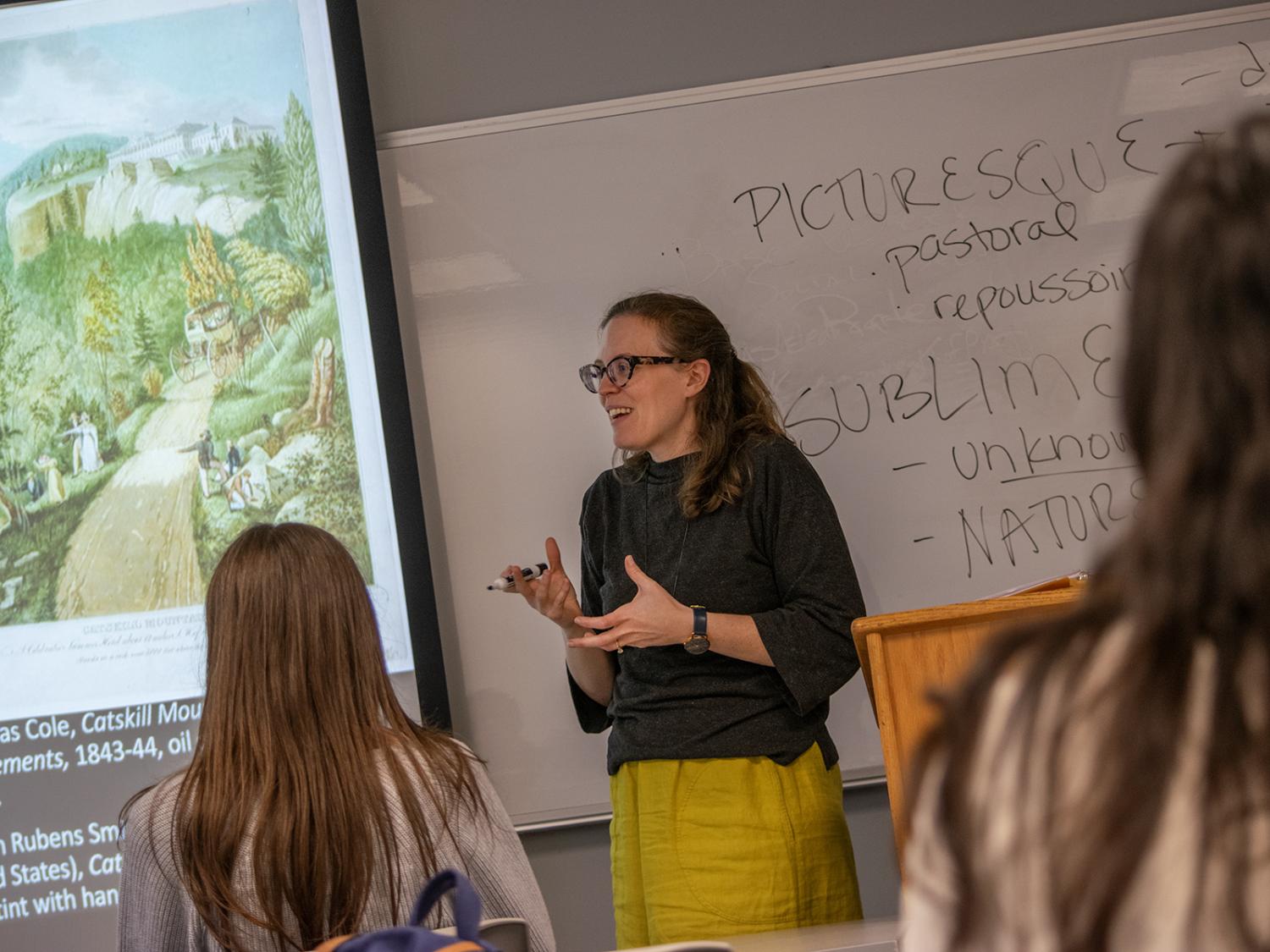

Last autumn, students at Penn State Harrisburg were shown images of a painting few of them would have come across before. Completed in 1850, the “Panorama of the Monumental Grandeur of the Mississippi Valley” stands 7.5 feet high and runs 348 feet in length. Unrolled scene by scene, it was an early attempt at an immersive visual experience, made possible by 3D scanning.
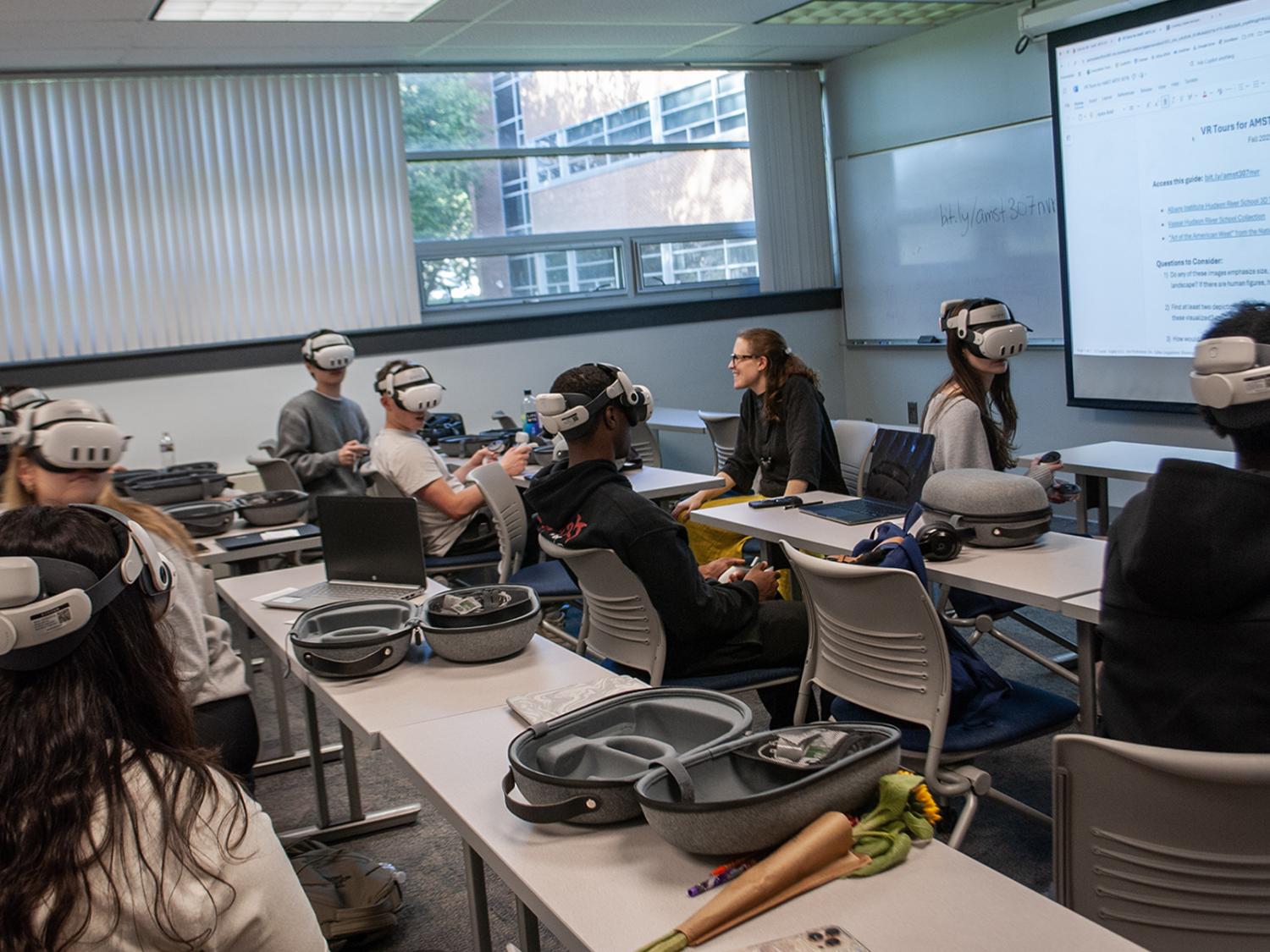
As part of the project, Mariah Kupfner, assistant professor of American studies and public heritage, had her students put on virtual reality headsets and tour two museums, walking through the galleries to view the artwork on display. Sarah Kettell, an educational applications developer at the campus’s Center for Teaching Excellence, showed the class how to use the equipment.
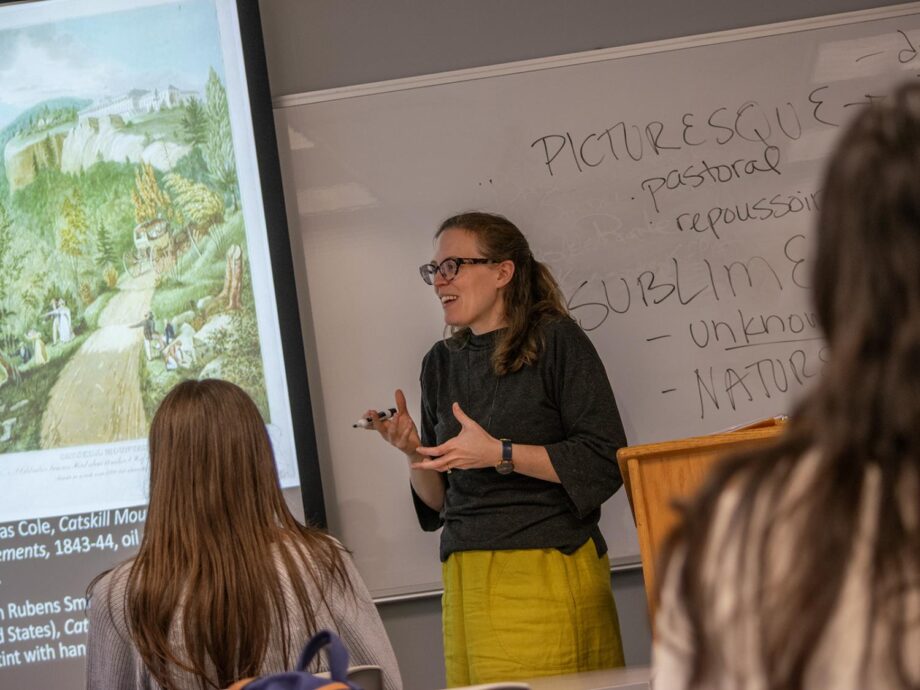
“As you’re walking through these virtually, I want you to think about the experience of people who saw the moving panorama,” Kupfner told them. “You can think about similarities and differences between that visual technology and this one. Both are trying to give people a sense of immersion in a space where they are not physically.”
In a follow-up discussion, one student admitted they’d never used VR before. Like the panorama’s first viewers, he said, he was encountering the technology for the first time, and for him it was probably a life-changing experience.
Kupfner agreed. “Yeah, the sense of being able to see something that you haven’t seen before, but also in a way you haven’t seen before,” she said. “That is in many ways, I think, more transformative.”
Bringing the past to life with VR
The Teaching and Learning with Technology (TLT) faculty partners with selected teachers on bringing a variety of digital tools into the classroom. Kupfner’s proposal centers on using virtual reality to get students thinking rigorously about virtual space and design thinking. She wants them to create digital content themselves, building critical thinking and digital fluency, and to learn how the way an object is presented in a digital space to convey history and meaning.
Her students range from those meeting general education requirements to graduate students in American studies, many specializing in museum studies. She first used VR in art history classes so students could visit galleries and see artworks from a remote location.
“I started thinking I should really be doing this in my museum studies classes too, and not just to visit places, but to think about how this digital space is set up,” she said.
That thinking shaped the final projects in her spring 2025 museum studies course, for which students designed virtual exhibitions. As well as the content, they were responsible for the environment around it: the lighting, the seating, the height at which objects were displayed and the fonts used on labels. Exhibition designers weigh up these factors every day, yet they are difficult to reproduce in a classroom.
“It’s one thing to think theoretically about the ways that lighting, seating, the height of artifacts, and fonts will work together with exhibition content and something completely different to actually build these things out in an environment and have the opportunity to experience them immersively,” Kupfner said.
Building immersion with 3D scanning
The fellowship put Kupfner in touch with technical specialists who helped work out how students could use each tool. It also came with funding, which paid for 3D scanners so students could digitize physical objects and import them into their virtual spaces.
Dan Getz, a TLT specialist at Penn State’s University Park campus, said the team had been experimenting with the technology for some time.
“Within Teaching and Learning with Technology, 3D scanning is something that we’ve been exploring for a while but with recent advancements and cost reductions in the technology, it’s allowed us to expand our efforts and find unique use cases for the technology like Mariah is currently working on,” he said.
TLT places a high priority on giving students across Pennsylvania access to equipment and training, he added, and portable scanners and mobile apps have now improved enough for students and staff to use them independently.
“Combining 3D scanning with the VR headsets is also something that brings a deeper level of engagement with the content that is very exciting. The ability to see an object in true 3D, as opposed to viewing a model on an internet browser or through your phone, makes for a much more unique and interesting viewing experience,” Getz said.
Fieldwork at Lincoln Cemetery
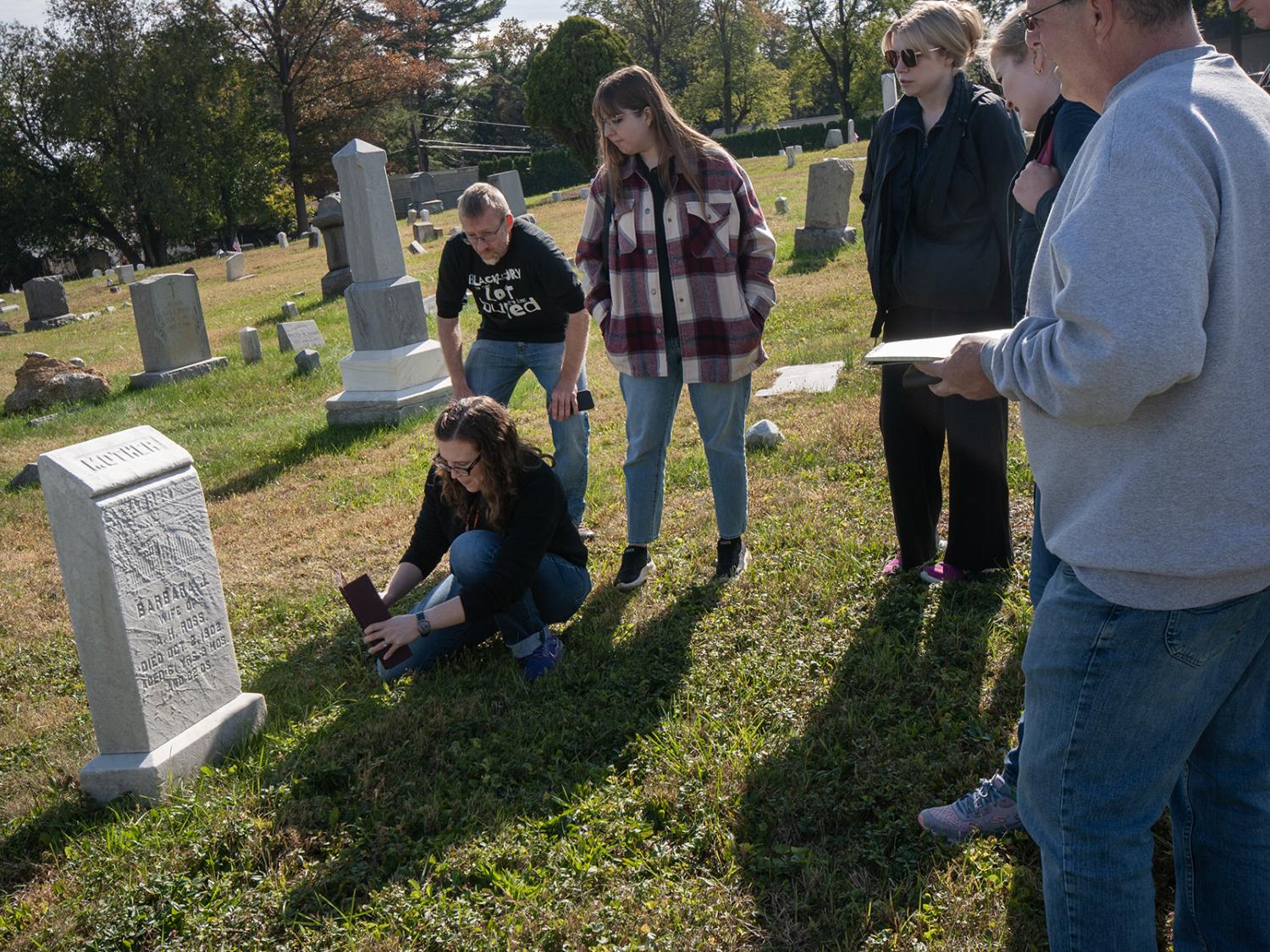
In late-2025, Kupfner took her public heritage practices class to Lincoln Cemetery, one of the oldest sites of its kind in Harrisburg, Pennsylvania. A non-profit organization, SavingOurAncestorsLegacy, is restoring the site and working to preserve the stories of the people buried there.
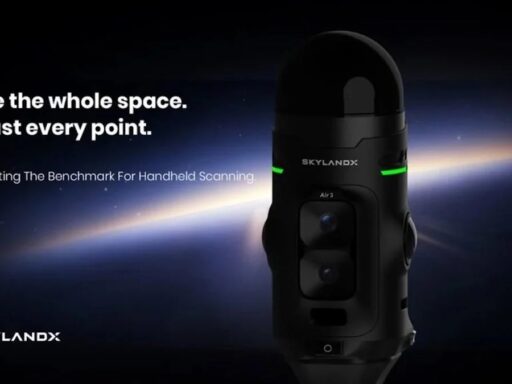
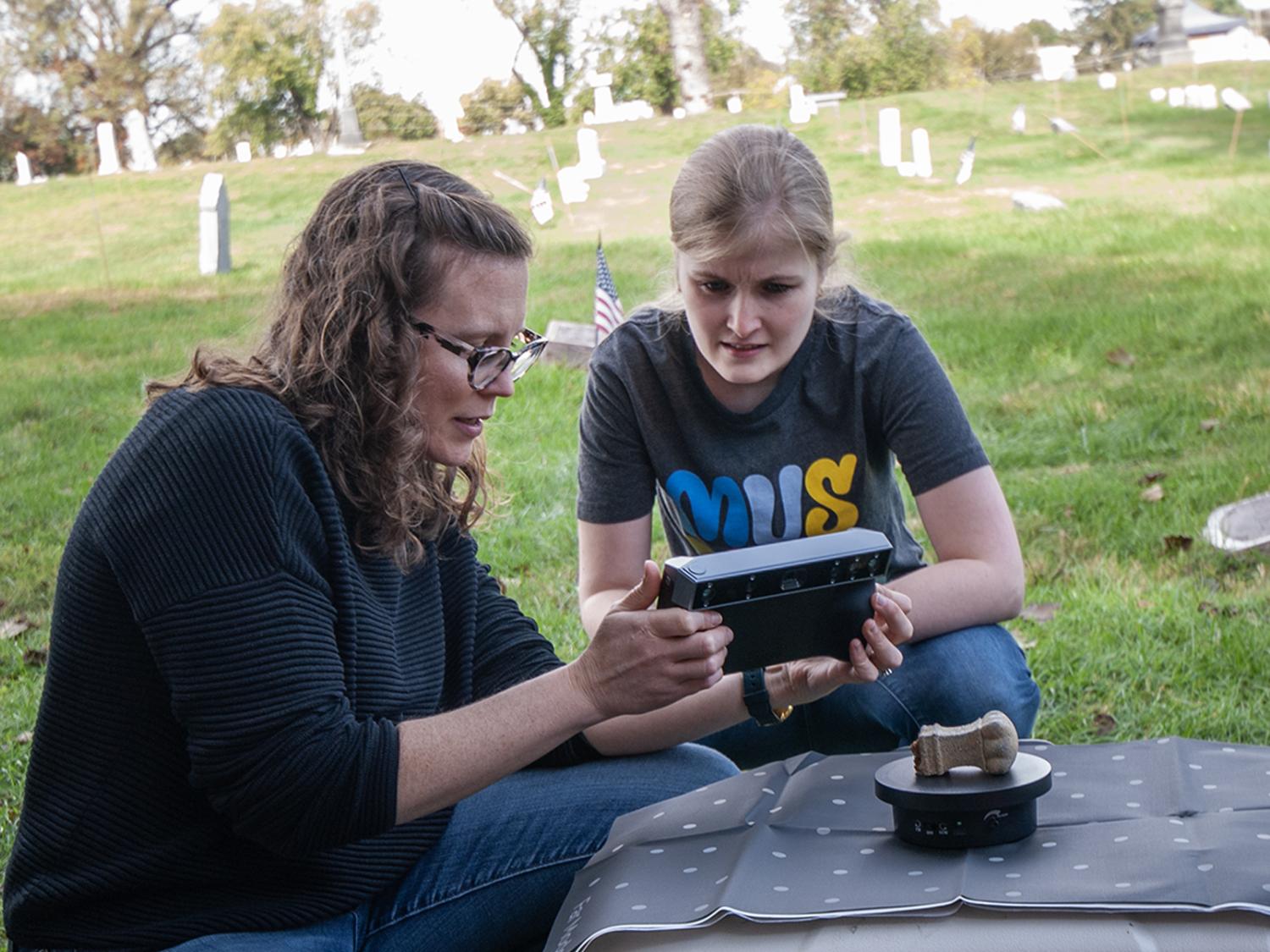
Using 3D scanning apps on phones and tablets, as well as a handheld 3D scanner, students recorded objects linked to their research projects, which covered subjects such as headstone design and the lives of those buried there.
Payton Becker, a doctoral student in American studies who is also completing a graduate certificate in heritage and museum practice, joined Kupfner to scan a set of coffin handles uncovered at the site. Together they tested different lighting conditions and set-ups to capture as much surface detail as possible.
“I think that 3D scanning can open up unique avenues of inquiry,” Becker said. “It also requires you to slow down and really look at the object you are scanning — to notice the details and how the different parts connect and work together. This ‘slow looking’ is really important to material culture methodology, which is what I specialize in, so it was nice to encounter an object in a different way (through the 3D scan) but apply a familiar method.”
The scans also meant she could return to the handles and study them again at a later date. Becker noted that this could be particularly useful for fragile objects, where handling needs to be kept to a minimum.
For Kupfner, the technology serves a wider purpose. She brings VR and digital tools into her teaching to make students more attentive to physical objects and places, and the cemetery visit showed how that works in practice. Students picked up on details they might otherwise have missed, such as the names of stonemasons carved into the headstones.
“I was impressed by the level of curiosity and care displayed by these students — and they made some remarkable scans that document and digitally preserve some of the material culture of this amazing site,” she said.
Kupfner credits the fellowship with bringing 3D scanners and VR headsets into many of her classes, and with giving her access to instructional designers and technical experts to help integrate them properly.
“I never want this work to feel gimmicky or tacked on,” she said. “Instead, I am interested in using technology in thoughtful — and even sometimes critical — ways to help us get closer to understanding, interpreting, and sharing history and our material world in rigorous, engaging, and accessible ways.”