
Summary
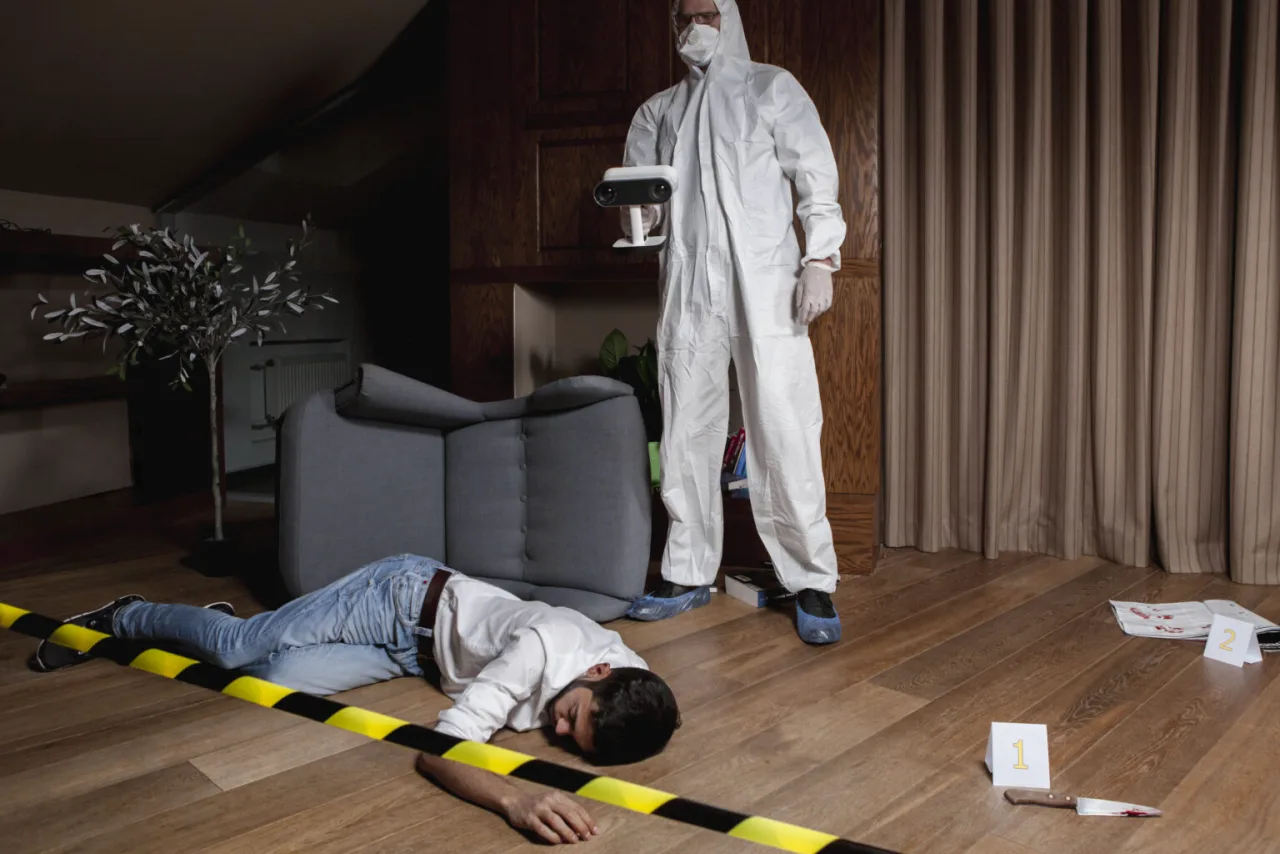
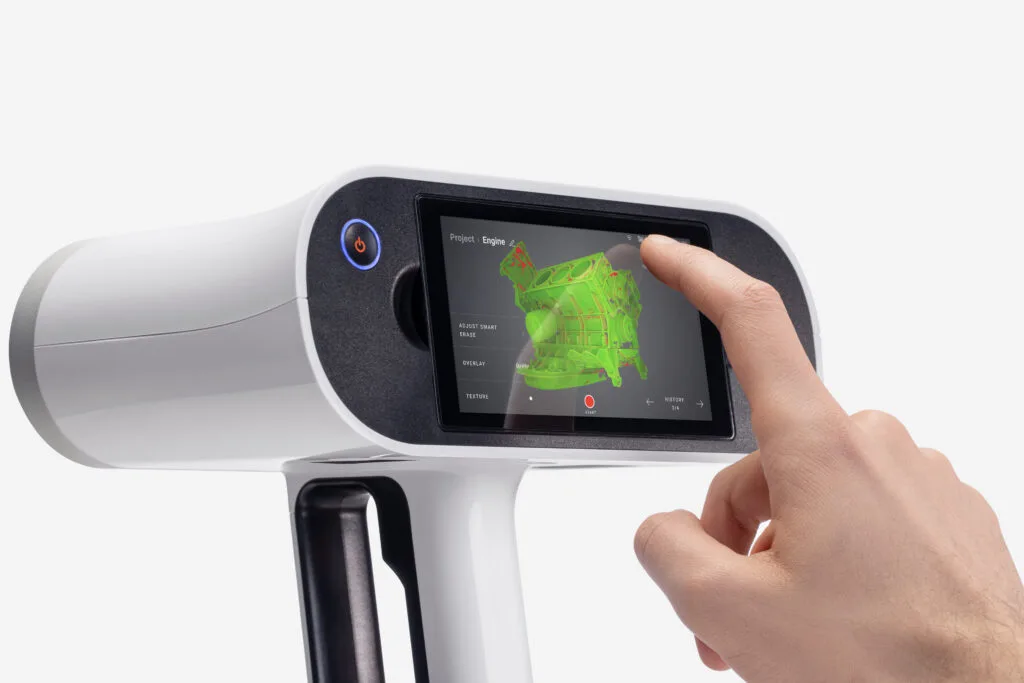
The Artec Leo forensic 3D scanner is a best-fit tool for close-range forensic documentation when the task is to capture localized evidence surfaces, small to medium objects, and other near-field geometry with a handheld structured-light device. Artec lists manufacturer-stated, device-level specifications of up to 0.1 mm 3D point accuracy, up to 0.2 mm 3D resolution, and a 0.35-1.2 m working distance, which places Leo in a close-range capture envelope rather than a full-scene mapping role. [S1]
Whether Leo is the right choice depends on work volume, point density, triangulation angle, target geometry, and surface characteristics. NIST notes that structured-light performance is configuration- and surface-dependent, so published specifications are a starting point, not a guarantee for every forensic scene or evidence type. Agencies should validate Leo against their own evidence classes, operators, software versions, and reporting needs before relying on measurements in casework. [S14]
Background (brief): Why modern forensic documentation is increasingly multi-scale
Crime scene documentation is often a multi-scale problem. A room, roadway, vehicle, or outdoor scene may require broad geometry for context, but also close-detail capture of impressions, edges, contact marks, deformation, or localized damage. One device can be well matched to one scale and poorly matched to another, which is why teams often separate scene-control capture from evidence-detail capture in both crime scene work and accident reconstruction. Foundational guidance likewise emphasizes preserving context, evidence integrity, transparency, and scientifically reliable decision-making rather than assuming one instrument covers every task. [S12] [S15]
A peer-reviewed hierarchical scanning example in the Journal of Forensic Sciences illustrates the point. The authors used three scanners with spatial resolutions of 2.0 mm, 0.3 mm, and 0.05 mm to document different levels of detail from the same scene context. Those exact values are not universal requirements, but they support the broader point that whole-scene geometry and close evidentiary detail often belong to different measurement regimes. That is the practical reason to discuss Leo alongside scene-scale tools such as Ray II, rather than treating handheld capture as a universal substitute. [S17]
Core terms and measurement language used in this article
A structured-light scanner projects a known pattern and measures how that pattern deforms to reconstruct surface geometry. A terrestrial laser scanner, often discussed as TLS or LiDAR in field practice, measures distance with laser ranging instead of projected light patterns. A point cloud is the raw set of measured 3D points, a mesh is the connected surface model created from those data, and registration is the process of aligning multiple scans into a common coordinate system. Those distinctions matter because acquisition, alignment, and post-processing are separate steps in a forensic 3D workflow.
Accuracy is closeness to a true or reference value, while precision describes how tightly repeated results cluster. ISO 5725-1:2023 frames the topic in terms of trueness and precision, rather than treating accuracy as simple repeatability. Resolution is the level of detail a system can represent, but it is not the same as accuracy. A scanner can therefore produce fine-looking detail and still require careful setup and validation before its measurements are trusted. [S11]
How Artec Leo captures data (structured light / triangulation): Why that matters in the field
Leo is a portable structured-light scanner that reconstructs shape by projecting light, observing the surface response, and solving geometry by triangulation. In field use, working distance, field of view, line of sight, and surface behavior directly affect what can be documented. Artec lists a 0.35-1.2 m working distance, with a linear field of view of 244 × 142 mm at the closest range and 838 × 488 mm at the furthest range, plus an angular field of view of 38.5 × 23°. Those figures help with pass planning because they show how much surface is visible at once and how easily recesses, sharp transitions, and hidden faces can be missed. Glossy, dark, wet, or visually complex surfaces can also complicate capture because the scanner depends on what it can see and how the projected pattern behaves on the target. [S1]
NIST’s structured-light error work is especially relevant because performance depends on sensor configuration, projected patterns, sensor or work volumes, point densities, triangulation angles, target size and form, and the characteristics of the objects being measured. No single vendor number should therefore stand in for all real forensic scenes. [S14]
Structured light vs photogrammetry
Photogrammetry can also support forensic documentation, but its 3D result is image-derived and depends heavily on overlap, camera geometry, texture, and scale control. Structured light is less dependent on natural surface texture and more dependent on line of sight, surface response to projected patterns, and staying within the intended capture envelope. In practice, Leo is usually better matched to measurable local geometry, while photogrammetry often serves as a complement or backup when image-rich documentation is already being collected. [S9]
Leo specs that matter in forensic work (and what they do not mean)
For Leo, the most important numbers are the ones that define device capability, but they need careful framing. Artec states manufacturer-stated values of up to 0.1 mm 3D point accuracy and up to 0.2 mm 3D resolution, plus an accuracy-over-distance figure of up to 0.1 mm + 0.3 mm/m. These are not interchangeable metrics. Resolution is not the same as accuracy, and the distance-qualified figure is not a blanket statement of whole-project error. Together with the 0.35-1.2 m working distance, the specifications show that Leo is designed for close-range geometry, not that every registered scene model will inherit those values automatically. [S1]
Other published figures matter for workflow planning, but they also need interpretation. Leo’s capture modes differ: real-time fusion is listed at up to 22 fps, 3D video recording at up to 44 fps, and 3D video streaming at up to 80 fps. Artec also lists data acquisition speed at up to 35 million points per second, 3D and 2D exposure times of 0.0002 s, internal storage of 512 GB SSD, dimensions of 231 × 162 × 230 mm, and weight of 2.6 kg / 5.7 lb. Scanning does not require a computer, but processing does. Artec lists Windows 8.1, 10 (x64), or 11 for data processing, with recommended hardware of an Intel Core i7 or i9, 64+ GB RAM, and an NVIDIA GPU with 8+ GB VRAM. Leo also exports OBJ, PLY, WRL, STL, AOP, ASC, PTEX, E57, XYZRGB, STEP, IGES, X_T, CSV, DXF, and XML. [S1]
A registered multi-scan project can accumulate additional uncertainty from alignment, fusion, meshing, decimation, and other processing choices, so manufacturer-stated device specs should not be presented as project-level uncertainty or courtroom measurement uncertainty without validation. Format support is also not a substitute for checking what survived export, import, and review in the downstream toolchain. [S1] [S8]
Metrics to interpret carefully
- 3D point accuracy: a manufacturer-stated, device-level specification, not a scene-wide error guarantee. [S1]
- 3D resolution: a detail-representation specification, not the same as accuracy. [S1]
- Accuracy over distance: a distance-qualified vendor metric, not volumetric scene accuracy. [S1]
- Capture rates (22 / 44 / 80 fps): mode-dependent figures that should not be collapsed into a single “80 fps scanning” claim. [S1]
- Points per second: acquisition throughput, not final mesh fidelity. [S1]
- Exposure time: one capture parameter, not a guarantee of blur-free or artifact-free performance on every surface. [S1]
- Portability and onboard storage: logistics advantages, not evidence-validity claims. [S1]
Field workflow with Leo: From scene entry to export-ready deliverables
A defensible handheld-scanning workflow begins before the scanner is turned on. Conventional scene notes, photographs, safety controls, and evidence handling still matter because 3D capture supplements documentation rather than replacing it. Leo’s standalone design is useful in the field because scanning does not require a tethered computer, but the back-office part of the workflow remains significant. Artec lists Windows 8.1, 10 (x64), or 11 for processing, with recommended workstation-class hardware. In forensic practice, field convenience and office processing burden should be evaluated together. [S1]
On-scene to deliverables (10 steps)
- Confirm scene safety, access controls, and conventional documentation requirements before scanning begins.
- Define the capture objective and set a scale or reference plan for the evidence area.
- Check scanner status, power, storage, and relevant settings per agency SOP.
- Plan the scan path around line-of-sight limits, occlusions, and the evidence geometry.
- Capture the evidence area and perform on-device QA for coverage, overlap, and obvious tracking problems.
- Use HD recording selectively for key items or surfaces where the extra data burden is justified. [S2]
- Transfer the dataset and create an immediate backup before extended processing begins.
- Process the scans in Artec Studio or the approved agency workflow, documenting settings and steps used. [S1]
- Export the deliverable appropriate to the use case, such as E57, OBJ, PLY, STL, CSV, DXF, or XML. [S1]
- Archive the raw and derived outputs with chain-of-custody and processing-history documentation.
HD mode is a practical tradeoff, not a universal “max it out” setting. Artec’s documentation explains that HD frames are large, that higher HD frequency increases project size, slows scanning, and lengthens import and reconstruction time, and that a recommended value is 1/8. The same documentation also states that storage encryption is disabled by default, and that enabling or disabling storage encryption requires formatting Leo’s storage, which destroys stored data. The manual confirms the same default-disabled status. Those are device-security controls, not evidence-management substitutes. [S2] [S3]
Leo’s broad export support helps with downstream review, but interoperability still has to be tested in the actual toolchain. ASTM E2807 describes E57 as a format that can store 3D point data, related attributes such as color and intensity, and 2D imagery in SI units. After E57 export/import, verify units, color, registration state, and metadata retention in your actual software stack. That check matters more than the file extension alone. [S1] [S8]
When Leo is enough: When you need Ray II or other scene-control tools
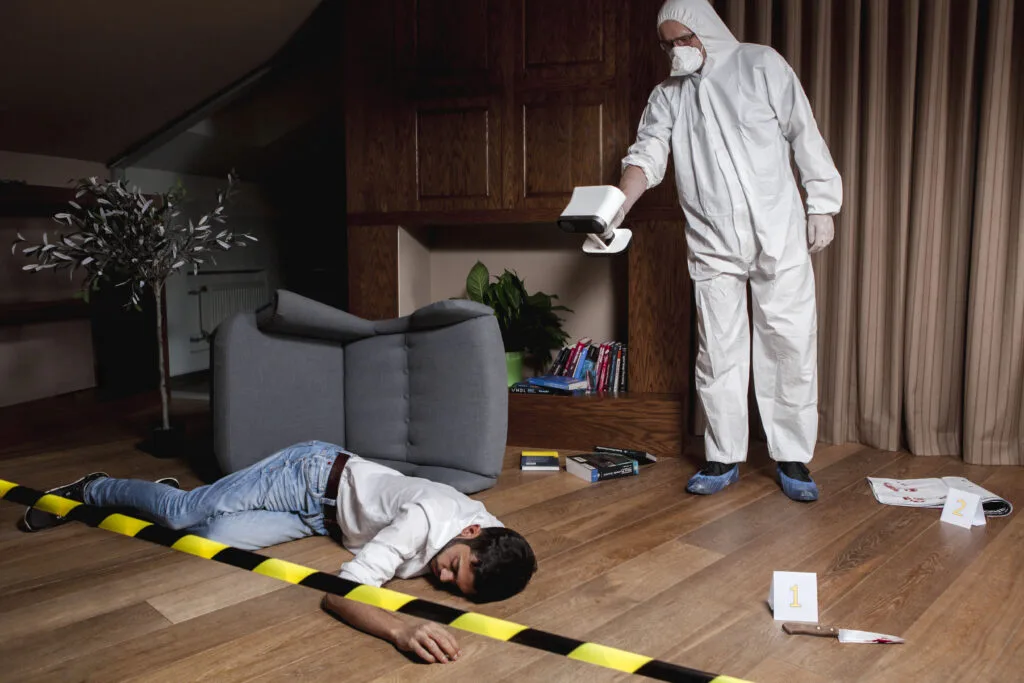
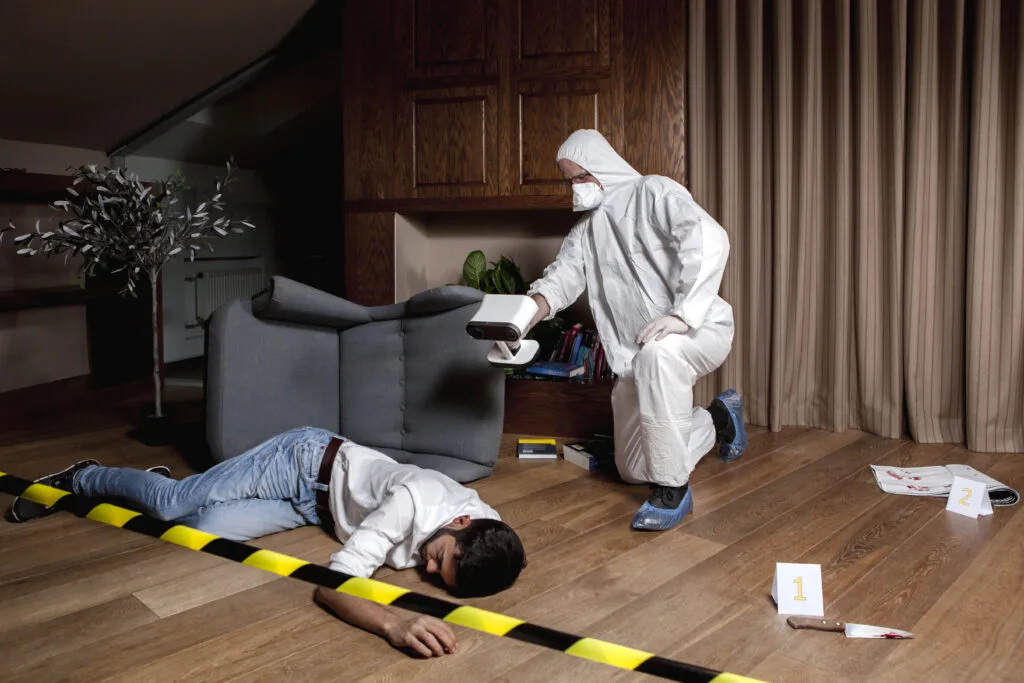
Leo is enough when the forensic question is localized: a footwear impression area, a tool-contact region, a bullet impact zone, a vehicle interior detail, a damaged component, or another evidence item that fits inside Leo’s close-range working envelope. In those cases, handheld structured-light capture can provide dense local geometry without bringing in scene-scale hardware. [S1]
The decision changes when the goal is broad scene geometry, longer standoff distances, or reconstruction-grade spatial control. Artec positions Ray II for full scenes and large objects, while Leo is described as the handheld complement for specific areas and angles. Ray II covers 0.5-130 m and uses a different measurement class, with manufacturer-stated point accuracy of 1.9 mm at 10 m, 2.9 mm at 20 m, and 5.3 mm at 40 m. Artec also lists up to 2 million points per second and a full-dome scan time at 3 mm resolution of 1 min 42 sec without texture or 2 min 42 sec with texture. Those numbers are not directly comparable to Leo’s close-range structured-light specs because the devices operate at different scales and with different ranging physics. Reconstruction-grade scene control may also rely on total stations, GNSS, and/or drone photogrammetry, depending on SOP and scene scale. For justice-system-facing TLS process context, the OJP guideline is a useful independent reference, but it remains TLS-focused rather than a handheld standard. [S4] [S15]
Leo vs Ray II vs photogrammetry
This comparison is about role, operating principle, and failure modes, not about naming a universal winner.
| Tool / method | Measurement principle & typical scale | Best-fit forensic role | Key limitations / failure modes |
|---|---|---|---|
| Artec Leo | Structured light / triangulation; close-range handheld capture with a 0.35-1.2 m working distance. [S1] | Local evidence, small to medium objects, close-detail surfaces, and near-field color capture. [S1] | Sensitive to surface behavior and occlusion; project uncertainty depends on registration and processing choices. [S1] [S14] |
| Artec Ray II | TLS / LiDAR; time of flight enhanced by Waveform Digitising (WFD), with a 0.5-130 m range. [S5] [S4] | Whole-scene geometry, large objects, larger rooms, roadways, and broad spatial context. [S4] | Lower local detail than close-range handheld capture; line-of-sight limits, reflective or absorptive surfaces, and scan planning still matter. [S4] [S15] |
| Photogrammetry | Image-derived 3D; workflow- and scale-control-dependent. [S9] | Texture-rich documentation, complementary scene capture, and some trace workflows when acquisition is well controlled. [S9] | Requires scale control, overlap, lighting discipline, and sufficient feature richness; repeatability must be checked locally. [S9] [S18] |
These are different measurement regimes and should not be reduced to one headline number. Leo is the close-range tool, Ray II is the scene-scale tool, and photogrammetry is often a complement rather than an automatic replacement. A useful controlled example comes from footwear-impression work, where one peer-reviewed study summary reported 97% repeatability with less than about 0.5 mm variation between models in many substrates. That does not generalize to every scene, but it does show that image-based methods can be highly repeatable when scale control and acquisition discipline are strong. [S18]
Validation & defensibility: Turning vendor specs into agency-acceptable measurement practice
Validation is the step that connects a manufacturer’s spec sheet to actual casework. For a forensic documentation scanner, that means testing how performance changes with evidence-like surfaces, operator choices, lighting, geometry, and software settings, then documenting acceptance criteria before field deployment. NIST’s structured-light paper supports that approach because it emphasizes that performance depends on scanner configuration and object characteristics, not just published headline numbers. [S14]
A useful comparison point comes from NIST IR 8583, which reports on a TLS-focused Measurement Week held at NIST from May 12-16, 2025. The event involved five law-enforcement agencies and four TLS manufacturers, and the interim performance assessment design used 20 targets measured from four TLS positions with 24 inter-target distances in the accuracy portion of the test. That is not a handheld certification scheme for Leo, but it is a good example of separating accuracy from precision and structuring validation around known targets, repeatable geometry, and documented procedures. Vendor training exists, including Artec Academy’s forensic course listing of 1 h 54 min with a displayed last-update stamp of 03/06/2024, but vendor training is not independent validation. [S13] [S7]
Agency validation minimums (example)
- Use known artifacts or reference objects and scale bars that reflect the kinds of evidence actually documented.
- Perform repeat scans by the same operator and by multiple operators to separate precision from workflow variation.
- Include challenge surfaces such as dark, glossy, wet, or low-texture materials if they appear in casework.
- Record software version, firmware version, HD frequency, processing settings, and export choices. [S2]
- Define acceptance criteria in the SOP before deployment, and document deviations or mitigations.
- Track training and competency, but do not treat vendor instruction as a substitute for validation. [S7]
Limits, risks, and controls (court-facing language)
Leo’s published numbers are manufacturer-stated “up to” figures, and the real-world result still depends on capture geometry, surface behavior, and scene conditions. Reflective, dark, transparent, wet, or partly hidden surfaces can reduce data quality or force additional passes. NIST’s structured-light work is useful here because it shows that a structured-light system can behave differently as configuration, target form, and object characteristics change. A close-range scanner should therefore be described as validated for a defined use, not as universally accurate in every environment. [S14]
Registration adds another layer of uncertainty because each aligned scan can contribute small positional differences to the final project. Meshing, decimation, smoothing, hole filling, and other processing steps can also change derived dimensions or visual appearance. For reporting purposes, authors should state whether measurements were taken from the point cloud or from a mesh and explain why that output was used. That kind of transparency matters more than repeating a device headline spec after the project has already gone through multiple post-processing stages.
On Leo, storage encryption is disabled by default, and changing that status requires formatting the storage. That makes encryption a device-security feature, not a chain-of-custody system. Court-facing defensibility comes from documented workflow, version control, reproducible processing, and clear disclosure of what was done to the data between capture and presentation. [S2] [S3]
ISO caveat
ISO 10360-13:2021 applies to optical 3D coordinate measuring systems when surface characteristics such as glossiness and colour are restricted and within a cooperative range. It can inform QA thinking, acceptance testing, and reverification logic, but it does not certify uncontrolled crime-scene conditions or prove that a particular handheld scan will behave the same way on messy, dark, glossy, wet, or occluded evidence. [S10]
Standards & interoperability (practical, not encyclopedic)
The standards stack is most useful when each document stays in its lane. ANSI/ASB Standard 159, First Edition, 2024, provides foundational scene-investigation and reconstruction principles. ASTM E2807 defines the E57 file format as a way to store 3D point data, associated attributes such as color or intensity, and 2D imagery in SI units. ASTM E3452-26 is the current ASTM guide for forensic photogrammetry. ISO 10360-13:2021 addresses acceptance and reverification tests for optical 3D coordinate measuring systems under cooperative-surface conditions. NIST IR 8583 is a September 2025 report on a TLS interim performance assessment process, which makes it useful as a QA model even though it is not a handheld-scanner standard. [S12] [S8] [S9] [S10] [S13]
In practical workflow terms, those documents help define what should be checked and recorded after capture: units, attributes, registration state, metadata retention, software version, firmware version, and post-processing history. They support validation, interoperability, and transparency, but none of them certifies Leo for every forensic use case by itself. Agencies still have to verify how E57, meshes, and derived outputs behave in their own review, archive, and testimony pipeline. [S8] [S10]
Market context (short) + procurement questions
The broader 3D scanner for forensics landscape includes handheld structured-light systems, scene-scale TLS or LiDAR devices, and image-based photogrammetry workflows. NIJ’s landscape study, initially reported in January 2016 and updated in August 2018, is still useful as a reminder that agencies should compare devices by use case, workflow, and operational burden rather than by marketing language alone. Secondary industry coverage reflects that broader market, but it is context, not validation. [S16] [S19]
For procurement, the practical question is whether the device fits the agency’s evidence types, scene scales, QA expectations, and downstream software environment.
Questions to ask before buying for forensic use
- What scene sizes and evidence classes will the scanner actually be used on?
- What validation artifacts, surfaces, and repeatability tests will we run, and how often?
- How will we document project processing history, software versions, and export settings?
- What is our export and import pathway for E57, mesh, and measurement outputs, and what metadata must survive?
- What surfaces, lighting conditions, weather, or access constraints are typical in our cases?
- What other instruments, such as TLS, total station, GNSS, or drone photogrammetry, already exist in SOP?
Conclusion: When to choose Artec Leo
The Artec Leo forensic 3D scanner is well suited to close-range evidence capture when the job is local detail, handheld access, and near-field geometry rather than whole-scene mapping. Its role is grounded in a 0.35-1.2 m working distance and manufacturer-stated device specs of up to 0.1 mm point accuracy and up to 0.2 mm resolution. [S1]
For wider environments, the decision changes. Pair with Ray II or another TLS for scene geometry; use Leo for close detail and occluded areas. Artec positions Ray II for full scenes and large objects, with a 0.5-130 m range, so the two tools occupy different roles rather than serving as direct substitutes. In accident reconstruction and other larger-scene workflows, total stations, GNSS, and/or drone photogrammetry may still be required depending on SOP and scene scale. The neutral takeaway is simple: use Leo where the forensic problem is close-range detail, and add scene-control tools when the measurement problem becomes spatially larger than Leo’s operating envelope. [S4] [S15]
FAQ
Is the Artec Leo forensic 3D scanner accurate enough for evidence documentation?
It can be, if the workflow is validated for the evidence type and scene conditions. Artec lists manufacturer-stated specifications of up to 0.1 mm 3D point accuracy and up to 0.2 mm 3D resolution, but those are device-level figures, not guaranteed project-wide uncertainty values. Leo also lists accuracy over distance as up to 0.1 mm + 0.3 mm/m, which means setup and stand-off matter. Forensic use therefore depends on validation, repeatability checks, and transparent reporting, not on the spec sheet alone. [S1] [S14]
What does Leo’s accuracy-over-distance figure actually mean for vehicles or larger areas?
It is a distance-qualified vendor metric, not a promise that a large vehicle or multi-pass project will stay within one simple global error figure. Leo’s published value is up to 0.1 mm + 0.3 mm/m, and the scanner is designed to work in a 0.35-1.2 m envelope. Once a project involves multiple passes, alignment steps, and processed surfaces, uncertainty can accumulate beyond the raw device spec, so larger areas need workflow-specific validation and careful reporting. [S1]
Can Artec Leo replace TLS or LiDAR for full-scene crime scene 3D scanning?
Usually not. Leo is a close-range structured-light scanner, while Ray II is a scene-scale TLS or LiDAR device that Artec rates for 0.5-130 m capture and positions for full scenes and large objects. That difference is not just about convenience; it reflects different measurement physics, different stand-off distances, and different spatial roles. For full-scene work, Leo is better viewed as a complement for close detail than as a universal replacement for scene-scale capture. [S4] [S5]
Expert: How should an agency validate a handheld structured-light scanner workflow before using measurements in casework?
Start with evidence-like artifacts and challenge surfaces, then separate repeatability from accuracy. NIST’s structured-light work supports local-condition validation because performance depends on configuration and surface behavior. A useful QA mindset also comes from NIST IR 8583, even though it is TLS-focused. The report describes a structured test design using 20 targets, four positions, and 24 inter-target distances to keep accuracy and precision conceptually distinct. Agencies should adapt that logic to handheld casework, not copy TLS procedures blindly. [S14] [S13]
Expert: Does E57 export guarantee interoperability and auditability across forensic software?
No. ASTM E2807 describes E57 as a format that can store 3D point data, associated attributes such as color and intensity, and 2D imagery in SI units, which is why it is widely used for exchange. But a successful export is not the same as successful forensic transfer. Agencies still need to verify units, color, registration state, metadata retention, and processing history after import into the receiving software. Auditability comes from that verification trail, not from the extension alone. [S8] [S1]
How does forensic photogrammetry compare with structured light for trace evidence such as impressions?
Photogrammetry has its own forensic guidance in ASTM E3452-26, and it can perform well when scale control, overlap, and acquisition discipline are strong. It is often best treated as a complement or backup rather than a direct substitute for close-range structured-light scanning. In a controlled footwear-impression example summarized through a university record of a peer-reviewed paper, the authors reported 97% repeatability with less than about 0.5 mm variation between models in many substrates. That is encouraging, but it is still context-specific. [S9] [S18]
Should measurements be taken from the point cloud or the mesh?
State which one you used, because they are not interchangeable outputs. A point cloud is closer to the sampled measurement data, while a mesh is a processed surface model that may be influenced by fusion, smoothing, simplification, hole filling, and other settings. In reporting, the important part is to document the measurement domain, the software version, and the processing steps that affected the result. That is more defensible than treating every derived 3D output as equivalent. [S1] [S13]
Related on 3D Mag
- Artec Leo: the best 3D scanner for cultural heritage
- Artec Leo: the best 3D scanner for automotive
- Artec Leo Preview: Video, Sample Scan, Specs, Price & Release Date
Sources
- S1 — Artec Leo product page
- S2 — Artec Leo documentation: Settings
- S3 — Artec Leo Advanced User Manual 1.8
- S4 — Artec Ray II product page
- S5 — Artec Ray II brochure PDF
- S6 — Artec forensics solutions page
- S7 — Artec Academy forensic course page
- S8 — ASTM E2807 listing
- S9 — ASTM E3452 listing
- S10 — ISO 10360-13:2021 listing
- S11 — ISO 5725-1:2023 listing
- S12 — ANSI/ASB Standard 159 page
- S13 — NIST IR 8583
- S14 — NIST: Sources of Errors in Structured Light 3D Scanners
- S15 — OJP Guidelines for the Use of Terrestrial LiDAR Scanners in Criminal Justice
- S16 — NIJ landscape study
- S17 — J Forensic Sciences hierarchical multi-resolution scanning paper (PubMed listing)
- S18 — Photogrammetry reliability for footwear impressions paper summary
- S19 — All3DP Pro law-enforcement scanners article