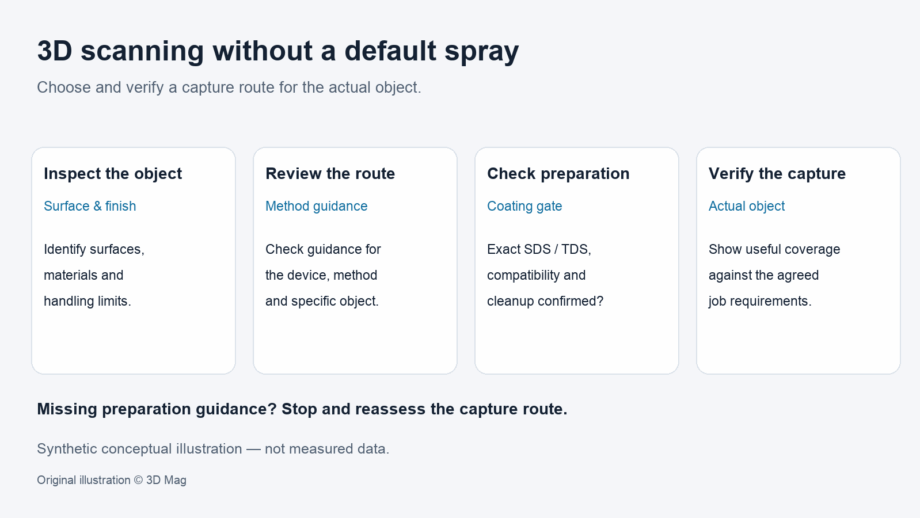
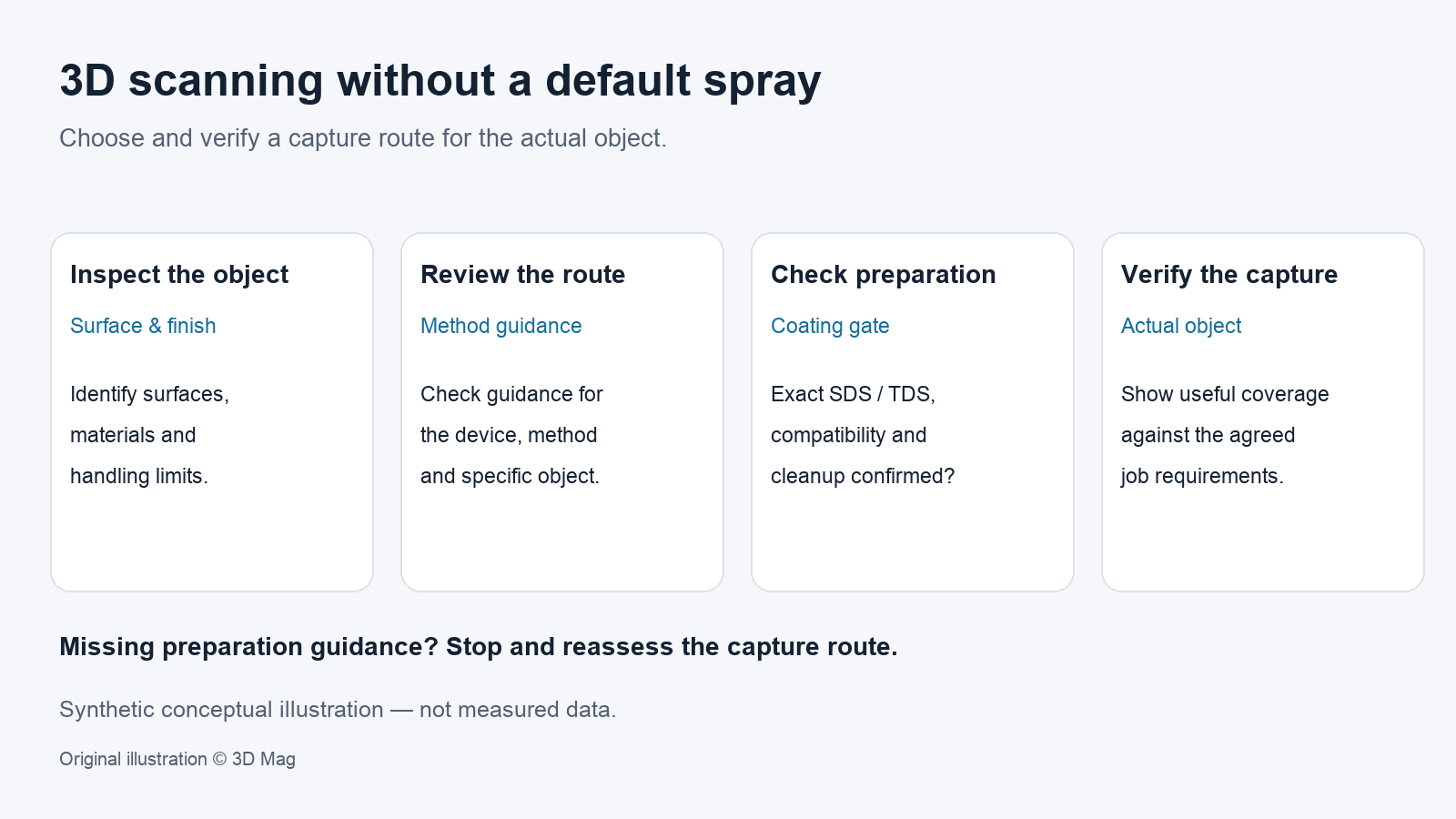

No single product or technique replaces scanning spray for every surface. Start by identifying the surface and the scanner. Then, on the actual object, try the non-coating adjustments your scanner’s manufacturer lists. Artec’s guidance, for example, lists sensitivity, angle and distance (Artec support). Check the result against the job’s requirements. Consider a coating only after you have the exact product’s current documents and the material owner’s approval. If either is missing, stop instead of improvising.
Why some materials and finishes defeat optical capture
Artec explains that a structured-light scanner projects a structured light pattern onto the object’s surface, captures the reflection and evaluates the pattern deviation to calculate the shape (Artec support).
The same Artec article, dated 2020-03-19, says optical scanners can find some surfaces challenging. These include dark (black), reflective, transparent and translucent materials, and surfaces without a solid structure, such as fur and hair.
Artec’s examples are summarised below (Artec support):
| Surface type | What happens to the light | Typical examples |
|---|---|---|
| Black-coloured | Absorbs some of the structured light pattern | Potentially any black material |
| Reflective | Reflects too much | Mirrors, metals, galvanized and polished surfaces |
| Transparent | Passes the light through | Glass, ice, water and other liquids |
| Translucent | Diffuses the light | Candle wax, some types of stone |
| Red (Artec Spider and Micro only) | Does not work best with the blue LED 3D Flash | Some types of red surfaces |
| No solid structure | Difficult for optical capture | Fur, hair |
Artec notes that the list is not exclusive. A surface can fit several categories at once, such as black polished leather shoes, which are both black and reflective (Artec support).
A difficult finish is only one possible cause of poor capture. It does not rule out problems with the scanner, its settings or the scanning technique, so diagnose the actual setup.
What measurement integrity requires before choosing a route
Define acceptance in project terms before you try anything: which areas must be covered, what detail must be resolved and what dimensional tolerance applies. A vendor’s resolution figure is not metrological accuracy, and neither tells you whether a particular object will meet your tolerance.
A coating brings its own variable. AESUB describes its White spray as applying a “homogeneous, thin matting layer onto the surface of the object” (AESUB). The retained source gives no thickness value, so you must assess the layer’s effect against your tolerance.
Preparation-free trial on the actual object
Artec lists increasing the scanner’s sensitivity as one option. On Artec Eva, sensitivity is adjusted automatically. On Artec Spider/Space Spider, you set it with a slider in the “Advanced” settings of the main scan panel (Artec support). This historical guidance names specific models. Check whether it applies to your current scanner and software.
Artec also advises adjusting the scanning angle and distance. It states that certain surfaces can be “seen” by the scanner from a specific angle and distance, and that depending on the object’s size and shape you might be able to scan it this way (Artec support).
The following is a proposed validation workflow, not a test we carried out:
- Record the scanner model, software version, settings, angle, distance and lighting.
- Scan the actual object, or an approved area of it, without any preparation.
- Inspect the difficult regions for coverage gaps and noise.
- If a reference measurement or tolerance exists, compare against it and repeat the scan to check consistency.
- Accept preparation-free capture only if the documented result meets your acceptance criteria.
If a coating is considered: self-vanishing versus permanent
Artec lists using “a scanning spray or another suitable coating for the surface” as one option (Artec support). The guidance does not define “suitable”. That definition has to come from the product’s documents and the material owner.
AESUB describes AESUB Blue as a self-vanishing spray that “evaporates within a few hours, meaning that there is no need for cleaning after scanning”. It also states that Blue contains no pigments, which it says avoids pigment contamination of sensitive areas. The page gives no temperature or airflow conditions for that timing.
In contrast, AESUB describes AESUB White as a permanent scanning spray. It states that coated parts need to be cleaned or disposed of after scanning.
These are manufacturer claims about two categories of coating, not recommendations for your object. Neither establishes residue-free behaviour or compatibility with a particular material.
Health, compatibility and cleanup gate: stop if documents are missing
AESUB’s download page provides Safety Data Sheets and Technical Data Sheets, which you select per product. This article did not retain the current documents for any specific product and region. It therefore gives no hazard, ventilation, PPE, application or disposal guidance for any coating.
Before any coating is used, confirm every item below:
- The exact product and the region where it will be used.
- The current SDS and TDS for that product and region.
- Written compatibility approval from the material owner or the object’s manufacturer.
- A named authority for cleanup and disposal.
If any item is missing, the chemical route stops here. Do not substitute household products.
Decision table: three outcomes
| Outcome | Condition | Next step |
|---|---|---|
| Preparation-free capture | Demonstrated on the actual object and meets the acceptance criteria | Document the settings and the evidence |
| Approved coating | Every item in the gate is satisfied | Follow only the current product documents and the owner’s approval |
| Neither | No demonstration, or the gate is incomplete | Refer to a specialist or consider an alternative measurement method |
Reader questions
Can I scan shiny or black parts without spray? Sometimes, but nothing guarantees it. Only a documented trial on the actual object, against your requirements, can show whether non-coating adjustments are enough.
Are vanishing sprays residue-free on every material? The sources used here do not establish that. Compatibility must come from the current product documents and the material owner.
Can I use a household product instead? This article gives no household-chemical instructions. Without a current SDS/TDS and material approval, stop and consult a specialist.
Does a coating affect measurement? Any added layer is a variable to assess against your tolerance; the sources used here give no thickness value.
Related reading: how to use 3D scanning spray and how to choose a 3D scanning spray.
Sources
This explainer is based on cited published sources; 3D Mag did not conduct hands-on testing. Publisher sponsorship.