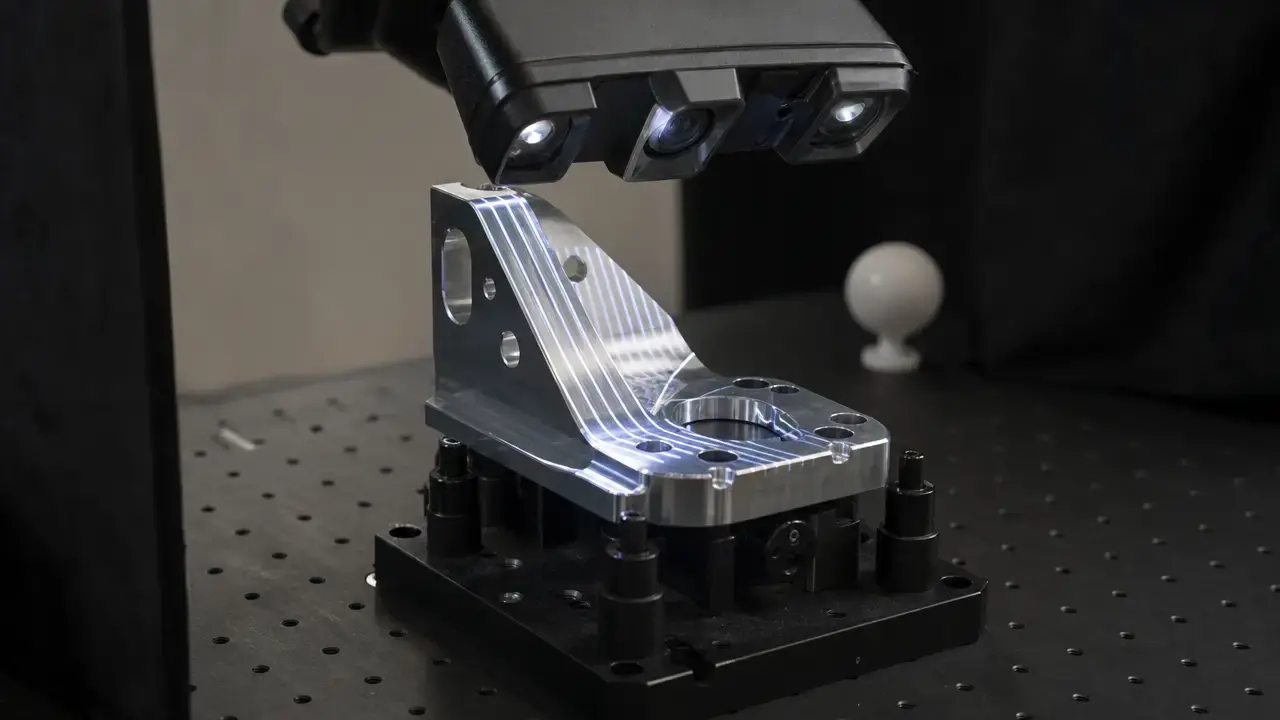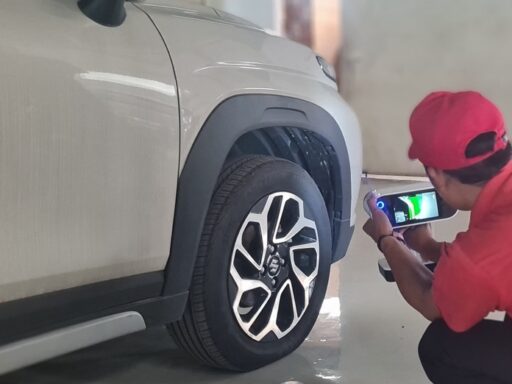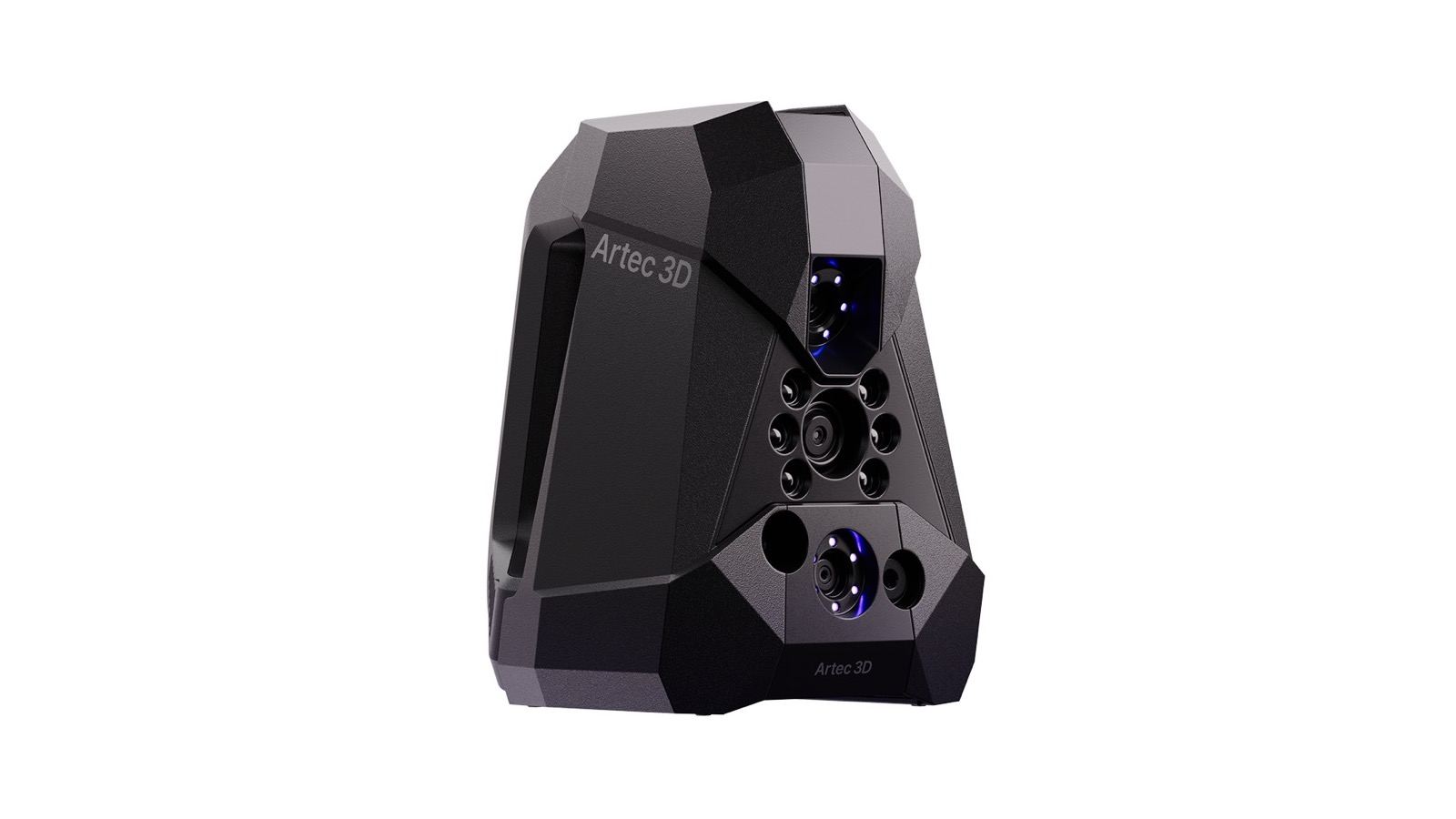

Inspection and reverse engineering have long forced a trade-off. Target-based laser scanning holds tight tolerances, but the part has to be covered in reference stickers first. Structured-light scanning captures colour and fine detail quickly, but its error grows over long distances. Artec Neo is Artec 3D’s answer to that trade-off: a handheld blue-light scanner that tracks on targets where a tolerance has to hold and on geometry and texture everywhere else — in one scan and one dataset.
This overview is based on Artec’s published specifications and documentation, checked on 12 November 2026. It explains what the accuracy figures mean, how the hybrid workflow is meant to be used, what you need to run the scanner and where a different scanner is the better tool.
Artec Neo at a glance
Artec launched Neo on 14 September 2026 and showed it first at IMTS in Chicago — see our launch report. The headline figures from Artec’s technical specifications:
| Specification | Artec Neo |
|---|---|
| Accuracy, with targets | 0.025 mm |
| Volumetric accuracy, with targets | 0.025 mm + 0.035 mm/m |
| Accuracy, without targets | 0.050 mm |
| Volumetric accuracy, without targets | 0.050 mm + 0.3 mm/m |
| Mesh resolution | 0.050 mm |
| Texture | 5 MP, 24 bpp colour |
| Working distance | 0.19–0.3 m |
| Field of view, closest / furthest | 128 × 104 mm / 171 × 152 mm |
| Depth of field | 110 mm |
| Volume capture zone | 1,800 cm³ |
| Data acquisition speed | up to 8 million points/s |
| Real-time fusion rate | up to 15 fps |
| Light sources | 450 nm blue LED structured light; white LED texture light, CRI > 95, 4000 K |
| Connection | Wi-Fi or cable, compatible with Thunderbolt 4 |
| Battery | 40–50 min continuous scanning |
| Dimensions, H × D × W | 187 × 156 × 118 mm |
| Weight | 1.3 kg with batteries |
| Acceptance test | VDI/VDE 2634 Part 3, in an ISO/IEC 17025-accredited lab |
| Warranty | 2 years |
| US price | US $38,600 (Artec online store, 12 November 2026) |
Artec notes that Neo is a new product and that its specifications may change as it is updated.
What “hybrid” means on Artec Neo
Neo has three ways of keeping track of its position while scanning, according to Artec’s product page:
- Target-based tracking — the scanner locks onto retroreflective targets. This is the mode behind the 0.025 mm figures.
- Target-free tracking — it follows the part’s own geometry and texture, with no preparation, at up to 0.05 mm accuracy.
- Hybrid mode — it switches between the two automatically, within one part and one scan.
The word “hybrid” describes tracking, not the light source. Neo uses a single 450 nm blue LED structured-light projector plus a separate white LED for colour. Some other scanners sold as hybrid combine laser and infrared projectors, which is a different idea. If the difference between laser and structured-light capture is new to you, start with our plain-language guide to laser 3D scanning.
Artec calls the approach tolerance-driven scanning. Targets act as metrology anchors on the features that carry tolerances — datums, fits, seals, interfaces — and the rest of the part is captured target-free, at full resolution and in colour. The logic mirrors GD&T, where the drawing already says which features have to be tightly controlled.
Five ways to place targets
Artec describes five set-ups, from a full field of targets to none at all. Each one ends in a single dataset.
| Set-up | Where the targets go | Typical jobs named by Artec |
|---|---|---|
| Full coverage | Across the whole part | First article inspection, golden samples — 0.025 mm + 0.035 mm/m over the entire surface |
| Toleranced features | Around datums, fits and interfaces; the rest is captured target-free | Reverse engineering, validation |
| Fixture only | On the fixture or target boards, not on the part | Inspecting critical or worn surfaces without covering them; deep channels measured as they are |
| Target trail | A trail linking separate features | Assembly, retrofitting, machine installation — flange-to-flange distances and bolt circles over several metres |
| No targets | None | Design, prototyping, 3D modelling — up to 0.05 mm accuracy and resolution |
The practical gain is time. Placing and removing targets takes a large share of a target-based job, and covering a worn or damaged surface hides the very thing you are trying to measure. Artec publishes one comparison on its product page: 13 minutes to scan a part with Neo against 34 minutes with “a metrology-grade laser scanner”. The page does not name that scanner or describe the test conditions, so read it as the manufacturer’s illustration rather than an independent benchmark.
How to read the accuracy figures
Neo has two kinds of accuracy figure, and they answer different questions:
- Accuracy — 0.025 mm with targets, 0.050 mm without — describes local detail: a small feature, a hole, an edge.
- Volumetric accuracy — 0.025 mm + 0.035 mm/m with targets, 0.050 mm + 0.3 mm/m without — describes a whole object, where the error grows with the distance between the points being measured.
- Mesh resolution — 0.050 mm — is the spacing of the captured surface detail. It is not an accuracy figure.
Artec says both accuracy figures come from measurements of a calibrated reference object at multiple angles across the full working range. The specifications were established with Artec’s own retroreflective targets, and Artec warns that third-party targets may not reach the specified accuracy.
Applying Artec’s published formulas shows why targets matter on long parts. The distance-dependent term is 0.035 mm per metre with targets and 0.3 mm per metre without — roughly 8.6 times larger:
| Distance between measured points | With targets | Without targets |
|---|---|---|
| 0.5 m | 0.0425 mm | 0.200 mm |
| 1 m | 0.060 mm | 0.350 mm |
| 2 m | 0.095 mm | 0.650 mm |
| 3 m | 0.130 mm | 0.950 mm |
The table is also a simple guide to target placement. For features a few centimetres apart, target-free capture may already meet the tolerance; across a metre or more, a tight tolerance needs targets.
Calibration and the accuracy certificate
Artec states that every Neo is individually calibrated and verified before shipment and ships with its own accuracy certificate. Acceptance testing follows VDI/VDE 2634 Part 3, the guideline used in industrial metrology to verify optical 3D measuring systems, with robot-driven trajectories and internationally traceable reference objects to remove operator influence.
On 29 September 2026 Artec announced that its metrology calibration laboratory in Luxembourg had received ISO/IEC 17025 accreditation from OLAS, the Luxembourg Office of Accreditation and Surveillance, under accreditation number 2/009. OLAS is a signatory to the EA MLA and the ILAC Mutual Recognition Arrangement, so, according to Artec, certificates carrying its mark are recognised in more than 100 countries and regions. Artec said calibration in the accredited laboratory would start with Artec Spider II and Artec Neo.
If a tender or a supplier quality system requires an accredited calibration certificate, ask the reseller to confirm that the certificate for your specific unit carries the accreditation mark. The requirement is about the document that ships with the scanner, not only about the lab.
Wireless operation and hardware
- Battery and Wi-Fi. A built-in battery gives 40–50 minutes of continuous scanning, and the product page lists four batteries in the box. Over Wi-Fi the scanner can work up to 6 metres from the router.
- Wired. At the workstation Neo connects by cable — Artec’s FAQ describes a Thunderbolt 3 interface, and the specification lists compatibility with Thunderbolt 4 — and runs from an AC/DC adapter, DC 24 V.
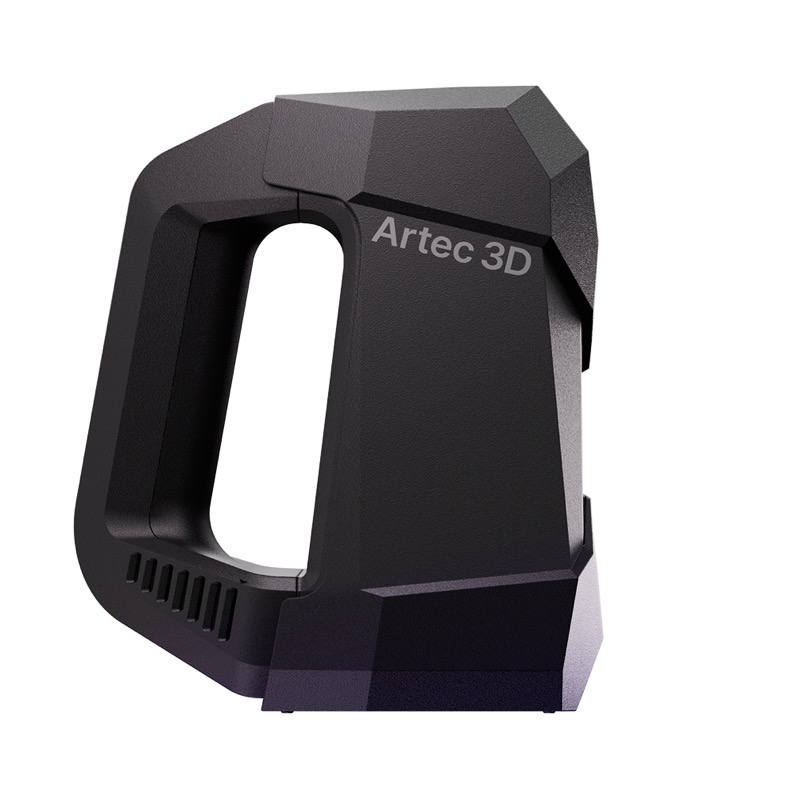
- Size and weight. 187 × 156 × 118 mm and 1.3 kg with batteries.
- Not a standalone computer. Neo streams data to a PC running Artec Studio. Unlike Artec Leo, it has no onboard processing or touchscreen. At launch Artec said a companion app for iOS and Android would let a smartphone act as Neo’s display; check its availability with your reseller.
Software, computer and file formats
Neo runs in Artec Studio, the same software as the rest of Artec’s range. According to Artec, it includes scan-to-CAD tools — fitting CAD primitives, 2D sections for sketching and one-click auto-surfacing — and mesh-to-CAD and mesh-to-mesh deviation analysis for inspection. For heavier work, data goes to Geomagic Design X, Geomagic Control X, SOLIDWORKS or PolyWorks|Inspector. Artec Twins, Artec’s software for large datasets, can combine Neo scans with data from Artec’s long-range LiDAR scanners.
Computer requirements, per Artec:
- Operating system: Windows 11. No macOS support is listed.
- Recommended: 13th or 14th Gen Intel Core i7 or i9, NVIDIA RTX 4070 8 GB.
- Minimum: 12th Gen Intel Core i9, NVIDIA RTX 4060 8 GB.
Export formats: OBJ, PLY, WRL, STL, AOP, ASC, PTX, E57 and XYZRGB for meshes and point clouds; STEP, IGES and X_T for CAD; CSV, DXF and XML for measurements.
Where Artec Neo fits — and where it does not
Artec positions Neo for small-to-medium parts — its S and M size classes, roughly 5 to 50 cm — and, with targets, for assemblies and structures spanning several metres, such as vehicle bodies and aircraft panels. The jobs Artec names:
- Automotive — flush and gap control at panel interfaces; reverse engineering of engines and components with the surrounding body captured for context. Our look at automotive 3D scanning covers the wider field.
- Aerospace and MRO — wear and damage assessment, repair validation and first article inspection, without covering aircraft surfaces with markers.
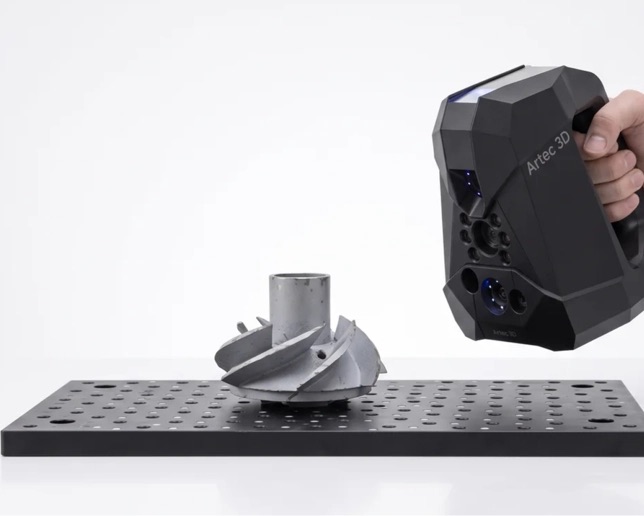
- Oil and gas — on-site inspection of pumps and impellers, including deep channels.
- Manufacturing — incoming and in-process QC, part-to-CAD comparison, mould and die inspection, jigs and fixtures.
- Defence — reverse engineering of legacy parts whose drawings no longer exist.
- Infrastructure — retrofit and installation measurements of connection points, without scanning everything in between.
It is the wrong tool, or not the only one, in these cases:
- Very small parts. Below about 5 cm and with micron-level tolerances, Artec’s desktop Artec Micro II, rated at 5-micron accuracy, is the closer match.
- Rooms, buildings and sites. Neo’s 0.19–0.3 m working distance is built for parts. For spaces, Artec’s own line points to Artec Ray II or Artec Jet.
- Large surfaces where speed matters more than tolerance. Artec Leo’s larger field of view covers big areas faster, and Artec itself suggests pairing Neo with Leo.
- No laptop on site. Neo needs a PC; Leo processes on board.
- Mostly polished, black or transparent parts. Artec does not publish Neo-specific guidance for these surfaces. Ask for a demo on your own part; our guide to scanning difficult surfaces without spray covers the general options.
- Mac-only teams. Artec lists Windows 11 as the supported operating system.
Price, delivery and what to check before buying
Artec’s online store listed Artec Neo at US $38,600 when we checked on 12 November 2026, with a 2-year warranty and “In stock” status. Prices differ by region and reseller, and the page does not break down taxes or shipping. Artec’s delivery terms say most items ship the same or next business day and usually arrive within 5 business days; a unit that arrives dead can be returned for a replacement within 14 days. Technical support is available 24/7 from local resellers or the Artec Support Team.
Before you order, check:
- Which Artec Studio licence, and for how long, is included in the quote.
- Whether the calibration certificate for your unit is the ISO/IEC 17025-accredited version, if your quality system needs it.
- How many targets come with the scanner, and whether your set-up needs extra Artec targets or target boards.
- Whether your workstation meets the CPU and GPU requirements above.
- How Neo handles your own part — Artec offers free demos.
Recognition so far
Neo was named in DEVELOP3D’s D3D 30 for 2026, the magazine’s annual list of technologies changing design and engineering, and Artec 3D has been shortlisted in the 2026 3D Printing Industry Awards in the 3D Scanning or Metrology Company category. Neo makes its European premiere at Formnext in Frankfurt, 17–20 November 2026, on Artec’s stand in Hall 11.0, Booth D45.
FAQ
How accurate is Artec Neo?
Artec specifies 0.025 mm accuracy and 0.025 mm + 0.035 mm/m volumetric accuracy with targets, and 0.050 mm and 0.050 mm + 0.3 mm/m without targets. Mesh resolution is 0.050 mm.
Does Artec Neo need targets?
No. It can scan target-free using geometry and texture tracking. Targets are needed only where you want the 0.025 mm accuracy class, and they can go on the part, around key features, on the fixture or along a trail between features.
Is Artec Neo wireless?
Yes. It has a built-in battery for 40–50 minutes of continuous scanning and works over Wi-Fi up to 6 m from a router. It still needs a PC running Artec Studio.
How much does Artec Neo cost?
US $38,600 on Artec’s online store as of 12 November 2026. Regional and reseller prices differ.
What computer does Artec Neo need?
Windows 11, with at least a 12th Gen Intel Core i9 and an RTX 4060 8 GB. Artec recommends a 13th or 14th Gen Core i7 or i9 with an RTX 4070 8 GB.
Can Artec Neo be combined with other Artec scanners?
Yes. Data from Artec’s handheld, desktop and long-range scanners can be merged in one Artec Studio project, and Artec Twins combines Neo scans with long-range LiDAR data.
Sources
- Artec 3D (accessed 2026-11-12). Artec Neo — product page, technical specifications, FAQ and delivery terms.
- Artec 3D (2026-09-29). Certified 3D scanning accuracy: Artec 3D metrology calibration laboratory achieves ISO/IEC 17025 accreditation — company news.
- 3D Mag (2026-10-01). Artec 3D launches Artec Neo and introduces tolerance-driven 3D scanning.
- 3D Mag (2026-10-29). Artec Neo named in the DEVELOP3D ‘D3D 30’ for 2026.
- 3D Mag (2026-11-12). Artec 3D shortlisted in the 2026 3D Printing Industry Awards.
- DEVELOP3D. The D3D 30.
This overview is based on Artec 3D’s published documentation; 3D Mag did not conduct hands-on testing. Publisher sponsorship.