
What Is a 3D Printing Convention?
A 3d printing convention is an informal umbrella term for an in-person gathering focused on additive manufacturing (AM) technologies, applications, and professional exchange. It is not an ISO/ASTM event category or a standardized meeting label. In practice, these events may combine an exhibition floor, technical presentations, workshops, demonstrations, training, and networking among suppliers, researchers, designers, manufacturers, and prospective collaborators.
The field extends well beyond desktop machines producing polymer parts. ISO/ASTM 52900:2021 establishes AM vocabulary and describes additive shaping as building physical three-dimensional geometries through successive addition of material. [1] An event may therefore cover design and file preparation, printing, post-processing, inspection, materials, software, and finished-part use rather than treating the printer as an isolated machine.
The practical question is not whether an event uses the word “convention,” but what its format allows a visitor to learn. A demonstration can reveal a workflow; a technical session can explain methods and limits; and a meeting can uncover preparation, finishing, software, or inspection requirements that are not evident in a specification sheet. Start with a real decision problem and seek evidence appropriate to its consequence.
From Rapid Prototyping Meetings to Broader AM Gatherings
The language around these meetings has expanded with the technology. An organizer timeline states that the first SME RAPID conference, held in 1990, was a Rapid Prototyping/Stereolithography conference. [9] That organizer-attributed history helps explain why present-day AM gatherings may bring together prototyping, production, materials, software, metrology, and quality work under overlapping labels.
Expo, Conference, User Group, or Standards Meeting? (Event Types That Get Called “Conventions”)
These categories overlap, and many events are hybrids. An expo or trade show is primarily for comparing equipment, services, and workflows in person. A technical conference centers on papers, case studies, panels, and methods, where test conditions and limitations may matter more than a live machine demonstration. User-group events emphasize operating experience among people using related equipment or software. Research- and standards-oriented meetings focus more closely on benchmarks, validation, test methods, and shared technical language. AM-Bench, for example, combines benchmark measurements, challenge problems, and conferences so modelers can compare simulations with controlled measurement data. [7]
Eligibility, badge types, session entry, and workshop access vary by organizer and edition. Some user-focused events are not open to the general public: AMUG’s terms require attendee registrants to directly own commercially available AM equipment used for professional applications and allow its board to limit or deny access. [10] Use the table as a planning tool, not as a ranking of event quality.
| Event format | Primary purpose | Best evidence to collect | Best suited to |
|---|---|---|---|
| Expo/trade show | Compare offerings | Demonstrated workflow, specifications, follow-up contacts | Initial market scan |
| Technical conference | Share methods and results | Test conditions, data, limitations | Understanding processes |
| User-group conference | Exchange operating experience | User lessons, application constraints | Existing practitioners |
| Research/standards-oriented meeting | Improve comparability and validation | Benchmarks, methods, draft requirements | Technical evaluation |
What Happens at an Additive Manufacturing Trade Show (and Why It’s Not Just “Seeing Printers”)
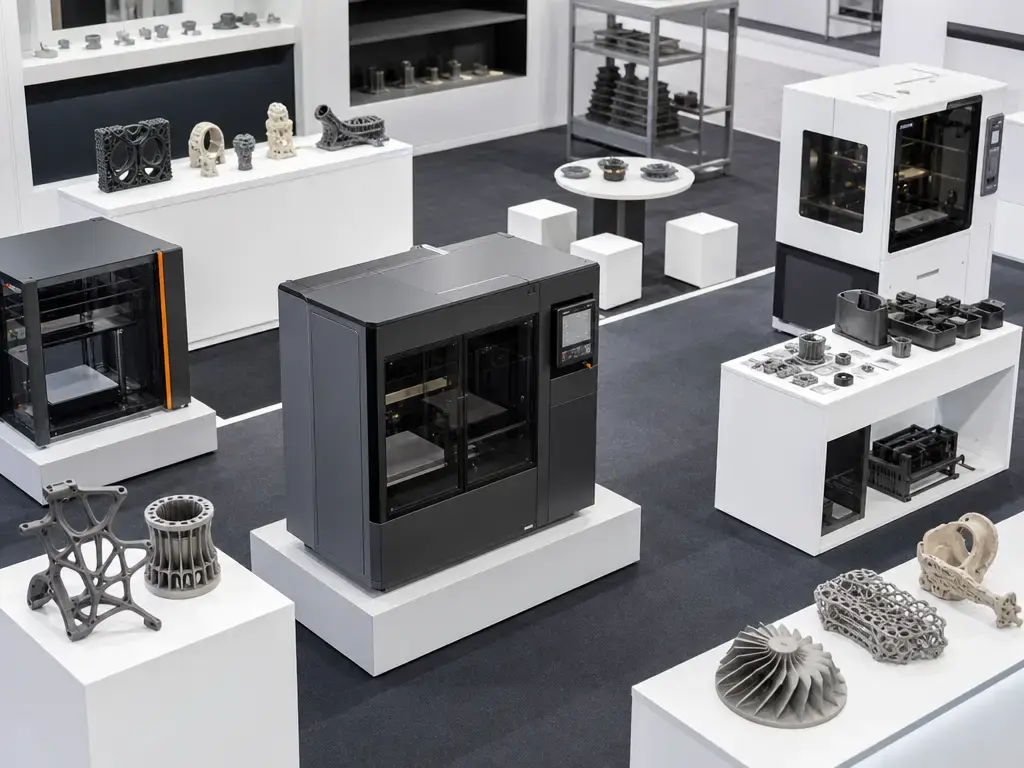
An additive manufacturing trade show can cover far more than machine builders. Exhibits may include feedstock and material characterization, design and build-preparation software, scanning and metrology, post-processing, automated handling, contract manufacturing, and equipment for cleaning, curing, heat treatment, machining, or inspection. Testing, documentation, process-development, and quality-system providers may also be present. Seeing these elements together helps visitors map a manufacturing route from a digital model to a verified part.
Meetings are an evidence-gathering tool, not merely a networking opportunity. Applications engineers can explain intended use cases; quality leads can clarify traceability and measurement needs; integrators can describe equipment handoffs; and users or supply-chain partners can identify constraints that emerged after installation. Record what was observed, what was stated, and what documentation is available for later review. A short demonstration can show usability, but it does not by itself establish production maturity.
As a dated illustration, RAPID + TCT’s organizer-reported 2025 recap stated that the event drew more than 10,000 visitors and over 500 exhibitors. The organizer also reported co-location with SME AeroDef Manufacturing, SAE WCX, and America Makes TRX. [8] Those figures apply only to the 2025 event, but they show why a large expo benefits from a meeting plan and why adjacent manufacturing communities can affect the floor mix.
Who Should Attend (and What Each Role Should Try to Leave With)
Engineer/designer: a shortlist of process constraints tied to a specific geometry, material, tolerance, and finishing requirement. Manufacturing/process owner: a workflow map covering build preparation, machine time, operator interventions, post-processing, inspection, and likely bottlenecks. Quality/regulatory/validation: a record of available process documentation, traceability practices, inspection methods, and gaps between a supplier’s stated capability and the evidence needed for a controlled application.
Procurement/supply chain: comparable supplier contacts, material-availability questions, service boundaries, and commercial follow-ups. Research/academia/students: benchmark problems, methods, collaborators, and a clearer technical question. Service bureaus/partners: potential referral relationships, complementary capabilities, and realistic requirements for files, inspection data, and finishing. Not every event is open to every group; badge classes and eligibility vary. AMUG is one example of a user-group event with professional-equipment ownership requirements for attendee registration. [10]
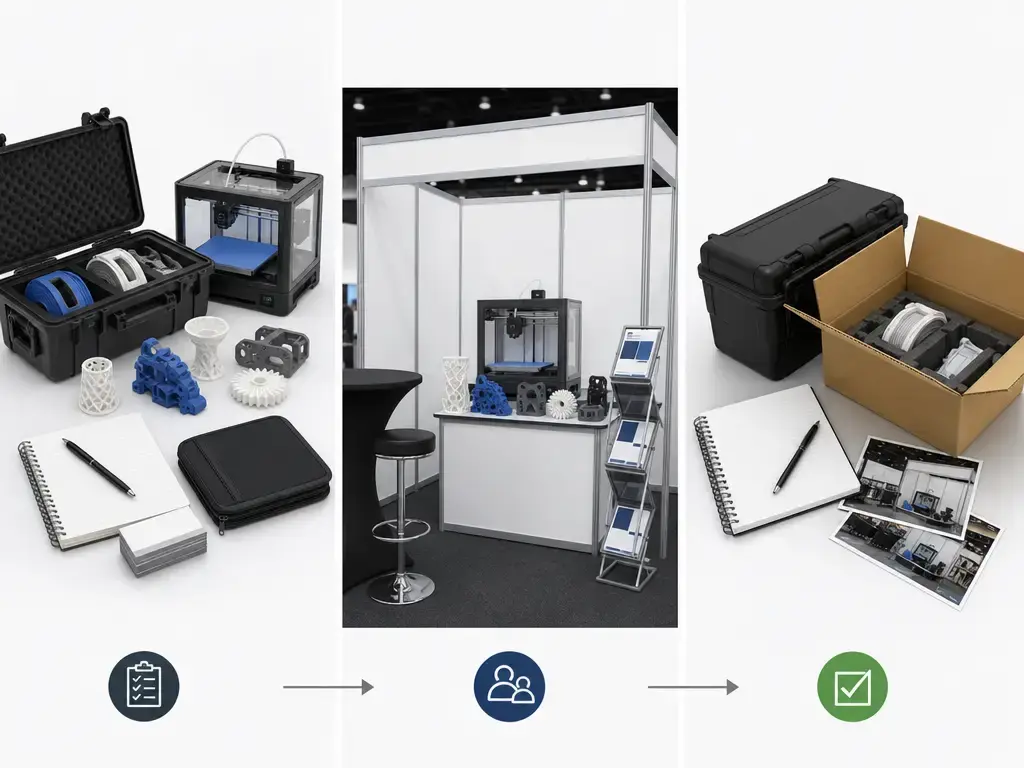
How to Prepare for a 3D Printing Convention (Before, During, After)
Preparation begins with a decision problem, not a wish to “see what is new.” Define one to three questions that could change an engineering, sourcing, or validation decision. For example: Can a proposed process make a given geometry in the required material? What workflow could support a stated production volume? What evidence is needed before accepting a part? Attach constraints to each question: material and condition, critical geometry, volume, acceptance criteria, finishing route, inspection needs, and the meaning of throughput. This prevents nominal build rate from being mistaken for delivered-part capacity. Identify the people who will need the answer after the event, such as design, manufacturing, quality, or procurement.
Before, During, and After the Event
- Define one to three decision questions for each use case.
- Record application constraints: material, geometry, volume, acceptance criteria, and finishing needs.
- Book meetings with shortlisted exhibitors, users, or technical contacts.
- Pre-select sessions by process, application, or measurement topic.
- Prepare a comparable question sheet for each discussion.
- Document demonstration conditions and follow photography or sample-handling rules.
- Separate observed facts from supplier claims, assumptions, and follow-up actions.
- Request documentation after the event, or clarify whether an NDA is needed. Where parameters are proprietary, ask about validated or locked status, parameter windows, change control, monitoring, and shareable log summaries.
- Write a decision memo promptly after the event while notes are fresh.
Comparable notes are more useful than a large collection of brochures because they preserve the conditions behind each claim.
Decision memo template
| Field | Record |
|---|---|
| Use case + constraints | Part function, material, geometry, volume, acceptance criteria |
| Evidence category (from evidence ladder) | Observation, supplier statement, document, or validation result |
| Source (who said it / what document) | Person, organization, session, sample, or document reference |
| Assumptions | Material, geometry, throughput definition, and other required conditions |
| Open questions | Missing data, unclear limits, or needed comparisons |
| Next validation step + owner | Test, review, quotation, or technical follow-up |
| Commercial constraints | Lead time, support, supply-chain dependencies |
The Evidence Ladder (How Not to Get Fooled by Demos)
A show-floor demonstration can reveal useful operational details, including interface steps, part handling, support removal, automation links, and the questions a supplier is prepared to answer. A sample part can begin a conversation about surface condition, internal channels, distortion, or finishing. It does not establish that the same result will be achieved repeatedly for a buyer’s material, geometry, machine configuration, site, and acceptance criteria. Treat the demonstration as an observation and record what was actually shown.
Evidence ladder
- Observed demo (show-floor observation)
- Vendor collateral (datasheet / marketing deck)
- Application case study (context-specific; may still be cherry-picked)
- Third-party test report (method + sample basis matter)
- Customer-specific qualification record (site/process-specific)
- Validated part program (defined acceptance criteria + traceability + ongoing control)
Lower rungs are not useless; they answer narrower questions. A datasheet may help narrow a process search, while a case study may identify an application or follow-up contact. Label every example in notes—for example, “this is rung 2 evidence”—so an observed sample, a supplier claim, and a documented validation result do not become one conclusion. Customer logos, displayed parts, and anecdotes can signal experience, but they are not qualification evidence.

Performance Metrics That Actually Compare (Process-Aware Checklist)
First identify the AM process category and intended application, then connect every requested metric to an acceptance criterion. A dimensional result is not comparable unless the material, geometry, orientation, feature measured, post-processing state, measurement method, and tolerance are known. The same discipline applies to mechanical properties, surface condition, density, or defect limits. ISO/ASTM 52902:2023 describes test artefacts and measurements used to assess AM-system geometric capability and support calibration. [5]
- Accuracy vs precision: Accuracy concerns closeness to a reference value, while precision concerns agreement among repeated results under stated conditions.
- Repeatability vs reproducibility: Repeatability concerns results under unchanged conditions; reproducibility concerns results when specified conditions change, such as operator, setup, location, time, equipment, or process condition.
- Measurement uncertainty: A reported measurement needs its method, sample basis, and associated uncertainty to be interpretable.
NIST cautions that accuracy, precision, repeatability, reproducibility, and uncertainty are qualitative concepts that should be used carefully rather than as standalone numeric labels. [11] Measurement-process characterization includes repeatability and reproducibility, so the measurement system matters alongside the printed part. [12]
Throughput is a workflow metric, not a single machine attribute. It can mean deposition or build rate, completed parts per week, or accepted parts per week; those measures are not interchangeable. Define batch size, uptime, setup, post-processing capacity, inspection capacity, and yield before comparing claims.
Evidence to request from an exhibitor
- Exact machine configuration and software versions used for the cited result.
- Material designation and condition, including applicable lot, storage, and recycling assumptions.
- Feasible parameter evidence: validated or locked parameter-set status, parameter-window description, change-control policy, process-monitoring approach, and shareable machine-log summaries.
- Post-processing route and required equipment, including curing, support removal, heat treatment, machining, or finishing where relevant.
- Inspection method and acceptance criteria: what was measured, when, how, and against what requirement.
- For metal PBF, whether material data sheets follow a recognized format such as ISO/ASTM 52929:2025, which specifies minimum reporting content but is not a qualification basis. [4]
- For geometric-capability or accuracy claims, which test artefact and measurement approach support the result, including an ISO/ASTM 52902-type approach. [5]
- For metal PBF finished-part claims, which elements of the post-processing, inspection, testing, qualification, and quality-assurance workflow are covered. ISO/ASTM 52908:2023 addresses those areas. [6]
Standards and Qualification Claims: What to Ask When Someone Says “ISO Compliant”
“ISO compliant” is incomplete unless the speaker identifies the exact designation, revision, scope, process or equipment boundary, and supporting evidence record. Ask whether the claim concerns a machine, manufacturing site, material data set, test method, or particular part workflow. A standards reference can clarify terminology and expectations, but it does not by itself establish performance for an unstated application.
ISO/ASTM TS 52930:2021 concerns installation qualification, operational qualification, and performance qualification for PBF-LB equipment. Its scope is limited to equipment issues directly related to the AM system and excludes feedstock qualification and post-processing beyond powder removal. [3] That boundary matters when a machine-qualification claim is presented as evidence for material control, heat treatment, machining, inspection, or finished-part acceptance.
For a broader industrial lens, ISO/ASTM 52920:2023 specifies requirements for AM processes and production sites and defines quality-assurance measures along the manufacturing process. [2] For metal PBF, distinguish a material data sheet from qualification: ISO/ASTM 52929:2025 addresses presentation of material-property data and explicitly does not provide a qualification basis. [4] ISO/ASTM 52908:2023 covers metal-PBF qualification, quality assurance, post-processing, inspection, and testing requirements. [6]
Research and Standards Context (Why Some “Conventions” Look Nothing Like Trade Shows)
Some technical gatherings focus on reducing uncertainty rather than comparing equipment. Sessions may examine benchmark data, predictive models, round-robin studies, measurement methods, uncertainty statements, and disagreements about how results should be interpreted. The useful output is often a better-defined problem: which variables need control, whether measurements are comparable, and what a model or method must demonstrate.
AM-Bench illustrates this format. NIST describes it as a series of benchmark measurements, challenge problems, and conferences designed to let modelers test simulations against controlled benchmark measurement data. [7] NIST states that AM-Bench uses a three-year conference cycle; its first conference was held on June 18, 2018, its second took place during the week of August 15, 2022, and planning for AM Bench 2028 is underway. [7]
Limitations of Show-Floor Demonstrations (and the Right Next Step)
Show-floor demonstrations are optimized for visibility, conversation, and a limited time window. They can provide rung 1 evidence about interface use, handling, automation, or a displayed part, but they do not prove long-run stability, yield, tolerance capability across a part family, or commercial cost per accepted part. Important work may occur outside the visible build: material handling, preparation, support removal, heat treatment, machining, cleaning, inspection, retesting, and disposition of nonconforming parts. For metal PBF, ISO/ASTM 52908:2023 includes post-processing, inspection, and testing within its scope. [6] The next step is a sequence: shortlist → NDA or document request → controlled trials → commercial diligence → qualification or validation as required.
Getting Value from a 3D Printing Convention
A 3d printing convention is most useful when limited time is converted into answers for defined decisions. Arrive with a part, workflow, sourcing, or research question; state the constraints that make an answer meaningful; and speak with people who can explain conditions as well as outcomes. Keep observations, supplier claims, and follow-up needs separate in your notes.
Fewer, better-prepared meetings usually produce stronger evidence than trying to see everything. Use the evidence ladder as a mental model: a demonstration can start a conversation, but higher-consequence decisions require stronger records and testing.
FAQ
Formats, attendance policies, badge access, workshop entry, and technical-session availability vary by organizer and year. Verify current conditions directly with the organizer before relying on an event for a particular meeting, demonstration, or learning objective.
What is a 3D printing convention?
It is an informal umbrella term for a gathering focused on additive-manufacturing technologies, applications, and professional exchange. It may combine exhibits, talks, workshops, demonstrations, and networking rather than describe one fixed event type. ISO/ASTM 52900:2021 provides formal AM vocabulary and describes additive shaping as building three-dimensional geometries through successive addition of material. [1]
What happens at an additive manufacturing trade show?
Visitors can examine machines, materials, design software, metrology, post-processing, automation, contract services, and quality support. Meetings with applications engineers, users, integrators, and supply-chain contacts can clarify the conditions behind a claim. Demonstrations and sample parts are useful observations, but they do not alone establish long-run production performance, yield, or suitability for a specific part.
How should I prepare for a 3D printing conference or expo?
Start with one to three decision questions tied to a real part, workflow, sourcing issue, or research problem. Record material condition, geometry, volume, acceptance criteria, post-processing, and inspection needs. Arrange priority meetings, pre-select relevant sessions, and use one comparable note sheet for each discussion. Separate observations from supplier statements and follow-up requests, then write a decision memo promptly after the event.
Who can attend—are these events open to the public?
Not always. Eligibility can depend on the organizer’s policy, registration category, professional role, equipment ownership, or available badge type. AMUG, for example, states that its conference is not open to the general public and requires attendee registrants to directly own commercially available AM equipment used professionally. [10] Check current eligibility, session restrictions, and workshop rules rather than assuming a user-focused event is publicly accessible.
Expert: When a vendor says “ISO compliant,” what should I ask for?
Ask for the exact document designation, revision, applicable scope, equipment or process boundary, and evidence record. Do not treat the phrase as a conclusion about a material, site, machine, or finished part. ISO/ASTM TS 52930:2021 is limited to PBF-LB equipment IQ/OQ/PQ and excludes feedstock qualification and post-processing beyond powder removal. [3] ISO/ASTM 52920:2023 provides a broader framework for industrial AM processes and production sites. [2]
Expert: What’s the difference between repeatability, reproducibility, and measurement uncertainty in accuracy claims?
Repeatability concerns variation under unchanged stated conditions. Reproducibility concerns variation when specified conditions change, such as operator, setup, location, time, equipment, or process condition. Measurement uncertainty expresses the uncertainty associated with a reported result. NIST cautions that accuracy, precision, repeatability, reproducibility, and uncertainty require careful contextual use. [11] Ask what was measured, by which method, on what sample basis, which conditions changed, and what uncertainty accompanied the result.
Sources
- ISO/ASTM 52900:2021 — Additive manufacturing — General principles — Fundamentals and vocabulary
- ISO/ASTM 52920:2023 — Qualification principles — Requirements for industrial additive manufacturing processes and production sites
- ISO/ASTM TS 52930:2021 — Additive manufacturing — Qualification principles — Installation, operation and performance (IQ/OQ/PQ) of PBF-LB equipment
- ISO/ASTM 52929:2025 — Additive manufacturing of metals — Powder bed fusion — Presentation of material properties in material data sheets
- ISO/ASTM 52902:2023 — Additive manufacturing — Test artefacts — Geometric capability assessment of additive manufacturing systems
- ISO/ASTM 52908:2023(en) — Additive manufacturing of metals — Finished part properties — Post-processing, inspection and testing of parts produced by powder bed fusion
- NIST — Additive Manufacturing Benchmark Test Series (AM-Bench)
- RAPID + TCT — An Arsenal of Innovation: RAPID + TCT 2025 in Review
- RAPID + TCT — 30 Years as North America’s Leading Additive Manufacturing Event
- AMUG — Registration Terms and Conditions