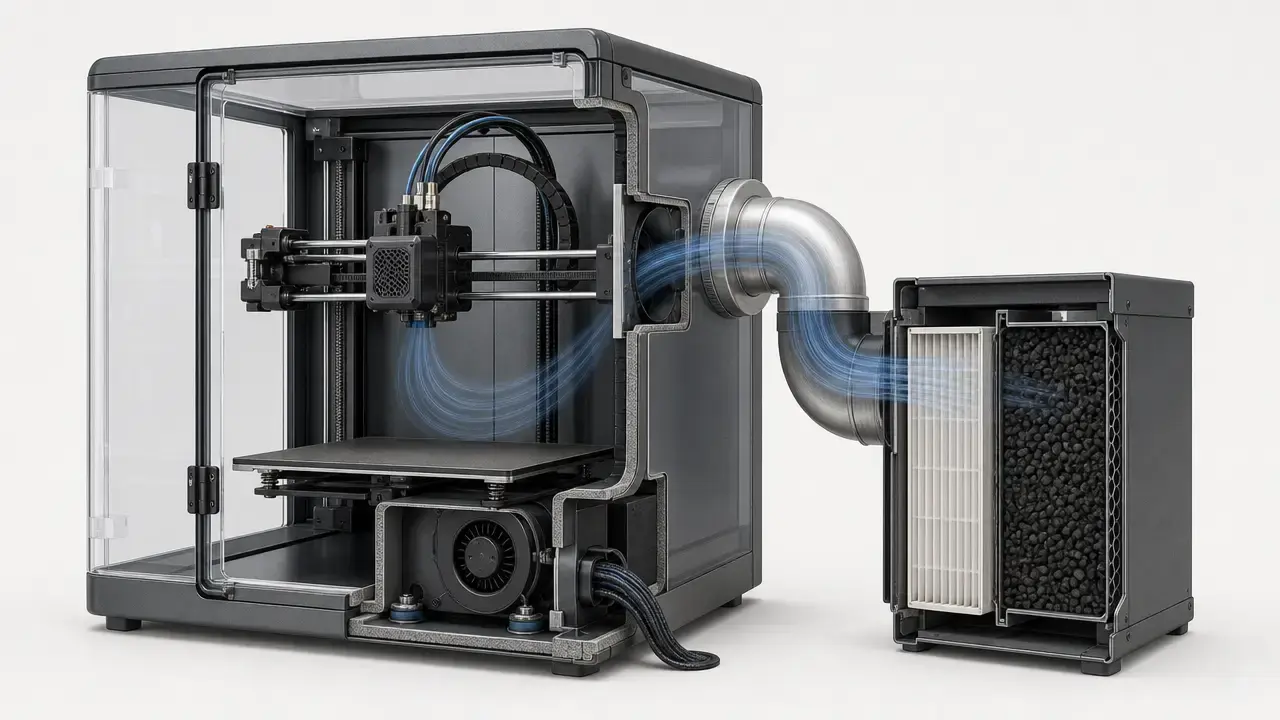

Summary: Do you need an air purifier for your 3D printer?
Yes — an air purifier for 3D printer use can help, but for many setups it should be a secondary control, not the first one. EPA says air cleaning is useful only alongside source control and ventilation, not as a substitute, and CADR ratings apply to particles rather than VOC removal. [5] [3]
If you print occasionally with lower-emission materials in a larger room, a room purifier can reduce some of what remains in the air after release. [3] But if you print ABS, ASA, HIPS, nylon, PC, or resin, or if the printer runs long jobs in a bedroom, home office, classroom, or shared space, stronger 3D printer ventilation usually matters more than room cleanup alone. [8] The practical hierarchy is simple: control emissions at the printer first, then use room cleaning as a backup layer. [5] [8] The next section gives a quick way to choose between a purifier, an enclosure, and outdoor exhaust.
Quick decision: purifier, enclosure, or exhaust? (start here)
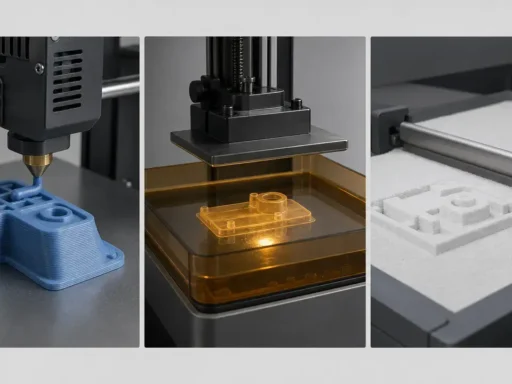
Start with the process and the room, not the purifier label. Material-extrusion printers — usually called FFF or FDM — and vat photopolymerization printers such as SLA, MSLA, and DLP create different exposure patterns. [8] If you can capture emissions in an enclosure and vent them outdoors, that is often the strongest practical option because it removes contaminants from the occupied room instead of trying to clean them after they spread. [8] [20] If outdoor exhaust is not feasible, an enclosure with well-controlled filtered recirculation is usually a stronger step than a room purifier by itself. [8] [12]
A room purifier makes the most sense when printing is occasional, the room is fairly large, the material is lower-emission in the available studies, and people are not sitting next to the printer for hours. [3] [10] It is much less convincing for resin, higher-emission filaments, small occupied rooms, long duty cycles, or multiple machines, because those situations call for source control before room cleanup. [5] [8] In plain terms, ventilation replaces or exhausts air, filtration cleans recirculated air, and source capture tries to stop emissions from entering the room in the first place. [5] [8]
Use a stronger control if…
- You print ABS, ASA, HIPS, nylon, or PC.
- You print resin.
- Your prints are long or frequent.
- The room is small.
- The printer is in a bedroom or home office.
- The printer is in a school or makerspace.
- You run multiple printers.
- Sensitive occupants share the space.
What “3D printer fumes” actually means: particles vs VOCs vs odor
| Pollutant type | What it is | Best control | Metric to check | What it won’t tell you |
|---|---|---|---|---|
| UFP / particles | Very small airborne solids or droplets; EPA frames ultrafine particles as about 1–100 nm. [1] | Source capture, enclosure ventilation, LEV, then particle filtration | Particle number or mass, depending on instrument | It does not describe gas-phase emissions |
| VOCs / gases | Chemicals that evaporate into air during printing, heating, washing, and post-processing. [11] [21] | Source control, ventilation, then sorbent media where appropriate | VOC sampling or compound-specific analysis | It does not tell you particle levels |
| Odor | Human perception, not a pollutant class | Ventilation and source control | Occupant reports only | It does not prove the air is clean |
Particles are not the same as visible smoke. EPA describes ultrafine particles as roughly 1–100 nm, while indoor PM guidance often focuses on PM10 or PM2.5 by mass instead. [1] [2] PM10 means particles 10 micrometers and smaller, which is far larger than typical UFPs from many 3D-printing studies. [2] That is why a PM2.5 reading and a UFP emission rate are not interchangeable measurements.
VOCs are different again. In desktop-printing studies, common examples include caprolactam, styrene, and lactide, with reported individual emission ranges of about 2–180 µg/min for caprolactam, about 10–110 µg/min for styrene, and about 4–5 µg/min for lactide in the tested setups. [11] Those compounds track different filament families rather than a single universal “3D printer smell.” [11] VOCs can also come from resin handling and wash steps, not just from the printer itself. [21]
Odor matters for comfort, but it is not a control metric. A setup can smell strong without being the highest emitter in a study, and odor can also fall before particles or gases are fully controlled. [11] That is one reason “it doesn’t smell bad” is weak evidence that the air is actually clean.
Source control beats room cleanup: enclosures and local exhaust (LEV)
Source control works upstream. Instead of waiting for pollutants to mix into the room and then trying to dilute or filter them, it captures emissions at the nozzle, chamber, or build area before they spread. [8] For 3D printer ventilation, that difference is crucial because capture efficiency at the printer and cleanup efficiency in the room answer different questions. NIOSH explicitly treats ventilated enclosures, hoods, and local exhaust as engineering controls that are more efficient than general dilution ventilation for 3D printing. [8]
The performance gap can be large when the control is designed well. In the NIOSH guide, a filtered enclosing hood reduced particle emissions by 97% to 99%, a retrofit enclosure reduced them by 97%, an enclosure plus LEV with HEPA-filtered exhaust increased that reduction to 99%, and a NIOSH-designed print-head capture hood reduced emissions by at least 98% in the tested printer. [8] Those are not universal numbers for every hobby enclosure, but they show why source capture often beats room-only cleanup. [8]
Design details still matter. A 2026 low-cost controls study reported minimum capture efficiencies of 99.7%, 91.6%, 28.6%, and 99.8% for four tested controls, with the partial enclosure performing badly because internal fans let emissions bypass the intended flow path. [9] A box around the printer is not enough by itself; leaks, bypass, and airflow direction can make or break the result. [9]
CADR (room) vs capture efficiency (at the printer)
CADR tells you how much relatively clean air a room purifier can deliver for particles in room air, after contaminants are already in that air. [3] Capture efficiency tells you how much pollution a hood, enclosure, or LEV setup intercepts before it mixes into the room. [8] A purifier can have a useful CADR and still do nothing to stop emissions leaving the nozzle or resin vat, while a good source-capture system can prevent much of that room contamination from happening in the first place. [3] [8]
- Do not treat a room CADR as proof of source capture.
- Do not assume a HEPA label means the whole setup captures emissions well.
- Do not assume a partial enclosure works if internal airflow creates bypass.
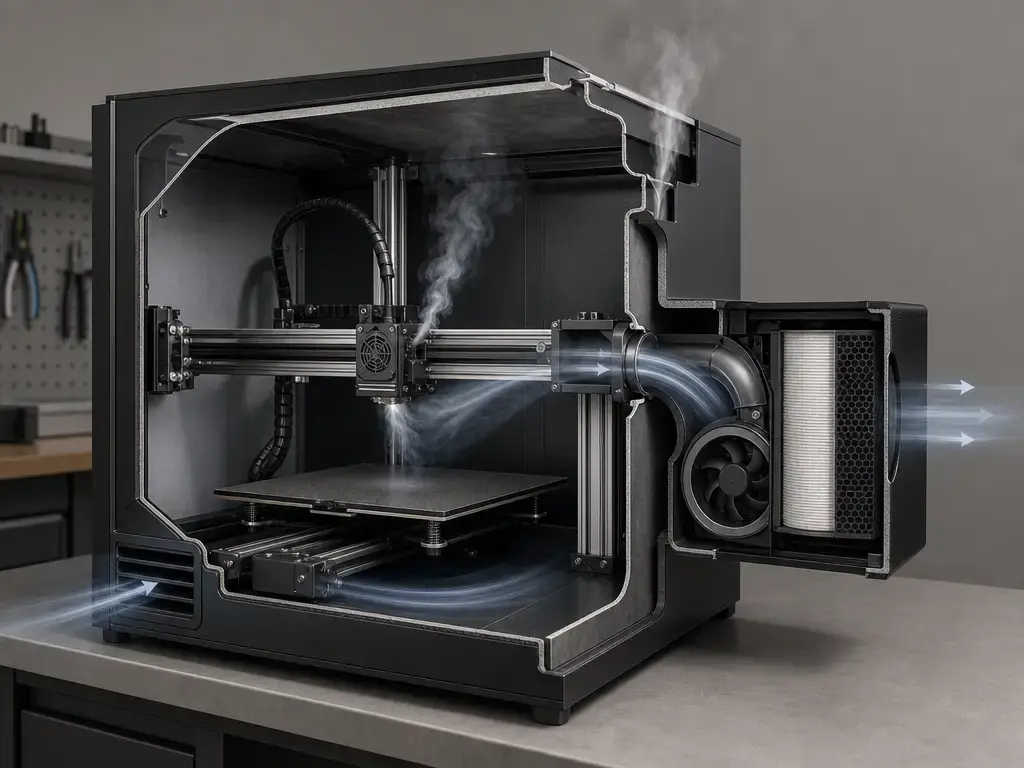
If you are deciding where to spend effort first, source control usually comes before room cleanup.
Air purifier for 3D printer fumes: when it helps—and when it doesn’t
A room purifier can help with occasional printing in a larger room, especially if the material is lower-emission in available studies and the purifier is a second layer rather than the only control. [3] [10] In that role, it can reduce particle load after release and improve general room air mixing. [3] What it does not do is stop emissions at the nozzle, inside the chamber, or over an open resin vat. [5]
The limits matter. EPA’s consumer guidance says CADR is a particles-only rating and notes that there is no widely used performance rating system for portable gas or VOC removal. [3] EPA’s sizing examples for 8-foot ceilings scale from 100 ft² → 65 cfm to 600 ft² → 390 cfm, which shows how quickly airflow needs rise with room size. [3] But those numbers still address particle cleanup, not source capture and not a universal answer for VOCs. [3] For 3D printing specifically, no reliable universal purifier size, carbon mass, or filter-replacement interval exists across all rooms, printers, and materials. [3]
If you use a purifier, place it where air can move through the occupied space rather than hiding it in a closet or blocked corner, run it for the full print and cooldown period, and maintain filters according to the device’s airflow design and manufacturer guidance. [3] [5] That is practical housekeeping, not a substitute for stronger controls when the printer is busy, the room is small, or the material is higher-emission. [5]
Material & process categories (evidence-weighted, no “safe filament” claims)
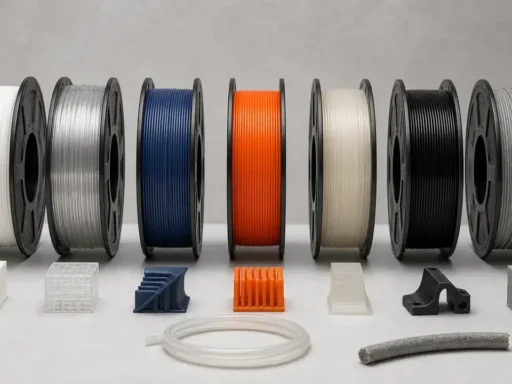
The clearest comparison is still PLA versus ABS. In the 2013 Stephens study, estimated UFP emission rates were about 2.0×10¹⁰ particles per minute for PLA and about 1.9×10¹¹ particles per minute for ABS in the tested printer and conditions. [10] That does not make PLA “safe,” but it does show that material choice can shift emissions by about an order of magnitude in at least one real-world office study. [10]
Beyond PLA and ABS, the literature is more mixed. Azimi and colleagues reported median UFP emission rates across tested printer-filament combinations spanning roughly 10⁸ to 10¹¹ per minute, and total VOC emission rates from about 3 µg/min for PC to nearly 200 µg/min for nylon. [11] The same study found that polycarbonate and T-Glase had low total VOC emissions but high UFP emissions, which is a useful reminder that “low VOC” does not automatically mean “low particles.” [11] In another study, particle specific emission rates ranged from 2.0×10⁹ #/min for a PETG-based GLASS filament to 1.7×10¹¹ #/min for ASA, with ABS at (4.7±1.1)×10¹⁰ #/min in that test chamber. [13] Separately, one VOC study found that ASA’s styrene emission rate was less than one-quarter of ABS in that setup, and PETG had the lowest VOC emissions among the four materials tested. [14]
Resin needs to be split into three different moments: printer operation, washing and post-processing, and curing, outgassing, and storage. During printer operation, emissions depend on the machine, the open-vat geometry, and room ventilation. [19] During washing and post-processing, solvent can dominate the VOC picture; one institutional guidance document cites chamber work in which isopropanol accounted for more than 97% of the summed VOC emission rates during wash treatment. [21] During curing, outgassing, and storage, the issue becomes exposed resin and leftover solvent in the workspace. [21] Formlabs recommends at least three full air exchanges per hour for its own SLA products and says not to operate them in closets or unventilated small rooms, but that is manufacturer-specific guidance rather than a universal rule for all resin systems. [19]
What the evidence is strongest for / weaker for
-
Strongest
-
PLA versus ABS UFP comparisons from early emissions studies. [10]
-
Chamber-study VOC families such as styrene, caprolactam, and lactide, showing that different materials change both gas and particle profiles. [11]
-
Weaker / variable
-
PETG rankings, because one study found low VOCs while another still found nontrivial particle emissions. [13] [14]
-
ASA across brands and formulations, because results differ by chemistry and test method. [13] [14]
-
PC and composites, because low VOC does not guarantee low UFP. [11]
-
Third-party resins, because formulation differences make generic “safe resin” claims unreliable. [19] [21]
Recommended 3D printer ventilation setup (principles, not HVAC design)
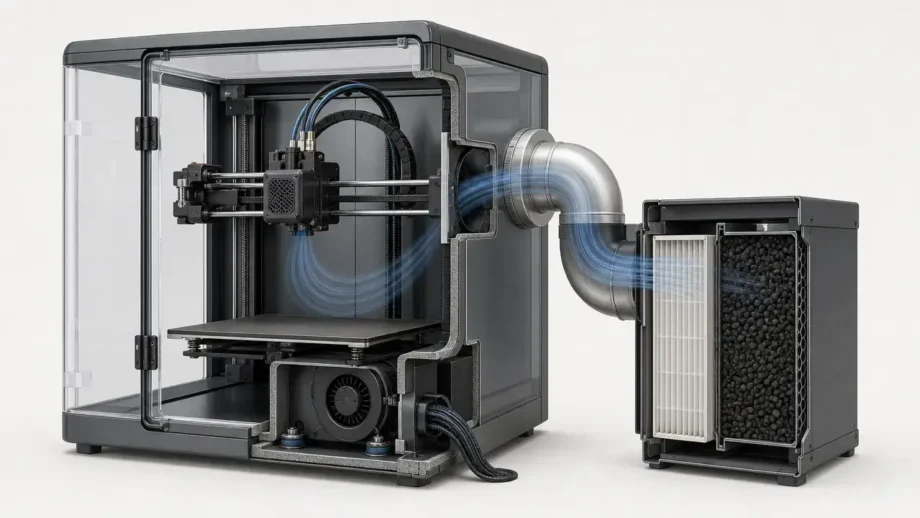
A good 3D printer ventilation setup starts with source control: contain the printer in a sealed-ish enclosure or capture emissions with local exhaust so they are intercepted before they mix into room air. [8] When outdoor exhaust is feasible, it is often the cleanest conceptual approach because contaminants leave the occupied space instead of being recirculated. [8] But exhausting air outdoors is still a ventilation design issue, not a magic accessory. EPA warns that larger exhaust fans may need makeup air so the space does not become overly depressurized and cause backdrafting or other problems. [20]
If outdoor exhaust is not practical, the next step is usually a recirculating enclosure with a controlled airflow path and combined particle and gas filtration. [8] [12] That can reduce both particles and some gases, but performance depends on sealing, fan placement, leakage, and maintenance rather than on filter labels alone. [3] [4]
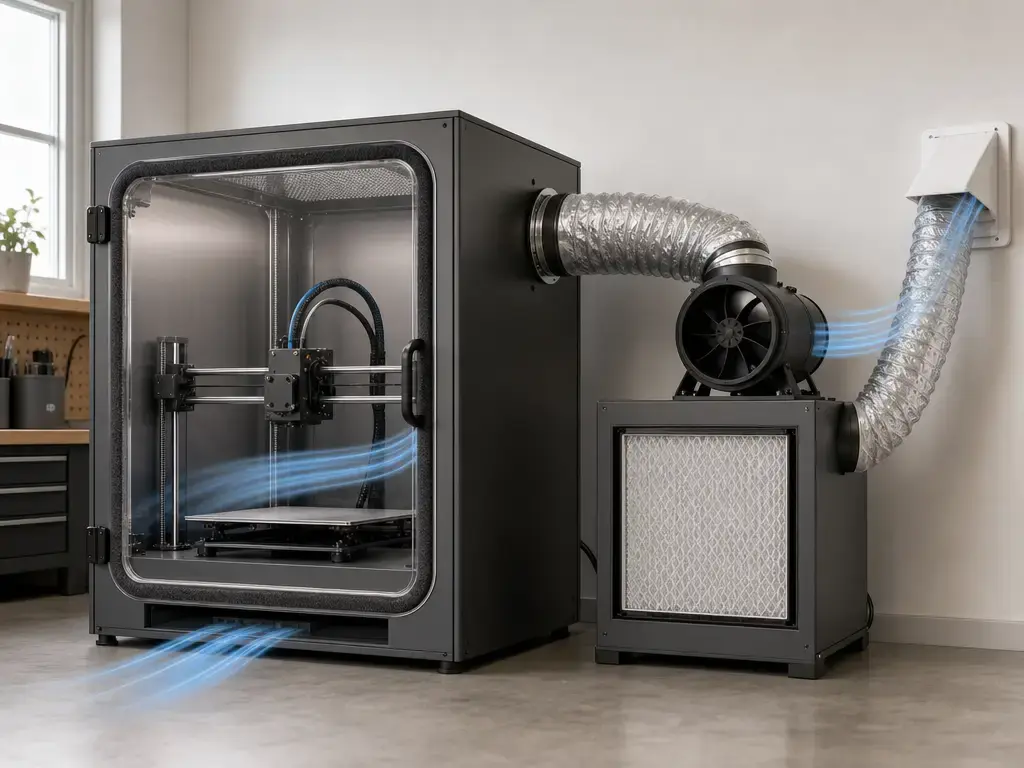
Basic enclosure ventilation checklist
- Sealed-ish enclosure
- Controlled intake
- Exhaust fan
- Negative pressure
- Outdoor ducting or sealed HEPA + carbon recirculation
- Maintenance
- Thermal and electrical safety
- Do not block electronics cooling
For permanent outdoor-exhaust installs, especially in schools, libraries, or makerspaces, review the plan with HVAC or EHS rather than treating it like a plug-in appliance. [20]
Metrics & claims: what to check before you buy (and what not to trust)
CADR is useful, but only for one job: room-air particle cleanup. [3] EPA’s sizing examples for 8-foot ceilings run from 65 cfm at 100 ft² to 390 cfm at 600 ft². [3] That helps compare purifiers for room size, but it does not tell you whether a printer enclosure captures emissions well, and it does not rate gas removal. [3]
HEPA is a filter-media definition, not a whole-device guarantee. EPA describes HEPA in this context as at least 99.97% capture at 0.3 µm. [4] Useful as that is, whole-device performance still depends on sealing, bypass, and airflow path. [4] In one 3D-printing modeling paper, portable air-cleaner scenarios used UFP CADRs of 100 and 300 m³/hr and assumed 60% HEPA single-pass efficiency, which shows how strongly real performance depends on airflow as well as media efficiency. [12]
Activated carbon is harder to compare. EPA notes that there is no widely used portable gas or VOC rating system, and the same modeling paper assumed 70% VOC removal by carbon media only as a scenario, not a universal product rule. [3] [12] So “has carbon” is not enough information by itself, and no reliable universal figure exists for purifier size, carbon mass, or replacement interval for all 3D-printing setups. [3]
| Control option | Best for | Weak point | Article verdict |
|---|---|---|---|
| Open window / room ventilation | General dilution | Unpredictable airflow and no source capture | Better than nothing, but not a precise control |
| HEPA room purifier | Particle cleanup after release | No source capture; CADR is particles only | Useful supplemental layer |
| Carbon + HEPA room purifier | Particles plus some gas adsorption | Carbon capacity and VOC performance are hard to compare | Better than HEPA-only for mixed emissions, still supplemental |
| Enclosure with exhaust or filtered recirculation | Source control before room mixing | Depends on sealing, airflow path, and maintenance | Usually the strongest practical hobby/prosumer control |
Room purifiers act after release. Enclosures and LEV aim to intercept before room mixing.
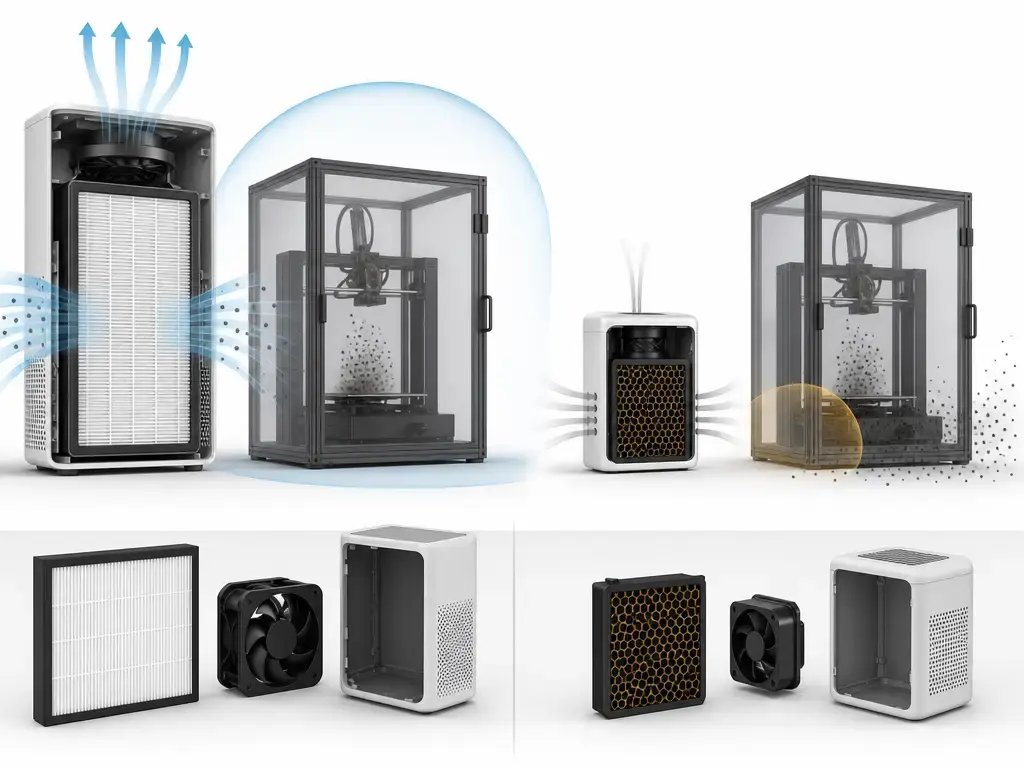
What not to trust
- Smell as proof.
- PM2.5-only readings as proof.
- Tiny carbon pads.
- Unspecified carbon amount.
- “Medical grade.”
- Ozone or ionizer features.
EPA warns that no federal agency has approved ozone generators for use in occupied spaces, and ozone at levels high enough to clean air effectively is unsafe. [6]
Scenarios: bedroom, home office, garage, classroom/makerspace
Bedrooms and home offices are the hardest cases because people spend long periods close to the printer. In those spaces, an air purifier for 3D printer use can be a helpful second layer, but frequent printing, long jobs, resin, or higher-emission filaments all push you toward enclosure control, LEV, or outdoor exhaust first. [5] [8]
Garages and basements can be better if they are truly separated from occupied rooms, but separation is not the same as ventilation. If air leaks back into the house, or if the printer runs for long periods, source control still matters. [8] A purifier may help with residual air after release, but it does not replace capture at the printer. [5]
Classrooms and makerspaces need the most caution because occupancy, duty cycle, and printer count stack up quickly. The NIOSH guide cites one study recommending a minimum of 6 ACH in makerspaces and another finding that 3 ACH was not sufficient for regular or long-time use of desktop printers. [8] Those figures are context for institutional spaces, not a universal home rule. [8] Institutions should consult EHS or professional ventilation design rather than relying on a purifier alone.
Standards, certifications, and why they don’t replace good ventilation
UL 2904 Ed.2-2023 is a standard method for measuring particle and VOC emissions from 3D printers in defined non-industrial indoor scenarios. [15] The ANSI abstract page says it was published on May 26, 2023, and that it covers coarse, fine, and ultrafine particles plus VOCs in settings such as classrooms, offices, libraries, residential spaces, and other non-industrial indoor environments. [15] It also says the standard does not purport to address all safety, health, comfort, or performance concerns, including comfort issues such as odor. [15] So UL 2904 is useful as a test framework, not as a blanket declaration that a printer is suitable for every room and every material. [15]
GREENGUARD certification for 3D printers is based on UL 2904 in this context, which makes it a certification program built on that emissions-testing framework rather than a substitute for ventilation design. [16] Manufacturer filtration examples belong in the same narrow category: they are product-specific claims, not universal rules. UltiMaker’s S5 Pro Bundle manual gives a filter replacement example of every 1,500 printing hours, while Prusa’s enclosure filtration page claims at least 600 hours of life and 99.9% HEPA efficiency for its filter assembly. [22] [23] Historically, this standards picture followed the earlier emissions evidence: the 2013 Stephens paper helped establish that desktop printers were not emission-neutral, and later VOC/UFP work supported more formal testing and certification frameworks. [10]
Bottom line: is ventilation enough for 3D printer fumes?
Not by itself in every setup. The most reliable hierarchy is still source control first, then a well-designed enclosure or LEV system, then outdoor exhaust when feasible and properly reviewed, with a room purifier used as a supplemental layer rather than the main defense. [5] [8] That is why an air purifier for 3D printer use can be worthwhile for residual particles in a larger room, but it is rarely the best stand-alone answer for ABS, ASA, nylon, PC, resin, small occupied rooms, or long printing schedules. [3] [5] If you remember one rule, make it this: try to stop emissions from entering the room in the first place, because cleaning the room afterward is usually the weaker control. [8]
FAQ
1. Do you need an air purifier for 3D printer use?
Sometimes, yes — but usually as a backup layer, not the first line of control. EPA says air cleaning may help when used with source control and ventilation, but it is not a substitute for either. [5] A purifier is most defensible for occasional printing in a larger room. For small occupied rooms, resin, or higher-emission filaments, capture at the printer usually matters more. [3] [8]
2. Is ventilation enough for 3D printer fumes?
Sometimes, but not always. General room ventilation helps dilute contaminants, yet NIOSH treats source control as more efficient than dilution alone for 3D printing. [8] For routine or higher-emission printing, the better question is whether you are capturing emissions before they spread, not just whether the room has some air exchange. [8]
3. Does a HEPA filter remove 3D printer fumes?
HEPA helps with particles, not all fumes. EPA describes HEPA here as at least 99.97% capture at 0.3 µm, which is a particle standard. [4] That does not make it a VOC filter, and it does not guarantee the whole device performs perfectly if air leaks around the filter or the airflow path is poor. [3] [4]
4. Is activated carbon “enough” for ABS/ASA smells and VOCs?
Not as a universal rule. Activated carbon can adsorb some gases and odors, but EPA says there is no widely used portable VOC rating system, so comparing carbon performance is hard. [3] Carbon effectiveness depends on media amount, airflow, contact time, and saturation, which is why tiny pads and vague “VOC filter” claims are weak evidence. [3] [12]
5. Is PETG safer than ABS/ASA for indoor printing?
The evidence is mixed, so “safer” is too broad. One VOC study found PETG had the lowest VOC emissions among four tested materials, while ASA’s styrene emission rate was less than one-quarter of ABS in that setup. [14] But a different particle study still found a PETG-based filament at 2.0×10⁹ #/min and ASA at 1.7×10¹¹ #/min, with ABS at (4.7±1.1)×10¹⁰ #/min in that chamber test. [13] PETG may be lower-emission for some VOC outcomes, but it is not particle-free.
6. Resin printing: why do washing and curing often matter as much as the printer itself?
Because the workflow changes the emission source. Printing involves the vat and machine enclosure, but wash steps add solvent, and one institutional guidance document cites chamber work where isopropanol accounted for more than 97% of summed VOC emission rates during wash treatment. [21] Curing and storage can also keep releasing vapors if parts or solvent remain exposed. [21] That is why resin control has to cover printing, washing, and curing/storage together.
7. CADR vs capture efficiency vs ACH: which metric answers which question?
They answer three different questions. CADR tells you how much particle-cleaning a room purifier can provide after contaminants are in the room. [3] Capture efficiency tells you how much a hood, enclosure, or LEV system intercepts at the printer before room mixing. [8] ACH describes how much air in a room is replaced or cleaned over time, and in the NIOSH makerspace context one study recommended 6 ACH while another found 3 ACH insufficient for regular or long-time use. [8] None of those metrics can substitute for the others.
Sources
- EPA — 3D Printing Research at EPA
- EPA — Sources of Indoor Particulate Matter (PM)
- EPA — Guide to Air Cleaners in the Home (2nd ed., PDF)
- EPA — What is a HEPA filter?
- EPA — Air Cleaners, HVAC Filters, and Respiratory Viruses
- EPA — Ozone Generators that are Sold as Air Cleaners
- NIOSH — Approaches to Safe 3D Printing (DHHS/NIOSH 2024-103, PDF)
- O’Connor et al. — Four Low-Cost Engineering Controls (CDC Stacks landing page)
- Stephens et al. — Ultrafine particle emissions from desktop 3D printers
- Azimi et al. — Emissions of UFPs and VOCs from desktop 3D printers
- Azimi/Fazli/Stephens — Exposure modeling & control strategies
- EPA HERO record — Gu et al. (2019) Environment International
- Molecules (PMC) — Emission Profiles of Volatiles during 3D Printing with ABS, ASA, Nylon, and PETG
- ANSI Webstore — UL 2904 Ed.2-2023 abstract/scope page
- UL — GREENGUARD Certification for 3D Printers
- Formlabs — Safety with Formlabs SLA Products
- EPA — Addressing Indoor Environmental Concerns During Remodeling
- SFSU EHS (PDF) — Safe Use of 3D Printing for Institutions of Higher Learning
- UltiMaker (PDF manual) — S5 Pro Bundle User Manual v2.2
- Prusa — Advanced Filtration System for Original Prusa Enclosure