
Summary
A 3D scanner for human body projects captures the body’s external surface geometry — shape, contours, and sometimes color texture — rather than internal anatomy. ISO 20685-1 addresses 3-D surface-scanning for acquiring human body shape data and measurements defined in ISO 7250-1, while ISO 7250-1 provides the measurement basis used to extract standardized 1D and 2D values from 3D scans. [1] [3]
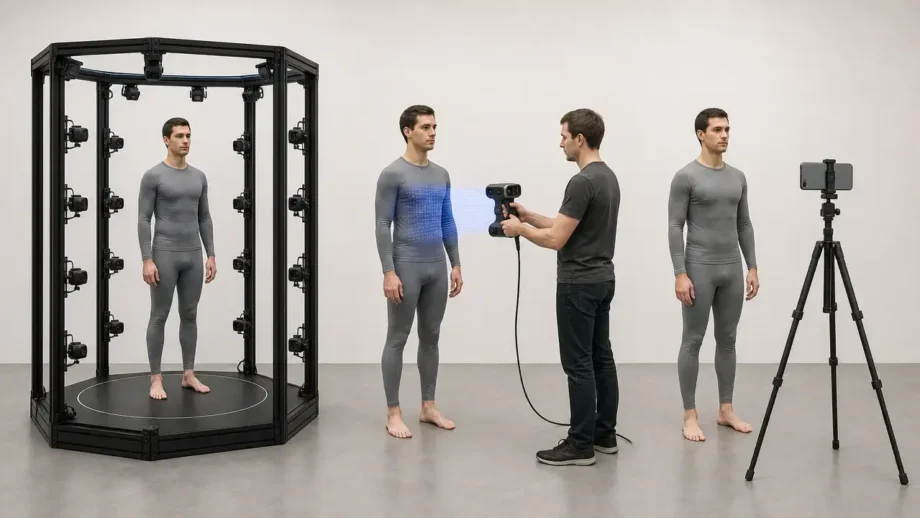
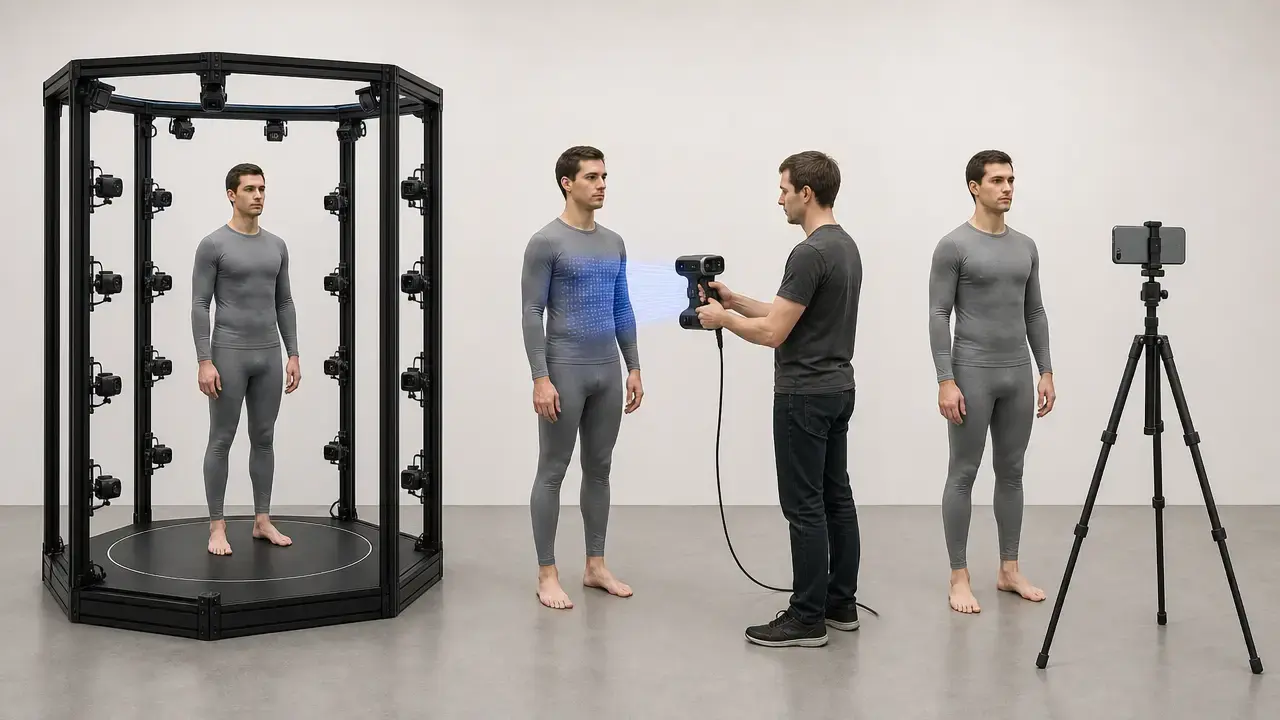
Body 3D scanning includes photogrammetry or passive stereo, structured light, laser-based triangulation, time-of-flight and other depth sensing, fixed multi-camera booths, handheld systems, and smartphone-assisted capture. In practice, results depend as much on the workflow as on the sensor itself: pose control, clothing and hair prep, calibration, registration, meshing, landmarking, and quality checks all affect whether the output is useful. There is no universal best full body 3D scanner. The right system depends on the use case — standardized measurements, avatars, printing, ergonomics, or research — and on whether the workflow has been validated for that task. [8] [1] [3]
What Human Body 3D Scanning Captures (and What It Doesn’t)
Human body scanning records external surface geometry and, in some systems, surface appearance. Typical deliverables are a point cloud, a surface mesh, and sometimes a texture map, along with software-generated landmarks and derived anthropometric measurements. ISO 7250-1 is the measurement basis commonly used when standardized dimensions are extracted from 3D scan data. [3]
Outputs: direct vs derived
| Output category | What it is | Is it raw sensor output? |
|---|---|---|
| Raw depth or points | Surface samples captured as depth pixels or 3D points | Usually yes |
| Mesh or texture | A reconstructed surface and optional color or appearance layer | Usually processed |
| Derived measurements | Circumferences, lengths, breadths, heights, inseam, and similar outputs computed from the scan | No |
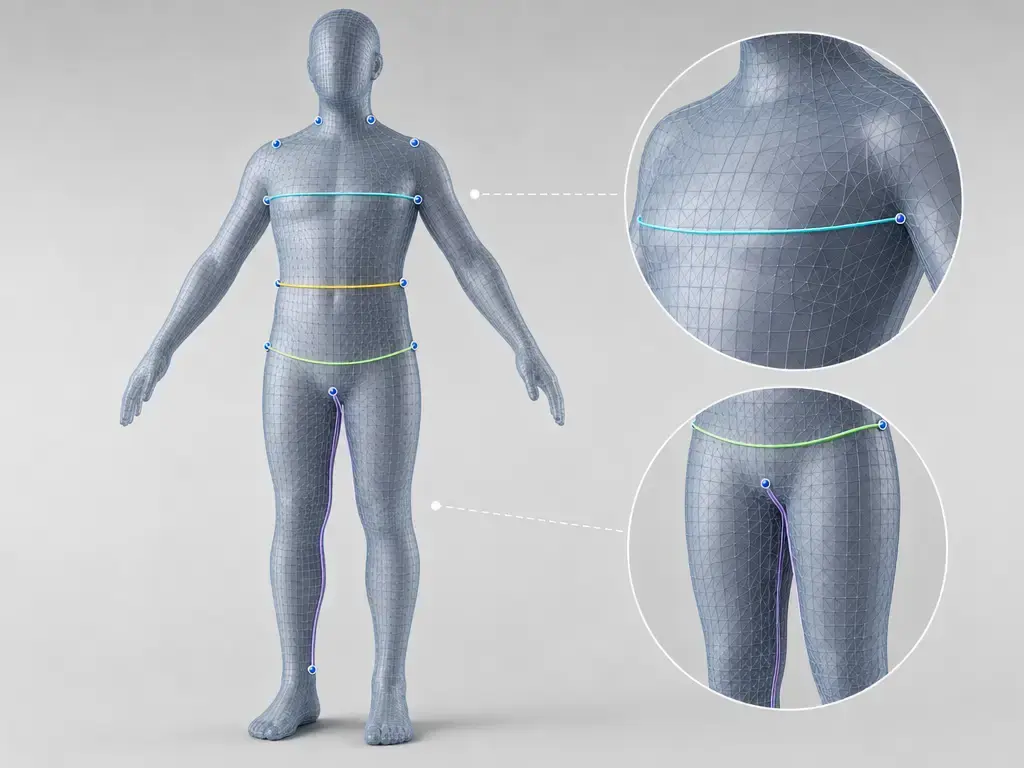
A point cloud is a set of sampled 3D surface points. A mesh is a reconstructed connected surface built from those points or from depth data so the body can be visualized, cleaned, measured, simplified, or exported. Texture adds appearance information, but it is not the same as geometric measurement. Landmarks are another derived layer: software, an operator, or both identify anatomical reference locations and use them to calculate anthropometric measurements. In other words, the scanner captures surface data, while many of the outputs people care about most are computed later from that surface according to a rule set. That distinction matters because a visually complete mesh does not automatically guarantee a reliable waist, inseam, or chest value. It also matters for terminology: measurement accuracy is closeness to a true value, and VIM treats it as a property of measurement results rather than a standalone numeric quantity. [3] [6]
Body scanning does not directly image internal anatomy, diagnose disease, or reveal body composition from geometry alone. If a system reports body fat percentage or similar estimates, those results are model-based and need separate validation against an appropriate reference method. For anthropometric work, the relevant question is whether the scan supports the required external measurements consistently and according to the selected landmark and measurement standard. [3]
Body 3D Scanning Method Families
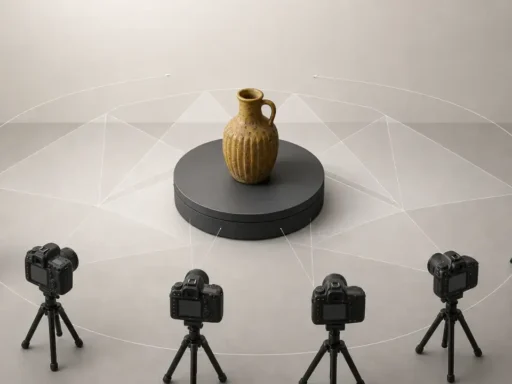
Body 3D scanning methods differ mainly in how they infer surface shape, and those differences affect speed, detail, coverage, and tolerance to movement. Reviews of body-measurement systems commonly group the core sensing approaches into passive stereo, structured light, and time-of-flight imaging, with practical products also using laser triangulation, fixed multi-camera installations, handheld sweeps, or hybrid combinations. In use, the best method is less about the label and more about whether the workflow prioritizes throughput, portability, texture, or motion tolerance. [8]
Common method families
- Photogrammetry or passive stereo.
- Structured light.
- Laser triangulation.
- Time-of-flight or other depth sensing.
- Multi-camera booths.
- Hybrid systems.
| Method family | How it works | Best suited for | Main limitations |
|---|---|---|---|
| Photogrammetry or passive stereo | Reconstructs shape from overlapping images and viewpoint geometry | Low-contact capture, texture-rich scenes, flexible camera setups | Sensitive to motion, pose drift, and weak texture |
| Structured light | Projects a known pattern and reads its deformation on the body surface | Controlled capture with good geometric detail | Needs stable subject pose and controlled capture conditions |
| Laser triangulation | Estimates depth from known laser-camera geometry | Detailed surface capture and guided handheld workflows | Can be operator-sensitive and harder on moving subjects |
| Time-of-flight or depth sensing | Estimates distance from active depth measurements | Faster capture and larger working volumes | Often lower fine-detail fidelity than controlled high-end setups |
| Multi-camera booths | Captures many synchronized views around the person | Throughput and broad coverage in fixed installations | Installation, calibration, and workflow rigidity |
| Hybrid systems | Combines two or more sensing modes | Flexibility across different tasks | More complex processing and validation |
Photogrammetry vs structured light body scanning
Photogrammetry uses multiple images to recover 3D shape from overlap across viewpoints, so it depends heavily on consistent pose, visible features, and enough surface texture to match points across images. Structured light instead projects a known pattern and reconstructs the body from the way that pattern deforms on the surface. In practice, photogrammetry is often more sensitive to subject motion and texture quality, while structured light is more dependent on controlled geometry between projector and cameras and on a stable capture volume. That is why photogrammetry vs structured light body scanning is usually a workflow decision as much as a sensor decision. Reviews of body measurement systems treat both as common approaches, alongside time-of-flight imaging. [8]
Laser triangulation and time-of-flight systems sit in a different part of the trade-off space. Laser triangulation infers depth from known geometry between a projected laser and imaging system, while time-of-flight and related depth sensors estimate distance from the behavior of emitted light. Multi-camera booths reduce occlusion by seeing the body from many angles at once, whereas handheld systems trade fixed installation for operator mobility. Hybrid products mix depth, color, or laser channels to improve coverage or robustness, but that can make the downstream pipeline more complex. [8]
Smartphone and app-based body scanning should be treated as a separate category rather than a direct substitute for a dedicated body scanner. On the sensing side, Apple’s TrueDepth camera is a structured-light example that combines a color camera, an infrared camera, and a structured-light projector, while ARKit’s ARDepthData exposes per-pixel depth in meters and can provide a confidence map. Google’s ARCore Depth API uses depth-from-motion and can merge hardware depth sensors when available; its documentation notes that depth is most accurate at roughly 0.5 m to 5 m from the scene. On the validation side, one smartphone anthropometric study reported waist-circumference mean absolute error of about 3.4 ± 2.6 cm and RMSE of 4.4 cm, despite high reported correlations. That shows feasibility under a defined protocol, not blanket equivalence to every dedicated measurement workflow. [16] [15] [17] [14]
Full-Body Scan Workflow
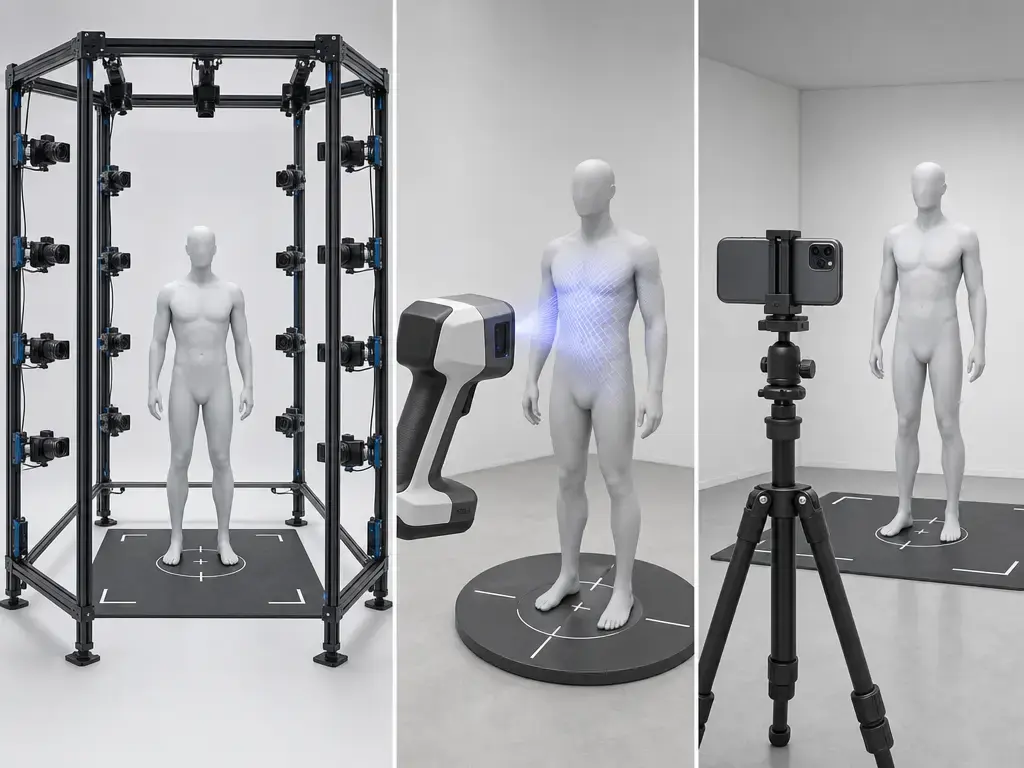
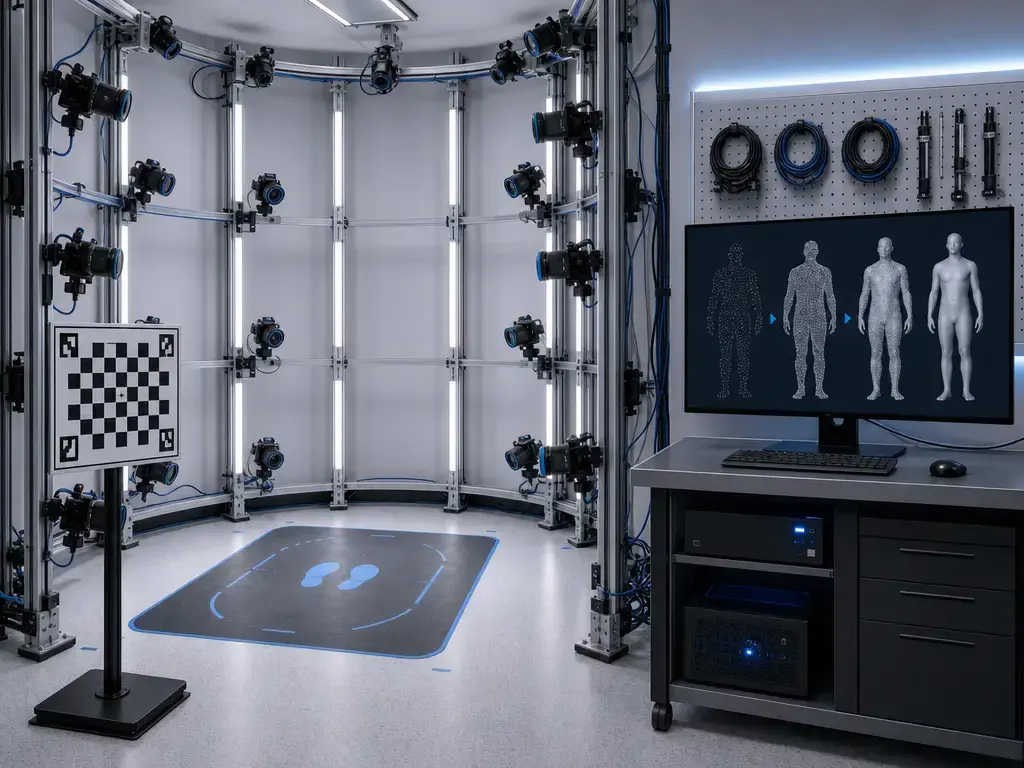
A full-body scan is a repeatable pipeline, not a single capture event. Results depend on use-case definition, subject preparation, calibration, pose control, motion management, registration, surface reconstruction, landmarking, and quality assurance. Reviews of body-measurement workflows note that stationary systems often capture in seconds while handheld workflows can take minutes, and faster capture can reduce motion artifacts simply because the subject has less time to breathe, sway, or fidget. Reproducibility work in the field likewise treats calibration and subject protocol as part of the measurement method, not as background detail. In one reliability study, subjects were scanned motionless in an anatomic standing position at end of expiration. [8] [12]
A practical workflow typically includes the following steps.
- Consent + use case definition. Decide whether the goal is measurement, avatar creation, print, fit analysis, or another output, and get informed consent for the intended use and storage.
- Clothing and hair prep. Reduce interference from loose garments, reflective materials, and hair that can hide landmarks or distort the visible surface.
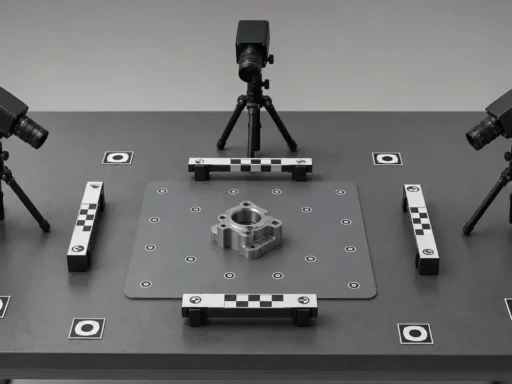
- Calibration. Calibrate the system before capture, and redo calibration when the setup changes, after transport, after major environmental change, or when the software indicates it is needed.
- Pose definition + landmark visibility plan. Standardize stance, arm position, head orientation, and any landmark-visibility strategy before capture begins.
- Capture. Run the acquisition as a single-shot, synchronized booth capture, handheld sweep, or phone-guided session.
- Registration or alignment. If the system uses multiple views or frames, align them into one coordinate system.
- Noise cleanup or hole handling. Remove outliers, trim artifacts, and assess missing regions.
- Meshing, remeshing, or simplification. Build a usable surface and adapt it for measurement, visualization, or export needs.
- Texture mapping, if needed. Add or refine surface appearance for review, avatars, or downstream visualization.
- Landmarking + measurement extraction rules. Apply the chosen landmark and measurement definitions to compute circumferences, lengths, and other outputs.
- QA. Check coverage, drift, consistency, and, when necessary, perform repeat scans.
- Export + retention policy. Export the required files and measurements, then retain or delete them according to the agreed handling policy.
The key point is that scan time is only one step in a longer chain. A phone-based workflow study, for example, mounted an iPhone 14 Pro on a tripod 1.7 m from the subject, asked the subject to rotate 360°, and captured 150 images over 10 s before later reconstruction and normalization steps. That kind of protocol sensitivity is not unique to phones; it is typical of body scanning more broadly. If the use case is measurement, the operator also needs a landmark-visibility plan, consistent breathing instructions where relevant, and a rule for when to rescan. [14] [12]
From Geometry to Measurements: Landmarks, Pose, and Algorithms
A surface scan becomes an anthropometric dataset only after software and protocol turn geometry into defined measurements. The chain is straightforward: capture the external surface, reconstruct it into a usable representation, identify landmarks, apply a measurement definition, and calculate the final value. ISO 7250-1 anchors the measurement names and landmark concepts used for standardized body dimensions, while ISO 20685-1 addresses 3-D surface-scanning used to acquire body shape data and measurements defined in ISO 7250-1. ISO 20685-2 frames testing protocols for surface-scanning systems and includes scope limits relevant to evaluation. [3] [1] [2]
| Measurement error source | What changes | Typical symptom in outputs | Mitigation |
|---|---|---|---|
| Scanner geometry error | The captured or reconstructed surface itself is distorted | Warped shape, shifted dimensions, inconsistent global form | Calibration, stable setup, reference-object checks |
| Software measurement error | The algorithm or rule used to derive a measurement changes | Different circumferences or lengths from the same mesh | Documented definitions, validated software, fixed extraction rules |
| Landmark or pose error | Landmark location or body posture changes between captures | Waist, inseam, shoulder, or torso values drift without obvious mesh failure | Standardized pose, breathing control, landmark protocol, repeat scans |
Scanner geometry error is not the same as software measurement error, and neither is the same as landmark or pose error. Two systems can produce meshes that look similar on screen yet still disagree on waist circumference, inseam, or shoulder breadth. One system may place the waist plane slightly higher, another may smooth the torso differently before tracing a contour, and a third may infer landmarks differently from the same body surface. That is why comparison work in this area is usually framed around compatibility and repeatability rather than around one universal ground-truth method for every output. [9]
This standards boundary matters as well. ISO 20685-1 and ISO 20685-2 concern 3-D surface scanning used for anthropometric measurements and testing, and both exclude instruments centered on measuring the location or motion of individual landmarks directly. They help frame evaluation of a measurement workflow, but they do not eliminate the need to validate the actual pipeline used on human subjects. A good-looking mesh can still produce poor anthropometric outputs if the pose rule, landmarking logic, or measurement algorithm is unstable. [1] [2] [9]
Performance Metrics
In body scanning, the most useful metrics are often the ones vendors define least clearly. Accuracy is closeness to a true value, and VIM notes that it is not itself a quantity with a single numerical value. Precision is closeness among replicate measurements under specified conditions and is often expressed using spread statistics. Resolution or point spacing describes the smallest distinguishable change or sampling increment in the output. Volumetric accuracy refers to how well a system preserves geometry across a larger 3D region. Scan time can mean shutter time, sweep time, or end-to-end workflow time, depending on how the claim is framed. [6] [7]
| Term | What it means (VIM-aligned) | How vendors often measure it | Why it misleads in body scanning |
|---|---|---|---|
| Accuracy | Closeness to a true or reference value | Error on a rigid reference object or in a preferred mode | A good mesh can still produce biased body measurements |
| Precision | Agreement among repeated measurements under stated conditions | Repeat scans under one setup or operator | Tight repeats can still all be offset |
| Resolution | Smallest distinguishable increment or feature sampling | Point spacing, pixel size, or mesh density | Fine sampling does not guarantee correct landmarks or circumferences |
| Volumetric accuracy | Shape fidelity across a larger 3D region | Deviation across a test object or volume | Local detail and whole-body dimensional fidelity can differ |
| Scan time | Duration of capture or workflow completion | One-shot time, sweep time, or total throughput | Fast capture may still need long registration and cleanup |
Vendor “up to” specifications are poor predictors of on-body measurement error unless you know the mode, distance or working volume, test object, and stitching conditions behind the number. Motion, breathing, soft tissue, occlusion, pose changes, and landmark ambiguity can dominate the result on living subjects even when the rigid-object spec looks excellent. Mode dependence alone can be significant: the EinScan H2 lists manufacturer accuracy claims of up to 0.05 mm in white-light mode and up to 0.1 mm in IR mode, which illustrates that a quoted number may describe one operating mode rather than universal performance. The point is not that the claim is wrong, but that it is conditional — and the page is not a human-subject validation study. [20]
A better way to read specifications is to pair them with protocol context. One reproducibility paper described a multi-camera white-light scanner with 32 cameras, 16 sensors, up to 1,600,000 data points, a scan field of 2.1 m × 1.2 m × 0.6 m, and a 7 s scan time; under that paper’s described setup, the software was reported as giving point accuracy below 1 mm and circumferential accuracy below 3 mm. Those figures are informative, but only in the context of that specific system, subject position, and measurement workflow. Cross-system comparison work shows the same problem from another angle: example outputs from four systems were reported at 40 s, 20 s, 3 s, and 5 s, with large differences in vertex counts and file sizes. “Fast” does not automatically mean “best for measurement,” and “dense mesh” does not automatically mean “better anthropometry.” [12] [11]
For standards-aware evaluation, the question is not whether a scanner is accurate in the abstract. It is whether the scanner and its workflow produce repeatable, compatible measurements for the intended population, pose, and task. ISO 20685-1 and ISO 20685-2 frame anthropometric surface-scanning and testing, while ISO 7250-1 defines the measurement basis, but none of those standards removes the need for validation under actual subject conditions. [1] [2] [3]
Metrics to ask vendors for
- What exactly does accuracy mean in this spec, and what reference object or subject condition was used?
- Is the number tied to a specific mode such as white light, IR, structured light, or another sensor path?
- Does the claim apply to single-shot capture, stitched sweeps, or multi-view registration?
- What distance, working volume, or scan field was used when the number was measured?
- Is the result based on a rigid object, a mannequin, or a human subject?
- What does scan time mean here: sensor exposure, sweep duration, or end-to-end throughput?
- What pose, clothing, and motion constraints are assumed?
- How are landmarks and measurements defined and extracted?
- What repeatability data exist for the actual measurements you care about?
- Which export formats and measurement outputs are available?
- What are the stated safety class and operating precautions for the specific device?
- What are the default privacy, storage, and retention options in the software workflow?
Applications and Real Uses
Human body scanning is used where external shape needs to be measured, compared, archived, or turned into a digital asset. In apparel and uniform sizing, ISO 8559-1 provides the anthropometric measurement list and terminology used for clothing size designation and databases, while ISO 15535 provides database-level requirements for anthropometric collections that use measurements taken according to ISO 7250-1. The CAESAR database overview is a useful historical reminder that collecting landmarks and standardized anthropometric measurements takes time and trained personnel, which is why many scan datasets contain surface models without a full measurement database attached. [4] [5] [25]
Typical application areas include:
- Apparel and uniform sizing.
- Orthotics and prosthetics surface capture.
- Ergonomics and workplace design.
- Sports and fitness monitoring.
- Avatars, VFX, games, and XR.
- 3D printed figurines.
- Research datasets and digital twins.
The same scan file can support different outputs, but not all outputs are equally validated. A workflow optimized for avatar realism may prioritize texture quality, surface completeness, and visual appeal. A workflow optimized for sizing may prioritize standardized landmarks, repeatable circumferences, and compatibility with measurement definitions. In ergonomics, the body model can help describe posture, seated geometry, or fit to environments without making diagnostic claims. In O&P-adjacent work, the value is surface capture for shape comparison and device-fitting workflows, not internal anatomy. For figurines and printed replicas, visual completeness may matter more than measurement traceability. The scan is only the starting point; the meaning of the result depends on the downstream rule set and validation target. [4] [25] [5]
Limitations, Artifacts, and Ethics
The biggest practical limits in human body scanning are often not headline resolution but motion and visibility. Breathing, sway, fidgeting, arm contact with the torso, and small posture changes can alter the shape being measured. Occlusion is a constant problem around underarms, inner thighs, torso sides, hands, and overlapping limbs. Hair, loose clothing, reflective materials, and patterned fabrics can interfere with geometry or landmark placement, while lighting and weak texture can reduce reconstruction quality in image-based workflows. These effects can dominate nominal resolution. A dense mesh may still be the wrong mesh for anthropometry if the subject moved or if the relevant landmark region was poorly captured. That is why waist measurement studies emphasize standardization: one paper showed that breathing cycle and posture affect both the magnitude and location of waist girth, and another reproducibility protocol explicitly used standing scans at end of expiration. [13] [12]
Privacy is a practical issue because a body scan can be biometric in the descriptive sense that body shape can help identify a person. That does not automatically make every body-scan workflow a legal special case, but it does mean governance should be planned before capture. In practice, that means clear consent, purpose limitation, retention rules, access control, and defined sharing policies. If scans are stored with names, dates, or linked records, the operational risk is higher than in a de-identified workflow.
A surface scan is not a diagnosis, and health-related interpretation requires separate validation and oversight. Safety claims are also device-specific rather than universal. Artec Leo documentation classifies the device as Laser Class 1 under EN 60825-1:2014 when used as intended and includes a 35 cm lens-viewing warning; Fit3D states that the ProScanner operates with a Class 1 laser; and EinScan H2 lists its IR mode as Class I, eye-safe. Those statements matter for those devices, but they should not be generalized to all body-scanning systems. [21] [22] [20]
Current Research and Market Context
The research base is active but still heterogeneous. A systematic review of camera-based markerless technologies used for anthropometric purposes reported a final search date of 2024-12-13, screened 1,778 records, and included 33 studies. For that circumference-focused purpose, it reported no included 4D studies. Here, 4D should be defined tightly as 3D surface over time — not just a single-shot multi-camera still capture, and not sparse marker-based motion capture. That gap matters because static anthropometric workflows and temporal surface-capture workflows are different evaluation cases. [10]
The current market is better understood as several workflow families than as one converged category. Booth systems are usually chosen for throughput and controlled repeatability, handheld systems for portability and flexible coverage, smartphone workflows for accessibility, and dynamic platforms for time-varying surface capture. As one manufacturer example, 3dMDbody positions its system around dynamic capture with options up to 120 fps. At the same time, cross-system comparison work shows that installed body scanners can differ sharply in scan time, mesh density, and file size, so market context is really a map of trade-offs rather than a single maturity curve. [23] [11]
Historical Notes
An earlier milestone in the standards trail is ISO 20685:2005, which is listed as withdrawn. Later revisions split the topic into ISO 20685-1:2018 for body dimensions extracted from 3-D body scans and ISO 20685-2:2023 for evaluation of surface shape and repeatability of relative landmark positions. The shift is useful because it mirrors how the field matured: the challenge is not only capturing a surface, but producing measurements and databases that are comparable enough to be useful. The CAESAR project’s long-running lesson still applies: standardized landmark collection is labor-intensive, which is one reason a surface model alone is not the same as a ready-made anthropometric database. [24] [1] [2] [25]
Standards and Validation Boundaries
ISO 20685-1 and ISO 20685-2 are anthropometric standards, not universal certification labels for every human-body scanning task. ISO 20685-1 addresses protocols for 3-D surface-scanning used to acquire human body shape data and measurements defined in ISO 7250-1 that can be extracted from scans, and it does not apply to instruments that measure the location and/or motion of individual landmarks. ISO 20685-2 establishes protocols for testing 3-D surface-scanning systems used to acquire body shape data and measurements, applies mainly to whole-body and segment scanners that measure the human body in a single view, and likewise does not apply to instruments that measure motion of individual landmarks. [1] [2] [3]
That boundary matters because an anthropometric evaluation workflow is not the same as an avatar, VFX, figurine, or motion-capture workflow. A scan can be visually excellent for XR or printing while still being poorly controlled for waist, inseam, or shoulder-breadth extraction. Conversely, a measurement-oriented workflow may be highly standardized but visually plain. ISO 20685-1 and ISO 20685-2 therefore help evaluate compatibility and testing for surface-scanned anthropometric measurements; they do not certify avatar realism, figurine aesthetics, or landmark-motion capture systems. [1] [2]
File Outputs and Downstream Deliverables
A body scan becomes practical only when its outputs fit the next tool in the chain. Some workflows need a point cloud or measurement report, some need a watertight mesh, and some need textured geometry for visualization or avatars. Those outputs are not interchangeable. A measurement workflow may care more about clean geometry and exported dimensions than about color appearance, while a print or avatar workflow may care more about surface continuity and texture. [18]
Export support varies by ecosystem. Artec Studio lists surface exports such as OBJ, PLY, WRL, and STL, and measurement-related exports such as CSV, DXF, and XML depending on edition. Styku states that scans can be exported to OBJ and STL. EinScan H2 lists OBJ, STL, ASC, PLY, P3, and 3MF among its output formats. The practical lesson is simple: do not assume every system exports editable measurements, and do not assume every downstream workflow needs texture. [18] [19] [20]
How to Choose a 3D Scanner for Human Body Projects
There is no universal best scanner for body measurement or body capture more broadly. The right choice depends on what you need to validate. If the project is about standardized anthropometric measurements, prioritize documented landmarking, repeatability, compatible measurement definitions, and evidence that the workflow works on the intended population. If the project is about avatars, XR, or figurines, prioritize surface completeness, texture handling, cleanup burden, and export compatibility. If the project is about throughput, fixed multi-camera systems may make sense; if it is about portability, handheld or phone-assisted approaches may fit better, but they usually demand more protocol discipline. Privacy constraints may also push the decision toward workflows with simpler retention and sharing controls. Comparisons should be grounded in compatibility and repeatability rather than abstract “best” claims, and phone-based capture should be judged carefully because strong correlations can still coexist with centimeter-level absolute error for some measurements. [9] [11] [14]
The best decision framework is workflow-first: match the scanner to the validated use case, not to the prettiest spec sheet.
If you only remember 3 things…
- There is no universal best scanner.
- Match the scanner to the validated use case.
- Compare workflows, not just specifications.
FAQ
What is a 3D scanner for human body used for (and what is it not used for)?
It is used to capture external body surface geometry for tasks such as measurement extraction, sizing, avatars, printing, ergonomics, and research. It is not an internal-imaging tool, and the ISO body-scanning standards discussed here are about surface-based anthropometric measurement workflows rather than diagnosis or internal anatomy. [1] [3]
What are the main body 3D scanning methods?
The main body 3D scanning methods include photogrammetry or passive stereo, structured light, laser triangulation, time-of-flight or related depth sensing, fixed multi-camera booth capture, handheld capture, and hybrid systems. Different workflows balance motion tolerance, coverage, portability, and detail differently. [8]
Photogrammetry vs structured light body scanning: which should you choose?
Choose based on workflow, not slogans. Photogrammetry depends heavily on overlapping images, stable pose, and enough visible texture, while structured light depends on projected-pattern geometry and controlled capture conditions. Neither is automatically better in every body-scanning task. [8]
How accurate is a full body 3D scanner for measurements like waist and inseam?
That depends on three separate things: the geometric quality of the captured surface, the subject’s pose and motion, and the landmarking or measurement algorithm used afterward. VIM also cautions that accuracy is not a single numeric quantity by itself. In practice, similar-looking meshes can still produce different circumferences if the systems define landmarks or trace measurement paths differently. [6] [7] [9]
What is the best 3D scanner for human body measurement?
There is no universal best. A good choice for standardized measurements may be different from a good choice for avatars, portability, or fast throughput. The most defensible comparison is based on validated workflow fit, repeatability, and measurement compatibility, not on a single advertised specification. [9] [11]
How do ISO 20685-1 and ISO 20685-2 apply to evaluating a scanner workflow — and where do they not apply?
They apply to 3-D surface-scanning workflows used to acquire anthropometric body shape data and measurements, and to testing such systems within that measurement context. They do not certify avatar, VFX, figurine, or landmark-motion workflows, and they exclude instruments focused on measuring the location or motion of individual landmarks directly. [1] [2]
Why can two systems produce similar-looking meshes but different circumferences?
Because circumferences are derived outputs, not raw sensor observables. Differences in pose, landmark placement, smoothing, contour height, segmentation, and measurement rules can change the final number even when the rendered surfaces look similar. [3] [9]
Sources
The numbered sources below match the in-text citations.
- ISO 20685-1:2018 — 3-D scanning methodologies for internationally compatible anthropometric databases — Part 1. https://www.iso.org/standard/63260.html (Accessed 2026-09-26)
- ISO 20685-2:2023 — 3-D scanning methodologies for internationally compatible anthropometric databases — Part 2. https://www.iso.org/standard/84350.html (Accessed 2026-09-26)
- ISO 7250-1:2017 — Basic human body measurements for technological design — Part 1. https://www.iso.org/standard/65246.html (Accessed 2026-09-26)
- ISO 8559-1:2017 — Size designation of clothes — Part 1. https://www.iso.org/standard/61686.html (Accessed 2026-09-26)
- ISO 15535:2023 — General requirements for establishing anthropometric databases. https://committee.iso.org/cms/live/live/en/sites/isoorg/contents/data/standard/08/25/82541.html (Accessed 2026-09-26)
- JCGM/BIPM Annotated VIM3 — Measurement accuracy (2.13). https://jcgm.bipm.org/vim/en/2.13.html (Accessed 2026-09-26)
- JCGM/BIPM Annotated VIM3 — Measurement precision (2.15). https://jcgm.bipm.org/vim/en/2.15.html (Accessed 2026-09-26)
- Bartol et al. — A Review of Body Measurement using 3D Scanning (PDF). https://www.move4d.net/wp-content/uploads/2023/03/A_Review_of_Body_Measurement_using_3D_Scanning_compressed-1.pdf (Accessed 2026-09-26)
- IEEE SA Industry Connections — Comparative Analysis of Anthropometric Methods… (PDF). https://standards.ieee.org/wp-content/uploads/2022/06/comparative-analysis-anthropometric-methods.pdf (Accessed 2026-09-26)
- Scataglini et al. — Exploring and analysing 3D and 4D camera based markerless technologies… systematic review (PubMed record). https://pubmed.ncbi.nlm.nih.gov/40945183/ (Accessed 2026-09-26)
- Peer-reviewed device-output comparison (open access). https://pmc.ncbi.nlm.nih.gov/articles/PMC9990507/ (Accessed 2026-09-26)
- Lopez-Jimenez et al. — Reliability of a 3D Body Scanner for Anthropometric Measurements of Central Obesity (open access). https://pmc.ncbi.nlm.nih.gov/articles/PMC5189636/ (Accessed 2026-09-26)
- Njoku et al. — Breathing Cycle and Posture Affect… Waist Girth… (3D Scanning) (3DBODY.TECH). https://proc.3dbody.tech/papers/2018/18190njoku.pdf (Accessed 2026-09-26)
- McCarthy et al. — Beyond Body Mass Index… With 3D Smartphone Application (open access). https://pmc.ncbi.nlm.nih.gov/articles/PMC11606355/ (Accessed 2026-09-26)
- Apple Developer — ARDepthData (ARKit). https://developer.apple.com/documentation/arkit/ardepthdata (Accessed 2026-09-26)
- Apple (archive) — TrueDepth Camera (Device Compatibility: Cameras). https://developer-mdn.apple.com/library/archive/documentation/DeviceInformation/Reference/iOSDeviceCompatibility/Cameras/Cameras.html (Accessed 2026-09-26)
- Google Developers — ARCore Depth API overview. https://developers.google.com/ar/develop/depth (Accessed 2026-09-26)
- Artec 3D — Artec Studio tech specs (export formats, measurement exports). https://www.artec3d.com/3d-software/artec-studio/tech-specs (Accessed 2026-09-26)
- Styku — Export OBJ/STL support article. https://www.styku.com/en-us/support-kb/can-i-export-a-scan-to-use-with-a-3d-printer-or-other-3d-software-can-i-make-a-3d-print-of-my-scans (Accessed 2026-09-26)
- EinScan — EinScan H2 specs (mode-separated accuracy + Class I statement). https://www.einscan.com/handheld-3d-scanner/einscan-h/einscan-h2-specs/ (Accessed 2026-09-26)
- Artec 3D — Artec Leo safety & handling (Laser Class 1). https://docs.artec3d.com/leo_/1.8/safety-handling.html (Accessed 2026-09-26)
- Fit3D — Scan Safety (Class 1 laser statement). https://service.fit3d.com/knowledge/scan-safety (Accessed 2026-09-26)
- 3dMD — 3dMDbody system page (dynamic capture specs + technique claims). https://3dmd.com/3dmdbody/ (Accessed 2026-09-26)
- ISO 20685:2005 (withdrawn) — historical reference. https://www.iso.org/standard/35514.html (Accessed 2026-09-26)
- CAESAR database overview (HumanShape.org). https://www.humanshape.org/CAESAR/ (Accessed 2026-09-26)