
Summary
How much does 3d printer filament cost? In U.S.-visible USD snapshots accessed 2026-09-10, commodity PLA and PETG examples appeared around $19.99/kg on refill, sale, or regular listings, while higher-priced examples included Prusament PA11 Natural at $93.43 for 800 g, which normalizes to $116.79/kg, and UltiMaker PVA at $99.95 for 750 g, which normalizes to $133.27/kg. Unless a seller states otherwise, treat these sticker prices as excluding shipping, taxes, and duties. [S20] [S21] [S22] [S23] [S24] [S25] [S26] [S29]
A 3d printer filament price only becomes comparable after you normalize it by net filament weight, because “a spool” can mean 500 g, 750 g, 800 g, 900 g refill, or 1 kg. The same material can also appear as regular, sale, bulk-threshold, refill, with-spool, or discounted category-listing pricing. For budgeting, convert the listing to price per kg, then to cost per gram, then multiply by the slicer’s total consumed grams for that print setup, not just the finished part’s visible mass. [S21] [S22] [S24] [S25] [S26] [S28] [S29] [S10] [S11] [S9]
Sampled filament prices (USD) normalized to $/kg (accessed 2026-09-10)
| Product + price label | Net weight | Listed price (USD) | Normalized price ($/kg) |
|---|---|---|---|
| Bambu PLA Basic, refill | 1 kg | $19.99 | $19.99/kg |
| Creality Hyper Series PLA, sale | 1 kg | $19.99 | $19.99/kg |
| HATCHBOX Natural PLA, regular | 1 kg | $21.99 | $21.99/kg |
| Prusament PLA, discounted category listing | 1 kg | $25.49 | $25.49/kg |
| Bambu PETG Translucent, refill | 1 kg | $19.99 | $19.99/kg |
| Prusament PETG Ultraglow Green, discounted category listing | 800 g | $65.32 | $81.65/kg |
| UltiMaker S Series PLA, regular | 750 g | $39.00 | $52.00/kg |
| UltiMaker PVA, regular support material | 750 g | $99.95 | $133.27/kg |
| Prusament PA11 Natural, regular | 800 g | $93.43 | $116.79/kg |
Table values are direct list prices or simple listed-price ÷ net-weight normalizations from the cited manufacturer pages accessed 2026-09-10. [S20] [S21] [S22] [S23] [S24] [S25] [S26] [S29]
What Counts as 3D Printer Filament (and What Doesn’t)
Here, “filament” means thermoplastic feedstock supplied as spool or refill material for material-extrusion 3D printing, the family usually called FDM or FFF in desktop use. ISO/ASTM 52900:2021 provides the vocabulary anchor for additive-manufacturing terminology, and ISO/ASTM 52903-1:2020 frames how requirements for plastic materials are defined for extrusion-based AM processes, but neither standard sets consumer spool sizes or retail pricing. Commercial filament is commonly sold in 1.75 mm or 2.85 mm diameters, and literature examples span roughly 300 g to 2 kg packages. Resin, powder-bed fusion powders, metal AM feedstock, and service-bureau pricing are out of scope here, and pellets or granules are different feedstock forms rather than spool or refill filament. [S1] [S2] [S3]
Why “A Spool” Isn’t a Unit (Diameter, Weight, Refills)
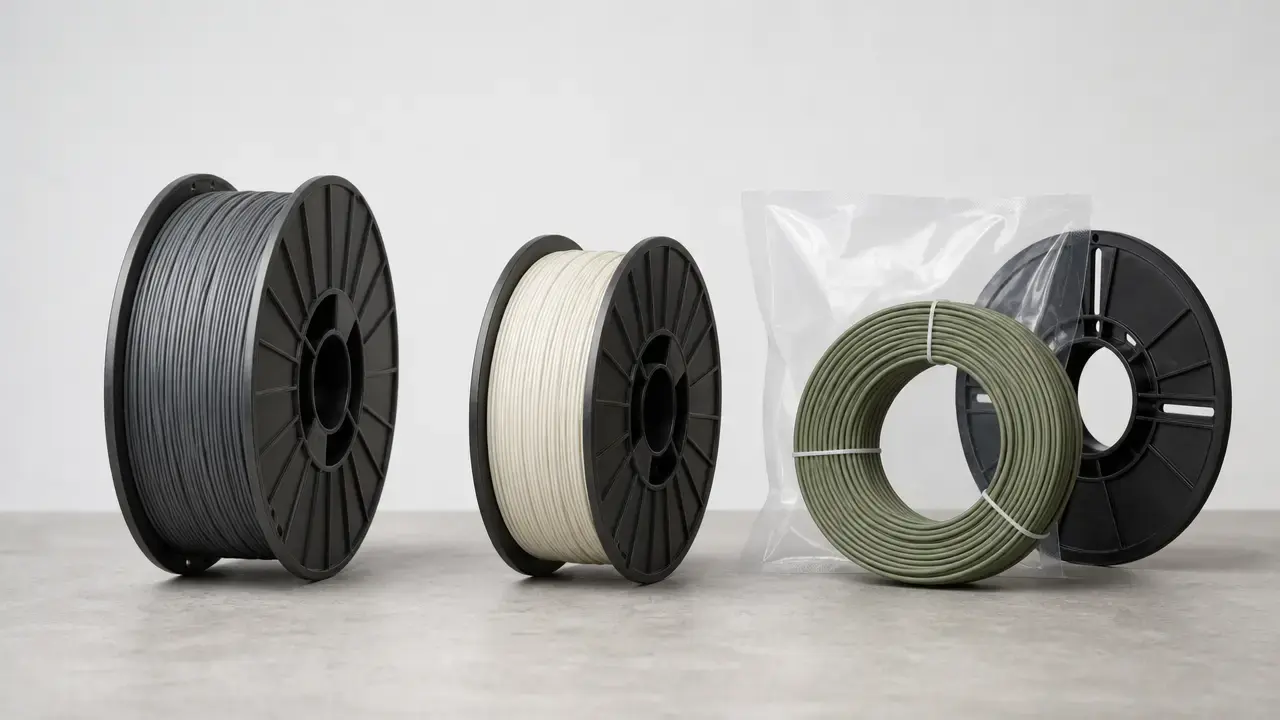
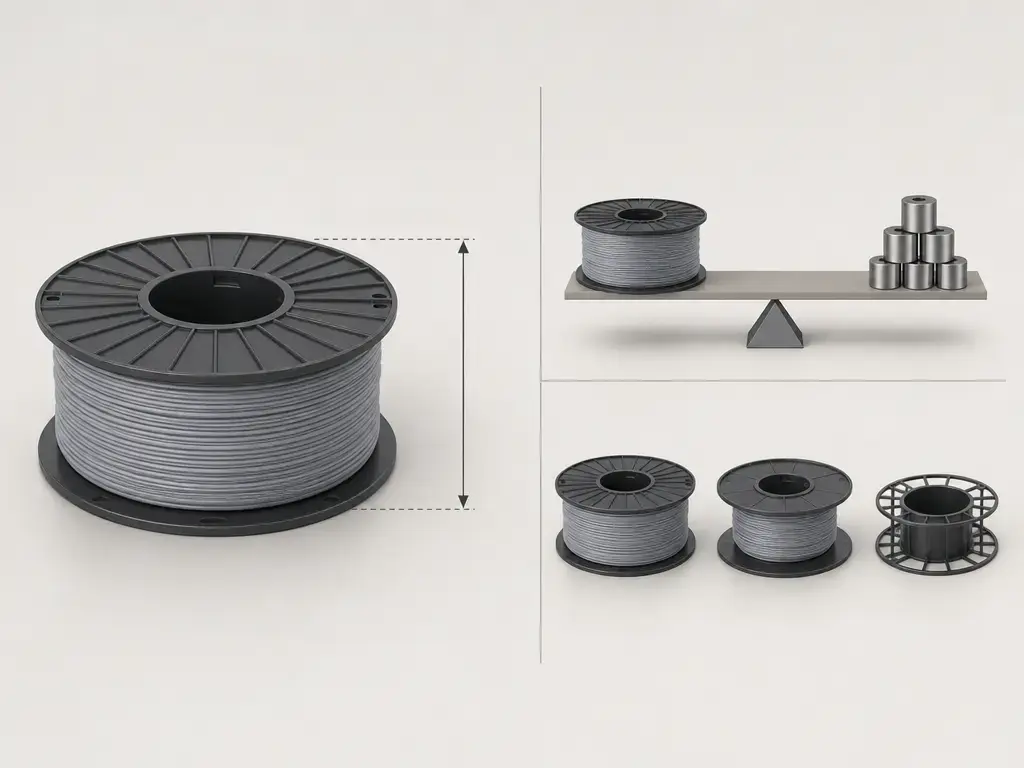
Filament is not sold in one universal package size, so “a spool” is a poor pricing unit. The market commonly includes 1.75 mm and 2.85 mm diameters, and published examples in the literature run from roughly 300 g to 2 kg. That means a 500 g TPU spool, a 750 g PLA spool, an 800 g nylon spool, and a 1 kg PLA spool can all look similar at a glance even though their sticker prices are not directly comparable. The fair comparison is net filament weight first, then normalized price per kg. [S3]
Refills make the comparison trickier. Bambu’s official pricing table separates with-spool and refill pricing for PLA, PETG, and ABS, which is a reminder that refill is refill-only pricing, not the true first-purchase cost if you still need the reusable spool. Bulk-threshold pricing is a separate case again and should not be discussed as if it were a one-roll shelf price. [S21]
Price per Spool vs Price per kg vs Cost per Gram (The Only 3 Numbers You Need)
For material-only budgeting, these are the three numbers that matter:
- Price per kg = listed price ÷ net kg.
- Cost per gram = price per kg ÷ 1000.
- Filament cost per print = cost per gram × slicer total consumed grams. [S9]
These formulas still work when packaging changes. UltiMaker S Series PLA is a regular 750 g listing at $39.00, which normalizes to $52.00/kg, while UltiMaker PVA is a regular 750 g support-material listing at $99.95, which normalizes to $133.27/kg. Prusament TPU 95A Jet Black is a regular 500 g listing at $34.99, which normalizes to $69.98/kg; Prusament ASA at $25.92 for 800 g normalizes to $32.40/kg; and Prusament PA11 Natural at $93.43 for 800 g normalizes to $116.79/kg. Once you know cost per gram, you can multiply it by the grams used per print from your slicer to get a transparent material budget. [S29] [S28] [S27] [S26] [S9]
PLA Filament Price per kg
In U.S.-visible snapshots accessed 2026-09-10, the current PLA filament price per kg spans several price states rather than one market number. Bambu PLA Basic showed $19.99 for 1 kg on its product page, and Bambu’s official filament table separated that into $22.99 with-spool pricing and $19.99 refill pricing, with 4+ roll bulk-threshold pricing at $17.99 with spool and $14.99 refill. Creality Hyper Series PLA showed a 1 kg sale price of $19.99, was $32.99, and listed bulk-threshold pricing at $16.99 each for 5, $15.99 each for 10, and $14.99 each for 20. HATCHBOX Natural PLA showed a regular 1 kg price of $21.99, and Prusament’s PLA category showed multiple 1 kg spools in stock at $25.49 as discounted category listings with a -15% label. [S20] [S21] [S22] [S23] [S24]
Those numbers should not be mixed together as if they described the same buying situation. Refill pricing is not the same as a first spool, and bulk-threshold pricing is not the same as a single-roll checkout. Density only enters the discussion because slicers use it to estimate weight: Bambu PLA Basic’s TDS lists density at 1.24 g/cm³ and net filament weight at 1 kg, which helps explain how slicers turn geometry into gram estimates without making density itself the cost metric. [S21] [S32]
PETG Filament Cost per Spool
PETG filament cost per spool can overlap PLA at the commodity end and climb much higher in specialty grades. In U.S.-visible snapshots accessed 2026-09-10, Bambu’s official table listed PETG Translucent at $22.99 with spool and $19.99 refill, with 4+ roll bulk-threshold pricing at $17.99 with spool and $14.99 refill. Prusament’s PETG category showed baseline 1 kg discounted category listings at $25.49, but it also listed PETG Carbon Fiber Black at $46.74 for 1 kg and PETG Ultraglow Green at $65.32 for 800 g, which normalizes to $81.65/kg. So PETG is not automatically pricier than PLA; commodity PETG can land near commodity PLA, while filled or effect PETG can move much higher. For slicer and workflow context, Bambu’s PETG HF TDS lists density at 1.28 g/cm³ and drying guidance of 65 °C for 8 h, which matters as a handling-cost caveat rather than a retail-pricing rule. [S21] [S25] [S33]
Other Filaments: ABS/ASA, TPU, Nylon/PA, and Support Materials
ABS / ASA
In snapshots accessed 2026-09-10, Bambu’s official table listed ABS at $22.99 with spool and $19.99 refill, with 4+ roll bulk-threshold pricing at $17.99 with spool and $14.99 refill. Prusament’s ASA category showed regular 800 g spools in stock at $25.92, which normalizes to $32.40/kg. Even when ABS or ASA sticker prices look close to commodity PLA or PETG, enclosure needs and failed-print risk can raise real material spend because repeats and scraps still consume filament. [S21] [S27]
TPU
TPU is a good example of why sticker price alone misleads. Prusament TPU 95A Jet Black was listed in stock at $34.99 for 500 g on 2026-09-10, which normalizes to $69.98/kg. That is not just “a $35 spool”; it is a half-kilogram spool at roughly three-and-a-half times the per-kilogram cost of a $19.99 commodity roll. [S28]
Nylon / PA
Nylon, often sold as PA, is one of the clearest examples of a higher-cost engineering filament. Prusament PA11 Natural was listed in stock at $93.43 for 800 g on 2026-09-10, which normalizes to $116.79/kg. That puts it far above the commodity PLA and PETG examples in this article, which is why nylon is usually budgeted more like a specialty material than a casual default spool. [S26]
Support materials
Support spend falls into three cases. First, same-material supports use the same spool as the part, so there is no extra support SKU, but the grams still count. Second, dedicated breakaway support is a separate filament class; UltiMaker Breakaway was listed at $69.95 for 750 g on 2026-09-10. Third, dedicated soluble support is often costlier again; UltiMaker PVA was listed at $99.95 for 750 g, which normalizes to $133.27/kg. Formlabs gives broader context of about $100–$200/kg for support materials, and its professional-ecosystem framing also places soluble supports in that higher band. That is why a multi-material job can end up spending more on supports, purge, and interface structures than on the visible model body. [S29] [S7] [S8]
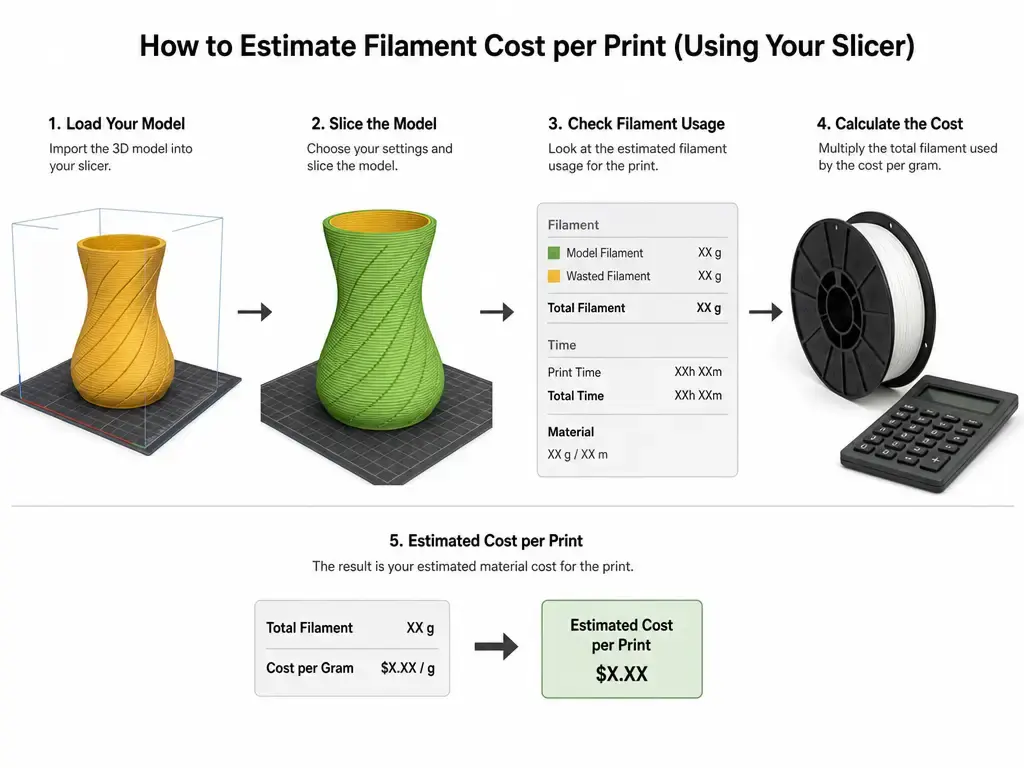
How to Estimate Filament Cost per Print (Using Your Slicer)
Use the slicer’s total consumed grams for that exact print setup. In plain terms, that means part material plus supports, purge or wipe structures, priming, and other auxiliary geometry, not just the model’s visible mass. [S10] [S11] [S9]
Most slicers can handle this once material data is entered. PrusaSlicer documents explicit inputs for filament cost per kg and filament density, while Cura’s replacement-pattern documentation includes {filament_weight} and {filament_cost} placeholders when density and price are known. That is why a good slicer filament estimate is usually more reliable than guessing from spool size alone. Technical sheets help when you need density for the conversion layer: Bambu PLA Basic’s TDS lists 1.24 g/cm³, and Bambu PETG HF’s TDS lists 1.28 g/cm³. [S10] [S11] [S32] [S33]
Worked example: if your slicer reports 150 g total consumed, treat that as an example setup total, not a typical print. At $19.99/kg, the cost per gram is $0.01999/g, so 150 g comes to about $3.00 in material. At $25.49/kg, the cost per gram is $0.02549/g, so the same 150 g comes to about $3.82. That is the whole idea behind filament cost per print: use the setup total, multiply by material cost per gram, and keep it separate from machine time, labor, and other overhead. [S20] [S25] [S9]
What to add to the slicer estimate
- supports
- brim/raft
- purge/wipe tower
- priming line
- failures
- calibration
- leftover unusable length
- shipping/taxes if budgeting
Why Some Filament Costs Much More (What You’re Paying For)
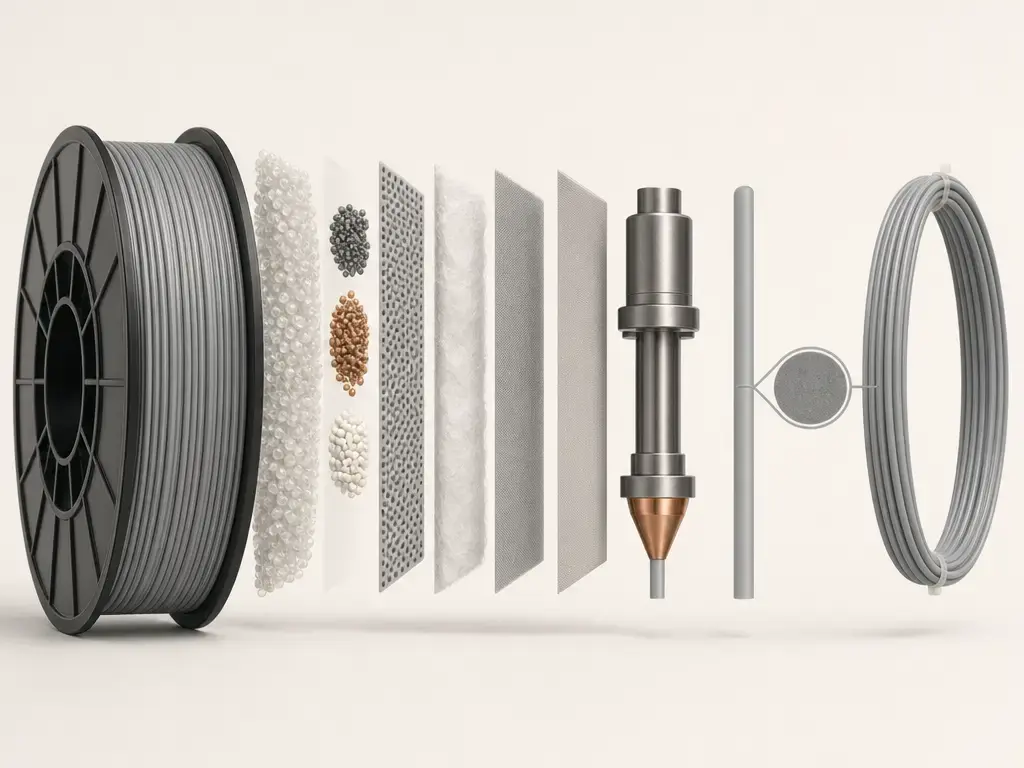
Higher prices usually track back to the polymer family itself, plus additives, fillers, tighter dimensional control, lower-volume production, moisture-safe packaging, and ecosystem features such as proprietary spools or RFID tagging. Formlabs’ broader context puts many standard and engineering FDM materials around $20–$150/kg and support materials around $100–$200/kg, while its more professional FDM-vs-SLA framing says common FDM materials often start around $50/kg in that ecosystem, with specialized filaments around $100–$150/kg and soluble supports around $100–$200/kg. A 2024 review lands in the same general pattern, listing contextual bands such as PLA filaments at 20–40 $/kg, ABS filaments at 15–35 $/kg, and PA filaments around 100 $/kg. Retail snapshots show the same spread in miniature: baseline Prusament PETG sat at $25.49/kg-equivalent for 1 kg listings, while specialty PETG moved to $46.74 for carbon-fiber PETG and $65.32 for an 800 g glow filament, and UltiMaker support materials climbed well above ordinary PLA. [S7] [S8] [S4] [S25] [S29]
“Carbon fiber filament” is not one price class. Chopped-fiber blends and continuous-fiber systems are economically different products, and a 2024 study reported approximate spool costs around €60 for PETG, €60 for chopped-carbon PETG, and €300 for continuous carbon fiber in its studied setup. [S6]
Workflow: From Model to Material Budget
- Slice the model with the final layer height, infill, supports, and material choice you actually plan to print.
- Record the slicer’s total consumed grams for that setup, not just the part-only mass.
- Normalize the chosen listing to $/kg and then to $/g.
- Add allowance for supports, purge, priming, failed starts, calibration, and any shipping or tax line you want in the budget.
- Re-slice and re-price whenever settings or materials change, because the weight output depends on the final print configuration. [S10] [S11] [S9]
Current Market Context (How to Interpret These Numbers)
The current picture is not one tidy average. Consumer open-material desktop buying can show commodity PLA or PETG near the low end of the market in live snapshots, while engineering and support materials sit much higher. Formlabs frames many standard and engineering FDM materials around $20–$150/kg and support materials around $100–$200/kg, but its professional-system comparison also notes that common FDM materials can start around $50/kg in that context. A 2024 review similarly lists PLA at 20–40 $/kg, ABS at 15–35 $/kg, and PA around 100 $/kg as contextual bands rather than live U.S. store quotes. Filament-vs-pellet economics are a separate question, and even within filament, form factors vary enough that package appearance alone is not a safe price signal. [S7] [S8] [S4] [S3]
Bottom Line: How Much Is 3D Printer Filament?
If you want the short answer to how much is 3d printer filament, everyday PLA or PETG can be relatively inexpensive in current snapshots, but the sticker price is only meaningful after you check whether the listing is refill, with-spool, sale, or bulk-threshold pricing. [S20] [S21] [S22] [S25]
- Check the net weight first.
- Convert the listing to $/kg and $/g.
- Use the slicer’s total consumed grams, not part-only mass.
- Add supports, purge, brim, failures, and any shipping or tax budget line you care about.
- Re-check the access date before relying on a retail number. Filament is only one line item, and total print cost also depends on machine time and other overhead. [S10] [S11] [S29] [S7]
FAQ
How much does 3D printer filament cost in 2026?
In U.S.-visible snapshots accessed 2026-09-10, commodity examples included PLA at $19.99 for 1 kg on Bambu refill pricing, PLA at $19.99 for 1 kg as a Creality sale listing, PLA at $21.99 for 1 kg from HATCHBOX, and baseline PETG at $25.49 for 1 kg on Prusament category listings, while broader industry context still spans about $20–$150/kg for many standard and engineering filaments and about $100–$200/kg for support materials. [S20] [S21] [S22] [S23] [S25] [S7]
How much is 3D printer filament for a beginner?
For a beginner buying PLA, compare normalized cost instead of sticker price. A regular 1 kg PLA listing at $21.99 can be cheaper per kilogram than a smaller regular 750 g spool at $39.00, because that 750 g listing normalizes to $52.00/kg. Start by checking net weight, then the price state. [S23] [S29]
What is the filament cost per print?
It is the material-only cost for that print setup. The practical formula is cost per gram multiplied by the slicer’s total consumed grams, where total consumed grams includes supports, purge, and other auxiliary structures rather than only the model’s visible mass. [S10] [S11] [S9]
Is PETG always more expensive than PLA?
No. In snapshots accessed 2026-09-10, commodity PETG could overlap commodity PLA: Bambu’s PETG Translucent refill pricing showed $19.99 for 1 kg, while Bambu PLA Basic refill pricing and Creality Hyper PLA sale pricing also showed $19.99 for 1 kg. What changes the budget is specialty PETG, such as carbon-fiber or glow variants. [S21] [S22] [S25]
Is a 1 kg spool always 1 kg of usable filament?
Not necessarily as a buying assumption. Some filament is sold as 500 g, 750 g, 800 g, or 900 g refill packages rather than 1 kg spools, and refill listings may require a compatible reusable spool. Read the net filament weight and the price label, not just the word “spool.” [S21] [S25] [S26] [S28] [S29]
(Expert) Why does my slicer’s gram estimate change when I change material profiles?
Because slicers use profile data, including density, to convert model geometry into estimated weight and cost outputs. PrusaSlicer exposes cost-per-kg and filament-density inputs, Cura’s weight and cost placeholders depend on density and price being known, Bambu’s PLA and PETG HF TDS files list 1.24 g/cm³ and 1.28 g/cm³ respectively, and Polymaker’s PolyLite PLA page shows why source hierarchy matters by giving 1.19 g/cm³ in page body text but 1.17 g/cm³ in the technical table. [S10] [S11] [S32] [S33] [S31]
(Expert) How should I price multi-material prints where purge towers dominate usage?
Treat purge towers, wipe structures, and dedicated support material as part of the total consumed grams, then price each material stream at its own $/g. That matters because support-specific filaments can be expensive on their own; UltiMaker’s Breakaway and PVA listings show how a support spool can materially change the print budget even when the model body is small. [S29] [S7] [S8]
Sources
- S1 — ISO/ASTM 52900:2021, Additive manufacturing — General principles — Fundamentals and vocabulary. ISO landing page.
https://www.iso.org/standard/74514.htmlAccessed 2026-09-10. - S2 — ISO/ASTM 52903-1:2020, Additive manufacturing — Material extrusion-based additive manufacturing of plastic materials — Part 1. ISO landing page.
https://www.iso.org/standard/67290.htmlAccessed 2026-09-10. - S3 — Sola (2022), review on FFF materials requirements and commercial filament form factors. Wiley.
https://onlinelibrary.wiley.com/doi/full/10.1002/mame.202200197Accessed 2026-09-10. - S4 — Patti et al. (2024), review comparing pellets and filaments including price bands. Wiley.
https://onlinelibrary.wiley.com/doi/full/10.1002/marc.202400249Accessed 2026-09-10. - S6 — MDPI Polymers (2024), continuous-fiber economic analysis.
https://www.mdpi.com/2073-4360/16/18/2656Accessed 2026-09-10. - S7 — Formlabs, “How Much Does a 3D Printer Cost?”
https://formlabs.com/eu/blog/how-to-calculate-3d-printer-cost/Accessed 2026-09-10. - S8 — Formlabs, “FDM vs SLA: Compare Types of 3D Printers.”
https://formlabs.com/blog/fdm-vs-sla-compare-types-of-3d-printers/Accessed 2026-09-10. - S9 — QIDI, “3D Printer Filament Pricing & Cost Factors.”
https://qidi3d.com/en-br/blogs/news/3d-printer-filament-pricing-cost-factorsDated 2026-04-08; accessed 2026-09-10. - S10 — PrusaSlicer manpage.
https://manpages.ubuntu.com/manpages/focal/man1/prusa-slicer.1.htmlAccessed 2026-09-10. - S11 — Cura replacement patterns documentation.
https://files.fieldofview.com/cura/Replacement_Patterns.htmlAccessed 2026-09-10. - S20 — Bambu PLA Basic product page (US).
https://bambulab-us.myshopify.com/products/pla-basic-filamentAccessed 2026-09-10. - S21 — Bambu filament discount price table (US).
https://bambulab-us.myshopify.com/pages/bambu-filamentAccessed 2026-09-10. - S22 — Creality Hyper Series PLA 1 kg product page.
https://store.creality.com/products/hyper-series-pla-3d-printing-filament-1kgAccessed 2026-09-10. - S23 — HATCHBOX Natural PLA 1 kg product page.
https://www.hatchbox3d.com/products/3d-pla-1kg1-75-natAccessed 2026-09-10. - S24 — Prusament PLA category.
https://www.prusa3d.com/category/prusament-pla/Accessed 2026-09-10. - S25 — Prusament PETG category.
https://www.prusa3d.com/category/prusament-petg/Accessed 2026-09-10. - S26 — Prusament PA11 Natural 800 g product page.
https://www.prusa3d.com/pl/produkt/prusament-pa11-natural-800g-nfc/Accessed 2026-09-10. - S27 — Prusament ASA category.
https://www.prusa3d.com/category/prusament-asa/Accessed 2026-09-10. - S28 — Prusament TPU 95A Jet Black 500 g product page.
https://www.prusa3d.com/en/product/prusament-tpu-95a-jet-black-500g-nfc/Accessed 2026-09-10. - S29 — UltiMaker S Series materials listing.
https://store.ultimaker.com/3d-printer-materials/s-series-materialsAccessed 2026-09-10. - S31 — Polymaker PolyLite PLA product page.
https://shop.polymaker.com/products/polylite-plaAccessed 2026-09-10. - S32 — Bambu PLA Basic Technical Data Sheet PDF, V3.0.
https://store.bblcdn.com/s7/default/b189de92249a4b9ebed28b8ea1f080f0/Bambu_PLA_Basic_Technical_Data_Sheet.pdfAccessed 2026-09-10. - S33 — Bambu PETG HF Technical Data Sheet PDF, V1.0.
https://store.bblcdn.com/s6/default/20423d7f839c4a66b9712508549c68b4/Bambu_PETG_HF_TDS.pdfAccessed 2026-09-10.