
Summary
carbon fiber 3d printer filament is usually worth the money when you need more stiffness, better warp control, or a matte surface that reduces cosmetic rework. It is not automatically stronger in every direction, because consumer CF filament is still a filled or reinforced thermoplastic feedstock, usually with chopped carbon fiber, not a continuous-fiber laminate. [2] [10] [17]
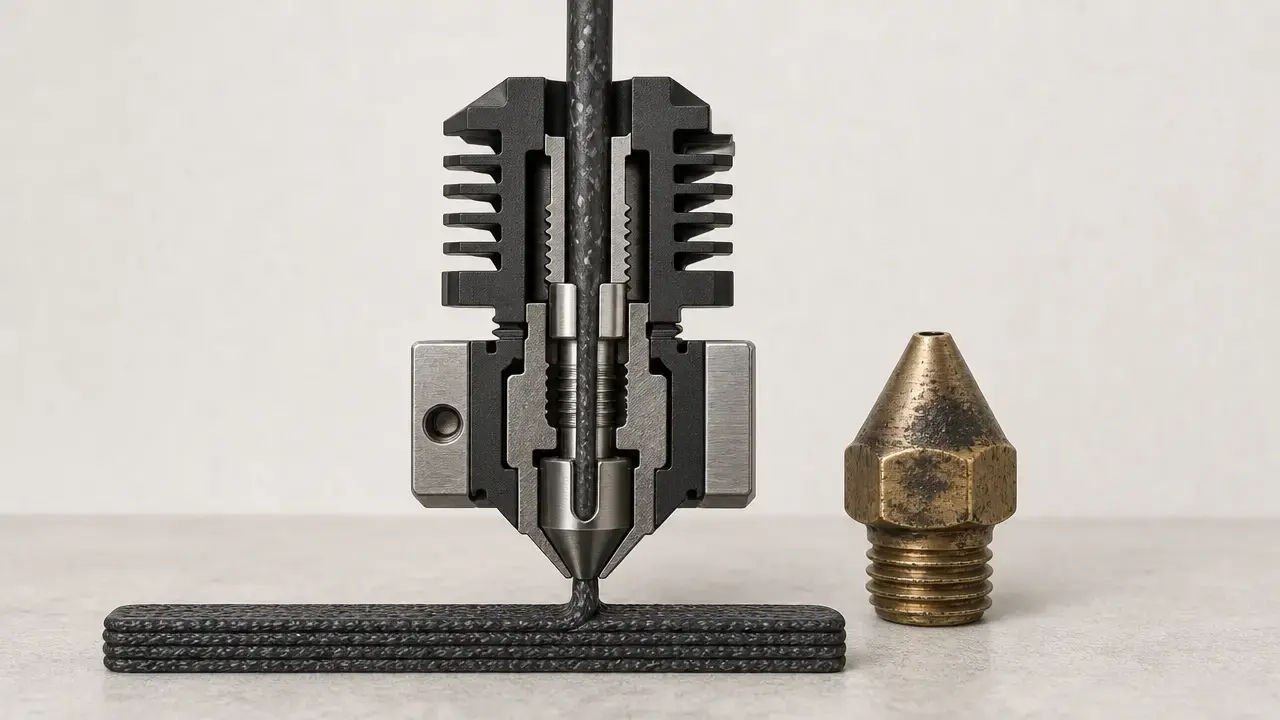
The better buying question is price per successful part, not price per spool. That means counting filament cost, drying time, nozzle wear, tuning, scrap, inspection, and whether reduced ductility or weaker through-layer behavior forces a redesign. In a peer-reviewed wear study on short-carbon-fiber-reinforced polyamide, ultimate tensile strength dropped by 37% and surface roughness rose from Ra 1.7 μm to Ra 14.1 μm as nozzle wear accumulated to 5540 minutes. E3D also documented severe wear after printing 250 g of carbon-filled filament through a 0.40 mm brass nozzle, a useful reminder that abrasion is not theoretical. [18] [20]
What “carbon fiber 3D printer filament” actually means
The vocabulary baseline is ISO/ASTM 52900, which defines additive manufacturing terms and process families. In desktop use, people commonly say FFF, and many hobby users also say FDM, but the broader process term is material extrusion, or MEX. ISO/ASTM 52903-1 then frames the plastic feedstocks used in extrusion-based AM as unfilled, filled, or reinforced materials, which is the right category for most consumer carbon-fiber-filled filament. [1] [2]
In consumer FFF/MEX, carbon fiber reinforced filament usually means a thermoplastic matrix containing chopped or short carbon fiber. It does not usually mean continuous reinforcement, and it does not mean the printed part suddenly behaves like a high-performance laminate. Resin carbon-filled systems are not in scope here. For this article, strength means the load a part can carry before failure, while stiffness means how much it resists elastic bending. XY means in-plane, Z means through-layer, and conditioning state means whether the sample was dry, wet, annealed, or otherwise prepared before testing. [1] [2]
Terms we will use carefully:
- chopped or short carbon fiber: short fibers dispersed in a thermoplastic matrix. [2]
- continuous fiber reinforcement: a separate process class from ordinary chopped-CF filament workflows. [17]
- matrix polymer: the base plastic, such as PLA, PA11, or PA6, that largely determines heat and moisture behavior. [10] [11] [14]
- material extrusion (MEX): the process family; FFF is common desktop language, while FDM is common brand-linked shorthand. [1]
- strength vs. stiffness: failure load versus resistance to elastic deflection. [3]
- XY vs. Z: anisotropic directions that often test very differently in printed parts. [3] [10] [11] [14]
- conditioning state: dry, wet, annealed, or otherwise prepared before testing. [3] [10] [14]
Quick decision: when CF filament is worth the money
CF filament is worth it when its behavior lowers the total cost of making a correct part. That usually means a part class where added stiffness, flatter geometry, or a better-looking surface saves reprints or post-processing. A jig that stays aligned, a housing that prints with less shape drift, or a visible bracket that needs less finishing can justify the extra workflow. A part that only needs ordinary plastic behavior often cannot. [10] [13]
The clearest yes-signals are simple: you need stiffness more than flexibility, you need repeatable geometry more than raw impact tolerance, or you want a matte surface that hides layer lines. The clearest no-signals matter just as much: you need a part to flex or snap repeatedly, you cannot control moisture, or the part’s critical load path is in Z and you have not validated orientation. One manufacturer explicitly states that its PA11-CF has lower layer-to-layer adhesion than pure PA11, and one PA6-CF20 datasheet shows dry-versus-wet property changes large enough to alter material selection, not just slicer tuning. [13] [14]
Worth it vs not worth it (fast screen)
| Use case | Why CF helps | Main risk | What to cite |
|---|---|---|---|
| Jigs/fixtures | Higher stiffness and better shape control. | Nozzle wear can drift quality and measured strength over time. [18] | Wear-driven UTS and roughness change. [18] Severe brass-nozzle wear example. [20] |
| Housings near heat | Sometimes better dimensional stability, and heat claims can be good when the matrix polymer supports them. [11] [14] | Heat claims depend on polymer, load, and conditioning state, not “carbon fiber” alone. [6] [8] [9] | Use HDT values only with stated load conditions. [10] [11] [14] |
| Cosmetic brackets | Matte chopped-fiber surfaces can reduce visible layer lines and finishing work. [10] | Extra cost may add little if the part is noncritical. | Surface-finish claim from manufacturer TDS. [10] |
| Snap-fit or impact-prone parts | Stiffness can help some geometries. | Lower ductility or weaker layer bonding can be the limiting factor. [13] [14] | Layer-adhesion warning and dry/wet delta. [13] [14] |
Before assuming savings, print a few coupons in the real orientation and inspect the result. If the first trial still needs redesign, drying changes, or extensive post-processing, CF may not be the cheaper choice. [3]
Hardware and workflow requirements
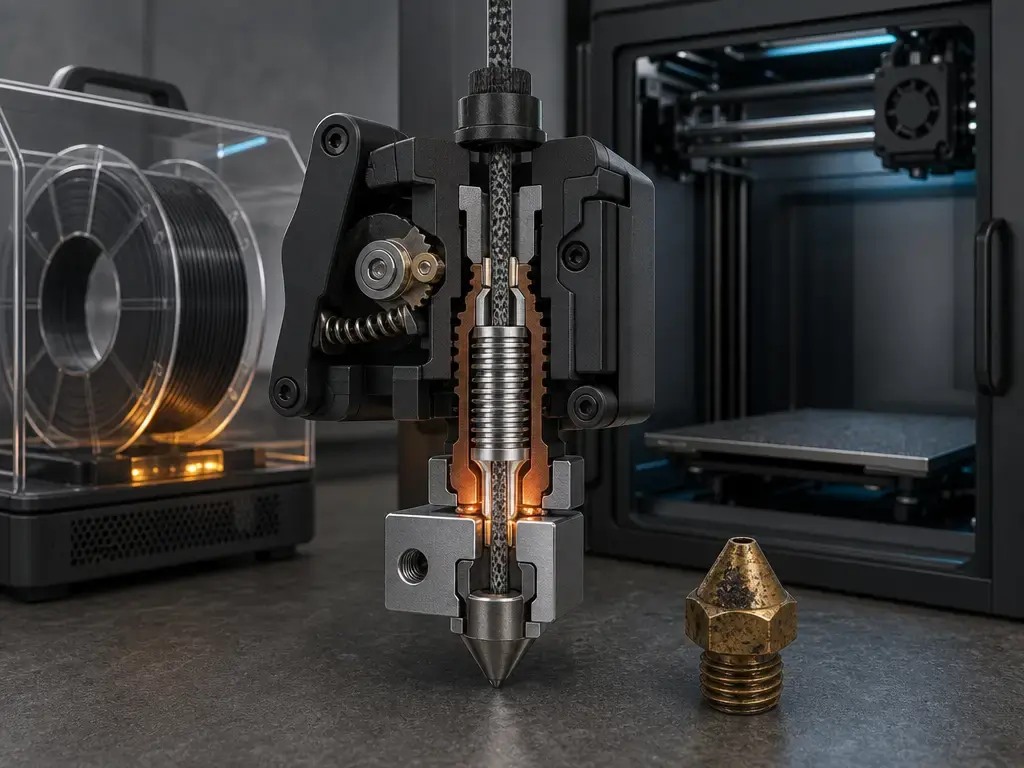
Carbon fiber filament should be treated as an abrasive workflow, not a casual material swap. In the cited wear study on short-CF polyamide, nozzle wear tracked to 5540 minutes coincided with a 37% drop in ultimate tensile strength and a roughness increase from Ra 1.7 μm to Ra 14.1 μm. E3D’s microscope example points the same way: after 250 g of carbon-filled filament through a 0.40 mm brass nozzle, the nozzle geometry was already badly degraded. That is why a hardened nozzle is the default starting point for CF work, not an upgrade to postpone until failure. [18] [20]
Drying is the second part of the hardware bill. Bambu’s PLA-CF is easier than nylon-CF, but its TDS still specifies drying at 55 °C for 8 hours, storage and printing below 20% RH, and nozzle sizes of 0.4, 0.6, or 0.8 mm. Prusament PA11 Carbon Fiber is much more demanding, with a 285 ± 5 °C nozzle, 110 ± 10 °C bed, up to 100 mm/s, 20% fan, and an explicit statement that a hardened nozzle is necessary. Fiberon PA6-CF20 is harsher again: its TDS says brass-nozzle life would be approximately 9 hours, recommends a wear-resistant nozzle, and says the filament should be stored and used below 20% RH. The peer-reviewed wear study also dried its PA-CF filament at 110 °C for 2 hours before printing and kept the spool in a dryer at 70 °C during printing, a strong example of why some PA-CF jobs need active drying, not just pre-drying. [10] [11] [14] [18]
Extruder gears belong in the same wear budget. eSUN says carbon fiber inclusion may cause excessive wear on nozzles and extruder gears and recommends hardened components where possible, so that is best treated as a manufacturer warning rather than a universal law for every machine. [21]
Before buying, verify the actual filament sheet, your hotend limits, and your drying plan instead of assuming a generic PLA profile will transfer cleanly. [10] [11] [14]
Before buying CF filament, check:
- Nozzle material and minimum size: Bambu lists 0.4/0.6/0.8 mm for PLA-CF, and Prusa’s current product guidance specifies a 0.4 mm hardened nozzle for its PA11-CF. Confirm the maker’s sheet instead of assuming every CF spool behaves well through smaller nozzles. [10] [13]
- Hotend temperature: PLA-CF and PA-CF live in very different print windows, so make sure your printer can actually reach the matrix polymer’s range with margin. [10] [11]
- Bed surface or adhesion method: Some PA-CF products specify a special PA Nylon sheet or separation layer rather than generic “clean PEI and go” assumptions. [11] [13]
- Dry box or dryer capability: For moisture-sensitive PA-CF, plan for drying before printing and, for long jobs, sometimes during printing too. [14] [18]
- Enclosure or ventilation: Follow manufacturer guidance for airflow and odor control rather than guessing from PLA habits. [12] [13]
- Slicer profile availability: Start from a profile close to the material’s actual needs to reduce trial-and-error scrap.
- Extruder wear plan: CF may accelerate extruder gear wear according to eSUN, so hardened drive components may be worth considering on high-use machines. [21]
Performance metrics without the hype
There is no single trustworthy answer to “how strong is carbon fiber filament?” ASTM F3489 is the reason. For MEX polymers and polymer-based composites, reported properties vary with material choice, anisotropy, storage, preparation, porosity, specimen build orientation and location, gripping, testing environment, speed, and temperature. A CF filament number without context is not a material constant; it is a result from a specific workflow. [3]
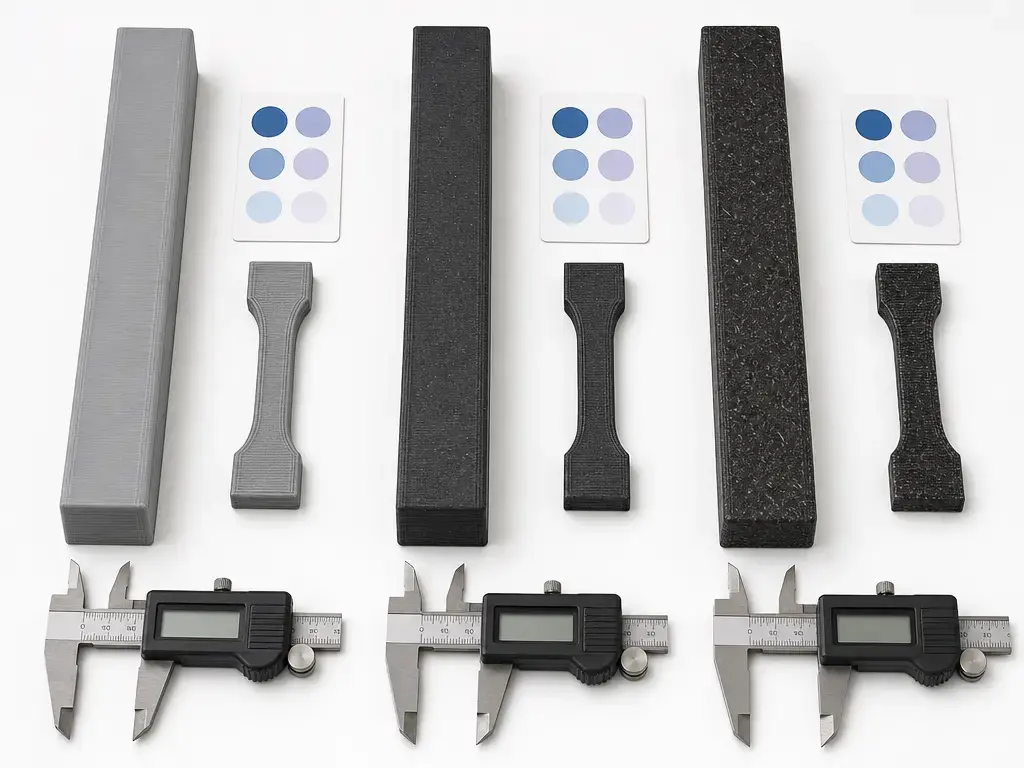
The safest way to read a TDS is to pair four things every time: the metric, the test standard, the orientation, and the conditioning state. ASTM D638-22 covers tensile properties of unreinforced and reinforced plastics under defined conditions, and its scope notes thickness applicability up to 14 mm. ASTM D790-25 covers flexural properties by three-point loading. ASTM D648-18 is the ASTM heat-deflection boundary and explicitly warns against using HDT results to predict elevated-temperature performance outside similar conditions. On the ISO side, many filament sheets use ISO 527 for tensile work, ISO 178 for flexural data, and ISO 75 for temperature of deflection under load; ISO 75-2 specifically includes filled and fibre-reinforced plastics within scope. Bambu’s PLA-CF TDS is a good model of what to look for because it labels XY and Z values and discloses specimen preparation: 230 °C nozzle, 35 °C bed, 180 mm/s, 100% infill, then annealed and dried at 55 °C for 8 hours before testing. [4] [5] [6] [7] [8] [9] [10]
Dimensional stability is not the same thing as machine accuracy. What CF often improves, in manufacturer examples, is warp and shrink behavior or the visual stability of a part’s shape. That does not eliminate the need for calibration, correct flow, and orientation-aware design. [10] [13]
Comparison disclaimer
Manufacturer TDS values are illustrative, not a controlled bake-off. Compare trends within one brand and one test method first, because ASTM F3489 and the manufacturers’ own disclaimers both warn that printing conditions, specimen preparation, and surrounding conditions can change the result substantially. [3] [10] [11] [14]
Named, sourced examples
These are illustrative named materials, not rankings. They are only useful if you keep product name, orientation, conditioning state, and test method tied together in the same sentence. [3]
PLA-CF
Bambu PLA-CF is a 1.75 mm filament sold in 1 kg spools, with a nozzle range of 210 to 240 °C, a bed range of 35 to 45 °C, listed nozzle sizes of 0.4/0.6/0.8 mm, and recommended printing and storage humidity below 20% RH. The same TDS specifies drying before printing at 55 °C for 8 hours, a reminder that even entry-level CF workflows still benefit from moisture control. [10]
For printed specimens, Bambu discloses the conditioning state clearly: samples were printed at 230 °C nozzle, 35 °C bed, 180 mm/s, and 100% infill, then annealed and dried at 55 °C for 8 hours before testing. Under ISO 527, Bambu PLA-CF reports Young’s modulus of 2790 ± 120 MPa in XY and 2160 ± 90 MPa in Z, and tensile strength of 38 ± 4 MPa in XY and 26 ± 2 MPa in Z. Under ISO 178, the same conditioned material is listed at 3950 ± 190 MPa bending modulus in XY and 2260 ± 180 MPa in Z, with bending strength of 89 ± 4 MPa in XY and 49 ± 3 MPa in Z. Under ISO 75, HDT is 54 °C at 1.8 MPa and 55 °C at 0.45 MPa, which is why PLA-CF is best read as an easier stiffness-and-finish option, not a high-temperature nylon substitute. [10]
PA11-CF
Prusament PA11 Carbon Fiber Black sits in a different workflow band. Its TDS specifies a 285 ± 5 °C nozzle, 110 ± 10 °C bed, print speed up to 100 mm/s, 20% fan, and an explicit note that a hardened nozzle is necessary. The same sheet lists density at 1.11 g/cm³ and moisture absorption at 0.20% after 24 hours and 0.50% after 7 days at 24 °C and 22% RH, useful context for storage and conditioning discipline. [11]
For printed specimens, the TDS discloses print conditions but does not disclose a separate conditioning state before testing. With that limitation noted, Prusament PA11-CF reports tensile yield strength of 42 ± 1 MPa in Horizontal and 49 ± 2 MPa in Vertical xz under ISO 527-1. Under ISO 178, the same TDS reports flexural modulus of 3.0 ± 0.1 GPa in Horizontal and 6.2 ± 0.3 GPa in Vertical xz. Under ISO 179-1, Charpy impact strength is listed as 30 ± 4 kJ/m² in Horizontal unnotched and 51 ± 4 kJ/m² in Vertical xz unnotched. For heat performance, the TDS gives ISO 75 HDT values of 192 °C at 0.45 MPa and 152 °C at 1.80 MPa, a very different thermal class from PLA-CF. [11]
PA6-CF20
Fiberon PA6-CF20 is the most moisture-sensitive example here and one of the clearest cases where workflow is part of material cost. Its TDS says abrasion of a brass nozzle happens frequently, estimates brass-nozzle life at approximately 9 hours, recommends a wear-resistant nozzle such as hardened steel or ruby, and says the material should always be stored and used below 20% RH. The same sheet lists ISO 75 HDT values of 215 °C at 0.45 MPa and 173 °C at 1.8 MPa, impressive on paper but only meaningful when you also respect the conditioning notes. [14]
Fiberon’s dry-versus-wet data show why moisture state cannot be treated as a footnote. In the TDS, dry specimens were annealed at 100 °C for 16 hours before testing, while wet specimens were annealed at 100 °C for 16 hours and then immersed in water at 60 °C for 48 hours; the average moisture content of the wet specimens was 5.30%. Under ISO 527, dry PA6-CF20 is reported at 109.3 ± 2.4 MPa tensile strength in XY and 54.0 ± 5.2 MPa in Z, while wet PA6-CF20 drops to 54.7 ± 1.1 MPa in XY and 25.5 ± 1.2 MPa in Z. Under the same ISO 527 context, dry Young’s modulus in XY is 8636.5 ± 211.4 MPa, while wet XY modulus drops to 2508.1 ± 82.6 MPa. That is not a subtle change; it is large enough to change whether the material is appropriate for the part at all. [14]
Illustrative property snapshots (not a bake-off)
| Material (named) | Conditioning stated by source | Orientation | One key metric to cite |
|---|---|---|---|
| Bambu PLA-CF | Printed at 230 °C nozzle, 35 °C bed, 180 mm/s, 100% infill; annealed and dried at 55 °C for 8 h before testing. [10] | XY. [10] | Young’s modulus 2790 ± 120 MPa under ISO 527. [10] |
| Prusament PA11 Carbon Fiber Black | Print settings disclosed, but conditioning state not disclosed in the TDS. [11] | Horizontal. [11] | Flexural modulus 3.0 ± 0.1 GPa under ISO 178. [11] |
| Fiberon PA6-CF20 | Dry specimens annealed at 100 °C for 16 h; wet specimens annealed at 100 °C for 16 h, then immersed in 60 °C water for 48 h to 5.30% average moisture. [14] | XY. [14] | Dry tensile strength 109.3 ± 2.4 MPa under ISO 527. [14] |
Different labs, printers, and specimens; not directly rankable. [3]
Continuous carbon fiber: boundary case
Continuous carbon fiber is a separate process system from consumer chopped-CF filament. Markforged’s datasheet makes that boundary explicit by separating a Composite Base Test from a Continuous Fiber Test. In that example, Onyx, a micro carbon fiber filled nylon, is listed at 2.4 GPa tensile modulus under ASTM D638, 3.0 GPa flexural modulus by a method similar to ASTM D790, and 145 °C HDT under ASTM D648 Method B at 0.45 MPa/66 psi, with conditioning state not disclosed in the datasheet. The continuous carbon fiber data are in a different category again: 800 MPa tensile strength and 60 GPa tensile modulus under ASTM D3039, also with conditioning state not disclosed. Consumer chopped-CF filament should not be assumed to reach those laminate-style values. [17]
- Category separation: chopped-CF base materials and continuous-fiber reinforcement solve different engineering problems. [17]
- Test-condition warning: Markforged notes that its test plaques were uniquely designed to maximize performance, with fiber plaques fully filled with unidirectional fiber and printed without walls. [17]
Hidden costs, failure modes, and what breaks first
The first hidden cost is abrasion. CF filament is abrasive, so nozzle condition becomes a process variable instead of a maintenance afterthought. In the cited wear study, increasing nozzle service time corresponded to a 37% drop in UTS and a jump in roughness from Ra 1.7 μm to Ra 14.1 μm. Fiberon’s PA6-CF20 TDS adds a shop-floor version of the same warning by estimating brass-nozzle life at about 9 hours, and E3D’s microscope example shows why even a short carbon-filled run can permanently change nozzle geometry. The cost is not only replacement hardware, but also scrap, inspection time, and loss of confidence in measurements taken with a worn nozzle. [14] [18] [20]
The second hidden cost is moisture control. PA6-CF20 makes this obvious because the dry and wet states are far apart in both tensile strength and modulus, and the wet-state method is clearly defined in the TDS. If your storage, drying, or service environment differs from that dry lab condition, the part can behave very differently from the number you used to choose it. The resulting cost shows up as reprints, failed fit, or a part that only behaves correctly right after drying. [14]
The third hidden cost is anisotropy. Chopped-CF materials are often bought for stiffness, but stiffness does not erase weaker layer interfaces. One manufacturer explicitly states that its PA11-CF has lower layer-to-layer adhesion than pure PA11, a direct reminder that carbon fiber filling is not a universal Z-strength upgrade. In practice, that makes CF a better fit for jigs, brackets, and housings than for repeated snap fits, hinge-like features, or parts that need to absorb impact through layer interfaces. When wear, moisture mistakes, or orientation errors go unnoticed, the price per successful part rises much faster than the spool price suggests. [13]
Safety and handling
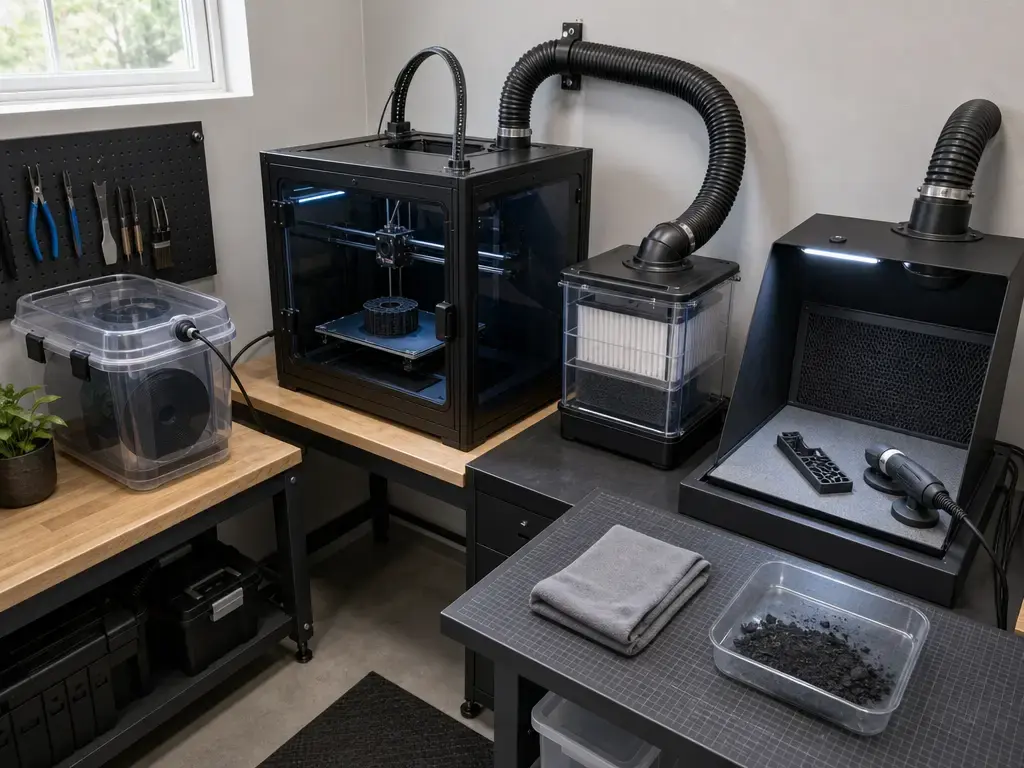
In the manufacturer documents cited here, the practical safety themes are ventilation, dust control, and thermal-decomposition exposure, not exotic special handling. Prusa’s PA11-CF MSDS says inhalation of vapours due to thermal decomposition carries a risk of irritation of the respiratory system and says toxic effects cannot be excluded. The same MSDS says thermal decomposition gives toxic and corrosive products, recommends ventilation in the workspace, and says a suitable closed cover for a 3D printer is recommended if clean-air measures are not in place. Prusa’s current product page adds simpler user guidance: print in a well-ventilated area or use an enclosure with active filtration. [12] [13]
Dust control matters most when you cut, sand, drill, or clean up debris. Fiberon’s SDS lists chopped carbon fiber at 20 to 30% and reproduces occupational dust limits for that ingredient, including OSHA values of 15 mg/m³ total dust and 5 mg/m³ respirable fraction. Prusa’s MSDS also says dust inhalation can irritate the respiratory system and stresses good housekeeping and control of dust accumulation. In practical terms, use local extraction where possible, clean benches and tools routinely, and wear a mask when you are generating dust rather than only while the printer is running. [12] [15]
Research and standards context
The standards and metrology side of polymer AM is still active, which is one reason broad, context-free CF claims age badly. NIST’s additive manufacturing of polymers page says NIST studies the characteristics, properties, and behaviors of polymers to develop metrology tools and measurement standards for polymer AM, and the page metadata shows it was created on November 13, 2024 and updated on May 16, 2025. [19]
Other chopped-CF matrices also exist in consumer ecosystems, including PLA-CF, PETG-CF, PET-CF, PAHT-CF, PA6-CF, PPA-CF, and PPS-CF. That taxonomy is useful mainly because it shows the common workflow trend: hotter, drier, and more abrasive as you move up the engineering-polymer ladder. It is not a license to compare cross-brand properties as if they came from one test program. [22]
Buying checklist
A carbon fiber 3d printer filament purchase only makes sense when the whole workflow beats a cheaper polymer at producing a correct part. As of 2026-09-01, Prusament PA11 Carbon Fiber Black was listed at $155.55 for 800 g, or $194.44/kg pre-tax and excluding shipping, while Fiberon PA6-CF20 was listed at $39.99 for 0.5 kg, or $79.98/kg on the same basis. Those figures are useful reminders, not verdicts. ASTM F3489 is the better decision rule because it pushes you to validate orientation, storage, porosity, specimen preparation, and test conditions before trusting a material choice. [13] [16] [3]
Buyer filter in 60 seconds
- Part requirement: Do you need stiffness, warp control, matte finish, or heat performance first, and which matrix polymer actually fits that need? [10] [11] [14]
- Printer capability: Can your machine reach the right nozzle and bed temperatures, and does it support the enclosure or print-surface method the filament expects? [10] [11] [13]
- Moisture plan: Can you dry the spool, store it dry, and for PA-CF keep it dry during long prints if needed? [14] [18]
- Abrasion plan: Do you have a hardened nozzle and a habit of inspecting wear before quality drifts into scrap? [14] [18] [20]
- Evidence plan: Will you print coupons in the real orientation and record the conditions before scaling up the job? [3]
FAQ
What is carbon fiber 3d printer filament?
It is usually a thermoplastic feedstock for material extrusion that contains chopped or short carbon fiber in a plastic matrix. In ISO/ASTM 52903-1 terms, it fits the filled or reinforced feedstock category, not a special class that is always stronger than ordinary filament in every direction. [2]
What is CF filament — chopped vs continuous fiber?
In desktop use, CF filament usually means chopped carbon fiber mixed into a printable thermoplastic. Continuous fiber systems are different hardware and different test categories. Markforged’s datasheet separates composite base material data from continuous fiber data, which is why chopped consumer filament should not be treated as equivalent to continuous reinforcement. [17]
How strong is carbon fiber 3D printer filament?
No reliable single figure found. Strength depends on the matrix polymer, orientation, conditioning, and test method. For example, Bambu PLA-CF, annealed and dried before testing, is listed at 38 ± 4 MPa tensile strength in XY and 26 ± 2 MPa in Z under ISO 527, while Prusament PA11-CF, with conditioning state not disclosed in the TDS, is listed at 42 ± 1 MPa Horizontal and 49 ± 2 MPa Vertical xz tensile yield strength under ISO 527-1. [10] [11]
Do I need a hardened steel nozzle?
As a default, yes. The strongest justification is not marketing but wear evidence: in one peer-reviewed study on short-CF polyamide, nozzle wear correlated with a 37% drop in UTS and roughness growth from Ra 1.7 μm to Ra 14.1 μm. E3D’s brass-nozzle example after 250 g of carbon-filled filament points in the same direction. [18] [20]
Why do XY and Z numbers differ so much, and what does ASTM F3489 say to record?
Because printed parts are anisotropic. The bead path and the layer interfaces are not the same thing mechanically, so in-plane and through-layer behavior can diverge sharply. ASTM F3489 says to record factors such as material choice, anisotropy, storage and preparation methods, porosity, orientation, build-plate location, testing environment, alignment, speed, and temperature before treating a reported number as decision-grade data. [3]
How does moisture conditioning change PA6-CF20 properties and what was the conditioning method?
A lot. In Fiberon’s TDS, dry PA6-CF20, annealed at 100 °C for 16 hours, is listed at 109.3 ± 2.4 MPa tensile strength in XY under ISO 527. The wet condition, annealed the same way and then immersed in 60 °C water for 48 hours to 5.30% average moisture, drops to 54.7 ± 1.1 MPa in XY. That is a material-selection issue, not just a tuning detail. [14]
Can CF filament wear extruder gears too?
It can. eSUN explicitly says carbon fiber inclusion may cause excessive wear on nozzles and extruder gears and recommends hardened components where possible. That is best read as an official manufacturer warning, not a universal certainty for every printer and every CF blend. [21]
Sources
- ISO/ASTM 52900:2021 Additive manufacturing — General principles — Fundamentals and vocabulary
- ISO/ASTM 52903-1:2020 Additive manufacturing — Material extrusion-based additive manufacturing of plastic materials — Part 1: Feedstock materials
- ASTM F3489-23 Standard Guide for Additive Manufacturing of Polymers and Polymer-Based Composites by Material Extrusion
- ASTM D638-22 Standard Test Method for Tensile Properties of Plastics
- ASTM D790-25 Standard Test Methods for Flexural Properties of Unreinforced and Reinforced Plastics and Electrical Insulating Materials
- ASTM D648-18 Standard Test Method for Deflection Temperature of Plastics Under Flexural Load in the Edgewise Position
- ISO 178:2019 Plastics — Determination of flexural properties
- ISO 75-1:2020 Plastics — Determination of temperature of deflection under load — Part 1: General test method
- ISO 75-2:2013 Plastics — Determination of temperature of deflection under load — Part 2: Plastics and ebonite
- Bambu PLA-CF Technical Data Sheet V2.0
- Prusament PA11 Carbon Fiber Black Technical Data Sheet
- Prusament PA11 Carbon Fiber Black MSDS
- Prusa e-shop product page: Prusament PA11 Carbon Fiber Black 800g NFC
- Fiberon PA6-CF20 Technical Data Sheet V1.0
- Fiberon PA6-CF20 SDS US EN V2
- Polymaker shop listing: Fiberon PA6-CF20
- Markforged Composites Material Datasheet
- Bianchi et al. 2024, International Journal of Advanced Manufacturing Technology
- NIST Additive Manufacturing of Polymers
- E3D blog: Are abrasives killing your nozzle?
- eSUN news post on ePLA-CF
- Bambu Lab filament guide page