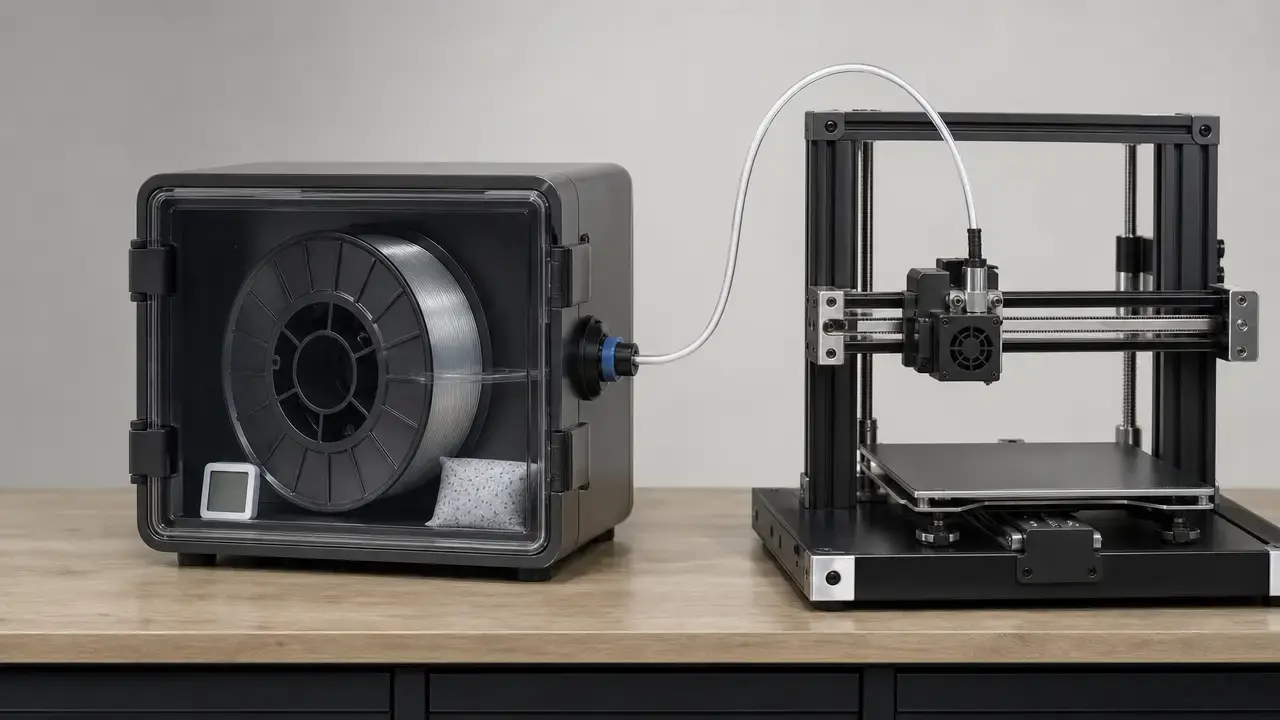

Summary: 3D Printer Filament Storage in One Workflow
3D printer filament storage works best as a workflow: dry a spool first if it has already picked up moisture, then seal it with desiccant, monitor the storage environment, and protect it again during printing. Prusa explicitly states that its Drybox does not dry wet filament, so drying and storage are separate steps. [S10]
The first decision is not “bag or box?” but “is this spool already wet, or am I only trying to slow further uptake?” A low RH reading inside a box, cabinet, or dry box can help you manage the air around the spool, but it does not directly measure water already inside the polymer. That is why the right workflow depends on material family, additives, how long the spool sat open, and whether it stays loaded on the printer between jobs. The sections below separate standards, independent studies, and manufacturer guidance so you can choose by material instead of guessing from one hygrometer reading.
Fast workflow
- Dry first if the spool was exposed long enough to affect print behavior.
- Seal the spool with desiccant after use.
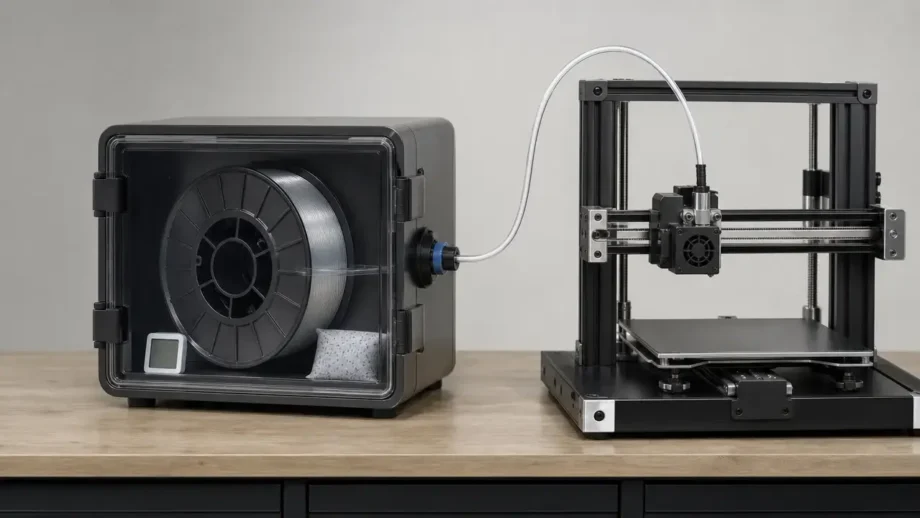
- Use a dry box for low-humidity feeding during printing, not as a substitute for drying wet filament. [S10]
- Treat the hygrometer as a container indicator, not a direct polymer-moisture test.
- Check the spool label or TDS first when the material is Nylon/PA, a soluble support, or a filled composite.
Storage vs Drying: What Problem Are You Solving?
Storage and drying solve different problems. Storage limits future moisture uptake by reducing the water vapor around the spool. Drying removes moisture that is already inside the filament, usually through controlled heat and airflow. If a spool is already wet, moving it into a sealed box with desiccant may slow additional uptake, but it does not automatically reverse what has already diffused into the polymer. Prusa makes that boundary clear in its Drybox documentation: the box is for low-humidity handling, and moist filament must be pre-dried first. [S10]
This matters because a spool can sit in low-RH air and still behave like a wet spool. The hygrometer reports the air inside the container, not the water content of the filament itself. That air reading also has limits: Prusa lists TPM40 accuracy at ±3% RH and ±1 °C, and notes that the reading may need up to 1 hour to decrease and stabilize after conditions change. [S10] A low box reading is useful for environment control, but it is not proof that the filament core is dry.
Dry first if…
- extrusion starts popping, sizzling, or bubbling;
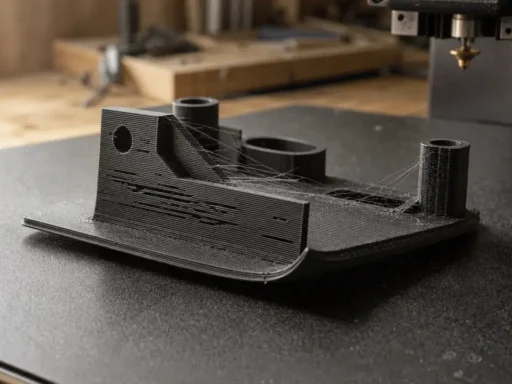
- stringing or surface roughness suddenly gets worse without another obvious cause;
- the spool is a known moisture-sensitive material or support;
- the spool has spent a long time open between jobs;
- the filament needs to stay dry while it remains loaded on the printer.
Technical Principles: RH, Moisture Uptake, and What Actually Goes Wrong
Relative humidity (RH) is the amount of water vapor in air relative to how much that air could hold at the same temperature. In filament handling, RH refers to the air inside a bag, box, cabinet, or dry box. It does not directly tell you the filament’s internal moisture content. You can lower RH inside a container quickly, while the polymer may still retain moisture from earlier exposure.
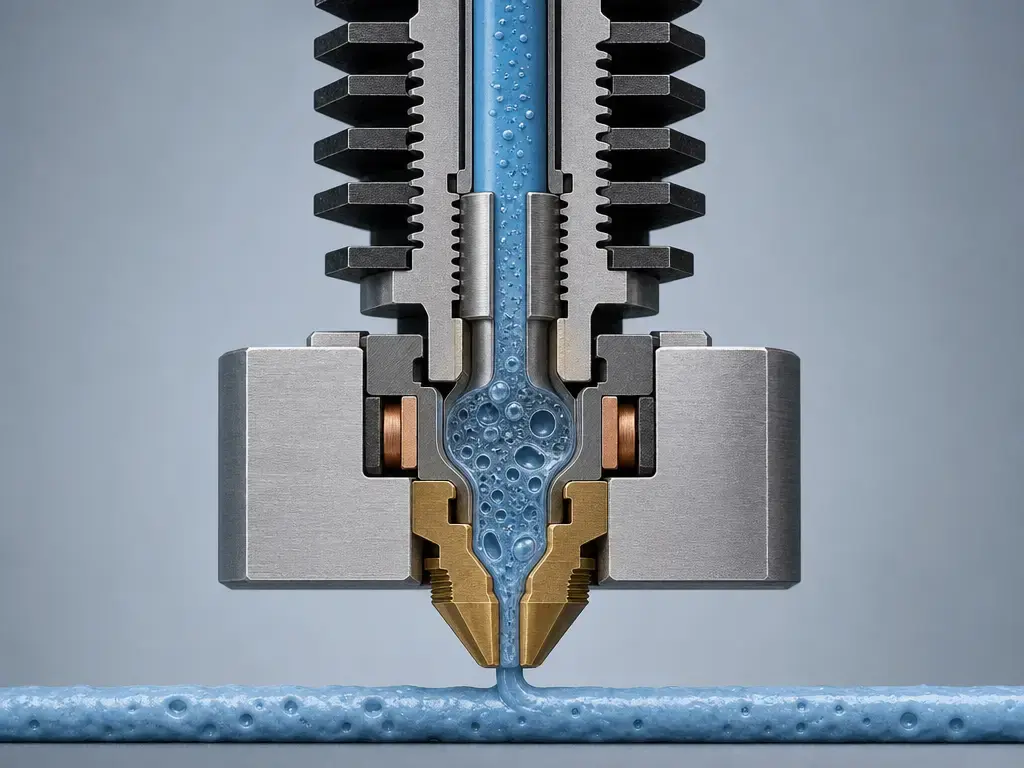
What happens physically is a mix of surface adsorption, bulk absorption, and diffusion. Water can collect at the surface, enter the polymer, and then move deeper into the strand over time. Different materials respond differently: some mainly show print-quality changes, some swell more, and some are far more sensitive to exposure history. A comparative study of 12 filament types tested across 16% to 97% RH at room temperature showed large differences among materials, including nylon swelling strain up to 2.5%. [S08] In the hot end, absorbed moisture can vaporize and promote bubbles, voids, rough surfaces, and higher part porosity. In one PLA study, filament conditioned at 10% to 90% RH before printing showed porosity rising from 0.84% to 4.42% and melt flow rate changing from 10.9 to 19.2 g/10 min at 215 °C and 2.16 kg. [S05]
Standards help mainly as test context, not as storage prescriptions. ASTM D570 addresses water absorption when specimens are immersed, and its scope covers sheets 0.13 mm (0.005 in.) or greater in thickness, so those numbers should not be treated as direct proxies for spool-in-air storage or dry-box handling. [S03] Chemistry also needs care: hydrolysis risk is polymer- and condition-dependent, not a universal “wet filament always chemically degrades” rule. In the same PLA study, the authors reported no considerable alteration in molecular integrity or crystalline structure as a function of storage RH under that study’s pre-print conditioning conditions. [S05]
Terminology Boundary: FFF/FDM vs Material Extrusion (MEX) and What Counts as Filament
Readers often say FFF or FDM, but the standards reference point is ISO/ASTM 52900:2021, and the broader standards-family term is material extrusion. In that standards context, filament means feedstock characterized by extreme length relative to a uniform cross section, which helps distinguish it from pellet or granulate feedstock. [S01] [S02]
3D Printer Filament Storage Requirements by Material
Storage requirements vary because filament is not one moisture class. The base polymer matters, but so do fillers, reinforcements, blends, and use pattern. A spool of plain PLA used once a month is a different workflow problem from a carbon-filled PLA left loaded on a printer, and both differ again from a nylon support spool left open all week. Independent studies also support the idea that formulations behave differently rather than following one universal RH rule. [S08]
Use the table below as a workflow priority guide, not a spec sheet. It shows when sealed storage is often enough and when keeping the spool dry during printing starts to make more sense.
| Material family (examples) | Moisture priority | Minimum storage | When “print from dry box” becomes sensible |
|---|---|---|---|
| PLA | Lower | Sealed bag or airtight box with desiccant | When the spool stays open between jobs or a print is long |
| Filled PLA (PLA-CF and similar) | Medium | Sealed storage with desiccant; treat brand guidance as primary | When the brand’s TDS calls for low-RH storage or always-loaded handling |
| PETG / PET-based CF | Medium to higher | Sealed storage; lower-RH feed path if the spool stays loaded | When the filament must remain dry during printing, not only between prints |
| ABS / ASA | Medium | Airtight box or dry cabinet | When jobs are long or the room is humid |
| TPU and other flexibles | Higher | Dry box or dry cabinet | When the spool is part of a continuous feed path |
| PC | Higher | Dry cabinet or sealed system with low-RH feeding | When the spool will be reused repeatedly after opening |
| PVA / BVOH | Very high | Dry box or dry cabinet; keep exposure short | Very quickly after opening, because soluble supports are moisture-sensitive in normal workflow |
| Nylon / PA variants | Very high | Dry cabinet or active dry-box workflow | Whenever the spool will be used after opening, especially if it remains loaded |
| Engineering composites (PA-CF/GF, PET-CF, etc.) | Very high | Sealed storage plus low-RH feeding or dry cabinet | When the spool is always available on the printer or must stay consistently dry |
Read any RH figure with its measurement location attached. Prusa’s examples are hygrometer readings inside its dry box: PLA below 30% RH with short-term tolerance up to 40%; PETG, TPU, PVA, PC, and BVOH below 20%; ABS below 30% and ideally below 15%; ASA below 30% and ideally below 10%. [S10] UltiMaker gives a different kind of example, recommending below 50% RH for PVA, Nylon, Nylon CF Slide, and TPU 95A in its material-handling guidance. [S12] Bambu’s PLA-CF and PET-CF sheets are stricter still, each specifying sealed storage with desiccant below 20% RH. [S14] [S15] Stratasys lists 13 to 24 °C and 20 to 60% RH for Fortus canister handling, which is another system-specific reference point rather than a universal desktop target. [S13]
Shelf life is not the same as ready-to-print dryness. A spool can remain packaged for a long time and still need drying after exposure, while a dry cabinet only helps if it is kept closed and monitored. That difference matters most with filled materials, Nylon/PA grades, and soluble supports.
Quick Decision Matrix: Do I Need to Dry This Spool, or Just Seal It?
Start with two inputs: material sensitivity and exposure history. If the spool is relatively tolerant and was only opened briefly, sealed storage with desiccant may be enough. If it is Nylon/PA, a soluble support, a flexible, or a filled composite, the safer assumption is that exposure history matters more and “seal it later” may not be good enough. The same logic applies when the spool remains loaded on the printer: you are no longer just storing it, you are managing it during use.
Time to equilibrium can also be slow. ASTM D618 says substantial equilibrium under normal humidity and temperature conditions can take 20 to 100 days or more, depending on material, thickness, and prior history. [S04] That does not mean filament always takes that long to become printable; it means short storage intervals are easy to overinterpret. Likewise, Prusa notes that its dry-box RH reading may need up to 1 hour to stabilize, and the TPM40 tolerance is ±3% RH and ±1 °C. [S10]
If you only remember 5 rules…
- Seal first if the spool was only briefly exposed and the material is usually forgiving.
- Dry first if the material is visibly misbehaving or is known to be moisture-sensitive.
- Treat box RH as a local environmental proxy, not a direct polymer-moisture value.
- For PVA or BVOH, minimize open time and assume storage discipline matters immediately.
- For Nylon/PA, use the TDS and exposure history as the decision point, not just one container reading.
Storage Methods: Bags, Vacuum, Airtight Boxes, Dry Boxes, Dry Cabinets
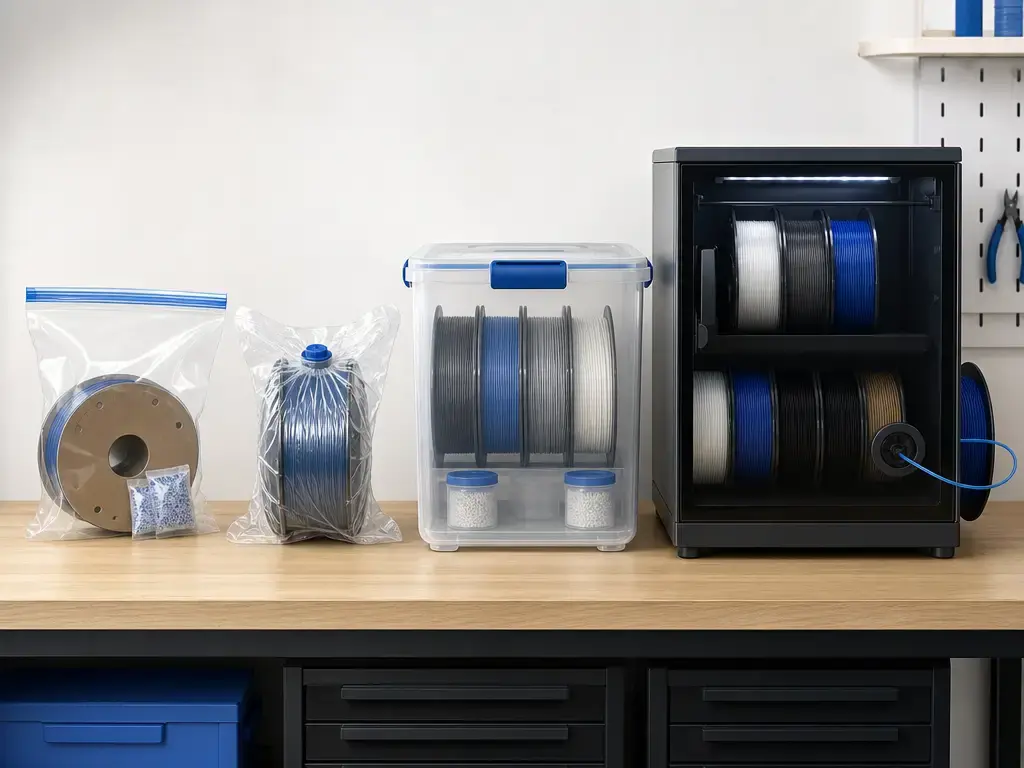
Sealing effectiveness and daily convenience are different things. A resealable bag, vacuum storage bag, or airtight container can greatly reduce moisture exchange when paired with desiccant, especially for spools used occasionally. These methods are simple and inexpensive, but they depend on good sealing discipline every time you reopen them. A passive box mainly slows uptake. A dry box or cabinet becomes more useful when the spool needs to stay available, loaded, or printable across repeated starts and stops. Prusa’s documentation is explicit here: its Drybox is for keeping filament at low humidity during printing, not for drying wet filament. [S10]
Method choice comes down to workflow fit. Bags are compact and work well for single-spool storage. Vacuum bags save space and reduce air exchange, but repeated opening can cancel that benefit. Airtight totes can store many spools, but a large tote is only as good as its opening discipline: frequent access means frequent air replacement. A dry box is most useful when the spool feeds through an enclosed path. A dry cabinet or integrated material station makes more sense when multiple spools stay ready all the time. UltiMaker’s Material Station is one example of that category: while powered and with the door closed, it keeps relative humidity below 35%. [S11]
Choose the setup by usage pattern
- One or a few PLA spools: resealable bag or airtight box with desiccant.
- Many colors used occasionally: labeled airtight containers or vacuum storage bags.
- Regular PETG or TPU use: dry box if the spool stays on the printer.
- Nylon, PVA, BVOH, PC, or composites: dry box or dry cabinet with closer RH control.
- Print farm: dry cabinet or material station, plus labels and an opening log.
How to Keep Filament Dry During Printing
Once printing starts, storage becomes feed-path exposure control. A spool that was dry at the beginning of the job can keep exchanging moisture with room air if it sits exposed for the rest of the print. That matters more for hygroscopic materials, repeated stop-start use, and spools that stay loaded for days rather than hours. Manufacturer guidance for engineering PA composites shows how explicit this can be: Fiberon’s PA12-CF10 says to store and use the material below 20% RH, and Raise3D says PA12 CF+ should be placed in a dry box during printing. [S17] [S18]
The practical habits are simple: use the smallest workable feed-through, close unused ports, avoid leaving the box or cabinet open longer than necessary during changes, and return partly used spools to controlled storage as soon as the job ends. Stratasys provides a strong controlled-system caution here, noting that an unsealed canister can absorb enough moisture to become unusable in less than one hour. That is not a universal timer for hobby filament, but it is a useful reminder that handling exposure can matter as much as storage between prints. [S13]
Drying Wet Filament Without Damaging Filament or the Spool
The safest rule is manufacturer first. Drying temperatures and times are not generic by polymer family because the exact grade, additives, spool material, and enclosure all matter. Prusa’s guidance alone ranges from PLA at 45 °C for 6 h to PEI at 150 °C for 8 h, which is enough to show why one setting for “all filament” is bad practice. [S09] Bambu, BigRep, Fiberon, and Raise3D also publish brand-specific drying guidance for individual materials and systems. [S14] [S15] [S16] [S17] [S18]
Boxed warning: Drying temperature must be safe for both the filament and the spool or container. Prusa warns that home ovens can have imprecise temperature control and recommends an external thermometer if one is used. It also notes that its newer black spools are rated to 90 °C and its grey high-temperature spools to 150 °C. Bambu’s examples show the same spool-limit issue from another angle: PLA-CF uses an ABS spool with 70 °C temperature resistance, while PET-CF uses a PC+ABS spool with 90 °C temperature resistance. Avoid hot spots, poorly controlled heaters, and assumptions based only on the polymer name. [S09] [S14] [S15]
Read the table below as example guidance only. These are vendor- or system-specific figures, not universal defaults for “all PLA,” “all nylon,” or “all composites.”
| Material | Example source (brand/system) | Drying temp/time | Critical notes (spool limits, print-from-box, etc.) |
|---|---|---|---|
| PLA | Prusa. [S09] | 45 °C / 6 h | Prusament example only; do not generalize to all PLA. |
| PETG | Prusa. [S09] | 55 °C / 6 h | Brand-specific example. |
| TPU | Prusa. [S09] | 60 °C / 4–6 h | Flexible materials can still be spool-limited. |
| ASA | Prusa. [S09] | 80 °C / 4 h | Check spool tolerance first. |
| PC Blend | Prusa. [S09] | 85 °C / 5 h | Example system guidance only. |
| PA11 CF | Prusa. [S09] | 90 °C / 6 h | Filled grades may differ from neat nylon. |
| PEI | Prusa. [S09] | 150 °C / 8 h | High-temperature example; spool and enclosure limits become critical. |
| PLA-CF | Bambu Lab. [S14] | 55 °C / 8 h | TDS also specifies storage below 20% RH sealed with desiccant; spool resistance 70 °C. |
| PET-CF | Bambu Lab. [S15] | 80 °C / 8–12 h | TDS also specifies storage below 20% RH sealed with desiccant; spool resistance 90 °C. |
| BVOH | BigRep. [S16] | 60 °C / 4–6 h | Soluble support; TDS lists 12-month shelf life when stored properly. |
| PA12-CF10 | Fiberon / Polymaker. [S17] | 100 °C / 10 h | TDS says store and use below 20% RH. |
| PA12 CF+ | Raise3D. [S18] | 80 °C / 8 h | Support note also says to place the filament in a dry box during printing. |
If no reliable figure is published for your exact filament and spool combination, treat that as “no reliable figure found” and do not guess. Use the spool label, TDS, or official support note for the exact material you have.
What to Monitor and What Not to Overinterpret
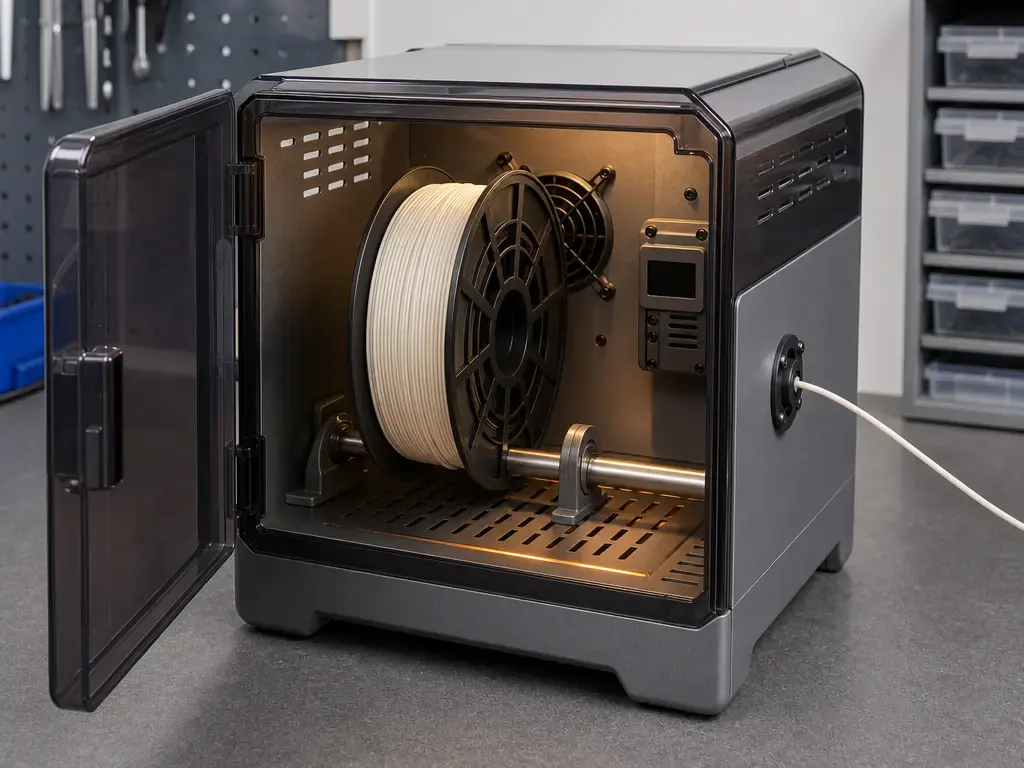
The most useful reading is the RH inside the storage system you actually use. That could be a resealable box, a dry cabinet, a material station, or a print-from-dry-box enclosure. That number helps you judge whether the container stayed closed and whether the desiccant still has capacity. It does not directly tell you the filament’s internal moisture content. Other useful signals are operational: whether the desiccant has changed state or weight, whether the spool has a clear “opened” or “dried” label, and whether print symptoms changed after the spool sat out. These are workflow indicators, not lab measurements.
Measurement limits matter. Prusa’s TPM40 example is specified at ±3% RH and ±1 °C, and Prusa says the reading may need up to 1 hour to stabilize after a change. [S10] Better component-level sensor specs exist, but they still need context: Sensirion lists typical RH accuracy of ±2 %RH for SHT30, ±2 %RH for SHT31, and ±1.5 %RH for SHT35. [S20] If you want a rough confidence check, the NBS saturated-salt method is inexpensive and simple, and the generated RH is roughly temperature-independent, but the classic caution is that the method is only about 1% RH control, not laboratory metrology. [S19]
Reasonable monitoring stack by budget
- Minimal: resealable bag, desiccant, and date labels.
- Mid: airtight box with a hygrometer and a simple desiccant check.
- High: dry cabinet or material station with a log of openings, drying dates, and material-specific notes.
Observable Print Symptoms vs Possible Property Changes
Moisture-related print symptoms are easiest to spot at the machine. Common clues include popping, sizzling, visible bubbles, rough or fuzzy surfaces, unexpected stringing changes, pitting, or dull-looking extrusion. These are useful troubleshooting cues, but they are not direct measurements of tensile strength, flexural strength, or moisture content. The same symptom can also overlap with contamination, temperature choice, or extrusion problems.
Property changes need to be labeled as study-specific. In the PLA study cited earlier, filament was conditioned before printing in a 10% to 90% RH chamber workflow; as RH increased, porosity rose from 0.84% to 4.42%, flexural strength shifted from about 103.0 MPa to 99.6 MPa, and impact strength from 18.2 to 16.2 kJ/m². [S05] In one ABS paper, gravimetrically measured filament moisture from 0.17% to 0.75% was associated with about a 25% strength decrease, and the paper’s summary also reported a 10% thickness increase. [S06] In a nylon study, filament was exposed in a 40 °C and 80% RH chamber; the tensile comparison used virgin filament at 0.9% moisture and 72-hour conditioned filament at 5.5% moisture, with reported ultimate tensile strength values in the 40 to 54 MPa range. [S07] These results are useful evidence that moisture can matter, but they are not universal property tables.
Applications: Home Users, Print Farms, and Engineering Materials
For home users, storing 3D printer filament can stay simple. If you print PLA or PETG occasionally, a sealed bag or airtight box with desiccant is often a practical baseline. A dry box becomes more useful when the spool stays on the printer between jobs, when the room is humid, or when the material is less forgiving. The goal is not to copy an industrial setup, but to match the storage method to how often the spool is exposed.
For print farms and engineering materials, the workflow shifts from “keep it closed” to “keep it controlled and documented.” A dry cabinet or integrated material station makes more sense when multiple opened spools stay ready, and UltiMaker’s Material Station provides one reference example by keeping RH below 35% while powered and closed. [S11] For PA composites, manufacturer instructions can be stricter: Fiberon says PA12-CF10 should be stored and used below 20% RH, and Raise3D says PA12 CF+ should remain in a dry box during printing. [S17] [S18]
Common Mistakes and Limits of the Method
The most common mistakes are simple: putting a wet spool into a passive box and expecting it to recover, reusing desiccant that is already saturated, and opening large totes so often that the air exchange wipes out the benefit of the seal. A good container cannot compensate for poor handling discipline.
Factory sealed and shelf life do not mean “ready to print right now.” Stratasys is useful as a contrast example: for its Fortus canister system, it recommends 13 to 24 °C and 20 to 60% RH, says unopened canisters can exceed 3 years, and says opened canisters can remain acceptable for 6 to 8 weeks or more with proper handling. [S13] That is guidance for one controlled system, not a universal rule for every desktop spool. The larger point is that long storage life on paper does not prove that a specific opened spool is still dry enough for your next print.
The other big limit is measurement. One RH number is never universal unless you also know where it was measured, how accurate the sensor is, how long it had to stabilize, and what material you are talking about. Consumer hygrometers are best used as local trend indicators, not as final truth about polymer moisture.
Practical Takeaway: 3D Printer Filament Storage That Scales
Good 3D printer filament storage scales when you stop treating it as a container choice and start treating it as a moisture-control workflow. A dry box is for protecting filament during use, not for drying wet filament, and independent studies show that even familiar materials such as PLA can print and test differently after high-RH conditioning. [S10] [S05] The repeatable sequence is simple: dry when needed, seal with desiccant, monitor the storage environment, protect the spool during printing, and check the TDS for material-specific handling.
FAQ
What is the best 3D printer filament storage method?
There is no universal best method. For occasional PLA or PETG use, a sealed bag or airtight box with desiccant is often enough. For always-loaded spools, flexibles, Nylon/PA, soluble supports, or composites, a dry box or dry cabinet is usually a better fit.
What humidity control for filament storage should I aim for?
It depends on where RH is measured and whose system numbers you are using. Prusa’s examples are internal dry-box readings by material, such as PLA below 30% RH and PETG, TPU, PVA, PC, and BVOH below 20%. [S10] UltiMaker gives a broader handling recommendation of below 50% RH for PVA, Nylon, Nylon CF Slide, and TPU 95A. [S12]
Is a filament storage box the same as a filament dryer?
No. Passive storage slows moisture uptake; it does not reliably remove moisture already absorbed into the filament. Prusa states this directly in its Drybox documentation, which says moist filament must be pre-dried first. [S10]
How do I interpret RH readings if my hygrometer is only accurate to a few %RH?
Use it for trends and system checks, not as a direct measurement of polymer moisture. Prusa lists ±3% RH and ±1 °C for its TPM40 example and says the reading may need up to 1 hour to stabilize. [S10] If you want a rough calibration reference, saturated-salt methods are inexpensive and simple, but they still come with about a 1% RH control caution rather than lab-grade certainty. [S19]
Why can two filaments at the same box RH still print differently?
Because the box reading only describes the air in that container at that moment. Materials, fillers, and exposure history differ. A comparative study covering 12 filaments across 16% to 97% RH found major sorption differences, including nylon swelling strain up to 2.5%. [S08] Two spools can share one box reading and still behave differently if one was dried recently and the other sat exposed longer.
Can wet filament be restored?
Often, yes, but only if the manufacturer’s drying conditions are safe for both the polymer and the spool. Use the TDS or official support note first, because the correct value may differ sharply by brand and grade. Examples in Prusa, Bambu, Fiberon, and Raise3D documentation show why guessing from the generic material name is unsafe. [S09] [S14] [S15] [S17] [S18]
Sources
- S01 — ISO/ASTM 52903-1:2020 OBP excerpt (filament definition). https://www.iso.org/obp/ui?_escaped_fragment_=iso:std:iso-astm:52903:-1:ed-1:v1:en
- S02 — ISO/ASTM 52900:2021 standard record, Additive manufacturing — General principles — Fundamentals and vocabulary. https://www.iso.org/standard/74514.html
- S03 — ASTM D570-22 record page (water absorption by immersion; 0.13 mm thickness scope). https://store.astm.org/standards/d570
- S04 — ASTM D618-21 record page (conditioning and equilibrium context). https://store.astm.org/d0618-21.html
- S05 — Lendvai et al., Results in Engineering (2024), PLA RH-conditioning study. https://real.mtak.hu/206271/7/1-s20-S2590123024012684-main.pdf
- S06 — Hamrol et al., Materials (2024), ABS filament moisture absorption/desorption study. https://pdfs.semanticscholar.org/658b/674ea29faa2da6d279b5b0ca9edf4b76c67c.pdf
- S07 — Gong et al., Technologies (2025), nylon filament moisture study. https://doi.org/10.3390/technologies13080376
- S08 — Aniskevich et al., Polymers (2023), comparative moisture sorption study across 12 filaments. https://pmc.ncbi.nlm.nih.gov/articles/PMC10304609/
- S09 — Prusa Knowledge Base, “Drying filament.” https://help.prusa3d.com/article/drying-filament_332086
- S10 — Prusa Knowledge Base, “Prusa USS Drybox.” https://help.prusa3d.com/article/prusa-uss-drybox_1014382
- S11 — UltiMaker S8 installation and user manual v1.4, Material Station RH control example. https://um-support-files.ultimaker.com/manuals/user-manual/S8/EN-UltiMakerS8-V1.4-2025-07.pdf
- S12 — UltiMaker S8 installation and user manual v1.4, RH recommendation for PVA, Nylon, Nylon CF Slide, and TPU 95A. https://um-support-files.ultimaker.com/manuals/user-manual/S8/EN-UltiMakerS8-V1.4-2025-07.pdf
- S13 — Stratasys Fortus, “Canister Shelf Life and Handling.” https://sites.tufts.edu/bray/files/2020/09/Fortus-Canister-Shelf-Life-and-Handling.pdf
- S14 — Bambu Lab PLA-CF Technical Data Sheet v2.0. https://store.bblcdn.com/842f399d4e274507953a5231126ec8c1.pdf
- S15 — Bambu Lab PET-CF Technical Data Sheet v3.0. https://store.bblcdn.com/9690d6226f024acab2ba0dd52dabb654.pdf
- S16 — BigRep BVOH Technical Data Sheet. https://bigrep.com/wp-content/uploads/2023/06/TDS-BigRep-BVOH-web.pdf
- S17 — Polymaker/Fiberon PA12-CF10 Technical Data Sheet v1.1. https://fiberon.polymaker.com/wp-content/uploads/TDS_FIBERON-PA12-CF10_V1.1_EN.pdf
- S18 — Raise3D support note, PA12 CF+ drying and storage. https://support.raise3d.com/E2CF/notes-on-drying-and-storage-of-pa12cf-filament-and-pa12cf-support-filament-25-1591.html
- S19 — NBS Letter Circular LC1026 (April 1957), saturated salt humidity calibration reference. https://www.govinfo.gov/content/pkg/GOVPUB-C13-5f342e44f67ed612744ea5b3de5b7340/pdf/GOVPUB-C13-5f342e44f67ed612744ea5b3de5b7340.pdf
- S20 — Sensirion SHT3x-DIS datasheet, Version 7 (December 2022). https://sensirion.com/media/documents/213E6A3B/63A5A569/Datasheet_SHT3x_DIS.pdf