
Summary
Yes, a 3D printer filament recycler can turn failed prints back into filament again, but only under controlled conditions. In practice, that means sorted polymers, clean feedstock, drying before extrusion, stable melt processing, and some way to verify the strand you actually made. [S07] [S08] [S24]
What separates a workable system from a crude shred-and-extrude setup is control across the whole chain: sorting, size reduction, drying, extrusion, cooling and pulling, diameter metrology, spooling, and print validation. Early recyclebot work showed the concept was technically feasible, but with diameter spread far wider than premium commercial filament. Later open-hardware work improved throughput and energy use, yet still reported diameter variation much looser than premium commercial QA benchmarks. This article covers workflow, machine classes, metrology, degradation evidence, safety, and economics. Resin waste recycling is not covered. [S07] [S08] [S24]
Key terms and what “recycler” actually means
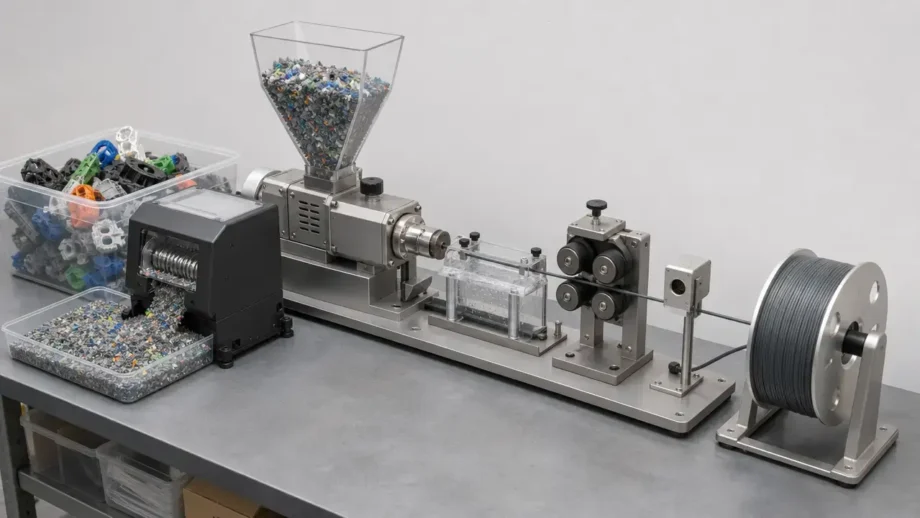
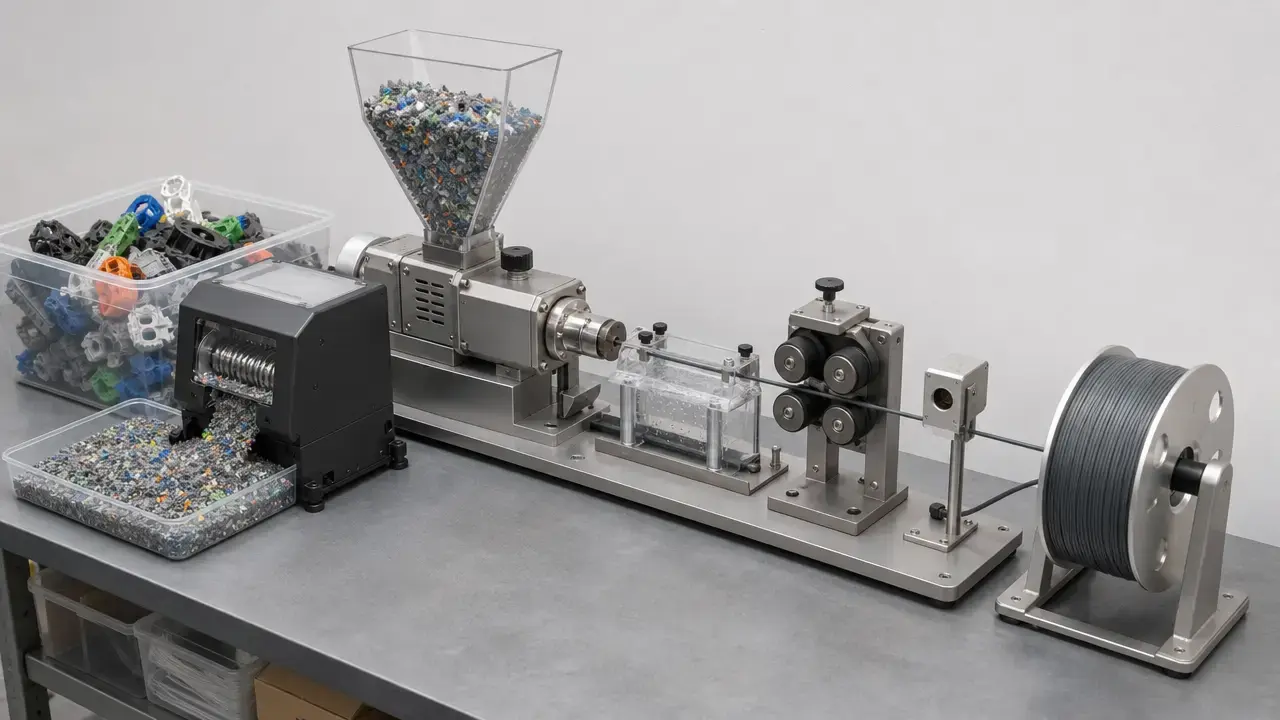
FFF means fused filament fabrication. FDM is a trademark of Stratasys, so it is better treated as a branded term than as a generic label for every material-extrusion printer. In this article, “recycler” does not mean a single box that turns scrap into spools. It usually means a chain of modules: material sorting, shredding or granulating, drying, melting in a filament extruder, and checking the output as it cools and winds. [S04]
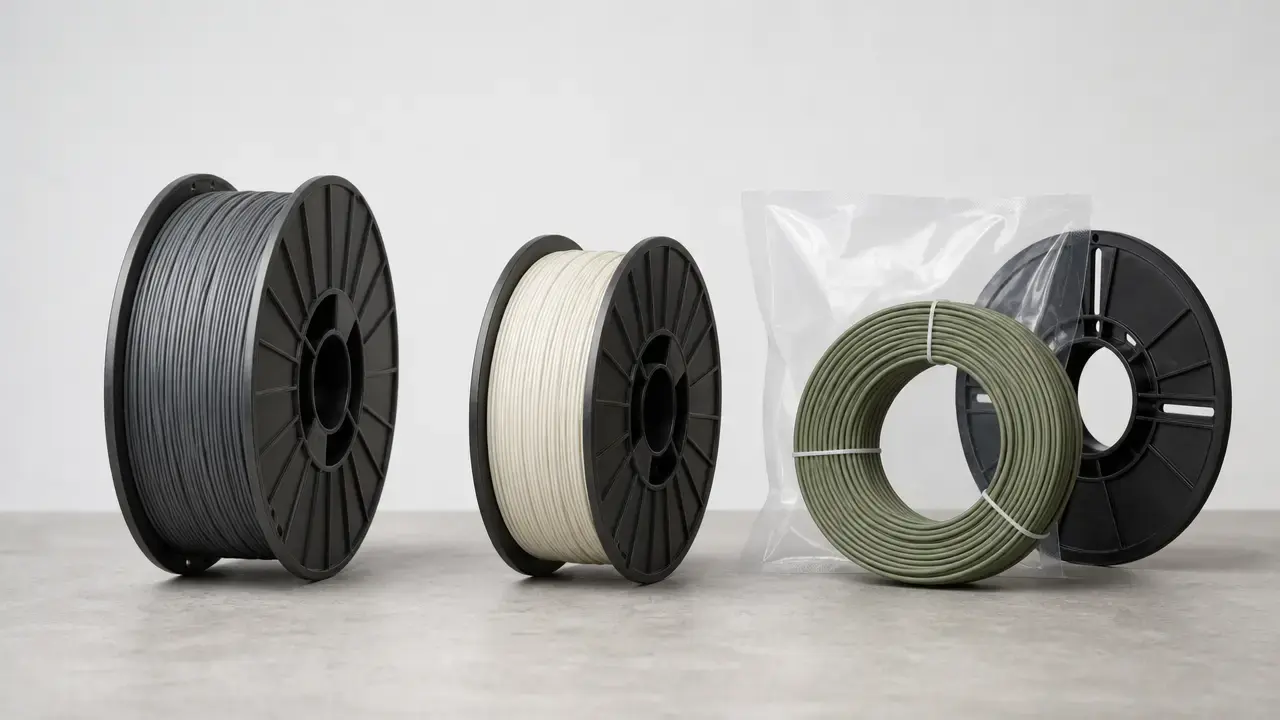
ISO/ASTM 52903-1:2020 is a feedstock standard for material-extrusion plastics. In that vocabulary, filament is feedstock characterized by extreme length relative to its uniform cross section, while pellets are small masses of preformed feedstock having relatively uniform dimensions within a batch. That matters because pelletizing and filament extrusion are different operations, even when both sit within the same recycling loop. [S02] [S03]
- Filament: feedstock characterized by extreme length relative to a uniform cross section. [S03]
- Pellets: small preformed feedstock pieces with relatively uniform dimensions in a batch. [S03]
- Regrind: practical shop term for shredded waste, such as failed prints, supports, purge scrap, or trimmed filament.
- Shredding / granulating / pelletizing: shredding and granulating reduce parts into smaller pieces; pelletizing then converts prepared material into more uniform pellets for easier feeding.
- Diameter tolerance or accuracy claim: a stated allowable departure from nominal diameter, if the maker discloses one.
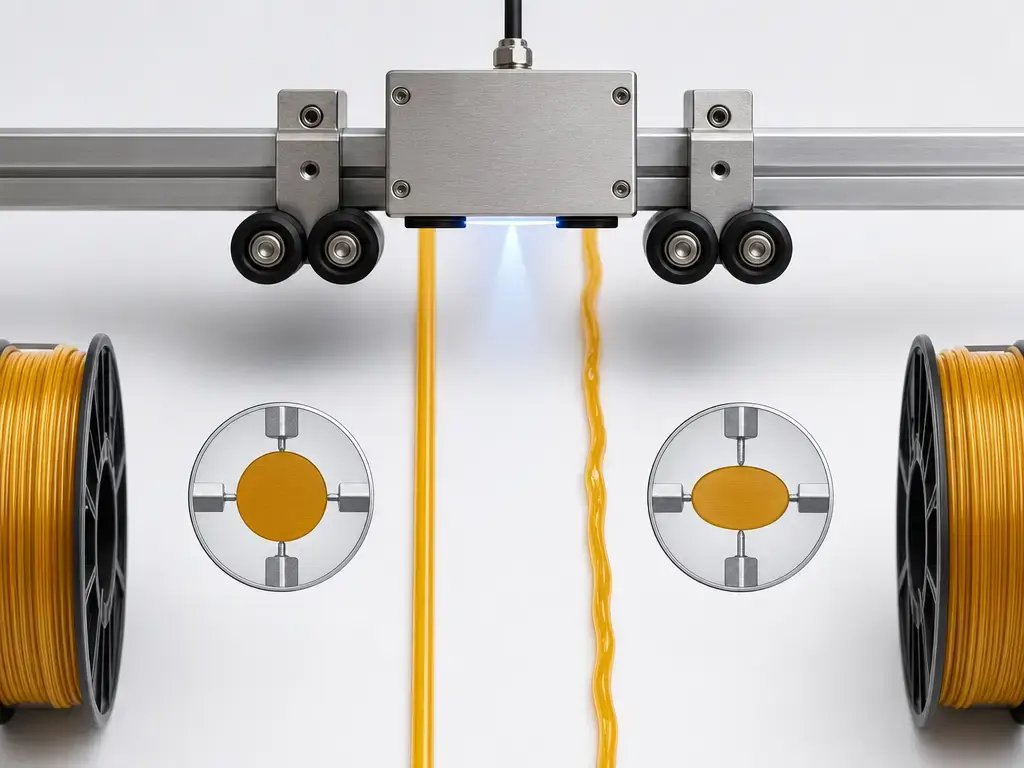
- Ovality: how far the cross section departs from round, not just whether the average diameter looks right.
- Spikes: short local oversize or undersize defects that can still jam a printer even when the average diameter seems acceptable.
Can failed prints become reliable filament again?
Yes, failed prints can become reliable filament again, but only if the waste is clean, dry, well sorted, and processed with enough control to hold diameter and shape in range. The failure points are easy to underestimate: unknown polymer identity, mixed-material bins, dust, moisture, oil or grease, glue from the print bed, irregular chunk size, unstable pull speed, and poor cooling all work against consistency. One manufacturer guidance example recommends feedstock no larger than 4 mm for compatible feeding and explicitly warns about contaminants such as dust, moisture, oil or grease, and glue on recycled prints. [S19]
In practice, “reliable” means more than producing a strand. It means the filament feeds consistently, prints without repeated jams, and suits the intended part. Scholarly evidence supports the basic feasibility of recycling plastic into usable filament, but not the assumption that recycled output is automatically equal to premium store-bought filament. The early recyclebot evaluation reported wide diameter spread, and a later open-hardware benchmark still reported diameter variation of ±4.6%. That can be acceptable for prototypes, jigs, organizers, or other noncritical parts, but it is a different standard from tightly controlled production filament. [S07] [S08]
A short, sourced history: RecycleBot to today’s desktop filament makers
A useful starting point is Baechler, DeVuono, and Pearce’s recyclebot work, published in 2013 from a 2012 paper record. Their evaluation showed that waste plastic could be converted into printable filament, but the output was not premium-grade by modern commercial expectations. They reported an average filament diameter of 2.805 mm, with 87% of samples between 2.540 and 3.081 mm, an average extrusion rate of 90 mm/min, and energy use of 0.06 kWh/m. Those numbers show both sides of the argument: the loop worked, but quality spread was broad. [S07]
By 2018, Woern and colleagues had pushed the concept further with a RepRapable recyclebot. Their HardwareX paper describes a system costing under $700 in materials, fabricated in about 24 hours, producing filament at 0.4 kg/h using 0.24 kWh/kg, with reported diameter variation of ±4.6%. That was a meaningful step toward practical desktop reuse, but it still did not imply premium commercial consistency. The broader distributed-recycling literature adds context: Zhong and Pearce demonstrated a closed-loop ABS pathway from post-consumer plastic to filament to printed products, and Kreiger and colleagues published an HDPE life-cycle assessment showing lower embodied energy for the distributed scenario they studied than for the best-case centralized scenario in that comparison. These studies are illustrative, not exhaustive. [S08] [S09] [S10]
How a filament recycler line works
A filament recycler line is best understood as a small plastics-processing line, not a single appliance. It takes failed prints, supports, purge strands, or other prepared regrind and moves that material through size reduction, drying, melting, die formation, cooling, pulling, measurement, and spooling. Each stage has to make the next one easier, because defects accumulate. If the feedstock is inconsistent, the extrusion stage compensates poorly. If the cooling and pull stages drift, the strand geometry drifts with them.
Inside the extruder, an auger or screw conveys material into heated zones where it softens, melts, and mixes. The melt is then pushed through a die that sets the target strand size. Some systems add a melt filter to catch debris or unmelted fragments, but that is configuration-dependent, not universal. After the die, the strand must follow a stable path through cooling and pulling before it reaches the spool. Pull speed matters because it changes final diameter. Spool tension matters because it can stretch, flatten, or tangle the strand if the line is not synchronized.
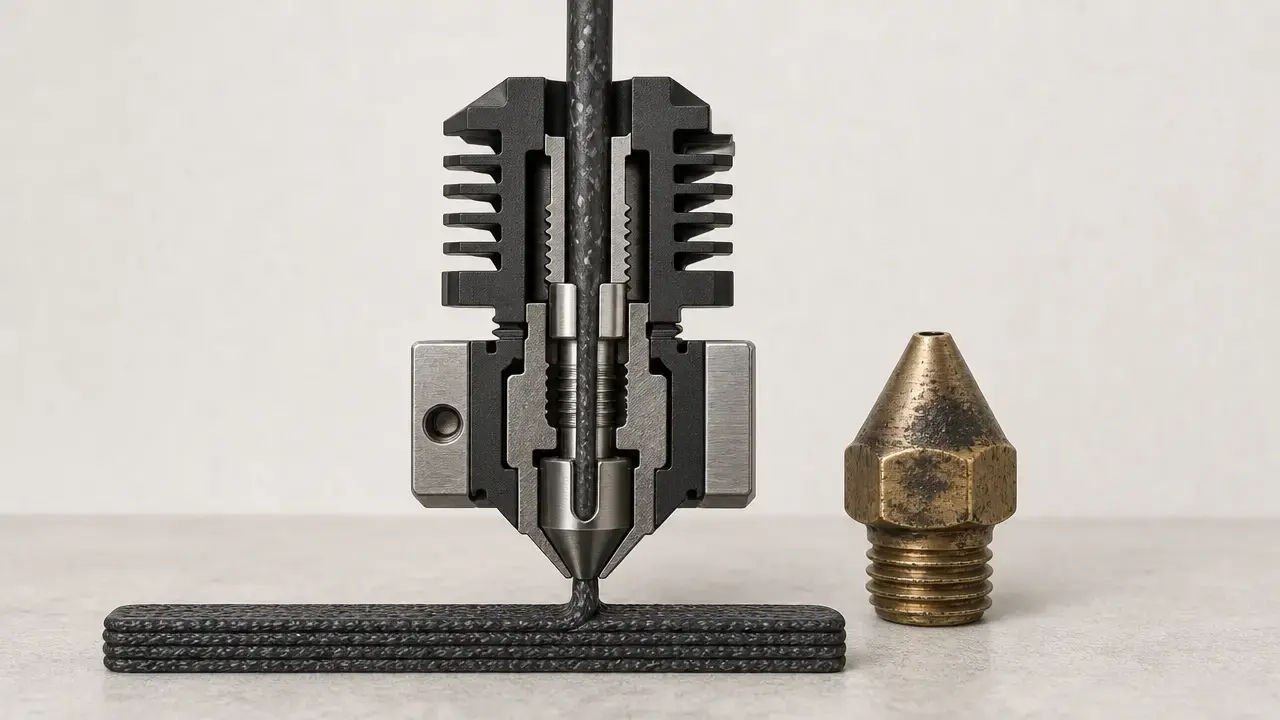
This is why filament-making extrusion should not be confused with printer hotend extrusion. A printer hotend meters already-made filament into a part. A filament extruder is making the feedstock itself, so it has to create diameter stability before the printer ever sees the material.
Size reduction: shredding, granulating, pelletizing
Before extrusion, scrap has to be reduced to machine-compatible size. Shredders and granulators do that job, and some workflows go one step further by pelletizing prepared material to improve feeding regularity. Particle size matters because large or irregular pieces can bridge in the hopper, melt unevenly, or clog further downstream. 3devo’s guidance gives a concrete example: material fed into its Filament Maker should be no larger than 4 mm in diameter. The same guidance also warns that contamination and poor handling can ruin output quality even if the polymer itself is compatible. [S19]
Extrusion control: what diameter numbers actually mean
Control here means keeping the strand close to nominal diameter, limiting ovality, and avoiding short local spikes. That is why a headline such as “±0.05 mm” is incomplete unless you also know the nominal diameter, polymer, feedstock condition, and measurement method. Premium QA systems can log diameter and ovality continuously across the spool, while simpler setups may rely on spot checks with calipers or a less fully described optical sensor. Prusament is a useful benchmark because it states 1.75 mm filament, ±0.02 mm manufacturing precision, and continuous measurement and recording of diameter and ovality across the full spool. [S24]
Workflow checklist: failed prints to testable filament
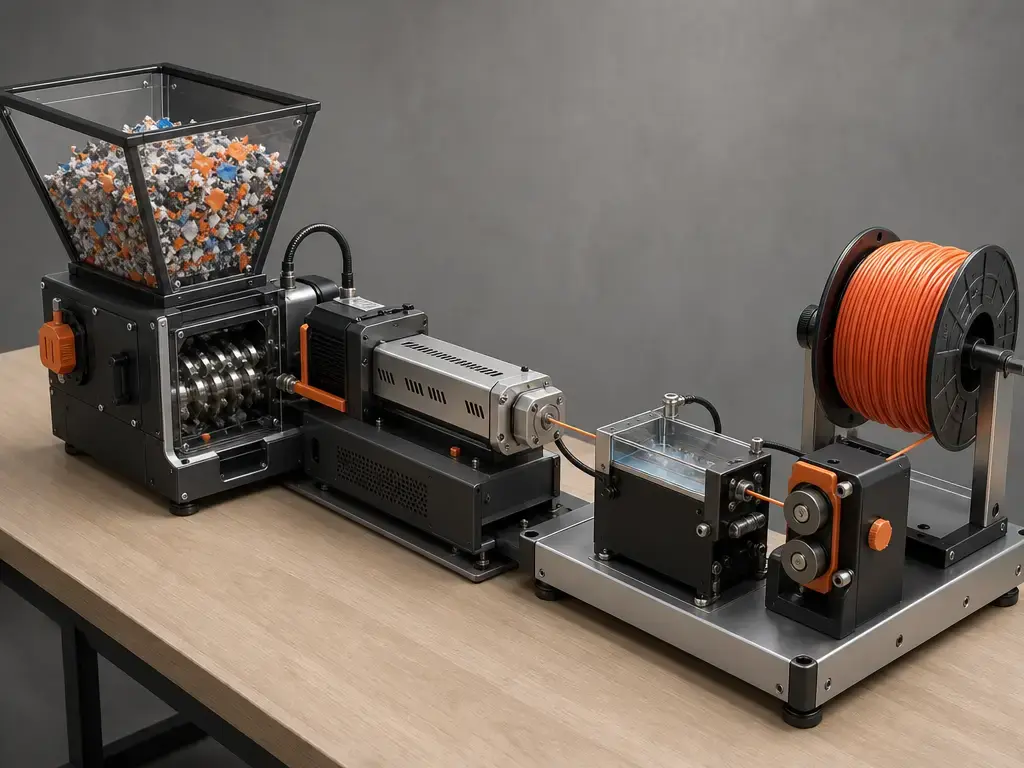
Workflow discipline matters more than brand choice. A capable machine can still produce poor filament if the waste stream is mixed, dirty, too wet, or fed in oversized chunks. The reverse is also true: modest hardware performs better when the inputs are disciplined and the operator treats the job like materials processing rather than casual tinkering. Manufacturer guidance on recycled feedstock explicitly lists dust, moisture, oil or grease, cross-contamination, and bed glue as realistic ways to ruin output quality. [S19]
Drying for extrusion is not the same as drying a finished spool for printing. Extrusion drying is about reducing moisture before heat and shear act on the melt. Print-side drying is about restoring handling and print behavior before the filament goes into a printer. Follow your polymer technical data sheet where possible, and do not universalize one schedule. For example, one 2026 PLA recycling study dried washed material at 75 °C for 12 hours, but that is a study-specific condition, not a universal rule for all PLA grades or all recyclate mixtures. [S27]
- Sort by polymer and color.
- Remove inserts, hardware, labels, tape, and magnets.
- Minimize glue-heavy surfaces and treat glued scrap as a contamination risk. [S19]
- Wash only if needed, then dry thoroughly.
- Break down parts safely.
- Shred or granulate to machine-compatible size, using ≤ 4 mm as one manufacturer example rather than a universal rule. [S19]
- Dry regrind or pellets using a material-specific procedure.
- Run a purge or startup pass to clear previous material.
- Measure diameter continuously, or at a defined interval, and log the results.
- Print test coupons before functional use.
Types of filament recyclers
A filament recycler can range from a bench-top experiment to a more instrumented lab platform. The categories matter because each one assumes a different level of feedstock preparation, operator time, and QC burden. A DIY rig assumes the user will solve sorting, drying, pulling, and spooling issues manually. A lab filament maker assumes cleaner feedstocks, documented recipes, and more formal testing.
The main trade-off is not simply price. It is how much process control the machine expects you to add around it. DIY and open-source systems offer the lowest entry cost and the best visibility into how the process works, but they put more safety and metrology burden on the operator. Modular setups let you choose a shredder, dryer, extruder, puller, and spooler separately, which is flexible but makes integration your problem. Integrated systems reduce handoffs, yet marketing pages often compress important caveats into small print. Lab and R&D machines usually give better sensing and higher thermal headroom, but that does not mean every recycled blend becomes easy. Services avoid machine ownership entirely, at the cost of local control.
The best class depends on scrap volume, polymer discipline, acceptable risk, and QC maturity. If you want to learn and reuse small amounts of one material, a DIY route may be enough. If you want repeatable output from a controlled waste stream, a modular line is usually the safer fit. If you want method development or material studies, lab equipment is easier to characterize.
| Recycler type | Typical inputs | Strengths | Watch-outs |
|---|---|---|---|
| DIY/open-source kit | Sorted regrind or pellets | Lower cost, repairable, educational | Tuning burden, safety load, limited logging |
| Desktop extruder + separate shredder | Pellets, flakes, prepared scrap | Modular, flexible | Diameter control and spooling may be separate |
| Integrated recycler system | Scrap processed through built-in stages | Workflow convenience | Claims may still be campaign-stage or lightly documented |
| Lab/R&D filament maker | Pellets, powders, additives, controlled blends | Better controls and higher-temperature capability | Higher cost and training burden |
| Recycling service | Sorted scrap shipped out | No machine ownership | Less control over returned material and blend history |
Real product pages show why context matters. Felfil Evo lists 1.75 mm and 2.85 mm nozzle options, average extrusion speed of 100 to 150 grams per hour, 250 °C or 300 °C heater options, and 5 kg weight. That is a useful hours-per-spool reality check, not a promise of saleable output rate. [S16]
ARTME’s MK3 shows why feedstock condition should travel with every diameter claim. The product information lists 1.75 mm and 2.85 mm output and a filament-diameter accuracy claim of ±0.05 mm with granules or pellets versus ±0.07 mm with shredded 3D-print waste. On the same page, ARTME lists 150 to 300 g/h as normal extrusion performance with filament calibration, melt filter, and a 1.7 mm die, plus an average of about 4 to 7 hours to produce about 1 kg of 1.75 mm filament. The page does not disclose the measurement method behind the diameter claim. [S17]
At the lab end, 3devo’s Precision 450 lists a maximum temperature of 450 °C, optical sensor accuracy of 43 µm, average energy consumption of 300 to 400 W, maximum consumption of 1300 W, and a 0.5 to 3 mm filament diameter range. That sensor figure describes the measurement head, not a guarantee that every recycled polymer blend will come out within 43 µm. [S18]
Filabot’s EX3 is a modular extruder example. Its product page lists a maximum run temperature of 425 °C, 0 to 42 RPM drive motor speed, 33 Nm torque, a 14:1 L/D screw, 1.75 mm and 2.85 mm nozzles, input from 1/8 in. / 3.18 mm pellets to powder, and an extrusion-rate claim of over 2 lb / 1 kg per hour using PLA. Again, that is raw extrusion rate, not guaranteed finished spool yield. [S20]
For integrated or campaign-stage systems, caution increases. At access date, ReDeTec listed the ProtoCycler V3 at $9,999 USD, with the grinder configuration shown as +$2,000. Creality’s Filament Maker M1 and Shredder R1 are still best treated here as campaign or emerging hardware because the cited page is a crowdfunding page, not a conventional shipped-product datasheet. Its headline claims are ±0.05 mm diameter tolerance and up to 1 kg/h output, but the detailed claims on the same page separate 1.70 to 1.80 mm diameter using 100% virgin PLA pellets from 1.65 to 1.80 mm using recycled scraps. The page does not disclose the measurement method behind those claims. [S22] [S23]
Performance metrics that matter
One successful print is not the same as a stable recycling process. A recycler can produce a strand that prints once and still fail as a repeatable feedstock system if diameter drifts, the strand is oval, or local spikes trigger intermittent jams. Quality control therefore has to treat filament as a continuous product, not just a yes-or-no printability check.
The core metrics are straightforward once separated. Mean diameter is the average over a defined sample length. A tolerance or accuracy claim is the stated departure from nominal, if the maker discloses it. Ovality is the difference between the largest and smallest cross-sectional dimensions. Spikes are short local oversize or undersize defects. Sampling interval is how often you measure along the strand. Measurement method matters because inline optical gauges and occasional caliper checks do not describe the product with the same depth. Melt flow is a related material-flow property, but it is not a substitute for filament geometry control. For MFR or MFI discussion, ASTM D1238-26 is the current anchor method, and ASTM notes that it addresses the same subject matter as ISO 1133 while differing in technical content. [S05]
Published diameter numbers only make sense with context. Prusament is a premium benchmark because it pairs nominal 1.75 mm filament with a ±0.02 mm manufacturing-precision claim and continuous logging of diameter and ovality across the spool. Bambu Lab’s PET-CF product page gives another manufacturer benchmark, 1.75 mm ±0.03 mm, but the page does not disclose the measurement method. ARTME’s MK3 separates its filament-diameter accuracy claim by feedstock condition, ±0.05 mm with granules or pellets and ±0.07 mm with shredded 3D-print waste, again without a disclosed measurement method. Creality’s campaign page is more cautionary: it advertises a ±0.05 mm headline, yet its detailed figures expand to 1.70 to 1.80 mm with 100% virgin PLA pellets and 1.65 to 1.80 mm with recycled scraps. Those are not equivalent claims, even though they appear on the same page. [S24] [S25] [S17] [S23]
A useful yield expression is: finished spool rate = raw extrusion rate × usable fraction. Raw extrusion rate is what the machine pushes out. Usable fraction is what remains after purge material, startup and shutdown waste, off-size sections, broken strands, and QC rejects are removed. That is why a maker’s “1 kg/h” or “150 g/h” claim should never be read as identical to saleable spools per hour. Throughput without yield is incomplete. [S16] [S17] [S20] [S23]
- Mean filament diameter.
- Tolerance and max local spikes.
- Ovality / roundness.
- Spool winding tension / tangling risk.
- Drying history / storage humidity, if known.
- Melt-flow consistency, using a stated method where relevant.
- Nozzle clog frequency.
- Surface roughness / bubbles.
- Printed-coupon tensile strength and modulus, framed as study-specific if reported.
- Printability across nozzle sizes and layer heights.
Testing ladder by user type
Minimum viable QC saves time because it stops a recycled spool from being called reliable before it has earned that label. It also improves traceability. When a print fails, you want to know whether the problem came from the recycled feedstock, the extrusion run, or the printer settings.
Testing depth should follow use case. A hobbyist making shop aids does not need the same burden as a print farm trying to repeat parts every day, and neither needs the same documentation depth as a lab studying recycled polymers. In lab contexts, ASTM D1238 is the anchor for melt-flow discussion, and ASTM WK89212 exists because tensile testing of filament itself still lacks a settled ASTM method. [S05] [S06]
- Hobbyist minimum: define a sampling interval for diameter spot checks, inspect the strand visually, run short calibration prints, and record extrusion settings for each batch.
- Makerspace / print farm: prefer logged diameter data where available, set reject thresholds, keep traceable bins and batch labels, and print the same standardized test coupon each time.
- Lab / R&D: add full traceability, retained samples, controlled blends, repeatability studies, and ASTM D1238 MFR or MVR testing where feasible. If tensile properties of the filament itself matter, document your method clearly because the standardization gap is still active work rather than settled practice. [S05] [S06]
Materials: PLA, PETG, ABS/ASA, TPU, and mixed waste
For PLA, the literature is useful but limited enough that overgeneralization is risky. In one 2026 study on mechanically recycled PLA filament, the authors reported successful recycling and reprinting up to three generations, but with printability deteriorating after the third cycle. Comparing generation 0 with generation 3, ultimate tensile strength fell from 44.7 to 40.5 MPa, strain to failure from 10.4% to 7.5%, and Young’s modulus from 1.603 to 1.055 GPa. The same study used drying at 75 °C for 12 hours before extrusion. That is a valid study condition, not a universal schedule. A 2024 review broadens the picture by showing that recycled PLA properties often degrade with repeated cycles, especially after the first, but also that performance can be modified by blending, additives, and process control. [S27] [S29]
PETG shows the same need for caution and context. In one 2022 study, the 100% recycled, non-pelletized sample measured 1.71 ± 0.07 mm, and its tensile strength was 13 MPa lower than the reference, a reported 28.2% decrease. The same study found that a 100% recycled pelletized sample performed 9 MPa better than the non-pelletized recycled sample and explicitly linked that improvement to more homogeneous size and shape of the starting material. That does not prove pelletizing is always required, but it does support the practical point that homogeneity of feed preparation can matter as much as the polymer name on the bag. [S28]
For ABS, ASA, TPU, nylon, PC, and other higher-risk or less forgiving polymers, the safest rule is to keep streams separate and treat mixed waste as a no for reliable filament production. Scholarly ABS closed-loop work exists, but that does not mean every shop’s mixed scrap bin can be made dependable. Unknown additives, unknown aging history, moisture exposure, and mixed elastomer-rigid combinations all make stable extrusion harder. [S09] [S19]
Limitations, failure modes, and why recycled filament often prints worse
Recycled filament often prints worse for chain-of-process reasons, not because recycling is a single failure mode. Moisture can create bubbles or unstable extrusion. Contamination can raise clog risk. Large or inconsistent particles feed poorly. Diameter spikes create local over- and under-extrusion even when the spool’s average diameter looks acceptable. In the 2026 PLA study, printability deteriorated after the third recycling cycle, and the authors pointed to brittleness and nozzle-clogging behavior as part of the failure pattern they observed. [S19] [S27]
It also helps to separate sensor specification from process outcome. For example, 3devo lists 43 µm optical sensor accuracy for the Precision 450, but that is a property of the sensing hardware. It does not guarantee that every polymer, blend, or recycled feed condition will produce filament within 43 µm of nominal. Final consistency still depends on melt behavior, feed homogeneity, cooling, pulling, and winding. Premium brands that emphasize tight geometry, such as Prusament, pair their claims with continuous logging of diameter and ovality across the spool rather than sensor accuracy alone. [S18] [S24]
This is why downcycling is often the honest outcome. A recycled spool may be perfectly useful for organizers, fit-checks, purge towers, or prototype parts while still being a poor choice for customer-facing parts, tight-tolerance assemblies, or work that depends on repeatable mechanical properties. The literature supports reuse, but it also supports caution about repeated cycles and uncontrolled waste streams. [S27] [S28] [S29]
Safety and operating controls
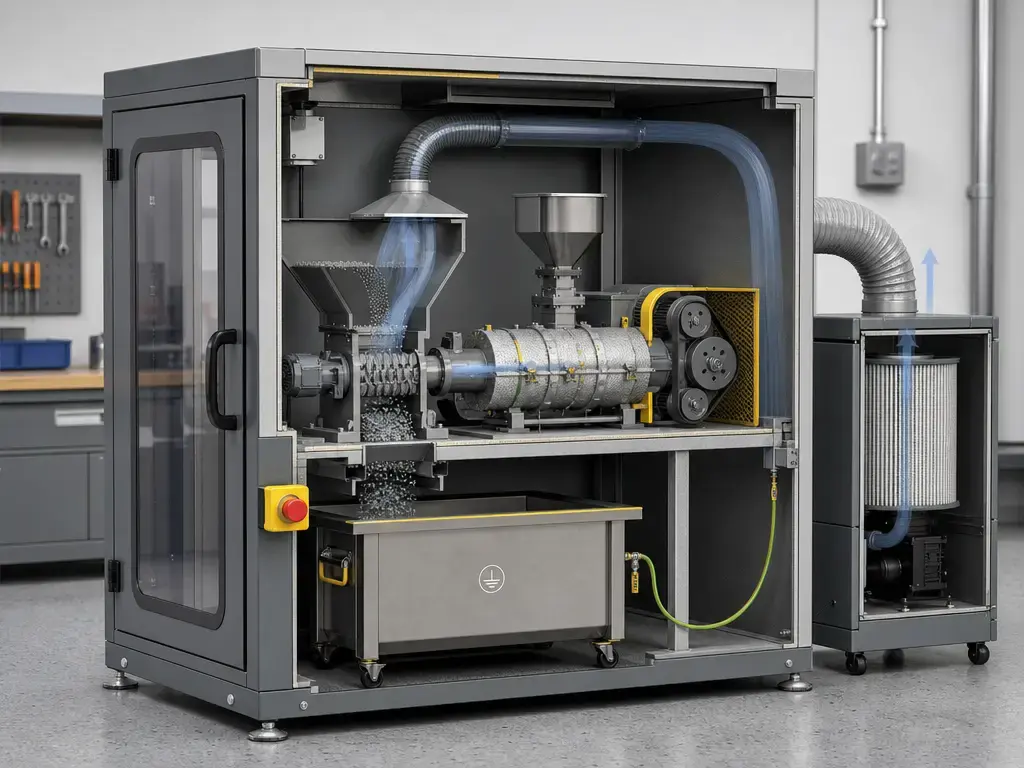
A filament recycler adds hazards that a printer alone may not. EPA notes that 3D printing can release VOCs and ultrafine particles, with ultrafine particles described in the 1 to 100 nm range, and its filament-extruder summary says extruder ultrafine particle emission rates were comparable to those found in other 3D-printer studies. That is why a recycler should be treated as a small plastics-processing setup, not as a harmless desktop accessory. [S13]
Controls should follow the hierarchy of controls, especially in schools, libraries, and makerspaces. NIOSH’s guide for safer 3D printing in those settings is Publication 2024-103, published in November 2023, and the PDF is 40 pages long. NIOSH’s 2018 office bulletin also reported that local exhaust ventilation could reduce or eliminate the ultrafine-particle concentrations measured in its conference-room test. In practice, that means putting local exhaust near the emission source, planning room airflow deliberately, and treating HEPA filtration as a supplement rather than a substitute for source capture. NIOSH also discusses enclosed ventilated racks and snorkel-style exhaust as engineering controls for non-industrial settings. [S11] [S12]
Mechanical hazards matter too. Shredders and cutters introduce pinch points, exposed edges, and rotating parts. Extruders add hot surfaces, hot polymer, and debris from failed runs. Housekeeping matters because plastic dust, fragments, and loose regrind spread easily. Unknown feedstock should be rejected, not tested anyway, if polymer identity or additive history is unclear. UL 2904 is relevant only as an emissions testing and assessment method for operating 3D printers in defined indoor scenarios. It is not a blanket safety certification for recyclers. [S12] [S14]
Economics: is a filament recycler worth it?
Sometimes, but only when you treat it as a cost-of-ownership, yield, and quality problem rather than free filament. Capital cost is the obvious starting point, yet it is rarely the whole story. At access date, ReDeTec listed the ProtoCycler V3 at $9,999 USD, with the grinder configuration shown as +$2,000. Even much smaller machines imply time costs: Felfil Evo lists average extrusion speed of 100 to 150 g/h, and ARTME lists roughly 4 to 7 hours to produce about 1 kg of 1.75 mm filament under its stated configuration. Those are process-time reminders, not guaranteed saleable-spool outputs. [S22] [S16] [S17]
A workable scenario model should include at least these variables:
- CapEx: extruder, shredder or granulator, dryer, puller or spooler, and any diameter sensors.
- Labor time: sorting, prep, drying, startup, monitoring, cleanup, and rework.
- Electricity: extrusion plus drying.
- Virgin blend ratio: if you are not running 100% recycled feedstock.
- Startup purge and QC reject fraction: the main drivers of yield loss.
- Maintenance and consumables: nozzles, blades, bearings, filters, and wear parts.
Those variables matter because labor and reject rate often dominate before electricity does. A machine can look efficient on paper and still be uneconomic if it turns many runs into purge material, off-size filament, or troubleshooting time.
Campaign pages can still be useful as examples of vendor messaging, but not as proof of ROI. Creality’s campaign recommends a 50/50 mix of recycled scrap and virgin PLA and lists about $15 per roll as a typical market price versus about $5 as estimated production cost. That is a vendor estimate, not an audited operating result, and it says nothing about labor, rejects, maintenance, or downtime in a real shop. [S23]
Decision framework and when not to recycle into filament
A 3D printer filament recycler makes the most sense for users with steady scrap volume, disciplined single-polymer streams, and enough QC capacity to verify the material they make. That usually points to labs, serious makerspaces, educators with controlled procedures, or print farms generating repeated waste from a limited set of materials. Schools and public makerspaces should treat ventilation, supervision, and guarding as gating factors, not add-ons, because NIOSH has specific guidance for those environments. [S12]
Decision matrix
- Yes, buy/build: high scrap volume, mostly one polymer family, trained operator, batch logging, and source-capture ventilation.
- Maybe: lower or intermittent volume, but strict sorting, cautious blend use, and output aimed at prototypes or other low-critical applications.
- No / outsource / alternative reuse: unknown or mixed scrap, frequent contamination, classrooms without controls, or parts that face regulated or customer-critical requirements.
Unknown or contaminated feedstock deserves special caution because the realistic failure list is mundane: dust, moisture, oil or grease, and glue from bed adhesion. If those conditions are normal in your waste stream, recycling into new filament is often the wrong use of time and energy. In those cases, alternative reuse routes, service recycling, or simply buying fresh filament may be more rational. [S19]
FAQ
What is a 3D printer filament recycler?
It is usually a workflow, not one magic box. In practice it combines sorting, size reduction, drying, filament extrusion, cooling and pulling, measurement, and spooling. In standards language, the output is filament feedstock, while some systems also use pellet feedstock upstream. [S03] [S19]
Can you turn failed 3D prints into reliable filament?
Yes, conditionally. The material has to be sorted, clean, dry, and compatible with the line, and the output still needs QC. The research record supports feasibility, but it does not support assuming recycled filament is automatically equivalent to premium commercial filament. [S07] [S08] [S19]
Why does recycled filament often print worse than store-bought filament?
Because the weak points stack up: contamination, moisture, inconsistent particle size, diameter drift, ovality, local spikes, and polymer degradation from repeated processing. Store-bought premium filament also tends to have stronger process control and better metrology than most desktop recycling lines. [S19] [S24] [S27] [S28]
How accurate does filament diameter need to be, and how should I measure it?
There is no single universal threshold detached from use case, but any claim should include nominal diameter, feedstock condition, and measurement method. As benchmarks, Prusament states 1.75 mm filament with ±0.02 mm manufacturing precision and continuous logging of diameter and ovality, while ARTME separates its claim into ±0.05 mm with pellets and ±0.07 mm with shredded 3D-print waste, without disclosing the measurement method on the cited page. Creality’s campaign page shows why detail matters: the same page pairs a ±0.05 mm headline with wider detailed ranges for recycled scraps. [S24] [S17] [S23]
What tests should I run before trusting recycled filament for functional parts?
At minimum, define a diameter sampling interval, inspect for surface defects, and print a repeatable test coupon. For higher stakes, add traceability, reject thresholds, retained samples, and more formal property testing. In lab settings, use ASTM D1238 where melt-flow behavior matters, and document tensile methods carefully because ASTM WK89212 shows that filament tensile testing itself is still an active standardization area. [S05] [S06]
Is melt-flow (MFR/MFI) useful for recycled filament batches?
Yes, but only when you state the method and conditions. ASTM D1238-26 is the current anchor method, and it is useful for quality-control comparisons of thermoplastics. It is still not a substitute for measuring filament geometry, because a batch can have acceptable melt-flow behavior and poor diameter control at the same time. [S05]
Is a filament recycler worth it financially?
Sometimes. It is most defensible when scrap volume is steady, polymer sorting is disciplined, labor is available, and the user accepts some reject rate. Manufacturer prices and campaign estimates can help frame the discussion, but they are not proof of real-world ROI unless the full yield and labor picture is included. [S16] [S17] [S22] [S23]
Sources
- [S02] ISO/ASTM 52903-1:2020 standard page. https://www.iso.org/standard/67290.html
- [S03] ISO OBP preview: ISO/ASTM 52903-1 terms and definitions. https://www.iso.org/obp/ui?_escaped_fragment_=iso:std:iso-astm:52903:-1:ed-1:v1:en
- [S04] Stratasys legal information. https://www.stratasys.com/en/legal/legal-information/
- [S05] ASTM D1238 standard store page. https://store.astm.org/standards/d1238
- [S06] ASTM WK89212 work item page. https://www.astm.org/workitem-wk89212
- [S07] Baechler, DeVuono, and Pearce (2013) recyclebot evaluation. https://digitalcommons.mtu.edu/materials_fp/29/
- [S08] Woern et al. (2018) RepRapable Recyclebot. https://www.sciencedirect.com/science/article/pii/S2468067218300208
- [S09] Zhong and Pearce (2018) distributed recycling and printing loop. https://www.sciencedirect.com/science/article/pii/S0921344917303014
- [S10] Kreiger et al. (2014) LCA of HDPE to filament. https://www.sciencedirect.com/science/article/pii/S0959652614001504
- [S11] NIOSH Science Bulletin (2018) office emissions and controls. https://www.cdc.gov/niosh/bulletin/2018/3d-printing.html
- [S12] NIOSH Pub 2024-103, Approaches to Safe 3D Printing. https://www.cdc.gov/niosh/docs/2024-103/pdfs/2024-103.pdf
- [S13] US EPA 3D printing research page. https://www.epa.gov/chemical-research/3d-printing-research-epa
- [S14] UL 2904 Ed. 2-2023 ANSI listing. https://webstore.ansi.org/standards/ul/ul2904ed2023
- [S16] Felfil Evo product page. https://felfil.com/felfilevo-filament-extruder/
- [S17] ARTME MK3 product information. https://www.artme-3d.de/produkte/desktop-filament-extruder-mk3/03-produkt-information/
- [S18] 3devo Precision 450 specs PDF. https://s.cdnmpro.com/490505258/content/3DEVO/Precision-450-Specs.pdf
- [S19] 3devo feedstock guidance: what is allowed in the FM. https://support.3devo.com/what-is-allowed-in-the-fm
- [S20] Filabot EX3 filament extruder page. https://www.filabot.com/products/filabot-ex3-filament-extruder
- [S22] ReDeTec ProtoCycler V3 product page. https://redetec.com/products/protocycler
- [S23] Creality crowdfunding campaign page. https://crowdfunding.creality.com/
- [S24] Prusament PLA product page. https://www.prusa3d.com/product/prusament-pla-filament/
- [S25] Bambu Lab PET-CF product page. https://us.store.bambulab.com/en/products/pet-cf?id=41090354348168
- [S27] PLA multi-generation recycling paper. https://link.springer.com/article/10.1007/s00170-026-18921-w
- [S28] PETG recycling paper. https://link.springer.com/article/10.1007/s42452-022-05039-3
- [S29] Systematic review of recycled PLA in 3D printing. https://www.sciencedirect.com/science/article/pii/S2667344424000033