
Summary
Cold spray additive manufacturing is a solid-state metal deposition process that uses a cold spray jet to build material on a substrate for coatings, dimensional restoration, repair, and near-net-shape features without intentionally melting the feedstock. In this context, “cold” means no intentional melting of the powder, not room-temperature operation. [4] [6]
The process matters because it gives metal a very different thermal history from fusion-based additive manufacturing, which makes it attractive for repair, feature buildup, and cases where heat input is constrained. The tradeoff is equally important: cold spray can deposit material quickly, but as-sprayed shape control is limited and qualification is often application-specific. It also sits awkwardly in standard AM taxonomy. ISO/ASTM 52900:2021 is the baseline vocabulary document for additive manufacturing, but a 2024 review notes that cold spray AM may not fit neatly into the standard seven categories. [1] [2]
Cold spray, repair, and CSAM: the three workflows
Cold spray was developed as a coating technology in the 1980s, and its core mechanism has stayed the same: powder particles are accelerated in the solid state and bond by high-velocity impact rather than by melting. [6] From that shared mechanism, three workflows are usually distinguished. The first is coating, where the goal is surface protection or added function. The second is repair or dimensional restoration, where material is added back to a worn, corroded, or undersized region of an existing part. The third is cold spray additive manufacturing proper, where deposition is used to build a feature, a near-net-shape section, or a freestanding form upward from a substrate. [4] [6]
These workflows do not carry the same approval burden. A corrosion repair, a dimensional restoration, and a qualified structural repair are not interchangeable labels. Official defense programs show real use in aircraft-component repair, but approvals remain component-specific rather than universal, so when a case is not documented the safest wording is qualification status unclear. [11] [4] Cold spray additive manufacturing is also not LPBF, not consumer aerosol “cold spray” cans, and not automatically a certified structural repair route.
Standards and classification reality
ISO/ASTM 52900:2021 is the baseline vocabulary document for additive manufacturing. The ISO record identifies it as Edition 2, published in November 2021, 28 pages long, and confirmed in August 2025. [1] That standard is the main reference point for how the AM field names processes and categories. Even so, a 2024 review explicitly notes that other additive processes may not fit ISO/ASTM 52900:2021 cleanly, including cold spray additive manufacturing. [2]
That matters because standards do more than define terms. They help teams describe the process, set up process control, frame testing, and separate coating work from repair or structural restoration claims. For cold spray, MIL-STD-3021 is especially important because it treats cold spray as a manufacturing process that can be manual or automated and requires additional qualification planning for structural or other critical applications. [4]
A newer sign of industrial maturity is SAE AMS7057, issued on December 5, 2024. Its scope is process control: it establishes process controls for repeatable implementation of CSAM for metallic and metal-nonmetal blend components. That is evidence of formalization, not blanket approval for all parts, all geometries, or all industries. [3]
Metrics not to confuse:
- Deposition rate vs deposition efficiency. Deposition rate is how much material is added per unit time. Deposition efficiency is how much of the supplied feedstock ends up in the deposit.
- Particle velocity vs gas velocity. Particle velocity is the speed of the powder particles. Gas velocity is the speed of the process gas.
- Porosity vs density. Porosity is the fraction of void space. Density is mass per unit volume.
- Feature size or nozzle spot vs dimensional accuracy. Feature size describes the scale of material delivery. Dimensional accuracy describes closeness to the intended geometry.
- As-sprayed properties vs post-processed properties. As-sprayed values describe the deposit immediately after spraying. Post-processed values describe the part after machining, heat treatment, HIP, or other finishing.
How cold spray additive manufacturing works
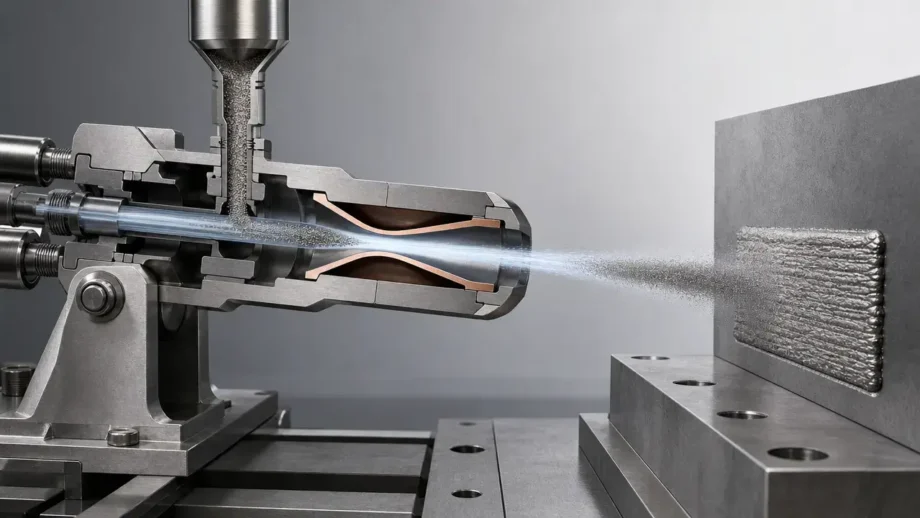
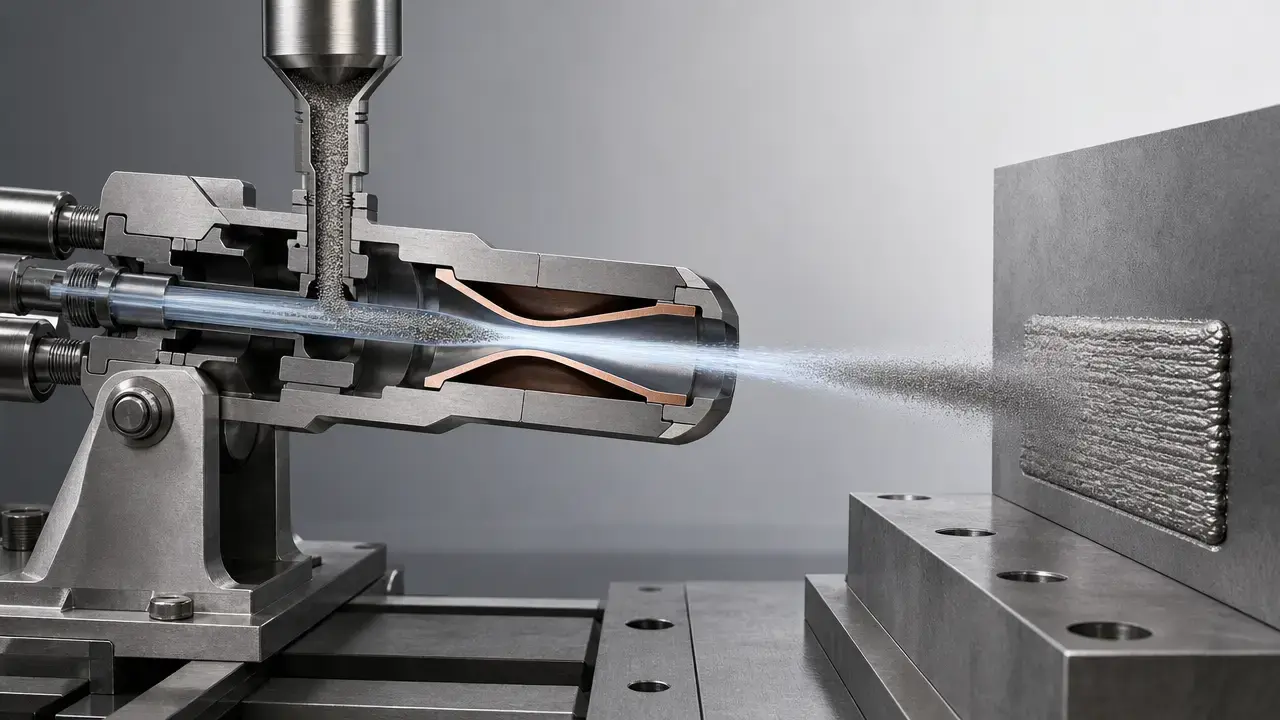
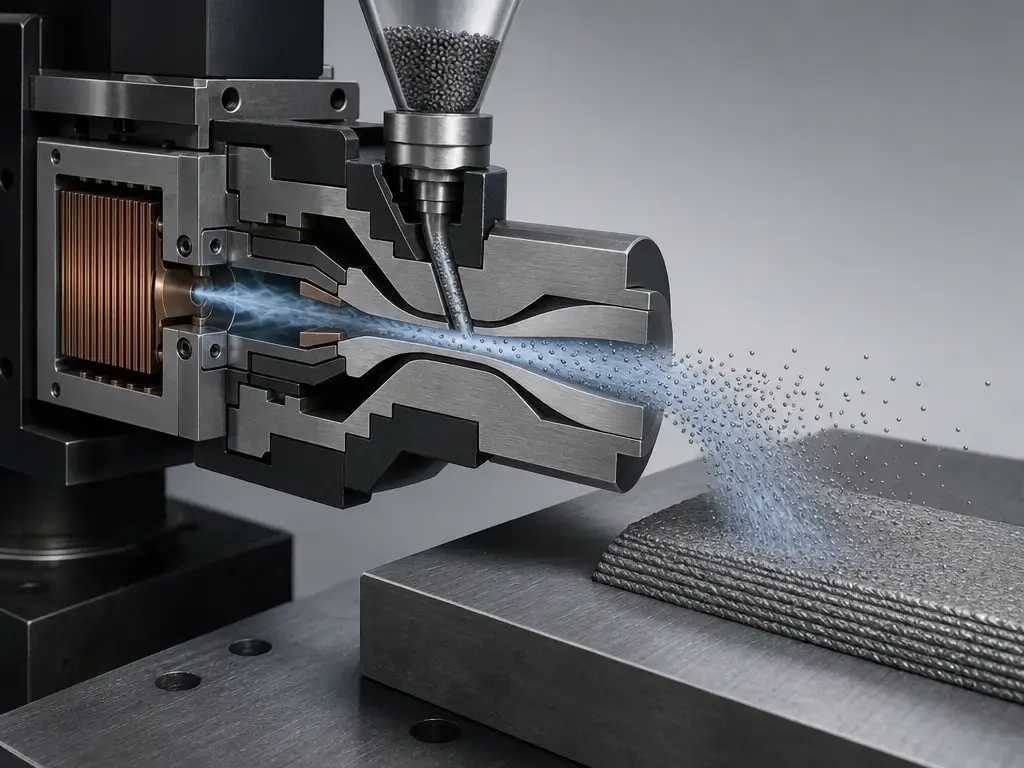
A cold spray system combines powder feedstock, a pressurized gas stream, and a nozzle that accelerates the gas into a high-speed jet. In CSAM, that nozzle is typically a converging-diverging de Laval design. The powder is injected into the flow, accelerated toward the substrate, and deposited by impact in the solid state. [4] [7]
MIL-STD-3021 describes cold spray particles as roughly 1 to 100 μm in diameter and typically 300 to 1200 m/s. [4] The mechanism is straightforward to describe but sensitive in practice. Particle velocity depends strongly on gas properties, particle density, and particle size. [7] When particles strike the substrate, they plastically deform, can disrupt oxide films, and can create intimate contact with the substrate or previously deposited material over very short timescales. [4] [8] Bonding occurs only when impact conditions exceed a critical velocity, but there is no single universal number because the threshold depends on temperature and the thermomechanical properties of the material system. [8] Adiabatic shear instability is one influential explanation for how local softening and interface disruption help bonding, but it is not the only mechanism discussed in the literature. [8]
The word “cold” is easy to misread. The gas is often preheated, and MIL-STD-3021 explicitly notes that gas heating is used to achieve higher flow velocity rather than to melt or soften the particles. [4] In other words, the process is cold relative to fusion routes, not necessarily cold in the everyday sense. That distinction matters because a Physical Review Letters study found that, under at least some conditions, melting can hinder impact-induced adhesion rather than improve it. [9]
Core process variables:
- gas type;
- gas pressure;
- gas temperature or preheat;
- powder size and morphology;
- particle velocity in flight;
- nozzle geometry;
- stand-off distance;
- traverse speed and scan strategy;
- substrate preparation.
Process types and equipment taxonomy
Cold spray systems are usually divided first by pressure class. A 2025 review describes low-pressure cold spray as below 1 MPa and high-pressure cold spray as above 1 MPa, while also noting that the boundary is somewhat arbitrary because pressure is a continuum and systems can overlap. [5] This is a practical taxonomy, not a hard physical boundary.
| Type | Typical role | Strengths | Constraints |
|---|---|---|---|
| Low-pressure cold spray (LPCS) | Portable coating or repair work, often where simpler deployment matters. [5] | Smaller, more portable systems are common. [5] | Usually framed as below 1 MPa, but the boundary with HPCS is not absolute. [5] |
| High-pressure cold spray (HPCS) | Higher-control deposition for coatings, repair, and many CSAM studies or industrial builds. [5] | Broader process window and stronger process-control emphasis are commonly associated with this class. [5] | Usually framed as above 1 MPa, with more infrastructure and overlap with adjacent operating conditions. [5] |
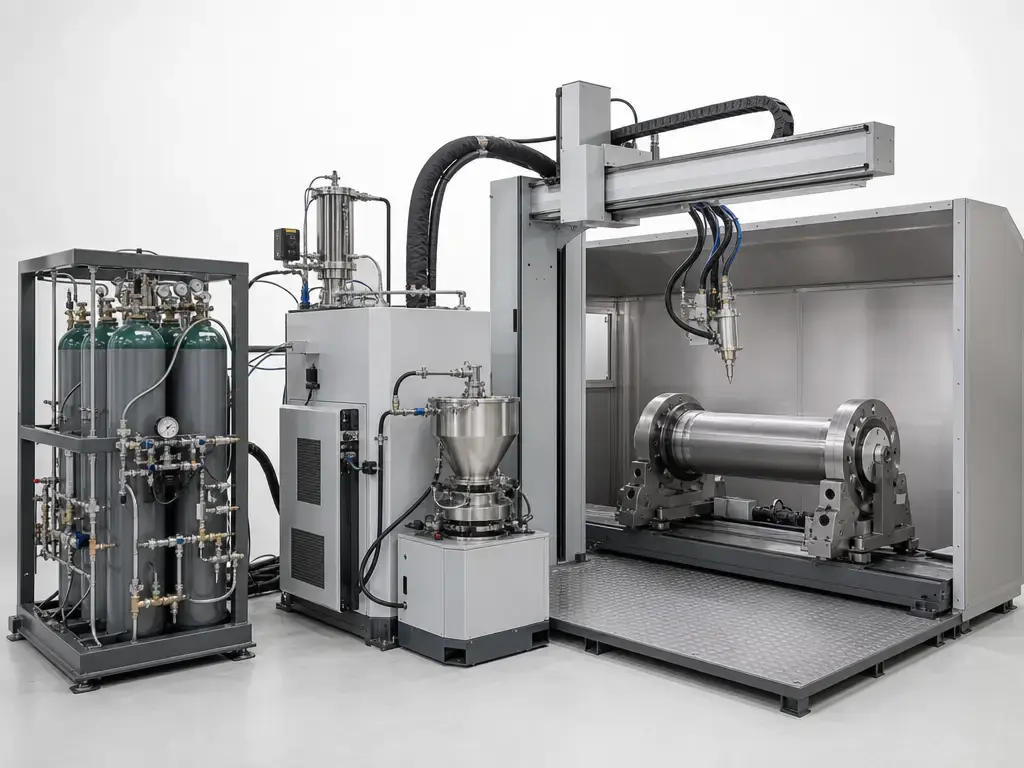
| Robotically controlled CSAM cell | Form factor for repeatable path control and larger additive builds; it may use HPCS or another pressure setup. [4] [5] | Better control of stand-off, path overlap, and repeatability. [4] | It is not a pressure class by itself and still inherits the limits of the chosen spray process. [4] [5] |
Pressure class and system form factor should be kept separate. MIL-STD-3021 includes both hand-held and robotically manipulated gun contexts, which is why a portable repair unit, a robotic cell, and an enclosed printer are best treated as deployment formats rather than different physics. [4]
Materials: what works well, what is difficult, and why
Cold spray additive manufacturing is usually most straightforward with powders that can deform on impact. Commonly reported material classes include aluminum, copper, titanium, nickel alloys, steels, and some metal-matrix-composite blends. [6] Ductility is central, but it is not the only factor. Oxide behavior, powder morphology, particle size distribution, hardness, and substrate compatibility all affect whether particles flatten, rebound, fragment, or bond. [6] [7] Harder or more brittle systems often have narrower process windows, and some are discussed in practice through blends or MMC-style feedstocks rather than as simple single-material deposits. [5]
The safest way to describe material performance is through study-specific examples rather than universal promises. One copper study reported average conductivity of about 73% IACS for cold-sprayed copper versus about 41% IACS for SLM copper. [17] A 6061 Al study reported about 460 MPa ultimate strength with about 3% ductility in the as-deposited condition. [18] A HIP study reported large tensile-strength changes for several cold spray deposits after post-processing, including 316L from 30 to 211 MPa, pure titanium from 70 to 480 MPa, and Ti-6Al-4V from 20 to 560 MPa. [19] These are material-specific, route-specific results, not generic cold spray capability numbers.
Metrics and part quality: from inputs to finished part
Process inputs
Gas type, gas pressure, gas temperature, powder size, powder morphology, and nozzle geometry shape the particle state before impact. The underlying gas-dynamics literature shows that particle velocity depends strongly on gas properties, particle density, and particle size. [7] Because LPCS and HPCS are better understood as a continuum than as a perfectly discrete split, relatively small changes in settings can shift a process toward stronger bonding, more rebound, or different track geometry. [5]
In-flight metrics
The main in-flight metric is particle velocity, not gas velocity. Gas flow conditions matter because they determine how the particles accelerate, but bonding depends on the particle impact state. [7] Critical velocity is therefore a process-state concept, not a fixed lookup number. Assadi and coauthors showed that the threshold depends on temperature and on the thermomechanical properties of the sprayed material. [8] That is why a setting that works for one alloy cannot simply be copied to another.
Deposition outcomes
At the deposition stage, the important metrics are deposition rate, deposition efficiency, and track geometry. They are related, but not interchangeable. Shape control remains one of CSAM’s main technical bottlenecks because deposits often follow a Gaussian-like profile that produces waviness, tapering, and edge loss unless passes are overlapped carefully. [10] A 2025 review also reports typical single-layer thickness below 1 mm, values as thin as 10 μm, and a commercial nozzle exit diameter around 6 mm. [10] That helps explain why as-sprayed dimensional control is not the same as nozzle size, and why no reliable figure was found for a single universal accuracy value.
Part outcomes
Part quality is best described at three levels. Interface-level properties concern adhesion or cohesion where particles meet the substrate or previous layers. Deposit-level properties include porosity, residual stress, and local density in the as-sprayed material. Finished-part-level properties include any machining, heat treatment, HIP, or other finishing steps applied later. ASTM C633-24 is a useful anchor in coating and repair discussions because it is a tensile adhesion or cohesion test method loaded normal to the coating plane, but it is not a universal qualification method for every CSAM build. [13] For cold spray work in critical applications, MIL-STD-3021 provides broader qualification framing, including a mandatory Appendix A for additional structural-application requirements tailored by the Cognizant Engineering Authority. [4]
Cold spray additive manufacturing vs laser powder bed fusion
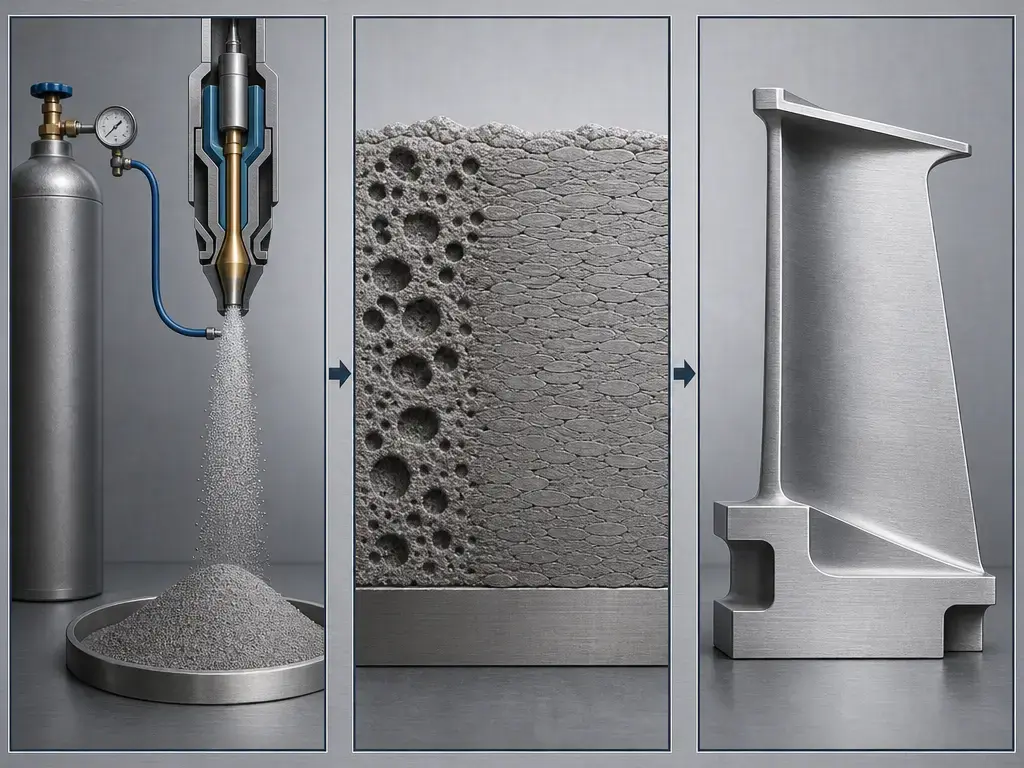
Cold spray additive manufacturing and LPBF solve different problems. CSAM is a solid-state route that adds material without intentional melting, which can be attractive for repair, buildup on existing substrates, and parts where lower heat input matters. [4] LPBF is a fusion process and usually makes more sense when the target geometry depends on finer unsupported detail, enclosed internal channels, or powder-bed resolution. The shape-control literature on CSAM is especially relevant here: nozzle-scale tracks and Gaussian-like profiles limit feature sharpness and increase the need for post-machining. [10]
Material response is also process-route dependent rather than process-brand dependent. A copper study that compared cold spray and SLM found markedly different conductivity for nominally the same metal, which is a useful reminder that thermal history and consolidation mode can dominate outcomes. [17] Neither process is universally better. The right choice depends on part function, starting geometry, material, service environment, and qualification path. [1] [2]
| Criterion | Cold spray additive manufacturing | LPBF | Practical implication |
|---|---|---|---|
| Heat input and bonding mode | Solid-state deposition with no intentional melting of feedstock. [4] | Fusion process with localized melting and solidification. | CSAM is often attractive when repair or lower heat input matters. |
| Geometry and internal features | Better suited to open buildup on existing parts; fine internal channels and sharp small features are constrained by track geometry and nozzle scale. [10] | Better suited to intricate detail and enclosed internal features, subject to support and process strategy. | Geometry ambition often points toward LPBF, while repair or buildup often points toward CSAM. |
| Starting point | Commonly used from an existing substrate or component surface. [4] [11] | Commonly used for build-from-scratch parts. | CSAM is often a process-route choice for restoration or hybrid manufacturing. |
| Property route dependence | Study-specific properties can differ strongly from fusion routes; for copper, one study reported about 73% IACS for CS versus about 41% IACS for SLM. [17] | LPBF properties are also route-dependent because melting, solidification, and post-processing drive outcomes. | Do not generalize one material result across all alloys or all AM processes. |
| Position in AM taxonomy | Often discussed as adjacent to, or outside, a neat fit within the seven-category ISO/ASTM map. [2] | Fits cleanly within the standard fusion-based AM landscape. [1] | The comparison is practical, but the taxonomy is not perfectly symmetrical. |
Repair and applications: what is realistic, what needs qualification
The most realistic application classes are coatings, corrosion repair, dimensional restoration, and additive feature buildup on an existing component. In aerospace, defense, marine, and energy work, that can mean rebuilding worn edges, restoring bearing or journal regions, protecting a reactive substrate, or adding stock for later machining. Portable or depot-style setups also make cold spray relevant to field and expeditionary scenarios where a build-from-scratch process may be less practical. [11] Whether a given case counts as corrosion repair, dimensional restoration, or qualified structural repair depends on the actual approval basis, not on the label used.
Approval status is application- and authority-specific; cold spray is not “certified” as a process by itself. [4]
The U.S. defense case shows why careful wording matters. SERDP/ESTCP states that premature failures of affected magnesium aircraft components cost the Department of Defense about $100 million per year, and it notes a cold spray demonstration facility at Navy Fleet Readiness Center East in North Carolina. [11] The same program context also includes repair-program-specific throughput language: coatings exceeding 20 lb/hour and thicknesses of 0.030 in in seconds have been reported, but these are repair figures from that program context and should not be generalized to all CSAM systems or materials. [12] For structural applications, MIL-STD-3021 points back to tailored qualification plans under a Cognizant Engineering Authority. [4]
Limitations and failure modes
The first limitation is shape control, not just raw deposition. A 2025 review identifies Gaussian-like deposit profiles, waviness, tapering, and edge loss as core CSAM constraints. [10] That means toolpath overlap matters because each pass changes the surface seen by the next one. It also means the edge of a build can fall away faster than the center if the path strategy is not tuned. Access and shadowing limit what can be deposited consistently, especially for recessed or sharply enclosed features. When impact conditions fall below critical velocity, particles tend to rebound instead of building useful material. [8] At more aggressive conditions, erosion, residual stress from severe plastic deformation, or delamination risk can enter the process window. Machining allowance is therefore commonly needed when finished geometry matters. [10]
Operationally, cold spray can also be limited by gas supply, powder handling, and qualification effort. Heated, pressurized gas infrastructure is often substantial, and powder logistics are part of process control rather than a minor detail. A simple hotter-is-better view is also wrong here, because melting can hinder adhesion under some conditions. [9]
Commercial examples (numbers are examples only)
The systems below are illustrative only. Their published numbers are machine-specific examples, not general capability claims for cold spray additive manufacturing.
| System | What it illustrates | Published specs (select 2–4) | Source |
|---|---|---|---|
| WarpSPEE3D | Large-format CSAM platform. | Max part size Ø1 m × 0.7 m; max part weight 40 kg; deposition rate up to 100 g/min; deposition spot size 6 mm. [14] | SPEE3D brochure. [14] |
| VRC Raptor | Heater-supported, high-pressure repair or deposition platform. | Up to 1000 PSI (69 bar); up to 1652°F (900°C); 21 kW heater; nitrogen, helium, or air options. [15] | VRC product page. [15] |
| Impact Gun 6/11 AH EvoCSII | Gun-level example showing high gas temperature and pressure are normal in industrial cold spray. | Up to 60 bar process gas pressure; up to 1100°C process gas temperature; integrated heating capacity 44 kW. [16] | Impact Innovations datasheet package. [16] |
Taken together, these examples show that commercial systems vary widely in footprint, gas infrastructure, and deployment model. They also reinforce a point made earlier: “cold” does not mean unheated gas, and one vendor datasheet should never be treated as a universal CSAM process limit.
When CSAM is the right fit
Cold spray additive manufacturing is best treated as a process-selection tool, not a universal replacement for other metal AM routes. Its strengths are clearest when solid-state buildup, repair on an existing component, or controlled low-heat deposition matter. [4] [11]
Use CSAM when:
- you need solid-state metal deposition without intentional feedstock melting. [4]
- the starting point is an existing part and the job is coating, corrosion repair, dimensional restoration, or localized buildup. [11]
- the geometry is fairly open and can tolerate machining allowance after deposition. [10]
- field, depot, or hybrid-manufacturing context matters more than very fine unsupported detail. [11]
Prefer LPBF or DED when:
- the design depends on finer unsupported detail, sharp small features, or enclosed internal channels. [10]
- the part is being designed from scratch rather than rebuilt from an existing substrate.
- the qualification path is already centered on a melt-based process family.
- the required surface condition and dimensional tolerance are tied to a fusion-based production route rather than sprayed buildup plus finishing.
FAQ
What is cold spray additive manufacturing?
Cold spray additive manufacturing is the use of cold spray to build features or near-net-shape sections by solid-state particle deposition rather than by melting and resolidifying metal. [4] [6] ISO/ASTM 52900 is the vocabulary baseline for AM, but CSAM is often discussed as a process that does not fit neatly into the standard seven-category map. [1] [2]
How does cold spray 3D printing work?
Powder is carried in a pressurized gas stream, accelerated through a nozzle, and directed at a substrate at very high speed. MIL-STD-3021 describes particles roughly 1 to 100 μm in size and typically 300 to 1200 m/s. [4] If the particles hit with the right impact state, they plastically deform, disrupt surface oxides, and bond to the substrate or earlier layers. [4] [8] The build grows by impact-driven accumulation rather than by melting.
Does cold spray melt the metal?
No, not intentionally. In cold spray, the feedstock remains solid during deposition, which is the defining difference from fusion-based routes. [4] [6] The gas is often preheated, but that heating is used to improve flow conditions and particle acceleration, not to melt the powder. [4] Under some conditions, melting can actually hinder impact-induced adhesion. [9]
What metals can be used in cold spray AM?
Commonly reported material classes include aluminum, copper, titanium, nickel alloys, steels, and some metal-matrix-composite blends. [6] The practical question is not only whether a metal can be sprayed, but whether it can deform and bond within an achievable process window. Ductile systems are generally easier to discuss as CSAM candidates, while harder or more brittle systems often need tighter control or more post-processing. [5]
Cold spray vs laser powder bed fusion: how do you choose?
Choose cold spray when the problem is repair, low-heat buildup on an existing part, or solid-state deposition onto an accessible surface. [4] Choose LPBF when the design depends on finer unsupported detail, enclosed passages, or a build-from-scratch geometry that fits a powder-bed fusion route better. [10] The two processes are not interchangeable, and the best choice depends on geometry, material, service conditions, and qualification strategy. [1] [2]
What is critical velocity, and why does it not have one universal value?
Critical velocity is the impact speed above which bonding becomes likely for a given particle and substrate combination. It is central to cold spray, but it is not a universal constant. Assadi and coauthors showed that the threshold depends on temperature and on the thermomechanical properties of the sprayed material. [8] That means “enough velocity” is always relative to the alloy system, particle condition, and process window.
How is bond strength or adhesion typically tested or qualified for cold spray repairs?
Testing depends on the application. ASTM C633-24 is a common reference point in coating and repair discussions because it measures adhesion or cohesion strength under tensile loading normal to the coating plane. [13] But that test method is only one part of a broader qualification picture. For critical or structural cold spray work, MIL-STD-3021 provides the process framework and includes a mandatory Appendix A for additional structural-application qualification requirements tailored by the Cognizant Engineering Authority. [4]
Sources
- ISO/ASTM 52900:2021 Additive manufacturing — General principles — Fundamentals and vocabulary. https://www.iso.org/standard/74514.html
- Recycled aluminium feedstock in metal additive manufacturing: A state of the art review. https://pmc.ncbi.nlm.nih.gov/articles/PMC10923728/
- SAE AMS7057 Cold Spray Additive Manufacturing (CSAM) Process. https://saemobilus.sae.org/standards/ams7057-cold-spray-additive-manufacturing-csam-process
- MIL-STD-3021 with Change 2 — Materials Deposition, Cold Spray. https://quicksearch.dla.mil/WMX/Default.aspx?token=5734224
- Air-based cold spray: An advanced additive manufacturing technique for functional and structural applications. https://link.springer.com/article/10.1007/s00170-025-15022-y
- Cold spray additive manufacturing and repair: Fundamentals and applications. https://www.sciencedirect.com/science/article/pii/S2214860417302993
- Gas Dynamic Principles of Cold Spray. https://doi.org/10.1361/105996398770350945
- Bonding mechanism in cold gas spraying. https://doi.org/10.1016/S1359-6454(03)00274-X
- Melting Can Hinder Impact-Induced Adhesion. https://journals.aps.org/prl/abstract/10.1103/PhysRevLett.119.175701
- Cold Spray Additive Manufacturing: A Review of Shape Control Challenges and Solutions. https://link.springer.com/article/10.1007/s11666-025-01970-0
- SERDP/ESTCP — Cold Spray Technology for Aircraft Component Repair. https://serdp-estcp.mil/page/1c0da28a-b986-41e5-bace-4c7c4ee1afdd
- SERDP/ESTCP — Cold Spray. https://serdp-estcp.mil/newsitems/details/4d079da9-8917-458e-941d-29e5984d8d73/cold-spray
- ASTM C633-24 Standard Test Method for Adhesion or Cohesion Strength of Thermal Spray Coatings. https://store.astm.org/standards/c633
- SPEE3D — WarpSPEE3D / LightSPEE3D brochure PDF. https://www.spee3d.com/wp-content/uploads/2024/04/WarpLightSPEE3D_Brochure-04-24.pdf
- VRC Metal Systems — VRC Raptor product page. https://vrcmetalsystems.com/equipment/vrc-raptor/
- Impact Innovations — Datasheet package PDF. https://impact-innovations.com/wp-content/uploads/2024/11/ALL_Impact_Innovation_Datasheets_2025-2.pdf
- Pure copper components fabricated by cold spray (CS) and selective laser melting (SLM) technology. https://www.sciencedirect.com/science/article/pii/S0257897220306058
- Microstructure and mechanical properties of cold sprayed 6061 Al in as-sprayed and heat treated condition. https://www.sciencedirect.com/science/article/pii/S0257897216313214
- Influence of hot isostatic pressing on the properties of 316L stainless steel, Al-Mg-Sc-Zr alloy, titanium and Ti6Al4V cold spray deposits. https://www.sciencedirect.com/science/article/pii/S0257897220314067