Summary (direct answer)
The 3D Manufacturing Format (3MF) is an additive manufacturing file format standardized as ISO/IEC 25422:2025 (Edition 1), published in 2025-06 (International Standard published: 2025-06-06). [1] A 3MF file is an Open Packaging Conventions (OPC) package stored as a ZIP container rather than a single flat mesh, and its core model declares units with a default of millimeter. [2]

Historical Background
The 3MF Consortium describes the format as formed in 2015 by Autodesk, Microsoft, and HP, and states that the first 3MF core specification was released in 2015. [4][3] In the consortium’s narrative history, Autodesk, Shapeways, and SLM Industries are described as joining and becoming founding members. [3] The Library of Congress (LOC) similarly notes that the 3MF Consortium was launched in 2015 and describes it as a Joint Development Foundation project, providing an institutional framing of stewardship rather than a specification text. [6]
A cited Cambridge Engineering Department report characterizes STL as the most commonly used 3D printing file format while also describing STL as lacking provisions to store material, texture, colour, measurement, or structural information. [7] The same report frames 3MF as an “upcoming alternative” and describes AMF and 3MF as XML-based and open/evolving, which is commonly used to justify the development of “full-fidelity” exchange formats in additive manufacturing workflows. [7]
What a 3MF File Is (Scope and Intended Use)
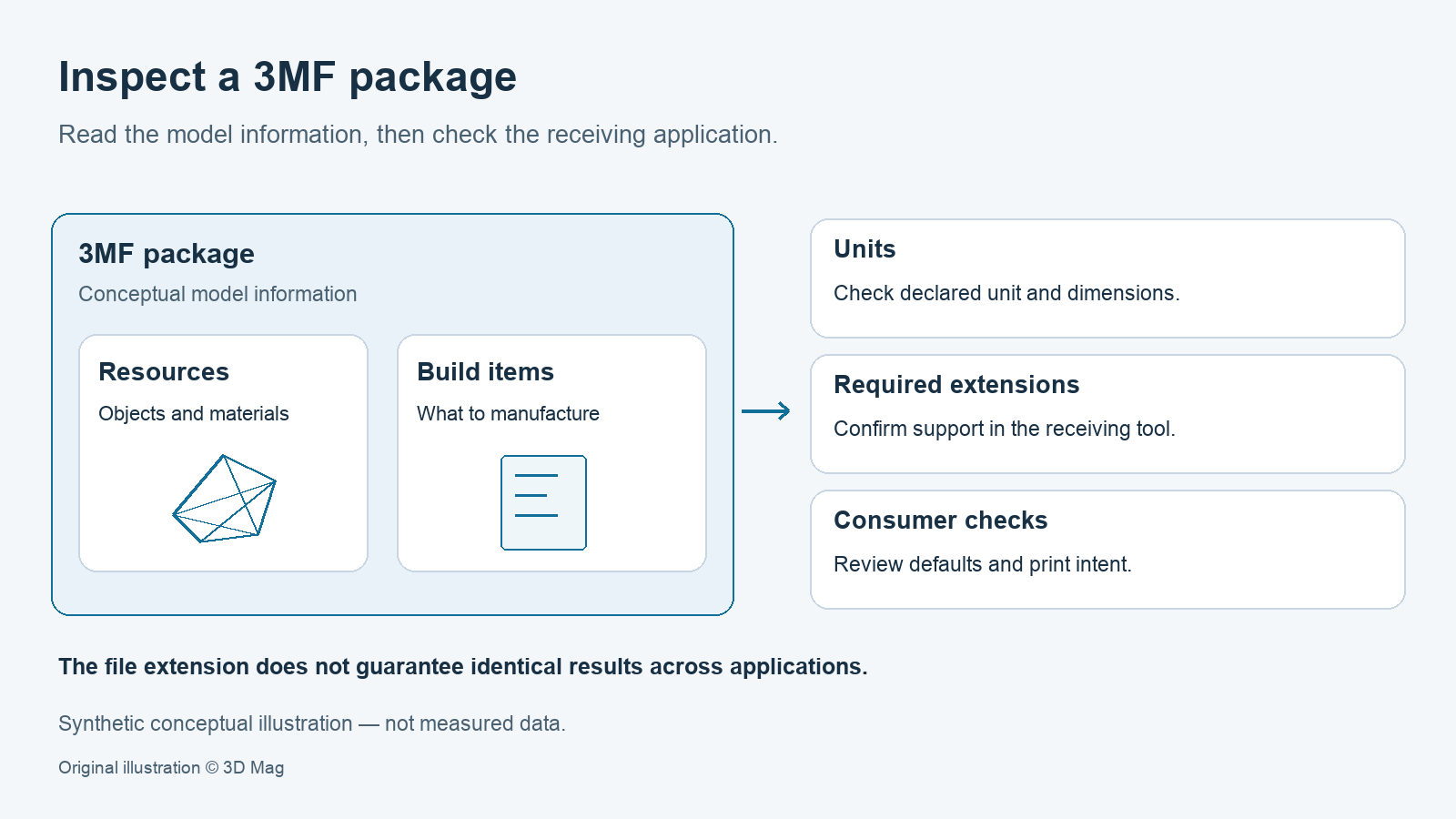
Microsoft’s platform documentation describes 3MF as a set of conventions using XML to describe the appearance and structure of 3D models for manufacturing, in which required and optional parts are connected by defined relationships and the resulting data set can be saved with the .3mf extension. [8] In practice, some applications use 3MF both for model exchange and as a slicer project file snapshot; for example, PrusaSlicer’s “Save Project as” produces a 3MF that contains objects and settings, and it documents that the file extension can be changed from .3mf to .zip to inspect its contents. [9]
Technical Anatomy of a 3MF Package (OPC + ZIP)
The 3MF Core Specification v1.3.0 defines a 3MF document as a package whose requirements extend the Open Packaging Conventions (OPC) model of parts and relationships. [2] At the physical container level, the core specification requires that a 3MF document MUST use a ZIP archive, which is why “3MF” is typically treated as a bundle of multiple interrelated files rather than a single monolithic geometry payload. [2] This packaging approach is also consistent with Microsoft’s description of 3MF as conventions that define required/optional parts and relationships between those parts. [8]
For interoperability, the core specification constrains ZIP compression methods to Deflate (method “8”) or stored uncompressed (method “0”), which limits the set of encoders that can be used if broad consumer support is required. [2] The same specification states that consumers MUST support PKWARE ZIP64 and the ZIP “streaming extension,” making ZIP64 handling and streaming-compatible readers a conformance-relevant implementation detail rather than an optional optimization. [2] In addition, the core specification states that 3MF documents MUST NOT reference resources external to the package unless an extension allows it, reinforcing a “self-contained” artifact model for exchange and archiving. [2]

In typical inspection and debugging workflows, the ZIP requirement means a 3MF can be opened by ZIP tooling to enumerate parts, extract XML, and view embedded resources such as images, subject to the constraints above. [2] The “self-contained” rule is also a practical boundary: when a producer needs data not representable by the core model, it is expected to use a defined extension mechanism rather than referencing external assets by URL, unless a relevant extension explicitly permits such references. [2] This architectural intent is aligned with the broader motivation described in the Cambridge report, which highlights missing metadata channels in STL-centric exchanges and motivates richer packaging and structured metadata in alternatives such as 3MF. [7]
Core Data Model Essentials (Units, Resources, and Common Payloads)
At the model layer, the 3MF Core Specification v1.3.0 defines a <model> attribute unit whose default is millimeter and whose valid values include micron, millimeter, centimeter, inch, foot, and meter, enabling explicit unit declaration within the exchanged content. [2] The core specification also standardizes some non-geometry payload conventions, including that thumbnail parts MUST be JPEG or PNG, illustrating the intent to carry preview and user-interface artifacts inside the same package. [2] For implementers handling the XML content of these parts, the core specification requires XML to be UTF-8 encoded, establishing a fixed baseline for parsers and serializers in compliant producers and consumers. [2]
Extension Specifications (What “Full-Fidelity” Means in Practice)
3MF is published as a suite of specifications rather than a single document, and the consortium’s public specification index lists multiple extension specifications alongside the core. [5] The consortium’s listing shows that these components are versioned and updated independently, including Core Specification v1.3.0 (updated 02/27/2025), Materials and Properties v1.2.1 (updated 02/27/2025), Production v1.1.2 (updated 02/27/2025), Secure Content v1.0.2 (updated 02/27/2025), Slice v1.0.2 (updated 02/27/2025), Volumetric v0.8.0 (updated 02/27/2025), and Boolean Operations v1.1.0 (updated 04/03/2025). [5] This independently revised structure is one reason compatibility is often described in terms of “core + supported extensions” rather than a single unqualified statement of 3MF support. [5]
The same suite framing is echoed at the ISO layer: ISO/IEC 25422:2025’s abstract states that the standard defines the Core Specification and extensions, and that the “Suite” changes only when components are added or removed, indicating that extension documents are part of the standardized conceptual unit. [1] In practical terms, this means that “full-fidelity” interchange is conditional on the intersection of extension support between a producing tool and a consuming tool, and it also means that extension names such as “materials,” “properties,” “slice,” and “volumetric” are formally recognized as part of the suite vocabulary even when a given pipeline only consumes the core representation. [1][5]
Standardization, Governance, and Patent Posture
ISO/IEC 25422:2025 (Edition 1) is listed by ISO with publication month 2025-06 and an “International Standard published” lifecycle event dated 2025-06-06, and its abstract positions the standard as defining the 3MF Core Specification and extensions as a suite whose membership changes only when components are added or removed. [1] For governance context outside consortium statements, the LOC format description frames the consortium as a Joint Development Foundation project and records a “Last Updated: 03/31/2025” page date, which is frequently used as a neutral, third-party description of stewardship metadata rather than a source of technical specification rules. [6] On licensing and implementation risk, the consortium’s specification page states that members agreed to make necessary patent claims available royalty-free for the Core Specification and public extensions, which is commonly cited as an IP posture intended to reduce barriers for implementers of the published suite. [5]
Tooling and Ecosystem Usage Patterns (CAD, Slicers, OS APIs)
In operating-system and platform tooling, Microsoft’s documentation presents 3MF as conventions using XML that define parts (required and optional) and relationships, and it describes the outcome as a data set that can be saved as a .3mf file. [8] This description is consistent with the core specification’s OPC-derived packaging model, which makes “package traversal” (enumerating parts, resolving relationships, and parsing the relevant XML content) a central implementation pattern rather than a format-specific special case. [2][8]
In slicer-centric workflows, some tools use 3MF as a project container rather than a pure interchange artifact, and Prusa’s documentation explicitly describes “Save Project as” creating a 3MF that includes objects and settings, as well as the practical note that renaming .3mf to .zip enables viewing its contents. [9] This “project” usage can coexist with core-spec 3MF interchange because the same ZIP container can carry additional parts, but the suite model described by ISO and the consortium implies that interoperability depends on whether the consuming tool supports the relevant core structures and extensions found in the package. [1][5]
Comparison Table: 3MF vs STL vs OBJ vs AMF vs STEP
The table below is a decision-oriented summary that emphasizes what is explicitly supported by the cited sources, and it should not be interpreted as a universal compatibility guarantee for any specific CAD system, slicer, or printer software stack. [7] The Cambridge report’s discussion of STL’s limitations provides the main third-party motivation contrast, while the 3MF Core Specification v1.3.0 provides the package and unit-handling baseline for 3MF. [7][2]
| Format | Container / packaging model | Encoded information (as supported by cited sources) | Units behavior (as supported by cited sources) |
|---|---|---|---|
| 3MF | ZIP archive; OPC (parts + relationships) package. [2] | Intended to support richer manufacturing-relevant data than STL in response to STL limitations described in the literature; non-geometry parts such as JPEG/PNG thumbnails are standardized by the core spec. [7][2] | Declared via <model> unit; default millimeter; valid values enumerated (micron, millimeter, centimeter, inch, foot, meter). [2] |
| STL | No reliable statement found in provided sources about container model. | Report describes STL as most commonly used and as lacking provisions for material, texture, colour, measurement, or structural information. [7] | Report describes STL as lacking provisions for measurement information. [7] |
| OBJ | No reliable statement found / No reliable statement found. | No reliable statement found in provided sources. | No reliable statement found in provided sources. |
| AMF | No reliable statement found in provided sources about container model. | Report describes AMF as XML-based and open/evolving in the same context as 3MF. [7] | No reliable statement found in provided sources. |
| STEP | No reliable statement found in provided sources about container model. | No reliable statement found in provided sources. | No reliable statement found in provided sources. |
Implementation Notes and Common Pitfalls (Developer-Facing)
For parsers and serializers, the 3MF Core Specification v1.3.0 fixes several baseline requirements: XML content MUST be UTF-8, and DTD content MUST NOT be used, with consumers advised to treat DTD presence as an error as part of denial-of-service mitigation guidance. [2] These requirements are typically treated as conformance constraints rather than style preferences, because they affect default XML parser configuration and security posture in downstream tooling. [2]
At the container level, the core specification requires a ZIP archive and permits only Deflate (“8”) or stored (“0”) compression methods, and it further requires consumer support for ZIP64 and the streaming extension. [2] In addition, the document-level dependency rule states that 3MF documents MUST NOT reference external resources unless an extension allows it, which is relevant to reproducibility expectations and to threat modeling when 3MF packages are ingested from untrusted sources. [2] For user-facing previews and package browsing, thumbnail parts MUST be JPEG or PNG, which can be used as a lightweight validation check when inspecting a 3MF package’s resource set. [2]
- Confusing “3MF (spec)” with “3MF project files” produced by slicers (which may embed tool-specific settings). (help.prusa3d.com). [9]
- Assuming unitless workflows — the core model’s
unitdefault is millimeter and valid values are enumerated in the spec. (3mf.io). [2] - Ignoring ZIP/OPC constraints — consumers may require ZIP64 support; producers must follow permitted compression modes. (3mf.io). [2]
- Treating XML parsing as “generic” — DTD content is forbidden by spec guidance, and UTF-8 is required. (3mf.io). [2]

FAQ
What is a 3MF file (3D Manufacturing Format) used for in 3D printing?
3MF is defined in Microsoft documentation as a set of conventions using XML to describe the appearance and structure of 3D models for manufacturing, saved with the .3mf extension, and it formalizes required and optional parts and their relationships. [8]
Is 3MF an ISO standard 3D manufacturing format?
ISO/IEC 25422:2025 is published as an International Standard, with ISO listing a publication month of 2025-06 and a publication event dated 2025-06-06, and its abstract states that it defines the 3MF Core Specification and extensions as a “suite.” [1]
What does a 3MF file contain that an STL file typically does not?
A cited industry report describes STL as lacking provisions to store material, texture, colour, measurement, or structural information and frames 3MF as an upcoming alternative, and 3MF’s core specification also defines that a 3MF package can include non-geometry parts such as JPEG/PNG thumbnails. [7][2]
Why can a 3MF file be opened like a ZIP container?
The 3MF core specification requires the 3MF document format to use a ZIP archive, and slicer documentation also notes that changing the extension from .3mf to .zip allows inspection of contents. [2][9]
Expert: What unit system does the 3MF core model use — and how is it declared?
The core specification defines a <model> attribute unit with default millimeter and enumerates valid unit values including micron, millimeter, centimeter, inch, foot, and meter, and coordinates are interpreted according to that declared unit. [2]
Expert: What are the XML security constraints in the 3MF core specification?
The core specification requires UTF-8 encoding for XML content and states that DTD content must not be used, with consumers advised to treat DTD presence as an error as part of denial-of-service mitigation guidance. [2]
Sources
- ISO/IEC 25422:2025 — Additive manufacturing — 3D Manufacturing Format (3MF) — Core specification and extensions
- 3MF Core Specification v1.3.0 (Published)
- 3MF Mission (Consortium history narrative)
- 3MF Who’s Who (Formation summary)
- 3MF Specification (Core + extensions list, dates, and patent commitment statement)
- Library of Congress — 3D Manufacturing Format (3MF) Format Description Document
- Investigating the Impact of CAD Data Transfer Standards for 3DP-RDM (Cambridge report)
- Microsoft Learn — Generate 3MF 3D manufacturing files
- Prusa Knowledge Base — Saving projects as 3MF