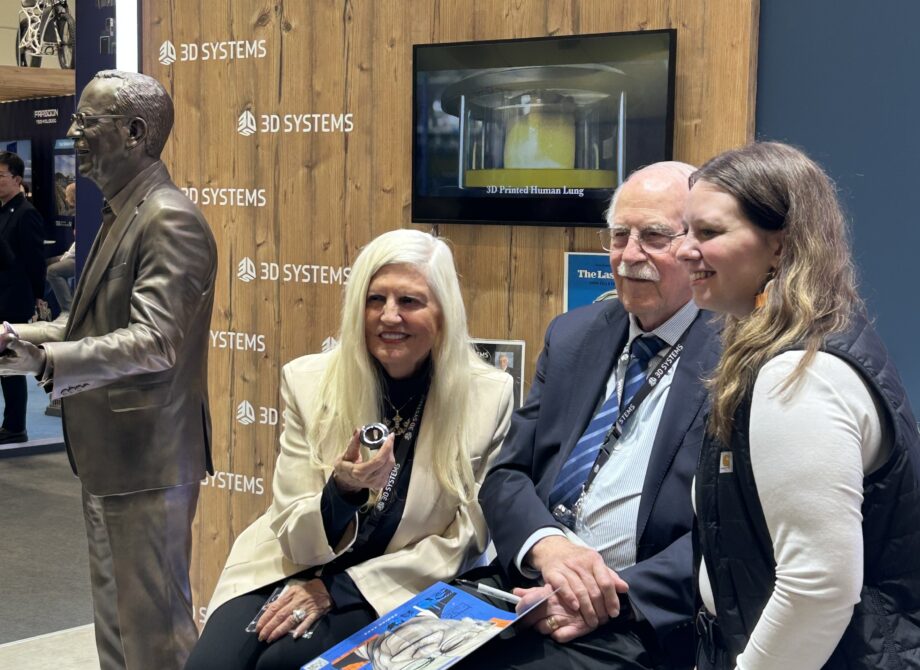
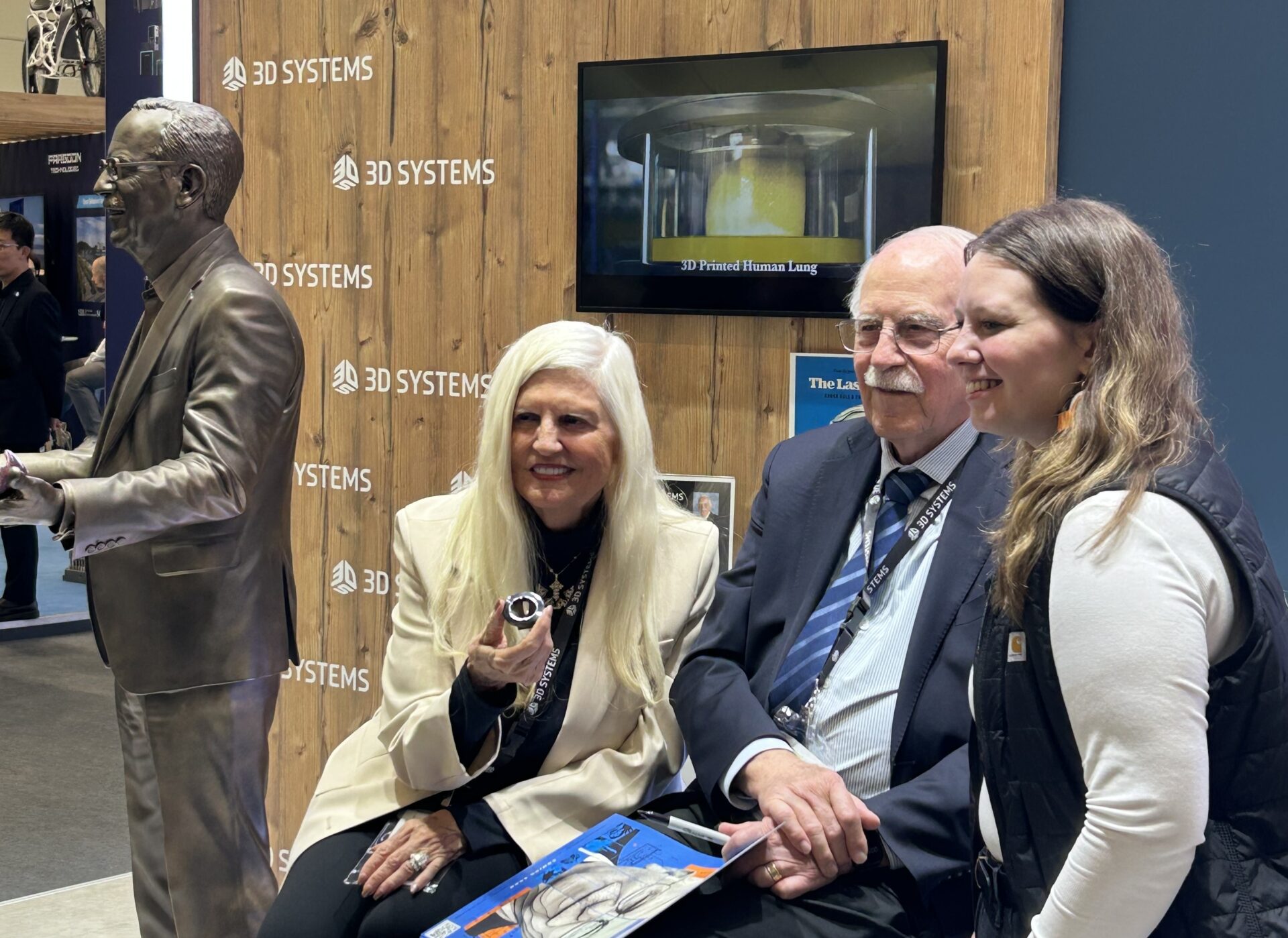

Chuck Hull, the inventor of 3D printing, made a rare trade show appearance at Formnext 2026 in Frankfurt, where 3D Systems marked its 40th anniversary with a life-size 3D printed statue of its co-founder.
The statue stood on the 3D Systems booth throughout the show, its right holding a replica of his first-ever print, and his left a modern 3D print. Hull, now 87, was there in-person with his wife Anntionette, who brought the original part along for visitors to see and handle.
On the opening day, Hull joined Patrick Dunne, 3D Systems’ SVP of Advanced Applications, on the Technology Stage, and the company held an anniversary evening at its booth the following day. Hull also spoke about The Last Inventor: Chuck Hull & the Hope of 3D Printing, a new documentary on his career directed by Brent Wilson.
“This is a true celebration for 3D Systems, but also the 3D printing industry as a whole,” Hull said. The company also credited other pioneers, among them Scott Crump, who invented fused deposition modeling (FDM), and Carl Deckard and Joseph Beaman, who developed selective laser sintering (SLS).
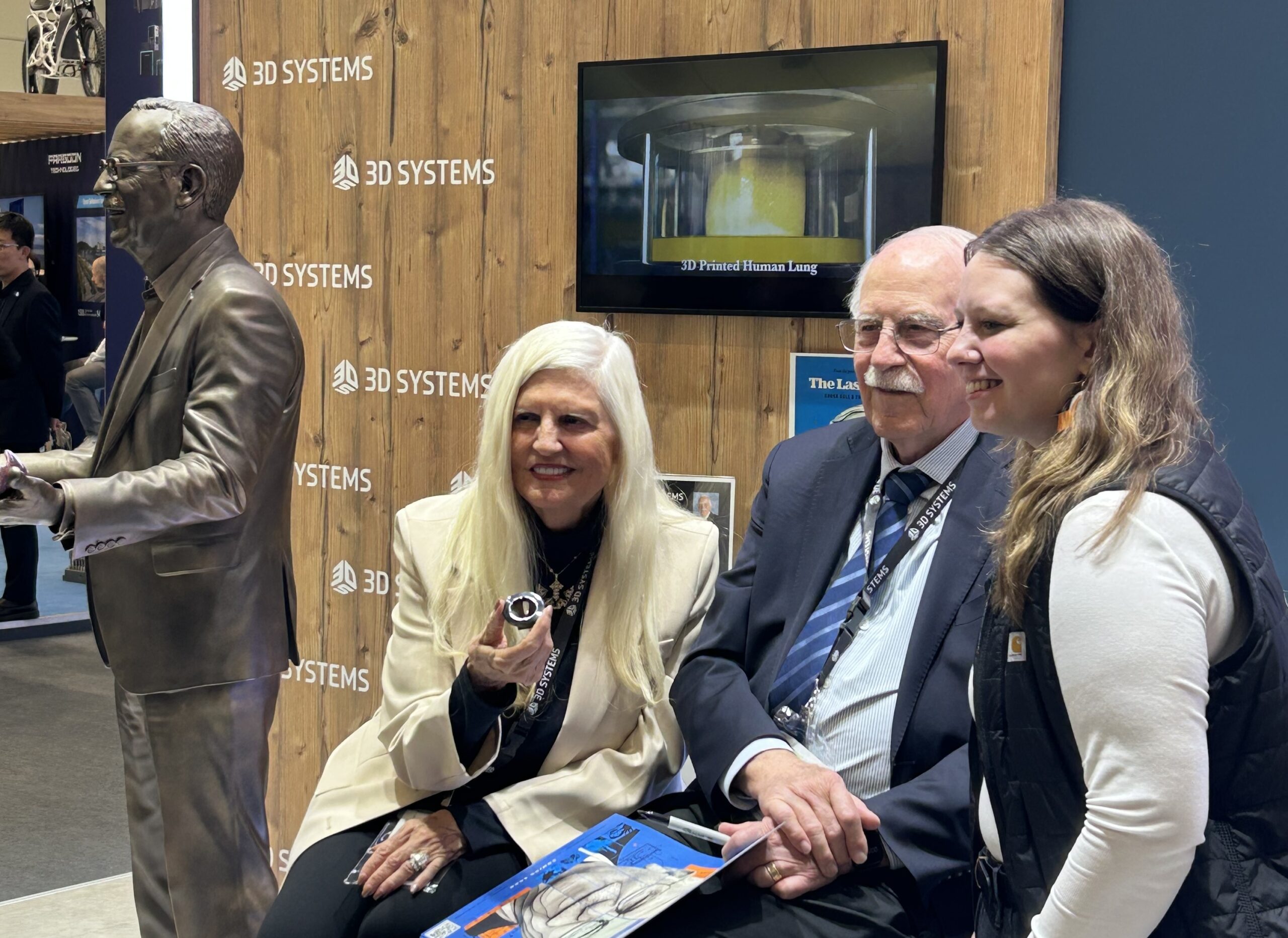
What was the first 3D printed part?
The object in the statue’s hand was a small black eyewash cup, about 5 cm tall. Hull made it in 1983, while working at UVP, a company that used ultraviolet lamps to cure hard coatings on furniture. “So, I was working on a problem: basically, prototyping parts that were going to be injection molded,” he told TCT Magazine at the show.
Hull then filed his patent in August 1984, coining the term stereolithography, and it was granted on March 11, 1986, the same year that he co-founded 3D Systems. The company’s SLA-1 followed in 1987 as the first commercial 3D printer. The process still underpins much of today’s resin 3D printing industry.
What did 3D Systems launch at Formnext?
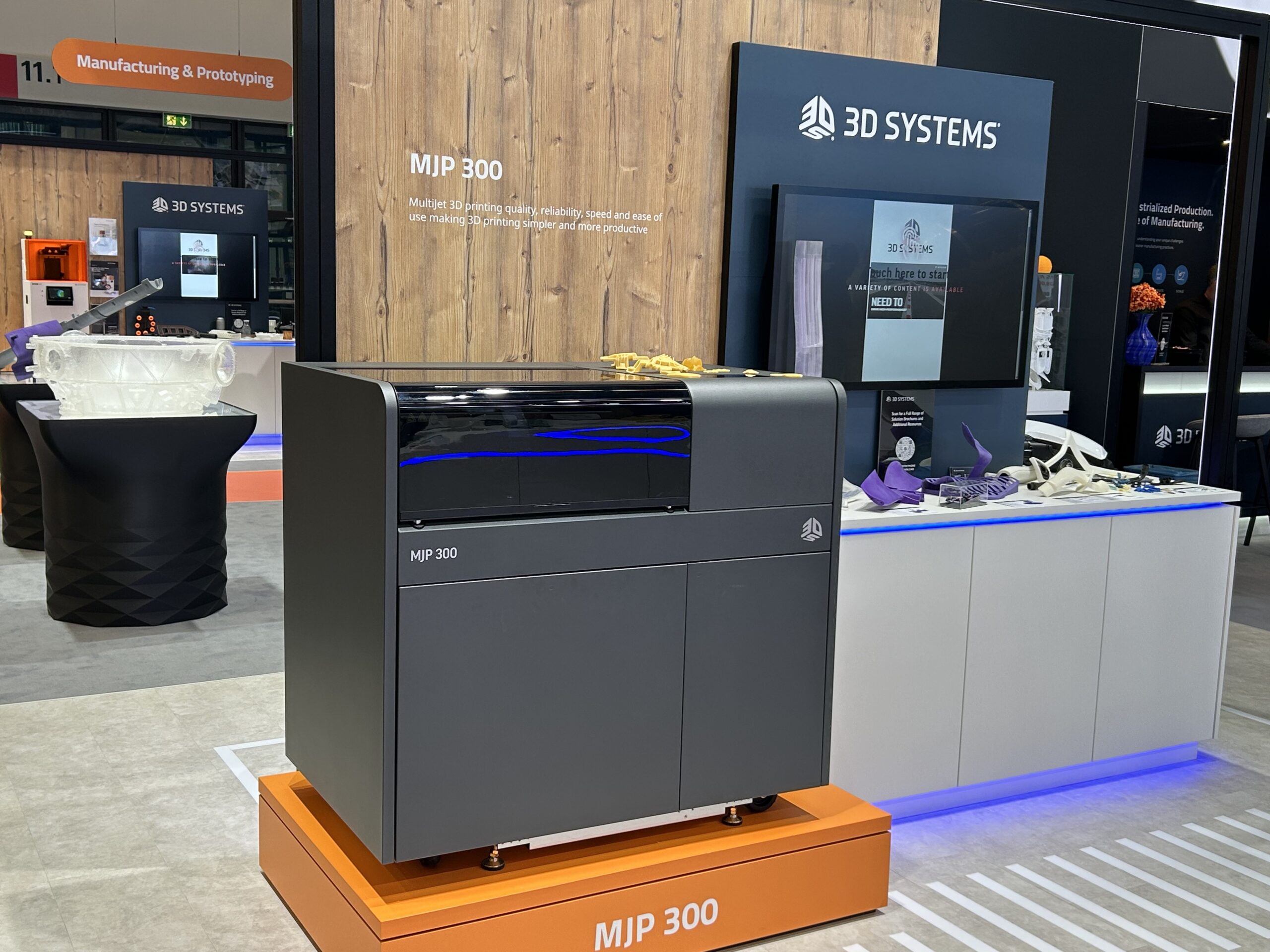
At this year’s Formnext, 3D Systems launched the MJP 300, a new MultiJet printer that builds plastic parts from acrylate resins. It prints layers as thin as 16 microns, and its 294 x 211 x 144 mm build area can be split into three lanes, so short and tall parts can be printed in separate groups.
Five VisiJet materials will be available at launch, with orders opening in the first quarter of 2027. “The MJP 300 represents a new generation in multijet 3D printing,” said Martin Johnson, Vice President, Product & Technical Fellow at 3D Systems.
For metal printing, the company introduced the TSR (Transport-Sieve-Reload) module, which collects, sieves and reuses leftover powder from DMP Flex 350 printers without exposing it to air. It also released an Industrial Wax Kit that lets the MJP 300W Plus produce larger wax casting patterns, mainly for aerospace, and added .finite to its 3D Sprint software, a tool that protects print files from unauthorized use and places a limit on total print count.
Body scanning at Formnext 2026
Life-size figures of icons like Chuck Hall usually begin with a full-body 3D scan. Scanning was a major draw at the event, where Artec Neo made its European debut. The wireless handheld scanner reaches 0.025 mm accuracy on features marked with targets and captures the rest of a part target-free, in full color. 3D Mag listed it among the five must-see new 3D scanners at Formnext 2026.
Artec also demonstrated Gaussian Splatting in Artec Twins, alongside its wider scanner range, including the wireless Artec Leo, which is often used to capture people and sculptures. Sculptor Timothy Schmalz previously used Leo to scan a 20-foot statue for the Vatican, so that smaller copies could be 3D printed with every figure intact.
Artec 3D lists more on its Formnext 2026 page, and 3D Mag has previously covered how 3D scanning preserved an 18th-century statue.