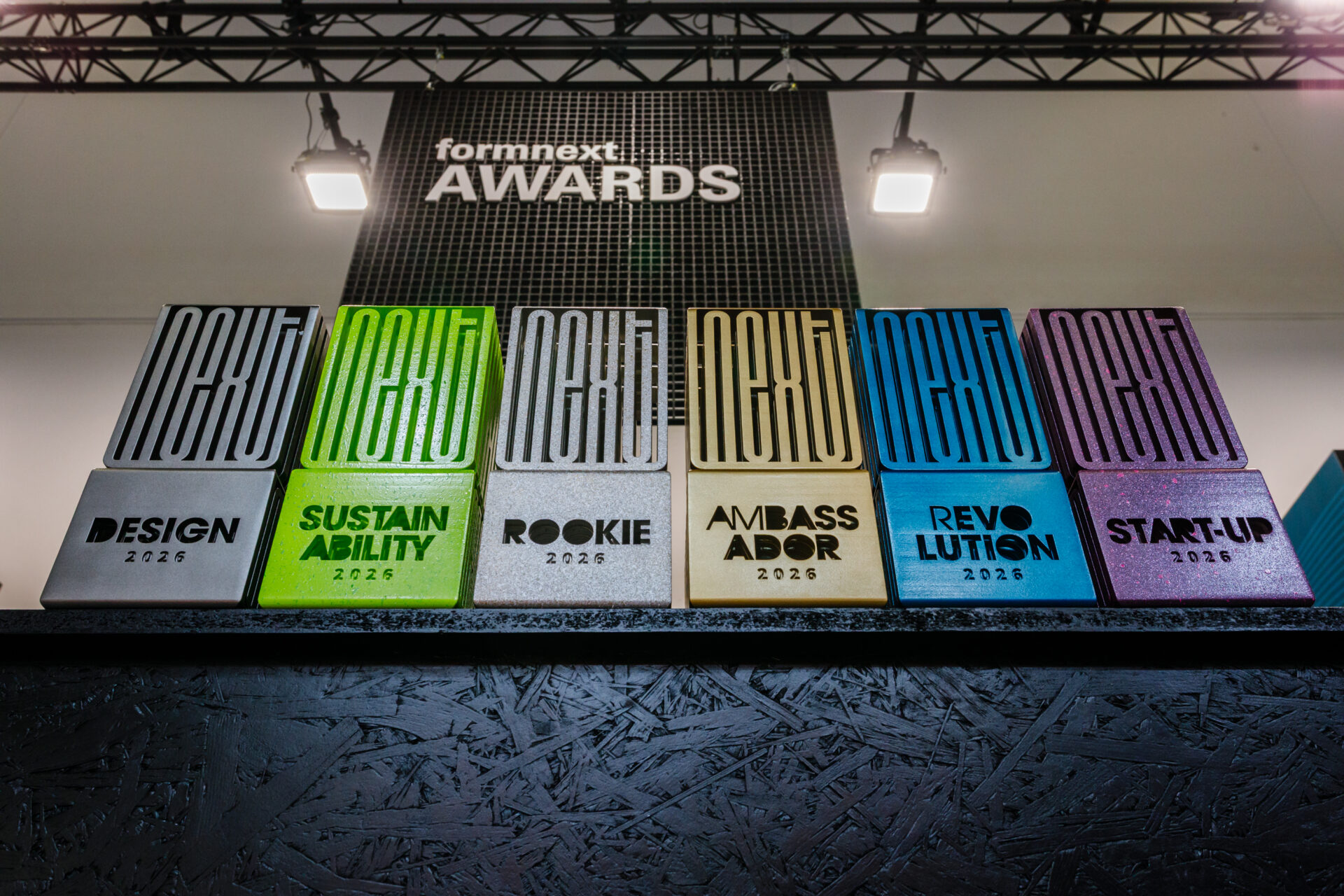

The winners of the 2026 Formnext Awards have been announced in Frankfurt – and there are some exciting 3D printing innovations among this year’s entries.
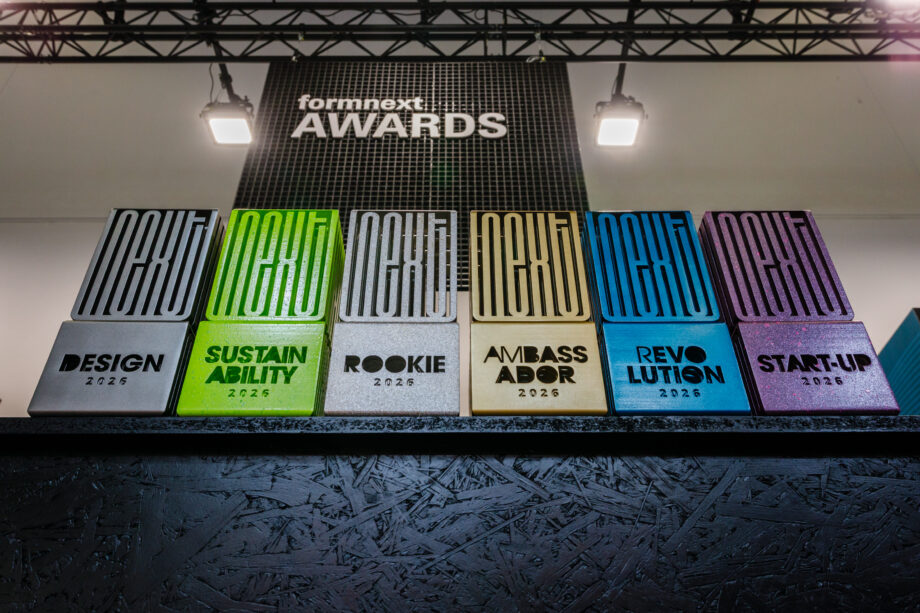
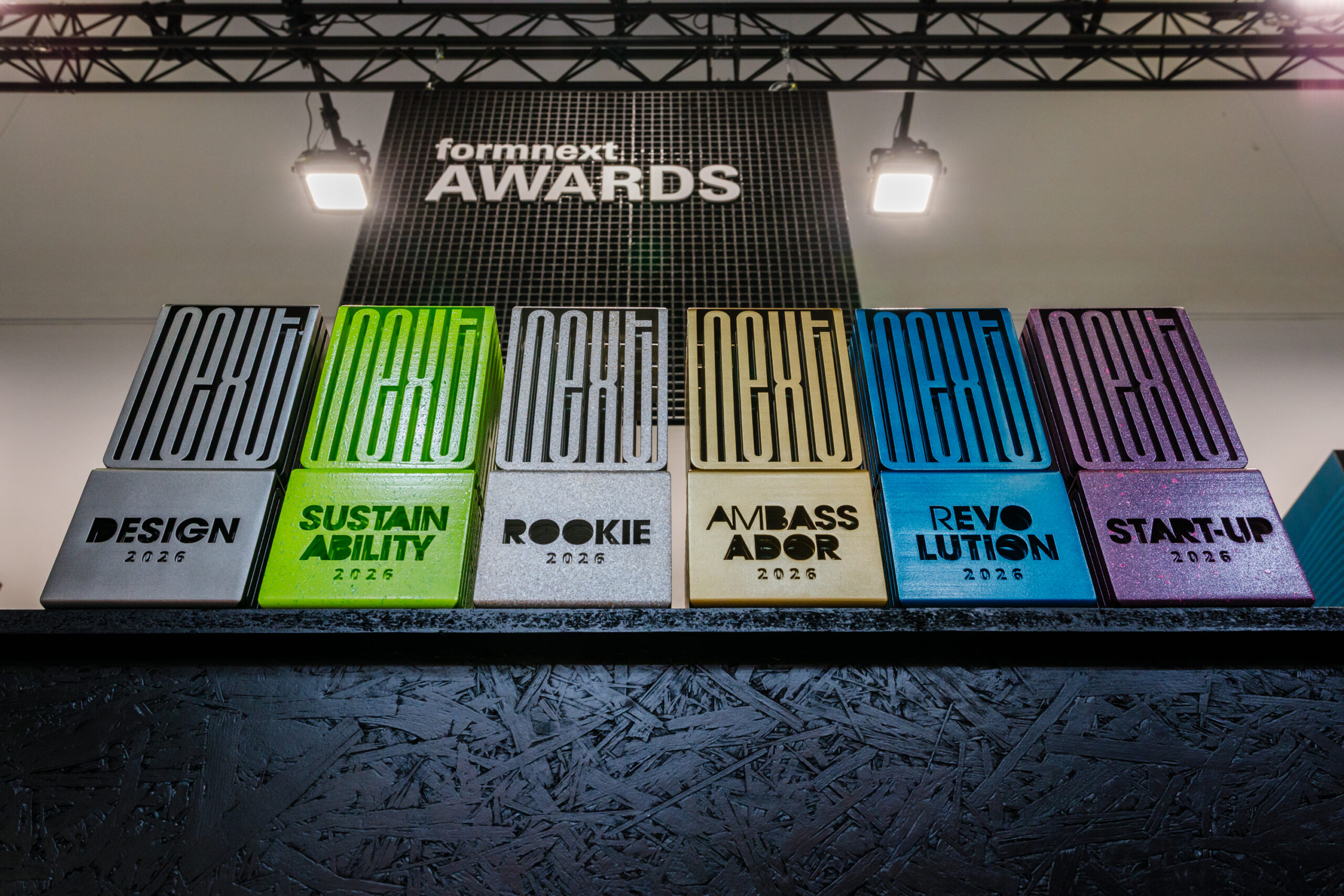
Six winners emerged from a field of finalists that were previously previewed online, then physically exhibited at the show. Visitors cast their votes in the halls and online, before each winner eventually left with a 3D printed trophy, designed by Sutosuto and produced by FKM Sintertechnik.
What stands out this year is how many winners looked beyond manufacturing to the rest of the process chain: materials, waste, and the type of part made possible.
For jury member and industry stalwart Arno Held, the awards double up as a scouting exercise: “The Formnext Awards reward companies and individuals that contribute to the AM industry in an extraordinary way and I am proud to having been a jury member from early in. For me as an investor, it is a highly important tool to identify the future winners very early and before many others.”
AMbassador Award
Each year, 50-60 students work under Dr. Michael Kraemer at the Additive Manufacturing Center (AMC) located at TU Darmstadt. The center has contributed to ten PhD theses in the past three years alone, and Kraemer’s influence reaches well beyond campus: with IHK Rhein-Main and industry partners, he has helped build AM training for technical apprentices. That commitment to growing the next generation of talent earned him the AMbassador Award.
Design Award
Anyone who has fought with flexible filament will appreciate what Maya Kaplan has achieved. Her Computational Bra, developed for her Industrial Design master’s at the Technion – Israel Institute of Technology, was printed entirely from TPU on a desktop FDM machine.
Computationally designed textile structures place elasticity, support, and compression precisely where it’s needed. A garment like this lives or dies by fit. One bespoke lingerie designer takes a similar approach, 3D scanning each client with Artec Eva.
(R)Evolution Award
Damp filament remains an FDM 3D printing issue, and nylon is among the worst offenders, soaking up moisture until prints come out stringy, bubbled, and weak. Malta-based Thought3D is addressing this problem at the point of use.
Its Drywise system conditions only the stretch of filament about to enter the extruder, holding it at the right moisture level throughout to cut out long drying cycles. The payoff in part quality and strength can be measured precisely with scan-to-CAD inspection.
Rookie Award
cAIclone has yet to launch at a commercial level, but it already has an award on the shelf. The Munich team combines AI, CFD simulation, and Bayesian optimization to design 3D printed hydrocyclones that separate particles between 1 and 50 μm. The technology is being aimed at battery recycling, it’ll be exciting to see how it can make an impact in future.
Start-up Award
Swiss start-up sallea prints hollow carbon fiber part cores and tooling so exterior material simply washes away, leaving lightweight thermoset CFRP components with highly complex geometries. Its target markets, including motorsport and sporting goods, already rely on 3D scanning.
The likes of Catesby Projects 3D scan race cars with Artec Leo for aerodynamic simulation, and once a composite part leaves the mold, a high-resolution scanner such as Artec Spider II can show whether it matches initial designs.
Sustainability Award
FlexCycle Solutions turns discarded electronics into copper powder for AM and powder metallurgy by purely mechanical means, with no melting at any stage. Metal printers gain too: the powder’s spherical yet rough particles absorb laser energy readily, a significant advantage in the world of laser powder bed fusion (LPBF).
Interested in finding out more about Formnext 2026? Follow 3D Mag’s other coverage on the most exciting 3D scannersat the show and where AI is being applied in CAD modeling.