
What 3D-Printed Food Is (and Isn’t)
3d printed food examples include edible items shaped through digitally controlled deposition or other additive processes from a design file. Additive manufacturing builds physical three-dimensional geometries through the successive addition of material; in food, that principle applies to chocolate, dough and pasta, starch or vegetable purees, sugar confections, plant-based alternatives, and multi-ingredient research demonstrations. [1] The printer controls ingredient placement and geometry, but it does not create a separate category of food.
A printable food must move through its delivery system, retain enough shape after placement, and pass through a food-contact path that can be cleaned appropriately. Printing is a shaping method, not a safety guarantee. [2] [8]
A Short History (Without “First Ever” Claims)
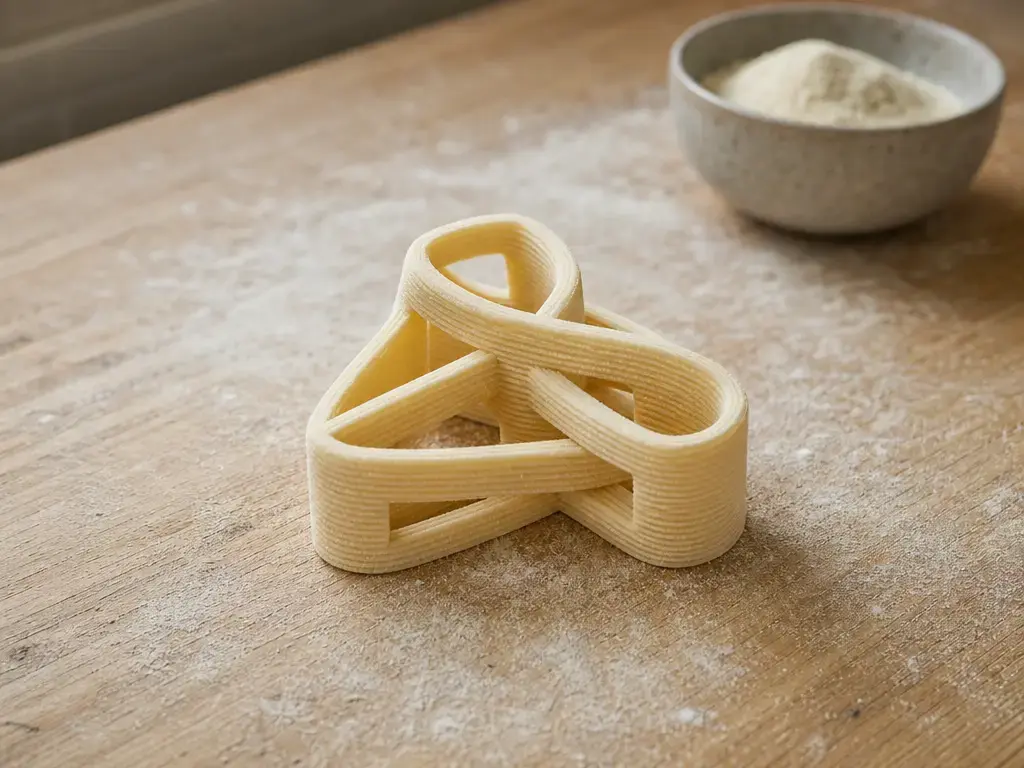
Food printing adapts additive-manufacturing concepts to materials that must also become edible, stable structures. Unlike a plastic part, deposited food may need to cool, crystallize, gel, dry, bake, boil, or otherwise finish before it holds its intended form and texture. Pasta is a clear example: dough can be arranged into digitally designed shapes that are difficult to produce through conventional cutting or molding alone. Barilla states that it created a prototype to produce 3D-printed pasta in 2014 and later developed the concept under its BluRhapsody brand. [10] This is one company milestone within a gradual convergence of food formulation, machine control, and culinary finishing.
How 3D Food Printing Works (From File to Finished Bite)
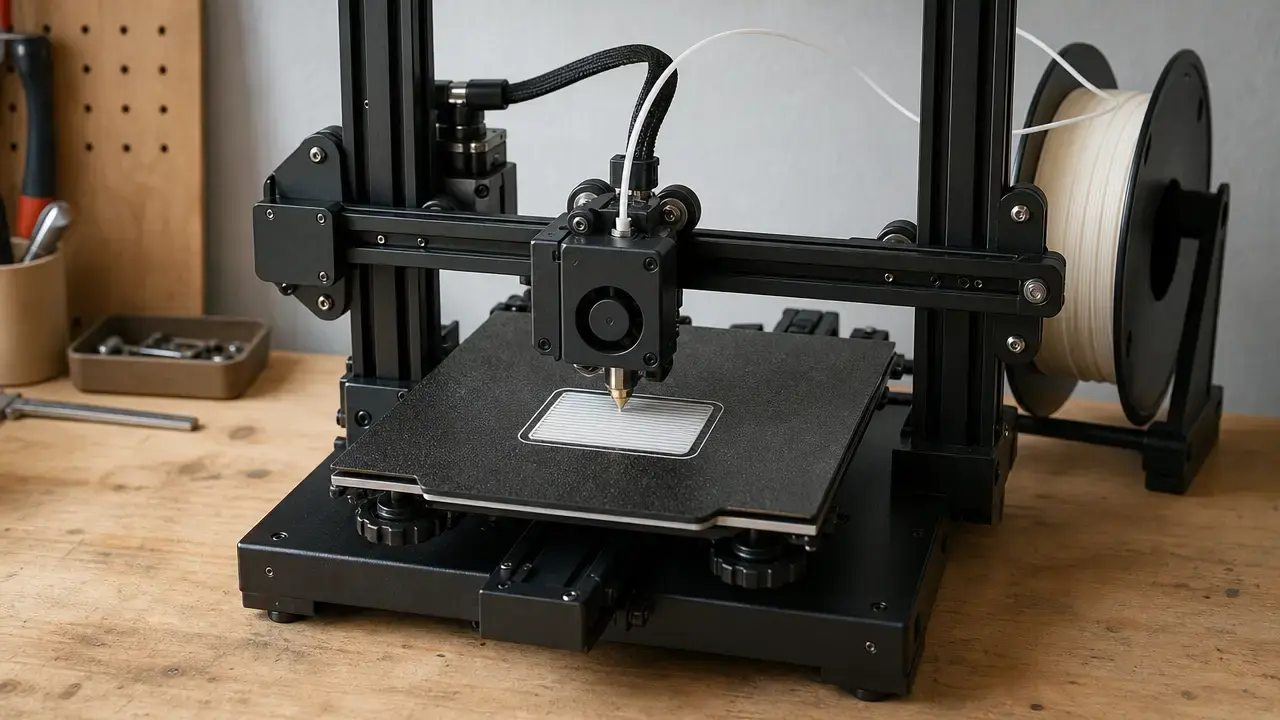
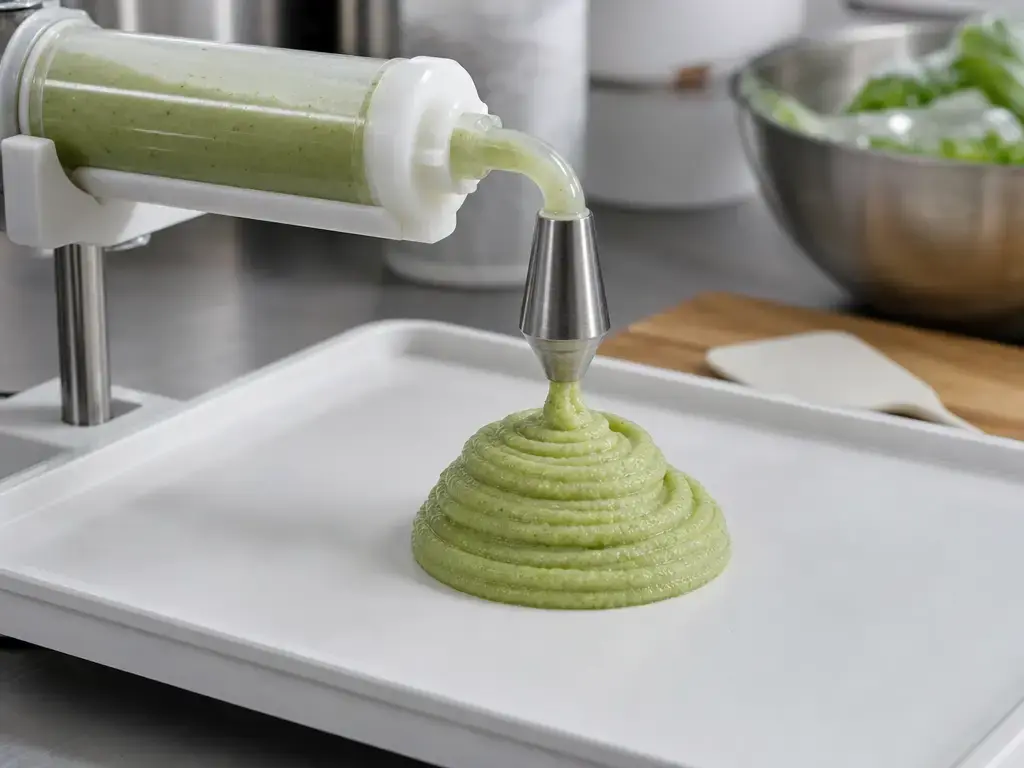
The digital chain begins with a model of the intended food shape. Software converts the geometry into a toolpath, slicing divides it into layers, and the machine follows those motion instructions while placing edible material at specified locations. The path-planning principle resembles FDM or FFF, but the feedstock is usually a soft edible formulation rather than solid thermoplastic filament. [3]
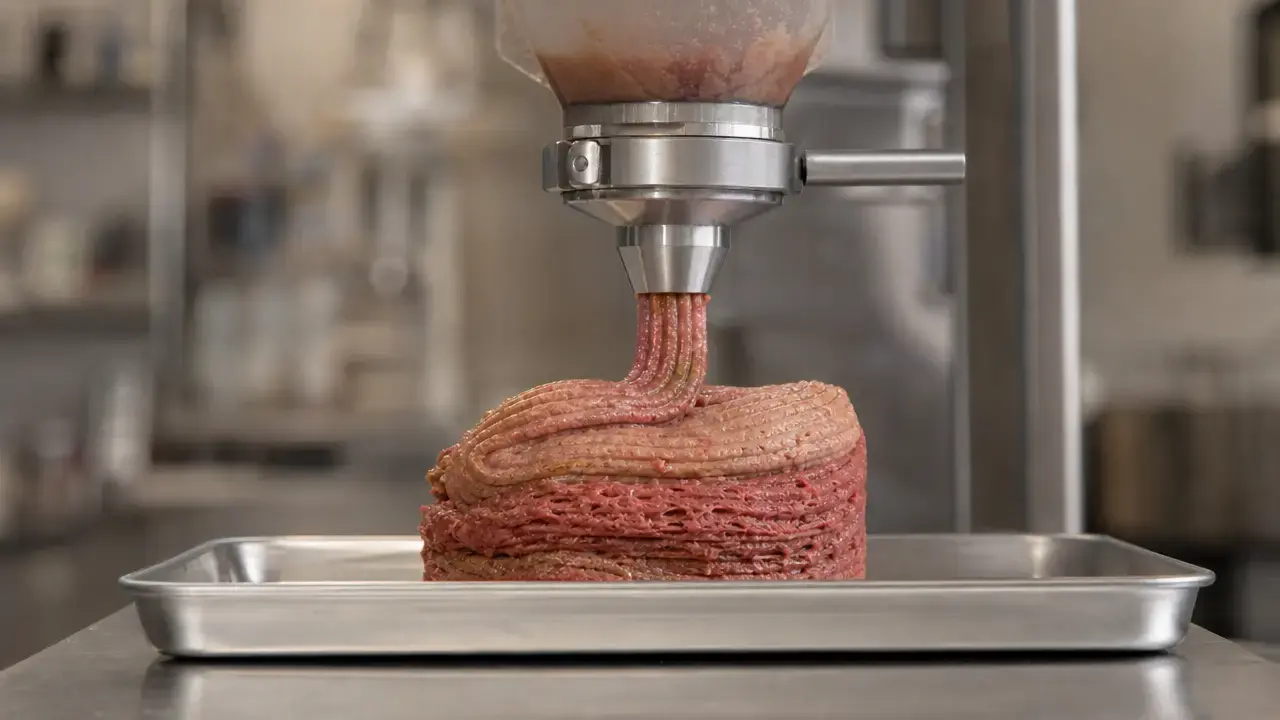
Extrusion-based food printing is the most familiar workflow because it can handle many pastes, doughs, melts, and purees. [2] A cartridge, syringe, hopper, screw mechanism, or air-pressure system pushes a food ink through a nozzle. Here, “food ink” means an edible formulation prepared for controlled deposition, not conventional printer ink or a standardized consumable such as plastic filament. The nozzle, delivery mechanism, and complete food-contact path must suit the formulation. [3]
- Prepare or formulate the food ink, including texture, particle size, and temperature.
- Load the cartridge, syringe, or hopper and identify the food-contact path.
- Generate geometry and toolpath, matching slicing settings to the nozzle and material.
- Deposit layer by layer while controlling temperature and flow to avoid slump or clogs.
- Finish by chilling, baking, boiling, drying, or otherwise setting the structure.
- Clean and, where applicable, sanitize food-contact components before the next run.
Deposition is only the shaping stage. Chocolate may need controlled cooling, pasta may be boiled or dried, dough may be baked, and moisture-rich purees may need chilling, heating, or gelation. Printability and final texture are linked, so a shape that deposits successfully can still require formulation or finishing changes before it becomes a satisfactory food. [2]
Edible 3D Printing Technologies (Why They’re Not All the Same)
Reported edible 3D printing technologies include extrusion-based printing, powder-bed binder jetting, powder-bed fusion, and inkjet-related approaches. Extrusion directly places a paste, dough, melt, or puree along a programmed path. In binder jetting, a liquid binder is selectively added to a bed of edible powder. Powder-bed fusion uses controlled heating, including laser or hot-air approaches reported for sugar powders, to fuse suitable material. “Inkjet” is used less consistently in food-printing literature, but generally refers to small deposited droplets rather than continuous extruded strands. [3] [4]
These approaches use different routes to structural stability. Chocolate can set through cooling and crystallization; dough gains structure through cooking or drying; hydrocolloid formulations can gel; binder jetting joins selected powder regions with liquid; and powder-bed fusion depends on thermal energy. They also differ in equipment, material constraints, and practical readiness, so they should not be treated as equally suited to home use. [3] [4]
What Makes a Food “Printable”? (Food Inks, Not Filament)
A food formulation must do two competing jobs: flow through the printer, then resist spreading after deposition. Many successful extrusion formulations are shear-thinning, meaning they flow more readily while extrusion force is applied but recover enough resistance or structure once that force stops. The balance depends on the nozzle, delivery system, geometry, and desired result. No reliable universal viscosity range has been found. Being edible does not automatically make an ingredient printable. Food inks are purpose-made edible formulations, and reviews distinguish materials that are natively printable, non-printable, or made printable through alternative ingredients or formulation changes. [2] [3]
A practical classification starts with material state and setting route: molten fat-based materials such as chocolate; doughs; starch pastes such as potato-based formulations; fruit, vegetable, or protein purees; gels and hydrocolloid systems; and powders for powder-bed processes. [2] [3] Small particles and uniform mixing can help reduce blockage risk, but thickeners, gelling agents, or binders are selected case by case rather than through a universal recipe.
3D Printed Food Examples: A Practical Comparison
These 3d printed food examples are reported material-and-process categories, not guaranteed recipes or universal printer capabilities. Results depend on formulation, machine design, geometry, and finishing method.
| Food category | Typical deposited material state | How it holds or sets | Practical status / key limitation |
|---|---|---|---|
| Chocolate and dessert pastes | Warm chocolate or fat-based paste | Cooling and crystallization; tempering affects finished structure and appearance. [7] | Common workflow category; tempering is not mere melting. [7] |
| Dough and pasta shapes | Dough or semi-solid paste | Cooking or drying after shaping, including baking or boiling. [2] | Custom-geometry category; formulation and post-processing remain material-specific. [2] [10] |
| Purees and texture-modified foods | Thick starch, vegetable, or meat pastes | Shape retention from rheology, followed by heating, chilling, or gel setting. [2] [3] | Useful for customized shapes or portioning research; highly formulation-sensitive. [2] |
| Sugar and powder confections | Sugar powder with liquid binder, or a powder bed intended for fusion | Binder jetting uses liquid binder to bond powder; powder-bed fusion uses heat, laser, or hot air to fuse powder. [4] | Research-oriented and specialized; distinct from extrusion candy. [4] |
| Plant-based meat alternatives | Protein, fat, and polysaccharide blends | Deposition followed by cooking or other setting intended to support internal structure. [6] | Emerging, targeted R&D with limited commercialization; not cultivated meat or a universal printer capability. [6] |
| Multi-ingredient printed desserts | Multiple edible pastes in separate cartridges | Layered ingredient placement that may be combined with controlled heating. [5] | Research-oriented demonstration of placement control. [5] |
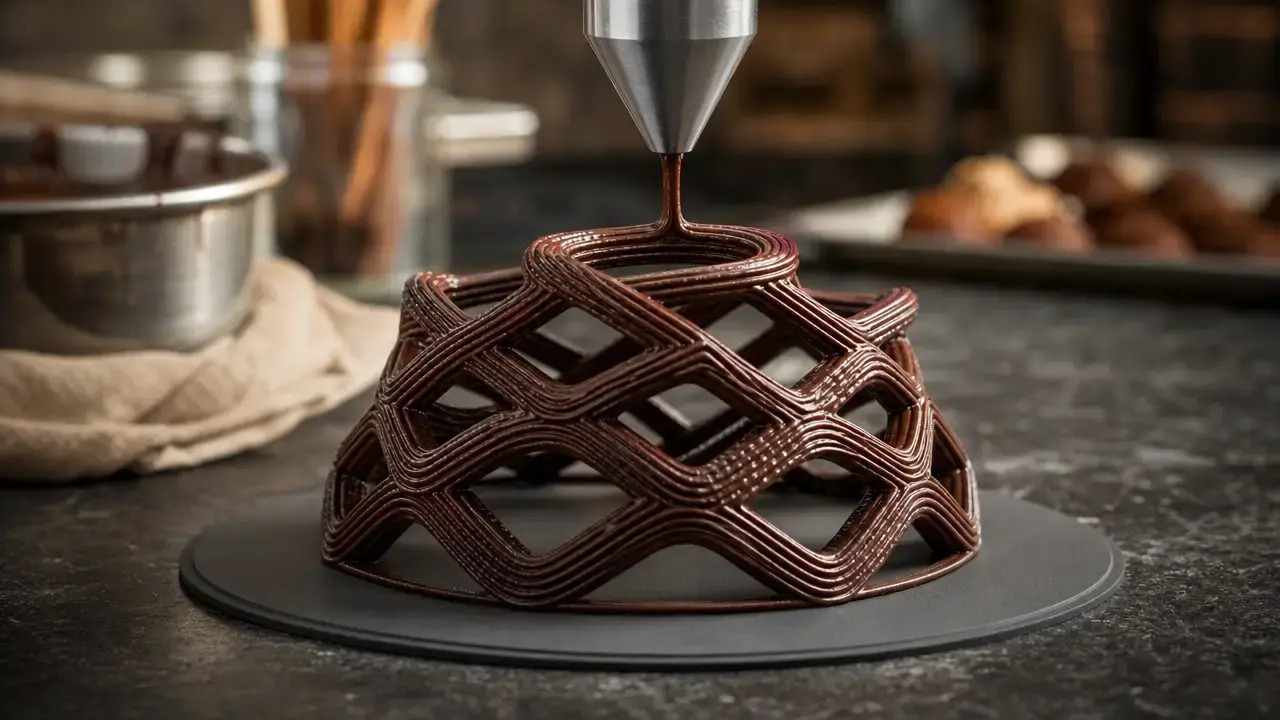
Chocolate and sugar are visually prominent because delicate lattices, decorative forms, and granular structures make the shaping process easy to see. Chocolate printing, however, is more than dispensing melted chocolate: cocoa-butter crystallization and tempering affect finish and mechanical behavior. [7] Dough, pasta, and purees reveal more of the engineering challenge because they must retain intended geometry through cooking, drying, chilling, or other finishing steps. [2]
Plant-based alternatives are a targeted structuring application rather than a standard home-printing use. Reviews position 3D printing alongside high-moisture extrusion and shear-cell processing as routes for arranging proteins, fats, and polysaccharides into meat-like structures. [6] This category is separate from cultivated or cell-based meat, which involves different production concepts and constraints.
Metrics That Matter More Than “Resolution”
“Resolution” is ambiguous in food printing. A small nozzle alone does not guarantee a sharp edible feature, because a deposited line can spread, sag, or change during cooling, baking, boiling, drying, or other finishing. A more useful assessment asks whether lines retain their intended width, layers retain height, unsupported regions slump, and the finished object remains close to the CAD geometry. Shape fidelity is the match between intended and printed geometry, assessed through dimensions and visible deformation before and after post-processing. [3]
A reported software-controlled cooking system used a nozzle with a 1.5 mm inner outlet diameter, but that is a bounded example from one research system rather than a general recommendation. [5] No reliable cross-device figure has been found for speed, resolution, or accuracy in food printing. Comparisons need the specific material, nozzle, temperature, geometry, measurement stage, and finishing method.
- Nozzle inner diameter: The inside opening through which the formulation exits, recorded with the specific nozzle and material.
- Layer height: The programmed vertical increment between layers, assessed alongside whether the material retains that height.
- Deposited line width and line spreading: The measured width after placement compared with the intended path width.
- Minimum feature size, as printed: The smallest visible feature that survives deposition without merging, tearing, or collapsing.
- Dimensional accuracy: The difference between measured printed dimensions and the CAD model at a stated measurement stage.
- Repeatability or precision: The variation across multiple prints made with the same material and process conditions.
- Shape fidelity: The match between printed and intended geometry, measured before and after post-processing. [3]
- Extrusion consistency: The stability of material flow over time, including pulsing, clogs, gaps, or changing line dimensions.
- Post-processing deformation: Shrinkage, warpage, spreading, or other geometric change after cooking, drying, chilling, or setting.
Where 3D Food Printing Is Actually Used (Applications Without Hype)
3D food printing applications often focus on geometry where digital placement is visibly useful: confectionery and pastry decoration, customized dough and pasta shapes, and portions formed to a chosen design. Food printing is also investigated for texture-modified foods in research and care contexts, where controlled form and texture may matter but should not be confused with proven clinical or nutritional outcomes. Printed-confectionery research, for example, examines how processing and geometry influence mechanical behavior. [4]
Powder-bed confections and plant-based structuring are more specialized paths than familiar paste extrusion. [4] [6] Multi-ingredient digital cooking remains largely a research direction. One demonstration printed and laser-cooked a seven-ingredient slice of cake, illustrating coordinated ingredient placement rather than a general household workflow. [5]
Food Safety, Food-Contact Components, and Sanitation (Principles + U.S. Context)
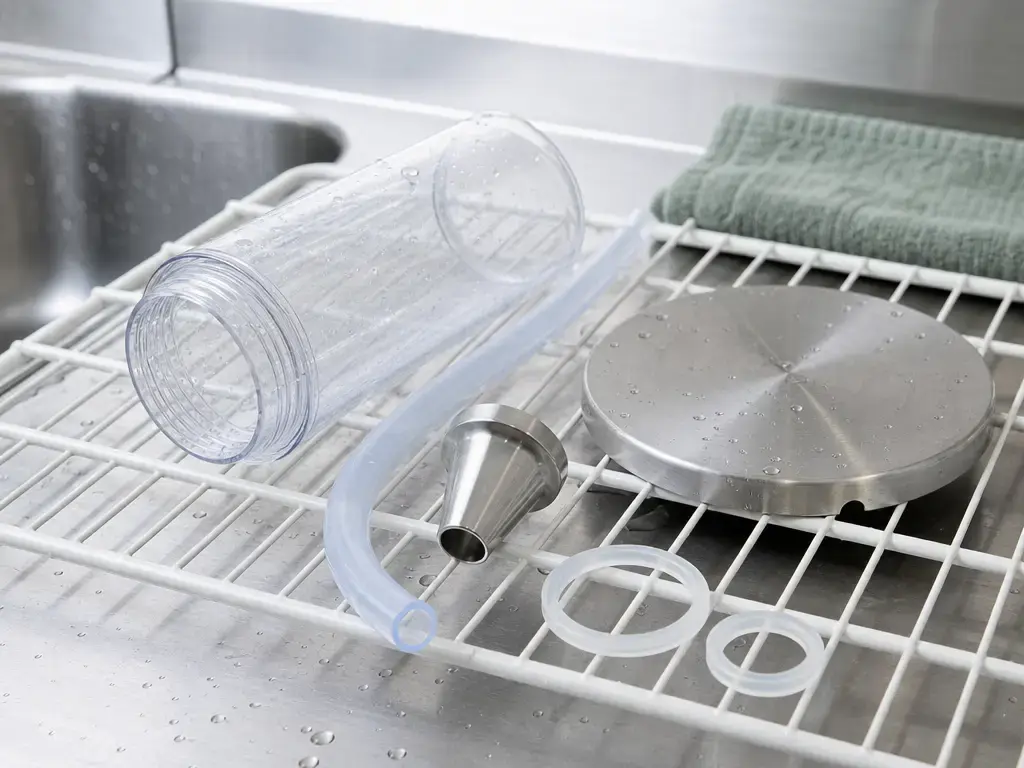
Ingredient edibility and equipment suitability are separate questions. The food-contact path includes every surface touched by the formulation: cartridge or hopper, tubing, seals, nozzle, and build surface. Cleaning becomes more difficult when components cannot be disassembled or when dead zones retain residues. A safe ingredient can be contaminated during transfer, deposition, storage, or cleanup in a poorly maintained system.
For certain regulated U.S. food operations, 21 CFR 117.40(a)(1) requires plant equipment and utensils to be adequately cleanable and maintained to protect against allergen cross-contact and contamination. [8] This applies to certain U.S. food facilities; it is not a home-kitchen checklist. The principle remains useful when evaluating a food printer: cleanability depends on access, disassembly, surface condition, seals, geometry, and the actual cleaning procedure, not simply on whether a nozzle is stainless steel.
For certain regulated U.S. food operations, 21 CFR 117.135(c)(3) identifies sanitation controls addressing food-contact-surface cleanliness and prevention of allergen cross-contact and cross-contamination. [8] This applies to certain U.S. food facilities; it is not a home-kitchen checklist. FDA’s Food Contact Substance Notification inventory concerns effective notifications for specific food-contact substances and identified manufacturers or suppliers. It is not a blanket basis for describing an entire printer as “FDA-approved.” [9]
- Use ingredients intended for human consumption.
- Map the entire food-contact path, not only the nozzle.
- Prefer designs that are adequately cleanable through access and disassembly. [8]
- Keep allergen-containing formulations segregated where needed.
- Prevent residue buildup in syringes, tubing, seals, and dead zones.
- Control time and temperature for perishable formulations.
- Validate any heating or cooking step for the specific food and geometry.
- Follow applicable local food-service or manufacturing requirements if operating as a business.
Limitations and Realistic Expectations
Food printing can be slow relative to conventional forming methods because material is placed layer by layer and often requires a separate finishing stage. Formulations are sensitive to changes in texture and processing conditions, while cleanup can be substantial for systems with cartridges, tubing, seals, and narrow nozzles. Common failures include slump, collapse, interrupted flow, and clogs. Even a successful print can deform during cooling, baking, boiling, or drying. For many familiar foods, mixing, molding, cutting, or conventional depositing remains simpler. [2] [3]
Recipes do not necessarily transfer unchanged between machines or kitchens. Nozzle geometry, material temperature, ambient humidity, particle size, delivery method, and finishing conditions can alter the result. A printable formulation should therefore be treated as a process-specific starting point and tested with the intended equipment and final preparation method. [3]
Conclusion: What 3D Printed Food Examples Actually Show
The most useful 3d printed food examples show controlled shape, texture, and ingredient placement rather than universal gains in nutrition, safety, or convenience. A digital model can guide where an edible formulation goes, but the result still depends on how that formulation flows, recovers after deposition, and changes during finishing. [2] Multi-ingredient research systems likewise demonstrate programmed placement rather than an automatic replacement for ordinary food preparation. [5]
The practical takeaway is straightforward: formulation, process control, finishing, and cleanability matter more than the novelty of printing. Evaluate a food-printing project by whether it reliably produces the intended finished food.
FAQ
These answers distinguish reported examples from universal consumer-printer capabilities. Results vary with formulation behavior, post-processing, and food-contact cleaning rather than following a single recipe or hardware setting.
What are 3d printed food examples people have actually made?
Reported examples include chocolate, dough-based forms, potato and other starch pastes, fruit or vegetable purees, meat-like pastes, gels, and sugar-based confectionery structures. [2] [3] These do not all use the same printing method or finishing step. Chocolate may cool and crystallize, dough may be baked or boiled, puree-based formulations may need chilling or gelation, and sugar can be processed as a powder-bed material rather than an extruded paste. [3] [4]
How does edible 3D printing work, and why is extrusion so common?
In extrusion-based edible printing, a prepared food formulation is pushed through a nozzle and placed along a digital toolpath. The material must flow under applied force, then retain enough structure after deposition to avoid spreading or collapse. [2] Extrusion is widely studied because syringe, cartridge, screw, and pressure-driven systems can handle many pastes, doughs, melts, and purees. [2] [3] That does not mean every edible ingredient will print reliably.
What materials are used for “food grade 3D printer materials”?
The phrase combines two different categories: edible inks and food-contact components. Edible inks are formulated foods, such as chocolate, dough, puree, gel, or powder-based systems, prepared for a particular process. [2] Food-contact components include cartridge walls, tubing, seals, nozzles, and build surfaces. FDA’s FCN inventory addresses specific food-contact substances and named manufacturers or suppliers, so it does not justify blanket “FDA-approved printer” language. [9]
Is 3D-printed food safe to eat?
Safety depends on ingredients, handling, time and temperature control, intended cooking or finishing, and cleanliness across the complete food-contact path. A formulation that prints successfully is not automatically safe to eat. For certain U.S. food operations, 21 CFR 117.40 requires equipment and utensils to be adequately cleanable and maintained to protect against allergen cross-contact and contamination. [8] This applies to certain U.S. food facilities; it is not a home-kitchen checklist. At home, use foods that can flow, hold shape, and be safely handled.
Why is chocolate 3D printing harder than it looks?
Chocolate printing is not simply melting chocolate and pushing it through a nozzle. Chocolate quality depends heavily on cocoa-butter crystallization, and tempering directs that process toward desirable finished traits such as gloss, snap, melting behavior, and stability. [7] The formulation must also pass through the nozzle without blockage and retain its geometry before setting. Changes in temperature, composition, or cooling conditions can therefore alter both print reliability and the final result. [2]
How do researchers measure shape fidelity and dimensional change after cooking or drying?
Researchers compare measured dimensions and visible geometry with the original CAD model. They can inspect line width, layer height, spreading, collapse, and deformation immediately after deposition, then repeat those checks after cooking, drying, chilling, or another finishing step. [3] Multiple prints are important because one successful object does not establish consistent performance. Shape fidelity therefore includes both the initial deposited form and its retention through post-processing. [3]
Why do sugar powder-bed methods, binder jetting, and powder-bed fusion behave so differently?
In sugar powder-bed binder jetting, a liquid aqueous binder is selectively deposited to join sugar particles. [4] Powder-bed fusion instead uses controlled heat, including laser or hot-air approaches, to fuse suitable powder. [4] These mechanisms differ from extrusion as well: binder jetting relies on liquid-mediated particle bonding, fusion relies on thermal energy, and extrusion places a continuous edible paste or melt along a programmed path.
Sources
- [[1]] ISO — ISO/ASTM 52900:2021 Additive manufacturing — General principles — Fundamentals and vocabulary (2021, Edition 2; last reviewed/confirmed 2025)
- [[2]] MDPI Foods — Food Texture Design by 3D Printing: A Review (2021)
- [[3]] Wiley — Three dimensional (3D)-printed foods: A review of printable materials, technologies and applications (2024)
- [[4]] Elsevier, via National Science Foundation — 3D printing confectionaries with tunable mechanical properties (2024)
- [[5]] Nature npj Science of Food — The future of software-controlled cooking (2023)
- [[6]] Nature npj Science of Food — Advancements in plant based meat analogs: A review (2024)
- [[7]] Nature Communications — Tempering of cocoa butter and chocolate using minor lipidic components (2021)
- [[8]] U.S. Government Publishing Office — 21 CFR Part 117: Equipment and utensils; Hazard analysis and risk-based preventive controls (2025 CFR annual edition) (§117.135)
- [[9]] U.S. Food and Drug Administration — Inventory of Effective Food Contact Substance Notifications (last updated 2024-03-21)
- [[10]] Barilla Group — Barilla pasta lands on astronauts’ menus (2023-12-14)