
Verdict: choose by configuration and material workflow, not headline speed
Elegoo Centauri Carbon 2 vs Bambu Lab P1S is not a simple headline-speed contest. The CC2 base and P1S base both specify a 256 × 256 × 256 mm build volume and a 500 mm/s motion ceiling. [S7] [S3] Those figures do not predict identical print times, finished-part quality, or throughput, which also depend on the model, filament, cooling, volumetric flow, selected settings, and material-management workflow. [S7] [S3]
Choose the CC2 Combo when its bundled CANVAS workflow, four-color operation, and documented fiber-filled material list suit the intended work. [S10] Choose a P1S base or P1S + AMS configuration only when the planned materials and spool types fit Bambu Lab’s published printer and AMS guidance. [S3] [S5] There is no universal winner because CC2 base, CC2 + CANVAS, CC2 Combo, P1S base, and P1S + AMS are different purchasing configurations. [S7] [S8] [S3] [S5] This comparison does not assign a print-quality winner because it lacks matched, controlled, model-specific independent test data. [S2]
Side-by-side specifications and configuration matrix
The labels below distinguish base printers from configurations with automated filament handling. [S7] [S8] [S3] [S5]
Configuration matrix
| Label used in article | What’s included | Multicolor inputs | Key constraints |
|---|---|---|---|
| CC2 base | Centauri Carbon 2 without CANVAS selected. [S7] | See workflow section. | CANVAS is a separate configuration choice. [S7] |
| CC2 + CANVAS | Centauri Carbon 2 with CANVAS added or selected separately. [S7] | See workflow section. | The cited documentation does not establish a standalone CANVAS color-count claim. [S7] [S10] |
| CC2 Combo | Centauri Carbon 2 with CANVAS included. [S8] | See workflow section. | Combo-specific specifications should not be applied to the CC2 base. [S8] [S10] |
| P1S base | P1S without AMS. [S3] | See workflow section. | No AMS hardware is included in the base configuration. [S3] |
| P1S + AMS | P1S paired with AMS through a Combo purchase or later-added AMS hardware. [S3] [S5] | See workflow section. | Filament use remains subject to AMS material and spool guidance. [S5] [S6] |
Specs that affect real printing
| Spec | CC2 (spec + configuration tag) | P1S (spec + configuration tag) | Why it matters |
|---|---|---|---|
| Build volume | 256 × 256 × 256 mm — CC2 base. [S7] | 256 × 256 × 256 mm — P1S base. [S3] | Defines the nominal maximum part envelope. |
| Headline motion speed | Up to 500 mm/s — CC2 base. [S7] | Maximum 500 mm/s — P1S base. [S3] | A motion ceiling is not a completed-job time. |
| Maximum acceleration | Up to 20,000 mm/s² — CC2 base. [S7] | 20 m/s² — P1S base. [S3] | The figures are numerically equivalent but do not establish identical motion tuning. [S7] [S3] |
| Maximum nozzle temperature | 350 °C — CC2 base. [S7] | 300 °C — P1S base. [S3] | A hardware ceiling is one material-processing constraint, not a universal success guarantee. |
| Maximum bed temperature | 110 °C — CC2 Combo, sourced from the Combo FAQ rather than verified as a CC2-base-only specification. [S10] | 100 °C — P1S base. [S4] | Relevant to first-layer adhesion and warp-management planning. |
| Stock nozzle material | Hardened steel — CC2 Combo. [S9] | Stainless steel — P1S base. [S4] | Nozzle material matters when abrasive filament is part of the plan. |
| Nozzle diameter information | The CC2 Combo manual shows 0.4 mm selected in ElegooSlicer, with 0.2, 0.6, and 0.8 mm options; no reliable official figure was found for CC2 base box contents. [S11] [S7] | 0.4 mm included; 0.2, 0.6, and 0.8 mm are optional replacement or upgrade nozzles — P1S base. [S3] | Diameter changes the detail-versus-deposition trade-off. |
| Build plate | No reliable official figure was found. [S7] | Bambu Textured PEI Plate — P1S base. [S4] | Plate surface affects the first-layer workflow. |
| Filtration / air management | HEPA plus coconut-shell activated-carbon composite filtration is a manufacturer feature claim — CC2 base. [S7] [S12] | Activated-carbon filter — P1S base. [S3] | These are feature descriptions, not exposure-control performance findings. |
| Camera | No reliable official figure was found for camera resolution or frame rate. [S7] [S9] | 1280 × 720 chamber-monitoring camera at 0.5 fps, with timelapse support — P1S base. [S3] | Camera specifications describe monitoring and timelapse capability, not print quality. |
No single row determines print time, print quality, reliability, or total ownership cost; those outcomes depend on configuration, material, model geometry, settings, and operating workflow. [S7] [S10] [S3] [S5] Prices, bundle contents, and accessory availability can change, so production should re-check them on the publication date in a dated claim ledger. [S7] [S8] [S3]
Filtration hardware does not replace ventilation, exposure controls, or polymer-specific safety guidance. [S12]
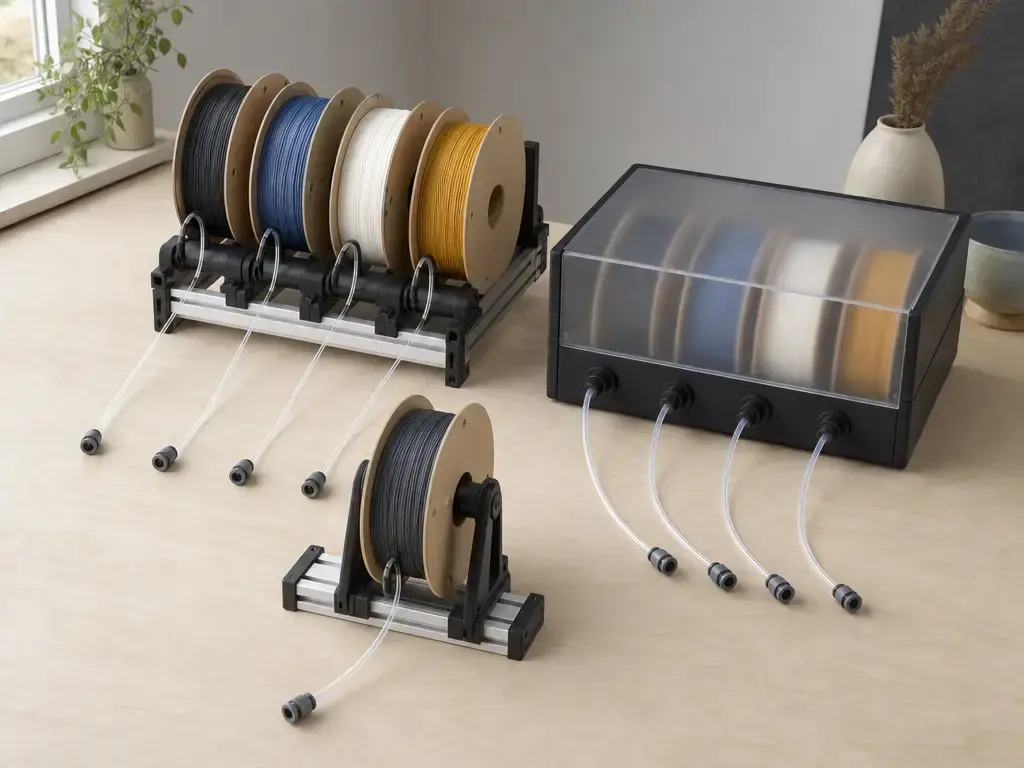
What actually differs: printer platform, enclosure, and configuration
Material extrusion is an additive-manufacturing process in which material is selectively dispensed through a nozzle or orifice to build a part through successive addition. [S1] “FDM 3D printer” remains a common consumer term for filament-based material extrusion, although FDM is a Stratasys trademark. [S15] CoreXY is a belt-driven arrangement for coordinated horizontal-axis movement, and both product families are identified by their manufacturers as CoreXY machines. [S7] [S10] [S3]
An enclosure surrounds the print area, while an actively heated chamber is a separately specified capability. [S3] [S7] The cited documentation supports enclosure-related descriptions but does not verify an actively heated chamber for either configuration. [S3] [S7] [S8] In this comparison, the enclosure, temperature limits, nozzle material, feeder path, and vendor material guidance are separate decision inputs. [S3] [S7] [S10]
Elegoo’s launch announcement for the Centauri Carbon 2 Combo was dated January 26, 2026. [S14]
Materials compatibility and wear: what the specifications do and do not guarantee
PLA and PETG are common starting materials, while ABS, ASA, PA (Nylon), and PC require separate consideration of warping, drying, enclosure use, and the finished part’s thermal requirements. [S3] [S10] A listed material category or temperature ceiling is a starting point for compatibility planning, not proof of success with every geometry or environment. [S3] [S7]
The CC2 base specifies a 350 °C maximum nozzle temperature. [S7] The CC2 Combo is specified with a 350 °C hardened-steel nozzle, and its Combo-only FAQ material list includes PLA, PETG, ABS, ASA, TPU, PC, PLA-CF, and PETG-CF. [S9] [S10] That Combo-only list should not be applied to the CC2 base without further verification. [S7] [S10]
For the P1S base, Bambu Lab lists PLA, PETG, TPU, ABS, ASA, PVA, and PET as Ideal; PA and PC as Capable; and carbon- or glass-fiber-reinforced polymers as Not Recommended. [S3] In the Bambu Lab P1S enclosure and materials decision, “Not Recommended” is vendor suitability guidance, not proof that a particular carbon-fiber spool cannot physically enter the machine. [S3]
A hardened nozzle does not make the entire filament path abrasion-proof. [S13] Elegoo advises CANVAS users to inspect and replace feed parts as needed during extended use of abrasive fiber-reinforced filament. [S13]
Material questions that matter more than a compatibility badge
- Is the intended filament abrasive, including carbon- or glass-fiber-filled grades? [S3] [S10]
- Does the part geometry and polymer require a warp-management workflow? [S10]
- Does the material require controlled drying before printing? [S3] [S10]
- Will flexible-filament handling be a routine requirement? [S3] [S8]
- What heat resistance must the finished part provide? [S3] [S10]
- Does the use case require outdoor durability? [S3] [S10]
- Is the material approved by the selected feeder or material-management path? [S5] [S8]
- Does the selected spool fit the planned feeder path and configuration? [S6] [S13]
Multicolor and material-management workflow: CANVAS vs AMS
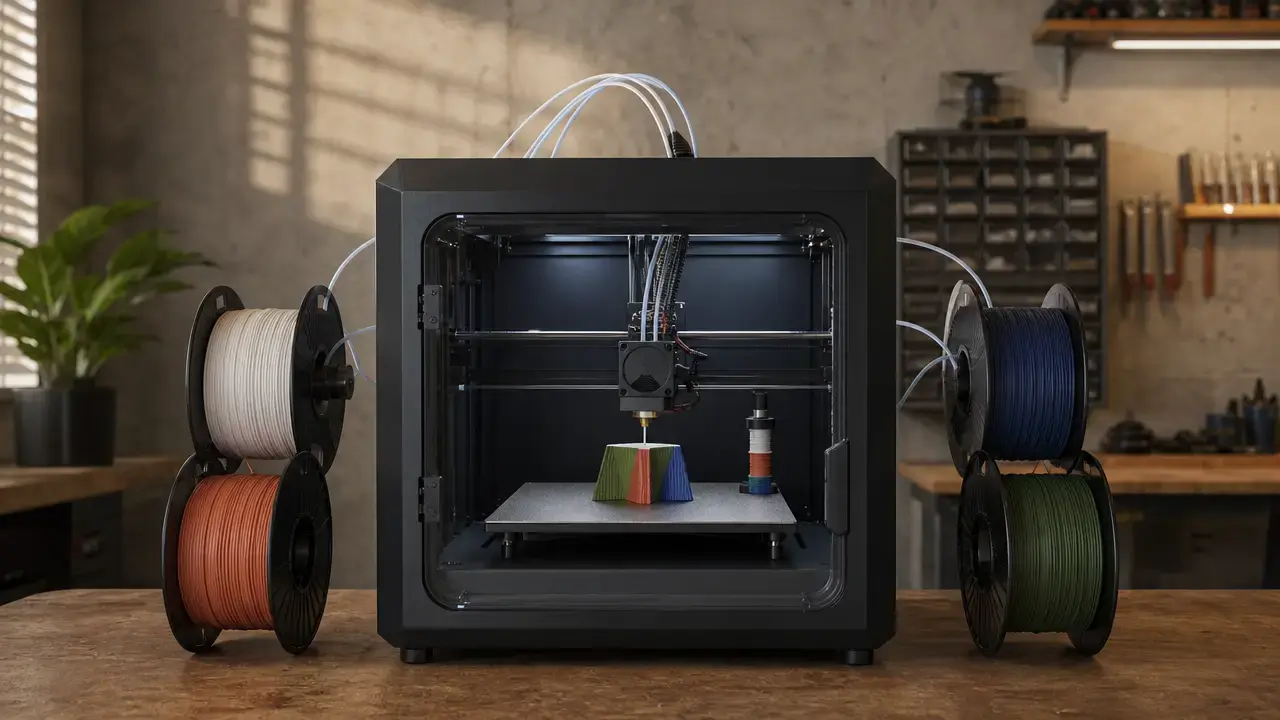
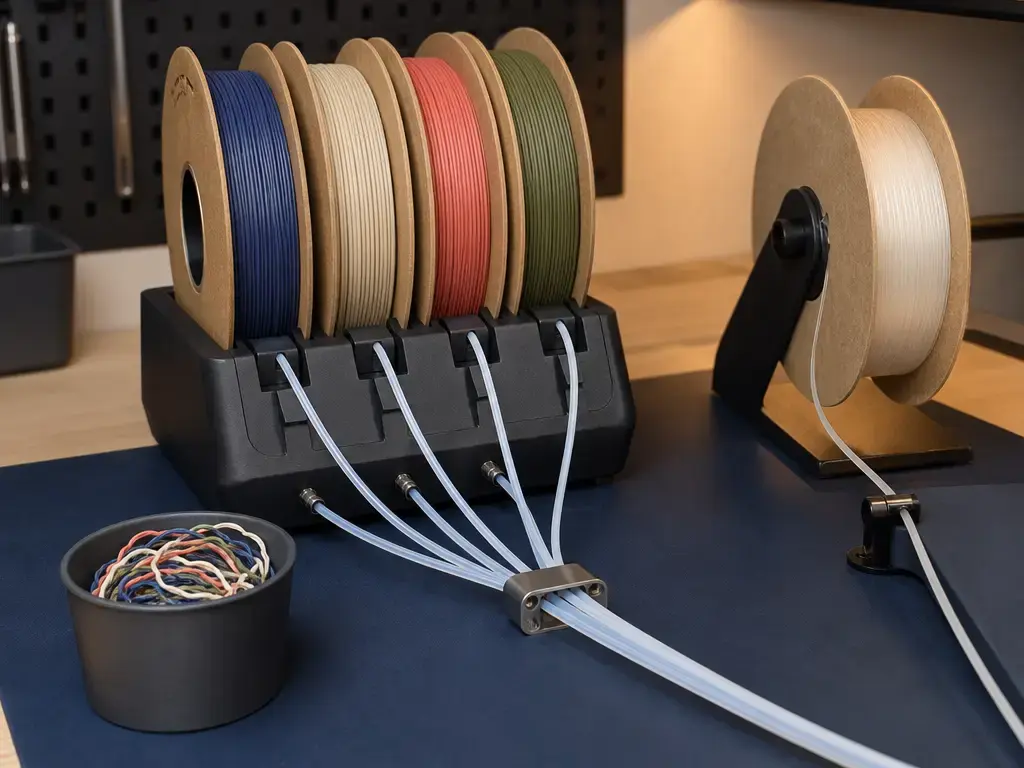
Color count is not the same as compatible polymer combinations. [S10] [S5] The CC2 Combo and P1S + AMS are single-nozzle workflows, so color or material changes require filament transitions and purging rather than simultaneous, unrestricted multi-material extrusion. [S10] [S5] Purging creates waste, but the cited documentation does not establish comparable purge volumes or waste mass for these systems. [S10] [S5]
The CC2 Combo is documented for four-color printing through CANVAS. [S10] CANVAS documentation for the CC2 Combo specifies spool-holder compatibility with 53–58 mm spool inner diameters; larger inner diameters require a printed adapter. [S13] CANVAS is described as compatible with fiber-reinforced filament, with inspection and possible replacement of feed parts advised during extended abrasive use. [S13] For TPU in the CC2 Combo workflow, Elegoo instructs users to install the flexible-filament adapter and disconnect the CANVAS cable before printing. [S8]
A P1S + AMS setup can reach up to 16 colors or materials only by connecting up to four AMS units. [S5] AMS guidance identifies elastic materials such as TPU as incompatible with the feeder and advises caution with cardboard spools. [S5] The published AMS spool window is 50–68 mm wide and 197–202 mm in diameter. [S6] In this Centauri Carbon 2 versus P1S comparison, TPU is therefore a feeder-path constraint when material-management hardware is used, not evidence that TPU cannot be printed directly by the underlying printer. [S8] [S5]
Feeder constraints you cannot ignore
| System | Spool constraints | Material constraints | Practical implication |
|---|---|---|---|
| CC2 + CANVAS | CANVAS documentation for the CC2 Combo specifies a 53–58 mm spool inner diameter; larger inner diameters need a printed adapter. [S13] | Fiber-reinforced filament is compatible, but extended abrasive use calls for feed-part inspection or replacement. [S13] | Confirm spool geometry and accept maintenance requirements before routing abrasive filament through CANVAS. |
| CC2 Combo | Included CANVAS hardware follows the documented spool-holder constraint. [S8] [S13] | TPU use requires a flexible-filament adapter and CANVAS-cable disconnection. [S8] | Plan a manual routing change when using TPU. |
| P1S + AMS | AMS guidance specifies 50–68 mm spool width and 197–202 mm spool diameter. [S6] | TPU is incompatible with AMS, and cardboard spools require caution. [S5] | Verify spool dimensions and feeder suitability before leaving a print unattended. |
Print quality: how to evaluate, and what this comparison is not claiming
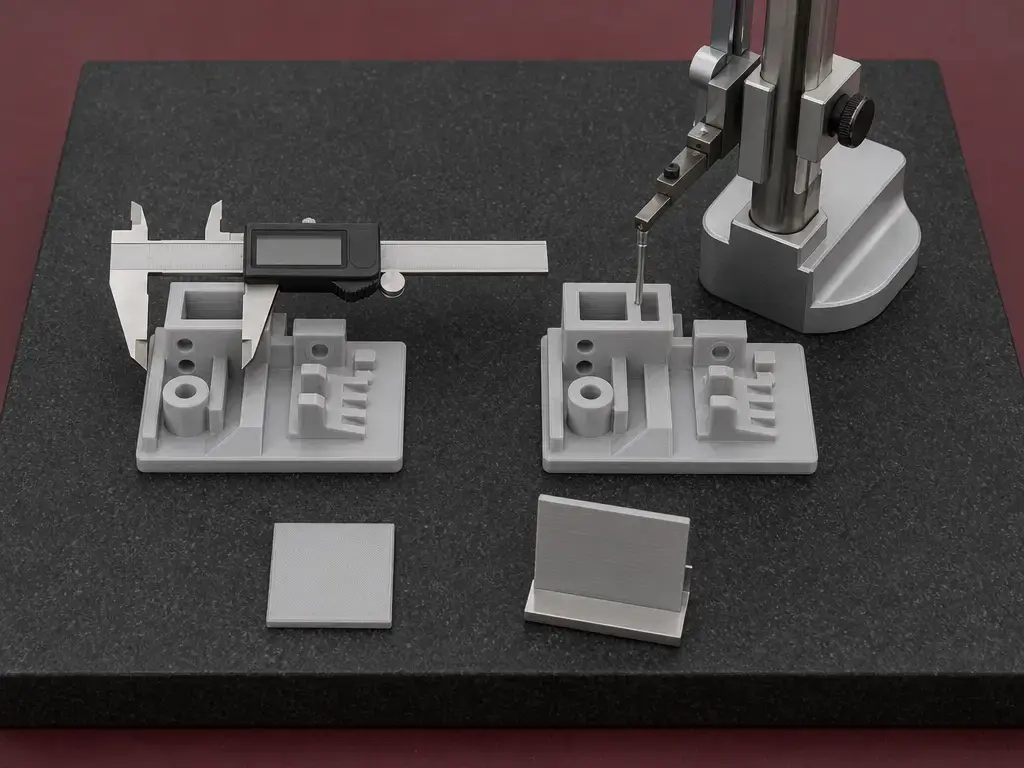
Elegoo Centauri Carbon 2 print quality: spec sheets are not print-quality test results. [S2] This comparison does not assign a print-quality winner because no controlled, model-specific, matched independent dataset was supplied for the relevant configurations. [S2] Surface finish, dimensional trueness, repeatability, ringing, bridging, warping, and long-run reliability are separate outcomes that require separately defined tests. [S2]
In ISO measurement terminology, accuracy involves both trueness and precision. [S2] A part may be close to its intended dimension while repeated parts still show undesirable variation, so dimensional accuracy and repeatability should not be used interchangeably. [S2]
Minimum defensible test protocol
- Use the same filament batch and drying protocol.
- Use the same nozzle diameter and layer height.
- Use the same model orientation.
- Document slicer version and profiles, distinguishing quality settings from speed settings.
- Define measurement features, instruments, and uncertainty framing. [S2]
- Record ambient conditions.
Speed, throughput, and noise: reading claims correctly
Toolhead speed is a motion ceiling, acceleration describes how quickly the motion system can change speed, volumetric flow concerns molten-material delivery, and completed-part throughput covers the whole job. [S3] [S4] Centauri Carbon 2 vs P1S specifications should therefore be read as separate metrics rather than compressed into a single “faster printer” claim. [S7] [S3]
For the P1S base, Bambu Lab states a maximum hot-end flow of 32 mm³/s in a 150 × 150 mm single-wall-model test using Bambu ABS at 280 °C. [S4] That condition does not establish a cross-printer throughput winner because no matched CC2 flow measurement is supplied here. [S4]
Elegoo’s current CC2 Combo product page states “under 45 dB” under a vendor test using Elegoo PLA in Silent Mode with the auxiliary part-cooling fan turned off. [S8] That result is configuration- and condition-specific, so it does not justify a noise-level winner against the P1S base without matched measurements. [S8] [S3]
Running costs and ownership: maintenance, consumables, and unknowns
Running cost includes consumables, wear components, filament preparation, purge waste, and the local availability of replacement parts, rather than only the purchase price. [S12] [S13] Elegoo documents a replacement composite filter for the CC2 as one consumable-category example, but the supplied documentation does not establish filter life or comparative filtration performance. [S12]
Reliability over hundreds of hours, actual multicolor waste, support experience, matched-load noise, and total ownership cost require independent measurement rather than inference from product pages. [S8] [S12] [S13]
Ownership checks before buying
- Inspect nozzle and drive-path components after abrasive-filament use. [S13]
- Manage drying for hygroscopic filaments before printing. [S3] [S10]
- Keep the build plate clean as part of routine print preparation. [S4]
- Verify feeder compatibility before routing TPU or abrasive materials. [S5] [S8] [S13]
- Re-check ventilation and safety guidance for the selected polymer. [S10] [S12]
- Verify replacement-parts availability in the intended region. [S12]
Ecosystem, connectivity, and monitoring: verify the workflow you will actually use
The P1S base specifies a 1280 × 720 chamber-monitoring camera operating at 0.5 fps and supports timelapse capture. [S3] Those specifications do not establish monitoring reliability or remote-operation safety. [S3] For CC2 camera resolution, camera frame rate, app access, LAN operation, cloud workflow, firmware-update cadence, and profile availability, no reliable official figure was found in the cited current source set. [S7] [S8] [S9]
Before buying, verify the following for the exact printer configuration and region:
- Whether LAN-only or cloud-connected operation matches the intended workflow.
- Slicer availability for the selected printer configuration.
- App availability before treating mobile control as part of the purchase decision.
- Documentation depth for setup, maintenance, and troubleshooting.
- Firmware-update information and release notes.
- Regional replacement-part availability.
- Profiles for the selected nozzle diameter and material.
Who should buy which: three configuration-aware buyer profiles
Profile 1 — conditional pick: P1S base. In an Elegoo Centauri Carbon 2 vs Bambu P1S decision, choose the P1S base when ordinary single-spool PLA or PETG work is the main plan and that plan fits Bambu Lab’s P1S base material guidance. [S3]
Profile 2 — conditional pick: CC2 Combo. Choose the CC2 Combo when a bundled, documented four-color CANVAS workflow fits the intended spool geometry, purge tolerance, and TPU-routing procedure. [S10] [S13] [S8]
Profile 3 — conditional pick: CC2 Combo. Choose the CC2 Combo when PLA-CF or PETG-CF is a documented material need and the required CANVAS feed-path inspection is acceptable. [S10] [S13] Re-check the exact bundle on publication day, and require matched testing before accepting quality, noise, throughput, or waste-superiority claims. [S8] [S13]
FAQ
Is the Elegoo Centauri Carbon 2 vs Bambu P1S comparison mainly about speed?
No. The Elegoo Centauri Carbon 2 vs Bambu P1S comparison includes 500 mm/s headline motion ceilings for both the CC2 base and P1S base, but those values do not rank completed-part time or throughput. [S7] [S3] Model geometry, material, cooling, flow capability, selected layer height, and feeder workflow all affect the finished job. [S3] [S4] [S5]
What does carbon fiber filament mean here, and why does nozzle material matter?
Carbon fiber filament is a fiber-filled polymer formulation that can be abrasive to filament-contact parts. [S3] [S13] The P1S base has a stainless-steel nozzle, while the CC2 Combo is specified with a hardened-steel nozzle. [S4] [S9] Nozzle material is only one consideration because CANVAS guidance also calls for feed-part inspection or replacement during extended abrasive use. [S13]
Why does “Not Recommended” for CF/GF on the P1S matter if the filament can physically load?
Bambu Lab labels carbon- and glass-fiber-reinforced polymers as Not Recommended for the P1S base. [S3] That classification is the manufacturer’s stated suitability guidance for material planning and maintenance risk, even if a particular spool can physically move through the printer. [S3] It should not be interpreted as a measured prediction of every possible print outcome. [S3]
Can both printers do multicolor, and what hardware is actually required?
The base configurations must be distinguished from the material-management configurations. [S7] [S3] The CC2 Combo documents four-color printing through included CANVAS hardware, while a P1S + AMS arrangement can reach up to 16 colors or materials only with up to four AMS units. [S10] [S5] Neither capability statement applies to the respective base printer alone. [S7] [S3]
How do spool dimensions and feeder-path constraints affect unattended printing reliability?
Physical spool fit and smooth routing are preconditions for predictable unattended feeder use, but the cited documentation does not provide a measured reliability comparison. [S6] [S13] AMS guidance specifies 50–68 mm spool width and 197–202 mm spool diameter. [S6] CANVAS documentation for the CC2 Combo specifies a 53–58 mm spool inner diameter, with a printed adapter required for larger inner diameters. [S13]
Is TPU equally convenient on both platforms once material-management hardware is added?
No. For TPU in the CC2 Combo workflow, Elegoo specifies use of a flexible-filament adapter and disconnection of the CANVAS cable before printing. [S8] Bambu Lab identifies elastic materials such as TPU as incompatible with AMS. [S5] These are feeder-workflow limits and do not establish that TPU is impossible to print directly on either underlying printer. [S8] [S5]
Sources
-
[S1] ISO/ASTM 52900:2021, Additive manufacturing — General principles — Fundamentals and vocabulary. Standard; 2021. Accessed October 26, 2026. https://www.iso.org/standard/74514.html
-
[S2] ISO 5725-1:2023, Accuracy (trueness and precision) of measurement methods and results. Standard; 2023. Accessed October 26, 2026. https://www.iso.org/cms/render/live/en/sites/isoorg/contents/data/standard/06/94/69418.html
-
[S3] Bambu Lab, P1S Technical Specifications. Manufacturer specification sheet. Accessed October 26, 2026. https://store.bblcdn.com/0de21072f69f4ac9ad9639adb36d4b20.pdf
-
[S4] Bambu Lab, P1S Quick Start Guide. Official documentation. Accessed October 26, 2026. https://cdn1.bambulab.com/documentation/quick-start-59b0cefdc0fc4/P1S/English%20version-Quick%20Start%20Guide%20for%20P1S.pdf
-
[S5] Bambu Lab, AMS Explained in Detail. Manufacturer blog; May 5, 2022. Accessed October 26, 2026. https://blog.bambulab.com/ams/
-
[S6] Bambu Lab, X1 Combo and X1-Carbon Combo Quick Start Guide. Official documentation. Accessed October 26, 2026. https://cdn1.bambulab.com/documentation/Quick%20Start%20Guide%20for%20X1%20Combo%26X1-Carbon%20Combo-v1.pdf
-
[S7] Elegoo, Centauri Carbon 2 Product Page. Manufacturer product page. Accessed October 26, 2026. https://us.elegoo.com/products/centauri-carbon-2
-
[S8] Elegoo, Centauri Carbon 2 Combo Product Page. Manufacturer product page. Accessed October 26, 2026. https://us.elegoo.com/products/centauri-carbon-2-combo
-
[S9] Elegoo, Centauri Carbon 2 Combo Official Landing and Specifications Page. Manufacturer landing and specifications page. Accessed October 26, 2026. https://www.elegoo.com/pages/elegoo-centauri-carbon-2-combo
-
[S10] Elegoo Wiki, Centauri Carbon 2 Combo FAQ. Official documentation. Accessed October 26, 2026. https://wiki.elegoo.com/en/faq/centauri-carbon-2-combo
-
[S11] Elegoo, Centauri Carbon 2 Combo User Manual, English V2.0. Official manual; V2.0. Accessed October 26, 2026. https://elegoo-downloads.oss-us-west-1.aliyuncs.com/tutorials/Centauri%20Carbon%202%20Combo/Centauri%20Carbon%202%20Combo%20User%20Manual-English-V2.0.pdf
-
[S12] Elegoo, Composite Filter for Centauri Carbon 2. Manufacturer accessory page. Accessed October 26, 2026. https://us.elegoo.com/products/composite-filter-for-centauri-carbon-2-3-pcs
-
[S13] Elegoo, Centauri Carbon 2 Combo + 4 kg PLA Basic with Refillable Spool. Manufacturer product page and specification notes. Accessed October 26, 2026. https://us.elegoo.com/products/centauri-carbon-2-combo-4-kg-pla-basic-with-refillable-spool-basic-colors
-
[S14] Elegoo, Elegoo Launches Centauri Carbon 2 Combo. Press release distributed by PRNewswire; January 26, 2026. Accessed October 26, 2026. https://www.prnewswire.com/news-releases/elegoo-launches-centauri-carbon-2-combo-a-family-friendly-multicolor-3d-printer-302669959.html
-
[S15] Stratasys, Legal Information. Trademark information. Accessed October 26, 2026. https://www.stratasys.com/en/legal/legal-information