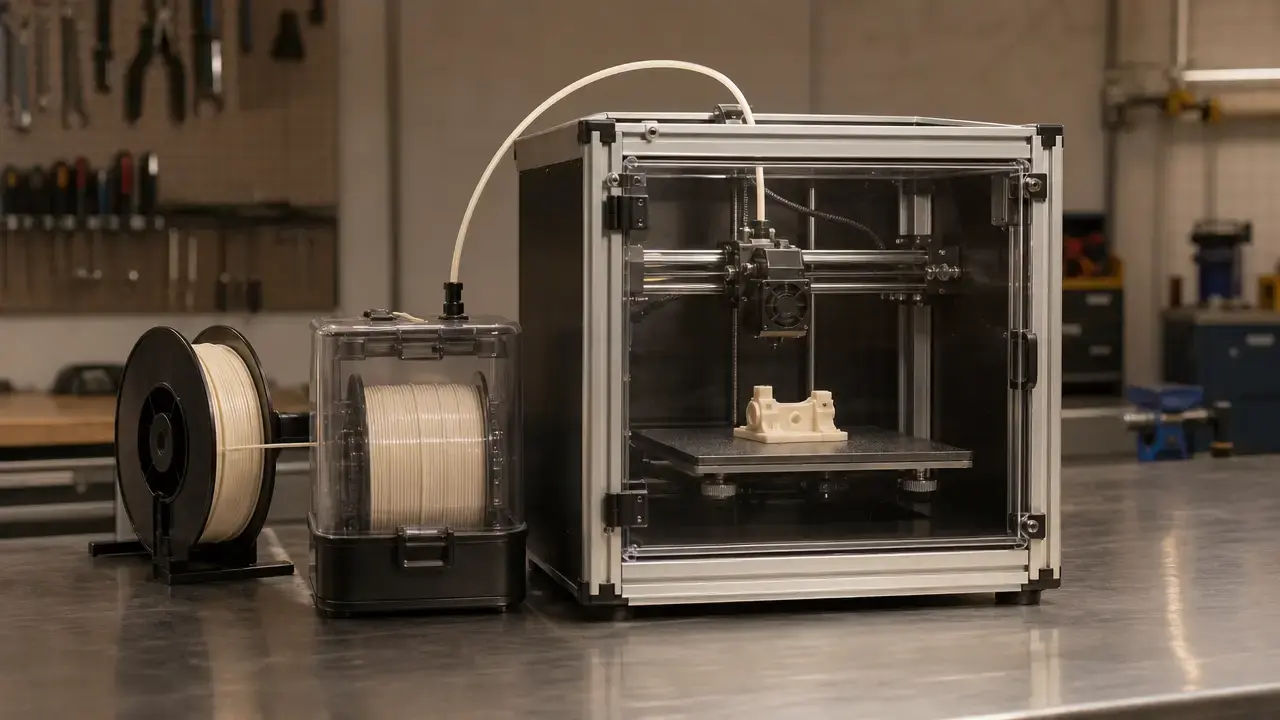

Nylon vs PETG
For nylon vs PETG, PETG is usually the easier default for many functional FFF/FDM parts, while nylon is usually the better fit when impact tolerance, ductility, repeated flex, or wear matter enough to justify stricter drying and process control. In this article, PETG means PETG filament, and nylon means unfilled nylon-family filament unless a specific grade or filled composite is named. The core numeric comparison later in the article uses the same-brand pair of UltiMaker PETG and UltiMaker Nylon technical data sheets. [8] [9]
That does not make the choice a simple “which is stronger” contest. Printed parts depend on the metric, build direction, conditioning state, and print setup. NIST notes that material-extrusion studies are hard to compare directly even at full infill, so the useful question is not “PETG or nylon in the abstract,” but which property set fits your part, environment, and workflow. [6]
- Choose PETG if you want the easier baseline for brackets, guards, housings, and fixtures.
- Choose PETG if lower process fuss matters more than maximum flex or impact tolerance.
- Choose PETG if you want a functional material that usually prints on a wider range of machines with less drying discipline.
- Choose nylon if the part must bend repeatedly, absorb impacts, or survive sliding contact better.
- Choose nylon if ductility and loaded-heat margin matter more than convenience.
- Choose nylon if you can dry filament, manage ambient conditions, and tune for warping and adhesion.
- Choose filled nylon only when you accept the extra nozzle and process requirements that composites can bring. [6] [11] [13]
What “stronger” actually means
In printed polymers, PETG vs nylon strength is not one number. A part can look better in tensile yield, worse in tensile stress at break, better in notched Charpy impact, worse in stiffness, or better only in one orientation. That is why this article separates strength, stiffness, toughness, ductility, fatigue, creep, wear, and interlayer or Z-strength instead of collapsing them into a single winner.
| Property | What it tells you |
|---|---|
| Strength, yield and break | Load carried before yielding or fracture |
| Stiffness, modulus | Resistance to elastic deformation |
| Toughness, impact | Energy absorbed before fracture, including notched impact behavior |
| Ductility, elongation | How far the part can deform before failure |
| Fatigue | Survival under repeated load cycles |
| Creep | Slow deformation under sustained load |
| Wear | Resistance to surface loss in sliding or rubbing contact |
| Interlayer / Z-strength | Bond quality between layers in the build direction |
From here on, every use of “stronger” should name the metric. If a bracket needs stiffness, modulus matters. If a snap-fit needs flex and recovery, elongation and toughness matter more. If a gear, hinge, or slider is involved, creep and wear can matter as much as initial tensile data. NIST and the UltiMaker TDS data reinforce the same point: orientation and interlayer behavior can dominate real printed-part performance. [6] [7] [8] [9]
Materials baseline and taxonomy
Here, PETG means PETG filament, not PET, PCTG, or carbon-fiber-filled PETG unless the grade is explicitly labeled. That distinction matters because nearby copolyesters and reinforced variants can shift stiffness, heat response, and print behavior enough to break a clean comparison.
Here, nylon means unfilled nylon-family filament unless a grade is named. That bucket can include PA6, PA6/66, PA11, PA12, and copolyamides such as CoPA. Polymaker states that PolyMide CoPA is based on a copolymer of Nylon 6 and Nylon 6,6. By contrast, Prusament PA11 Carbon Fiber is a filled PA11 composite, so it should not be treated as equivalent to unfilled nylon when reading tensile, impact, or HDT data. [12] [11]
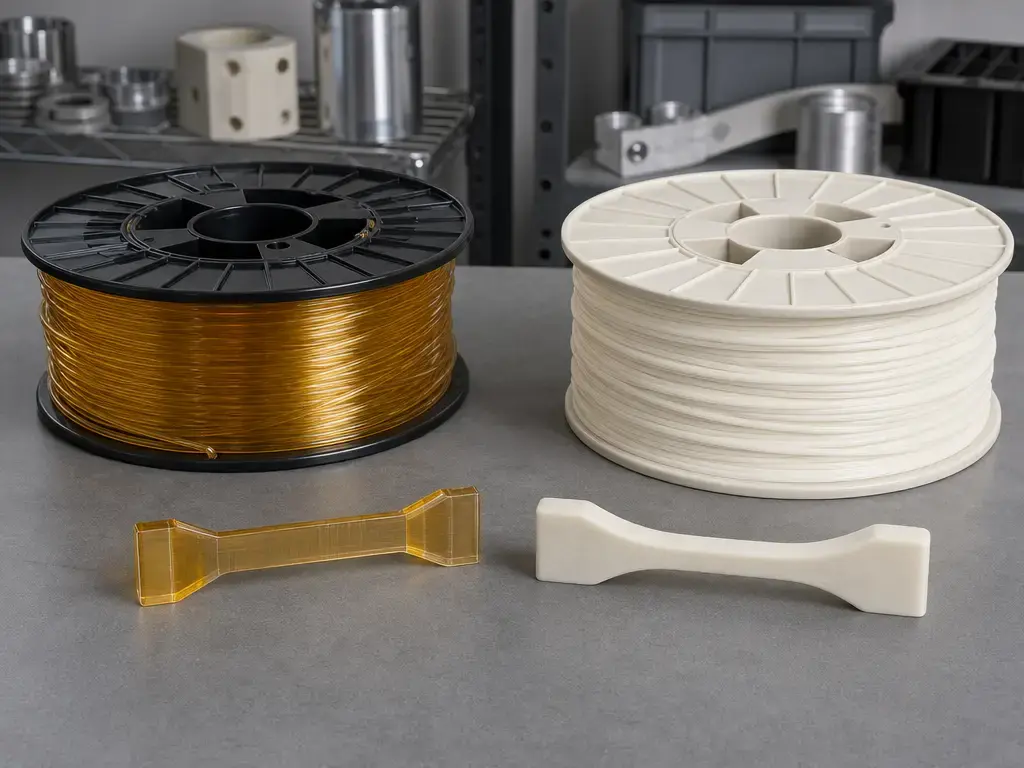
How to read datasheet numbers
Datasheet values only become useful when you read the test method, orientation label, specimen condition, and print setup together. The same-brand UltiMaker comparison is helpful because both TDS documents report printed-specimen data using the same general method family and similar conditioning notes, and both specify the print setup used for the samples. UltiMaker says the comparison samples were printed on an UltiMaker S5 Pro Bundle with a 0.15 mm layer height, an AA 0.4 print core, 100% infill, Cura 4.9, and at least 24 hours of room-temperature conditioning before testing. [8] [9]
Method box: In the core comparison, treat ASTM D3039 as the tensile method, ISO 178 as the flexural method, ISO 179-1 as the impact method, and ISO 75 as the heat-deflection method. Prusament’s PETG and PA11-CF sheets use the same style of method-tagged reporting for printed specimens, which is exactly why ASTM F2971-13 exists: AM test results need their process history reported, not just the material name. [8] [9] [10] [11] [5]
Orientation labels matter just as much. In the UltiMaker sheets, XY, YZ, and Z are not just extra columns; they are build-direction clues. The PETG TDS explicitly notes that Z often reflects interlayer adhesion and is typically the weakest direction in FFF. A missing yield point or “No yield” in Z does not automatically mean the material is bad; it can mean the printed specimen failed without showing a clean yield event in that orientation. [8] [9]
Quick comparison table
The table below is a decision aid, not a ranking. It summarizes typical behavior for PETG or nylon in functional parts, while later sections add the conditions and measured examples that make those generalizations useful. Because material-extrusion properties depend on build parameters and interlayer weld formation, treat every row as “often” or “typically,” not “always.” [6] [7]
| Decision factor | PETG (typical behavior) | Unfilled nylon-family (typical behavior) | What to do |
|---|---|---|---|
| Which is easier to print, nylon or PETG | Usually easier and more forgiving | Usually more demanding | Start with PETG unless the part clearly needs nylon-specific behavior |
| nylon vs PETG durability | Good general toughness | Often better for repeated flex, wear, and impact | Choose nylon when the failure mode is flex, abrasion, or impact |
| nylon vs PETG temperature resistance | Often adequate for moderate heat | Often better under load, but grade matters | Check HDT and service conditions, not the label alone |
| Moisture behavior | Less sensitive in routine handling | Hygroscopic enough to affect storage, printing, and properties | Dry and store nylon carefully |
| Dimensional stability | Usually more predictable | More prone to warp without control | Use enclosure or warm ambient control for nylon |
| Interlayer / Z behavior | Still orientation-sensitive | Also orientation-sensitive | Design with layer direction in mind |
| Workflow burden | Lower | Higher | Match the material to the printer and the user, not just the part |
Controlled head-to-head: UltiMaker PETG vs UltiMaker Nylon
The cleanest numeric comparison in this article is the UltiMaker pair because it keeps brand, reporting style, and print conditions aligned more closely than most public PETG-versus-nylon examples. That still does not remove anisotropy, specimen-shape effects, or the fact that another PA grade may behave differently. It does, however, give a more defensible answer to is nylon stronger than PETG than a cross-brand comparison. [8] [9] [6]
Read the table row by row, not as a single score. The tensile rows use ASTM D3039 at 5 mm/min, the impact row uses notched Charpy per ISO 179-1/1eB at 23 °C, the HDT row uses ISO 75-2/B at 0.455 MPa, and the density row uses ISO 1183. [8] [9]
| Metric (method / condition / orientation) | UltiMaker PETG | UltiMaker Nylon | Decision takeaway |
|---|---|---|---|
| Tensile stress at yield, ASTM D3039, 5 mm/min, XY / YZ | 46.2 ± 0.8 MPa / 50.3 ± 1.0 MPa [8] | 63.1 ± 1.1 MPa / 65.3 ± 0.5 MPa [9] | Nylon leads on in-plane yield |
| Tensile stress at break, ASTM D3039, 5 mm/min, XY / YZ / Z | 38.5 ± 1.4 MPa / 44.0 ± 3.7 MPa / 19.0 ± 6.4 MPa [8] | 40.4 ± 2.2 MPa / 42.3 ± 1.3 MPa / 23.0 ± 2.3 MPa [9] | Break strength is closer; Z remains limiting for both |
| Notched Charpy, ISO 179-1/1eB, 23 °C | 7.9 ± 0.6 kJ/m² [8] | 13.7 ± 1.2 kJ/m² [9] | Nylon is much tougher in this test |
| HDT at 0.455 MPa, ISO 75-2/B | 76.2 ± 0.8 °C [8] | 89.2 ± 5.6 °C [9] | Nylon has the higher loaded-heat figure here |
| Specific gravity, ISO 1183 | 1.27 g/cm³ [8] | 1.14 g/cm³ [9] | Nylon is lower density in this pair |
Note: UltiMaker Nylon’s exact PA grade is not specified in the TDS; treat it as UltiMaker Nylon (unfilled PA filament; grade not specified). [9]
In this controlled pair, nylon leads PETG in tensile yield, notched impact, and HDT, while tensile stress at break is much closer than “nylon is stronger” headlines suggest. PETG still remains the easier default material in many shops, but the UltiMaker numbers explain why nylon is often chosen when impact tolerance, ductility, or loaded heat margin matter enough to justify the harder workflow. [8] [9]
Moisture: two different problems
Moisture creates two different problems in nylon vs PETG. Before printing, moisture is mainly a process problem: bubbling, uneven extrusion, surface defects, and more mechanical scatter. Prusa says improperly stored nylon can absorb water up to 10% of filament weight and recommends drying for at least 4 hours below 90 °C before printing. Polymaker’s CoPA guidance is similarly strict about dry handling. [13] [12]
After printing, moisture becomes a part-property problem, especially for nylon-family materials. Polymaker’s CoPA sheet shows large dry-versus-conditioned shifts in XY data: tensile strength drops from 66.2 ± 0.9 MPa after dry/annealed testing to 31.4 ± 1.5 MPa after conditioning at 70% relative humidity for 15 days, while elongation at break rises from 9.9 ± 1.5% to 216.5 ± 12.1%, and Charpy impact rises from 9.6 ± 1.4 to 17.2 ± 1.4 kJ/m². That is why nylon numbers should always be read with a moisture state attached. [12]
| Stage | What moisture does | Evidence/examples |
|---|---|---|
| Pre-print moisture | Destabilizes extrusion and can worsen print quality and consistency | Prusa warns nylon can absorb up to 10% of filament weight if stored badly and recommends at least 4 h of drying below 90 °C; Polymaker says CoPA should be stored and used below 20% RH. [13] [12] |
| Post-print conditioning | Changes measured mechanical response | Polymaker CoPA shifts from 66.2 ± 0.9 MPa tensile strength dry/annealed to 31.4 ± 1.5 MPa conditioned, while elongation rises from 9.9 ± 1.5% to 216.5 ± 12.1%. [12] |
| PETG comparison point | PETG is less moisture-sensitive, but not moisture-proof | Prusament PETG reports 0.07% moisture absorption after 24 h and 0.10% after 7 days at 24 °C and 22% humidity. Treat that as a brand-specific example, not a universal PETG value. [10] |
The practical rule is simple: dry nylon before printing, keep it sealed or in a dry box, and decide whether your part will be used dry or conditioned before trusting the datasheet. PETG is easier to manage, but it still benefits from dry storage when repeatability matters. [10] [12] [13]
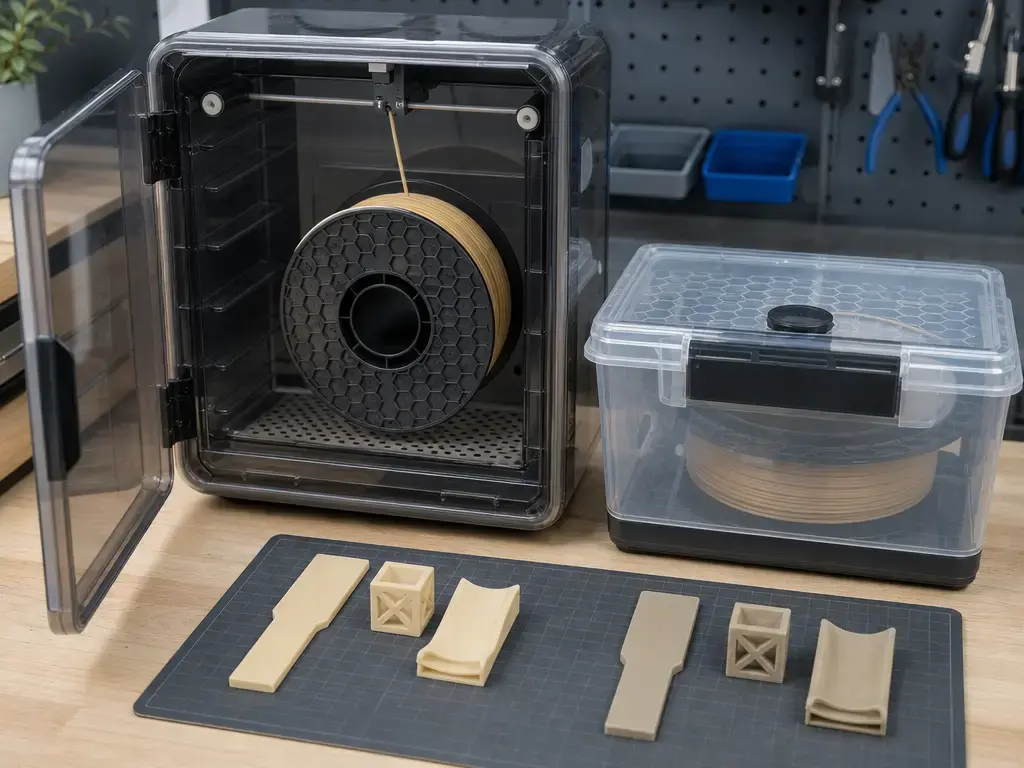
Temperature resistance: Tg vs HDT
HDT is measured under load at a stated stress; Tg is a polymer transition and is not a stand-alone service temperature limit. That distinction matters because printed parts can soften, creep, or lose shape under load in ways that Tg alone does not predict. For functional parts, nylon vs PETG temperature resistance is usually better compared through HDT plus the actual load case than through Tg alone. [8] [9]
The UltiMaker pair is a good example. UltiMaker PETG lists a Tg of 77.4 °C by DSC and an HDT of 76.2 ± 0.8 °C at 0.455 MPa. UltiMaker Nylon lists a lower Tg of 55.1 °C by DSC, but a higher HDT of 89.2 ± 5.6 °C at the same stress, plus a melting temperature of 188.4 °C. So a lower Tg does not automatically mean worse loaded-heat behavior in a printed-part dataset. [8] [9]
The composite caveat matters here too. Prusament PA11 Carbon Fiber lists HDT values of 192 °C at 0.45 MPa and 152 °C at 1.80 MPa, but that is a filled PA11 composite, not a stand-in for unfilled nylon as a whole. Use it only as proof that reinforcement can shift thermal behavior dramatically. [11]
Durability modes: impact, fatigue, creep, wear
Impact is where the PETG-versus-nylon split becomes easiest to quantify. In the UltiMaker pair, PETG’s notched Charpy at 23 °C is 7.9 ± 0.6 kJ/m², while Nylon’s is 13.7 ± 1.2 kJ/m². Prusament’s PETG TDS also shows orientation sensitivity, with notched Charpy values of 6 ± 1 kJ/m² in the horizontal case and 3 ± 1 kJ/m² in vertical xz. Even impact numbers should be read as method-and-orientation results, not as universal material labels. [8] [9] [10]
Fatigue and creep are harder to summarize cleanly from public sources because long-term printed-part behavior depends on load level, temperature, geometry, and build direction. A 2025 peer-reviewed PETG creep paper is useful here not because it settles the design question, but because it shows creep is still an active research topic for printed PETG rather than a solved lookup-table problem. There is no universal PETG-vs-nylon creep factor in the primary sources used here, so long-term load retention should be treated as application-specific. [15]
Wear and sliding contact are even more grade-specific. Independent nylon gear work exists: the Warwick study tested multiple nylon filaments and reported Nylon 618 as the best wear performer among the tested materials, while a 2025 nylon-gear paper notes that polymer gears are often used where self-lubrication is useful and that nylon gears are particularly popular, but wear understanding remains limited and manufacturing method affects performance. No defensible universal PETG-vs-nylon coefficient-of-friction ranking was found in the primary sources used for this article. The practical takeaway is cautious: nylon is usually the safer first candidate for repeated flex and wear-prone interfaces, but tribology claims should stay grade-specific and test-specific. [16] [17]
Print workflow: which is easier to print, nylon or PETG?
Printing difficulty comes from both the machine and the polymer. Machine capability means hotend temperature, bed temperature, enclosure or warm ambient control, and how dry the filament stays on its path to the nozzle. Material behavior means stringing, warp tendency, moisture sensitivity, and how forgiving the polymer is when settings are not perfect. PETG and nylon do not place the same demands on either side of that equation. [10] [12] [13]
For PETG, the workflow is usually simpler. Prusament PETG lists a nozzle temperature of 250 ± 10 °C and a bed temperature of 80 ± 10 °C, and its printed-specimen notes use a familiar 0.20 mm profile with 100% rectilinear infill for comparison samples. In day-to-day use, the common PETG annoyances are usually stringing, oozing, and sometimes over-strong bed adhesion on unsuitable surfaces rather than severe warping or humidity sensitivity. [10]
Nylon usually asks more from the shop. Prusa’s nylon guidance emphasizes drying and warns that badly stored nylon can absorb up to 10% of its weight in water. Polymaker’s CoPA sheet adds grade-specific examples of what “more demanding” looks like: 250–270 °C nozzle temperature, 25–50 °C bed temperature, 40–60 °C environmental temperature, cooling fan off, 30–60 mm/s print speed, storage and use below 20% relative humidity, and a post-print anneal recommendation of 80 °C for 6 hours. Those numbers are illustrative, not universal for every nylon, but the direction is clear: nylon rewards dry filament and tighter ambient control. [12] [13]
- Dry the filament before printing, especially nylon.
- Match the build surface to the polymer instead of assuming one sheet works for everything.
- Use an enclosure or warm ambient control when nylon warping becomes the limiting issue.
- Tune cooling deliberately instead of leaving the fan at a default profile.
- Print a small coupon before committing to a functional part.
- Store both the remaining filament and moisture-sensitive finished parts appropriately after printing.
So, which is easier to print, nylon or PETG? For most users, PETG is easier to print than nylon. A printer built for hot, dry, enclosed operation can narrow the gap, but PETG still wins on convenience for most functional parts. [10] [12] [13]
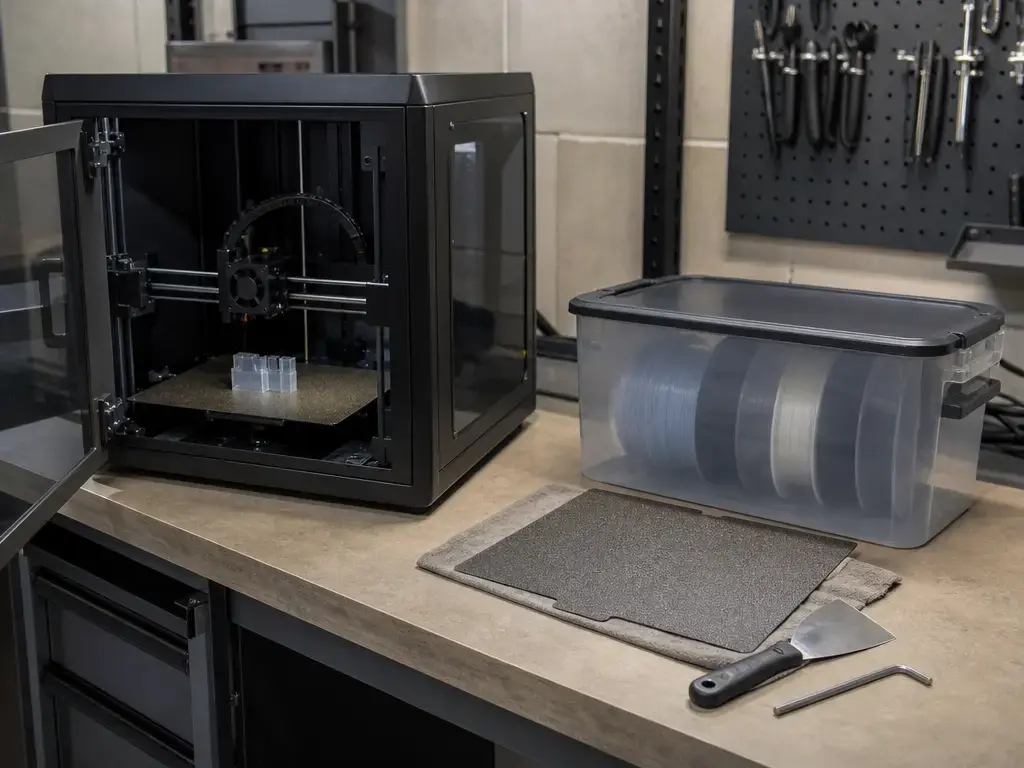
Applications: PETG or nylon for functional parts?
For PETG or nylon for functional parts, PETG is usually the more practical default for brackets, mounts, enclosures, guards, cable clips, and general shop fixtures that see moderate loads and modest heat. Its advantage is not that it always beats nylon on every property, but that it often delivers good-enough toughness with a much easier print workflow. That makes PETG a strong baseline material when the part is mostly static and the main goal is reliable production rather than maximum ductility or wear performance. [8] [10]
Nylon makes more sense when the part moves, flexes, or rubs. Hinges, snap features, lightly loaded gears, bushings, and wear-prone interfaces are the usual targets, but the evidence remains grade-specific. The Warwick spur-gear study and the 2025 nylon-gear paper both support nylon’s relevance in self-lubricating or wear-sensitive gear applications, while also showing that performance depends on the nylon grade, manufacturing method, and test setup. That is a good reason to prefer nylon as a starting point for repeated-flex and sliding-contact parts without turning it into a blanket guarantee. [16] [17]
Limits, failure modes, and what the datasheets don’t tell you
The biggest limit in any nylon vs PETG article is that printed parts are anisotropic and process-dependent. NIST IR 8059 says studies were not directly comparable even at full infill and emphasizes the role of raster angle, air gap, filament width, layer height, and build orientation. NIST’s weld-formation work explains the physics behind that warning: interlayer performance is a process outcome, not just a material-name property. Interlayer or Z direction is commonly limiting in real printed parts. [6] [7]
The UltiMaker data show the consequence clearly. PETG’s Z-direction tensile stress at break is 19.0 ± 6.4 MPa, far below its in-plane values, and UltiMaker Nylon also shows orientation-dependent break behavior plus “No yield” in Z. Those are test-bar results, not full design allowables for finished parts with holes, corners, stress risers, or mixed load paths. No single “strongest filament” number exists for nylon vs PETG. [8] [9]
Standards and research context
Standards matter here because users often say FDM or FFF, while standards more often use broader material-extrusion or additive-manufacturing terminology. ISO/ASTM 52900:2021 is Edition 2, was published in November 2021, and is shown by ISO as confirmed current in 2025. ASTM F3529-21 is the polymer material-extrusion design guide, and ASTM F2971-13 is the reporting practice for AM test specimens. NIST IR 8059 and NIST’s weld-formation publication explain why that reporting discipline matters: printed-polymer properties are inseparable from process history and interlayer physics. [1] [4] [5] [6] [7]
Nylon vs PETG: which should you choose?
For nylon vs PETG, the short answer is that PETG is the easier baseline and nylon is the more specialized option. The controlled UltiMaker pair supports that split: nylon leads in yield, notched impact, and HDT in that dataset, while PETG remains easier to deploy for many everyday functional prints. [8] [9]
Use PETG when the part is mostly static, service temperatures are moderate, and you want a process that is likely to succeed with less tuning. Use unfilled nylon when impact, repeated flex, wear, or loaded heat margin justify the added burden of drying and ambient control. Use filled nylon only when you accept the nozzle and process requirements of composites. PETG default → unfilled nylon when wear/fatigue/impact justify → filled nylon only when you accept nozzle + process requirements. [11] [13]
FAQ
Is nylon stronger than PETG?
Sometimes, but only for specific metrics. In the controlled UltiMaker comparison, nylon leads PETG in tensile yield and notched Charpy impact, while tensile stress at break is much closer and Z-direction behavior remains limited by build orientation. So the useful question is not “is nylon stronger than PETG,” but “stronger in which metric?” [8] [9]
Which is easier to print: nylon or PETG?
PETG is usually easier to print. Prusament PETG uses familiar settings around 250 ± 10 °C nozzle and 80 ± 10 °C bed, while Prusa’s nylon guidance stresses drying and Polymaker’s CoPA guidance adds strict humidity and ambient-control targets. Nylon can work very well, but it usually asks more from both the machine and the user. [10] [12] [13]
PETG vs nylon strength: why do XY/YZ/Z results look different?
Because printed parts are anisotropic. NIST says build orientation and processing variables strongly affect material-extrusion properties, and the UltiMaker TDS documents treat Z as an interlayer-strength clue rather than just another axis. That is why PETG and nylon can look strong in-plane but much weaker through the layer stack. [6] [8] [9]
Nylon vs PETG temperature resistance: should I compare Tg or HDT?
Use both, but do not confuse them. Tg describes a polymer transition, while HDT is measured under load at a stated stress and is usually closer to the printed part’s loaded heat limit. The UltiMaker pair shows why: nylon’s Tg is lower than PETG’s, yet its HDT is higher in that dataset. Filled PA11-CF can push HDT much higher still, but that is a composite example. [8] [9] [11]
Does nylon absorb more moisture than PETG — and what changes after conditioning?
Yes. Prusa says badly stored nylon can absorb up to 10% of filament weight, while Prusament PETG’s cited moisture-uptake example is far lower. More importantly, Polymaker’s CoPA data show that conditioning can sharply reduce strength while increasing elongation and impact, so nylon properties should always be read with the moisture state attached. [10] [12] [13]
Can PETG replace nylon for gears or bushings?
Sometimes for lightly loaded parts, but not as a rule. Nylon is more commonly chosen where repeated flex, wear, or self-lubricating behavior matter, and the available gear studies are nylon-grade-specific rather than universal. For PETG, creep remains an active research area, so gear and bushing use is better treated as a case-by-case engineering decision than a shortcut. [15] [16] [17]
Sources
- ISO/ASTM 52900:2021 Additive manufacturing — General principles — Fundamentals and vocabulary
- ISO/ASTM 52903-1:2020 Additive manufacturing — Material extrusion-based additive manufacturing of plastic materials — Part 1: Feedstock materials
- ISO/ASTM 52903-2:2020 Additive manufacturing — Material extrusion-based additive manufacturing of plastic materials — Part 2: Process equipment
- ASTM F3529-21 Guide for Additive Manufacturing — Design — Material Extrusion of Polymers
- ASTM F2971-13 Standard Practice for Reporting Data for Test Specimens Prepared by Additive Manufacturing
- NIST IR 8059 Measurement Science Roadmap for Material Extrusion
- NIST Weld formation during material extrusion additive manufacturing
- UltiMaker PETG Technical Data Sheet v1.00
- UltiMaker Nylon Technical Data Sheet v5.00
- Prusament PETG Technical Data Sheet v1.1
- Prusament PA11 Carbon Fiber Technical Data Sheet v1.0
- Polymaker PolyMide CoPA Technical Data Sheet v5.2
- Prusa Knowledge Base: Polyamide (Nylon)
- Prusa Knowledge Base: Drying filament
- Viscoelastic Creep of 3D-Printed PETG Samples
- Physical investigation of wear and thermal characteristics of 3D printed nylon spur gears
- Nylon gear wear monitoring paper