
Summary
ESD-safe filament is a useful market shorthand for 3D printing materials intended to help printed parts dissipate charge in electronics-facing uses such as trays, fixtures, and some enclosures. In this article, the term is treated as shorthand unless a named standard, metric, test method, specimen basis, conditioning setup, and acceptance context are provided. ANSI/ESD S20.20 is built around an ESD Control Program, including product qualification and compliance verification, and ESDA guidance notes that control items are qualified before initial use with typical conditioning at 12% ± 3% RH and 23°C ± 3°C. Material choice alone does not create a complete ESD workflow. [4] [6]
What “ESD-safe filament” means (in this article) — and what it doesn’t
Here, ESD-safe filament means a print material marketed for parts meant to reduce charge buildup or provide controlled charge dissipation in electronics work. It is not a formal standards definition, and it does not by itself mean certified, compliant, or suitable for every electronics task. “Anti-static filament” is often used in the same broad market sense, but the label alone does not tell you which electrical metric was measured, how it was measured, or whether the number came from filament, a printed coupon, or a finished part. [4] [6] [8]
That distinction matters because electronics users usually need controlled charge dissipation, not just a special-sounding plastic. NASA’s glossary notes that antistatic plastics may slightly increase surface conductivity, but that effect is usually insufficient to provide ESD shielding. [8]
“ESD-safe” can point to different performance targets depending on whether you are talking about work surfaces, packaging, tools, or printed parts. In practice, those items sit inside a larger ESD control program, and qualification happens in the context of intended use rather than from the label alone. [4] [6]
ESD standards landscape: materials vs programs vs packaging
ANSI/ESD S20.20 is a control-program framework, not a single-material pass/fail label for ESD filament or any other product. Its table of contents explicitly includes sections for the ESD Control Program, the product qualification plan, the compliance verification plan, grounding, ESD protected areas, and packaging. That framing is useful because it reminds you that grounding, handling, packaging, and materials are managed as parts of one electronics workflow rather than as isolated claims on a spool. [4]
ESDA guidance adds the practical layer: control items used to mitigate ESD risk are qualified prior to initial use, and that qualification typically includes conditioning at 12% ± 3% RH and 23°C ± 3°C. Packaging is related to printed-part use, but it is not identical to it. A bag, a tray, a work surface, and a printed fixture can serve different control functions, so the target should match the job instead of assuming one “ESD-safe” label covers every surface in the workflow. [6]
Quick terminology: anti-static vs dissipative vs conductive (and where “ESD-safe” fits)
Market labels compress several different electrical behaviors into a small amount of shelf text. That makes browsing easier, but it can hide the actual metric behind the claim. The label is a starting point, not the specification. [5] [7] [8]
| Term (market) | Typical goal | Common metric you’ll see | Key caution |
|---|---|---|---|
| Anti-static | Reduce charge buildup | Often surface resistance, surface resistivity, or a product-specific antistat claim | Anti-static does not mean shielding, and some antistat behavior depends strongly on humidity. [8] |
| Static dissipative | Let charge move away in a controlled way | Surface resistance or surface resistivity | ESDA guidance places dissipative materials above 1 × 10^4 Ω and below 1 × 10^11 Ω in the STM11.11 context. [5] |
| Conductive | Move charge readily | Resistance or resistivity, depending on the source | One ESDA explainer frames conductors below 10 kΩ, but definitions vary by standard and industry. [7] |
| Insulating | Resist charge flow | Very high resistance or resistivity | One ESDA explainer frames insulators above 100 GΩ, but that is still context-dependent. [7] |
| ESD-safe | Marketing umbrella for ESD-oriented behavior | Any of the above, depending on seller | Always check the actual metric, method, specimen basis, and environment. [5] [8] |
The table separates charge dissipation from shielding and keeps resistance-based and resistivity-based terms from getting mixed together. Definitions are not perfectly uniform across standards or industries, so treat them as context-dependent rather than universal labels. [5] [7] [8]
The practical takeaway is simple: the market term helps you start the search, but the measured electrical metric, the unit, the method, and the specimen basis tell you whether the material fits a real electronics workflow. [1] [3]
Resistance vs resistivity: what vendors report (and why it’s easy to misread)
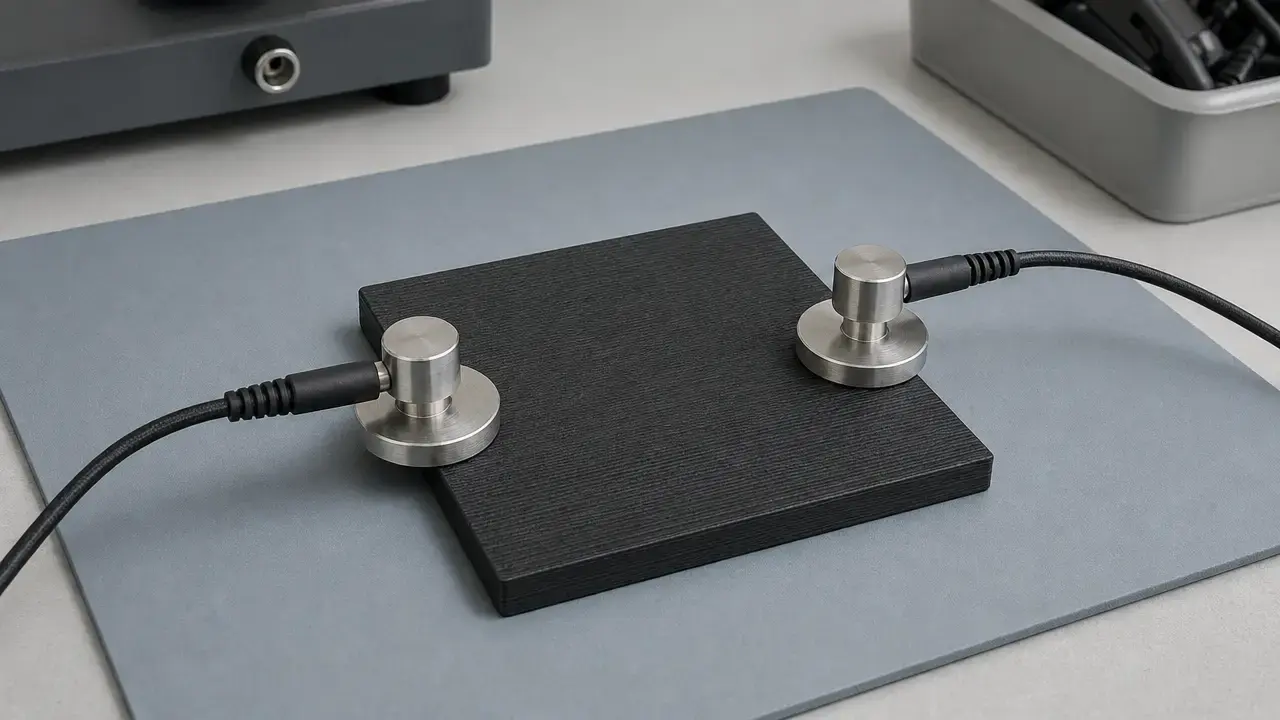
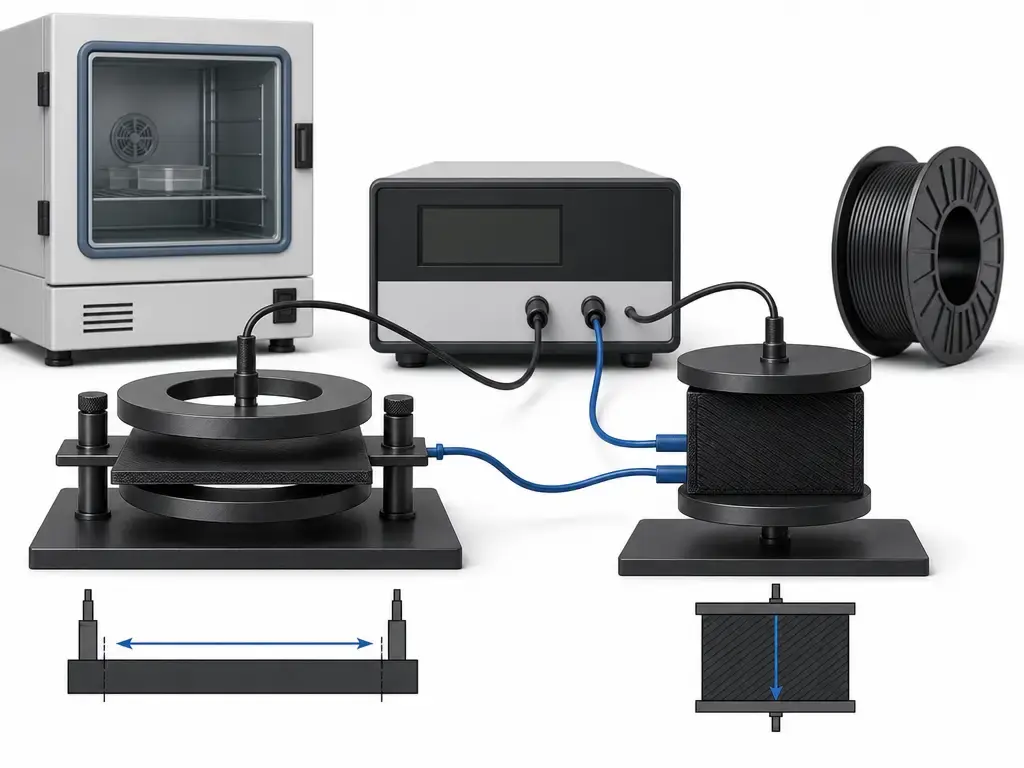
Surface resistance is the measured electrical resistance between electrodes placed on or near a surface. Volume resistance is the measured resistance through the body of a material between electrodes arranged for through-thickness flow. ASTM D257 covers dc insulation resistance, volume resistance, and surface resistance, and states that from those measurements, together with specimen and electrode geometry, surface and volume resistivity can be calculated. [1]
Surface resistivity and volume resistivity are the geometry-normalized forms of those measurements. Surface resistivity is commonly written in Ω/sq, while volume resistivity is commonly written in Ω·cm or Ω·m, depending on the reporting basis. Vendors often mix the terms because they are reporting different setups, specimen types, or test traditions. ASTM D4496 is the more relevant reference when the material falls in a moderately conductive range; its scope covers materials with volume resistivity from 10^0 to 10^7 Ω·cm or surface resistivity from 10^3 to 10^7 Ω/sq. [1] [2]
ASTM D257 also warns that surface resistance changes rapidly with humidity, while volume resistance changes more slowly. It further says surface resistance cannot be measured accurately, only approximated, because some volume contribution is always involved, and that contamination affects the result. Just as important, D257 says it is not suitable for moderately conductive materials and directs users to ASTM D4496 instead. That is why “how to test ESD-safe filament” is not the same as touching two multimeter probes to a printed part and reading a number. [1] [2] [6]
What a usable electrical property claim must include
- Metric name.
- Unit.
- Test method or standard.
- Specimen basis: filament, printed coupon, or printed part.
- Conditioning environment and acceptance context. [6]
How ESD-safe filaments work (in printed parts): percolation, fillers, and variability
In printed parts, ESD-safe filaments work by creating conductive pathways inside a polymer matrix rather than by turning the whole plastic into a metal-like conductor. A filler network can form once enough conductive particles connect or nearly connect, allowing charge to move through or across the part more readily than it would in an ordinary insulating polymer. That basic mechanism explains why a static-dissipative print can behave very differently from the unfilled base resin, but it does not predict final electrical performance by itself because the filler system is product-specific. [11] [13]
Printed parts are also not electrically uniform. ASTM D4496 warns that moderately conductive materials can be manufactured in ways that result in anisotropy of electrical conduction, and that the meaning of the test depends on specimen orientation relative to the electric field and to actual use. A peer-reviewed review on additive-manufactured polymers likewise notes that build orientation and internal air voids can influence electrical behavior by introducing barriers and anisotropy. That is why a conductive filament for electronics should be judged as a printed system, not only as a raw material family. [2] [16]
Filler systems you may see
- Carbon black or other carbon-filled systems.
- Carbon nanotube systems, as in 3DXTech’s multi-wall carbon nanotube examples. [11]
- Carbon-additive systems where abrasion can become a process concern, as Prusa notes for PC Space Grade Black. [13]
Testing & validation: choosing methods without overpromising DIY measurements
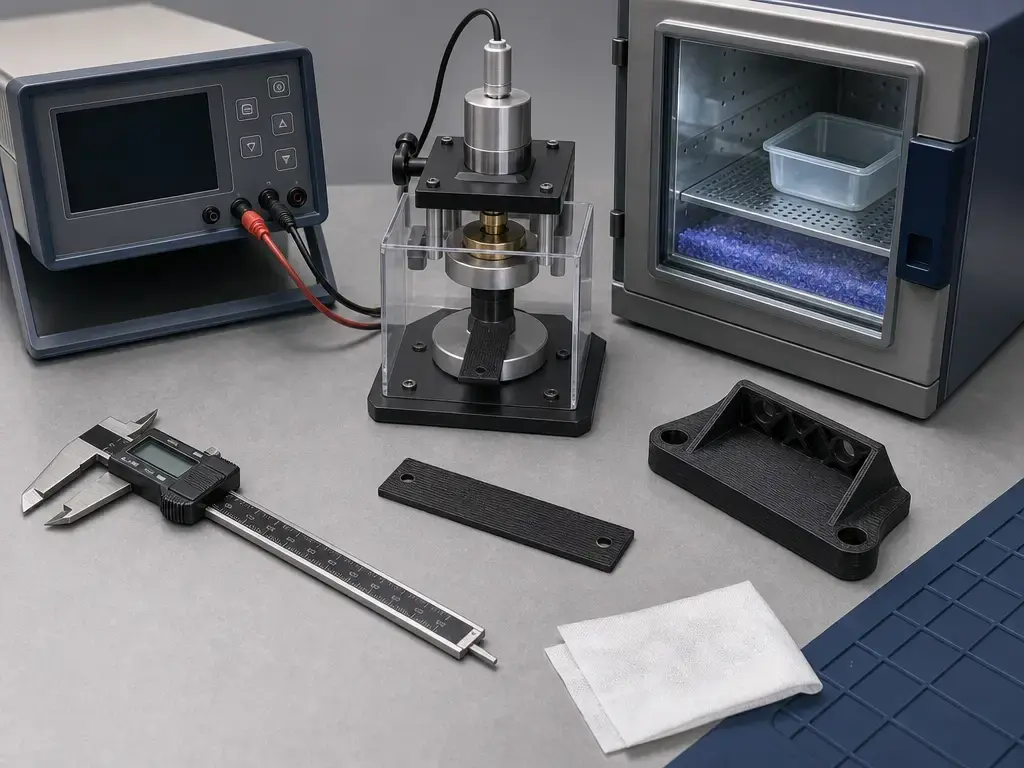
Testing starts with choosing a representative specimen, not a random spot on a finished part. A handheld multimeter can tell you continuity or gross conductivity, but that is not the same thing as a standardized surface-resistance or resistivity result. For printed polymers, geometry, finish, contamination, and orientation can all influence the reading, so a representative printed coupon or part is usually more meaningful than an ad hoc probe check. This article does not recommend “just use a multimeter” as validation. [1] [2] [3]
ASTM D257 is useful as terminology and method background for insulating materials, but its own limits matter here. It covers resistance measurements from which resistivity can be calculated, yet it says surface resistance is only approximated and that the method is not suitable for moderately conductive materials. ASTM D4496 is the missing counterpoint for moderately conductive systems, while ANSI/ESD STM11.11 is the planar-material method that includes sample preparation, conditioning, test equipment, reporting of surface resistance, and conversion to resistivity. Before comparing one ESD-safe filament with another, ask which of those method contexts the number actually comes from. [1] [2] [3]
Environmental conditioning is part of the answer, not a footnote. ESDA guidance says qualification is typically conducted at 12% ± 3% RH and 23°C ± 3°C, while NASA notes that many topical antistats become less effective below 30% relative humidity. A material tested dry, tested humid, and used on the line may not behave the same way. Accept or reject a datasheet number only in the same conditioning and acceptance context you plan to use. [6] [8] [1]
Before you accept a datasheet number, ask…
- What was the specimen basis: filament, printed coupon, or printed part?
- What conditioning was used before test?
- What test method or standard was used?
- What acceptance context was the number meant to support?
- Was the result reported on a flat planar sample or on a shaped part?
- Could humidity, contamination, or orientation change the result in your use case? [1] [2] [6]
Printing & processing considerations (FFF) — with product-specific examples
FFF, often called FDM, is the most common route for ESD-safe filament, but printability still depends on the polymer, filler package, and machine setup. In practice, nozzle temperature, bed temperature, moisture control, surface cleanliness, and post-processing can all matter before any electrical test is run. Manufacturer pages usually provide a starting window, not a universal recipe, and some vendors are clearer than others about whether a reported number came from filament, a printed specimen, or a finished part. [10] [11] [12] [13]
Nozzle wear is another process variable, but it is product- and filler-dependent rather than automatic for every ESD material. Prusa’s PC Space Grade Black is a clear example: the page reports electrical measurements on 3D printed samples, recommends 290 ± 10°C nozzle temperature and 120 ± 10°C bed temperature, suggests drying for 6 hours at 60°C, and says a hardened nozzle is necessary because the carbon additives are abrasive. E3D provides broader context that carbon-filled and other abrasive filaments can rapidly wear standard nozzles, but that is a general caution, not proof that every ESD filament behaves the same way. [13] [15]
| Material (process) | Metric reported (unit) | Reported value / band | Specimen/method notes |
|---|---|---|---|
| 3DXTech 3DXSTAT ESD-PLA (FFF) | Surface resistance (Ω) | Target 10^4–10^9 Ω | Example only; specimen basis and test method not stated by manufacturer. Extruder 230–260°C, bed up to 80°C, drying 65°C for 4 h. [11] |
| 3DXTech 3DXSTAT ESD-PETG (FFF) | Surface resistance (Ω) | Target 10^4–10^9 Ω | Example only; specimen basis and test method not stated by manufacturer. Extruder 230–260°C, bed 60–90°C, drying 65°C for 4 h. [12] |
| Prusament PC Space Grade Black (FFF) | Surface resistivity (Ω/sq); volume resistivity (Ω·m) | 6 × 10^7 Ω/sq; 2.2 × 10^4 Ω·m | Example only; reported on 3D printed samples, without post-processing. Nozzle 290 ± 10°C, bed 120 ± 10°C, drying 6 h at 60°C; hardened nozzle required due to carbon additives. [13] |
| Formlabs ESD Resin (SLA) | Surface resistivity (Ω/sq); volume resistivity (Ω·cm) | 10^5–10^8 Ω/sq; 10^5–10^7 Ω·cm | Example only; post-cured printed specimens. TDS lists ANSI/ESD 11.11 and notes properties may vary with geometry, orientation, settings, temperature, and post-processing. [10] |
All values in the table above are manufacturer-reported examples rather than category-wide truths, and the reporting quality varies by brand. [10] [11] [12] [13]
- Follow the material’s drying guidance, if provided.
- Assume you must validate the finished part, not just the filament.
- Avoid surface contamination when testing.
- If the datasheet omits method or specimen basis, treat the number as a rough indicator, not a finished specification. [1] [10] [11] [12] [13]
Common applications in electronics (with validation caveats)
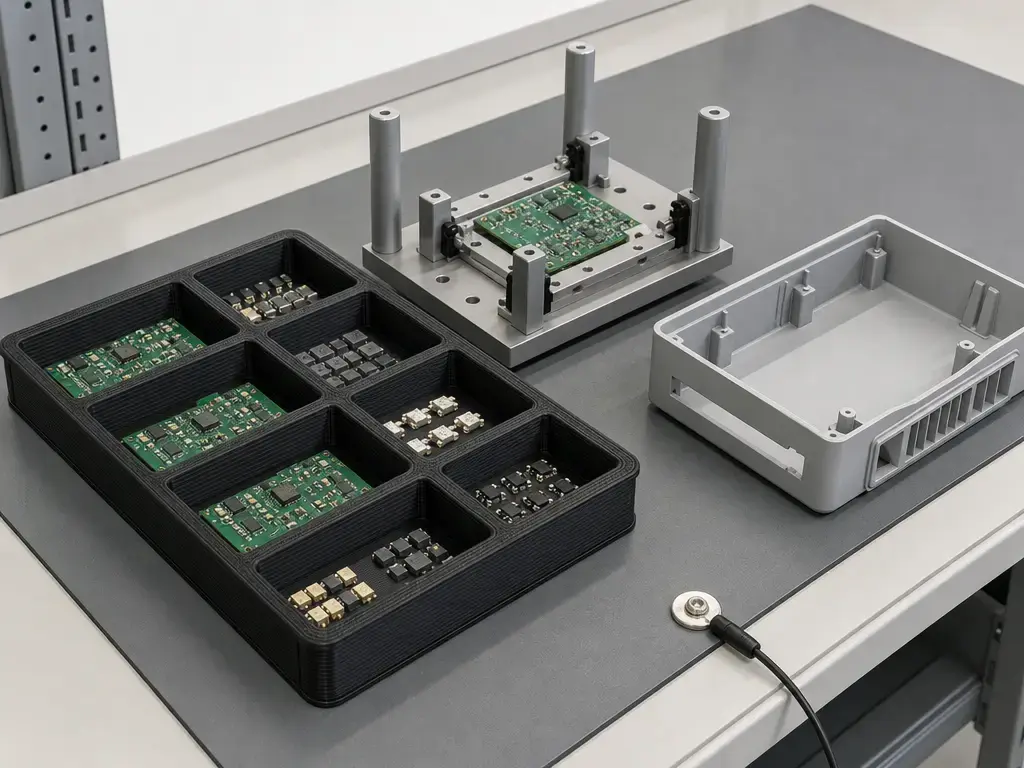
PCB handling trays and similar component-handling aids are a natural fit for ESD-oriented print materials because they can reduce charge accumulation during transfer or staging. Formlabs, for example, positions ESD Resin for custom trays for component handling and storage, alongside tooling and fixturing for electronics manufacturing. The printed tray still needs to fit the local ESD program, including cleanliness, grounding where applicable, and validation under the environment in which it will be used. [9] [6]
Jigs, fixtures, and manufacturing aids are another strong use case because they support repeatable handling and process organization. As one industry example, TCT Magazine reported in September 2020 that Continental used a Stratasys Fortus 450mc to produce ESD-compliant gluing jigs and X-ray guides in ULTEM 9085 and ABS ESD7. That is workflow context, not standards evidence, but it shows where ESD-oriented printed parts can sit in production. [14]
Electronics enclosures are often discussed next, but the required function has to be stated carefully. Formlabs also markets ESD Resin for enclosures intended to protect sensitive electronics from static discharge, yet that should not be read as an automatic shielding claim for any printed polymer enclosure. For enclosure use, tie material choice to the intended dissipation role and verify the finished geometry in context. [9] [8]
Limitations, failure modes, and the shielding trap
ESD-safe filament does not guarantee compliance in your ESD Protected Area by itself. ASTM D257 notes that surface resistance changes rapidly with humidity, that contamination affects the result, and that surface measurements are only approximations. ESDA guidance also places qualification and environmental conditioning inside program use, so a printed part should be treated as one validated control item in a larger system, not as proof that the whole workflow is protected. [1] [6]
Printed geometry adds another layer of uncertainty. ASTM D4496 warns that anisotropy matters and that result significance depends on specimen orientation relative to the electric field and to the way the material is used. Peer-reviewed additive-manufacturing literature supports the same caution by noting that build orientation and internal voids can affect electrical behavior. In short, a conductive filament for electronics may behave differently from coupon to coupon or part to part, even before cleaning or post-processing is considered. [2] [16]
Caution: Charge dissipation vs electrostatic shielding vs EMI shielding
These are different functions. ESDA distinguishes dissipative materials from discharge-shielding materials and associates discharge shielding with much lower resistance levels than the dissipative band. NASA defines an electrostatic shield as a barrier or enclosure that prevents penetration of an electrostatic field and says the barrier must be solid metal sheet or wire mesh to be effective; the same glossary also notes that such a shield may not offer much protection against electromagnetic fields. That is why antistatic plastic is usually not enough for ESD shielding, and why a printed polymer part should not be assumed to provide electrostatic shielding or EMI shielding automatically. [5] [8]
Market & material landscape (keep it compact)
ESD-safe 3D printing filament spans a wider market than one label suggests. On the easier-printing end, 3DXTech offers ESD-oriented PLA and PETG examples with target surface-resistance bands and straightforward temperature guidance. At the more demanding end, Prusa’s PC Space Grade Black is positioned more like an engineering material, with printed-sample resistivity data and a hardened-nozzle requirement tied to its carbon additives. The shared lesson is that the name alone is not the specification. [11] [12] [13]
ESD-oriented materials also exist outside filament. Formlabs ESD Resin is a good example of how the process changes the way properties are presented: the resin page and TDS report printed-specimen electrical properties and tie the material to specific electronics applications. When you compare options, evaluate the material family and the print process together instead of assuming all “ESD-safe” offerings are interchangeable. [9] [10]
Practical selection checklist
Selection should start with workflow risk and validation needs, not with the marketing label. In the S20.20 framing, qualification and compliance verification live inside a program, so the useful question is whether a given material can be validated for your specific role, environment, and process. [4] [6]
- Define the part’s function: tray, fixture, handling aid, or enclosure.
- Check the stated electrical metric and method, not just the product name.
- Confirm the specimen basis: filament, printed coupon, or printed part.
- Match the material to your printer, temperature range, drying workflow, and wear limits.
- Verify the environment of use, especially humidity and contamination sensitivity.
- Plan qualification before first use and a repeatable verification method after printing. [1] [4] [6] [13]
FAQ
What is ESD-safe filament?
ESD-safe filament is a market term for a material intended to help a printed part dissipate charge more readily than ordinary insulating plastics. In practice, it is one possible element inside an ESD control program, not a standalone guarantee. [4] [6]
ESD-safe filament vs anti-static filament: what’s the difference?
“Anti-static” usually means the material is meant to reduce charge buildup, but it does not automatically mean shielding or a specific resistance band. “ESD-safe” is often used more broadly as a marketing umbrella for ESD-oriented behavior, so the actual metric and method matter more than the label. [5] [8]
Surface resistance vs surface resistivity: what’s the difference, and why does it matter? (Expert-level)
Surface resistance is a measured resistance between electrodes on or near a surface. Surface resistivity is the geometry-normalized form, usually reported in Ω/sq, which makes comparisons more meaningful across defined setups. [1] [3]
What’s the right test standard for “ESD-safe” printed parts — ASTM D257, ASTM D4496, or ANSI/ESD STM11.11? (Expert-level)
There is no single universal answer. D257 is background for insulating-material resistance measurements, but it is not suitable for moderately conductive materials; D4496 is the better ASTM context for moderately conductive systems, while STM11.11 is the planar surface-resistance method to ask about for flat materials. [1] [2] [3]
Is ESD-safe filament enough to protect electronics by itself?
No. ESD control is program-based, so the material is only one element alongside grounding, handling, packaging, environmental control, and verification. [4] [6]
Can you use ESD-safe filament for electronics enclosures?
Yes, if the enclosure’s role is charge dissipation and the finished part is validated in its real geometry and environment. Do not assume that an ESD-oriented enclosure is automatically a shielding enclosure. [8] [9]
Why does humidity change ESD measurements so much?
Because surface behavior can depend strongly on moisture. ASTM D257 says surface resistance changes rapidly with humidity, and NASA notes that many topical antistats become less effective below 30% RH. [1] [8]
Sources
Sentence-end citations in this article use the format [1]. For evidence quality, standards and official sources come first, then peer-reviewed literature, then technical data sheets, then product pages, and finally trade press.
-
ASTM D257-14 — Standard Test Methods for DC Resistance or Conductance of Insulating Materials.
https://store.astm.org/d0257-14.html -
ASTM D4496-21e1 — Standard Test Method for D-C Resistance or Conductance of Moderately Conductive Materials.
https://store.astm.org/standards/d4496 -
ANSI/ESD STM11.11-2022 — Surface resistance measurement of planar materials; table of contents PDF.
https://www.esda.org/assets/Store/ToC/ANSI-ESD-STM11.11-2022.pdf -
ANSI/ESD S20.20-2021 — ESD control program standard; table of contents PDF.
https://www.esda.org/assets/Store/ToC/ANSI-ESD-S20.20-2021.pdf -
ESDA Fundamentals Part 3 — Basic ESD Control Procedures and Materials.
https://www.esda.org/esd-overview/esd-fundamentals/part-3-basic-esd-control-procedures-and-materials/ -
ESDA article — Does An ESD Control Program Require Humidity Controls?
https://www.esda.org/news/does-an-esd-control-program-require-humidity-controls/ -
ESDA article — Understanding ESD Control.
https://www.esda.org/news/understanding-esd-control/ -
NASA JSC-66552 Baseline — Glossary and ESD control definitions.
https://standards.nasa.gov/sites/default/files/standards/JSC/Baseline/0/JSC-66552BASELINE.pdf -
Formlabs ESD Resin product page.
https://formlabs.com/global/products/esd-resin/ -
Formlabs ESD Resin Technical Data Sheet, Rev. 01.
https://formlabs-media.formlabs.com/datasheets/2101621-TDS-ENUS-0.pdf -
3DXTech 3DXSTAT ESD-PLA product page.
https://www.3dxtech.com/products/3dxstat-esd-pla-1 -
3DXTech 3DXSTAT ESD-PETG product page.
https://www.3dxtech.com/products/3dxstat-esd-petg-1 -
Prusament PC Space Grade Black 850g product page.
https://www.prusa3d.com/product/prusament-pc-space-grade-black-850g/ -
TCT Magazine — Continental AG deploys Stratasys FDM 3D printing technology to produce ESD-compliant manufacturing aids.
https://www.tctmagazine.com/additive-manufacturing-3d-printing-news/continental-ag-stratasys-fdm-3d-printing-esd-manufacturing-aids/ -
E3D — Are Abrasives Killing Your Nozzle?
https://e3d-online.com/blogs/news/are-abrasives-killing-your-nozzle -
Zohdi, N.; Yang, R. Material Anisotropy in Additively Manufactured Polymers and Polymer Composites: A Review. Polymers 2021, 13(19), 3368.
https://www.mdpi.com/2073-4360/13/19/3368