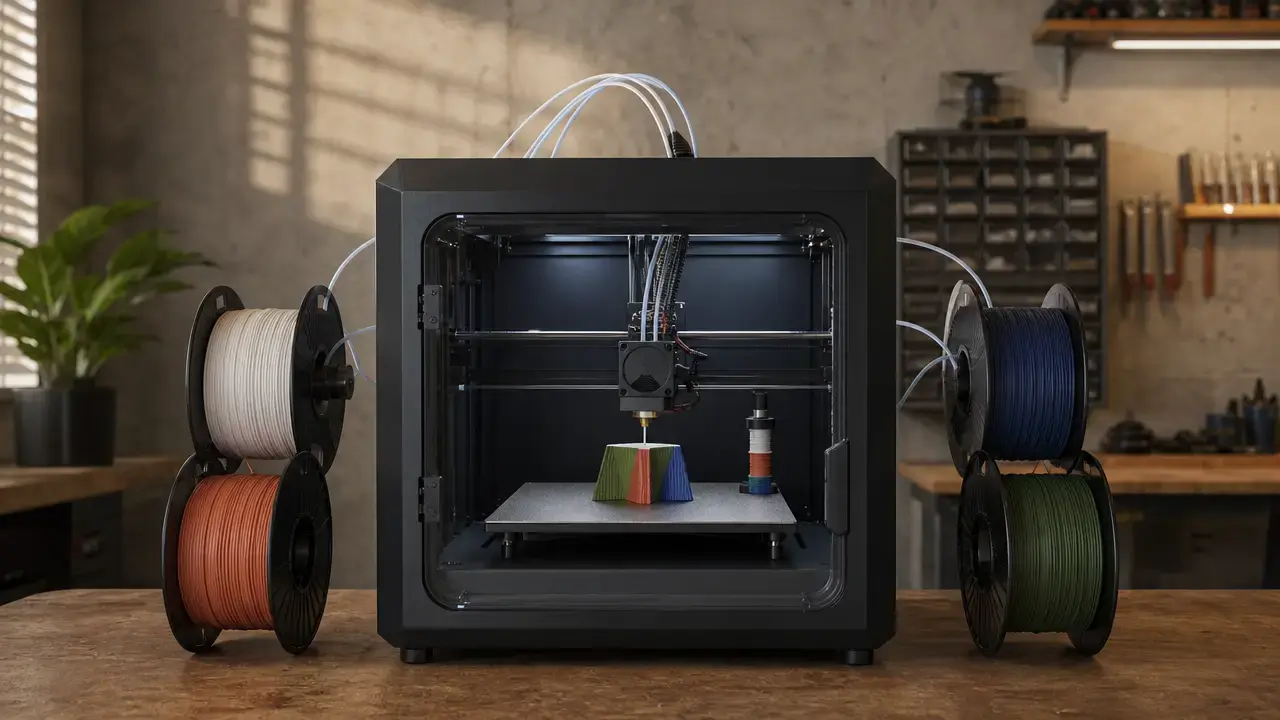

Verdict: begin with the K2 variant and buyer fit
The Creality K2 vs Bambu comparison changes depending on whether “K2” means the 260 mm Creality K2 or the 350 mm Creality K2 Plus. [2] The compact K2 belongs alongside the Bambu Lab P1S and, as a lifecycle-qualified comparison, the X1 Carbon. The K2 Plus instead belongs alongside the Bambu Lab H2D, where build-volume mode, chamber heating, and nozzle arrangement matter more than brand-wide assumptions.
For a compact Bambu option, the P1S is the practical new-unit starting point because Bambu Lab says it will continue to be manufactured and sold, with no foreseeable phase-out. [12] Choose the compact K2 when its size class and CFS feeder workflow suit the jobs you plan to run. Choose the K2 Plus when a true 350 mm cubic workspace is essential. Choose the H2D when dual-nozzle material assignment and active chamber heating are central to the workflow. [2] [17] These are workflow-fit choices, not claims of a universal print-quality or speed winner.
Quick answer: which K2 do you mean?
Choose the comparison group first.
- Base K2: 260 × 260 × 260 mm, placing it closest in size class to the P1S and X1 Carbon, both rated at 256 × 256 × 256 mm. [2] [8] [10]
- K2 Plus: 350 × 350 × 350 mm, placing it closer to the H2D’s larger, thermally capable class. H2D working volume changes between single-nozzle, dual-nozzle, and total two-nozzle operating modes. [2] [17]
- P1S: The compact Bambu comparison for buyers seeking an actively manufactured and sold model in this family. [12]
- X1 Carbon: Reached end of life on March 31, 2026. Treat it as a remaining-stock or installed-base option unless official availability is verified on the publication date. [11]
Availability and lifecycle in the United States
Lifecycle status is separate from a product page that remains visible online. Manufacturing, active sales, firmware maintenance, security patches, spare-parts supply, and support can each have different end dates. Bambu Lab states that the X1, X1 Carbon, and X1E reached end of life on March 31, 2026, which also marked the end of their manufacturing and active-sales period. Its published timeline lists feature and bug-fix updates through May 31, 2027, security patches through May 31, 2029, and spare-parts supply and support through March 31, 2031. [11] End of life changes the context for a new buyer, but it does not mean existing owners immediately lose service.
Bambu Lab’s February 10, 2026 statement says the P1S will continue to be manufactured and sold, with no foreseeable phase-out. [12] In the supplied November 2, 2026 U.S. store snapshots, the P1S page showed an in-stock state with shipping in two to three business days, while the X1 Carbon page showed “Sold Out” with a notification option. [9] [16] Availability varies; check the official store or authorized distributors on the publication date.
How this comparison works: specifications and workflow, not benchmark winners
Manufacturer specifications establish rated limits and supplied configurations. They do not, by themselves, establish a cross-platform winner for print quality, finished-part speed, dimensional accuracy, or multicolor throughput.
Material extrusion is the ISO/ASTM umbrella term for additive-manufacturing processes that selectively dispense material. Fused filament fabrication, or FFF, is useful terminology for filament-based desktop systems, while vendors commonly use fused deposition modeling, or FDM, as market-facing shorthand. [1]
Use these five comparison lenses:
- Build volume and physical dimensions
- Thermal limits and stock nozzle material
- Multicolor architecture
- Feeder constraints and filament restrictions
- Lifecycle and ecosystem
A meaningful comparison of output or elapsed time requires matched nozzle diameter, filament type and batch, model geometry, orientation, layer height, wall count, infill, slicer profile, and environmental conditions. Without those controls, a quoted maximum speed, showcase model, or single surface-finish photo describes a particular setup rather than a general printer ranking.
The five printers and the two comparison groups
This article uses two groups. The compact enclosed group contains the Creality K2, Bambu Lab P1S, and Bambu Lab X1 Carbon. The larger or advanced-material group contains the Creality K2 Plus and Bambu Lab H2D. The split begins with workspace: the K2 has a 260 × 260 × 260 mm build volume, while the K2 Plus has a 350 × 350 × 350 mm build volume. [2]
The H2D belongs in the second group because its official specifications distinguish between single-nozzle, dual-nozzle, and total two-nozzle build-volume modes. [17] This is a comparison map rather than a verdict. Laser and cutting functions are excluded unless they are specifically required for the buyer’s work.
Compact enclosed printers: specification table
The K2, P1S, and X1 Carbon are similarly sized enclosed material-extrusion printers, but their hardware and feeder ecosystems differ.
Manufacturer specifications; not matched performance tests.
| Specification | Creality K2 | Bambu Lab P1S | Bambu Lab X1 Carbon |
|---|---|---|---|
| Build volume | 260 × 260 × 260 mm. [2] | 256 × 256 × 256 mm. [8] | 256 × 256 × 256 mm. [10] |
| Physical dimensions (W×D×H) | 404 × 436 × 545 mm. [2] | 389 × 389 × 458 mm. [8] | 389 × 389 × 457 mm. [10] |
| Net weight | 18.3 kg. [2] | 12.95 kg. [8] | 14.13 kg. [10] |
| Max stated speed | 600 mm/s. [2] | 500 mm/s. [8] | 500 mm/s. [10] |
| Max stated acceleration | 20,000 mm/s². [2] | 20 m/s², or 20,000 mm/s² by unit conversion. [8] | 20 m/s², or 20,000 mm/s² by unit conversion. [10] |
| Max nozzle temperature | 300 °C. [2] | 300 °C. [8] | Not stated in the supplied official technical-specification source. [10] |
| Max bed temperature | 100 °C. [2] | 100 °C. [8] | 120 °C @ 110 V (U.S.) / 110 °C @ 220 V. [10] |
| Stock nozzle material | Hardened steel. [3] | Stainless steel. [8] | Hardened steel. [10] |
| Multicolor route | CFS, single nozzle. [4] | AMS, single nozzle. [13] | AMS, single nozzle. [13] |
The compact machines share a similar workspace class, but feeder workflow, supplied nozzle material, lifecycle status, and ecosystem remain consequential. The X1 Carbon product page’s “7 μm Lidar Resolution” wording describes a sensor specification, not print resolution, part tolerance, or dimensional accuracy. [16]
K2 Plus vs H2D: size, thermals, and nozzle architecture
The K2 Plus and H2D are larger enclosed systems, but their published specifications use different build-volume conventions. Evaluate the H2D in the operating mode relevant to the intended job.
H2D build volumes are mode-dependent; do not compare its total two-nozzle envelope as though it were its single-nozzle volume.
| Specification | Creality K2 Plus | Bambu Lab H2D |
|---|---|---|
| Build volume | 350 × 350 × 350 mm. [2] | Single-nozzle: 325 × 320 × 320 mm; dual-nozzle: 300 × 320 × 320 mm; total two-nozzle envelope: 350 × 320 × 320 mm. [17] |
| Physical dimensions plus net weight | 495 × 515 × 640 mm; 35 kg. [2] | 492 × 514 × 626 mm; 31 kg. [17] |
| Max stated speed | 600 mm/s. [2] | 1,000 mm/s. [17] |
| Max stated acceleration | 30,000 mm/s². [2] | 20,000 mm/s². [17] |
| Max nozzle temperature | 350 °C. [2] | 350 °C. [17] |
| Max bed temperature | 120 °C. [2] | 120 °C. [17] |
| Max chamber temperature | 60 °C. [2] | 65 °C with active chamber heating. [17] |
| Multimaterial architecture | CFS single-nozzle switching. [4] | Dual nozzle. [17] |
350 × 320 × 320 mm is the total two-nozzle envelope, not the standard single-nozzle envelope. [17] The K2 Plus provides a cubic 350 mm workspace, which can matter for parts needing similar extent on all three axes. The H2D requires buyers to select the relevant single-nozzle or dual-nozzle volume for the planned workflow. Its active chamber heating and second nozzle support a different material-assignment approach. The stated speed and acceleration limits are configuration limits, not evidence that either machine produces finished parts faster or at higher quality.
Print speed and print quality: what specification sheets cannot prove
A Creality K2 print quality and speed comparison cannot be settled by maximum motion speed or acceleration alone. These figures are rated maxima, not elapsed print time. Short toolpaths, corners, acceleration distance, cooling limits, extrusion volumetric-flow limits, layer time, geometry, and slicer choices all affect a job. Small models, in particular, cannot sustain a maximum motion value through every segment or corner. In single-nozzle multicolor work, filament swaps, purging, and associated pauses can dominate elapsed time even when travel and print moves are fast.
Print quality also needs defined measurements. Surface finish, dimensional error, ringing, first-layer consistency, seam control, and mechanical strength may not move together, and each requires controlled, matched artifacts for a fair comparison. No reliable, current, standardized cross-platform benchmark in the supplied source set establishes a universal print-quality, dimensional-accuracy, or multicolor-throughput winner across the K2, K2 Plus, P1S, X1 Carbon, and H2D.
Multicolor and multi-material workflow
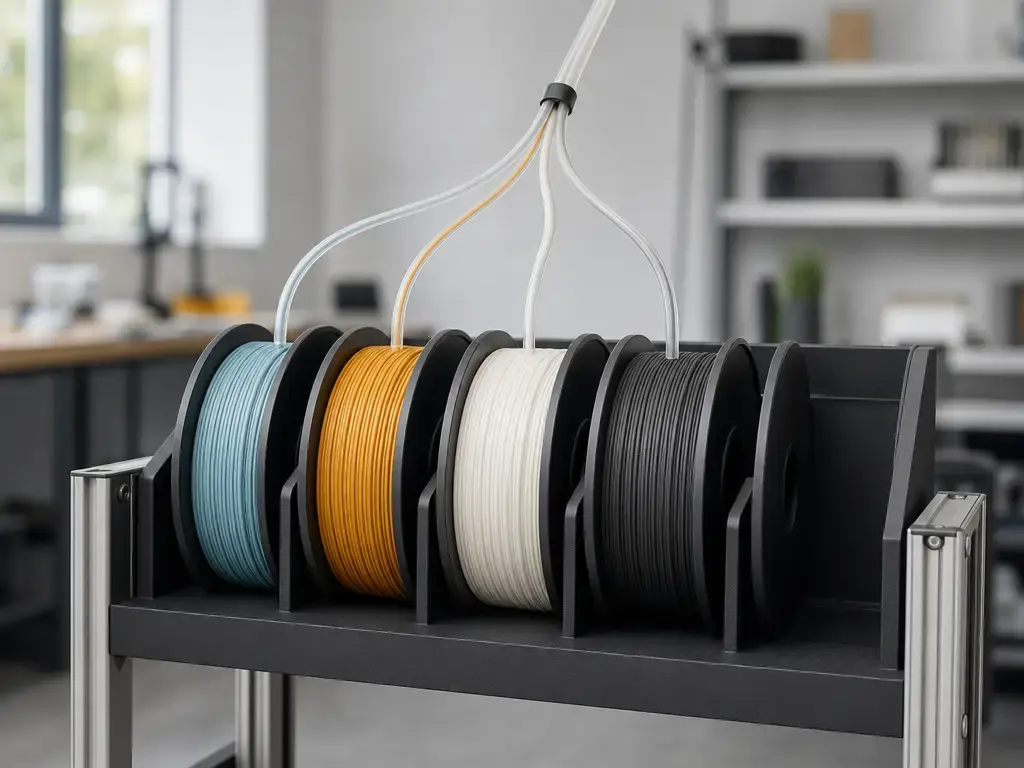
A Creality K2 multi color printing comparison should begin with switching architecture, not a color-count headline. In the configurations compared here, CFS on the K2 and AMS on the P1S and X1 Carbon are single-nozzle workflows: one nozzle deposits the material while the feeder system loads the selected filament. Creality states that the K2 series can use four CFS units for up to 16 colors, and the K2 manual limits CFS extension to four units. [4] [5] Bambu lists four slots per AMS and support for up to four AMS units, reaching up to 16 loaded positions through an AMS Hub. [13] The Hub expands compatible X1 and P1 configurations from one AMS with four channels to four AMS units with 16 channels. [14]
Sixteen colors means up to 16 loaded feeder positions in an expanded setup, not 16 colors deposited simultaneously. Purge volume, waste, and elapsed time are job-specific, depending on the model, color sequence, material pairing, and slicer settings. Flexible-filament plans need separate scrutiny: Bambu lists TPU among unsupported AMS examples, while Creality’s CFS brochure identifies TPU95A and other flexible filaments as incompatible. [13] [7]
Questions buyers should ask before choosing a feeder system
- Do you plan to print TPU or other flexible filaments?
- How many colors or materials does a typical job require?
- How frequently will jobs require color changes?
- Is there space for feeder modules and filament routing?
- Are you willing to manage purge and feeder-compatible spools?
When dual nozzles help, and when they do not
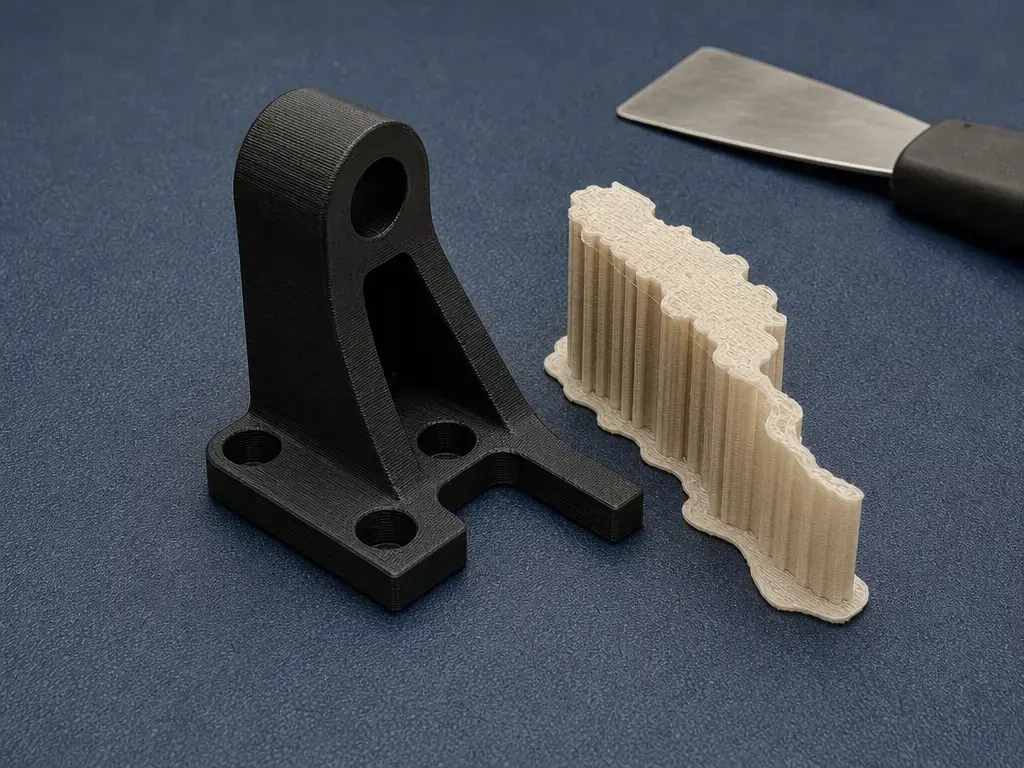
H2D dual nozzles help most when each nozzle can remain assigned to one material or color for long stretches. Assigning one nozzle to model material and the other to support material, for example, can reduce the repeated single-nozzle swaps that would otherwise occur across many layers. The H2D is a dual-nozzle platform, and its usable envelope must still be chosen according to the single-nozzle, dual-nozzle, or total two-nozzle operating context. [17]
Dual nozzles do not automatically make every job faster or less wasteful. The advantage narrows when colors are tightly interleaved or when priming, standby behavior, geometry, and slicer strategy dominate the process. Plan around material sequence and support strategy rather than nozzle count alone.
Footprint, installation, and running-cost planning
Use the dimensions and weights in the tables to assess bench load, occupied footprint, front-door clearance, top access where relevant, and space for filament routing. Creality’s K2 manual specifies a placement distance of at least 10 cm between the machine and a wall. [5] Feeder modules also need practical placement planning: an AMS measures 368 × 283 × 224 mm and weighs 2.5 kg, while the AMS Hub measures 140 × 60 × 22 mm. [13] [14] CFS placement likewise needs planning, even where its dimensions are not repeated.
Separate consumables from service items and accessories when estimating running costs. Filament use includes the printed part plus any job-dependent purge, so purge is not a fixed cost per printer or per print. Budget separately for replacement parts, feeder accessories, and the expected availability of service and spare parts over the intended ownership period.
Ecosystem, software, materials, and service horizon
Documented constraints are more useful than broad ecosystem claims. Creality’s K2 support specifications list PLA, PLA-CF, PETG, PET, and ABS, and identify a hardened-steel nozzle. [3] That does not remove feeder constraints: AMS lists TPU among unsupported examples, while the supplied CFS brochure says TPU95A and other flexible filaments are not compatible. [13] [7] Stock nozzle material, feeder behavior, nozzle temperature, bed temperature, and chamber temperature are separate considerations.
For the X1 series, Bambu Lab lists spare-parts supply and support through March 31, 2031. [11] Evaluate abrasive-filament plans, flexible-filament plans, and enclosed-chamber needs independently.
- Check feeder restrictions for the intended filament types.
- Verify stock nozzle material for abrasive-filament use.
- Review nozzle, bed, and chamber limits separately.
- Check lifecycle notices, support terms, and spare-parts horizon.
Who should buy which route?
For a Creality K2 vs Bambu decision, start by identifying the K2 variant and the maximum part size you truly need. The compact K2 and the K2 Plus address different workspace and thermal-workflow requirements.
Buyer profile 1 — compact Bambu route: Choose the P1S when an actively manufactured and sold compact Bambu model is the priority, subject to publication-day availability. [12] The X1 Carbon is primarily a remaining-stock or installed-base choice because it reached end of life on March 31, 2026. [11]
Buyer profile 2 — compact K2 route: Choose the K2 when its compact build class and CFS workflow suit the planned jobs, after checking feeder restrictions for the materials you expect to use. This is a workflow decision, not a print-quality ranking.
Buyer profile 3 — large-format or dual-nozzle route: Choose the K2 Plus for a verified need for a 350 × 350 × 350 mm workspace and its 60 °C chamber specification. Choose the H2D when mode-aware dual-nozzle assignment and a 65 °C active chamber are more important than a cubic single-nozzle envelope. [2] [17] When evaluating actual output, compare the same material, model, nozzle, settings, and intended workflow.
FAQ
These answers summarize the most common Creality K2 vs Bambu buying questions; configurations and availability should be checked on the publication date.
Which Creality K2 does “Creality K2 vs Bambu” usually mean: K2 or K2 Plus?
The term is ambiguous. The base K2 has a 260 × 260 × 260 mm build volume, while the K2 Plus has a 350 × 350 × 350 mm build volume. Confirm the variant before comparing it with a Bambu model. [2]
Is Creality K2 vs Bambu Lab P1S a fair comparison?
Yes, as a size-class comparison. The K2 is rated at 260 × 260 × 260 mm and the P1S at 256 × 256 × 256 mm. [2] [8] Their feeder workflow, stock nozzle material, software ecosystem, and lifecycle position still differ, so similar build volume does not make them identical purchase choices.
Is the Bambu Lab X1 Carbon still a smart buy in the U.S. in late 2026 if it’s end-of-life?
It is a remaining-stock or installed-base decision rather than the default new-unit route. Bambu ended X1-series manufacturing and active sales on March 31, 2026, while listing spare-parts supply and support through March 31, 2031. [11] End of life does not mean existing owners immediately lose support, but a new buyer should verify official availability and weigh the shorter future update horizon.
How do you actually get “16 colors” on CFS or AMS, and what extra hardware is required?
For K2, Creality specifies up to four CFS units for up to 16 colors, while the K2 manual limits CFS extension to four units. [4] [5] For Bambu, each AMS has four slots; up to four AMS units can provide 16 loaded positions through an AMS Hub, with additional bus cables and PTFE tubes needed for the four-AMS arrangement. [13] [14] K2, P1S, and X1 Carbon configurations still use single-nozzle filament switching.
Is Creality K2 Plus vs Bambu Lab H2D a direct comparison given H2D’s mode-dependent build volume?
It is a qualified comparison. The K2 Plus has a 350 × 350 × 350 mm cubic build volume. [2] The H2D lists a single-nozzle volume of 325 × 320 × 320 mm, a dual-nozzle volume of 300 × 320 × 320 mm, and a total two-nozzle envelope of 350 × 320 × 320 mm. [17] Use the operating-mode label with every H2D volume figure.
Sources
- ISO/ASTM 52900:2021 Additive manufacturing — General principles — Fundamentals and vocabulary — ISO, standard catalog record, 2021; confirmed 2025.
- K2 Combo | K2 Series 3D Printer — Creality, manufacturer product and specification page.
- K2 Series 3D Printer Support — Creality, official support and specifications page.
- Creality K2 Combo 3D Printer — Creality Store, manufacturer product page.
- K2 User Manual V1.0_EN — Creality Wiki, manufacturer manual.
- Creality Filament System CFS specification brochure — Creality, manufacturer brochure.
- P1S Technical Specifications — Bambu Lab, manufacturer technical-specification PDF.
- P1S product page, U.S. — Bambu Lab, manufacturer store page, accessed November 2, 2026.
- X1 Carbon Technical Specifications — Bambu Lab, manufacturer technical-specification PDF.
- The X1-series is EOL — The standard it set will remain forever — Bambu Lab, lifecycle notice, March 31, 2026.
- A farewell to P1P — Bambu Lab, lifecycle statement, February 10, 2026.
- AMS multicolor printing — Bambu Lab U.S., manufacturer product page.
- AMS Hub — Bambu Lab U.S., manufacturer product page.
- X1 Carbon product page, U.S. — Bambu Lab, manufacturer store page, accessed November 2, 2026.
- Bambu Lab H2D Technical Specifications — Bambu Lab, manufacturer technical-specification page.