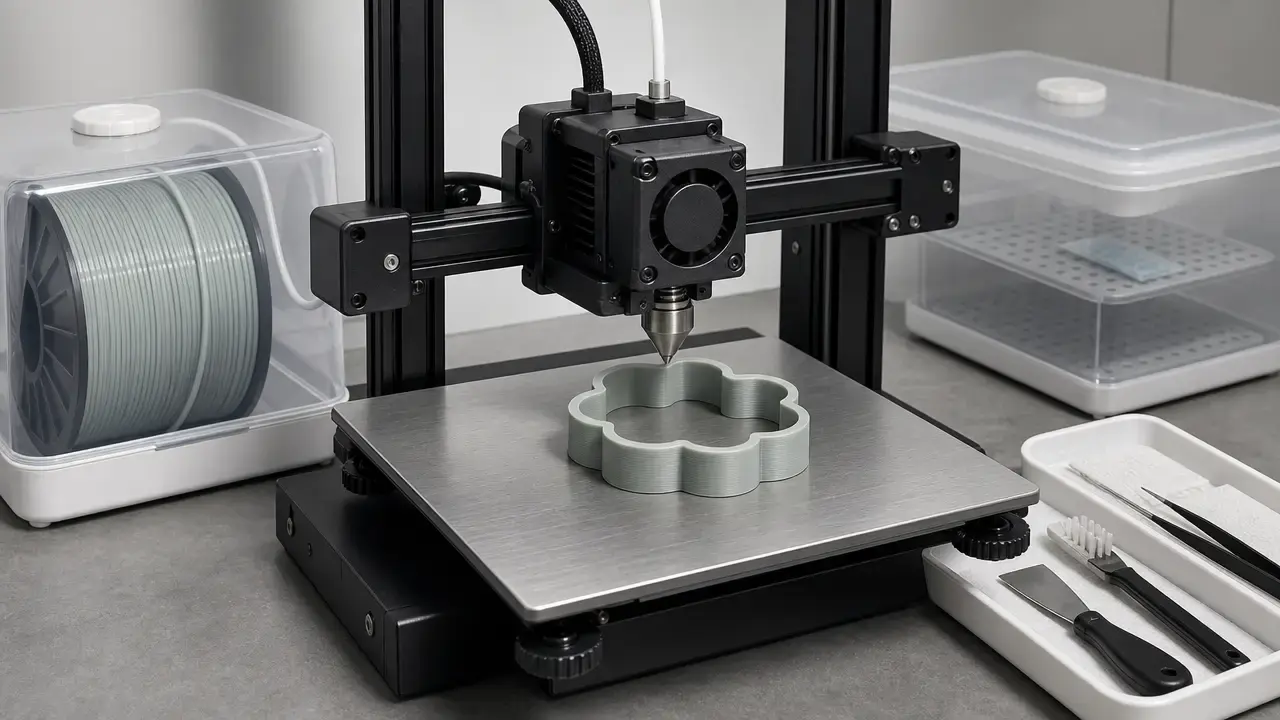

Summary + decision matrix
Food safe 3D printer filament is not a single approved category. The real question is whether the base polymer, the exact filament SKU, the additives, the print workflow, and the finished article all fit the intended food-contact use. FDA’s framework is migration-specific and intended-use-specific, so there is no universal “FDA food safe filament” label that automatically covers every spool or every print. [SRC-01] [SRC-03]
Reasonable use depends on food type, temperature, contact time, reuse, and cleanability. FDA conditions of use include categories such as high temperature heat-sterilized use over 212°F, hot fill or pasteurization above 150°F, and cooking at temperatures exceeding 250°F, so temperature is central to the decision. [SRC-02]
| Contact scenario | Examples | Risk level | Why |
|---|---|---|---|
| Brief, dry contact | cookie cutters, simple jigs | Lower | Short exposure and easier inspection and cleaning |
| Short contact with more geometry | scoops, handles, small tools | Medium | More surface area and more places for residue to remain |
| Reused contact parts | repeated kitchen use | High | Wear, cleaning, and time increase uncertainty |
| Hard-to-clean or warm-contact uses | porous, support-heavy, coated, or heated parts | Avoid | Validation becomes much harder |
This is a risk-assessment guide, not a blanket approval list. The matrix is meant to separate plausible hobby cases from uses that need much stronger evidence. The scientific evidence cited here addresses printed topography and biofilm behavior, not regulatory compliance. One often-cited study used PLA printed at 0.2 mm layer height and 15% infill and observed biofilms in grooves between layers. Prusa also says the standard brass nozzle is not considered food-safe, and Formlabs notes that coatings may reduce risk but do not guarantee prolonged-use safety. [SRC-18] [SRC-20] [SRC-21]
Key terms + evidence ladder
| Term | What it refers to | Common misuse to correct |
|---|---|---|
| Food grade | A material or product intended for food-contact use under defined conditions | Treating it as the same as universally food safe |
| Food safe | A use-specific judgment about food-contact risk and evidence | Using it as a marketing label with no conditions |
| FDA compliant | A claim that a material or article fits relevant U.S. requirements for a defined use | Reading it as an FDA endorsement or blanket approval |
Food grade and food safe are often conflated, but they are not the same. Food grade usually refers to a material or product category meant for food contact under stated conditions. Food safe is narrower: it is a judgment about a specific use, a specific part, and the evidence behind that use. [SRC-01] [SRC-03]
“FDA approved” is usually the wrong phrase for a filament. For food-contact substances, better terms are compliant, listed, notified, or certification-scoped, depending on the evidence. FDA regulates food contact through intended use, migration, and exposure logic, not through a generic approval label for an FDA food safe 3D printer filament. [SRC-01] [SRC-03]
A practical evidence ladder looks like this: Regulation text, FCN, Certification listing, Scientific study, and Manufacturer guidance. An FCN, or Food Contact Notification, is strong evidence for a specific substance from a specific manufacturer under stated conditions of use, but it does not automatically transfer to similar materials from other suppliers. FDA’s FCN 2312 is a useful PLA example because it is narrow: it covers a listed PLA substance, optionally containing up to 4 wt% D-lactic acid polymer units, for Conditions of Use B through H, effective 2023-10-24, and excludes infant formula and human milk. EU claims often appear as a Declaration of Compliance rather than an approval statement, and those documents matter only within their stated scope. NSF/ANSI 51 is different again: it is a certification listing for a specific listed product, with limits such as food categories and maximum temperature. [SRC-03] [SRC-04] [SRC-12] [SRC-15]
The regulatory pathways (US + EU) you’ll actually see in filament claims
United States: CFR listings vs FCNs vs TOR
In the United States, filament claims usually point to one of three things: a CFR listing, a Food Contact Notification, or a Threshold of Regulation discussion. None is a blanket approval for a hobby print. FDA says the regulatory status of a food-contact material depends on the status of each individual substance in the article, specifically the substances reasonably expected to migrate to food because of intended use. GMP logic also applies beyond the polymer name, because 21 CFR 174.5 requires suitable purity and use in no more than the amount reasonably required. [SRC-03] [SRC-05]
FCNs are especially narrow. FDA states that an FCN is effective only for the listed manufacturer, the food-contact substance, and the conditions of use in the notification, not for a similar or identical substance from another manufacturer. That is why “PLA has an FCN” is not the same as “my PLA spool is cleared.” Threshold of Regulation logic is narrow too: FDA uses a very low example level of 0.5 ppb for exemption consideration, which underscores that migration questions are quantitative, not marketing questions. [SRC-03] [SRC-04]
European Union: EU 10/2011 + GMP
In the EU, the framework most readers will encounter is Regulation (EU) No 10/2011 for plastics plus Regulation (EC) No 2023/2006 for good manufacturing practice. In practice, that means looking for declarations of compliance, relevant migration limits, and whether the final printed article still matches the declared conditions. Regulation (EU) No 10/2011 states an overall migration limit of 10 mg/dm², but that figure alone is not a performance claim for a printed part. [SRC-12] [SRC-14]
Another common mistake is repeating the generic SML of 60 mg/kg as if it were still the default EU rule. It is not. Regulation (EU) 2016/1416 deleted that generic default, so outdated summaries should not be used in place of the current text or a current declaration. [SRC-13]
Questions to ask before trusting a filament claim:
- What evidence class is it: CFR text, FCN, EU Declaration of Compliance, NSF listing, or just a marketing page? [SRC-03] [SRC-12] [SRC-15]
- Is the claim about the raw resin, the filament SKU, or the finished printed article? [SRC-03] [SRC-23]
- Does it cover the exact color, additives, pigments, or fillers in this product? [SRC-03] [SRC-23]
- Which food types, temperatures, and conditions of use are actually covered? [SRC-02] [SRC-04] [SRC-15]
- Is traceability or lot-level documentation available if you need to defend the claim later? [SRC-03] [SRC-14]
Why FDM/FFF prints are hard to validate for food contact
Define the problem carefully
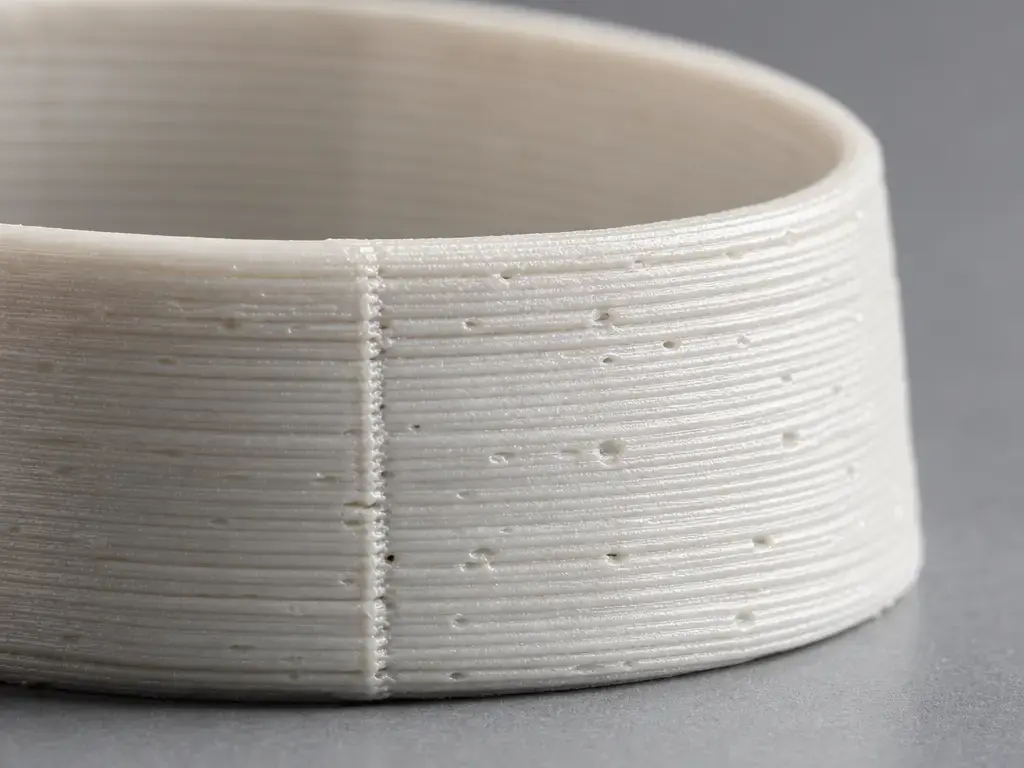
FDM/FFF prints are hard to validate for food contact because the geometry itself can create retained-residue potential. Layer grooves, internal voids, and porosity can trap food or cleaning residues, so cleanability becomes part of the validation problem. The issue is not only whether the polymer is acceptable in principle. It is whether the finished shape can be cleaned and used consistently under the intended conditions. [SRC-19]
The topography evidence is useful, but it is not compliance evidence. In the cited Frontiers study, PLA printed at 0.2 mm layer height and 15% infill showed biofilms filling grooves between printed layers. That supports a real hygiene concern: printed surface texture can help microbes persist. It does not measure migration into food or establish regulatory food-contact approval. [SRC-18] [SRC-01] [SRC-03]
Contamination vectors in real shops
Contamination in a real shop is usually mundane: nozzle wear, old filament residues in the hotend path, build surface residue, adhesive residue, support material residue, sanding dust, and handling. Guidance from Prusa, Formlabs, and university extension sources points in the same direction: the whole print path matters, not just the spool label. That is also why dedicated equipment is part of safer practice, and why Prusa prefers stainless steel or titanium over a standard brass nozzle for food-contact consideration. [SRC-19] [SRC-20] [SRC-21]
Minimum safer workflow for hobby use
Dedicated food-contact printing means controlling the whole path, not just buying a “food safe filament” or swapping one nozzle. That includes the documented filament SKU, storage, feeder path, extruder, hotend, nozzle, build surface, support strategy, post-processing tools, handling, cleaning, and storage after printing. Prusa recommends stainless steel or titanium instead of the standard brass nozzle when food-contact considerations matter, and Formlabs likewise recommends a dedicated stainless steel nozzle and a dedicated equipment path rather than assuming a mixed-use printer is acceptable. FDA chemistry guidance makes the broader point: migration testing logic should reflect the actual use conditions of the final article, not a generic assumption based on a coatings regulation or a broad polymer claim. [SRC-20] [SRC-21] [SRC-24]
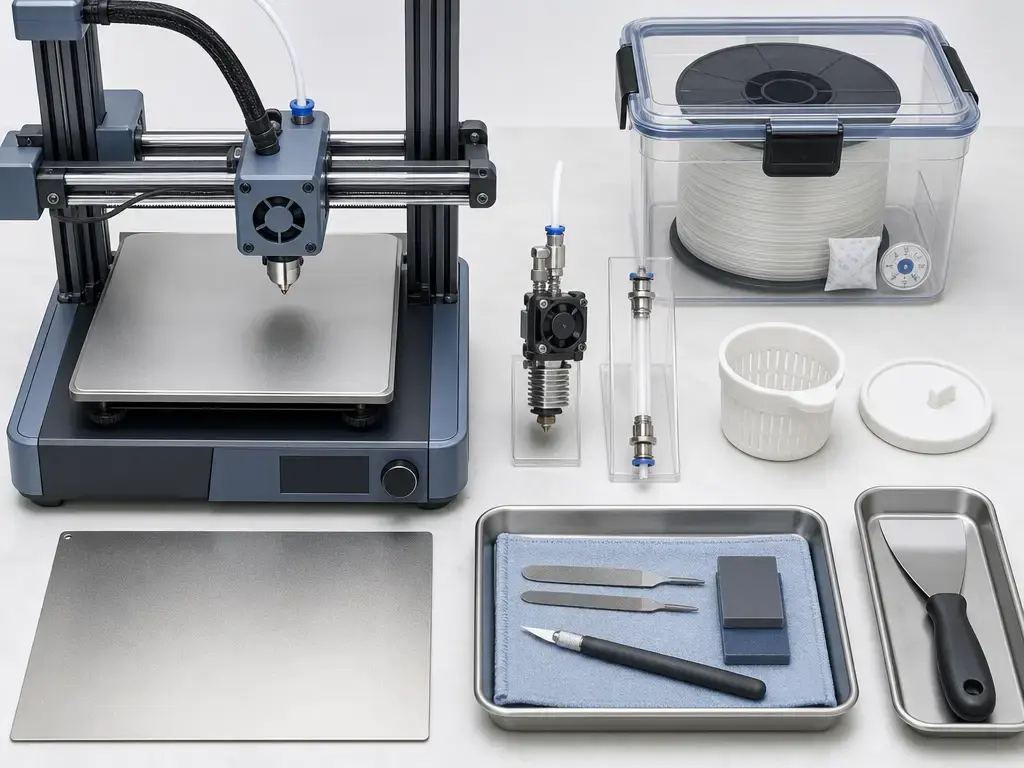
Repeated-use parts need extra caution. If you rely on food-safe coatings, treat that as a documentation and process decision, not a guarantee. Cure state, continuity, scratches, cleaning chemicals, wear, and the actual food-contact pattern all matter. A coating that works for a short demonstration piece is not automatically a durable repeated-use system. Discard parts that crack, chip, absorb odor, trap residue, or show coating damage. [SRC-19] [SRC-21] [SRC-24]
Minimum safer-printing workflow:
- Use a filament SKU with documentation for that exact formulation and color, not just a polymer family name. [SRC-23]
- Control the entire material path: dry filament, clean extruder and hotend, dedicated nozzle, and dedicated post-processing tools. [SRC-19] [SRC-21]
- Prefer a stainless steel nozzle or titanium nozzle, and avoid a standard brass nozzle for food-contact prints. [SRC-20] [SRC-21]
- Keep geometry simple and as solid as practical, avoid hidden cavities, avoid supports when possible, and avoid designs that trap moisture. [SRC-19]
- Post-process only with methods that are compatible with both the polymer and the intended food-contact use. [SRC-19] [SRC-24]
- If repeated use is intended, use a documented coating system and inspect it for wear over time. [SRC-21] [SRC-24]
- Discard parts that crack, chip, absorb odors, or lose coating integrity. [SRC-19] [SRC-21]
Materials, separated properly: PLA vs PET vs PETG vs copolyesters vs PP vs nylon vs PEI
This is not a best-filament list. Polymer family, filament SKU, additives, pigments, fillers, and print workflow need to be separated, because the polymer name alone does not answer a food-contact question. A useful assessment starts with the evidence class, then checks whether the exact printed article and its use still fit that evidence chain. [SRC-01] [SRC-03]
| Material family | Example evidence (label evidence class) | Main caveat in FDM prints | Realistic use |
|---|---|---|---|
| PLA | Narrow FDA FCN example (FCN) | Formulation and conditions matter; not every PLA is the same | Short-contact, low-heat items only |
| PET / PETG / CHDM copolyesters | CFR text or SKU-specific declaration (Regulation text / Manufacturer declaration) | PET, PETG, and copolyesters should not be treated as one bucket | Conditional, documentation-dependent contact parts |
| PP | 21 CFR 177.1520 (Regulation text) | Printability and formulation still vary | Plausible family if documentation and workflow support it |
| Nylon | NSF listing example (Certification listing) | Moisture behavior and listing scope matter | Controlled industrial or carefully validated hobby use |
| PEI / ULTEM | 21 CFR 177.1595 (Regulation text) | Industrial processing demands are high | Industrial note, not a hobby default |
PLA
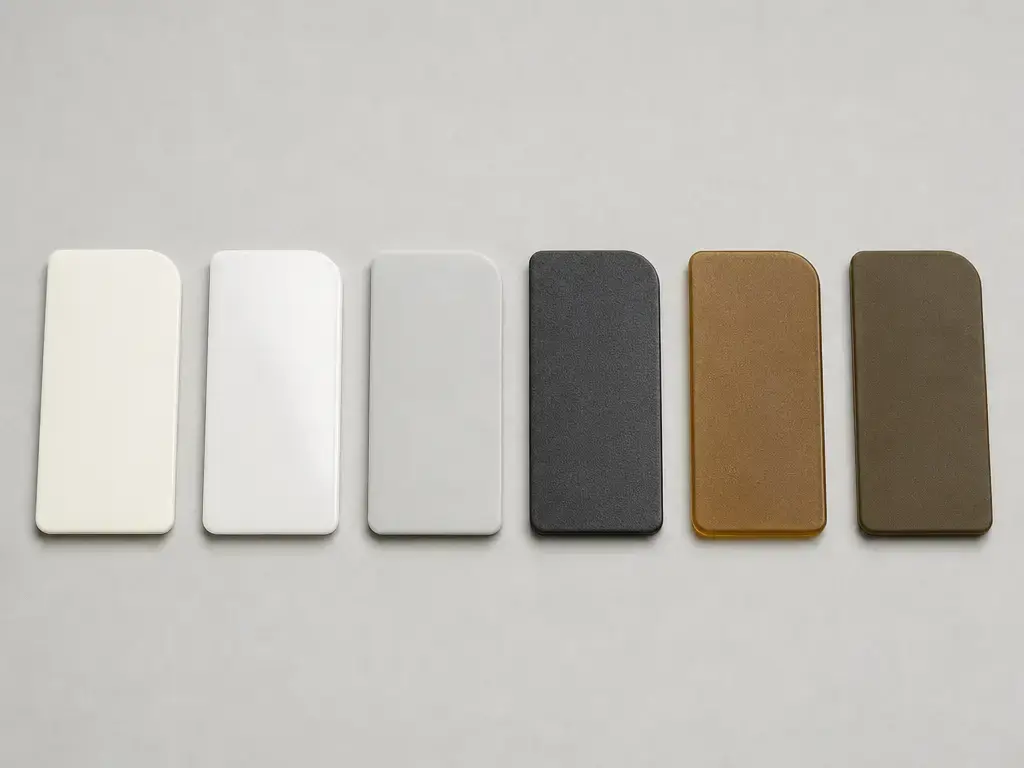
If the question is “is PLA food safe,” the honest answer is “sometimes, under narrow conditions.” FDA’s FCN 2312 is not a blanket approval for PLA filament. It covers a specific PLA substance, optionally containing up to 4 wt% D-lactic acid polymer units, for Conditions of Use B through H, with an effective date of 2023-10-24, and it excludes infant formula and human milk. [SRC-04]
That makes PLA a conditional case, not a universal yes. For hobby printing, the real question is whether the exact filament formulation, additives, surface finish, cleanability, contact temperature, and use pattern still fit a defensible evidence chain. Even where the resin story looks plausible, FDM layer texture and workflow contamination can still make the printed article a weak food-contact choice. [SRC-02] [SRC-18] [SRC-20]
PET / PETG / CHDM copolyesters
PET and PETG are often blurred together in casual discussion, but they are not the same regulatory story. PET has its own food-contact regulation in 21 CFR 177.1630, including specified extractives testing limits under stated solvents, times, and temperatures. That section also cross-references copolyesters described in 21 CFR 177.1315(b)(3), which is exactly why “PETG food safe” should not be treated as a one-line answer. [SRC-06] [SRC-07]
CHDM copolyesters have a separate regulatory basis under 21 CFR 177.1315. Some PETG-type market claims may point to that chemistry, but the claim still has to match the exact resin and finished use. A good illustration is Fillamentum’s PETG declaration from 2022-11-22: it is SKU-specific, color-specific, references both EU and U.S. frameworks, and still says migration limits for the final article intended for food contact must be determined. That is the right way to read a declaration: scoped evidence, not a blanket promise for every PETG print. [SRC-07] [SRC-23]
PP
Polypropylene is one of the more plausible food-contact filament families because it sits inside a regulated olefin-polymers framework under 21 CFR 177.1520. The text is compositional and condition-based, not a universal pass for every spool. The regulation includes detailed composition limits for different olefin polymer classes, including examples that specify not less than 85 wt% ethylene- and/or propylene-derived units in certain copolymers. [SRC-08]
In practice, PP can be attractive for food-contact plastics, but FDM printability, warping, moisture management, and the additive package still matter. A polymer family can look promising on paper and still fail as a printed article if the exact formulation or workflow falls outside the evidence base. [SRC-08] [SRC-19]
Nylon
Nylon usually enters this discussion through industrial systems rather than generic desktop claims. The strongest example in this source set is Markforged’s Nylon White FS, which appears in NSF/ANSI 51 listings with an explicit scope that includes food categories and a maximum temperature of use of 105°F. That listing is useful because it shows what a real certification claim looks like: product-specific, scope-specific, and limited. [SRC-15]
The companion datasheet reinforces the same point. It states that the material is certified by NSF to NSF/ANSI 51, but it also says end users remain responsible for validating suitability in their own application. For hobby readers, that is the key takeaway. A certified nylon example exists, but it does not mean “nylon is food safe” in general, and moisture behavior plus workflow control still matter. [SRC-22]
PEI / ULTEM
PEI, often sold under the ULTEM name, is best treated as an industrial-note material. It has a specific food-contact listing in 21 CFR 177.1595, with detailed extractives test conditions. The regulation states water extraction at 121°C (250°F) for 2 hours, with total nonvolatile extractives of not more than 12.3 µg/cm² for specified molded discs. [SRC-09]
That makes PEI a good example of a highly specified regulated polymer family, but not a shortcut for hobby food-contact work. Processing is demanding, equipment compatibility matters, and a regulation covering molded test articles is still not the same as blanket approval of an FDM print. [SRC-09] [SRC-21]
Across all of these materials, the pattern is the same: start with the exact evidence behind the polymer family, then check whether the filament SKU, additives, workflow, and printed article still fit that evidence. Food-contact temperature classes add another layer, because a brief cool-contact tool and a heated wet-contact part are not the same practical or regulatory problem. [SRC-02] [SRC-03]
Coatings and sealants: how to talk about them without unsafe generalization
The compliance idea
Coatings and sealants are often discussed as if they can convert any print into a food-contact part. That is too broad. In U.S. regulation, resinous and polymeric coatings are their own category, and 21 CFR 175.300 frames repeated-use coatings around a continuous film on a suitable substrate that serves as a functional barrier. That means the coating system, the substrate, and the intended use all matter. [SRC-10]
FDA chemistry guidance points in the same direction. Migration testing and exposure assessment should reflect the actual use conditions of the article, not just the fact that a coating category exists in the CFR. So even when a coating reduces direct contact with the printed substrate, it does not remove the need to consider the base material, cure conditions, food type, temperature, and wear. [SRC-24]
Editorial rule for coatings
For any mention of food-safe coatings, the safest rule is product-specific documentation, not category-level reassurance. Check cure requirements, continuity, pinholes, scratches, cleaning chemical compatibility, and temperature compatibility before treating a coated print as suitable for food contact. Extension guidance and manufacturer guidance both treat coatings as workflow-dependent rather than automatic solutions. [SRC-19] [SRC-21]
Formlabs also warns that coatings may degrade over time, which is why a coating should not be treated as a permanent waiver for the printed substrate underneath. A coating may help, but it does not make the underlying print harmless forever. [SRC-21]
What is actually reasonable to print?
What is reasonable to print depends less on brand marketing than on the exposure pattern. For food contact, the key variables are food type, moisture, temperature, contact time, geometry, reuse, and cleanability. FDA conditions of use are built around those variables, and practical extension guidance reaches the same conclusion in workshop terms: material, geometry, process, and use all matter together. [SRC-02] [SRC-19]
- Lower-risk: cookie cutters, dry-contact jigs, and simple tools that touch food briefly and are easy to inspect and clean. These are not certified by default, but they are the easiest hobby cases to defend if the workflow is controlled. [SRC-19] [SRC-20]
- Medium-risk: items with short cold or room-temperature wet contact but more surface complexity, such as dry ingredient scoops or utensil handles. These need stricter workflow control and more inspection over time. [SRC-19] [SRC-21]
- High-risk: repeated-use parts, wet-contact tools with scratches or worn coatings, and complex geometries with seams, supports, or internal cavities. These need much stronger evidence than a typical desktop print setup provides. [SRC-19] [SRC-21]
- Avoid: hot liquids, high-fat foods, high-acid foods, alcohol contact, baby or infant use, and raw-meat contact tools. These uses move quickly into higher-exposure, higher-hygiene, or narrower-scope territory, and they are not good candidates for casual hobby assumptions. [SRC-02] [SRC-04] [SRC-24]
Commercial sale / institutional use warning
A hobby workflow that reduces risk is not the same as a compliance path for commercial or institutional use. Once a printed part is sold, installed in a café, used in a school kitchen, or built into a food-processing workflow, the burden shifts to documented compliance. In practice, that can mean supplier declarations, GMP controls, traceability, migration testing, and professional regulatory review of the exact article under its real conditions of use. In the U.S., 21 CFR 174.5 requires suitable purity and use in no more than the amount reasonably required. In the EU, Regulation (EC) No 2023/2006 formalizes GMP-style controls for food-contact materials and articles. [SRC-05] [SRC-14]
Callout: if the part will be sold or used institutionally, “seems fine” is not a defensible standard. The evidence has to match the actual use conditions, including food type, temperature, contact time, cleaning, and wear, and any migration testing should reflect those real conditions. [SRC-24]
Failure modes + myths
A common myth is that dishwasher-safe means food-safe. It does not. Dishwasher resistance is a durability claim about wash conditions, while food-contact suitability depends on the resin system, additives, processing, and what can migrate from the finished article. Hygiene still matters, because residues, support scars, and geometry can raise practical risk even when the base material looks plausible. [SRC-03] [SRC-19] [SRC-21]
Another mistake is treating antibacterial marketing as proof of compliance. It is not. Antimicrobial language does not replace food-contact documentation, and it does not tell you whether repeated food contact is appropriate. The same caution applies to decorative or filled filaments: glitter, carbon fiber, wood-fill, and metal-fill products each need their own regulatory basis because additives and fillers can change the substance profile that matters for migration and compliance. Coatings are not a shortcut either, because wear can re-expose the underlying printed substrate. [SRC-03] [SRC-19] [SRC-21]
If a printed part shows rough wear, cracks, exposed infill, persistent odor, or coating damage, discard it rather than trying to rescue it with more cleaning. [SRC-19] [SRC-21]
Research + market context
Recent research adds useful but limited context to food safe 3D printing. The Frontiers in Microbiology study matters because it shows how printed surface topography relates to biofilm behavior. In that work, biofilms filled grooves between printed layers on printed specimens, which supports the practical hygiene argument that layer lines and texture can matter. But the study is not a food-contact compliance test, and it does not answer regulatory questions about migration, additives, or intended use. [SRC-18]
On the market side, documented certification and declaration claims are becoming more visible, especially in industrial ecosystems. The clearest examples are still narrow, such as the NSF listing for Markforged Nylon White FS with explicit food categories and a maximum temperature of use of 105°F. That is useful progress, but it also shows how specific serious claims usually are. Environment, health, and safety guidance for additive manufacturing is a separate topic from food-contact suitability, even though both matter in practice. [SRC-15] [SRC-17]
Practical conclusion
The practical conclusion is simple: food safe 3D printer filament is only one link in the chain. FDA logic is intended-use-specific and migration-specific, and the relevant question is always the exact resin, additives, processing path, and finished article. There is no universal FDA stamp that turns a spool into an automatically acceptable food-contact part. [SRC-01] [SRC-03]
For hobby use, the best-defended cases are brief-contact, cool, dry, simple, disposable or easy-to-inspect parts. For repeated or commercial food contact, the bar is much higher. That is where stronger documentation, tighter workflow control, coatings used only with proper caveats, and actual validation become necessary. [SRC-19] [SRC-21]
FAQ
What is food safe 3D printer filament and what is it not?
Food safe 3D printer filament is a material that may be usable in a food-contact application only when the exact resin, additives, colorants, processing conditions, and finished article fit the relevant evidence chain. It is not a blanket approval for every spool, printer, or use case. FDA regulates food-contact substances through substance-specific and intended-use-specific logic, so the same base polymer can be acceptable in one formulation and not in another. [SRC-01] [SRC-03]
Is PLA food safe for 3D printing?
Not by default. PLA can appear in food-contact contexts, but that does not make every PLA filament food safe for 3D printing. The FDA PLA example in FCN 2312 is narrow, manufacturer-specific, limited to Conditions of Use B through H, and excludes infant formula and human milk. Print surface, additives, cleanability, and workflow still matter. [SRC-04] [SRC-18] [SRC-20]
Is PLA food safe for cookie cutters?
Cookie cutters are among the more defensible hobby cases because contact is brief and the geometry can be simple, but that still does not make them certified by default. Reuse, wash cycles, support scars, and layer grooves all matter, so the printed article can still become a poor food-contact choice over time. [SRC-18] [SRC-19]
Is PETG food safe for 3D printing?
PETG food-safe claims depend on the exact chemistry and documents behind the filament. PET has one regulatory text, CHDM copolyesters have another, and PETG declarations are often SKU-specific and color-specific. Fillamentum’s declaration is a good example because it still says migration for the final article must be determined. So “PETG food safe” is never a complete answer by itself. [SRC-06] [SRC-07] [SRC-23]
Is there an FDA food safe 3D printer filament?
There is no universal FDA food safe 3D printer filament category. FDA regulates food-contact substances and their conditions of use, not a generic approved-filament sticker. A filament may rely on a relevant regulation, an FCN, or supporting supplier documentation, but the claim still has to match the exact material and intended use. [SRC-01] [SRC-03] [SRC-04]
Do I need a stainless steel nozzle for food safe 3D printing?
For food-contact work, a stainless steel nozzle is a sensible precaution and is explicitly preferred in Prusa’s guidance over a standard brass nozzle. Formlabs also recommends avoiding brass nozzles and using a dedicated stainless steel nozzle for food-contact items. The nozzle is only one part of the system, so a nozzle swap alone does not create a food-contact workflow. [SRC-20] [SRC-21]
What does NSF/ANSI 51 certification actually cover and how do I verify it?
NSF/ANSI 51 certification covers the listed product to the scope shown in the listing, not an entire material family by default. To verify it, check the exact trade designation, the food categories, and any limits such as maximum temperature. For example, the NSF listing for Markforged Nylon White FS shows a maximum temperature of use of 105°F and lists the covered food types. [SRC-15]
Sources
- SRC-01. Understanding How the FDA Regulates Substances that Come into Contact with Food. https://www.fda.gov/food/food-packaging-other-substances-come-contact-food-information-consumers/understanding-how-fda-regulates-substances-come-contact-food
- SRC-02. Food Types & Conditions of Use for Food Contact Substances. https://www.fda.gov/food/packaging-food-contact-substances-fcs/food-types-conditions-use-food-contact-substances
- SRC-03. Determining the Regulatory Status of Components of a Food Contact Material. https://www.fda.gov/food/packaging-food-contact-substances-fcs/determining-regulatory-status-components-food-contact-material
- SRC-04. FDA Food Contact Notification 2312 (PLA example). https://www.hfpappexternal.fda.gov/scripts/fdcc/index.cfm?id=2312&set=fcn
- SRC-05. 21 CFR 174.5, General Provisions Applicable to Indirect Food Additives. https://ecfr.io/Title-21/Section-174.5
- SRC-06. 21 CFR 177.1630, Polyethylene Phthalate Polymers. https://ecfr.io/Title-21/Section-177.1630
- SRC-07. 21 CFR 177.1315, Ethylene-1,4-cyclohexylene dimethylene terephthalate copolymers. https://ecfr.io/Title-21/Section-177.1315
- SRC-08. 21 CFR 177.1520, Olefin polymers. https://www.ecfr.gov/current/title-21/chapter-I/subchapter-B/part-177/subpart-B/section-177.1520
- SRC-09. 21 CFR 177.1595, Polyetherimide resins. https://www.law.cornell.edu/cfr/text/21/177.1595
- SRC-10. 21 CFR 175.300, Resinous and polymeric coatings. https://www.law.cornell.edu/cfr/text/21/175.300
- SRC-11. 21 CFR 175.105, Adhesives. https://ecfr.io/Title-21/Section-175.105
- SRC-12. Regulation (EU) No 10/2011 on Plastic Materials and Articles Intended to Come into Contact with Food. https://www.boe.es/buscar/doc.php?id=DOUE-L-2011-80033
- SRC-13. Commission Regulation (EU) 2016/1416. https://www.legislation.gov.uk/eur/2016/1416/pdfs/eur_20161416_adopted_en.pdf
- SRC-14. Regulation (EC) No 2023/2006 on Good Manufacturing Practice for Food Contact Materials. https://www.legislation.gov.uk/eur/2006/2023/pdfs/eur_20062023_2008-04-17_en.pdf
- SRC-15. NSF/ANSI 51 Listing, Markforged Nylon White FS. https://info.nsf.org/Certified/Food/Listings.asp?Company=C0825672&Standard=051
- SRC-16. ISO/ASTM 52900:2021, Additive manufacturing: General principles, fundamentals and vocabulary. https://www.iso.org/standard/74514.html
- SRC-17. ISO 27548:2024, Additive manufacturing of plastic materials: environment, health and safety. https://www.iso.org/standard/83712.html
- SRC-18. Frontiers in Microbiology study on bacterial biofilm formation on 3D printed materials. https://www.frontiersin.org/journals/microbiology/articles/10.3389/fmicb.2021.646303/full
- SRC-19. Oklahoma State University Extension, 3-D Printed Parts for Food Contact. https://extension.okstate.edu/fact-sheets/3-d-printed-parts-for-food-contact
- SRC-20. Prusa Help, Food Safe FDM Printing. https://help.prusa3d.com/article/food-safe-fdm-printing_112313
- SRC-21. Formlabs, The Essential Guide to Food Safe 3D Printing. https://formlabs.com/global/blog/guide-to-food-safe-3d-printing/
- SRC-22. Markforged Nylon White FS Datasheet. https://www.mark3d.com/de/wp-content/uploads/2024/11/Mark3D-Markforged-NylonWhiteFS.pdf
- SRC-23. Fillamentum PETG Product Compliance Declaration. https://filament2print.com/en/index.php?controller=attachment&id_attachment=2619
- SRC-24. FDA Guidance for Industry: Preparation of Premarket Submissions for Food Contact Substances, Chemistry Recommendations. https://www.fda.gov/regulatory-information/search-fda-guidance-documents/guidance-industry-preparation-premarket-submissions-food-contact-substances-chemistry