
Researchers at MIT have offered a new approach that could make 3D-printed concrete construction much more efficient – and potentially much greener. The team’s latest study demonstrates how factoring the real-world limitations of 3D printers into the design process can reduce wasted material while producing structures that are ready to print with little or no manual redesign, reports MIT News.
The research, published in Additive Manufacturing, tackles a long-standing challenge in computational design. Engineers often use topology optimization, a method that calculates the strongest possible structure while using the least amount of material. The problem is that these mathematically ideal, web-like geometries are often impossible for today’s large-scale concrete 3D printers to manufacture.
“We were finding a lot of cracks you can fall through when it comes to translating these super-optimal designs into manufacturable designs,” said co-first author Hajin Kim-Tackowiak, a postdoctoral researcher in MIT’s Department of Civil and Environmental Engineering. “Those cracks were like chasms.”
To bridge that gap, the MIT team worked alongside engineers in the Autodesk Research Residency Program, identifying three major printing constraints: the minimum width of each extruded concrete bead, how sharply the printer nozzle can turn, and the requirement to print in one continuous path. These limitations were then built directly into the optimization framework, allowing it to generate printable designs in around two minutes on a standard laptop instead of requiring days of post-processing.
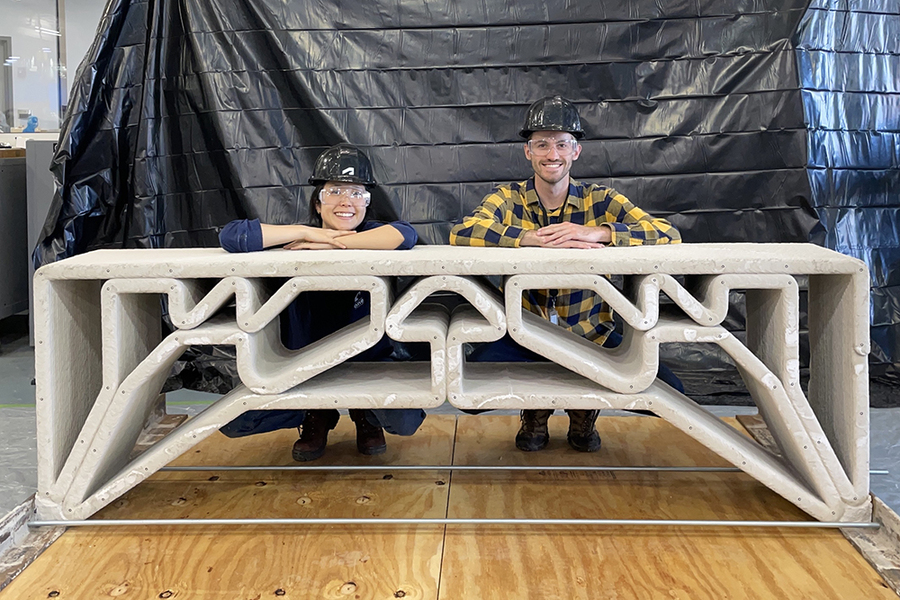
To validate the method, the researchers designed and 3D printed a 2.3-meter concrete bridge using standard off-the-shelf mortar. The bridge took just 30 minutes to print and, despite weighing around 900 pounds, successfully supported more than 2,000 pounds of concrete blocks during load testing with virtually no measurable bending, closely matching the team’s simulations.
Perhaps the biggest surprise came after the testing. Rather than revealing limitations in the concrete itself, the results showed that today’s 3D printing hardware is the real bottleneck.
“What we found was our result was super over-engineered,” Kim-Tackowiak said. “From zero to 200,000 pounds, your design is entirely driven by these ‘can I build it or not’ constraints.”
Using mixed-integer optimization, the researchers could also measure how much each hardware limitation affects material efficiency. Senior author Josephine Carstensen explained that because the framework identifies the global optimum, it can predict exactly how improved hardware would influence future designs. The analysis revealed that reducing the printed bead width from 4 centimeters to 1 centimeter could cut material use by as much as 76% while remaining well within safety margins.
The bridge also demonstrates another important structural principle. Every component is designed to remain in compression, where concrete performs best. Looking ahead, the researchers plan to extend the framework to reinforced concrete, exploring how reinforcement such as rebar can be integrated into 3D-printed structures. If successful, the approach could help unlock lighter, more sustainable construction while giving printer manufacturers a clear roadmap for the hardware improvements that could have the greatest environmental impact.