
Researchers in China have developed a 3D-printed piezoelectric tooth implant that can restore the sensation of chewing by converting biting forces into electrical signals that travel to the brain through the tooth nerve. The study, published in Advanced Science, offers a novel approach to one of the biggest limitations of conventional dental implants: the loss of natural sensory feedback.
The implant uses a piezoelectric core made from barium calcium zirconate, a material considered safe for human use, as reported by Advanced Science News. When pressure is applied during chewing, the core generates electrical signals that mimic the function of the mechanoreceptors found in natural teeth. A 3D-printed ceramic crown surrounds the core, creating a personalized, patient-specific implant.
“Existing implants are primarily designed to restore masticatory function yet fail to completely recover the sensory feedback of natural teeth,” said Yunyun Han, professor at Huazhong University of Science and Technology. “Over 90% patients reported the recovery of masticatory perception after being implanted with the piezoelectric tooth compared with those with commercial ceramic dental crowns.”
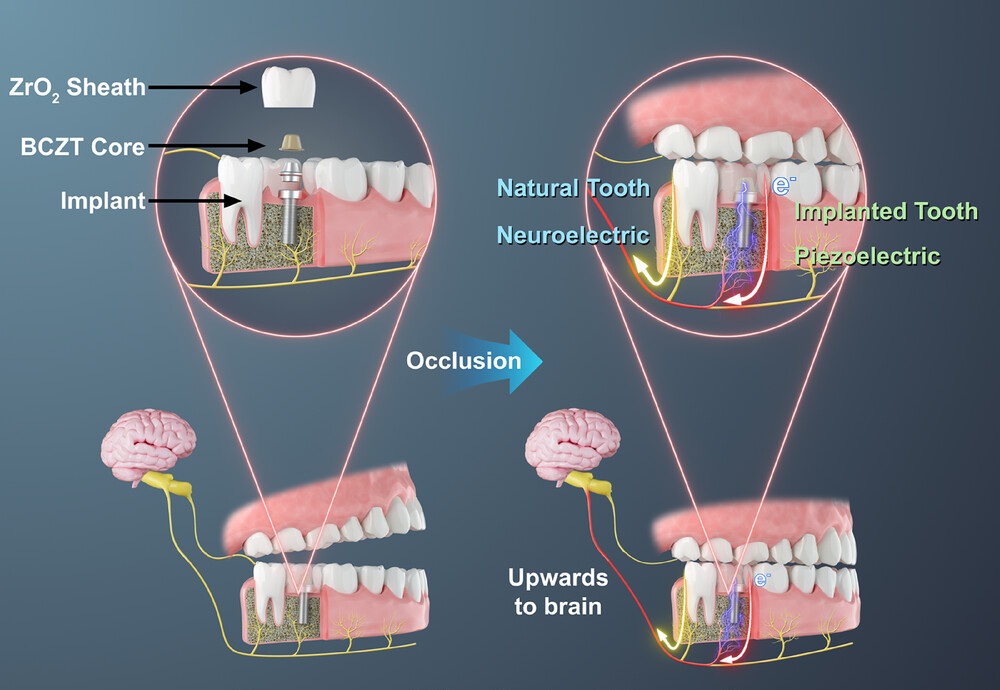
First human trials showed the implant restored chewing sensation, similar to a natural tooth. Image source: 10.1002/advs.202520786.
The team tested the technology in a first human trial with 23 volunteers. Compared with commercial implants, the 3D-printed implant performed much more like a natural tooth during biting and chewing tests. Around 90% of participants reported regaining natural feeling.
Rather than attempting to regenerate damaged ligaments or nerves, the researchers designed the implant itself to replace their sensing function. Measuring neural activity in both mice and humans also helped the team fine-tune how the implant responds to different levels of force.
“The artificial tooth converts force into electrical signals, shedding light on a solution to a critical clinical dilemma,” Han said.