
Summary
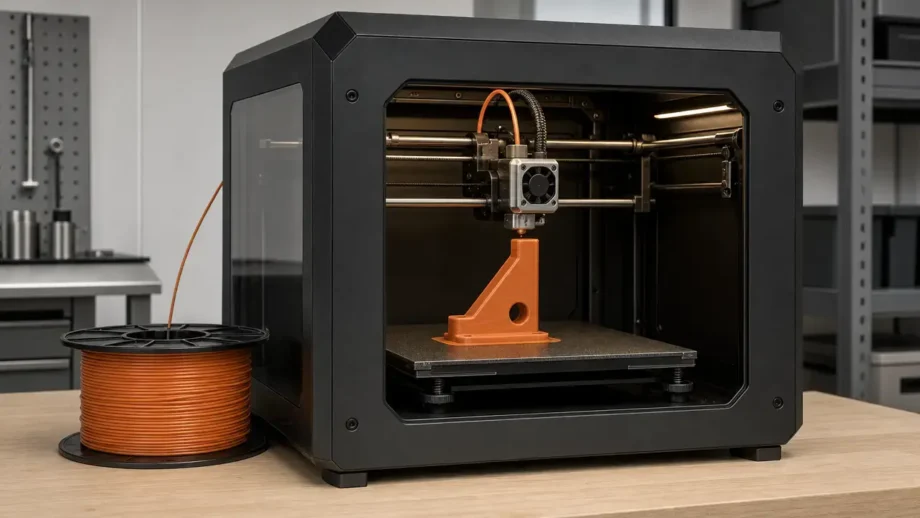
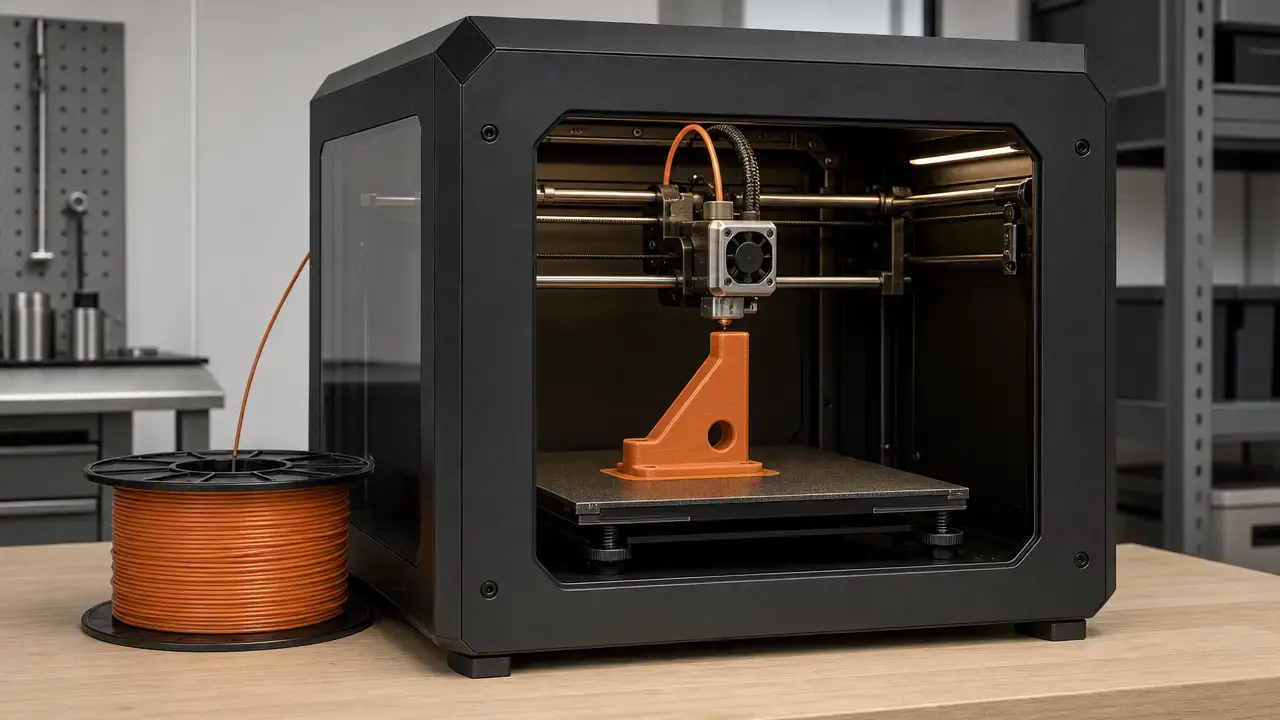
ASA filament is an ABS-like styrenic commonly used in material extrusion (MEX) for parts that may need better outdoor durability than standard ABS, especially where UV exposure and weathering matter. [1] [3] [17] In this article, MEX is the standards-aligned term; FDM is a Stratasys trademark, while FFF remains common informal shorthand for similar extrusion workflows. [1] [24] ASA can be a strong starting point for outdoor-capable prints, but success still depends on setup, orientation, enclosure use, ventilation or filtration, and realistic expectations about long-term service conditions. [3] [6] [19] [20]
ASA filament for outdoor use: what it is, what it’s good at, and what it doesn’t guarantee
ASA filament for outdoor use usually means choosing a material that is better positioned for sun and weather exposure than standard ABS, while still printing within the same MEX family used by many desktop and industrial extrusion systems. [1] [3] [17] Using standards-aware language helps: MEX is the general process name, while FDM is a brand-specific trademark from Stratasys. [1] [24]
Outdoor suitability also has limits. ASA does not guarantee multi-year life in every climate, immunity from weak layer bonding, identical results across brands or colors, or that a single datasheet heat number predicts real service behavior. ASA filament UV resistance is only part of ASA filament weather resistance; print quality, part geometry, orientation, load, and environment still determine whether a printed part remains useful outdoors.
| Material | Why people choose it | Outdoor caveat | Print setup caveat |
|---|---|---|---|
| PLA | Easy printing and low warp. | Heat and long-term outdoor exposure are common weak points. | Creep and softening can matter quickly in hot sun. |
| PETG | Often chosen for a balance of ease and toughness. | Outdoor performance depends heavily on temperature, load, and exposure. | Can string and still needs tuning. |
| ABS | Familiar engineering plastic. | Less outdoor-oriented than ASA where UV and weathering matter. | Warp control and air handling still matter. |
| ASA | Outdoor-capable styrenic option. | Better starting point, not a universal weatherproofing guarantee. | Enclosure, adhesion, and ventilation planning help. |
Brief history and naming context
The naming point here is practical. ISO/ASTM 52900 is the vocabulary anchor for additive manufacturing terminology, and standards writing uses material extrusion rather than a brand name as the general category. [1] That makes MEX the clean process label for this article.
FDM still appears in vendor literature and everyday shop language, but Stratasys explicitly states that FDM is a trademark or registered trademark. [24] Using MEX first avoids mixing a trademark with a generic process category, which is helpful when comparing ASA settings, emissions methods, and material behavior across brands.
ASA 3D printing settings
ASA 3D printing settings work best when treated as a workflow, not a single magic profile. ASA printing temperature, ASA bed temperature, cooling, enclosure conditions, and drying all interact. The aim is to reduce thermal shock, improve first-layer grip, and limit warping without assuming every spool or printer wants the same recipe. Manufacturer guidance is a useful starting point, but it remains brand- and machine-specific. [3] [6] [10] [12]
Prusa lists 260 °C nozzle temperature and 105 °C for the first bed layer, then 110 °C for later layers. [3] Bambu lists 240-270 °C nozzle temperature, 80-100 °C bed temperature, cooling from 0-80%, print speed below 250 mm/s, and a 45-60 °C chamber range for compatible actively heated machines. [6] colorFabb lists 240-260 °C nozzle temperature, 90-100 °C bed temperature, and 30-50 mm/s speed, while Spectrum lists 230-265 °C nozzle temperature, 75-100 °C bed temperature, and 0-20% cooling. [10] [12]
| Setting | Source-backed starting points | Why it matters | Caution |
|---|---|---|---|
| Nozzle temp | 260 °C; 240-270 °C; 240-260 °C; 230-265 °C. [3] [6] [10] [12] | Supports stable extrusion and interlayer bonding. | Too low can weaken bonding; too high can increase ooze or surface defects. |
| Bed temp | 105 °C first layer, 110 °C later; 80-100 °C; 90-100 °C; 75-100 °C. [3] [6] [10] [12] | Improves first-layer grip and helps resist corner lift. | The usable setting still depends on geometry and printer heat management. |
| Chamber / enclosure | Enclosure recommended for large parts; Bambu lists 45-60 °C chamber guidance for certain machines. [3] [6] | Reduces drafts and thermal gradients. | Bambu’s chamber figure is machine-specific guidance, not a universal requirement. |
| Cooling | 0-80% in one vendor guide; 0-20% in another; colorFabb advises the least cooling needed. [6] [10] [12] | Lower cooling often improves layer fusion and reduces warp. | Bridges and tiny features may still need some local cooling. |
| Speed | Below 250 mm/s; or 30-50 mm/s in a slower vendor profile. [6] [10] | Keeps melt flow and motion within the hotend’s real capacity. | Higher claimed printer speed does not guarantee stable ASA results. |
| Adhesion / draft control | Glue on suitable plates, large brim, tall skirt, or draft shield. [3] [10] | Helps hold edges down and keeps the part slightly warmer. | Over-adhesion can make removal or cleanup harder. |
| Drying / storage humidity | Dry at 80 °C for 8 h; store under 20% RH. [6] | Reduces moisture-related print defects and inconsistency. | Dryer performance and spool condition still vary. |
| Warm ambient conditions | Keep ambient temperature high and avoid drafts around the print. [3] | Lowers shrink-driven stress during the build. | Ventilation should not create a cold draft across the part. |
Basic ASA workflow:
- Dry the filament first. [6]
- Prepare the bed and first layer carefully. [3]
- Use an enclosure or draft-control strategy if the part is warp-prone. [3] [10]
- Start with low cooling and tune only as needed. [6] [10] [12]
- Plan ventilation or filtration separately from thermal control. [3] [7]
- Let the machine and part avoid sudden drafts during and right after the build. [3]
Prusa also explicitly separates print success from air handling: large ASA parts benefit from an enclosure, but the material also releases potentially dangerous fumes during printing and should be used in a well-ventilated area. [3] Consulting the SDS or MSDS before changing materials or operating conditions is part of the workflow, not an extra step. [7]
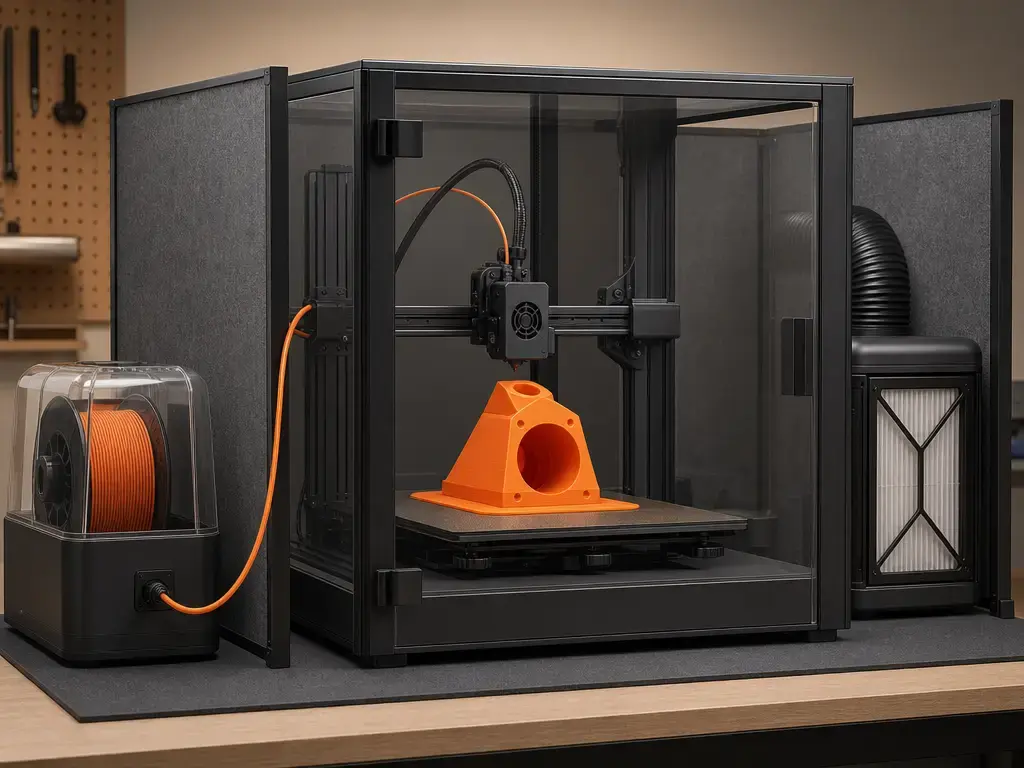
Enclosure vs ventilation: warping control and emissions control are different jobs
An enclosure helps ASA stay warm enough to print more consistently, while ventilation and filtration are meant to reduce airborne exposure. Those jobs can overlap in practice, but they are not the same control. [3]
ISO/ASTM 52933:2024 exists because emissions measurement from material extrusion printers in non-industrial places is method-dependent and needs standardized test conditions. [2] Chemical Insights also points to ANSI/CAN/UL 2904 as an emissions test and assessment standard for 3D printers, not a simple universal consumer safety badge. [21] Chamber studies show why that distinction matters. One 2019 study reported particle specific emission rates for ASA up to 1.7×10^11 #/min, while ABS in the same study was reported at (4.7±1.1)×10^10 #/min. [19] A 2023 consolidation covering 447 particle evaluations and 58 VOC evaluations found a wide spread in results, with particle IQR of 10^9-10^11 #/h and TVOC IQR of 0.2-1.0 mg/h, and it identified ASA among higher VOC-emitting materials in the literature. [20]
Engineering controls can substantially reduce concentrations, but that still does not create a one-number answer for home or school use. Chemical Insights reports that a ventilated enclosure reduced particle concentration by 99.7% and TVOC concentration by 69.5%, while filtration reduced maximum particle concentration by at least 95% in reported tests. [21] OSHA and NIOSH styrene limits are occupational references, not home-printer pass/fail thresholds. OSHA lists PEL-TWA 100 ppm, ceiling 200 ppm, and a 600 ppm peak for 5 minutes in any 3 hours; NIOSH lists REL-TWA 50 ppm, ST 100 ppm, and IDLH 700 ppm. [22] [23]
Mini checklist:
- Put the printer where exhaust can actually move air away from occupants.
- Use the enclosure for thermal stability, not as the only emissions control.
- Add HEPA plus carbon filtration when the enclosure and airflow design support it. [21]
- Check the SDS or MSDS before switching materials or changing print conditions. [7]
Why ASA is more weatherable than ABS
The chemistry point is limited but useful: ASA is often considered a substitute for ABS because the acrylate component in ASA is more resistant to ultraviolet attack than the unsaturated butadiene component in ABS. [17] That supports ASA’s general outdoor positioning, but it does not prove that every ASA formulation will outperform every ABS part in every environment.
UV resistance is only one part of weather resistance. Outdoor degradation also involves moisture, oxygen, heat cycling, stress, creep, colorants, and surface condition. A good-looking ASA print can still fail early if the part is thin, poorly oriented, overloaded, or mounted where it sees repeated thermal cycling.
Outdoor degradation drivers include:
- UV exposure.
- Moisture and wet-dry cycling.
- Heat cycling.
- Sustained load or creep.
- Pigment or color differences.
- Surface finish and notch sensitivity.
- Geometry that traps stress.
The practical takeaway is simple: ASA filament UV resistance improves the odds for outdoor use, but ASA filament weather resistance is still a system question involving the part, the print, and the environment. [17]
Thermal performance without confusion: Tg vs HDT vs Vicat vs temperature resistance
Thermal numbers are easy to overread because they describe different tests. Tg is a polymer transition concept, HDT measures deflection under a specified load, Vicat measures softening under a different method, and a vendor phrase such as “temperature resistance” may be a simplified summary rather than a formal universal rating. [3] [5] [6] [9] For ASA, the right question is not just “what temperature is it rated to,” but “which test was run, under what load, and how close is that to my real use case?”
| Metric | What it is | Example values and methods | What it does not mean |
|---|---|---|---|
| Tg | Polymer transition context. | Stratasys reports 108 °C by DMA. [5] | Not a continuous service limit. |
| HDT | Heat deflection under specified load. | Stratasys reports 98 °C at 66 psi and 91 °C at 264 psi by ASTM D648; Bambu reports 100 °C at 0.45 MPa and 92 °C at 1.8 MPa by ISO 75; MakerBot reports 96 °C at 66 psi by ASTM 648. [5] [6] [9] | Not the same as outdoor lifetime or “safe up to X” in every condition. |
| Vicat | Softening under a defined penetration method. | Stratasys reports 103 °C by ASTM D1525; Bambu reports 106 °C by ISO 306. [5] [6] | Not an in-service guarantee. |
| Vendor “temperature resistance” | Brand-level wording for practical heat behavior. | Prusa describes ASA as suitable for outdoor use thanks to UV and temperature resistance, “up to 93 °C.” [3] | Not a universal standard rating. |
HDT and Vicat are test conditions, not continuous service ratings. A part can still distort earlier in use if it carries load for a long time, absorbs heat unevenly, or has a weak orientation.
The example values also show why method and specimen preparation matter. Bambu reports printed test specimens made at 260 °C nozzle, 80 °C bed, 200 mm/s, 100% infill, then annealed or dried at 80 °C for 12 hours before testing. [6] That is useful context because published thermal numbers reflect conditioning and print setup as much as chemistry. Read Tg for transition context, HDT for load-bearing heat behavior, Vicat for softening behavior, and vendor “temperature resistance” only as vendor wording. [3] [5] [6]
Strength, layer adhesion, and dimensional stability
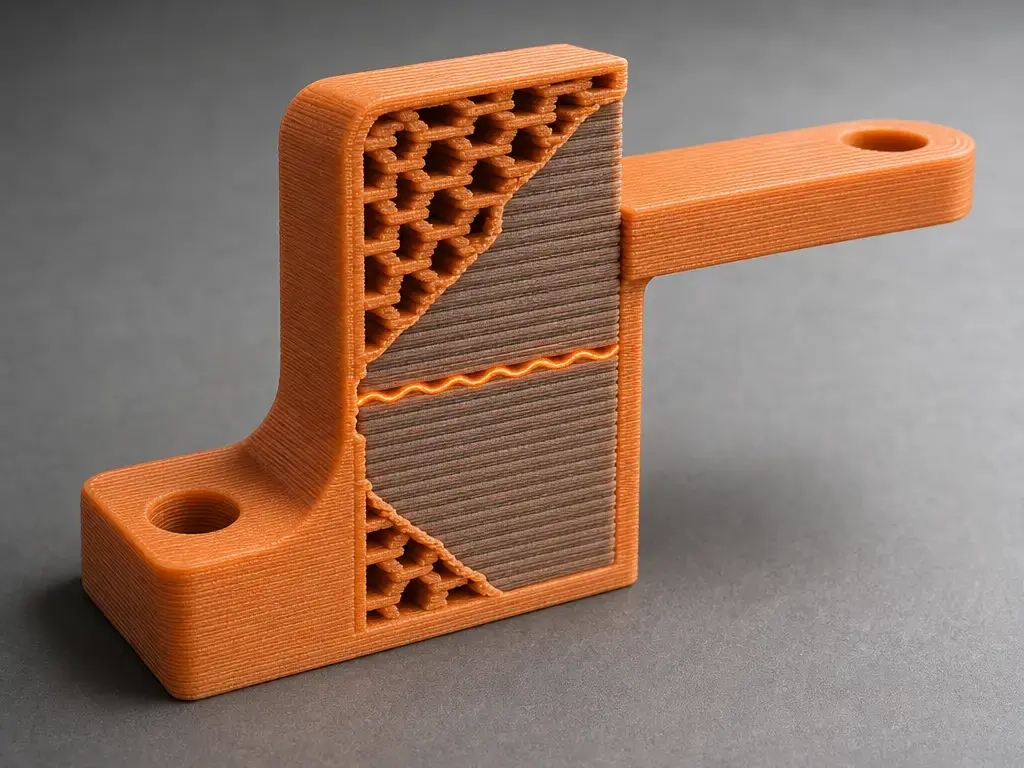
ASA’s outdoor usefulness is limited as much by print direction as by raw material choice. Stratasys design guidance says strength is highest along the X-Y plane and lowest in Z because layers are joined by thermal bonding rather than continuous material. [25] Bambu’s ASA data shows the same pattern numerically: Young’s modulus is 2450±270 MPa in X-Y versus 2120±260 MPa in Z, tensile strength is 37±3 MPa in X-Y versus 31±4 MPa in Z, and elongation is 9.2±1.4% in X-Y versus 4.6±0.8% in Z. [6] Stratasys also reports elongation at break of 9% in XZ versus 3% in ZX on its platform-specific specimens. [5] For clips, brackets, and covers outdoors, orientation can matter as much as the choice between ASA and ABS.
Print-stage dimensional stability means whether the part holds its intended shape while printing. With ASA, that mostly means shrinkage, warping, corner lift, and draft sensitivity during the build. [3] [10]
In-service dimensional retention is a separate question. After installation, a part may gradually change fit or fail because of creep, heat cycling, UV-driven surface damage, or repeated loading, even if it printed perfectly. Solving bed warp does not automatically solve long-term outdoor performance.
ASA vs ABS filament: what’s reliably different and what depends on the brand
In the ASA vs ABS comparison, the most reliable broad difference is weatherability. ASA vs ABS filament usually comes down to whether UV exposure and outdoor weathering matter enough to justify choosing the acrylate-based alternative to ABS’s butadiene-based rubber phase. [17]
| Attribute | ASA (general) | ABS (general) | Article note |
|---|---|---|---|
| UV / weathering | Better outdoor starting point. | More vulnerable to sun-related aging. | Broad trend, not a guarantee. |
| Printing difficulty | Moderate to higher. | Moderate to higher. | Both often benefit from draft control or an enclosure. |
| Warping tendency | Often significant. | Often significant. | Geometry and thermal setup matter more than labels. |
| Odor / emissions variability | Setup-dependent. | Setup-dependent. | Study method strongly affects reported results. [19] [20] |
| Finishing | Can be sanded, machined, or solvent-finished with appropriate precautions. | Can be sanded, machined, or solvent-finished with appropriate precautions. | Process safety still matters. |
| Typical use-cases | Outdoor covers, housings, brackets, signage. | General engineering parts, prototypes, indoor housings. | Use-case fit matters more than slogans. |
| Same-platform numeric example | 33 MPa tensile; 321 J/m unnotched Izod. | 32 MPa tensile; 300 J/m unnotched Izod. | Stratasys platform-specific comparison only. [4] |
The numeric row above should not be generalized across vendors. On the Stratasys platform, ASA and ABS-M30 are close in quoted ultimate tensile strength and unnotched Izod impact, which is a reminder that the real decision is often weatherability, not a dramatic universal strength gap. [4] Emissions are also not a simple one-material verdict: published chamber data shows both ASA and ABS vary with printer, chamber, operating conditions, and measurement method. [19] [20]
A brief PETG note: PETG is often easier to print than either ASA or ABS, but that does not make it the automatic answer for long outdoor exposure. Heat, load, and actual service conditions still decide whether the easier print is the better part.
ASA variants and taxonomy
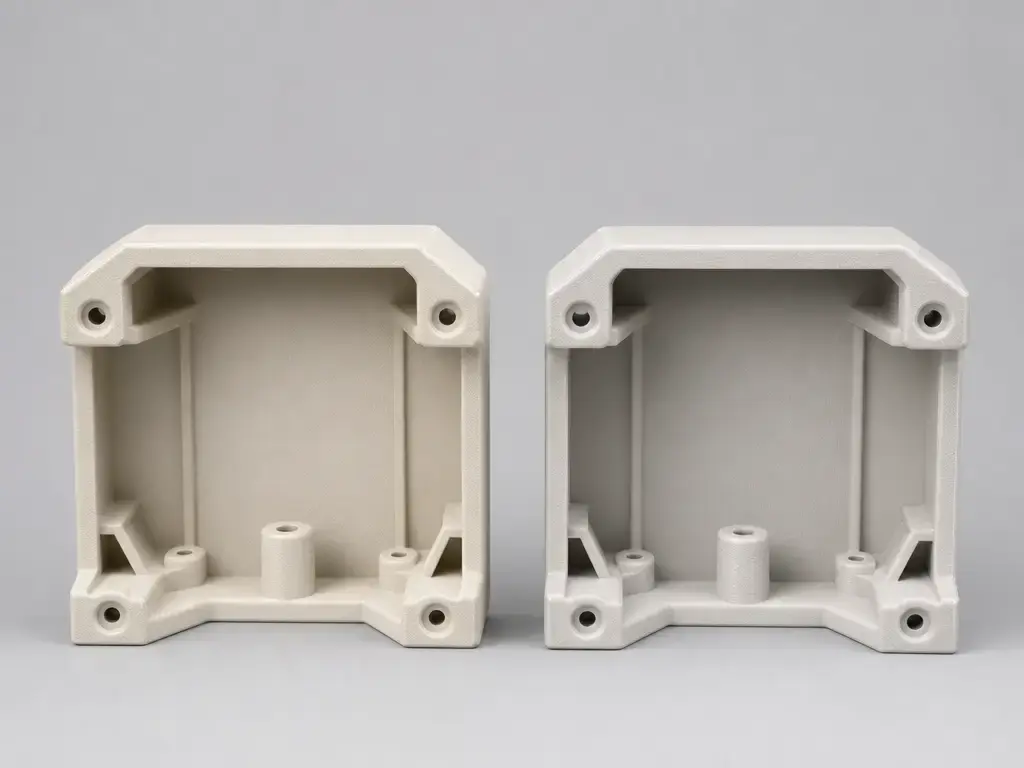
Standard ASA, filled ASA, and lightweight or foaming ASA should be treated as different practical material classes. Filled grades can deliver very different stiffness and thermal numbers from unfilled ASA, so their properties should not be copied back onto ordinary ASA filament. Spectrum’s ASA CF, for example, reports tensile strength at yield of 66 MPa, HDT of 88 °C, and Vicat of 96 °C. Those are product-specific values for that filled formulation, not universal ASA numbers. [13]
Lightweight or foaming ASA works differently again. Spectrum LW-ASA UltraFoam reports active foaming from 230-285 °C and final density as low as about 0.33 g/cm^3. [14] FormFutura ApolloX Foaming reports foaming activation around 230 °C, peak expansion at 270-285 °C, and fully expanded density of 0.33 g/cm^3. [15] colorFabb LW-ASA describes foaming that starts around 230 °C with volume increase of nearly 2.5×. [16] The taxonomy point is straightforward: filled ASA and foaming ASA are not shortcuts for predicting how standard ASA will print or perform.
Practical applications and hard limits
Suitable application categories include:
- Outdoor housings and covers.
- Signage and display parts.
- Garden hardware and light-duty fixtures.
- Outdoor prototypes exposed to sun and weather.
- Jigs or fixtures where UV exposure matters.
Hard limits and caveats include:
- No reliable universal outdoor service-life figure found; performance is conditional.
- ASA is not automatically suitable for critical load-bearing parts without validation.
- ASA is not automatically qualified for food-contact, medical, or fire-rated use.
- Orientation, thermal metrics, and emissions controls still matter even when the material choice is reasonable.
Current evidence snapshot
Controlled studies reinforce the same lesson as the datasheets: process settings can shift measured properties enough that “ASA strength” is not a single transferable number. A 2022 Taguchi optimization study reported maximum tensile strength of 51.86 MPa and flexural strength of 82.56 MPa under that study’s chosen conditions, with infill density and layer height among the most influential factors. [18] Those figures are useful as evidence that settings matter, not as a general strength rating for all ASA filament.
The emissions literature tells a similar story. Chamber studies and consolidated reviews show wide variability across printers, materials, and methods, and ISO/ASTM 52933 exists specifically to make non-industrial-place emissions testing more consistent. [2] [19] [20] The practical conclusion is not that one study gives a universal answer, but that setup, control strategy, and measurement method all change the result.
Choosing ASA filament: bottom line for outdoor 3D printing
ASA filament is a sensible choice when you want an outdoor-capable MEX material for housings, covers, signs, brackets, and other non-certified parts, and you are prepared to manage warp, heat, and emissions as part of the printing process. Compared with standard ABS, the outdoor case for ASA is usually stronger where UV exposure and weathering matter. [3] [17]
Use this decision checklist before you commit:
- Can your printer hold the required ASA printing temperature and ASA bed temperature consistently? [3] [6] [10] [12]
- Do you have a plan for enclosure use and a separate plan for ventilation or filtration? [2] [3] [21]
- Is the part oriented so Z-direction weakness will not dominate the load case? [6] [25]
- Are you choosing the right heat metric for the job instead of treating HDT or Vicat as service life? [3] [5] [6] [9]
- Do you have a finishing or sealing plan if the surface needs extra protection?
FAQ
Is ASA filament good for outdoor use?
Yes. ASA filament is one of the more common choices for outdoor MEX printing when sunlight and weather matter, but it is not automatically weatherproof. Its success still depends on print quality, orientation, wall thickness, load, and the actual environment. No reliable universal outdoor lifetime figure found.
Is ASA better than ABS for outdoor use?
Usually yes, if UV exposure and weathering are important. The chemistry rationale is that ASA’s acrylate component is more UV-resistant than the unsaturated butadiene component in ABS. [17] That does not mean every ASA part will outperform every ABS part, but it does explain why ASA is usually the safer starting point outdoors.
What settings are best for ASA 3D printing?
There is no single best profile. Practical starting points include Prusa’s 260 °C nozzle and 105/110 °C bed guidance, alongside vendor ranges such as 240-270 °C nozzle and 80-100 °C bed. [3] [6] [10] [12] Start with the maker’s profile for your spool and printer, then tune around warping, adhesion, and surface quality.
What temperature should I print ASA filament at?
ASA printing temperature is usually in the mid- to high-200s Celsius range, depending on brand and printer. Documented vendor guidance includes 260 °C, 240-270 °C, 240-260 °C, and 230-265 °C. [3] [6] [10] [12] The right number is the one that gives stable extrusion and good layer bonding on your machine.
What ASA bed temperature should I use?
Most ASA bed temperature guidance is much higher than for PLA. Published starting points range from 75-100 °C up to 105 °C for the first layer and 110 °C for later layers, depending on the vendor profile. [3] [6] [10] [12] Large flat parts usually need more careful bed and enclosure tuning than small compact parts.
Does ASA filament need an enclosure?
Often yes, especially for larger parts. Prusa explicitly says an enclosure is necessary for printing large ASA parts and also warns that ventilation is still needed because of fumes. [3] A chamber temperature figure like Bambu’s 45-60 °C should be read as specific-machine guidance, not as a rule for every printer. [6]
Does ASA filament release fumes such as VOCs or styrene?
Yes. Standards and chamber studies show that MEX printers can emit particles and VOCs during printing, and reported values vary widely by setup and test method. [2] [19] [20] Engineering controls can reduce concentrations substantially, but OSHA and NIOSH styrene limits are occupational references only and should not be treated as home safe/unsafe thresholds. [21] [22] [23]
Expert: Is HDT the same as service temperature for ASA parts outdoors?
No. HDT is a lab test under a defined load, not a universal outdoor service limit. ASA datasheets also report Vicat, Tg, or vendor phrases such as “temperature resistance,” and those numbers are not interchangeable. [3] [5] [6] [9] Real parts can deform earlier or later depending on orientation, load duration, sun exposure, and geometry.
Related on 3D Mag
Sources
- ISO — ISO/ASTM 52900:2021 Additive manufacturing vocabulary
- ISO — ISO/ASTM 52933:2024 EHS test method for hazardous substances emitted from material extrusion printers in non-industrial places
- Prusa Knowledge Base — ASA material guide
- Stratasys — ASA material page
- Stratasys — ASA material specification sheet
- Bambu Lab — Bambu ASA Technical Data Sheet V3.0
- Bambu Lab — Bambu ASA MSDS
- UltiMaker — Method series ASA page
- UltiMaker — MakerBot Precision ASA datasheet PDF
- colorFabb — ASA Printer Settings help article
- Rev1 Technologies — 3DXMAX ASA TDS Rev 3.0
- Spectrum — The Filament ASA TDS
- Spectrum — The Filament ASA CF TDS
- Spectrum — LW-ASA UltraFoam TDS
- FormFutura — ApolloX Foaming TDS
- colorFabb — LW-ASA TDS
- Tian et al. — Materials Letters (2015) ASA vs ABS weathering rationale
- Hameed et al. — Polymers (2022) Taguchi optimization for ASA printed parts
- Gu et al. — Environment International (2019) chamber emissions from 3D printing
- Zhang & Black — Environment International (2023) consolidated 3D printing emissions data
- UL Research Institutes / Chemical Insights — 3D printing emissions research and controls
- OSHA — Styrene exposure limits
- CDC/NIOSH — Styrene pocket guide
- Stratasys — What is FDM? PDF
- Stratasys — FDM design guidelines PDF