
Summary
RoHS compliance for 3D printers is the EU legal question of whether a printer, when it is electrical and electronic equipment, meets the substance restrictions in Directive 2011/65/EU. RoHS applies to equipment that depends on electric current or electromagnetic fields to work properly and is designed for use within 1,000 V AC or 1,500 V DC. The current RoHS list covers 10 restricted substances or substance groups, and the practical compliance questions are usually about scope, restricted substances, homogeneous material, and evidence. [1] [3]
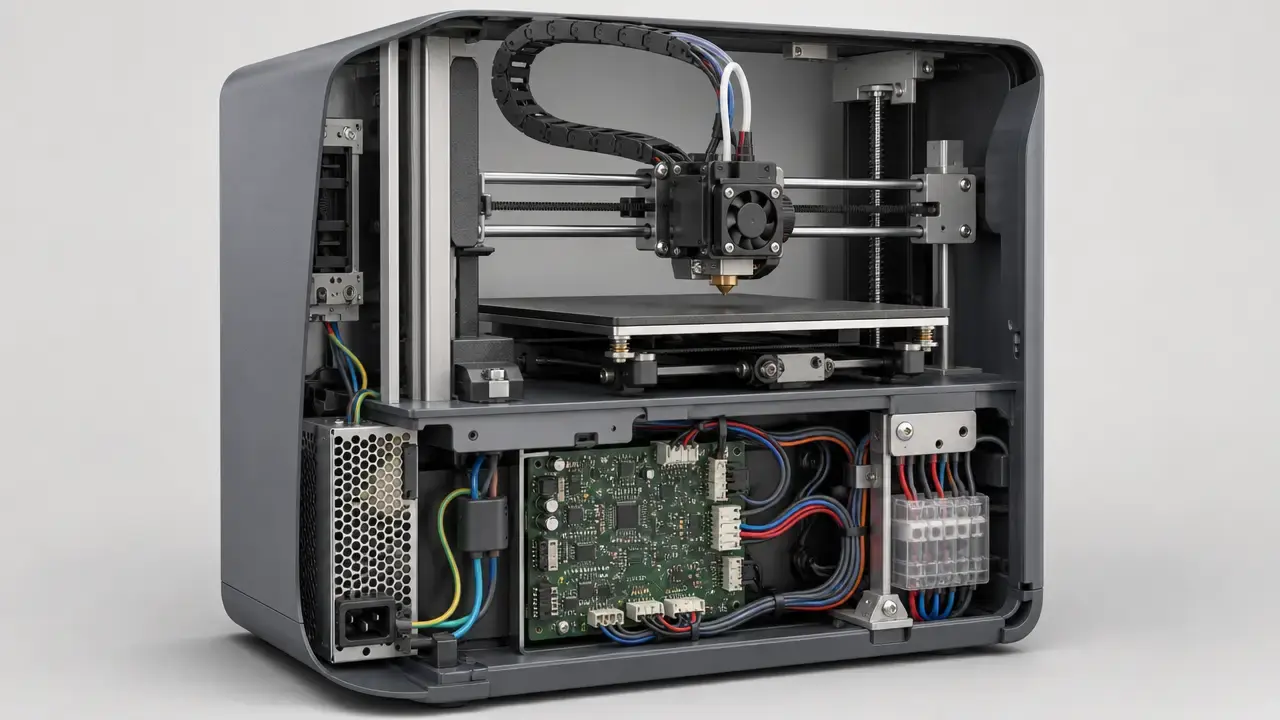
For most desktop fused-filament, resin, and small professional printers, the first answer is usually straightforward: they are EEE because powered electronics, motion systems, heaters, lasers, or light engines are part of their intended function. The harder questions come later. RoHS does not assess the whole printer by average weight; it assesses each homogeneous material. A supplier statement for filament or resin also does not stand in for the printer’s circuit boards, cables, solders, coatings, displays, or power supply. Industrial additive manufacturing systems need extra caution, because some may be in scope while others may fall under product-specific exclusions such as large-scale stationary industrial tools or large-scale fixed installations. [1] [4]
What RoHS compliance means for 3D printers
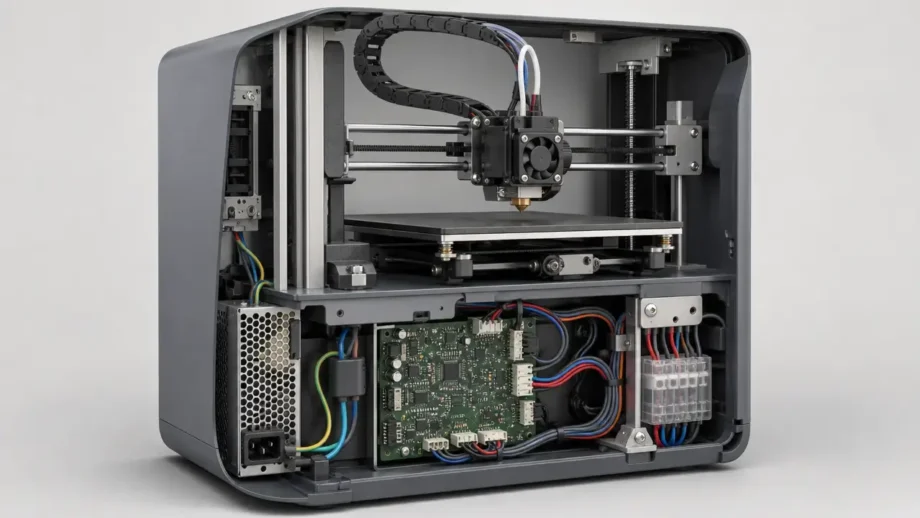
A typical 3D printer is an electrical product in the RoHS sense because it depends on powered control electronics, motors, sensors, interfaces, and either heating or curing hardware to perform its intended function. RoHS compliance therefore usually sits in the same technical file as other conformity evidence. It is also narrower than many buyers assume: RoHS restricts specified hazardous substances in EEE, and it is not a synonym for “eco printing” or a general low-emissions claim. [1] [3]
The current EU framework is Directive 2011/65/EU, but the regime began earlier with Directive 2002/95/EC. The 2011 recast kept the same core idea: restricting certain hazardous substances in EEE placed on the EU market. The list later expanded when Commission Delegated Directive (EU) 2015/863 added four phthalates to Annex II, bringing the current total to 10 restricted substances or substance groups. [1] [2] [3]
- 27 January 2003 — first RoHS Directive enters into force. Directive 2002/95/EC established the original EU-wide RoHS regime. [3]
- 21 July 2011 — recast Directive 2011/65/EU enters into force. The recast became the core current RoHS framework for scope, definitions, obligations, and Annex II substance restrictions. [1] [3]
- 22 July 2019 / 22 July 2021 — phthalate application milestones. The four added phthalates applied from 22 July 2019 for most EEE, and from 22 July 2021 for medical devices and monitoring and control instruments, including industrial monitoring and control instruments. [2]
In scope, out of scope, and where industrial AM gets tricky
RoHS applies to EEE falling within the categories set out in Annex I to Directive 2011/65/EU. Since the open-scope transition on 22 July 2019, many products that were not neatly covered by the older named categories can fall under Category 11, “Other EEE not covered by any of the categories above.” For many modern RoHS 3D printers, that is the clearest default framing rather than forcing every machine into an older category description. [1] [4]
The industrial edge cases are real. Relevant exclusions include large-scale stationary industrial tools, large-scale fixed installations, non-road mobile machinery made available exclusively for professional use, equipment specifically designed only for excluded equipment, and research-and-development equipment made available solely on a business-to-business basis. The Directive does not give a binding numeric size, weight, footprint, or power cutoff for large-scale stationary industrial tools or large-scale fixed installations, and the Commission’s FAQ treats both as case-specific classifications. [1] [4]
Professional or industrial use by itself does not remove a product from RoHS. The Commission FAQ states that RoHS does not generally differentiate between professional and non-professional EEE except where a specific exclusion says so. That is why a factory printer, powder-bed machine, controller cabinet, or robot-fed AM cell may still be in scope if it is placed on the EU market as EEE and no exclusion fits. [1] [4]
| Product scenario | Likely RoHS status | Why |
|---|---|---|
| Desktop FFF printer | Likely in scope EEE | Powered heaters, motion control, and electronics in a finished product placed on the market |
| Benchtop resin printer | Likely in scope EEE | Powered curing, motion, controls, and display functions |
| Standalone controller box | Often in scope if placed on the market as finished EEE | Status depends on whether it is sold as finished equipment, a component, or a spare part |
| Very large permanently installed AM line | Product-specific classification required | LSFI or LSSIT analysis may be needed |
| Equipment specifically designed only for excluded installation | May be excluded | The exclusion depends on exclusive design for the excluded equipment |
| R&D-only B2B equipment | May be excluded | The Directive includes a specific B2B R&D exclusion |
Editorial rule for unresolved industrial classifications
Classification depends on whether the product is placed on the market as in-scope EEE or qualifies for an exclusion such as a large-scale stationary industrial tool or fixed installation; no product-specific classification was verified. Do not infer exclusion from size, power, floor area, or price alone, because no reliable binding numeric cutoff was verified in the Directive or the Commission FAQ. [1] [4]
Which restricted substances RoHS covers
The current EU RoHS list contains 10 restricted substances or substance groups, and the operative limits are expressed by weight in homogeneous materials. For 3D-printer review work, the table below is more useful as a materials checklist than as a whole-machine summary. [2] [3]
| Substance / group | Abbreviation | Limit | Typical 3D-printer relevance |
|---|---|---|---|
| Lead | Pb | 0.1% w/w in homogeneous materials | Solder, brass parts, pigments, cable stabilizers, electronic components |
| Mercury | Hg | 0.1% w/w in homogeneous materials | Older lamps, switches, sensors, specialist display components |
| Cadmium | Cd | 0.01% w/w in homogeneous materials | Pigments, plated parts, contacts, older polymer stabilizers |
| Hexavalent chromium | Cr(VI) | 0.1% w/w in homogeneous materials | Conversion coatings, passivation layers, plated hardware |
| Polybrominated biphenyls | PBB | 0.1% w/w in homogeneous materials | Legacy flame-retardant plastics |
| Polybrominated diphenyl ethers | PBDE | 0.1% w/w in homogeneous materials | Flame-retardant housings, connectors, wire insulation |
| Bis(2-ethylhexyl) phthalate | DEHP | 0.1% w/w in homogeneous materials | Plasticized PVC cables, soft gaskets, flexible polymer parts |
| Butyl benzyl phthalate | BBP | 0.1% w/w in homogeneous materials | Flexible plastics, adhesives, sealants |
| Dibutyl phthalate | DBP | 0.1% w/w in homogeneous materials | Plasticizers in flexible polymers, inks, adhesives |
| Diisobutyl phthalate | DIBP | 0.1% w/w in homogeneous materials | Cable compounds and other flexible polymer components |
For RoHS restricted substances in additive manufacturing, the main pattern is simple: nine entries use a 0.1% limit by weight in homogeneous materials, while cadmium uses 0.01%. That is why a small solder joint, plated layer, PVC wire insulation, flame-retarded connector body, or flexible cable compound can matter even when it is only a small fraction of the printer by total mass. [2]
Why homogeneous material is the key RoHS concept
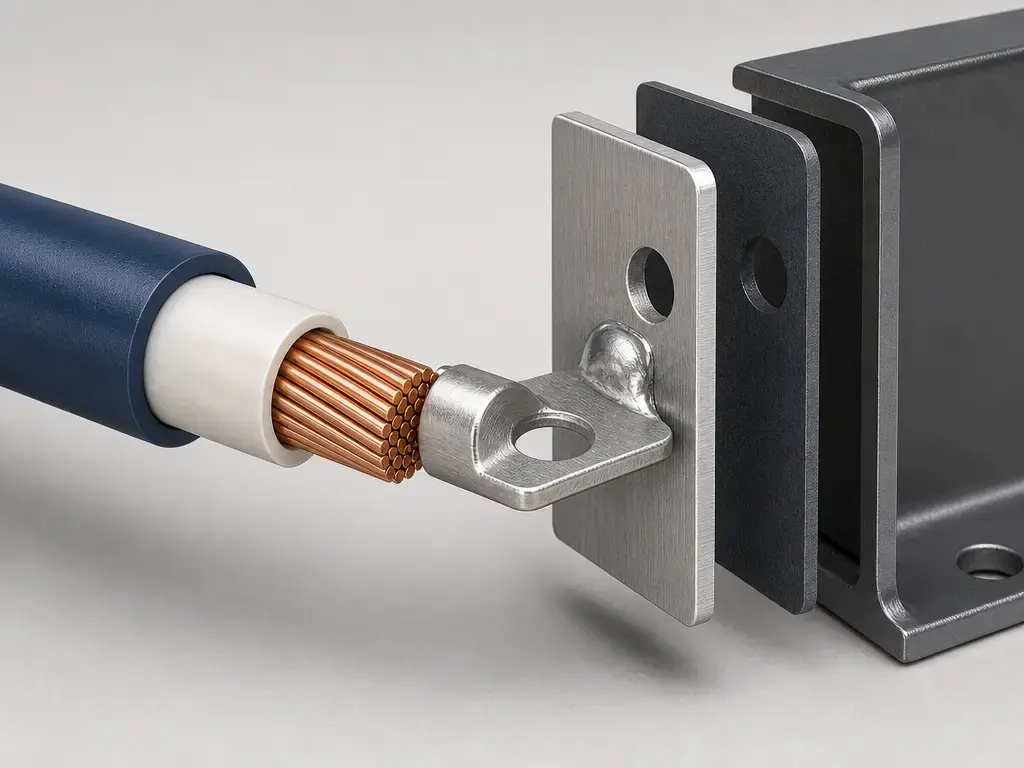
A homogeneous material is one material of uniform composition throughout, or a material that cannot be disjointed or separated into different materials by mechanical actions such as unscrewing, cutting, crushing, grinding, or abrasive processes. In practice, RoHS does not ask whether the assembled printer averages below a threshold. It asks whether each relevant material layer, alloy, coating, polymer, or compound stays within the applicable limit. [1] [2]
Think in separable subparts, not whole-printer averages. Each of the following may be its own assessment point under RoHS: a solder joint, PVC cable insulation, a plated bracket, and a brominated plastic connector housing. [1] [2]
A single visible printer part often contains several separately assessed materials. A cable can contain conductor metal, plating, insulation, jacket, ink, and connector plastics. A PCBA can contain laminate, copper, solder mask, component finishes, solder alloy, adhesives, labels, and coating. A frame bracket can contain a base alloy plus plating, conversion coating, paint, or powder coat. A heated bed can combine aluminum, glass, adhesive, heater traces, insulation, wiring, and surface coating. The same logic also applies to accessories and printed components used inside EEE, which is why a RoHS review usually follows the bill of materials and supplier declarations rather than the finished printer’s total weight. [1] [2]
What parts of a 3D printer usually need the closest RoHS review
In real projects, the highest-risk areas are usually purchased electrical assemblies and mixed-material subassemblies, not the heaviest structural parts. Article 4 applies to EEE placed on the market, including cables and spare parts, and the practical review usually focuses on materials with known RoHS risk patterns such as solder, cable compounds, platings, flame-retardant plastics, and soft polymers. That is why electronic components and power systems often drive the workload, while bare aluminum extrusions or plain steel frame members are usually lower risk unless coatings or attached subassemblies are involved. [1] [2]
Common hotspots include:
- PCBAs
- Power supplies
- Wiring harnesses and cable jackets
- Connectors and housings
- Displays / HMIs
- Motors, fans, sensors
- Coatings, platings, conversion layers
- Adhesives, sealants, and elastomers where material content matters
Do filaments, resins, powders, and printed parts count as RoHS-compliant?
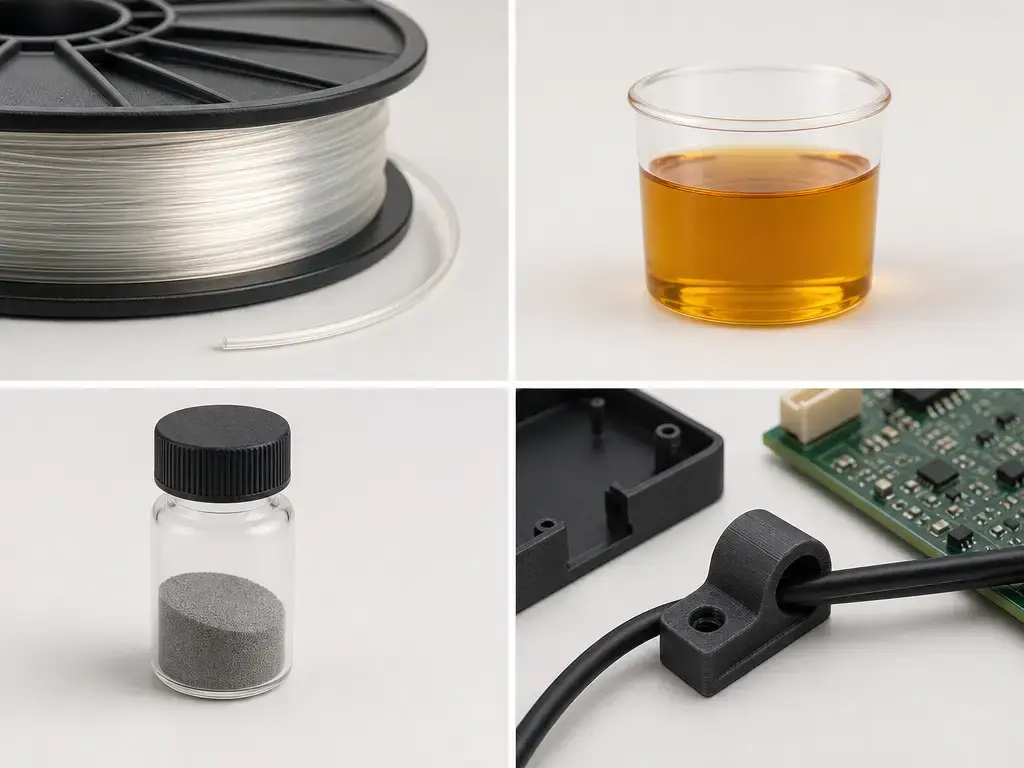
RoHS compliant 3D printing materials are best described as materials for which a supplier provides RoHS-related threshold evidence, not as proof that every consumable is directly regulated as EEE. The Commission FAQ says only consumables with an equipment constituent meeting the EEE definition, such as printer cartridges with electronic content, are in scope as EEE. Standalone consumables that are not EEE are generally outside direct RoHS scope. [4]
That distinction matters for printed parts as well. Components used in finished in-scope EEE, or supplied for repair or upgrade of that EEE, must allow the finished equipment to meet the substance restrictions, but such components generally do not need separate CE marking purely because they are components. So a printed cable clip, enclosure insert, or sensor bracket may not be a standalone RoHS product in its own right, yet its material content can still matter to the finished printer’s compliance file. [4]
| Item | In direct RoHS scope? | Typical evidence language | Safe wording for the article |
|---|---|---|---|
| Standalone filament / resin / powder | Usually no, if non-EEE | Supplier material declaration or test report against RoHS thresholds | Material has supplier evidence against RoHS thresholds; direct scope depends on whether it is EEE |
| Printer cartridge with electronics | Often yes, where it includes an equipment constituent meeting the EEE definition | Declaration covering the cartridge electronics and relevant materials | Cartridge may need RoHS evidence where it contains EEE |
| Printed component destined for EEE | Usually not a standalone RoHS product, but relevant to the finished EEE | Supplier declaration passed into the finished-product file | Printed part material must support the compliance of the finished in-scope EEE |
| Finished printer | Often yes, unless an exclusion applies | Technical file, supplier declarations, risk review, and targeted testing where needed | Printer compliance must be assessed at equipment and homogeneous-material level |
Illustrative manufacturer declarations exist for both finished AM equipment and consumables. Velo3D’s 2023 EU Declaration of Conformity for a metal powder laser sintering additive printer cites RoHS 2011/65/EU and 2015/863 alongside other EU legislation, while UltiMaker’s 2025 materials statement cites the same RoHS instruments and frames the thresholds at the homogeneous-material level for named filaments. Both are manufacturer declarations, not independent certification. [9] [10]
The narrow conclusion is that supplier declarations can support materials compliance, but they do not prove that a complete printer, its electronics, or every printed assembly is compliant. [4] [10]
Safe wording for material claims
For RoHS compliant 3D printing materials, safer phrasing is “some suppliers publish RoHS material declarations” or “supplier statement referencing RoHS thresholds for the named material.” That wording keeps the scope clear: many non-EEE consumables are outside direct RoHS scope, while the same material can still matter when it becomes part of finished in-scope EEE. Manufacturer declarations such as UltiMaker’s can be useful evidence, but they should not be rewritten as blanket legal claims about all filament, resin, powder, or printed parts. [4] [10]
How manufacturers, importers, and OEM brands build RoHS evidence
Under Directive 2011/65/EU, the manufacturer is the person who manufactures the EEE, or has it designed or manufactured, and markets it under its own name or trademark. For in-scope products, the manufacturer must draw up technical documentation, carry out the conformity-assessment procedure, draw up the EU Declaration of Conformity, and keep both the technical documentation and the declaration for 10 years after the EEE has been placed on the market. [1]
Importers have their own duties. Before placing a non-EU product on the market, they must ensure that the manufacturer has carried out the conformity-assessment procedure, drawn up the technical documentation, and applied the required marking and documents. Importers must also keep a copy of the EU Declaration of Conformity for 10 years and ensure that technical documentation can be made available to authorities on request. Economic operators must be able to identify both upstream and downstream operators for 10 years following market placement. [1]
Distributors are not passive in the RoHS framework. When making EEE available on the market, they must act with due care by checking that the product bears the CE marking, is accompanied by the required documents, and carries the required manufacturer and importer identification. An importer or distributor can also become the manufacturer for legal purposes if it places the product on the market under its own name or trademark, or modifies it in a way that can affect compliance. The Blue Guide explains the same own-brand logic across EU product rules and is useful background for private-label and OEM arrangements. [1] [6]
The role split is easiest to see in a simple matrix. [1] [6]
| Role | Core RoHS evidence duty | Main trigger |
|---|---|---|
| Manufacturer | Technical file, conformity assessment, EU DoC, 10-year retention | Own design, own brand, or controlled manufacture |
| Importer | Ensure manufacturer compliance steps; keep DoC 10 years; make technical documentation available on request | First EU market placement from outside the EU |
| Distributor | Due-care checks on marking, documents, and identification | Making an already placed product available on the market |
| OEM / private-label seller | May take on manufacturer obligations | Own name or trademark, or compliance-relevant modification |
Commission Implementing Decision (EU) 2020/659 lists EN IEC 63000:2018 as the harmonised standard for the technical documentation required for assessing materials, components, and electrical and electronic equipment in support of RoHS. EN IEC 63000 specifies technical documentation for assessing materials, components, and EEE with respect to substance restrictions; it is not a laboratory test method or a substitute for the legal limits in Annex II. NIST’s RoHS FAQ makes the same practical point from a trade-compliance perspective: RoHS in the EU is fundamentally a documentation-and-conformity regime for in-scope EEE, not a standalone “certificate” concept. [5] [7]
A practical evidence workflow usually looks like this:
- Determine scope and category / exclusion logic.
- Break the product into materials, parts, and subassemblies.
- Gather supplier declarations and any full material declarations.
- Review BOM against homogeneous-material risk points.
- Use targeted testing where supplier data is weak or risk is high.
- Compile technical documentation under EN IEC 63000.
- Draw up EU DoC and apply CE where applicable.
Evidence stack
- Supplier declaration
- Full material declaration
- BOM / homogeneous-material review
- Targeted analytical testing
- Technical file
- EU DoC

Cables, spare parts, and repair-market nuance
RoHS is not limited to the main printer chassis. Article 4 applies to EEE placed on the market, including cables and spare parts for repair, reuse, updating of functionalities, or upgrading of capacity. For 3D printers, that can pull replacement controller boards, wiring harnesses, power supplies, displays, fans, sensors, and upgrade kits into the same evidence logic as original parts. [1]
There are carve-outs for certain legacy-equipment dates and for some reused spare parts in auditable closed-loop business-to-business return systems. Those carve-outs are narrow timing and traceability questions, not a general repair-market exemption, so they should not be assumed without product-specific review. [1] [4]
What RoHS does not prove
RoHS restricts specified hazardous substances in in-scope EEE. It is not a general fire-safety certification, emissions certification, REACH determination, food-contact approval, biocompatibility decision, or proof that every printed part is ready for every regulated market. A RoHS-backed declaration says something important about restricted substances; it does not answer every regulatory or application-specific question about the printer or the part. [1]
That boundary matters for workplace exposures. NIOSH notes that additive manufacturing can involve hazards such as inhalation of powdered materials, volatile organic compound emissions, dermal exposure to powdered and liquid hazardous materials, and fire or explosion risks. Those issues are separate from RoHS substance-threshold compliance. [8]
Bottom line on RoHS compliance for 3D printers
RoHS compliance for 3D printers is mainly an EEE-classification and documentation discipline. For finished printers, the first question is whether the product is in scope under Directive 2011/65/EU or benefits from a specific exclusion. Since 22 July 2019, many products not covered by the older named categories can still fall under Category 11, while industrial exclusions remain case-specific rather than assumed. EN IEC 63000 then supports the technical-documentation side of the job. [1] [5]
Material claims need tighter wording than printer claims. Many non-EEE consumables sit outside direct RoHS scope, even though their supplier declarations can still support the compliance file for a finished printer or for a printed part used inside EEE. Manufacturers, importers, distributors, and private-label sellers also have defined roles, with 10-year documentation and traceability duties built into the supply chain. The safest rule is simple: treat RoHS as an auditable evidence chain, not a marketing adjective. [1] [4]
FAQ
-
What does RoHS compliance mean for 3D printers?
It means that a finished printer, if it is in-scope EEE, must meet the RoHS substance restrictions at the homogeneous-material level and be backed by the required documentation and EU Declaration of Conformity. For most desktop printers, that review reaches far beyond the frame to electronics, wiring, power supplies, coatings, and spare parts. [1] -
Which restricted substances are covered by RoHS, and why is cadmium different?
The current list contains 10 restricted substances or substance groups. Nine use a limit of 0.1% by weight in homogeneous materials, but cadmium is limited to 0.01%, which is why pigments, platings, and small material layers can become disproportionately important in a review. [2] [3] -
Are 3D printing materials RoHS compliant, or is that mostly supplier wording?
For many standalone consumables, it is mostly supplier wording about RoHS thresholds rather than proof that the consumable itself is directly regulated as EEE. The same declaration can still be useful when that material becomes part of finished in-scope EEE or is supplied with electronics, such as a cartridge with an equipment constituent. [4] [10] -
Do 3D printer spare parts and replacement cables need RoHS compliance?
Often yes. Article 4 expressly covers EEE placed on the market, including cables and spare parts for repair, reuse, updating of functionalities, or upgrading of capacity. Some narrow carve-outs exist for legacy equipment and certain reused spare parts, but those are exceptions that need specific review. [1] [4] -
Is a RoHS test report enough, or do manufacturers still need a technical file?
A test report can be part of the evidence, but it is not the whole system. Manufacturers still need technical documentation, a conformity-assessment process, and an EU Declaration of Conformity for in-scope EEE. EN IEC 63000 is the harmonised documentation standard; it is not itself the pass/fail source of the legal substance limits. [1] [5] -
How do Category 11 and open scope affect industrial additive manufacturing systems?
Since 22 July 2019, many products not covered by the older named categories can fall under Category 11, “Other EEE not covered by any of the categories above.” But that does not mean every industrial AM system is automatically in scope, because exclusions such as LSSIT or LSFI remain product-specific and case-specific. [1] [4] -
If a printed part is sold into another electrical product, when does RoHS start to matter?
It starts to matter when the printed part is intended for use in finished in-scope EEE or for repair or upgrade of that EEE, because the finished product can only comply if its components and parts support the substance restrictions. The part may not need standalone CE marking purely as a component, but its material evidence still matters. [4]
Sources
- Directive 2011/65/EU (consolidated text current to 2025-01-01) — official EU law, consolidated text current to 2025-01-01.
- Commission Delegated Directive (EU) 2015/863 — official EU law, 2015.
- European Commission RoHS overview page — official European Commission guidance, page current at access 2026-06-05.
- European Commission RoHS FAQ key guidance document — official European Commission guidance, 2012.
- Commission Implementing Decision (EU) 2020/659 — official EU decision, 2020.
- Blue Guide 2022 — official European Commission guidance, 2022.
- NIST RoHS FAQ — official explanatory guidance, no revision stated.
- NIOSH 3D Printing (Additive Manufacturing) — official occupational-health guidance, page current at access 2026-06-05.
- Velo3D EC Declaration of Conformity — manufacturer declaration example, 2023.
- UltiMaker RoHS statement for materials — manufacturer declaration example, 2025.