
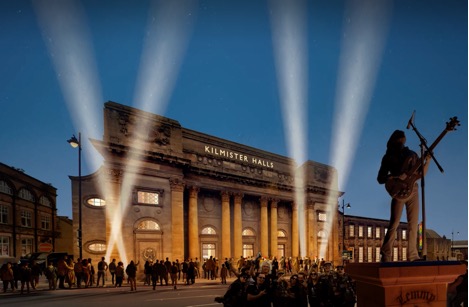
Musicians who leave a lasting mark on popular culture are usually remembered with a statue, a plaque or a street bearing their name. In Burslem, Stoke-on-Trent, the hometown of Motörhead founder, frontman and principal songwriter Ian “Lemmy” Kilmister, the people behind his memorial have set their sights considerably higher.
The town already has a bronze statue of Lemmy in its market square, and a visitor center opposite continues to draw fans from around the world. Both form part of a broader plan to convert a semi-derelict Edwardian building into a community venue for live music, recording and education.
That building is Queen’s Theater. Built more than a century ago as Burslem’s town hall, it only gained its auditorium at a later stage, almost as an afterthought. Under the current proposals, the space would be restored and repurposed as a modern music venue, complete with a dedicated recording studio equipped with both analog and digital gear.
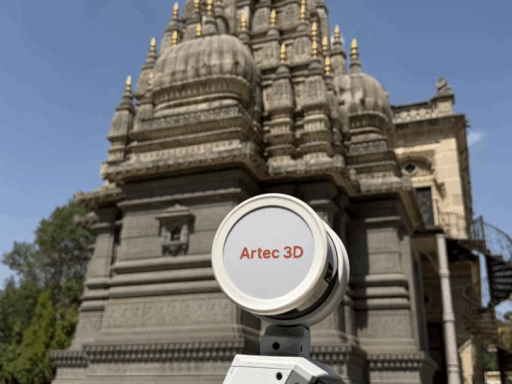
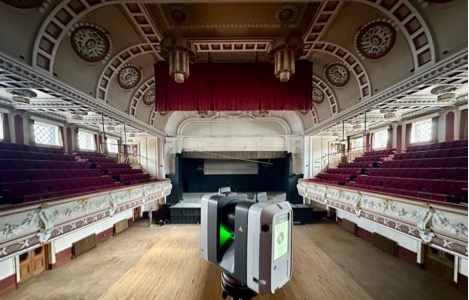
The renovation is expected to cost £19 million and will involve architects, acoustic engineers and a range of other audio specialists. Before any repairs could be planned, the team needed accurate as-built data, and the building’s original drawings had been lost. To fill that gap, Artec Ambassador Europac3D was brought in to scan the theater with Artec Ray II, a long-range laser scanner designed for capturing large objects and interiors.
Renovating a theater with Artec Ray II
Sculptor Andy Edwards has built a career on turning likenesses into permanent monuments. He has created more than fifty public statues, including a Beatles memorial in Liverpool and the Lemmy statue in Burslem’s market square. The Liverpool commission first brought him together with Europac3D, and the two have worked together regularly since, scanning small maquettes so they can be enlarged and full-size bronzes so they can be reduced.
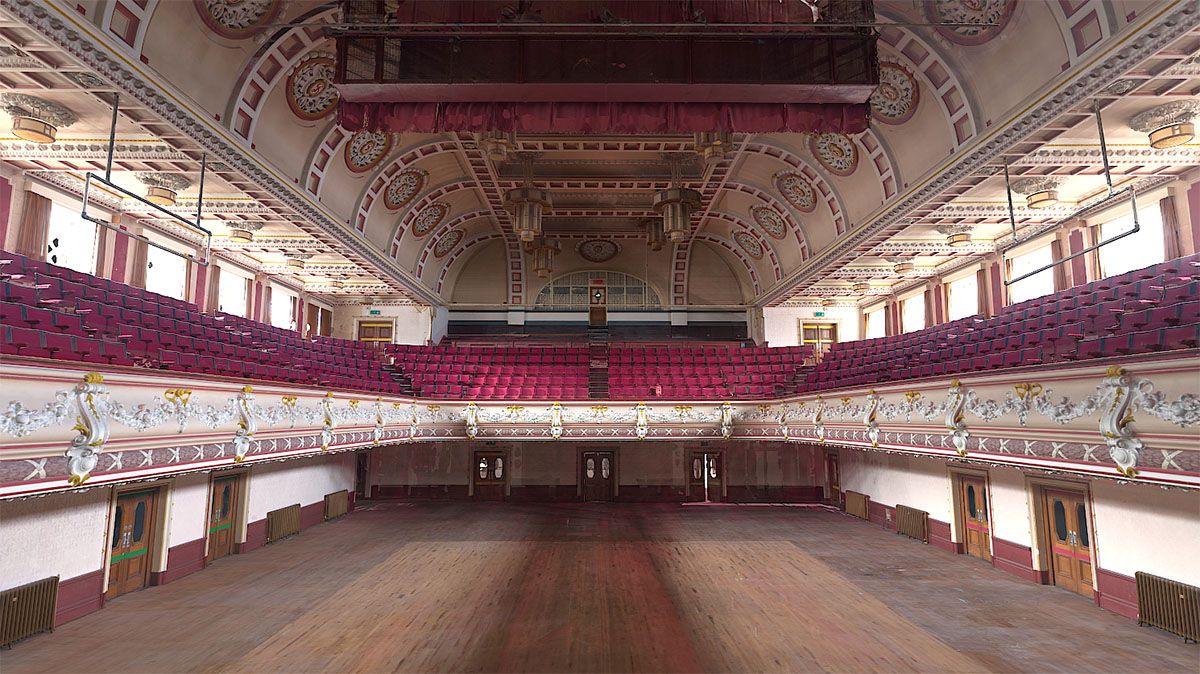
Queen’s Theater presented a very different task. Rather than a small model or a single statue, Edwards needed a digital record of an entire building. With multiple floors, staircases, balconies and corridors, the theater could not be captured from one position. Instead, 40 overlapping scans were taken from different locations around the building and aligned later in the workflow.
Europac3D’s Mark Beckett worked through the auditorium, stage, lobby and balconies systematically, completing the capture in five hours. The balconies proved the most demanding area, with traditional wooden seating and ornate decorative features, but he was still able to produce a complete model. With an accuracy of up to 1.9 mm, the scanner recorded fine detail throughout the space without any loss of precision.
“What I find particularly impressive about Artec Ray II is the detail it captures when it’s positioned close to a surface,” explained Beckett. “It recorded the ornate bas-relief on the balcony fascia exceptionally well, while also capturing the intricate ceiling from 20 to 30 meters away. Surveying large spaces and entire buildings quickly, without losing fine surface detail, is one of Ray II’s greatest strengths.”
Putting the scan data to work
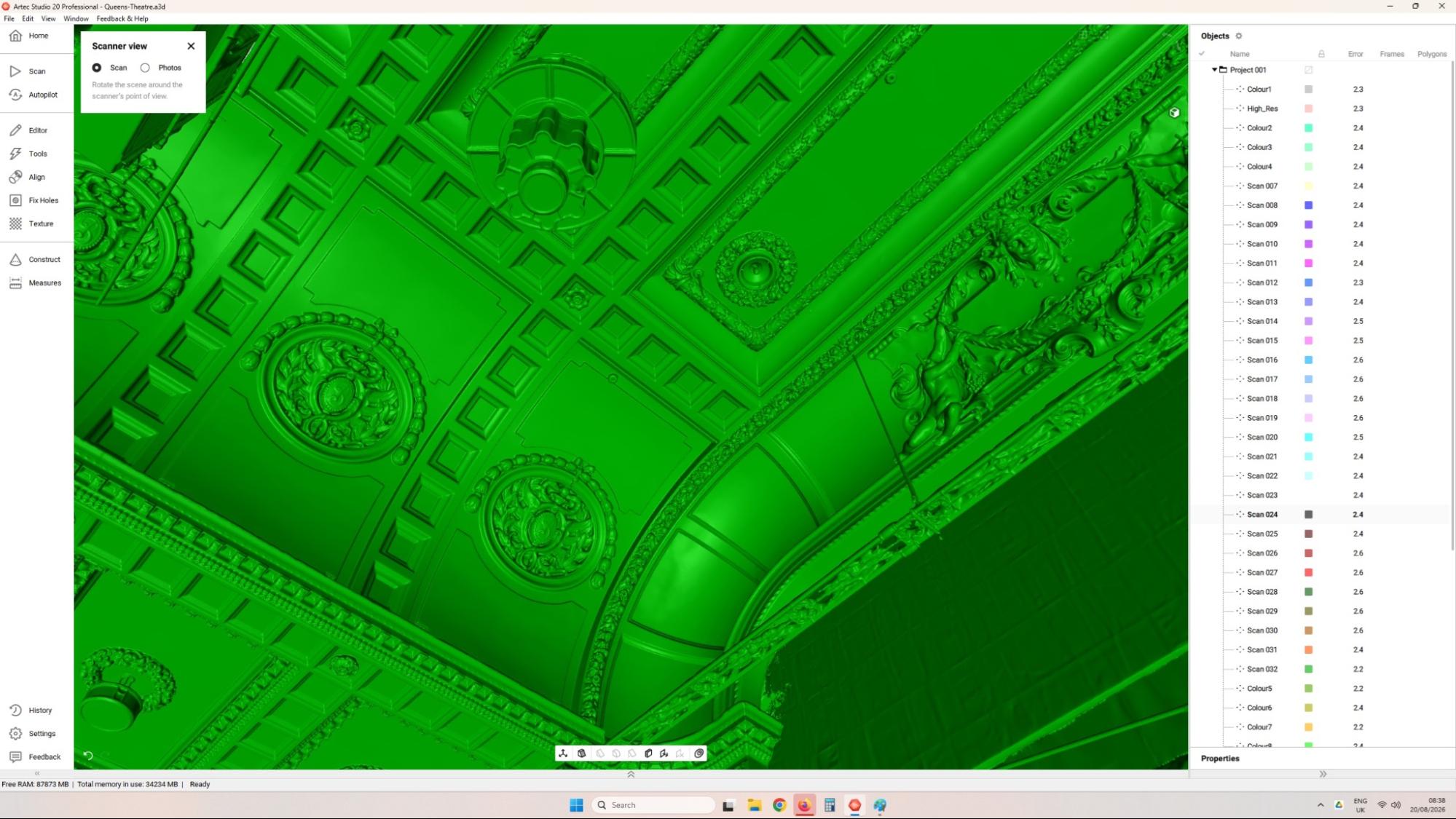
Back at the office, Beckett checked and refined the registration, removed unwanted data and merged the scans into a single, consistent dataset in Artec Studio. Europac3D then sent the resulting point cloud to an architectural team in London, which used it as the reference for a complete building model of the proposed renovation in Autodesk Revit.
The project’s acoustic consultants received the same dataset and are using it to tune the refurbished auditorium. The shape of the panels fixed to the interior walls determines how sound waves are reflected around the room, and at which frequencies. With an accurate 3D model, the consultants can carry out this work virtually, running simulations to see how changes to the layout would affect the acoustics before anything is built.
“You can put a VR headset on, sit wherever you like in the theater, and an audio engineer will tell you how the audio is in a particular seat,” said Edwards. “It’s about knowing where to put the baffles and reflectors so we can really focus and get that 4D sound. Also, I don’t want to play down the Lemmy factor. It has been a real rallying point for people all over the world, and we’re fortunate that management are huge believers in the technology.”
A full-color mesh of the theater has also been published to an online viewer, so it can be shared easily with project stakeholders, while processing the scan in Twinmotion has produced an immersive VR tour. That tour has been shown at Lemmy Bar, a fundraising venue opposite the statue, as part of a local media campaign previewing the new venue.
The scan data has already more than covered its cost. A drone-mounted scan of the roof revealed water ingress that, if left untreated, would have caused around £30,000 of damage within three months. Renting the scanner cost just a tenth of that sum. Presenting the scans to the city council and Historic England also helped the team secure a lease on the building, allowing the project to move forward.
A model for future heritage projects
Beckett is already considering how the process could be improved on future projects.
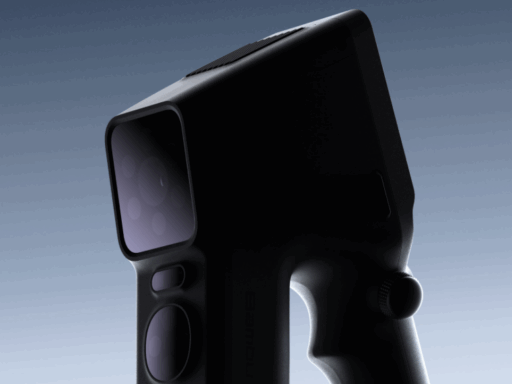
“With the benefit of hindsight, I’d probably now combine the Ray II with Artec Jet,” he said. “While Ray II is ideal for auditoriums and other large spaces, Jet’s a more mobile scanner, making it easier to capture tighter areas where line of sight makes fixed-position scanning harder. Together, they’d give us an even faster, more complete dataset.”
Europac3D sees wider potential for 3D scanning in the preservation of historic and architecturally significant buildings. A scan provides an accurate record of a structure before any work begins, supports scan-to-BIM renovation planning and supplies the geometry needed for acoustic analysis. Repeat surveys can also be compared with the original data to track how a building changes over time.
Edwards, meanwhile, is applying the same approach to other commissions, including a second Beatles statue, this time in Twickenham. For him, the theater project points to something broader than the restoration of one historic building. He sees 3D scanning as a way of refining ideas quickly and catching mistakes before they are cast in bronze.
“I used to work with a measurement tool called a pantograph,” concluded Edwards. “Basically, scan technology is that times a million. With it, I can take something on one scale, made from one material, and 3D print it in another. Let’s say I have a statue, and its head looks too small. In the old days, I’d have to resculpt the head. Now I just scan that head, make it proportional, and print it out again without losing any of the quality.”
“It’s a good filter as well as everything else, as well as the creative instigation of works,” he added. “It’s a very good judge and refining agent.”
More information on the project is available at: https://www.lemmyforever.uk/the-theatre
Europac3D’s 3D model of the theater can be explored online: https://europac3d.nira.app/a/KyupH06uSUK15WmJhm3UHQ/1