
Shenzhen-based desktop 3D printer manufacturer Bambu Lab has announced that it will release its first 3D scanner in November 2026.
For now, details around the “S1” device remain scarce. Though it already has its own page on the Bambu Lab website, this only offers a sign-up form for launch updates. The company has published neither a price nor technical specifications.
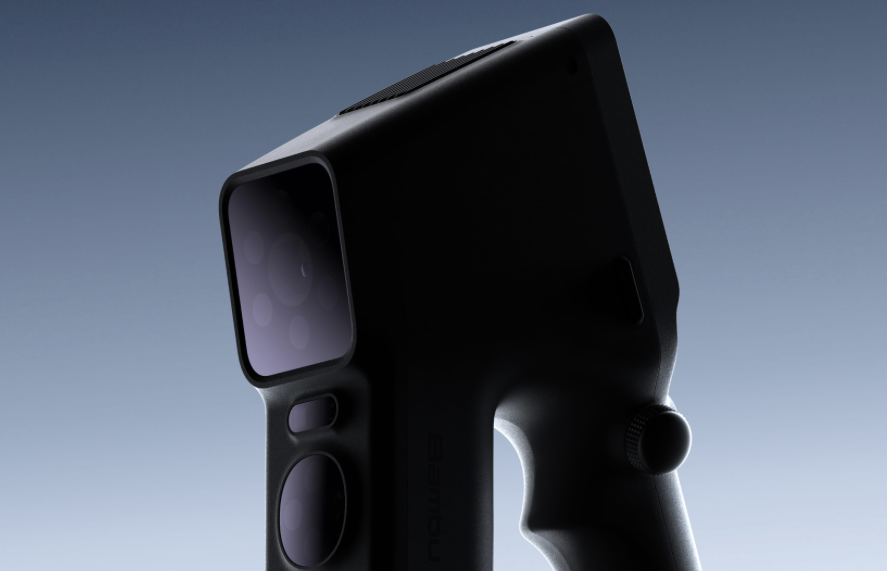
A teaser posted to the company’s social media channels offers slightly more. It shows a render of the scanner alongside the tagline “Easy in Hand. Pro in Every Scan” and describes the S1 as delivering “pro-level scanning precision.”
The company presents scanning as the next step after its printers and laser cutter, stating: “With the S1, we are once again doing what we do best: rigorous engineering craft, professional performance.”
Bambu Lab’s regulatory filing
On September 22, 2026, a filing with the U.S. Federal Communications Commission appeared under the ID 2A6J8-DS001, submitted by Shenzhen Tuozhu Technology, the company’s registered legal name. The paperwork confirmed four details: the product name, its classification as a 3D scanner, a rated power of 60 watts, and 5 GHz Wi-Fi with support for 20, 40 and 80 MHz channel widths.
A drawing showing where the regulatory label sits revealed a body with a molded grip and the first sign of a handheld design. Bambu Labs’ official teaser confirms that design.
The render shows a single front window with several lenses behind it, a grip fitted with a trigger-style control, and a knurled wheel on one side. A ribbed section on top may help with cooling, and observers have pointed to a flat area that could house a display.
The 60-watt rating, combined with the absence of any battery capacity on the label, suggests the S1 will run from mains power and may depend on a connected computer for processing. Although it must be said this is pure speculation. Bambu Lab has confirmed none of the above.
Partnering with SCANTECH
On January 29, 2026, Bambu Lab signed an agreement with SCANTECH, the Hangzhou manufacturer of industrial 3D scanners that sells internationally under the SCANOLOGY. Reports in the Chinese financial press at the time said the two companies would jointly design and develop consumer scanners, with SCANTECH responsible for manufacturing and Bambu Lab for sales.
Information shared with investors in May indicated a five-year term, development overseen by senior management from both companies, and first revenue expected during 2026. While there’s no confirmed connection between the S1 and SCANTECH (its name doesn’t appear anywhere in the FCC documents), the sequence of events does fit with an agreement in January, regulatory approval in September and an official teaser in October.
Offering the Bambu Lab S1 as a prize
Bambu Lab has already committed S1 units as prizes. Replying to a comment under its teaser post, the company said the scanner had joined the prize pool for the Make for Good: Accessibility Design Contest on MakerWorld, its model-sharing platform.
Launched in September with seven accessibility organizations, the contest asks entrants to design printable assistive devices. Winners will be named on December 18, 2026. Shipping scanners to them by that date would be consistent with a November launch, though it is still unclear whether November marks the start of preorders or deliveries.
What’s still to come
Bambu Lab hasn’t yet disclosed accuracy, resolution or scanning technology, whether structured light, laser or a combination of the two. It has not said whether the S1 captures color, processing happens locally, or how the device will connect with Bambu Studio software either.
The FCC has kept the user manual and the internal and external photographs confidential for 180 days, until around March 21, 2027. If the November launch goes ahead, those details will be public long before then. In the meantime, there are various other handheld 3D scanners available.
Artec 3D offers Artec Eva for the professional-grade 3D scanning of medium-sized objects, Artec Leo for wireless data capture away from your PC, and Artec Neo for metrology. The likes of Creaform, Shining3D, and ZEISS all operate in this space as well. It’ll be interesting to see whether the Bambu Lab seeks to compete with these established players, or go for the lower cost end of the market.