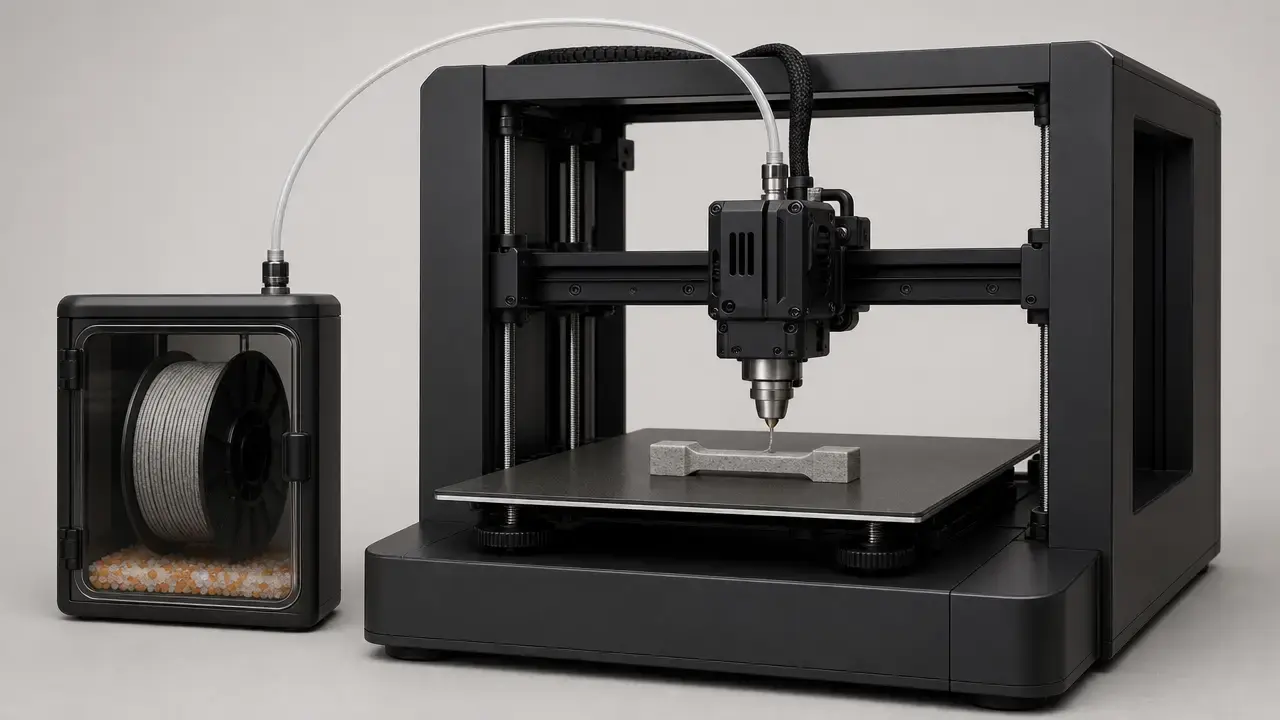

Summary: What Is Glass Fiber Filament?
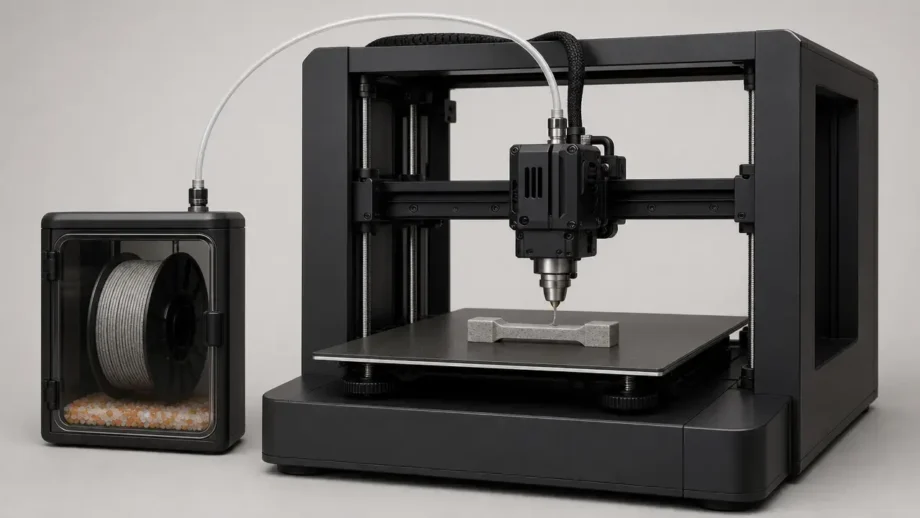
Glass fiber filament is a 3D-printing feedstock made from a thermoplastic matrix compounded with short or chopped glass fibers. In everyday use, people usually say FFF or FDM; in standards vocabulary, that process sits within the additive-manufacturing terminology framework defined by ISO/ASTM 52900:2021. It is not the same as printing glass, and it is not the same as a continuous-fiber composite system. [1]
In practice, GF filament can improve stiffness, dimensional stability, and some heat-related metrics, but results still depend heavily on the base polymer and print direction. Manufacturer TDS examples show the range: Bambu’s PA6-GF lists tensile strength of 75 ± 6 MPa in XY versus 27 ± 5 MPa in Z, while Fiberon’s PA6-GF25 lists HDT values of 191 °C at 0.45 MPa and 157 °C at 1.8 MPa. Prusament’s PP Glass Fiber shows the same load effect, with HDT dropping from 138.3 °C at 0.45 MPa to 112.6 °C at 1.80 MPa. [2] [7] [9]
Quick Answers
Many grades of glass fiber filament are abrasive in practice. Prusament explicitly labels its PP Glass Fiber as “Abrasivity: High” and says it requires a hardened nozzle. That is a useful reminder that nozzle wear is a setup issue, not an afterthought. [6]
For a glass fiber filament nozzle, the safe default is a wear-resistant nozzle such as hardened steel or another hardened material approved by the manufacturer. Bambu’s PA6-GF TDS lists 0.4, 0.6, and 0.8 mm nozzle sizes, with 0.6 mm recommended, and a 260–290 °C nozzle range. Fiberon adds a concrete wear example: with PA6-GF25, brass nozzle life is about 9 hours. A Bambu storefront note for PA6-GF also says 0.2 mm is not compatible and stainless steel is not recommended for that product. [2] [3] [9]
Drying depends on the matrix polymer, not just the presence of glass fibers. Nylon-based GF grades often need active drying and low-humidity storage: Bambu’s PA6-GF guidance is 80 °C for 8–12 hours in a blast drying oven, or 90–100 °C on a printer heatbed for 12 hours, with storage below 20% RH in a sealed container with desiccant. By contrast, Prusament says drying is not necessary for its PP Glass Fiber. [2] [6]
Safety is product-specific and operation-specific. One PA6-GF SDS from Bambu says the material is not classified under CLP, while a different PA6-GF SDS from Polymaker lists GHS carcinogenicity category 1B with the hazard statement “May cause cancer.” Prusament’s PP Glass Fiber SDS also separates heated-printing and post-processing risks, warning that vapors from heated or molten material and dust from grinding can be dangerous. Check the SDS for the exact spool you are using. [5] [8] [16]
The Material Science: Matrix, Short Fibers, and Print Anisotropy
From a materials perspective, glass fiber reinforced filament is still mostly about the matrix polymer. The chopped glass fibers reinforce the thermoplastic; they do not replace it. That is why short-fiber GF filament behaves differently from continuous-fiber composite systems, and why “glass fiber” alone does not tell you enough about print temperature, moisture sensitivity, or final properties. In ISO/ASTM terminology, this still sits within the additive-manufacturing vocabulary framework, while hobby users continue to say FFF or FDM. [1] [14]
Anisotropy, the directional dependence of part properties, remains central in fiberglass 3D printing. A peer-reviewed study by Shulga et al. on short-glass-fiber polypropylene showed that raster angle changed tensile performance substantially: the best ultimate tensile strength was 57.4 MPa with a 90° raster angle, versus 30.4 MPa for a 45°/135° criss-cross raster. Elasticity modulus in the same study shifted from 5.5 GPa to 2.5 GPa, with the thinnest printed layer thickness of 0.1 mm. That is not a universal law for every brand, but it is a strong scientific anchor for the broader point that short glass fibers do not erase print-direction effects. [14]
The practical takeaway is to start with the polymer family, then interpret the glass reinforcement through that lens. Nylon GF often brings drying and humidity control, PP-GF can simplify storage but still remains abrasive, and ABS-GF has its own thermal window and orientation dependence. [2] [4] [6] [7]
Printing Workflow for GF Filament
In workflow terms, the base polymer sets the print window first. Hotend temperature, bed temperature, chamber needs, and bed surface prep vary enough between PA6-GF, PA12-GF, PP-GF, and ABS-GF that one “GF profile” is not a reliable starting point. Bambu’s PA6-GF TDS lists 260–290 °C nozzle temperature, 80–100 °C bed temperature, 45–60 °C chamber temperature, and glue on supported plates, while Prusament’s PP Glass Fiber TDS lists 245 ± 10 °C nozzle temperature, 95 ± 10 °C bed temperature, a PP sheet, and a recommended brim. [2] [7]
Manufacturer TDS documents also show how much the maintenance routine can change by matrix. Bambu’s PA6-GF guidance is 80 °C for 8–12 hours of drying, or 90–100 °C on a printer heatbed for 12 hours, plus storage below 20% RH with desiccant. Fiberon’s PA6-GF25 also calls for dry conditions below 20% RH and recommends annealing at 100 °C for 16 hours. At the higher-hardware end, 3DXTech’s FibreX PA12+GF30 calls for 265–285 °C extrusion, 90–110 °C bed temperature, a heated chamber up to 120 °C, a hardened steel nozzle with 0.4 mm minimum diameter, 0.25 mm or higher layer height, and drying at 90 °C for 4 hours. Prusament’s PP Glass Fiber page, by contrast, says drying is not necessary. Fiberon’s wear example is another reason to prepare in advance: brass nozzle life is about 9 hours with PA6-GF25. Heatbed drying appears in some Bambu TDS documents, but it should be treated as a brand-specific fallback, not as universal advice for all GF filament. [2] [4] [6] [9] [11]
Checklist before printing GF filament
- Confirm the matrix polymer and read that product’s TDS before touching slicer settings. [2] [4] [7] [11]
- Dry the spool only if the product sheet calls for it, and follow the published temperature and time. [2] [4] [11]
- Keep humidity below the stated threshold when the manufacturer gives one, and use a dry box or sealed storage with desiccant when required. [2] [9]
- Choose a hardened steel nozzle or other approved wear-resistant nozzle for abrasive grades. [6] [7] [9] [11]
- Use only the nozzle sizes and temperature ranges listed for that filament. [2] [7] [11]
- Treat the Bambu PA6-GF note about 0.2 mm incompatibility and stainless-steel nozzles as a storefront-only compatibility note, not a universal rule for all GF products. [3]
- Print a small coupon first, then watch for wear, under-extrusion, or geometry drift on longer runs. [2] [9]
Types of Glass Fiber Reinforced Filament
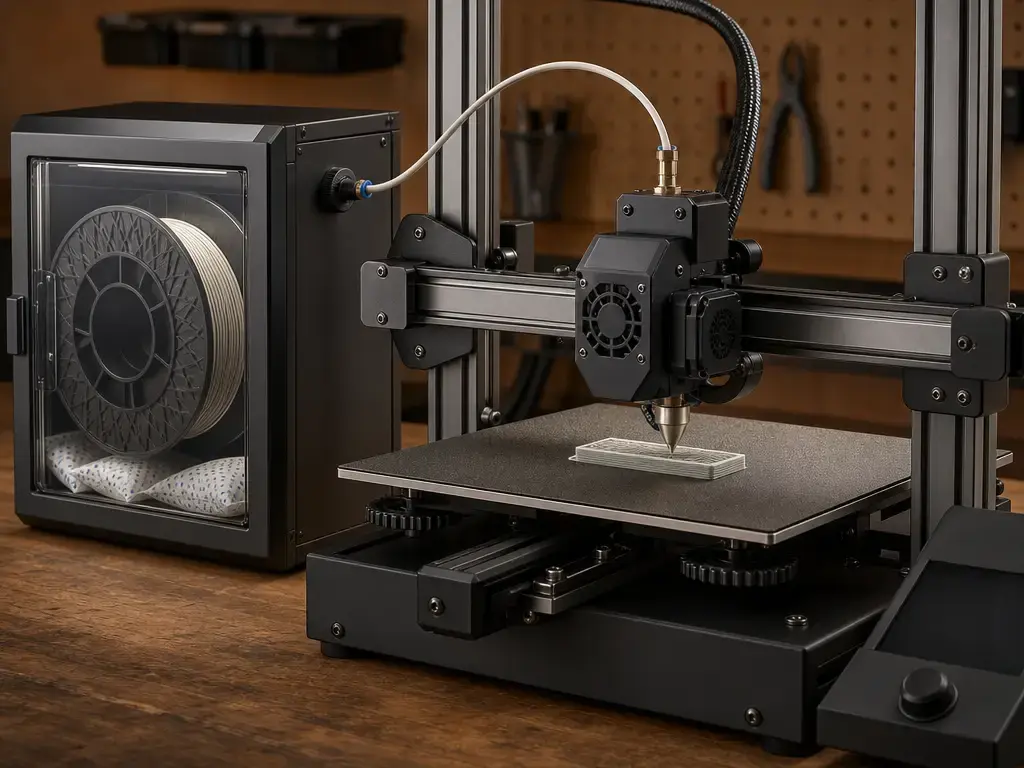
GF filament is not one material. It is a family of short-glass-fiber thermoplastic composites, and the matrix polymer controls most of the handling behavior. That is why PA6-GF, PA12-GF, PP-GF, ABS-GF, and PLA-GF should be treated as separate workflow families rather than as interchangeable variants with the same settings. Manufacturer TDS documents are the right evidence class for those differences. [2] [4] [7] [9] [12]
Nylon-based GF grades make the strongest case for reading the matrix first. Fiberon’s PA6-GF25 gives a clear dry-versus-wet example: dry, XY tensile strength is 80.1 ± 1.8 MPa, while wet, XY tensile strength drops to 40.2 ± 2.1 MPa, both under ISO 527 conditions listed in the TDS. Bambu’s PA6-GF guidance also calls for 80 °C drying for 8–12 hours and storage below 20% RH. For a more demanding nylon-GF setup, 3DXTech’s FibreX PA12+GF30 asks for a hardened steel nozzle of at least 0.4 mm, drying at 90 °C for 4 hours, and a heated chamber up to 120 °C, while its TDS lists HDT of 150 °C at 0.45 MPa and printed-specimen conditions of 0.4 mm nozzle, 0.25 mm layer height, 100% infill at ±45°, 285 °C extrusion, 110 °C bed, and XY-flat orientation. [2] [9] [11] [12]
PP-GF and ABS-GF show why “glass fiber” is not enough as a buying category. Prusament says drying is not necessary for its PP Glass Fiber and that large models can be printed without an enclosure, while its TDS lists 245 ± 10 °C nozzle temperature, 95 ± 10 °C bed temperature, and HDT of 138.3 °C at 0.45 MPa. Bambu’s ABS-GF TDS, meanwhile, lists HDT of 99 °C at 0.45 MPa and Young’s modulus of 3160 ± 170 MPa in XY versus 2250 ± 130 MPa in Z. PLA-GF belongs in the taxonomy as a descriptive category, but no registered source in this article’s source pack supports numeric PLA-GF comparisons, so it remains qualitative here. [4] [6] [7]
GF filament families at a glance
| Family | Why choose it | Main caution | Source-backed example |
|---|---|---|---|
| PA6-GF | Nylon-family option for higher dry stiffness and thermal metrics. | Moisture can dominate results. | Fiberon PA6-GF25: dry, XY tensile 80.1 ± 1.8 MPa vs wet, XY 40.2 ± 2.1 MPa; HDT 191 °C @0.45 MPa. [9] |
| PA12+GF30 | Higher-temperature nylon option for more demanding hardware. | Chamber, nozzle, and drying requirements escalate quickly. | 3DXTech FibreX PA12+GF30: hardened steel nozzle minimum 0.4 mm, heated chamber up to 120 °C, drying 90 °C for 4 h; HDT 150 °C @0.45 MPa. [11] [12] |
| PP Glass Fiber | Product-specific example with simpler drying workflow. | Still abrasive, and the bed setup differs from nylon. | Prusament PP Glass Fiber: drying not necessary on the product page; HDT 138.3 °C @0.45 MPa in the TDS. [6] [7] |
| ABS-GF | Lower-temperature GF family relative to the nylon examples here. | Orientation still matters. | Bambu ABS-GF: HDT 99 °C @0.45 MPa; Young’s modulus 3160 ± 170 MPa in XY vs 2250 ± 130 MPa in Z. [4] |
Read the condition labels before comparing any of those values. Dry versus wet, XY versus Z, and 0.45 MPa versus 1.8 MPa are not interchangeable contexts. [2] [4] [7] [9] [12]
How to Read Datasheets and Avoid False Comparisons
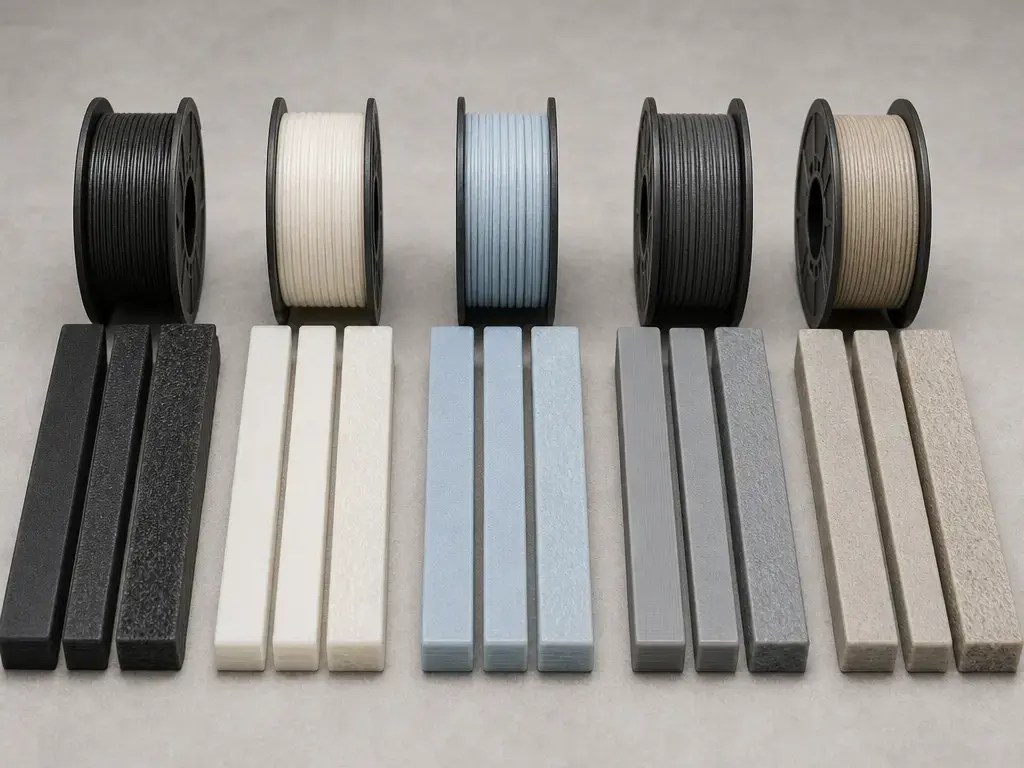
Datasheets often place tensile, flexural, impact, HDT, Vicat, and Tg values near each other, but they answer different questions. Tensile data describe resistance to pulling loads; flexural data describe bending; impact data describe sudden loading; HDT describes deflection under a stated load; Vicat describes softening under a penetrator; and Tg marks a transition in polymer behavior rather than a direct service-temperature limit. Bambu’s PA6-GF sheet is a useful example because it lists Vicat at 210 °C, HDT at 158 °C under 1.8 MPa, and HDT at 182 °C under 0.45 MPa in the same document. Prusament’s PP Glass Fiber TDS likewise lists HDT of 138.3 °C at 0.45 MPa and 112.6 °C at 1.80 MPa, while 3DXTech’s PA12+GF30 TDS lists Tg of 158 °C and HDT of 150 °C at 0.45 MPa. [2] [7] [12]
The next trap is ignoring how the number was produced. Bambu’s PA6-GF test specimens were printed at 265 °C nozzle temperature, 100 °C bed temperature, 100 mm/s speed, and 100% infill, then annealed and dried at 80 °C for 12 hours before testing. 3DXTech’s PA12+GF30 TDS specifies 0.4 mm nozzle, 0.25 mm layer height, 100% infill at ±45°, 285 °C extrusion, 110 °C bed, and XY-flat specimen orientation. Bambu’s ABS-GF TDS says its values are for design reference and comparison only, and 3DXTech’s TDS/SDS library says technical data from 3D-printed ISO specimens are highly dependent on printer and print settings and are offered as reference only. Typical values are not design allowables. [2] [4] [12] [13]
Glass Fiber Filament vs Carbon Fiber Filament
A fair glass fiber filament vs carbon fiber comparison starts with strict controls: same brand, same matrix family, similar conditioning, and the same orientation and load labels. Otherwise, you are not isolating the reinforcement effect; you are comparing different nylons, different moisture states, or different print setups. The Fiberon PA6 pair is useful precisely because both documents use the same family context and present dry, XY values in the same format. [9] [10]
Read that PA6 pair as a tradeoff, not a universal ranking. Fiberon’s PA6-GF25 reports dry, XY tensile strength of 80.1 ± 1.8 MPa, dry, XY Young’s modulus of 5356.9 ± 211.0 MPa, and HDT of 191 °C at 0.45 MPa. Its PA6-CF20 sibling reports dry, XY tensile strength of 109.3 ± 2.4 MPa, dry, XY Young’s modulus of 8636.5 ± 211.4 MPa, and HDT of 215 °C at 0.45 MPa. But the GF grade also shows how quickly context can change: the same PA6-GF25 drops from 80.1 ± 1.8 MPa dry, XY tensile strength to 40.2 ± 2.1 MPa wet, XY tensile strength, and its TDS gives a brass nozzle life of about 9 hours. [9] [10]
Glass fiber vs carbon fiber: same-family comparison rules in practice
| Comparison point | GF example | CF example | Evidence note |
|---|---|---|---|
| Same-brand PA6 tensile | Fiberon PA6-GF25: dry, XY tensile 80.1 ± 1.8 MPa. [9] | Fiberon PA6-CF20: dry, XY tensile 109.3 ± 2.4 MPa. [10] | Same family, same brand, same dry-XY context. |
| Same-brand PA6 modulus | Fiberon PA6-GF25: dry, XY Young’s modulus 5356.9 ± 211.0 MPa. [9] | Fiberon PA6-CF20: dry, XY Young’s modulus 8636.5 ± 211.4 MPa. [10] | Compare the stated condition labels, not product-name suffixes. |
| Thermal metric under the same load | Fiberon PA6-GF25: HDT 191 °C @0.45 MPa. [9] | Fiberon PA6-CF20: HDT 215 °C @0.45 MPa. [10] | Match the HDT load before drawing conclusions. |
| Moisture and wear context | PA6-GF25: dry, XY tensile 80.1 ± 1.8 MPa vs wet, XY 40.2 ± 2.1 MPa; brass nozzle life about 9 h. [9] | PA6-CF20 is still a nylon-family composite, so conditioning still matters even when this row uses the GF product as the numeric moisture example. [10] | Typical values remain reference values, not universal part allowables. |
If you need one narrowly scoped electrical example, keep it product-specific. 3DXTech’s PA12+GF30 TDS lists surface resistance greater than 10^13 Ω/sq by ASTM D257 for that grade only; that should not be generalized into a rule for all glass fiber reinforced filament. [12]
Applications and Selection Guidance
In actual use, glass fiber filament is usually more convincing in decision-first applications than in generic “strongest filament” claims. Good candidates include jigs, fixtures, brackets, lab racks, alignment aids, and heat-exposed covers where stiffness, dimensional stability, or a better thermal margin matters more than impact toughness or cosmetic finish. These examples should be treated as tooling, prototypes, and fixtures unless you already have qualification data for a higher-stakes application. [2] [4] [6] [7] [11] [12]
Before committing to a production part, validate the exact print orientation, service environment, and safety factor on your own machine. The reason is visible in the sources: TDS numbers are tied to specific specimen conditions, and orientation or moisture can shift the result far more than buyers expect from a product name alone. [2] [9] [12] [13]
How to choose a GF filament family
| Need | Likely matrix family | Printer requirements to check | Proof step before committing |
|---|---|---|---|
| Dry, stiff nylon-family functional parts | PA6-GF | Drying schedule, storage below stated RH, nozzle range 260–290 °C, and wear-resistant nozzle. [2] | Print a coupon in the target orientation, then re-check fit after conditioning. [2] [9] |
| Higher-temperature nylon workflow | PA12-GF | Hardened steel nozzle minimum 0.4 mm, 265–285 °C extrusion, 90–110 °C bed, heated chamber up to 120 °C, drying 90 °C for 4 h. [11] | Reproduce a small test part near your real geometry before scaling up. [11] [12] |
| Easier storage workflow in a GF grade | PP-GF | Product-specific note that drying is not necessary; check PP-specific bed setup and hardened-nozzle requirement. [6] [7] | Print a fit-critical sample and inspect edge adhesion after cooling. [7] |
| Lower-temperature GF option | ABS-GF | 240–280 °C nozzle, drying guidance if needed, and orientation-sensitive stiffness data. [4] | Compare the part against a non-GF baseline if dimensional stability is the goal. [4] |
Good candidate parts
- Assembly jigs and fixture blocks. [6] [12]
- Brackets and adapters where stiffness matters more than maximum toughness. [2] [4]
- Lab racks, holders, and alignment aids. [6]
- Heat-exposed covers or mounts that need more dimensional stability than a basic commodity filament. [2] [7] [12]
- Test coupons for fit, creep, and load validation before changing polymer family. [2] [12]
Limitations, Failure Modes, and Safety
The first limitation is hardware wear. Fiberon’s PA6-GF25 says brass nozzle wear happens frequently and gives an approximate brass nozzle life of 9 hours, which is why wear-resistant nozzles show up so often in GF guidance. Bambu’s PA6-GF TDS lists 0.4, 0.6, and 0.8 mm nozzle sizes, while 3DXTech’s PA12+GF30 requires a hardened steel nozzle with 0.4 mm minimum diameter and a heated chamber up to 120 °C. These manufacturer documents do not prove every failure mode on every printer, but they do justify routine nozzle inspection and caution around small, soft nozzles on abrasive grades. [2] [9] [11]
The second limitation is mechanical directionality. Bambu’s PA6-GF reports tensile strength of 75 ± 6 MPa in XY versus 27 ± 5 MPa in Z, and Bambu’s ABS-GF also shows directional modulus differences. The peer-reviewed Shulga study reinforces the same point from a different material system, with 57.4 MPa UTS and 5.5 GPa modulus at 90° raster versus 30.4 MPa and 2.5 GPa at 45°/135°. For nylon GF, moisture sensitivity adds another failure path: Fiberon’s PA6-GF25 drops from 80.1 ± 1.8 MPa dry, XY tensile strength to 40.2 ± 2.1 MPa wet, XY tensile strength. [2] [4] [9] [14]
The third limitation is that safety cannot be generalized across the whole category. Bambu’s PA6-GF SDS gives one example of a product that is not classified under CLP, while Polymaker’s PA6-GF SDS gives a different example, listing GHS carcinogenicity category 1B with the hazard statement “May cause cancer.” Prusament’s PP Glass Fiber SDS adds the practical workshop split: vapors from heated or molten material can be dangerous, and so can dust from grinding the material. The sensible rule is simple: read the exact SDS, ventilate the print area appropriately, protect eyes and skin as the task requires, and control dust during sanding or cutting. [5] [8] [16]
Brief History
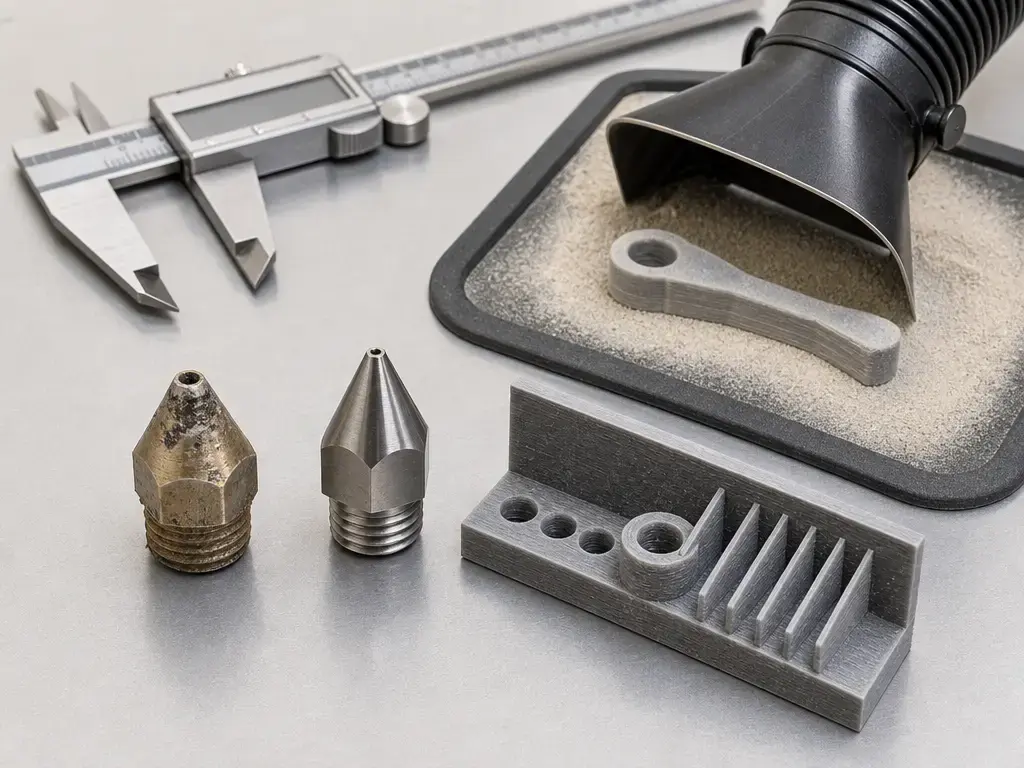
Fiberglass did not begin with 3D printing. Britannica notes that glass fibers were little more than a novelty until the 1930s, when their insulating properties became useful and methods for producing continuous glass filaments were developed. Modern glass fiber filament is a later adaptation of that older composite logic: use glass reinforcement inside a matrix to alter stiffness, dimensional stability, and thermal behavior. [15]
FAQ
What is glass fiber filament?
Glass fiber filament is a thermoplastic filament filled with short or chopped glass fibers for use in FFF/FDM-style printing, within the additive-manufacturing terminology framework defined by ISO/ASTM 52900:2021. It is not printed glass, and it is not the same as a continuous-fiber reinforcement system. The polymer matrix still determines most of the workflow, which is why PA6-GF, PA12-GF, PP-GF, and ABS-GF behave differently in practice. [1] [14]
Is glass fiber filament abrasive?
Often yes in practical use. Prusament explicitly labels its PP Glass Fiber as “Abrasivity: High” and says it requires a hardened nozzle. Fiberon’s PA6-GF25 gives a more concrete wear example by stating that brass nozzle life is approximately 9 hours. Those sources do not prove every GF product behaves identically, but they support treating nozzle wear as a real planning issue. [6] [9]
What nozzle should I use for glass fiber filament?
A wear-resistant nozzle is the safest default, usually hardened steel or another manufacturer-approved hardened option. Bambu’s PA6-GF TDS lists 0.4, 0.6, and 0.8 mm nozzles, with 0.6 mm recommended. Prusament’s PP Glass Fiber TDS says a hardened nozzle is necessary, and 3DXTech’s PA12+GF30 page specifies a hardened steel nozzle with a 0.4 mm minimum diameter. For Bambu PA6-GF specifically, a storefront note says 0.2 mm is not compatible. [2] [3] [7] [11]
Does glass fiber filament need drying?
Sometimes, but not always. Nylon-based examples in this source set do require drying: Bambu’s PA6-GF guidance is 80 °C for 8–12 hours, with storage below 20% RH in a sealed container with desiccant. 3DXTech’s PA12+GF30 also calls for drying at 90 °C for 4 hours. Prusament’s PP Glass Fiber is the counterexample here, because its material page says drying is not necessary. The matrix polymer decides the workflow. [2] [6] [11]
Is glass fiber filament safe?
Safety depends on the exact product and on what you are doing with it. One PA6-GF SDS from Bambu says the material is not classified under CLP, while another PA6-GF SDS from Polymaker lists carcinogenicity category 1B and the hazard statement “May cause cancer.” Prusament’s PP Glass Fiber SDS adds that vapors from heated or molten material and dust from grinding can be dangerous. That is why spool handling, printing, and post-processing should be treated as separate exposure situations. [5] [8] [16]
Expert: Why do GF prints have different XY vs Z strength, even when the datasheet looks strong?
Because the printed part is anisotropic. Bambu’s PA6-GF TDS lists tensile strength of 75 ± 6 MPa in XY but 27 ± 5 MPa in Z. A peer-reviewed short-glass-fiber polypropylene study found the same broader pattern from raster angle control, with best UTS of 57.4 MPa at 90° raster versus 30.4 MPa at 45°/135°. Glass fibers can help, but they do not make a printed part isotropic. [2] [14]
Expert: How should I compare HDT values at 0.45 MPa versus 1.8 MPa across filaments?
Treat them as different load cases, not as duplicate temperatures. Bambu’s PA6-GF lists HDT of 182 °C at 0.45 MPa and 158 °C at 1.8 MPa. Prusament’s PP Glass Fiber drops from 138.3 °C at 0.45 MPa to 112.6 °C at 1.80 MPa. Compare HDT only when the load, method, and specimen context match. [2] [7]
Related on 3D Mag
- Making the unprintable printable: MIT Lincoln Laboratory creates glass with low-temperature additive manufacturing
- MIT engineers 3D print glass bricks for sturdy construction
Sources
- ISO/ASTM 52900:2021
- Bambu Filament Technical Data Sheet V1.0: PA6-GF
- Bambu Lab US store page: PA6-GF
- Bambu Filament Technical Data Sheet V1.0: ABS-GF
- Bambu PA6-GF SDS (SDS20251127N08; 2025-11-27)
- Prusament material page: PP Glass Fiber
- Prusament PP Glass Fiber TDS (v1.0; last update 2024-11-15)
- Prusament PP Glass Fiber SDS (v1.0; issue date 2025-02-17)
- Fiberon PA6-GF25 TDS V1.0
- Fiberon PA6-CF20 TDS V1.0
- 3DXTech product page: FibreX Nylon 12+GF30
- 3DXTech TDS Rev 1.0: FibreX Glass Fiber Reinforced Nylon 12 [PA12+GF30]
- 3DXTech TDS/SDS library page
- Shulga et al., Materials (2020): PP + short glass fibers orientation study
- Britannica: fiberglass
- Polymaker SDS US v1.0 (2019-05-07): PolyMide PA6-GF