
Summary
Across manufacturer data sheets, tough resin is a vendor-defined label for vat-photopolymer materials aimed at functional parts, not a standardized ASTM or ISO grade. Vat photopolymerization forms structures by curing liquid photopolymer resin with ultraviolet light. [S1] [S3] [S9] [S10] [S11]
That makes the label on the bottle only a starting point. NIST IR 8059 is a useful reference for interpreting polymer additive-manufacturing test data, because resin claims only make sense when the test method, cure state, and workflow are known. [S2] A single resin can change materially between green and post-cured states: Formlabs Tough 2000 Resin V2 reports ASTM D638-14 ultimate tensile strength rising from 26.1 MPa green to 40.4 MPa post-cured, while elongation at break drops from 149% to 79%. [S9] In practice, the question is not just whether a resin is “tough,” but which measured properties, under which cure conditions, make it suitable for a specific part. [S2] [S9]
Standards and comparison protocol — read this before comparing TDS numbers
Before comparing numbers from any resin TDS, anchor the vocabulary and the test families. ISO/ASTM 52900:2021 is the additive-manufacturing vocabulary reference. ASTM D638-22 covers tensile properties, ASTM D790-25 covers flexural properties, ASTM D256-24 covers Izod impact, and ASTM D648-18 covers heat-deflection temperature under flexural load. [S3] [S4] [S5] [S6] [S7] These standards do different jobs: tensile data describe pull strength and elongation, flexural data describe bending response, impact data depend on the exact impact method used, and HDT is only meaningful with its stated load condition. [S4] [S5] [S6] [S7]
Comparability is the main trap. ASTM D648 itself warns that HDT data should not be used to predict general elevated-temperature behavior except under similar time, temperature, and loading conditions, and it notes that ASTM and ISO versions are not directly comparable. [S7] The same discipline applies across the rest of the TDS. A tensile number without cure state is incomplete. An impact number without the method family is incomplete. An orientation-free claim may hide anisotropy. Even industrial datasheets that describe parts as generally isotropic can still publish orientation-specific differences in elongation and notched Izod. [S7] [S12] Izod, Charpy, and Gardner are different tests and should not be treated as interchangeable “toughness” numbers. [S6] [S9] [S11]
Protocol box
Compare only when cure state, test family, units, specimen or standard, and ideally orientation align. Otherwise, treat the values as separate material profiles, not as direct rankings. [S2] [S4] [S5] [S6] [S7]
Technical principles — what the numbers are really describing
“Tough” is not one property. It is shorthand for a balance of crack resistance, deformation before failure, and load-bearing behavior that changes with resin chemistry, geometry, and post-processing. [S9] [S15]
For functional resin parts, the useful mechanical picture is broader than a single tensile number. Elongation at break describes how far a specimen stretches before fracture. Tensile and flexural modulus describe stiffness in pull and bending, which are not the same quantity. Impact values estimate how a defined specimen survives a defined impact test, but the result depends on notch geometry, units, and method family. HDT tells you the temperature at which a defined deflection occurs under a stated flexural load, not a universal service temperature. [S4] [S5] [S6] [S7] This is why a more ductile resin can still be weaker in direct tension or soften earlier under heat. Liqcreate Tough-X, for example, is strongly impact- and elongation-forward at 15 MPa tensile strength, 100–150% elongation at break, 72 J/m notched Izod, and 41 °C HDT-B at 0.45 MPa after UV post-curing. [S15] Formlabs Tough 2000 Resin V2 moves in a different direction after its validated post-cure, reaching 40.4 MPa ultimate tensile strength and 70 °C HDT at 0.45 MPa, but with lower elongation at break than in the green state. [S9]
Key properties in a tough resin TDS
- Tensile strength — how much direct pulling load a defined tensile specimen withstands before failure under ASTM D638 or an equivalent method. [S4]
- Elongation at break — how far the specimen stretches before rupture; higher values suggest more ductility, not automatically better overall performance. [S4]
- Modulus — tensile modulus and flexural modulus are different stiffness measures from different test families. [S4] [S5]
- Impact strength — always name the method family, such as ASTM D256 Izod; Gardner and Charpy are different tests. [S6] [S9] [S11]
- Shore hardness — a separate hardness metric commonly listed in TDS tables, useful for surface hardness comparisons but not a substitute for impact or fracture data. [S9] [S15]
- HDT with load — read the load condition every time, because 0.45 or 0.455 MPa and 1.8 or 1.82 MPa results are not interchangeable. [S7] [S13]
Two products can both be sold as tough while addressing different failure modes. Tough 2000 V2 is closer to a stiff, ABS-like profile with higher post-cured strength and HDT, while Tough-X is closer to a compliant profile that gives up strength and heat resistance to gain much higher ductility. That is a material trade-off, not a contradiction. [S9] [S15]
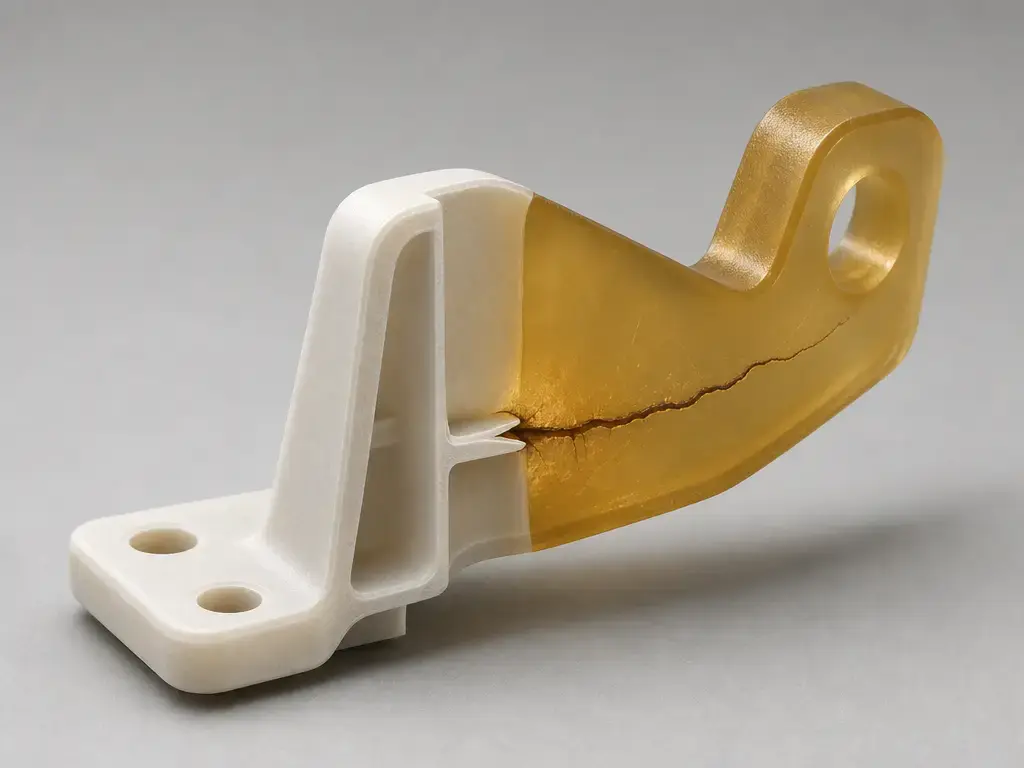
Tough resin vs standard, ABS-like, durable, and flexible resin
In buyer language, tough resin vs standard resin usually means a shift from detail-first printing toward greater crack resistance and deformation before failure. Consumer-facing resin guides also show how often shoppers use phrases like best tough resin for 3d printing and ABS-like before they ever open a TDS. [S22] But ISO/ASTM 52900 does not define “tough resin” as a standardized grade, so these labels are better treated as product taxonomy than formal material classes. [S3]
The same caution applies to tough vs ABS-like resin and abs like resin vs tough resin. Formlabs frames Tough 2000 Resin V2 as having toughness that rivals ABS, Tough 1500 Resin V2 as having toughness that rivals polypropylene, and Tough 1000 Resin as comparable in strength, stiffness, and toughness to HDPE. Those are limited behavior analogies, not full equivalence to injection-molded thermoplastics. [S9] [S10] [S11] A tough-labelled resin may be stiffer than a durable resin, softer than an ABS-like resin, or less heat-resistant than either. The label becomes useful only when you connect it to the failure mode you care about and the test values that support it. [S2] [S9] [S10] [S11]
| Label on bottle | Typical design goal | Metrics to check first | Main caution |
|---|---|---|---|
| Standard | General-purpose printing and surface quality | Tensile strength, hardness, printability | Not automatically impact-resistant |
| ABS-like | Stiffer everyday functional behavior | Tensile/flexural modulus, HDT, impact method | Not actual ABS thermoplastic |
| Tough | Better crack resistance and deformation before failure | EAB, impact method, tensile strength, HDT | Not one fixed property level |
| Durable | Repeated flex or long-use functional behavior | EAB, impact, wear/fatigue notes, modulus | Label varies by vendor |
| Flexible/Elastic | Bend and recover | Shore hardness, elongation, recovery behavior | Not a stiff structural material |
| High-temp/tough | Balance heat resistance with functional toughness | HDT with load, cure schedule, tensile data | Often depends on stricter post-cure |
The practical rule is simple: bottle labels are shortcuts, not material standards. Read them as a prompt to inspect the TDS, not as proof that two resins belong in the same comparison class. [S3] [S9] [S10] [S11]
Workflow — printing, washing, and post-curing tough resins
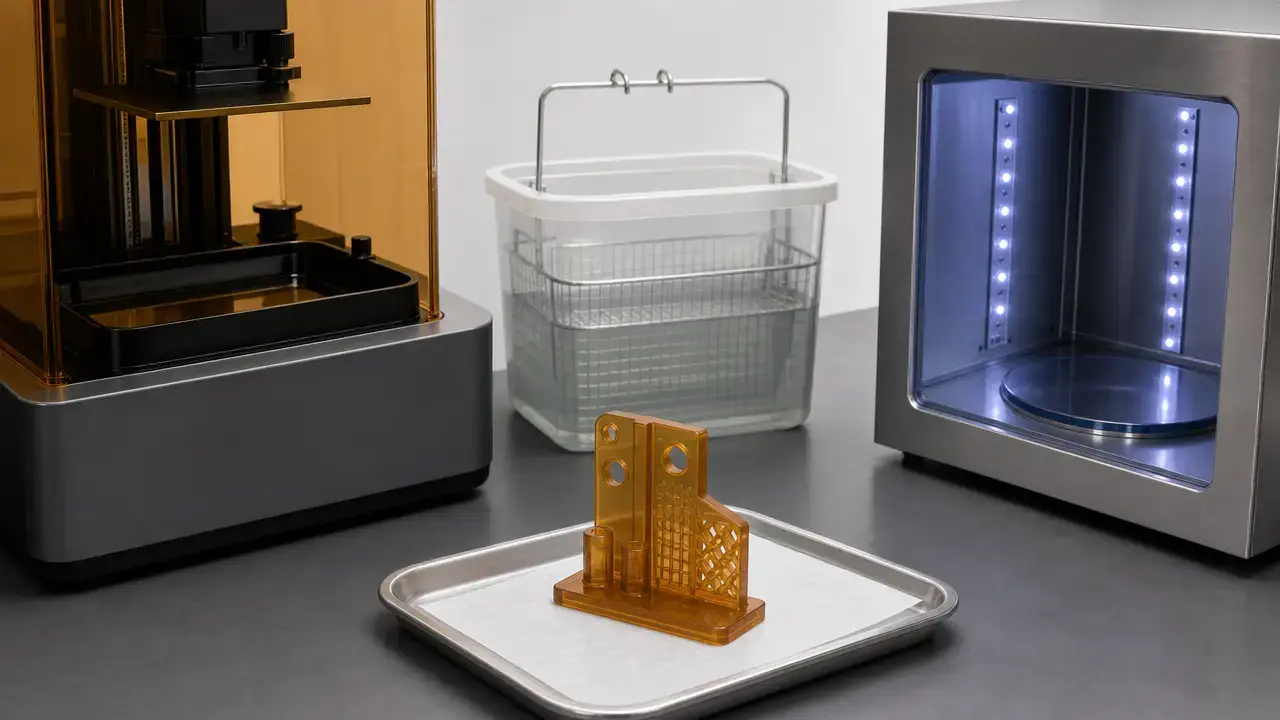
Mechanical performance in vat photopolymer parts is a workflow result, not just a bottle result. Formlabs Tough 2000 Resin V2, for example, ties its published data to parts printed on a Form 4 at 100 μm, washed for 10 + 5 minutes in at least 99% IPA, and post-cured at 70 °C for 12 minutes in a Form Cure V2. [S9] That level of disclosure matters because print settings, resin temperature, wash duration, and cure schedule all affect the final state being tested. Photocentric likewise specifies heating Durable DL110H resin to 30 °C before printing and then curing black parts for at least 4 hours at 60 °C, with a different cure time for translucent parts. [S14]
Post-cure is not automatically monotonic. More time or more heat is not universally better. [S20] [S21]
A 2021 Materials study on mSLA printouts found that post-curing time negatively affected tensile and bending strength in that tested setup, and that prolonged washing slightly reduced strength. [S20] A 2025 Polymers study on an SLA methacrylate resin found tensile properties initially increased, then began to decrease after about 30 minutes at higher post-curing temperatures in that system. [S21] UV-only and UV-plus-heat workflows are also not interchangeable. Some validated resin workflows publish final properties after UV post-cure alone, while others require an additional thermal step to reach the stated profile. LOCTITE 3D IND406 is a clear example: the TDS describes a two-step post-cure and states that, after UV post-curing, an additional heat post-cure at 140 °C for 2 hours is required, with ramp rate no greater than 4 °C/min, to reach final properties. [S13] Its published post-processed values then land in a very different performance range from many hobby-class “tough” resins, including 55 ± 1 MPa tensile stress at break and 107 ± 1 °C HDT at 0.455 MPa. [S13] If you move a resin onto a different printer, washer, or cure unit, assume you are creating a new workflow and validate it with your own test coupons. [S2] [S9] [S13]
- Confirm printer wavelength and resin compatibility.
- Calibrate exposure with a test piece.
- Control resin temperature.
- Wash without over-soaking.
- Dry fully before cure.
- Post-cure exactly as the TDS specifies, including UV-plus-heat if required.
- Test a coupon or sacrificial part in the real loading mode.
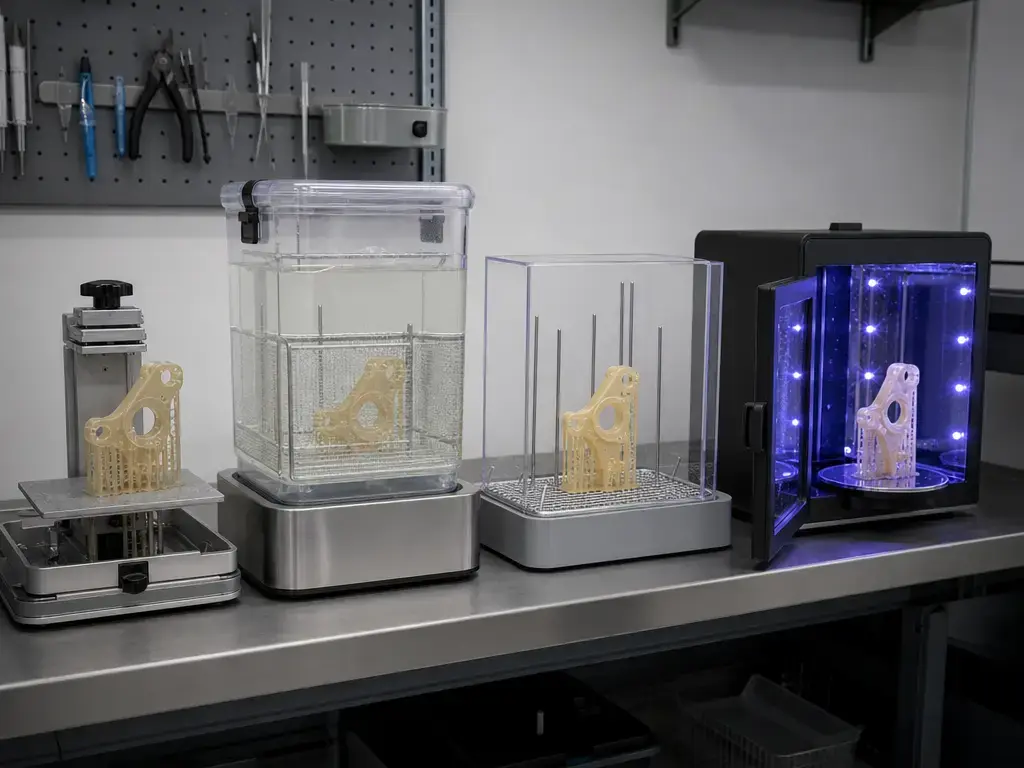
How to read a resin TDS and avoid fake comparisons
The TDS is the document that turns a marketing label into something engineering-like. NIST IR 8059 is useful here because it emphasizes standards applicability rather than blind number collection. [S2]
Before trusting any claim, check five things: the test family, the units, the cure state, the specimen or standard, and whether orientation is disclosed. Anycubic Tough Resin 2.0 is a good example of why this matters. Its linked TDS uses ASTM D638 for tensile data and ASTM D790 for flexural data, but lists impact under GB/T1843/U at 143 J/m and shrinkage under GB/T15223-2008 at 4.3–5.6%. [S18] The product page adds more confusion by listing “Bending Modulus” as 42–52 MPa and “Bending Strength” as 1500–2000 MPa, which appears internally inconsistent, and it lists Izod impact strength as 245 J/m without the same method detail shown in the TDS. [S17] [S18] By contrast, 3D Systems Figure 4 Tough 65C Black publishes ASTM and ISO-linked properties and also discloses orientation-specific elongation and notched Izod values, which makes its numbers easier to interpret. [S12]
Evidence grade
1. Validated closed-workflow TDS — strongest for a specific printer, wash, and cure setup. [S9]
2. Open-material manufacturer TDS — useful, but verify printer and post-process details. [S15] [S16]
3. Product-page specs — weakest, especially when method details or revision control are missing or inconsistent. [S17] [S19]
TDS interpretation cheatsheet
| Metric | What it actually tells you | What must be stated | Common misread |
|---|---|---|---|
| UTS | Maximum tensile stress before failure in that test | Test method, cure state, specimen | “Higher UTS means tougher” |
| EAB | Ductility before fracture | Method, cure state, rate | “Higher EAB means better in every use” |
| Modulus | Stiffness in pull or bending | Tensile vs flexural method | Treating tensile and flexural modulus as the same |
| Notched Izod | Response of a notched specimen in that impact method | Method family and units | Treating Izod as a universal toughness number |
| HDT | Temperature at defined deflection under load | Load, method, cure state | Reading it as general service temperature |
| Shore D | Hardness at the surface | Scale and cure state | Using hardness as a stand-in for impact or fracture behavior |
The load examples in the HDT row reflect common resin reporting such as 0.45 or 0.455 MPa and 1.8 or 1.82 MPa, which should not be mixed casually across TDSs. [S7] [S9] [S13] If a document omits cure state, method, or orientation, read it as a rough profile rather than a precise competitor comparison. [S2]
Types of tough resin for functional parts — profiles, not rankings
Before comparing across brands, treat the following examples as material profiles rather than winners, because the cure states, methods, printers, and disclosure depth are not identical. [S9] [S10] [S11] [S13] [S15] [S16] A stiff ABS-like tough profile is represented by Formlabs Tough 2000 Resin V2, which in its validated post-cured state reports 40.4 MPa ultimate tensile strength, 79% elongation at break, 25 J/m notched Izod, and 70 °C HDT at 0.45 MPa. [S9] A resilient, more compliant PP-like profile is represented by Formlabs Tough 1500 Resin V2 at 34 MPa post-cured UTS, 155% elongation at break, 42 J/m notched Izod, and 66 °C HDT at 0.45 MPa. [S10] A higher-ductility HDPE-like profile appears in Formlabs Tough 1000 Resin, which reports 26.3 MPa post-cured UTS, 180% elongation at break, 72 J/m notched Izod, and 13.1 J Gardner impact at 1/32 in thickness. [S11]
Other tough-labelled materials occupy different lanes again. LOCTITE 3D IND406 is better read as a high-HDT engineering-tough profile that depends on a stricter UV-plus-heat workflow and then reports 55 ± 1 MPa tensile stress at break, 25 ± 4% elongation at break, 35 ± 8 J/m notched Izod, 107 ± 1 °C HDT at 0.455 MPa, and 81 ± 2 °C HDT at 1.82 MPa. [S13] Liqcreate Tough-X is closer to a high-impact, high-elongation, lower-strength profile at 15 MPa tensile strength, 100–150% elongation at break, 72 J/m notched Izod, and 41 °C HDT-B at 0.45 MPa. [S15] Siraya Tech Blu is an open-ecosystem tough example with 50 MPa tensile stress at break, 1800 MPa Young’s modulus, 32% elongation at break, 45 J/m notched Izod, and 70 °C HDT at 0.455 MPa. [S16] Open-printer resins often disclose less workflow detail than closed systems, so use them as profiles and require more in-house validation before treating the published numbers as your own part’s numbers. [S15] [S16]
Performance metrics — how tough is tough resin?
No reliable single figure was found for “tough resin,” because the answer depends on formulation, workflow, and test method. [S2] [S9] [S15]
In materials language, toughness is an energy-to-failure idea, while impact resistance comes from specific test families. For resin buyers, that means Izod is only a partial indicator, not “the toughness number.” [S6] A high notched Izod result can coexist with modest tensile strength or low HDT, while a higher-tensile-strength resin may still be the worse choice for a snap-fit or thin wall that must deform without cracking. [S9] [S14] [S15] HDT needs the same discipline: a high HDT at 0.45 or 0.455 MPa does not make a resin universally heat-safe, and ASTM D648 explicitly warns against using the method as a broad predictor of elevated-temperature behavior outside similar conditions. [S7]
The most useful answer is a set of profiles. Formlabs Tough 2000 Resin V2, post-cured in its validated workflow, reports 40.4 MPa UTS, 79% elongation at break, 25 J/m notched Izod, and 70 °C HDT at 0.45 MPa. [S9] Liqcreate Tough-X, after UV post-curing, reports 15 MPa tensile strength, 100–150% elongation at break, 72 J/m notched Izod, and 41 °C HDT-B at 0.45 MPa. [S15] Photocentric Durable DL110H Black, with its 4-hour cure at 60 °C, reports 54 MPa ultimate tensile strength, 28% elongation at break, 110 J/m notched Izod, and 75 °C HDT at 0.45 MPa. [S14] These are three very different answers to “tough,” and none is universally best. [S9] [S14] [S15]
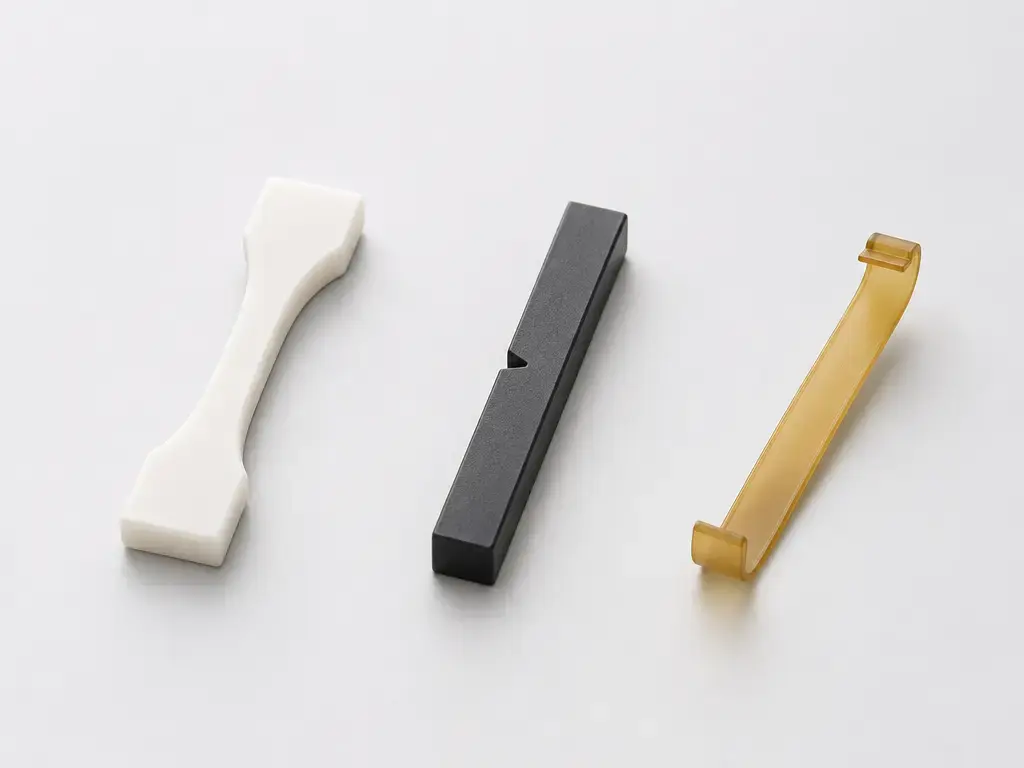
Applications — where impact-resistant 3D printing resin makes sense
Impact-resistant 3D printing resin makes the most sense in functional prototypes, housings and enclosures, brackets, clips, protective shells, snap-fits, jigs and fixtures, and test rigs where the part must survive more abuse than a standard detail resin typically would. Snap-fits care most about elongation at break and yield behavior. Jigs and fixtures care more about stiffness, HDT, and long-term deformation under load. Drop or shock cases care about impact data, with the method family stated. [S9] [S10] [S12] Formlabs positions Tough 2000 V2 and Tough 1500 V2 toward functional prototypes, enclosures, jigs, fixtures, and compliant mechanisms, while 3D Systems positions Figure 4 Tough 65C Black toward durable production-style parts, jigs, fixtures, and prototypes with published environmental stability data. [S9] [S10] [S12] These are prototyping and validated non-safety-critical use cases unless you test and validate the part in your own geometry, loading mode, and environment. [S2]
Limitations and failure modes
Orientation still matters. 3D Systems describes Figure 4 Tough 65C Black as generally isotropic, but the same datasheet also publishes orientation-specific elongation at break values of 35% in ZY, 15% in XZ, 27% in XY, and 25% in Z45, with notched Izod varying by orientation as well. [S12] That is a reminder that anisotropy may be smaller on some platforms than on others, but it is not safe to assume orientation has no effect unless the vendor shows the data. [S12] Post-processing is another limitation: the 2021 Materials study and the 2025 Polymers study both show that changing wash or post-cure parameters can shift mechanical results, and in the 2025 study some tensile properties improved first and then declined under longer, hotter cure conditions. [S20] [S21]
Environmental and chemical limits also need source discipline. 3D Systems cites indoor stability testing per ASTM D4329 and outdoor weathering per ASTM G154 for Figure 4 Tough 65C Black, while Photocentric cites ISO 4892 Part 2 Method A Cycle 1 for 1000 hours of UV ageing on Durable DL110H Black. [S8] [S12] [S14] Those references are useful, but they still describe specific accelerated tests, not universal lifetime guarantees. [S8] [S12] [S14] Chemical exposure is equally resin-specific. Formlabs Tough 2000 Resin V2, for example, includes a 24-hour chemical compatibility table with solvent weight-gain data, which is more useful than a broad claim that a “tough resin” is chemically resistant. [S9] For long-term load, creep, fatigue, and repeated flex, use only the resin-specific data that are actually disclosed and otherwise assume application-dependent behavior that you must validate yourself. [S2] [S9] [S11]
Current market and standards context
Shopping language around tough resin is broader than standards language. Consumer-facing resin roundups commonly group “tough” and “ABS-like” products together because that is how people search, but that does not make them a standardized family. [S22] ISO/ASTM 52900 is the vocabulary anchor for additive manufacturing, yet it does not define a formal “tough resin” grade. [S3]
That gap makes source quality more important as open ecosystems expand. A manufacturer product page may be useful for compatibility or packaging details, but it is weaker evidence than a TDS with clear methods and cure conditions. At access time on June 20, 2026, the Anycubic Tough Resin Ultra product page displayed a “Download TDS File” path that did not provide a usable visible mechanical TDS path for validation on the page itself, so its mechanical claims should be down-weighted until a real TDS is available and checked. [S19]
How to choose tough resin for 3D printing
There is no single winner in tough resin. The right choice depends on how the part is supposed to fail, or not fail. [S2] [S9] [S13]
If you need spring-back or snap-fits, prioritize elongation at break, yield behavior, and method-matched impact data. If you need stiffness for fixtures or brackets, prioritize modulus and HDT with the load clearly stated. If you need drop resistance, look for impact data from the same test family rather than mixing Izod, Charpy, and Gardner. If you need heat resistance, expect a stricter cure schedule and check whether the published values depend on added heat post-cure. [S6] [S7] [S9] [S13] Formlabs Tough 2000 V2 is a good closed-workflow example because its wash and cure conditions are explicit, while LOCTITE 3D IND406 shows how some engineering-tough materials require a 140 °C heat post-cure for 2 hours to reach the stated profile. [S9] [S13]
The practical answer to “best tough resin for 3d printing” is not a brand name but a process: read the TDS, match the test family, respect the cure workflow, and print your own coupons before trusting the label. Product-page claims without a solid TDS path, such as the Tough Resin Ultra example above, deserve less weight than validated workflow data. [S19]
FAQ
What is tough resin in 3D printing?
It is a vendor-defined vat-photopolymer resin category used for parts that need more crack resistance or deformation before failure than standard detail-oriented resin. “Tough resin” itself is not a standardized ASTM or ISO grade. [S1] [S3]
How tough is tough resin?
There is no single answer. Formlabs Tough 2000 V2 is a stiffer post-cured profile at 40.4 MPa UTS and 79% elongation at break, Liqcreate Tough-X is a more ductile profile at 15 MPa tensile strength and 100–150% elongation at break, and Photocentric Durable DL110H Black is a stronger but less ductile profile at 54 MPa UTS and 28% elongation at break. [S9] [S14] [S15]
Tough resin vs standard resin: what’s the real difference?
Standard resin is usually chosen for general-purpose printing and detail, while tough-labelled resins are positioned for better resistance to cracking, impact, or deformation in functional use. The trade-off may be different stiffness, different HDT, and more demanding post-processing. [S9] [S10]
Tough vs ABS-like resin: are they the same?
No. ABS-like is a limited behavior analogy, not material equivalence to molded ABS. Some tough resins are marketed as ABS-like, others as PP-like or HDPE-like, but those analogies describe only part of the behavior. [S9] [S10] [S11]
Does tough resin need heat post-cure?
Sometimes. Many tough resins publish final properties after UV post-cure alone, but some engineering-tough materials need more. LOCTITE 3D IND406 explicitly requires UV post-curing followed by a 140 °C heat post-cure for 2 hours with ramp rate no higher than 4 °C/min to reach final properties. [S13]
Expert: How do I compare impact numbers without fooling myself?
Keep the test families separate. ASTM D256 Izod, Charpy, and Gardner are different impact methods with different specimen geometries and units, so they are not interchangeable. Compare only like with like, and keep cure state and orientation in view. [S6] [S9] [S11]
Expert: How much can print orientation change elongation and impact strength in vat photopolymer parts?
A lot. 3D Systems Figure 4 Tough 65C Black reports elongation at break of 35% in ZY, 15% in XZ, 27% in XY, and 25% in Z45, and its notched Izod values also vary by orientation. That is enough to change how you interpret a resin for snap-fits or bending parts. [S12]
Sources
- S1 — NIST: Vat Photopolymerization. National Institute of Standards and Technology; official documentation; created 2024-11-15, updated 2025-05-15; accessed 2026-06-20. https://www.nist.gov/additive-manufacturing/research-areas/technologies/vat-photopolymerization
- S2 — NIST IR 8059 publication page: Materials Testing Standards for Additive Manufacturing of Polymer Materials: State of the Art and Standards Applicability. National Institute of Standards and Technology; official report page; published 2015-05-01, updated 2025-02-19; accessed 2026-06-20. https://www.nist.gov/publications/materials-testing-standards-additive-manufacturing-polymer-materials-state-art-and-0
- S3 — ISO/ASTM 52900:2021 listing: Additive manufacturing — General principles — Fundamentals and vocabulary. ISO; standard listing; 2021; accessed 2026-06-20. https://www.iso.org/cms/%20render/live/en/sites/isoorg/contents/data/standard/07/45/74514.html
- S4 — ASTM D638-22 listing: Standard Test Method for Tensile Properties of Plastics. ASTM International; standard listing; D638-22; accessed 2026-06-20. https://store.astm.org/d0638-22.html
- S5 — ASTM D790-25 listing: Standard Test Methods for Flexural Properties of Unreinforced and Reinforced Plastics and Electrical Insulating Materials. ASTM International; standard listing; D790-25; accessed 2026-06-20. https://store.astm.org/d0790-25.html
- S6 — ASTM D256-24 listing: Standard Test Methods for Determining the Izod Pendulum Impact Resistance of Plastics. ASTM International; standard listing; D256-24; accessed 2026-06-20. https://store.astm.org/d0256-24.html
- S7 — ASTM D648-18 listing: Standard Test Method for Deflection Temperature of Plastics Under Flexural Load in the Edgewise Position. ASTM International; standard listing; D648-18; accessed 2026-06-20. https://store.astm.org/d0648-18.html
- S8 — ASTM D4329-21 listing: Standard Practice for Fluorescent Ultraviolet (UV) Lamp Apparatus Exposure of Plastics. ASTM International; standard listing; D4329-21; accessed 2026-06-20. https://store.astm.org/d4329-21.html
- S9 — Formlabs Tough 2000 Resin V2 TDS. Formlabs; manufacturer TDS; prepared 2025-10-06, Rev. 01; accessed 2026-06-20. https://formlabs-media.formlabs.com/datasheets/251013-MS-TDS-Tough_2000_V2.pdf
- S10 — Formlabs Tough 1500 Resin V2 TDS. Formlabs; manufacturer TDS; prepared 2025-03-18, Rev. 05 2025-10-17; accessed 2026-06-20. https://formlabs-media.formlabs.com/datasheets/25011041-TDS-ENUS-0.pdf
- S11 — Formlabs Tough 1000 Resin TDS. Formlabs; manufacturer TDS; prepared 2025-09-23, Rev. 01; accessed 2026-06-20. https://formlabs-media.formlabs.com/datasheets/25011071-TDS-ENUS-0.pdf
- S12 — 3D Systems Figure 4 Tough 65C Black Datasheet. 3D Systems; manufacturer datasheet; dated 2021-07-09; accessed 2026-06-20. https://www.3dsystems.com/sites/default/files/2021-07/3d-systems-figure-4-tough-65c-black-datasheet-usen-2021-07-09-a-print.pdf
- S13 — Henkel LOCTITE 3D IND406 TDS. Henkel; manufacturer TDS; version 2025-03-28; accessed 2026-06-20. https://dm.henkel-dam.com/is/content/henkel/Loctite-3D-IND406
- S14 — Photocentric Durable DL110H TDS. Photocentric; manufacturer TDS; Revision 9, 2025-09-21; accessed 2026-06-20. https://photocentricgroup.com/wp-content/uploads/2025/10/TDS-Durable-DL110H-2025.pdf
- S15 — Liqcreate Tough-X technical specifications page. Liqcreate; manufacturer page; no revision date shown; accessed 2026-06-20. https://www.liqcreate.com/product/tough-x/
- S16 — Siraya Tech Blu Regular TDS page. Siraya Tech; manufacturer page; no revision date shown; accessed 2026-06-20. https://siraya.tech/pages/blu-tough-resin-tds-for-regular-blu
- S17 — Anycubic Tough Resin 2.0 product page. Anycubic; manufacturer product page; accessed 2026-06-20. https://store.anycubic.com/products/tough-resin-2
- S18 — Anycubic Tough Resin 2.0 TDS PDF. Anycubic; manufacturer TDS PDF; no revision date shown; accessed 2026-06-20. https://cdn.shopify.com/s/files/1/0245/5519/2380/files/ANYCUBIC-TDS-Tough_Resin_2.0_ba1eedb4-f8af-47d4-9102-8c2bfadade62.pdf?v=1758253760
- S19 — Anycubic Tough Resin Ultra product page. Anycubic; manufacturer product page; accessed 2026-06-20. https://store.anycubic.com/products/tough-resin-ultra
- S20 — Materials (2021): “Effect of Post-Process Curing and Washing Time on Mechanical Properties of mSLA Printouts”. MDPI; peer-reviewed article; 2021; accessed 2026-06-20. https://mdpi-res.com/d_attachment/materials/materials-14-04856/article_deploy/materials-14-04856-v2.pdf
- S21 — Polymers (2025): “Effects of Post-Curing on Mechanical Strength and Cytotoxicity of Stereolithographic Methacrylate Resins”. Polymers; peer-reviewed article; published 2025-08-02; accessed 2026-06-20. https://arts.units.it/retrieve/6bdbdb62-1d07-4435-b361-ddac00e9a04b/polymers-17-02132.pdf
- S22 — All3DP: “The Best Tough ABS-Like Resins”. All3DP; industry publication; accessed 2026-06-20. https://all3dp.com/2/best-tough-resin-abs-like-resin/