
Summary
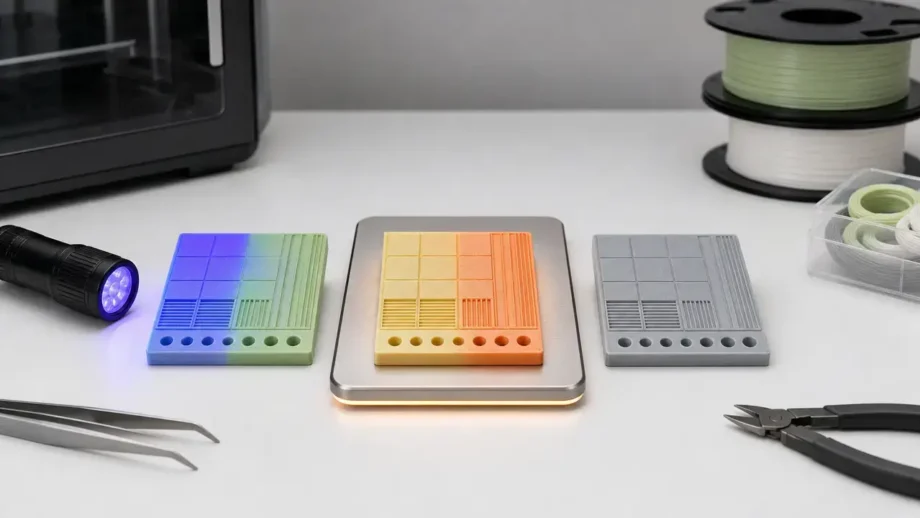
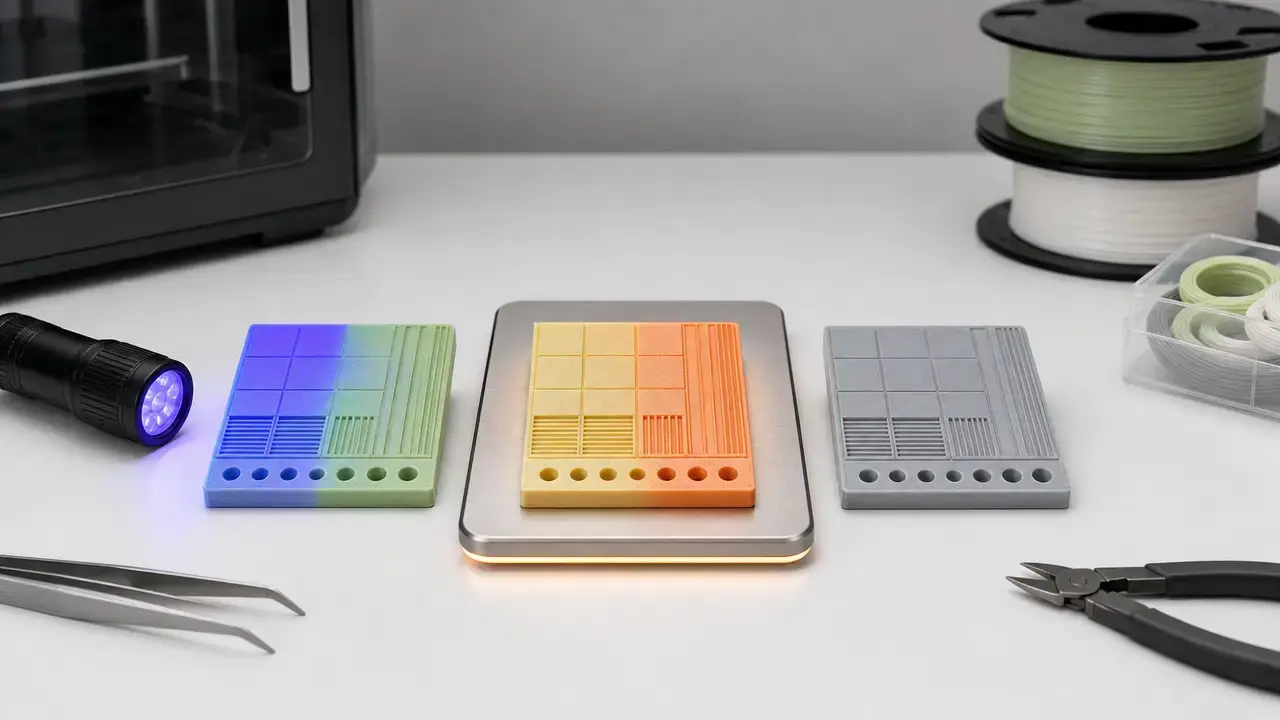
Color changing filament is a 3D printing filament formulated to change appearance after a stimulus such as temperature or UV exposure. In consumer FDM/FFF printing, that usually means a familiar base polymer loaded with either thermochromic or photochromic additives rather than a different printer process. [13] [10] Fluorescence and phosphorescence are different phenomena, and rainbow, gradient, silk, and dual-color co-extruded PLA are decorative effects rather than stimulus-responsive materials. [11] [12] Treat the visible shift as a qualitative indicator unless you calibrate it against known conditions. [10] [14]
Terminology: FDM vs FFF vs material extrusion (MEX)
FDM/FFF is the wording most readers will recognize, and it works as shorthand for desktop filament printing. The standards-based umbrella term is material extrusion, abbreviated MEX in current additive manufacturing vocabulary. [1] [2]
ISO/ASTM 52900:2021 is the vocabulary reference used here. It defines material extrusion as an additive manufacturing process in which material is selectively dispensed through a nozzle or orifice. [1] [2] Switching to a color-changing spool does not change the printer class; the difference is the filament formulation. [2]
How it works: three optical/chemical behaviors you’ll see in the wild
Product listings often blur several effects together, but the mechanisms are different. Thermochromic systems respond to temperature, photochromic systems respond to electromagnetic radiation and are commonly sold for UV or black-light effects, and decorative multicolor filaments only reveal colors that were already built into the strand. [13] [10]
Thermochromic: leuco dye systems in a polymer matrix
Many reversible thermochromic materials use a microcapsule system built around three parts: a color former such as a leuco dye, a color developer, and a solvent. As temperature changes, the solvent state changes and the dye-developer interaction changes with it, which alters the visible color. [13]
That shift is usually not a clean on/off switch. In a leuco-dye thermochromic composite study, color hysteresis widened to about 4 °C in an open-porous medium and to about 18 °C in a microencapsulated composite, meaning the heating and cooling paths did not align at one exact temperature. [14] That is why a printed part can start changing on warm-up at one point and recover on cool-down at another. [14]
Photochromic: reversible light-triggered change
IUPAC defines photochromism as a reversible transformation between two forms with different absorption spectra induced by electromagnetic radiation, with the back reaction occurring thermally or photochemically. It also notes that the number of cycles is an important parameter for a photochromic system. [10] In filament terms, that means a UV color-change print can react under sunlight, UV, or black light and then recover afterward, but the speed and durability depend on the chemistry and exposure history. [10]
Fluorescence and phosphorescence are different
Fluorescence is luminescence that occurs essentially only during irradiation. Phosphorescence is long-lived luminescence associated with a change in spin multiplicity. [11] [12] A glow-in-the-dark print is therefore not the same thing as a photochromic print: one emits stored light, while the other reversibly changes its absorption and visible color state. [10] [12]
Thermochromic vs UV color-change vs multicolor
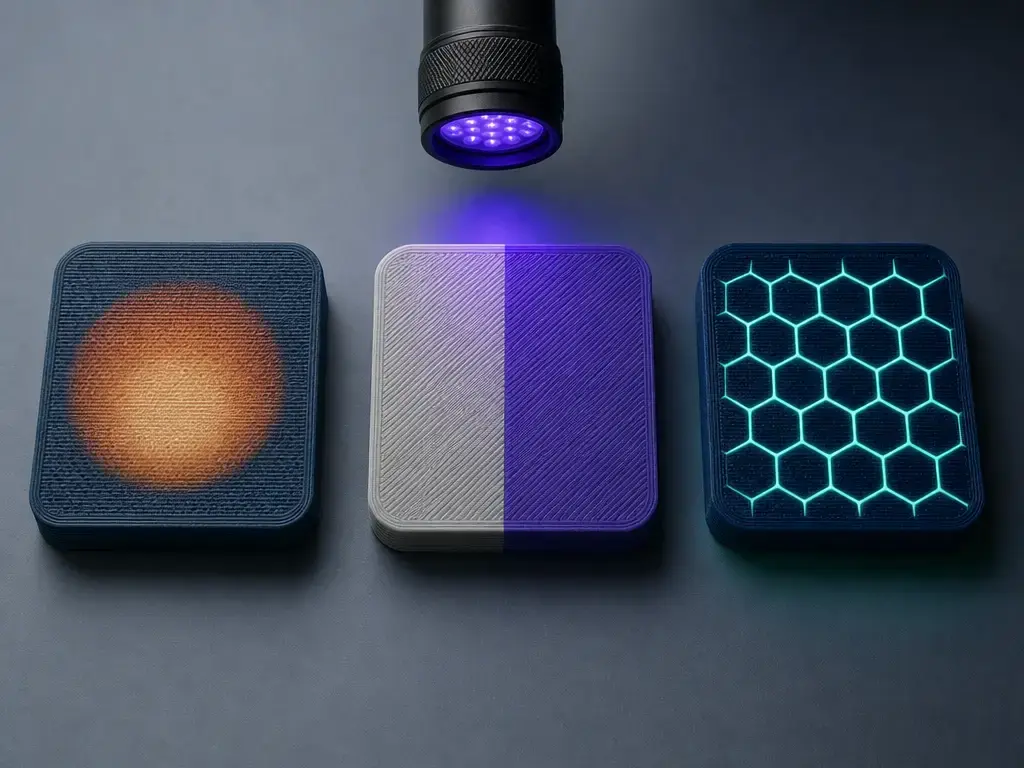
Shoppers often lump all “changing” filaments together, but the practical question is what makes the appearance change. Thermochromic filament is triggered by temperature, UV/photochromic filament is triggered by light, and gradient or silk-style multicolor filament simply reveals the colors already present in the strand. Photochromic behavior is reversible by definition, while thermochromic transitions can be gradual and hysteretic. [10] [14]
| Type | Trigger | Common base polymers | Key limitation |
|---|---|---|---|
| Thermochromic filament | Temperature. | PLA, TPU. | Product-specific transition; can be hysteretic. [14] |
| UV/photochromic filament | UV, black light, or sunlight. [10] | PLA is common. | Exposure conditions dominate, and response can fade with cycling. [10] [17] |
| Gradient, silk, or dual-color filament | Built-in color layout. | PLA is common. | Not stimulus-responsive. |
Materials and additives: PLA first, TPU as a distinct subtype
The simplest model is base polymer plus functional additive package. PLA is the most familiar consumer example because current retail products are often sold as modified PLA with official TDS or wiki guidance, including photochromic examples from eSUN and Polymaker. [4] [5] That does not make every spool interchangeable: additive chemistry, additive loading, and part geometry all affect how visible the shift will be. [4] [5]
TPU is a separate workflow case, not just softer PLA. eSUN’s temperature color-change TPU is listed at 95A hardness, with a transition temperature as low as 28 °C, and its official print guidance calls for 220–250 °C nozzle temperature, 45–60 °C bed temperature, speeds below 100 mm/s, and drying at 55 °C for 4 hours or more. [6] Its SDS also frames the material as 90–98% TPU with 2–10% additives, which is a useful reminder that the base polymer still drives feeding and handling even when the visible effect comes from the additive package. [7]
- Base polymer.
- Additive chemistry.
- Additive loading.
- Wall thickness.
- Infill.
- Surface finish.
- Lighting or heat exposure.
- Cooling rate.
- Calibration.
Printing workflow and calibration (make the color shift predictable)
Start with the official TDS or manufacturer wiki for the exact spool you have, because color changing filament is highly product-specific. Polymaker’s UV Shift PLA guidance lists 190–230 °C nozzle temperature, 25–60 °C bed temperature, speeds up to 200 mm/s, maximum volumetric speed up to 16 mm³/s, and drying at 55 °C for 6 hours only if the filament has absorbed moisture. [5] eSUN’s PLA UV Color Change TDS uses a different window: 190–230 °C nozzle temperature, 45–60 °C bed temperature, 100% fan, and 40–300 mm/s print speed. [4]
Use temperature towers, flow checks, retraction tests, and cooling adjustments to optimize print quality, not to guess the activation threshold. These tests help clean up layer lines, stringing, surface finish, and wall consistency; they do not reveal the true color-transition window by themselves. Trigger behavior should be evaluated after the part is printed and cooled, because nozzle heat during extrusion is not the same as the intended use condition. [4] [5]
For UV-reactive products, print small coupons and compare them under sunlight and under a controlled UV or black-light source. For thermochromic products, compare thin and thick coupons during warm-water, hand-contact, or controlled surface-heating tests, because section thickness changes how quickly the visible transition appears. Record what you used, because exposure intensity, exposure time, and viewing conditions all change what you see. [10] [17]
- Dry the filament if the manufacturer says moisture may be present or performance suggests it. [5] [6]
- Check nozzle guidance for that exact product before printing. [5] [8]
- Print a temperature tower or first swatch within the maker’s stated temperature range. [4] [5]
- Test both thin and thick swatches so geometry effects are obvious early.
- Trigger the color change only after printing and cooling. [9] [10]
- Record the exposure or temperature condition used for the test. [10] [17]
Recommended print settings (official examples only; no averaging)
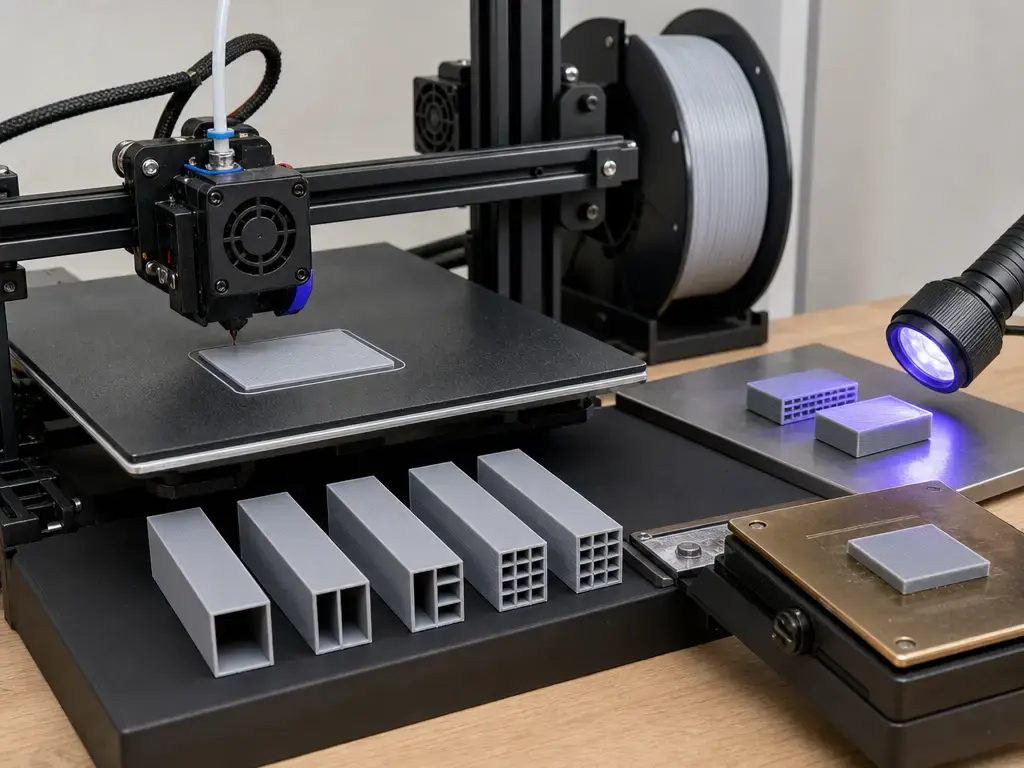
There is no universal color-changing filament profile, so the safest approach is to use brand-published settings as starting points and then calibrate on your own machine. The table below uses official product or manufacturer-document values rather than averaged community profiles. [4] [5] [6] [8] [9]
| Example product (base polymer) | Nozzle | Bed | Notes |
|---|---|---|---|
| eSUN PLA UV Color Change (PLA) | 190–230 °C. [4] | 45–60 °C. [4] | Fan 100%; speed 40–300 mm/s. [4] |
| Polymaker UV Shift PLA (PLA) | 190–230 °C. [5] | 25–60 °C. [5] | Up to 200 mm/s; max volumetric speed up to 16 mm³/s. [5] |
| Spectrum PLA Thermoactive (PLA) | 185–230 °C. [8] | 0–50 °C. [8] | Color changes when surface temperature exceeds 30 °C and gradually restores after cooling. [9] |
| eSUN TPU Color Change by Temp (TPU 95A) | 220–250 °C. [6] | 45–60 °C. [6] | Speed below 100 mm/s; dry at 55 °C for 4 h or more. [6] |
Reseller cards can conflict with manufacturer data. B&H lists Polymaker UV Shift PLA at 40–60 mm/s, which does not match Polymaker’s own “up to 200 mm/s” guidance, so trust the manufacturer first and then calibrate with swatches. [20] [5]
Performance metrics that matter (what to measure, what not to assume)
For color changing filament, the useful response metrics are the transition window, hysteresis, response time, fade time, exposure dependence, and geometry dependence. The visible state can be surface-led rather than bulk-led, so thin walls can react faster than thick sections, and heating and cooling may not follow the same path. In the leuco-dye composite study cited earlier, hysteresis widened to about 4 °C in one case and about 18 °C in another, which is why the transition temperature should be treated as a test-dependent window rather than a single magic number. [14]
Do not confuse that response window with nozzle temperature, bed temperature, glass-transition temperature, heat-deflection temperature, or Vicat softening data. If you want instrumental color reporting, CIELAB is the standards-based color-space context defined by ISO/CIE 11664-4, and ASTM D2244 is a common practice reference for calculating color differences from measured color coordinates. [15] [16] Separate from the color effect, ordinary print-performance data still matter: eSUN’s PLA UV TDS lists density at 1.25 g/cm³, melt flow index at 8.5 g/10 min (190 °C/2.16 kg), tensile strength at 27.58 MPa, and elongation at break at 2.88%. [4]
Applications (and when not to treat it as a sensor)
Color changing filament works best where a visible cue is more useful than a permanent label. Classroom demos, cosplay props, interactive handles, sun-reactive markers, and touch-reveal surfaces are all reasonable fits because the effect is easy to see without electronics. Spectrum even markets PLA Thermoactive for temperature-indicator-style applications, and its TDS ties the shift to surface temperature above 30 °C with gradual restoration afterward. [8] [9]
That visible response is useful, but it is not a measurement-grade sensor by itself. A print that changes color can tell you that heat or UV exposure happened; it does not automatically tell you exactly how much, how long, or how uniformly unless you calibrate it against known conditions and control the environment. Use it for indication, teaching, or interaction, not for safety-critical decisions or closed-loop process control. [10] [14]
Limitations: fading, heat limits, nozzle wear, and food contact
Color-transition behavior is not the same as heat resistance. eSUN’s PLA UV Color Change TDS lists an HDT of 50.75 °C at 0.45 MPa, which is a property of the printed polymer under that test condition, not the trigger temperature for the visible photochromic effect. [4] A part can therefore show a strong color effect and still soften under load at relatively modest heat. [4]
Photochromic systems also have durability limits. A 2026 review of spiropyran-based photochromes describes UV-light stability as a key drawback and says fatigue resistance across repeated irradiation cycles is often only moderate to low; it also discusses strategies used to mitigate photofatigue and photodegradation. [17] In practical terms, a print can respond well when new and still lose contrast or speed after long outdoor exposure or many switching cycles. [17]
Nozzle wear and food contact are both product-specific caution areas. Polymaker recommends a hardened nozzle for its UV Shift PLA because of the UV-reactive additives, while Spectrum’s PLA Thermoactive page says a ruby or hardened nozzle is not recommended, so there is no universal rule for all color-changing filaments. [5] [8] Food use should also default to no unless the supplier and the finished printed object are specifically certified for that purpose; Polymaker says it has no data showing the material is food safe and notes that certification would apply to the printed object, not just the raw filament. [5]
Troubleshooting: weak color shift, patchy shift, or it stopped working
Weak or no color change
If the part barely changes, first check whether you are using the right trigger. A thermochromic print will not behave like a photochromic one, and a UV-reactive print may respond weakly indoors simply because the UV intensity is low. Another common cause is that the part never reaches the transition region evenly, especially if the walls are thick or the active surface is shaded. Photochromic performance is also cycle-dependent, and IUPAC explicitly treats number of cycles as an important parameter. [10]
Patchy or uneven shift
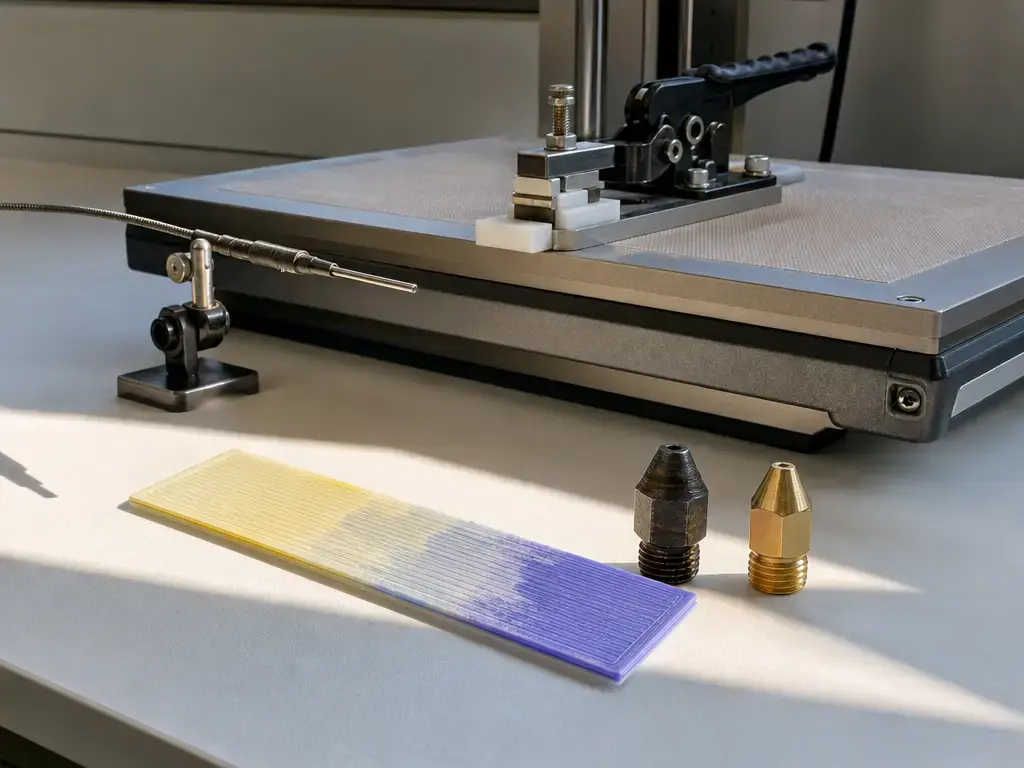
Uneven color change is often an exposure problem rather than a bad spool. Thin edges, overhangs, embossed details, and different wall thicknesses can warm or illuminate at different rates, so the same part may show several visible states at once. On UV-reactive parts, shadowing from geometry can keep one face active and another face dull. On thermochromic parts, local heat flow can create gradients across the same print. [10] [14]
Fading over time
If the response weakens after repeated use, look at cycling and sunlight exposure first. The 2026 photochromic review describes UV-light stability as a known challenge and notes that fatigue resistance is often only moderate to low for spiropyran-like systems. [17] In short, outdoor use and repeated switching can wear down the effect. For designs that need longer service life, it can help to make the active surface replaceable rather than burying it in a part that is hard to reprint. [17]
Buying and storage checklist
When choosing color changing filament, match the trigger to the job first. If you want hand-warmth, warm-water, or surface-temperature response, look at thermochromic products. If you want sunlight or black-light response, look at UV/photochromic products. Then confirm the activation conditions, print window, and any hardware cautions for that exact spool rather than assuming all PLA or all TPU products behave alike. [5] [6] [9]
- Choose thermochromic vs UV/photochromic by trigger, not by color alone. [10] [13]
- Check the stated activation or transition condition for the exact product. [6] [9]
- Confirm nozzle guidance instead of assuming the additives are or are not abrasive. [5] [8]
- Check drying recommendations before printing and before long storage. [5] [6]
- Print a small swatch first to confirm the actual shade and response on your machine. [4] [5]
- Avoid food-contact or safety-critical use unless the product and finished part are specifically certified for it. [5]
Store the spool in a dry, sealed environment and keep it away from unnecessary UV and heat exposure. That will not eliminate aging, but it does reduce moisture pickup and avoidable degradation. [5] [17]
Research and 4D printing context
This is research context, not consumer performance guidance. In lab work, authors often report measurable response using color-difference language such as ΔE instead of only saying that a sample changes color. A 2023 paper on photochromic PLA reported a recognizable ΔE response within seconds under UV irradiation and discussed cycling, including 25 cycles, which is useful as a measurement example but not a durability guarantee for retail filament. [18] If you see ΔE in papers, it usually sits in the CIELAB framework and is often reported using ASTM D2244-style calculation practice. [15] [16]
Adjacent 4D-printing work goes further by engineering the activation method itself. A 2025 electro-activated thermochromic display study used thermochromic PLA composites with embedded resistance wires, reported an optimal specimen thickness of 1.5 mm in that system, and reached about 78.5 seconds for 80% color change under its test conditions. [19] That is interesting for future smart displays, but it is not a direct benchmark for ordinary consumer filament on a standard desktop printer. [19]
FAQ
What is color changing filament?
Color changing filament is a filament formulated to visibly change after a stimulus such as temperature or UV exposure. In most consumer FDM/FFF use, that means either thermochromic or photochromic additives added to a familiar polymer base such as PLA or TPU. [13] [10]
What’s the difference between thermochromic and UV color-change filament?
Thermochromic filament changes with temperature. UV color-change filament is usually photochromic, meaning the change is induced by electromagnetic radiation and reverses thermally or photochemically. [10] They are different mechanisms, even if both are sold as color changing. [10]
Does sunlight activate UV color-change filament?
Usually, yes. Sunlight contains UV, so a photochromic print can respond outdoors even if it barely reacts under ordinary indoor lighting. The exact speed and strength still depend on the formulation and on how much UV reaches the printed surface. [10] [17]
What temperature does thermochromic filament change at?
There is no universal number. Spectrum’s PLA Thermoactive is documented to change once surface temperature exceeds 30 °C, while eSUN’s TPU temperature color-change product lists a transition as low as 28 °C. [9] [6] Always check the exact spool instead of assuming a generic thermochromic threshold. [6] [9]
Is UV color-change filament the same as glow-in-the-dark?
No. Photochromic filament changes its color state under irradiation and then recovers. Glow-in-the-dark materials rely on phosphorescence, which is persistent luminescence after the light source is gone. [10] [12]
Do I need a hardened nozzle for color changing filament?
Sometimes, but not always. Polymaker recommends a hardened nozzle for its UV Shift PLA because of the additives, while Spectrum’s PLA Thermoactive page says a ruby or hardened nozzle is not recommended. [5] [8] Follow the exact product guidance instead of generalizing from one brand. [5] [8]
Advanced: What is hysteresis and why does heating vs cooling matter?
Hysteresis means the visible change does not occur at exactly the same temperature on the way up and on the way back down. In the cited leuco-dye composite study, color hysteresis widened to about 4 °C in one condition and about 18 °C in another. [14] That is why a thermochromic print can look gradual or late to recover instead of flipping cleanly at one exact temperature. [14]
Sources
- ISO/ASTM 52900:2021 Additive manufacturing — General principles — Fundamentals and vocabulary
- Peer-reviewed paper quoting ISO/ASTM 52900 material extrusion definition
- eSUN PLA-UV Color Change product page
- eSUN PLA UV Color Change TDS
- Polymaker Panchroma UV Shift PLA official wiki
- eSUN TPU Color Change by Temp product page
- eSUN TPU-95A Color Change by Temp SDS
- Spectrum PLA Thermoactive product page
- Spectrum PLA Thermoactive TDS
- IUPAC Gold Book entry: photochromism
- IUPAC Gold Book entry: fluorescence
- IUPAC Gold Book entry: phosphorescence
- Review of reversible thermochromic microcapsules and leuco dye systems
- Study on hysteresis in leuco dye thermochromic composites
- ISO/CIE 11664-4:2019 Colorimetry — CIE 1976 Lab* Colour space
- ASTM D2244-21 Standard Practice for Calculation of Color Tolerances and Color Differences
- Review on photofatigue and UV stability in photochromic systems
- Photochromic PLA research article discussing Delta E, response, and cycling
- Electro-activated thermochromic display research article
- B&H reseller listing for Polymaker UV Shift PLA