
Summary
UL certification for 3D printers is imprecise buyer shorthand because the phrase can point to several different kinds of evaluation: finished-product safety certification, limited-scope classification, recognized components, additive-manufacturing material recognition, emissions testing or certification, and code or installation questions. [3] [5] [6] [1] [10] UL uses “Certified” as a broad term that encompasses legacy Listed and Classified marks, so the exact mark, file or unique ID, model, and scope matter more than the headline phrase alone. [3] [4] UL 2904 is a separate emissions method for particles and volatile organic compounds in defined indoor-use scenarios, not a full end-product electrical, fire, or mechanical safety certification. [1] [2]
What “UL certification for 3D printers” usually means
Why the phrase is imprecise
When a buyer asks about UL certification for 3D printers, the request may actually mean a finished-product mark, a limited-scope classification, recognized components inside the machine, additive-manufacturing material recognition, emissions testing or certification, or installation and code questions. [3] [5] [6] [10] Those buckets answer different risk questions, so a school, library, office, makerspace, or factory may need different evidence even when everyone uses the same shorthand. [10] [11] Even the phrase “UL listed 3D printer” is incomplete unless the seller can identify the exact model, the certification record, and the standard or program scope behind the claim. [3] [4]
The timeline is short: UL announced an additive-manufacturing equipment compliance guideline on February 25, 2015, publicized proposed first-edition UL 2904 development on February 23, 2018, announced GREENGUARD Certification for non-industrial 3D printers on February 25, 2019, and the current public UL 2904 listing shows the Second Edition published May 26, 2023. [13] [14] [2] [1] Official UL sources also separate industrial additive-manufacturing machines under UL 2011 from consumer 3D printers evaluated to UL 60950-1 and UL 62368-1, so one universal standards path should not be assumed. [9]
UL Listed, UL Certified, UL Classified, and UL Recognized Component
How the mark language maps to finished products and components
Before procurement language is written, it helps to separate the label on the product from the scope behind it. [3] UL testing by itself is weaker language than certification because third-party testing alone does not create a listing mark or ongoing factory surveillance for production units. [3]
| Term | Applies to | What it generally means | What it does not mean |
|---|---|---|---|
| UL certification (umbrella term) | Products, systems, or other evaluated items | A broad way to refer to certification under a UL program. [3] [4] | A single mark type or proof that every feature is covered. [3] |
| UL Listed / Enhanced UL Certified mark | Usually finished products | Certification for the applicable scope shown in the record; the enhanced mark can bundle multiple certifications. [3] [4] | Coverage of unlisted accessories, modifications, or installation conditions. [3] |
| UL Classified | Products or materials evaluated for specific properties or limited conditions | Certification for stated properties, limited hazards, or special conditions. [3] | Full finished-product certification for all hazards. [3] |
| UL Recognized Component | Components or subassemblies | Evaluation for use inside a larger certified product under conditions of acceptability. [5] | Certification of a standalone printer. [5] |
UL says “Certified” is a general term encompassing legacy Listed and Classified marks, and it says the Enhanced UL Certification Mark can bundle multiple certifications in one mark. [3] UL also says “Certified” meets the definition of “listed” in model codes, which is why purchase decisions should be tied to the record rather than to the word printed next to the mark. [3] [4] Existing Listing and Classification mark variations remain valid, so an older-style mark is not automatically obsolete. [4]
“Classified” and “Recognized Component” are narrower signals. [3] [5] A recognized component is not the same as a certified standalone printer because UL limits component recognition to components and subassemblies intended to be built into a larger end product and says conditions of acceptability apply. [5] In practice, that means a recognized power supply, board, switch, wire, or plastic part may help a manufacturer build toward certification, but it does not certify the assembled printer on its own. [5]
What printer certification may cover — and what it may not
Electrical, thermal/fire, and mechanical hazards
A printer safety question should start with hazard domains, not with the logo alone. [11] Desktop filament printers, enclosed classroom machines, resin systems, and industrial additive-manufacturing cells do not present the same mix of energized parts, heaters, moving axes, lasers, powders, resins, ventilation needs, or software-controlled interlocks. [11] [12] Not every certification path covers every hazard domain in the same way, so a finished-product mark, a classified property, and an emissions program should not be treated as interchangeable evidence. [3] [11]
UL 2011 covers industrial machines operating from 1000 V or less and explicitly includes industrial additive-manufacturing machines in scope. [9] The same public scope says consumer 3D printers are evaluated to UL 60950-1 and UL 62368-1, which is a product-class distinction rather than a universal rule for every installation. [9] For industrial equipment, UL frames equipment-level validation around fire, electrical, mechanical, and material hazards, including powders, resins, energy sources, ventilation, fire suppression, and operational controls. [11] UL’s safety guidance also identifies electrical exposure, unwanted irradiation, entrapment, thermal burns, hazardous fumes, VOCs, dust fire or explosion risk, and metal powders often under 100 µm as relevant additive-manufacturing hazards. [12]
Emissions and indoor-air hazards
Emissions are a separate hazard domain from shock protection, fire containment, guarding, and motion safety. [1] [11] A printer can have a finished-product safety path yet still require review for room size, duty cycle, material choice, filtration, exhaust, and maintenance, especially in classrooms, libraries, offices, and shared labs. [1] [17] Conversely, a low-emissions claim does not answer questions about hot surfaces, power supplies, accessible motion systems, or third-party accessories. [1] Buyers should read the certification scope and operating assumptions before treating any mark as complete proof of suitability. [3] [4]
What a buyer should verify:
- Exact model.
- Mark type.
- Standard or program.
- Emissions scope.
- Permitted materials and accessories.
- Installation requirements.
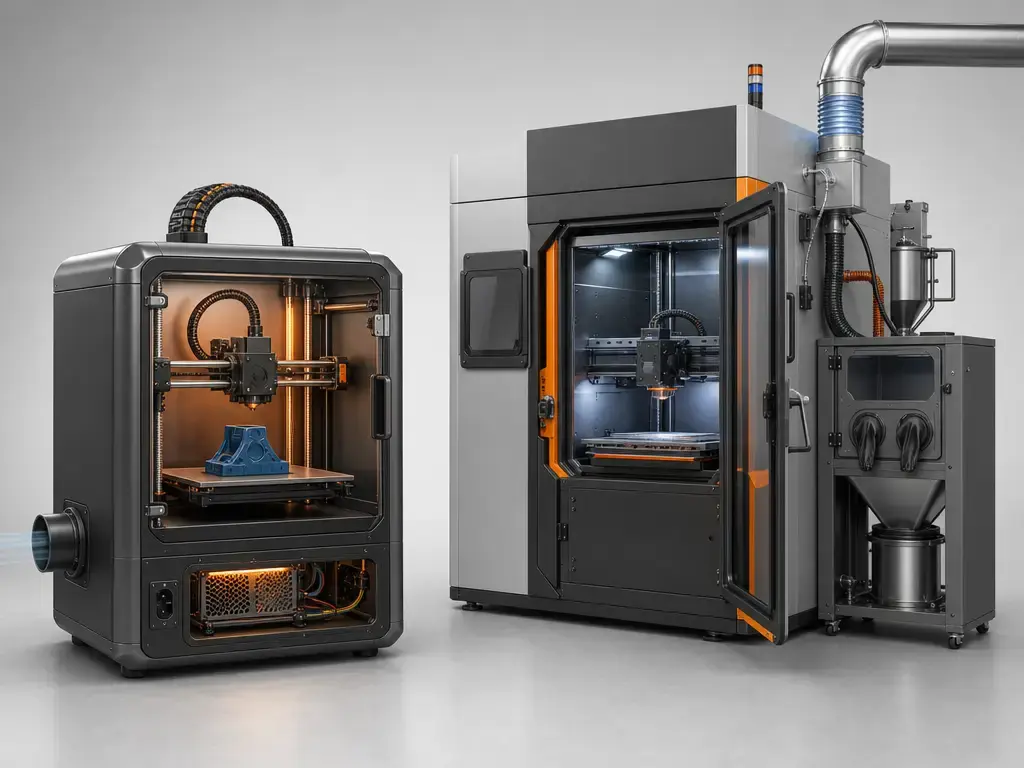
UL 2904 and GREENGUARD: low-emission claims, not full printer safety
What UL 2904 measures
UL 2904 is currently listed publicly as Standard Method for Testing and Assessing Particle and Chemical Emissions from 3D Printers, Second Edition, published May 26, 2023. [1] Its scope covers characterization and quantification of coarse, fine, and ultrafine particles plus volatile organic compound emissions from operating 3D printers under normal use in defined indoor environments such as classroom, office, and residential scenarios, and it primarily applies to printers and feedstock used in libraries, small and medium enterprises, and other non-industrial indoor spaces. [1] UL 2904 is an emissions test method under defined indoor-use conditions; it is not a substitute for full end-product safety certification. [1] [2]
What GREENGUARD adds
UL announced GREENGUARD Certification for non-industrial 3D printers on February 25, 2019, and said the program is based on UL 2904. [2] UL also says GREENGUARD Certification is awarded to printers and printing materials that demonstrate emissions below the UL 2904 limit, so buyers should label a claim by scope: printer-only, printer-plus-material, or a named program such as GREENGUARD. [2] EPA notes that 3D printers are now common in educational settings, which is one reason exposure claims need context rather than a generic “low emissions” label. [16]
Independent evidence shows why that distinction matters indoors. [15] [18] In a NIST library-office study, particle concentrations during printing generally stabilized at 30,000 to 60,000 particles/cm³ above background, and room ventilation at 9.45 air changes per hour cut concentrations by about half after 12 to 13 minutes and brought them near background within 18 to 20 minutes. [15] In a NIOSH office evaluation with up to 20 desktop printers, respirable particulate stayed below 0.03 µg/m³ and measured VOCs were below applicable occupational exposure limits, but NIOSH also said local exhaust could reduce or eliminate ultrafine-particle concentrations and that there are no occupational exposure limits specific to 3D-printer emissions. [18] A meta-analysis found that both ABS and PLA fused-filament printing produced ultrafine particles, with no substantial difference in mean size, while ABS produced higher ultrafine-particle concentrations than PLA. [19] A 2022 review covering 50 published studies found that higher printing temperature generally produced higher emissions, styrene was the main reported VOC during ABS printing, and additive-containing filaments could pose higher risk. [20] EPA’s practical controls are therefore still relevant even when a low-emissions claim exists: improve ventilation, use lower-emission printers and materials, reduce nozzle temperature where compatible with print quality, reduce time spent near the printer, and use enclosures or local exhaust where appropriate. [17]
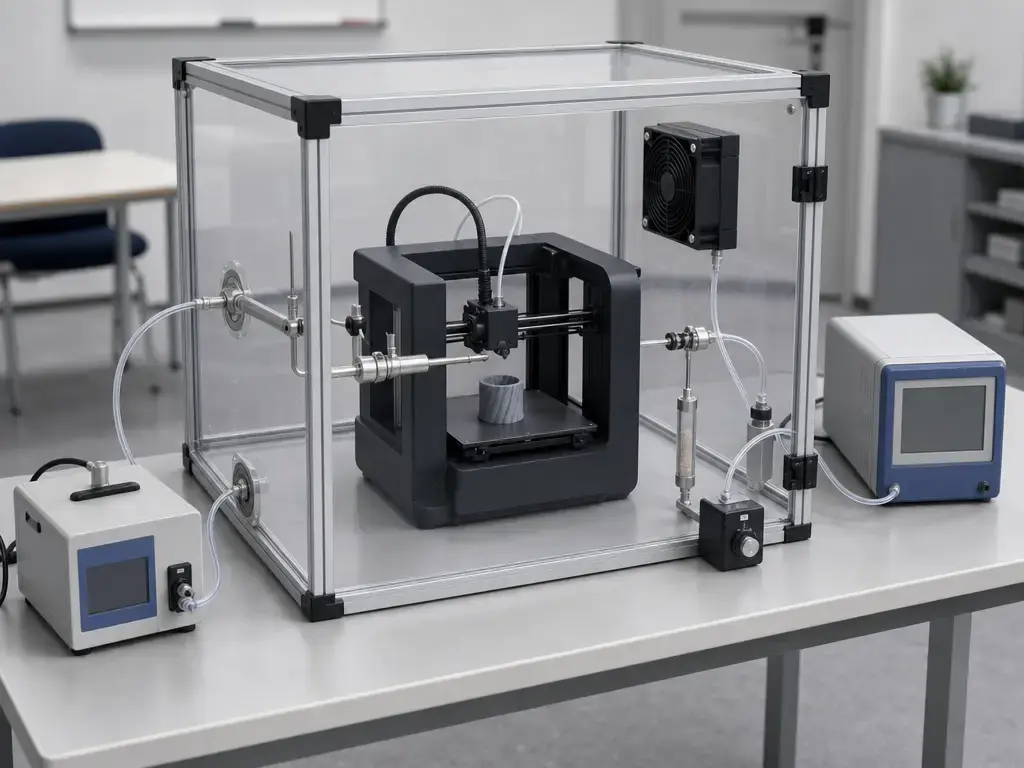
Component and material certifications are not printer certifications
A common buying mistake is to treat certified ingredients as proof that the assembled machine is certified. [5] [6] A printer built from UL Recognized parts is not automatically a UL-certified printer. [5]
Recognized parts inside a printer
Component recognition applies to components and subassemblies intended to be used inside a larger product, and UL says those parts are evaluated under conditions of acceptability. [5] In printer terms, that can include power supplies, wiring, plastics, switches, heaters, boards, motors, and similar subassemblies. [5] Those recognitions can support a finished-product evaluation, but they do not replace it, because the full machine still has to manage wiring routes, heat buildup, abnormal operation, accessible motion, enclosure design, and user access as one system. [5]
Material certifications and printer-specific conditions
Material recognition has a similar boundary. [6] UL’s additive-manufacturing plastics FAQ says Yellow Card ratings do not carry over to 3D printing, because additive-manufacturing material certification has to be evaluated separately with the specific printer and parameters. [6] UL’s Blue Card program publishes scope-sensitive information such as print technology, printer model designation, and build parameters, and UL says multiple Blue Cards may be needed where properties differ across printers or parameter sets. [7] A Blue Card can document a material-process-printer combination, but it should not be read as blanket certification of the printer itself or universal approval for substitute filaments and settings. [6] [7]
How to verify the certification scope before you buy
Reading the mark and the file number
Start with the physical or digital mark, then the unique ID or file number, then the exact model designation. [4] UL says the mark may carry a unique identifier or file number that can be verified in Product iQ, and UL also says legacy Listing and Classification marks remain valid. [4] If a seller only says “third-party testing,” ask whether that testing produced a current certification record for the exact model and configuration being quoted. [3]
| Claim on product page | What it may actually mean | What to verify |
|---|---|---|
| UL certified | Broad umbrella wording. [3] [4] | Mark type, unique ID or file number, and exact model coverage. [4] |
| UL listed | Finished-product certification claim. [3] | Exact model, category, and applicable standard. [3] [4] |
| Low emissions | Emissions testing or certification only. [1] [2] | Printer-only, printer-plus-material, or named program scope. [2] |
| Uses UL-recognized components | Certified parts inside the machine. [5] | Whether the complete printer is certified. [5] |
| Approved for classrooms | Marketing or suitability language. [10] [17] | Ventilation assumptions, emissions scope, supervision, and site rules. [10] [17] |
Checking Product iQ and the exact claim
UL’s Product Sourcing and Certifications Database says Product iQ is the tool for quickly accessing certification information and that searches can begin with a keyword or with information such as a file number. [8] Use the file number first if you have it, then search the exact model designation as a keyword and compare the record to the quotation, nameplate, manual, accessories, and permitted materials. [4] [8] For materials, do not assume a generic plastic rating applies to every printer, because UL says additive-manufacturing material recognition is printer- and parameter-specific and Blue Card documentation may differ by printer model designation and build conditions. [6] [7]
Before issuing a purchase order, record:
- exact model designation;
- mark type;
- standard or program;
- emissions scope;
- material, accessory, and site conditions.
Home, school, office, and industrial AM: what changes by setting
Nonindustrial desktop use
For homes, classrooms, libraries, and offices, the decision is usually a mix of electrical safety, supervision, materials, emissions, and ventilation. [10] [17] [18] The 2021 IFC is a code-context example, not a universal rule, but its Section 320.2.1 says nonindustrial 3D printers are listed and labeled in accordance with UL 2011, UL 60950-1, or UL 62368-1 and that the listing also verifies self-contained operation, maximum 30-liter prepackaged production materials, no external combustible dust collection, and no inert gas. [10] EPA also notes that 3D printing is a popular educational tool and that children and teenagers may be regularly exposed in settings such as classrooms and libraries, which is another reason to treat room conditions and operating practices as part of the safety picture. [16] NIST and NIOSH data show that measured outcomes vary with ventilation, room volume, number of printers, and control choices rather than with one universal indoor exposure number. [15] [18]
Industrial equipment, permits, and site approval
Industrial 3D printers add another layer because machine evaluation is not the same as facility safety management or authority approval. [10] [11] The 2021 IFC again provides code-context examples: Section 320.3 treats industrial additive-manufacturing operations as permit-triggering, and the code text says industrial 3D printers are listed and labeled to UL 2011 or approved for the application based on field evaluation by an approved agency. [10] UL’s industrial equipment guidance frames equipment-level validation around fire, electrical, mechanical, and material hazards, while naming powders, resins, energy sources, ventilation, fire suppression, and operational controls. [11] UL’s safety article adds site-level concerns such as hazardous fumes, thermal burns, dust fire or explosion, and metal powders often under 100 µm. [12] That is why industrial review must separate the machine mark, facility design, ventilation and suppression, material handling, housekeeping, training, and AHJ approval. [10] [11] [12]
No reliable universal U.S. requirement found; requirements vary by code edition, jurisdiction, buyer policy, and facility rules. [10] Questions procurement should ask vendors include which mark or program applies to the exact model, whether emissions certification is separate, which materials and accessories are included, what installation or ventilation assumptions apply, and whether additional AHJ review or field evaluation is needed. [4] [10] [11]
Questions procurement should ask vendors:
- Which mark or program applies to the exact model?
- Is emissions certification separate?
- Which materials and accessories are included?
- What installation or ventilation assumptions apply?
- Is additional AHJ or field evaluation needed?
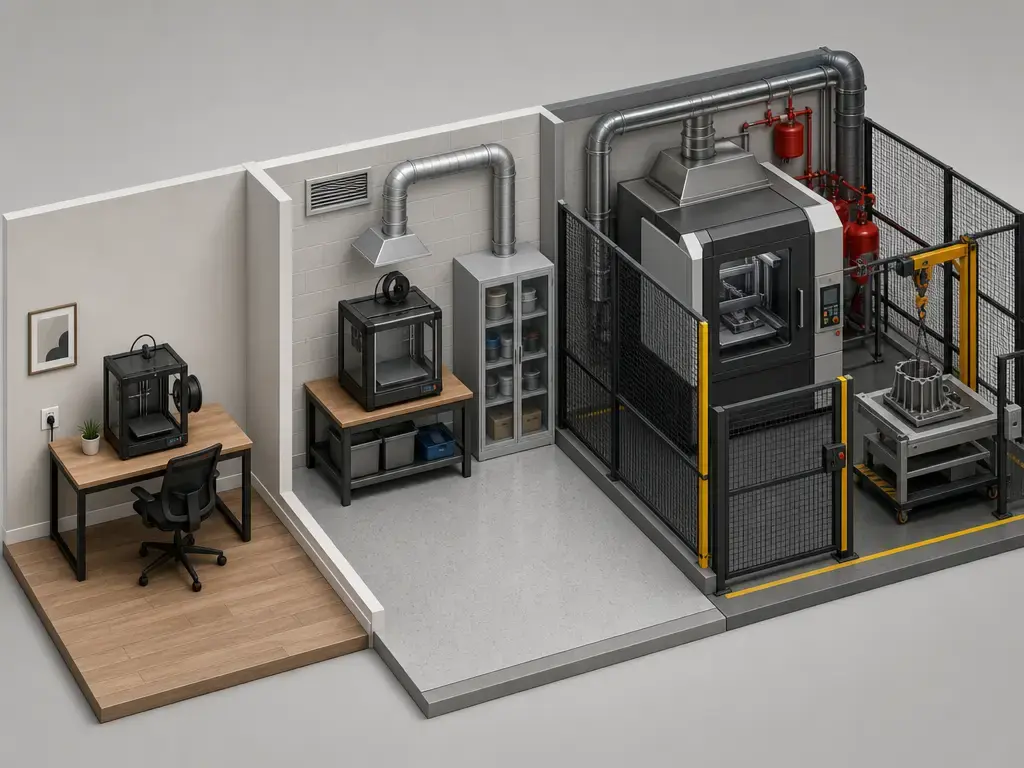
Limits of UL certification for 3D printers
What the mark does not guarantee
UL certification for 3D printers should be read as evidence within a defined scope, not as a blanket promise that every hazard was evaluated the same way. [3] [11] It does not mean zero emissions, because UL 2904 addresses particle and chemical emissions under defined indoor-use conditions rather than all hazard categories. [1] It does not mean universal suitability for every filament, resin, powder, accessory, replacement part, or user modification, because recognized components are not end-product certification and additive-manufacturing material recognition can depend on printer model and build parameters. [5] [7] It does not mean blanket acceptance under every local code, insurer rule, landlord policy, school policy, or buyer specification, because installation, ventilation, suppression, and material-handling questions can remain outside the machine mark. [10] [11] It also does not protect against blocked vents, bypassed interlocks, neglected filters, poor housekeeping, or unreviewed hardware changes, which is why EPA still recommends ventilation, lower-emission operating choices, lower nozzle temperature where workable, less time near the printer, and enclosures or local exhaust. [17] GREENGUARD and similar emissions programs are also narrower than complete product safety because they address emissions scope, not every electrical, thermal, or mechanical hazard. [2]
The practical takeaway is simple: verify the exact model, mark type, standard or program, emissions scope, permitted materials, accessories, and site assumptions before treating any claim as procurement-ready. [4] [8]
Practical guidance for buyers and lab managers
For informed consumers, school and library lab managers, makerspace operators, procurement teams, EHS readers, and SMB buyers, the safest purchasing language is scope-based rather than slogan-based. [3] Ask the vendor for the exact model designation, certification scope, emissions scope, included materials and accessories, and installation assumptions, then check the record in Product iQ instead of relying on phrases such as “third-party testing” or “compliance.” [4] [8]
Match the questions to the setting. [10] A classroom or office policy should still consider ventilation, lower-emission printers and materials, lower nozzle temperature where workable, reduced time near the printer, and enclosures or local exhaust. [17] For one universal requirement covering every home, school, office, and industrial installation, no reliable figure found; code and approval outcomes vary by jurisdiction and setting. [10]
FAQ
What does UL certification mean for 3D printers?
It is an umbrella phrase, not one single technical category. [3] The real question is what exactly was evaluated: the full printer as a finished product, a limited property, a component inside the machine, a material-process combination, or emissions performance under a defined program. [1] [3] [5] [6]
What is the difference between a UL listed 3D printer and UL certification?
“UL certification” is broad language, while “UL Listed” is one traditional finished-product mark type. [3] UL says newer marks may say “Certified,” and that term still meets the definition of “listed” in model-code usage. [3] [4] The practical distinction is whether the exact model is covered as a finished product or only under a narrower claim. [4]
Does UL 2904 mean a 3D printer is fully safe?
No. [1] UL 2904 addresses particle and chemical emissions from operating 3D printers under defined indoor-use conditions, and UL does not present it as a full electrical, fire, mechanical, or end-product certification path. [1] [2] Treat it as emissions evidence, not as complete printer safety certification. [1]
Does a printer with UL Recognized parts count as UL certified?
No. [5] Recognized parts are evaluated as components or subassemblies for use inside a larger product, and UL says conditions of acceptability apply. [5] A printer built from recognized power supplies, boards, plastics, or switches still needs end-product evaluation if the buyer requires a finished-product mark. [5]
Are UL-certified 3D printers required in schools or offices?
No reliable universal U.S. requirement found; requirements vary by code edition, jurisdiction, buyer policy, and facility rules. [10] The 2021 IFC gives one code-context example for nonindustrial printers, but local adoption, site policy, ventilation assumptions, and procurement rules can change the answer. [10] [17]
Expert: Which standards do official UL and code sources actually reference for nonindustrial and industrial additive manufacturing?
Official UL and 2021 IFC sources point to a split rather than a single path. [9] [10] UL 2011 includes industrial additive-manufacturing machines in scope, while the 2021 IFC nonindustrial section references UL 2011, UL 60950-1, and UL 62368-1 under stated conditions, and its industrial section points to UL 2011 or field evaluation by an approved agency. [9] [10]
Expert: Can a material’s UL recognition depend on the printer model and print parameters?
Yes. [6] UL says Yellow Card ratings do not simply carry over to 3D printing and that additive-manufacturing material certification must be evaluated with the specific printer and parameters. [6] UL also says Blue Card documentation can include print technology, printer model designation, and build parameters, and that multiple Blue Cards may be needed when properties differ across printers. [7]
Related on 3D Mag
Sources
Numbered references below map to the in-text citations used throughout the article.
- UL 2904 public standard page
- UL Announces GREENGUARD Certification for 3D Printers
- Third-Party Certification of Building Materials
- FAQ — Enhanced and Smart UL Certification Mark
- The UL Component Recognition Classification
- Certification Program for Plastics for Additive Manufacturing FAQs
- UL Solutions Blue Card Plastics for Additive Manufacturing
- Product Sourcing and Certifications Database
- UL 2011 public standard page
- 2021 IFC Chapter 3 General Requirements
- Additive Manufacturing Equipment
- Safety Considerations for Additive Manufacturing and 3-D Printing
- UL’s 3D Printing & Additive Manufacturing Equipment Compliance Guideline
- UL leading development of UL / ANSI standard for 3D printer emissions testing and evaluation
- Occupational exposure and indoor environmental quality evaluation from operating multiple desktop 3D printers in an office environment within a library
- 3D Printing Research at EPA
- Sources of Indoor Particulate Matter (PM)
- Characterizing 3D Printing Emissions and Controls in an Office Environment
- Particle emissions from fused deposition modeling 3D printers: Evaluation and meta-analysis
- Summary and derived Risk Assessment of 3D printing emission studies