

Summary
A STEP file is a neutral CAD format used to exchange product model data defined by the ISO 10303 family, most commonly encoded as an ISO 10303-21 “STEP Physical File” (Part 21) in clear text and identified by a referenced EXPRESS schema in the file header, which determines the semantics of the exchanged data. [8][4] As of May 16, 2026, the IANA-registered media type for this STEP file format is model/step (registered 2021-08-05), and the registry lists common STEP file extensions including .p21, .stp, .step, .stpnc, and .210. [8]

What Is a STEP File (ISO 10303) — Scope and Typical Content
ISO 10303 is a multipart standard for representing and exchanging product data, with work in ISO reported as ongoing “since 1984,” and STEP positioned as a standards-based mechanism for product model data exchange rather than a single monolithic file specification. [14] A STEP file, in the common Part 21 form, acts as an exchange structure whose meaning depends on an EXPRESS schema identified in the header, so the same physical encoding can carry different kinds of product data depending on the chosen schema and context. [8]
In STEP terminology, an “application protocol” (AP) specifies a domain-focused data model and usage rules, while an “implementation method” defines how that model is encoded for exchange (for example, Part 21 clear-text files or Part 28 XML). [4][12] Early STEP standardization illustrates the breadth of the effort: an initial release was described as twelve documents totaling 2104 pages submitted to ISO, reflecting the standard’s large scope and modular organization. [15]
Historical Background — From ISO Work Start to Part 21 Editions
A commonly cited starting point for STEP standardization work in ISO is 1984, preceding the broad early document releases described in 1994-era NIST materials. [14][15] For file interchange, ISO 10303-21 (Part 21) formalized the STEP Physical File clear-text encoding in ISO 10303-21:1994 (published 1994-12, edition 1, 57 pages), then advanced to a second edition in ISO 10303-21:2002 (published 2002-01, edition 2). [1][2] A third edition, ISO 10303-21:2016 (published 2016-03, edition 3), introduced additional capabilities including anchor, reference, and signature sections, support for compressed exchange structures in an archive, support for digital signatures, and support for UTF-8 character encoding. [3]
STEP File Syntax (ISO 10303-21) — Physical File Identification and Sections
A Part 21 STEP physical file can be identified by the first characters in its first record, ISO-10303-21;, which serves as a file signature for the encoding. [4] At a high level, Part 21 organizes content into a header and data representation consistent with an exchange file whose semantics are governed by the referenced EXPRESS schema in the header. [8]
A 2002-conformant file typically terminates with the record END-ISO-10303-21;, and guidance for the 2016 edition notes that digital signatures may appear after this terminator. [5] The Library of Congress description treats STEP physical files as exchange structures tied to EXPRESS-defined schemas, reinforcing that parsers and downstream tools must interpret entity instances in the context of the schema and AP expectations rather than as schema-free geometry alone. [4]
Encoding, Character Sets, and Compression — What 2016 Adds
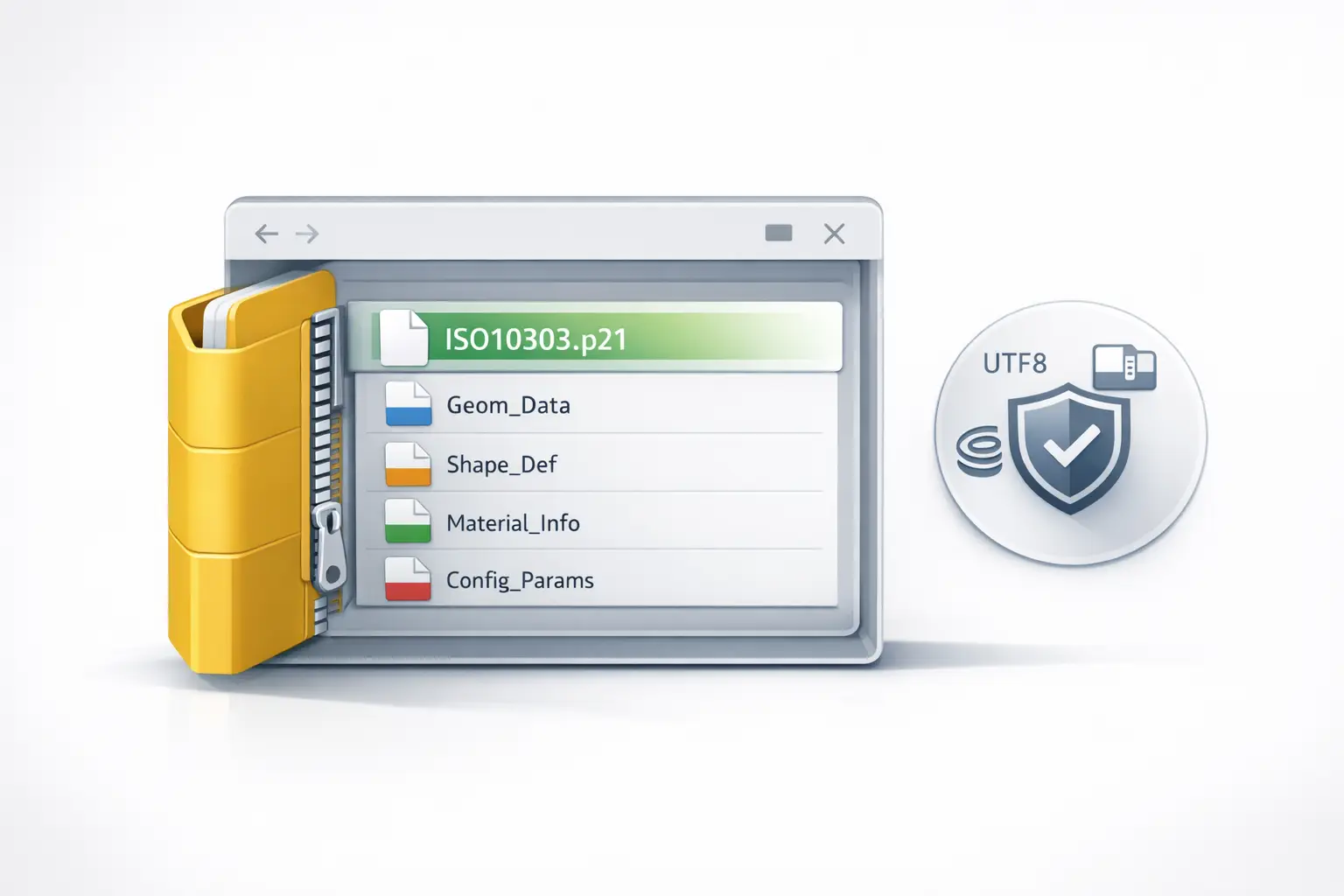
Part 21 is a text-based encoding with defined character constraints, and the Library of Congress summary describes a permitted character set that includes Unicode code points U+0020 to U+007E and U+0080 to U+10FFFF, with the 2016 edition extending the permitted alphabet to “high” codepoints using UTF-8. [6] ISO 10303-21:2016 also adds explicit support for compressed exchange structures in an archive and for digital signatures, along with anchor and reference sections intended to enhance structure and referencing within exchanged content. [3] Where ZIP packaging is used for a multi-file exchange structure, the Library of Congress description constrains it to PKZIP 2.04g with Deflate compression and specifies an archive root file name of ISO10303.p21. [7] No reliable figure found in the cited standards and registry documentation for typical STEP file size, compression ratios, or interchange “accuracy” metrics, so numeric performance expectations are not standardized at this level. [7]
Application Protocols (AP) — AP203 vs AP214 vs AP242
An application protocol (AP) selects the EXPRESS-based information model and conformance expectations for a given exchange scenario, so AP choice affects interoperability even when the same STEP Physical File (Part 21) encoding is used. [8][4] In industry positioning materials, STEP AP242 is described as the successor of AP203 and AP214, with AP242 Edition 1 published in 2014 and AP242 Edition 2 released in April 2020. [13]
AP242 is commonly framed around managed model-based engineering, including product and manufacturing information (PMI) and model-based definition (MBD) use cases where semantic representation of annotations (including geometric dimensioning and tolerancing, GD&T) is an objective, although specific payload outcomes still depend on the exporter, the receiver, and the exact AP conformance used. [11][13] As a current standards metadata reference point, ISO 10303-242:2025 (published 2025-08, edition 4, 64 pages) is the latest cited edition for AP242. [11]
The table below summarizes relationships and common usage notes at a high level, without implying a complete feature matrix. [13][11]
| AP | status/relationship | typical payload categories | noted timeline milestones / common usage notes |
|---|---|---|---|
| AP203 | predecessor to AP242 | B-rep (boundary representation) solid model geometry/topology and basic attributes in many CAD translators | Commonly offered export option alongside AP214 in CAD tools. [16][13] |
| AP214 | predecessor to AP242 | Similar exchange of geometry/topology plus presentation-related attributes such as colors and layers in many implementations | Commonly offered export option alongside AP203 in CAD tools. [16][13] |
| AP242 | successor to AP203 and AP214 | Managed model-based 3D engineering, often associated with PMI/MBD and broader lifecycle exchange contexts | Ed1 published 2014; Ed2 released April 2020; Ed4 is ISO 10303-242:2025. [13][11] |
STEP-XML (ISO 10303-28) — When XML Is Used
ISO 10303-28 (Part 28) specifies XML representations for STEP data defined by EXPRESS schemas, providing an implementation method often referred to as STEP-XML. [12] In this framing, STEP-XML is not a different application protocol; it is an alternative encoding approach for representing schema-governed product data compared with Part 21 clear text. [12]
As a standards metadata reference, ISO 10303-28:2007 (published 2007-10, edition 1, 309 pages) is a cited Part 28 edition for STEP-XML. [12] Systems that already maintain XML-oriented pipelines may use STEP-XML for integration, but schema references and AP expectations remain central to interoperability because the underlying semantics still come from the EXPRESS definitions rather than from XML alone. [12][8]
MIME Types and File Extensions — What to Use in Systems and Pipelines
For content typing in software systems, IANA registers the media type model/step (registration date 2021-08-05) for STEP exchange files and associates it with file extensions .p21, .stp, .step, .stpnc, and .210. [8] The same registry highlights an interoperability consideration: the semantics are given by an EXPRESS schema referenced in the header section of an exchange file, so correct handling depends on recognizing and supporting the referenced schema and intended AP usage rather than treating every .stp or .step file as equivalent. [9]
Practical Interoperability — What Typically Survives Translation
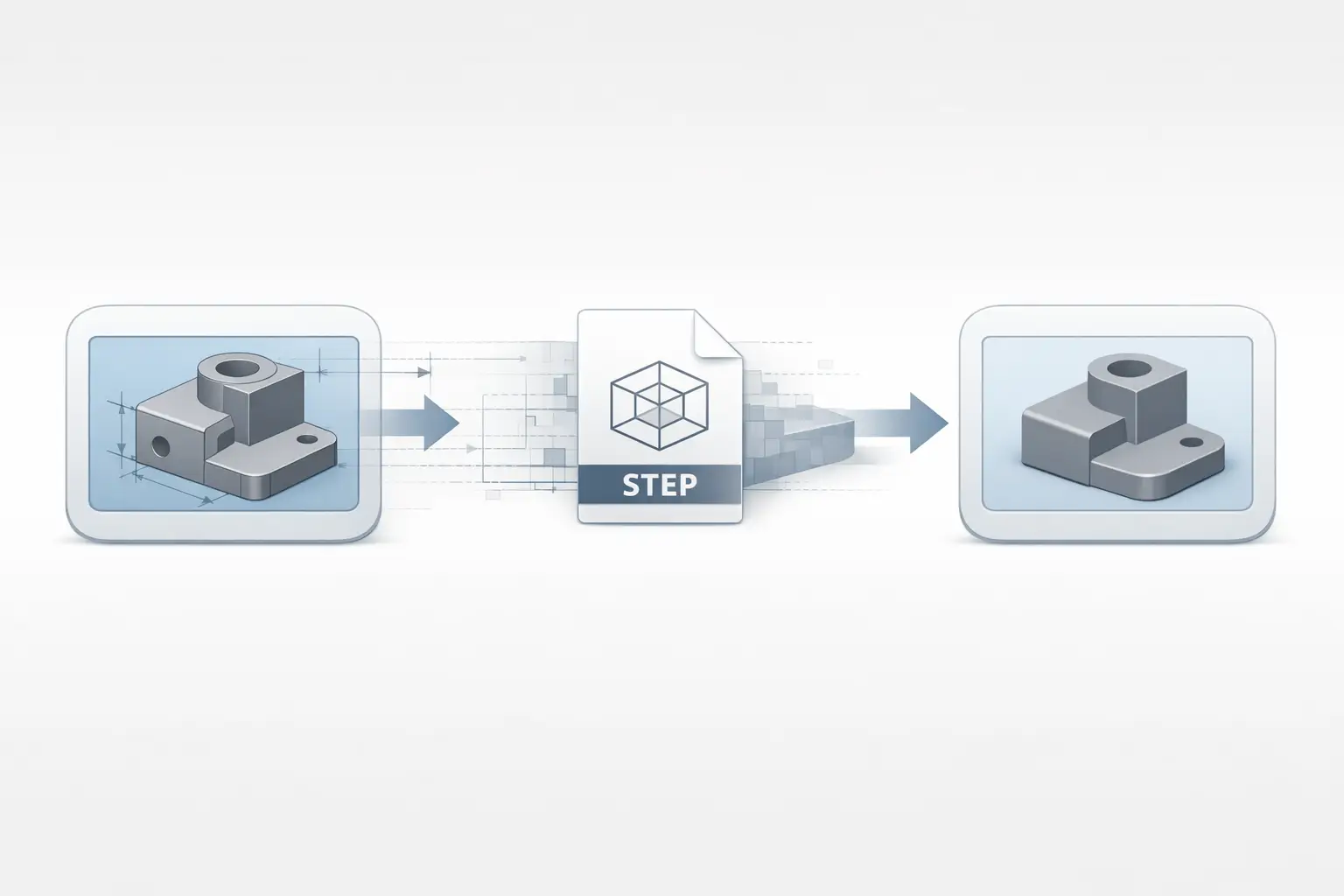
In practice, STEP exchanges often focus on precise geometry and topology rather than feature history, and vendor documentation can be used to illustrate what a particular tool preserves. [16] For example, Autodesk Alias documents STEP import as importing NURBS (non-uniform rational B-splines) and maintaining precise geometric surface and topology information (citing ISO 10303:42), while also carrying attributes such as layers, tolerances and units, and colors. [16]
The same Autodesk Alias documentation states that its STEP export uses AP203 or AP214, which reflects the common pattern that a tool’s supported AP set constrains what it can reliably write and what receivers can reliably interpret. [16] This aligns with the standards framing that a STEP physical file’s meaning is tied to the EXPRESS schema reference in the header, so “interoperability” depends on matching schema/AP expectations as much as on parsing the Part 21 syntax. [9][4]
Validation, Pitfalls, and “What STEP Does Not Guarantee”
STEP exchange is standards-based but not outcome-guaranteed: because semantics are determined by the EXPRESS schema referenced in the header, schema mismatch (including AP mismatch) can yield valid-looking files whose entities are interpreted differently by different importers, and this remains a primary interoperability risk. [9] Even within the Part 21 exchange structure, implementers must handle unit and tolerance interpretation consistently, and they must expect that some downstream systems treat layers, colors, and other attributes differently despite being representable in common STEP exchanges. [16] For long-term archival workflows (often discussed under long-term archiving, LOTAR) and for product data management (PDM) integrations, the existence of Part 21:2016 features such as UTF-8 and digital signatures does not by itself ensure that every tool in a pipeline supports those features uniformly. [3][6] No reliable figure found in the cited authoritative documentation for numeric translation “accuracy,” defect rates, or typical file sizes, so such metrics should be validated per toolchain rather than assumed. [7]
- Unit interpretation mismatches (especially when systems default differently). [16]
- AP mismatch (sender exports APxxx not supported by receiver). [16]
- Loss of feature history/parametrics (distinguish from B-rep exchange). [16]
- PMI presence vs semantic usability (do not assume semantic GD&T is usable without aligned AP and importer support). [11][13]
Q&A (FAQ)
What is a STEP file (.step/.stp) in CAD file formats?
A STEP file is an ISO 10303 exchange file commonly encoded as an ISO 10303-21 STEP Physical File, and IANA registers it under the media type model/step with extensions including .stp and .step. [4][8]
What does “ISO-10303-21;” mean at the top of a STEP file?
ISO-10303-21; is the Part 21 file signature that identifies the file as an ISO 10303-21 clear-text STEP physical file encoding. [4]
What is the difference between STEP Part 21 and STEP-XML (Part 28)?
Part 21 defines a clear-text STEP physical file encoding, while Part 28 (STEP-XML) defines an XML representation for STEP data based on EXPRESS schemas, and they are distinct implementation methods rather than different application protocols. [4][12]
Which STEP Application Protocol should be used — AP203, AP214, or AP242?
AP242 is described as the successor of AP203 and AP214, with Edition 1 published in 2014, Edition 2 released in April 2020, and a current cited standard edition ISO 10303-242:2025 (edition 4) published 2025-08. [13][11]
Expert — How is meaning/semantics defined in STEP exchange files, beyond geometry?
IANA notes that semantics are given by an EXPRESS schema referenced in the header of an exchange file, and the Library of Congress description similarly treats STEP files as exchange structures tied to EXPRESS-defined schemas. [9][4]
Expert — What changed in ISO 10303-21:2016 compared with earlier Part 21 editions?
ISO 10303-21:2016 (edition 3) adds anchor, reference, and signature sections, supports compressed exchange structures in an archive, supports digital signatures, and supports UTF-8, and the Library of Congress description notes that signatures may appear after the END-ISO-10303-21; terminator and describes the UTF-8 extension. [3][5][6]
Related on 3D Mag
Sources
- ISO 10303-21:1994 — Industrial automation systems and integration — Product data representation and exchange — Part 21: Implementation methods: Clear text encoding of the exchange structure
- ISO 10303-21:2002 — Industrial automation systems and integration — Product data representation and exchange — Part 21: Implementation methods: Clear text encoding of the exchange structure
- ISO 10303-21:2016 — Industrial automation systems and integration — Product data representation and exchange — Part 21: Implementation methods: Clear text encoding of the exchange structure
- Library of Congress — STEP-file (ISO 10303-21)
- IANA — Media Type model/step
- ISO 10303-28:2007 — Industrial automation systems and integration — Product data representation and exchange — Part 28: Implementation methods: XML representations of EXPRESS schemas and data, using XML schemas
- ISO 10303-242:2025 — Industrial automation systems and integration — Product data representation and exchange — Part 242: Application protocol: Managed model-based 3D engineering
- prostep ivip — Fact Sheet ISO 10303-242 STEP AP242
- Autodesk Help — Alias: STEP import/export
- NIST — Introduction to ISO 10303
- NIST — Standard for the Exchange of Product Model Data (STEP): A Ready-to-Use Industry Implementation