

Summary
REACH compliance for 3D printing materials means checking whether a substance, mixture, or, in some cases, a printed article is being supplied in a way that meets the duties of Regulation (EC) No 1907/2006. [1] It is not a generic material badge. The answer depends on what the product is, who places it on the EU market, and whether restricted substances or substances of very high concern (SVHCs) are present. [1] REACH entered into force on 1 June 2007. [3]
For additive manufacturing, the practical questions are product status, supply-chain role, and document quality. A filament spool, resin bottle, polymer powder, cleaning chemical, and printed part can sit in the same workflow but trigger different REACH consequences. [1] Article 33 communication duties apply when a Candidate List SVHC is present in an article above 0.1% weight by weight, and the Candidate List count must be date-qualified: ECHA reported 253 entries on 4 February 2026. [1] [5]
- Identify whether the supplied item is a substance, mixture, article, or a combination across the workflow.
- Identify your role in the EU supply chain before relying on any supplier declaration.
- Get the right information flow: SDS where required, or Article 32 information where no SDS is required.
- Check SVHC, Annex XVII restriction, and Annex XIV authorisation relevance for the specific product and use.
- Keep REACH separate from SCIP, CLP, workplace exposure control, and application-specific approvals.
Short legal time anchor
REACH entered into force on 1 June 2007. [3] For additive manufacturing, the key point is legal framing: the regulation applies through categories such as substance, mixture, and article, and through the role of the actor placing the product on the market. [1] That is why REACH review for 3D printing materials starts with the status of the feedstock, auxiliary chemical, or printed output, not with whether the printer is FFF, SLA, SLS, or another process family. [1]
First determine what the product is under REACH
Substance, mixture, or article?
REACH uses legal product categories rather than printer categories. A substance is a chemical element and its compounds, a mixture is a mixture or solution composed of two or more substances, and an article is an object whose function is determined more by shape, surface, or design than by chemical composition. [1] These definitions matter because one additive manufacturing workflow can involve a feedstock, a cleaning agent, a support-removal chemical, and a printed object with different REACH consequences. [1]
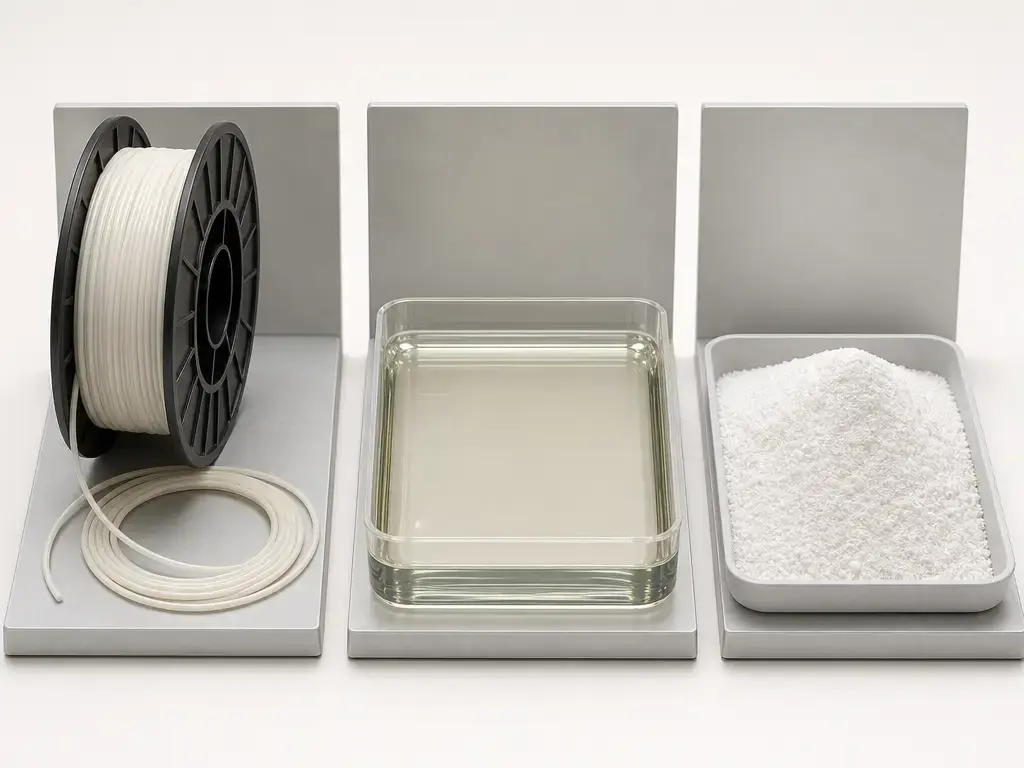
In additive manufacturing, feedstocks are often documented as mixtures in supplier files. Ultimaker’s PLA EU SDS lists the product form as a mixture, and EOS PA 2201 is also identified in its SDS as a mixture, with laser sintering listed as the relevant identified use. [11] [14] Printed outputs need separate analysis, because an object can fall into article review when its function is driven mainly by shape, surface, or design rather than chemistry. [1]
| Category | Legal test | AM example | Typical document pattern |
|---|---|---|---|
| Substance | Chemical element and its compounds. [1] | Neat chemical or feedstock constituent. | Registration and substance identity data. |
| Mixture | Mixture or solution composed of two or more substances. [1] | Filament, resin, or powder often documented this way. [11] [14] | SDS or Article 32 information. |
| Article | Function determined more by shape, surface, or design than by chemistry. [1] | Printed end-use part where geometry drives function. | Article 33 information if the SVHC trigger applies. [1] |
Why printed-part status is fact-specific
A printed object is not automatically an article for every REACH purpose; classification can be fact-specific and edge cases may require legal review. ECHA’s article guidance includes an ambiguous branch where it is “not possible to unambiguously conclude yes or no,” which is a useful warning against treating every printed shape as a simple article by default. [10] Where the object has an intended release function or substantial residual chemistry, the analysis can be less straightforward than for a conventional printed bracket or housing. [1] [10]

Who has which obligations in the EU supply chain?
REACH duties attach to the actor’s role, not to a generic “supplier” label. An importer is not the same as a distributor: ECHA treats the distributor as a distinct role that stores and places a substance or mixture on the market without changing its chemical composition, while a company bringing products in from outside the EU/EEA is acting as an importer. [16] A downstream user is also not a consumer; it is a professional or industrial actor using substances or mixtures in its activities, with its own obligations. [15]
For additive manufacturing, duties often shift when a company changes role by importing resin, reformulating filament, repacking powder, using a chemical in production, or supplying printed parts. Article 31 governs when SDSs are required for certain substances and mixtures, Article 32 can still require information where no SDS is required, and Article 33 applies to qualifying articles above the 0.1% w/w SVHC threshold. [1] Supplier-of-article duties are therefore not the same as feedstock-mixture duties. [1]
| Role | Typical AM example | Main duties | What to request or provide |
|---|---|---|---|
| EU manufacturer | Makes filament or resin in the EU. | Substance or mixture compliance, safe-use information, restriction screening. [1] | SDS where applicable, formulation-relevant declarations, restriction status. |
| EU importer | Imports powder, resin, or printed parts from outside the EU. | EU placing-on-market duties, including mixture information flow or article screening as relevant. [1] | Registration coverage where relevant, SDS or Article 32 data, SVHC information for articles. |
| Distributor | Resells sealed feedstocks without reformulating. [16] | Passes supply-chain information onward. [16] | Current SDS, supplier declaration, revision notices. |
| Downstream user | Uses purchased materials professionally to print parts. [15] | Applies communicated conditions of use and checks whether use is covered. [15] | Exposure-control instructions, operating procedures, internal use records. |
| Supplier of articles | Sells printed brackets, housings, jigs, or assemblies. | Article 33 communication when triggered; related SCIP review may also be relevant. [1] [9] | Article 33 information and, where relevant, SCIP-related data. |
The practical sequence is to identify the role, identify the product status, and then match the document set to both. A supplier declaration helps only when it is current and specific to the actual feedstock or printed article being supplied.
Safety Data Sheets, Article 31, and what documents actually prove
When an SDS is legally required, on request, or voluntary
A Safety Data Sheet is an important hazard-communication document, but SDS presence does not equal REACH compliance. SDS legally required: under Article 31(1), a supplier must provide an SDS where a substance or mixture is hazardous under CLP, where a substance is persistent, bioaccumulative and toxic or very persistent and very bioaccumulative, or where a substance is included in the Candidate List for Article 59 reasons other than those already covered by those hazard routes. [1]
SDS supplied on request under Article 31(3): a non-classified mixture may still need an SDS if the recipient asks and the mixture meets specified triggers. For non-gaseous mixtures, these include at least 1% w/w of certain hazardous substances, at least 0.1% w/w of certain higher-concern substances, or the presence of a substance for which there are Community workplace exposure limits. [1] Article 31(6) requires the familiar 16 SDS headings, and Article 31(8) requires the SDS to be provided free of charge no later than the date of first supply. [1]
Voluntary SDS: a supplier may issue an SDS even when it says one is not legally required. Ultimaker’s PLA SDS explicitly states that an SDS is not required for the product and that the document was created on a voluntary basis. [11] That can still be useful for handling, storage, and procurement review, but it is not proof that every REACH duty has been checked. Current SDS formatting is based on Commission Regulation (EU) 2020/878, which replaced REACH Annex II and applies from 1 January 2021. [2]
Article 32 matters because SDS logic is not the whole story. Where no SDS is required, suppliers of substances or mixtures may still have to communicate authorisation status, restriction details, and other relevant information needed for appropriate risk management. [1] For REACH 3D materials, that means procurement files should ask not only whether an SDS exists, but whether the correct Article 31 or Article 32 information has been provided for the specific product status and role. [1]
Required documents versus prudent procurement asks
A useful compliance file separates legally required communications from prudent procurement evidence. Bucket A covers information duties that can arise under REACH, such as Article 32 communication where no SDS is required and Article 33 substance-name disclosure for relevant articles. [1] Bucket B supports traceability, screening, and supplier due diligence, but it does not replace a legal communication duty. Formlabs’ BioMed Durable Resin page, for example, offers a request for a Material Certificate of Analysis, which is useful procurement evidence but not a substitute for an SDS, Article 32 information, or Article 33 communication. [13]
| Bucket | Document or ask | What it helps show |
|---|---|---|
| A | SDS where applicable. [1] | Required hazard and safe-use communication. |
| A | Article 32 information. [1] | Non-SDS REACH communication, including restriction or authorisation details where relevant. |
| A | Article 33 communication statement. [1] | SVHC article disclosure, at minimum the substance name. |
| A | Restriction or authorisation confirmation where relevant. [1] [18] | Whether substance-level REACH controls apply. |
| B | COA. [13] | Batch or material quality evidence. |
| B | Supplier declaration letter. | Supplier’s stated compliance position. |
| B | Questionnaire response. | Structured due-diligence answers. |
| B | Latest SDS revision history. | Change tracking. |
| B | CAS or EC disclosure where available. | Substance identity screening. |
| B | Test reports or TDS where relevant. | Performance or composition support. |
Bucket A and Bucket B are not interchangeable. A supplier declaration or COA may be helpful, but neither replaces the legally required information flow for the actual substance, mixture, or article being supplied. [1]
The REACH mechanisms that matter most for additive manufacturing materials
Candidate List and Article 33 communication
For printed parts that qualify as articles, Candidate List screening matters because Article 33 is triggered when an SVHC is present above 0.1% w/w in the article. [1] When that threshold is met, the supplier must provide enough information for safe use, and the minimum disclosure is the name of the substance. [1] If a consumer asks, the information must be supplied within 45 days of receipt of the request. [1] The Candidate List is not static, so the count should always be date-stamped: ECHA reported 253 entries on 4 February 2026. [5]
Article 7 notification is different from Article 33 communication
Article 7(2) is a separate article-context mechanism. It concerns notification to ECHA where a Candidate List substance is present in articles above 0.1% w/w and the total amount exceeds 1 tonne per producer or importer per year, subject to the regulation’s conditions and exemptions. [1] ECHA says these notifications are due no later than six months after the substance is included in the Candidate List. [7] This is not a universal duty for every company selling printed parts, because the thresholds, exemptions, and role all matter. [1] [7]
Annex XVII restrictions
Annex XVII restrictions work differently from Candidate List communication. ECHA explains that restrictions can limit or ban the manufacture, placing on the market, or use of substances on their own, in mixtures, or in articles. [17] For additive manufacturing materials, that can affect a resin ingredient, a pigment in a filament, an additive in a powder, a cleaning product, or a printed article, depending on the wording of the relevant entry. [17]
Annex XIV authorisation screening
Annex XIV authorisation screening is substance-specific and use-specific. ECHA’s Authorisation List is the list of substances included in Annex XIV, and companies that want to continue using a listed substance after the sunset date need to apply for authorisation before the latest application date. [18] That is different from saying that a whole material class such as “all photopolymer resins” or “all nylon powders” is covered. Where no SDS is required, Article 32 may still require communication of authorisation status and relevant restriction details. [1] [18]
| Mechanism | What triggers it | Typical AM relevance | What to ask or confirm |
|---|---|---|---|
| Article 31/32 information flow | SDS duty or non-SDS communication duty. [1] | Feedstock mixtures, auxiliaries, safe-use data. | Current SDS or Article 32 information. |
| Candidate List / Article 33 | SVHC above 0.1% w/w in articles. [1] | Printed parts or assemblies sold as articles. | Substance name and safe-use information. |
| Article 7 notification | Above 0.1% w/w in articles and over 1 tonne per producer or importer per year, subject to conditions and exemptions. [1] [7] | Higher-volume production or import of articles. | Whether notification or an exemption applies. |
| Annex XVII restriction | Entry-specific limit or ban. [17] | Constituents in materials or articles. | Relevant restriction entry and permitted use. |
| Annex XIV authorisation | Listed substance and continued use after sunset date. [18] | Specific high-concern substances in use. | Authorisation status and supply-chain coverage. |
These mechanisms overlap, but they do not replace one another. A product can have an SDS and still need restriction screening, and a printed article can pass a restriction check and still need Article 33 communication if the SVHC trigger is met. [1] [17]
Illustrative material examples: filament, resin, and powder
Filament example
As one supplier example, Ultimaker PLA shows why “PLA” is too generic a shortcut for REACH compliant 3D printer filaments. Its EU SDS lists the product form as a mixture and states that the SDS is not legally required but was created on a voluntary basis. [11] The same SDS notes less than 1% titanium dioxide in the form of or incorporated in particles with aerodynamic diameter at or below 10 µm. [11] It also gives a ventilation example of not less than 2 air changes per hour for 1 printer, assuming a room volume of 30 m³. [11] Those are supplier-specific details, not a market-wide conclusion about all PLA filaments. [11]
Resin example
As one resin example, the Formlabs Tough 1500 Resin SDS is issued under CLP and REACH and includes hazard statements H317, H335, and H411. [12] Its composition section includes phenyl bis(2,4,6-trimethylbenzoyl)-phosphine oxide at less than 1%. [12] The same SDS also includes transport classification information such as UN 3082 and Packing Group III. [12] These entries separate hazard communication, formulation disclosure, and transport status from the wider REACH question. They are relevant inputs, not a stand-alone conclusion that every intended use or printed output is covered. [12]
Powder example
As one powder example, EOS PA 2201 broadens the picture beyond filament and vat resin. Its SDS identifies the product as a mixture, lists laser sintering as the relevant identified use, and states that the mixture contains nanoforms according to REACH. [14] The same SDS says the product does not meet the classification and labelling criteria of the CLP Regulation. [14] This is useful because powder documentation can involve dust and nanoform context that is not captured by simply naming a polymer family. One powder file should not be generalised to all REACH 3D materials. [14]
Practical procurement workflow for EU buyers and suppliers
For procurement, QA, and service bureaus, chemical safety for additive manufacturing materials is easiest to manage as a repeatable file review. Do not start with blanket claims such as “all PLA is compliant” or “all certified resins are safe”; for market-wide compliance rates, no reliable figure found. Treat the supplier declaration as one input, not as the whole evidence package. [1]
- Identify your market role: manufacturer, importer, distributor, downstream user, or supplier of articles. [15] [16]
- Identify whether the supplied product is being sold as a substance, mixture, article, or a combination across the workflow. [1]
- Request the Article 31 or Article 32 information flow: SDS where applicable, or alternative REACH information where no SDS is required. [1]
- Screen for SVHC and Article 33 relevance where printed outputs are supplied as articles above 0.1% w/w, and track the 45-day timing where consumer requests are relevant. [1]
- Screen Annex XVII restrictions for substances, mixtures, and articles covered by the relevant entry. [17]
- Ask about Annex XIV authorisation status only where substance-level screening shows that a listed substance and a relevant use may be involved. [1] [18]
- Escalate unclear printed-part classification or opaque formulation issues before placing the product on the market. [10]
Where a printed product is supplied as an article, Article 7 may also need separate review. It is distinct from Article 33, and ECHA says notification is due no later than six months after Candidate List inclusion where the Article 7 conditions are met. [1] [7] Missing data should be treated as a gap, not filled with assumptions. Ask for the latest SDS revision, Article 32 information where relevant, restriction and authorisation statements, and prudent extras such as a COA where useful. Formlabs’ BioMed Durable Resin page is one example of a supplier offering a Material Certificate of Analysis request. [13]

What REACH does not prove
What REACH does not prove
REACH status should not be stretched into a wider safety or application claim. CLP is Regulation (EC) No 1272/2008, and hazardous substances and mixtures placed on the EU market must be classified and labelled under it. [4] That answers a different question from registration, restriction, authorisation, or article communication under REACH. Formlabs Tough 1500 Resin, for example, carries CLP hazard statements including H317, H335, and H411 in its SDS. [12] The same document also includes transport information such as UN 3082 and Packing Group III. [12] Those entries matter, but they do not prove that every intended use, workplace setup, or printed-part application is acceptable. [12]
In practical reviews, do not treat REACH-related paperwork as proof of emissions or ventilation adequacy, biocompatibility, food contact suitability, medical-device approval, or general worker-exposure compliance. Ultimaker’s PLA SDS gives one ventilation example of not less than 2 air changes per hour for 1 printer in a 30 m³ room, but that is not a universal ventilation design rule. [11] A COA request on a product page, such as the Formlabs BioMed Durable Resin Material Certificate of Analysis request, is also a separate document workflow from REACH compliance itself. [13]
SCIP belongs here, not in the REACH mechanism section
SCIP is established under the Waste Framework Directive; it reuses Article 33-type SVHC information, but it is not itself a REACH duty. [9] ECHA says the duty applies from 5 January 2021 for articles on the EU market that contain Candidate List SVHCs above 0.1% w/w. [9] Readers often confuse SCIP with REACH because both concern SVHC information in articles, but the legal basis is different. For additive manufacturing, the practical question is usually whether a printed part or assembly is being supplied as an article on the market. [9]
FAQ
Is an SDS enough to prove REACH compliance for a 3D printing material?
No. An SDS is important, but it is not standalone proof of full compliance. Article 31 governs when an SDS is required, while Article 32 can still require information where no SDS is required. [1] Some suppliers also issue voluntary SDSs; Ultimaker’s PLA SDS explicitly says it was created on a voluntary basis and was not legally required. [11] Restriction screening, SVHC review, and article duties may still need separate checking. [1]
Are 3D printer filaments REACH compliant?
There is no useful category-wide answer. Filaments differ by formulation, additives, pigments, supplier, revision, and supply-chain role. For a market-wide compliance rate, no reliable figure found. A better question is whether the named filament has current Article 31 or Article 32 information, relevant restriction screening, and, where printed outputs are sold as articles, any Article 33 review that may be needed. [1]
Does REACH apply to printed parts sold into the EU?
Yes, it can, but not under one automatic shortcut. The key issue is whether the printed output is assessed as an article and which role the company has in placing it on the market. [1] ECHA guidance recognises that some cases are ambiguous and that it may not be possible to unambiguously conclude yes or no, so borderline products can need legal review. [10]
What exactly does the 0.1% threshold mean under Article 33?
It is the Article 33 communication trigger for Candidate List SVHCs in articles. If an SVHC is present above 0.1% w/w in an article, the supplier must provide enough information for safe use, including at minimum the name of the substance. [1] If a consumer requests that information, it must be supplied within 45 days. [1] It is not a universal pass-fail threshold for all mixtures or all REACH duties. [1]
When does Article 7 notification matter for a printed product business?
Article 7 notification matters only in the article context, not as a general rule for all print sellers. It can become relevant where a Candidate List substance is present above 0.1% w/w in articles and the total amount exceeds 1 tonne per producer or importer per year, subject to the regulation’s conditions and exemptions. [1] ECHA says notification is due no later than six months after Candidate List inclusion. [7]
Is SCIP part of REACH, and when does it apply?
No. SCIP is not part of REACH; it is established under the Waste Framework Directive. [9] ECHA says the duty applies from 5 January 2021 for articles on the EU market that contain Candidate List SVHCs above 0.1% w/w. [9] For 3D printing, that usually concerns printed articles or assemblies placed on the market, not the mere existence of a feedstock SDS. [9]
Sources
- EUR-Lex consolidated REACH text
- Commission Regulation (EU) 2020/878
- ECHA: Understanding REACH
- ECHA: Understanding CLP
- ECHA: Candidate List update, 4 February 2026
- ECHA: Notification of substances in articles
- ECHA: SCIP
- ECHA: Guidance in a Nutshell on requirements for substances in articles
- Ultimaker PLA EU SDS
- Formlabs Tough 1500 Resin SDS (EU)
- Formlabs BioMed Durable Resin product page
- EOS PA 2201 powder SDS
- ECHA: Downstream user roles and obligations
- ECHA: Who is a distributor?
- ECHA: Restriction
- ECHA: Authorisation List