
Summary
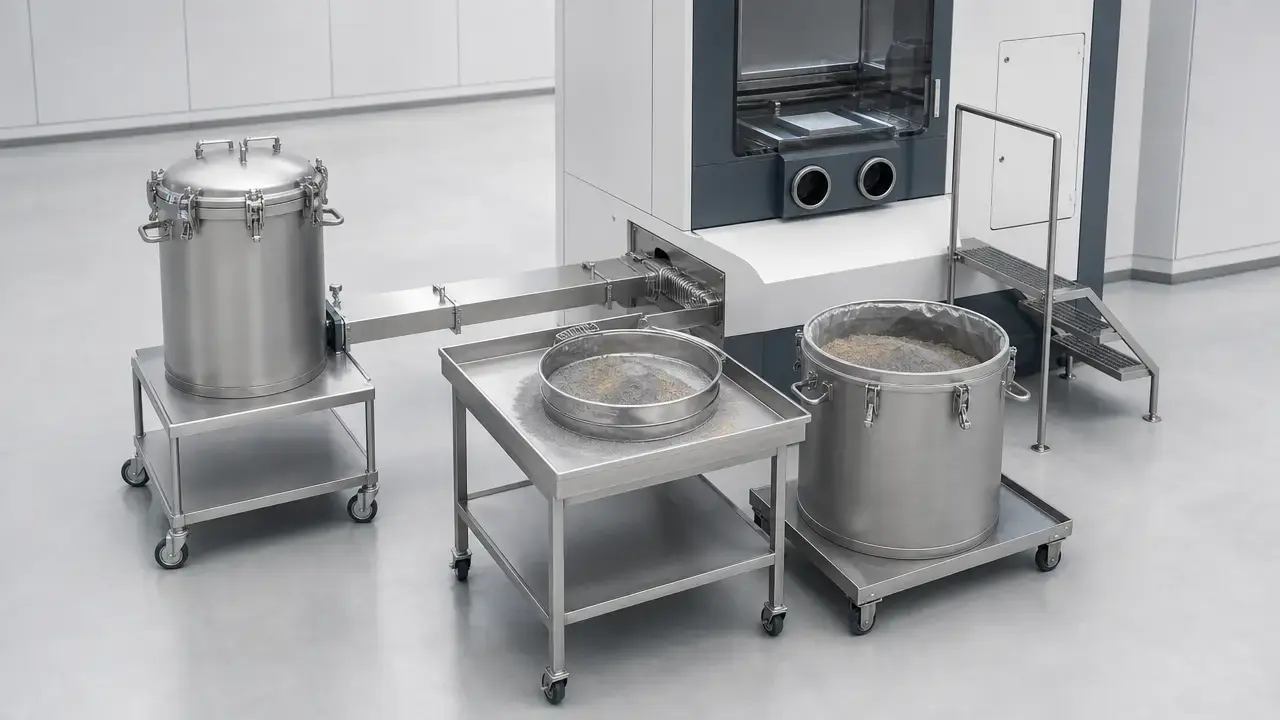
Material traceability in additive manufacturing is the documented ability to connect a part or build to the material identity, handling history, process route, inspection evidence, and release decision behind it. In industrial workflows, that usually means linking incoming powder, wire, resin, filament, or other feedstock to storage, internal handling, machine issue, build execution, post-processing, inspection, nonconformance handling, and final disposition. ISO 22095 frames chain of custody more broadly across materials and products, not services, so it should not be treated as a synonym for an AM shop’s internal genealogy. [2]
This matters because traceability is part of production control, quality assurance, and failure investigation, not just recordkeeping. ISO/ASTM 52920:2023 applies across AM technologies defined in ISO/ASTM 52900 and defines quality assurance measures along the manufacturing process, while NIST has identified insufficient traceability as a challenge for producibility, repeatability, reproducibility, and accountability in metals AM. [4] [9] These standards and NIST publications support qualification and audit practice, but they do not automatically create legal obligations on their own. In practical terms, additive manufacturing material traceability helps a team show what was made, from which material state, under which controlled conditions, and with which evidence. [2] [4]
What material traceability means in additive manufacturing
Before a traceability system can be designed, the vocabulary has to stay consistent. In additive manufacturing, one site may use different identifiers for a supplier lot, a material container, a build job, and a shipped serial part. If those relationships are vague, records become harder to trust during audits, investigations, and release review. ISO/ASTM 52900:2021, Edition 2, published in November 2021 and confirmed in 2025, is the terminology backbone used here for AM language. [1]
Key term distinctions
The terms below are easy to blur together, but they answer different questions. ISO/ASTM 52900 anchors the AM vocabulary, ISO 22095 provides broader chain-of-custody language, and NIST’s metrology guidance separates measurement traceability from batch tracking or lot number control. [1] [2] [7]
| Term | What it means in this article | What it is not |
|---|---|---|
| Identification | Assigning a controlled name, code, lot number, serial number, or other reference to a material, container, build, coupon, part, or record set. | Proof that the item is acceptable for use. |
| Traceability | The ability to follow documented links between material state, processing, inspection, and release decision. | A single label, certificate, or database field in isolation. |
| Genealogy | The parent-child relationship between material inputs, intermediate states, builds, coupons, and finished parts. | A complete quality argument by itself. |
| Provenance | Evidence of origin, source, and prior history for material or data. | A substitute for process control or acceptance evidence. |
| Chain of custody | A broader custody model for transferring responsibility and control across parties or stages. | The same thing as an internal AM material genealogy. |
| Measurement traceability | A metrology concept in which a measurement result is linked to stated references through a documented calibration chain. | Batch tracking, lot tracking, or a claim that an instrument is simply “NIST-calibrated.” |
These distinctions matter because custody evidence, material provenance, process evidence, and release evidence do different jobs. ISO 22095 applies across sectors to materials and products, and it explicitly says that chain of custody alone is not enough to substantiate claims about materials or products. [2] A usable audit trail therefore needs more than records of who handled what; it also needs technical evidence that the material condition, process route, and final disposition were acceptable. [2] [4]
Measurement traceability is a separate metrology issue. NIST states that metrological traceability belongs to a measurement result and requires a documented, unbroken calibration chain to specified references; merely using an instrument that was calibrated at NIST is not enough. [7] That prevents a common AM quality error: confusing “Can we link this part to a powder batch?” with “Can we link this dimensional or materials test result to recognized references with stated uncertainty?” Both matter, but they are different traceability problems. [7]
Traceability units depend on feedstock form
There is no universal AM traceability unit. The practical traceable unit changes with feedstock form, packaging, reuse, and how the material is divided before it reaches a build. For metallic powders, ASTM ISO/ASTM52907-19 covers documentation and traceability as well as packaging and storage, and it includes specific requirements for used metallic powders. ISO/ASTM 52928:2024 extends that discussion by focusing on powder lifecycle management and the control of virgin and used powders. [5] [6]
- metal powder: lot / heat / container / reused-powder history
- filament: spool
- resin: bottle / cartridge
Batch tracking should follow the way material is actually handled, not force every process into a powder model. In many extrusion workflows the spool is the practical handling unit, while resin workflows often revolve around bottle or cartridge identity plus tank life, mixing, and expiry controls. As a manufacturer-reported example, Formlabs says it offers lot numbers and certificate of conformance or certificate of analysis documentation for certain resin workflows. As another manufacturer-reported contrast, Bambu Lab says its AMS 2 Pro uses RFID to auto-match drying settings for official filaments. Those features can support identification and handling records, but they do not by themselves create full end-to-end traceable 3D materials control. [16] [18]
Why material traceability matters for quality assurance
Material traceability matters because AM quality assurance depends on being able to tell whether a suspect material condition is isolated, repeated, or spread across multiple builds and shipped parts. ISO/ASTM 52920 places quality assurance measures along the manufacturing process rather than treating them as a final archive step, and NIST has linked insufficient traceability to producibility, repeatability, reproducibility, and accountability challenges. [4] [9] When a nonconformance appears, a usable audit trail helps teams contain affected material, identify which builds are exposed, and support qualification or certification activities with evidence rather than reconstruction. [4] [9]
It also helps to separate three ideas that are often blurred together. Material provenance asks where the material came from and what happened to it before use. Process capability asks whether the controlled process can repeatedly meet requirements. Final part conformity asks whether a specific part or lot met defined acceptance criteria. NIST’s systems-integration work treats traceability information as necessary for verifying and validating an AM part through design-to-product transformations, which is broader than simply retaining supplier paperwork. [12]
What traceability supports — but does not prove:
- Qualification and certification support when linked to defined acceptance evidence.
- Nonconformance investigation by narrowing affected material, builds, machines, and parts.
- Containment or recall decisions by identifying where suspect states went.
- Regulated-sector documentation support without, by itself, proving compliance, safety, or fitness for use.
How the traceability chain works in practice
In production terms, material traceability is a linked record chain from supplier receipt to build execution to release. ISO/ASTM 52920 states that its AM requirements are additional to existing quality-management-system frameworks rather than replacements for them. [4] A practical implementation usually has three record layers: supplier material records, internal genealogy and build records, and conformance or release records. Keeping those layers distinct prevents a supplier certificate from being mistaken for proof that a later AM build or shipped part conformed. [4]
Supplier qualification and incoming material receipt
Supplier qualification is the starting point because the receiving site has to decide what evidence is acceptable before material enters production. For industrial AM processes and production sites, ISO/ASTM 52920 sets quality-assurance requirements across manufacturing activities. For metallic powders, ASTM ISO/ASTM52907-19 covers more than chemistry alone; its scope includes documentation and traceability, sampling, packaging, storage, and used-powder requirements. [4] [5] In practice, incoming control usually checks the purchase specification, material designation, certificate identity, lot number, packaging condition, quantity, and any storage or expiry limits. A damaged container or ambiguous certificate is a traceability break until it is dispositioned. [5]
This is where the three-layer model becomes concrete. Layer 1 is supplier certs and data: certificates of conformance or analysis, supplier declarations, material specification, and lot or heat identity where applicable. Layer 2 starts once the site receives, labels, quarantines, accepts, splits, opens, dries, sieves, or issues material internally. Layer 3 is the later link to inspection, deviations, concessions, and final release. As a manufacturer-reported example outside metal powder, Formlabs says it offers lot numbers and COC/COA documentation for certain medical resin workflows; useful supplier-side paperwork, but still only part of the full traceability stack. [16]
Storage, handling, and issue to machine/build
Between receipt and use, traceability depends on preserving identity while the material is stored, moved, conditioned, and assigned to production. For metallic powders, the applicable standards cover documentation, traceability, packaging, storage, and used-powder requirements, so the record should follow the actual container and its state, not just the nominal alloy name. [5] In practice that means recording accepted container identity, storage location, opening date, transfers, conditioning steps such as drying or sieving where used, and any split or merge of material. For filament and resin, the same principle applies through the spool, bottle, or cartridge actually issued to the build. [5]
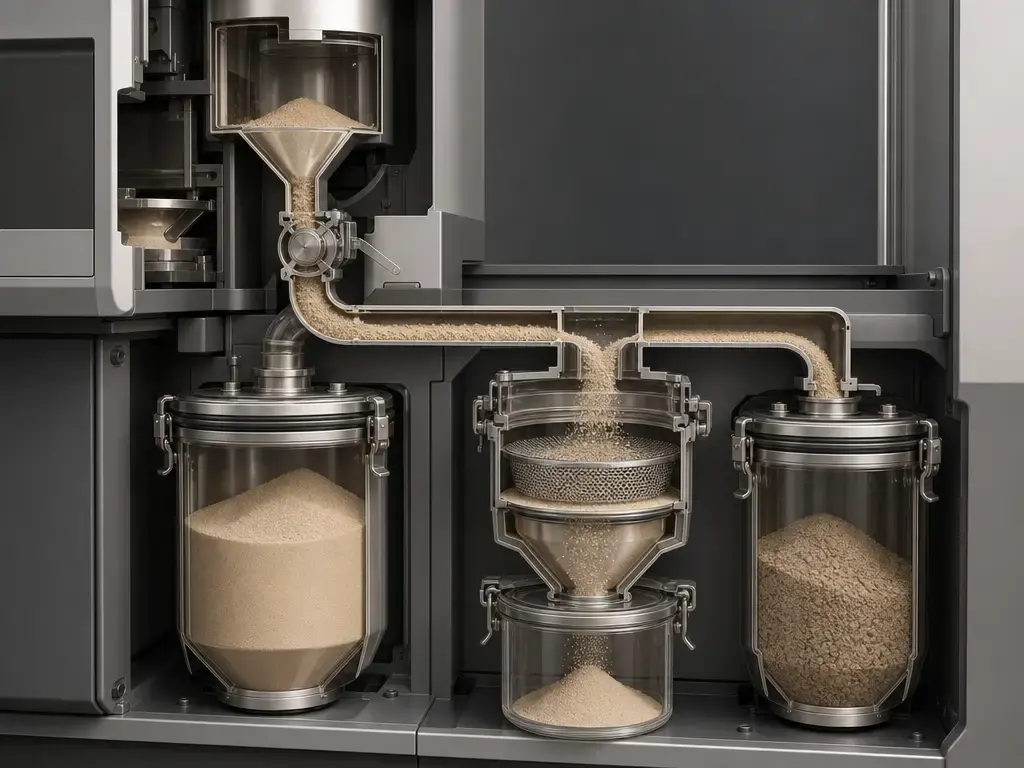
Issue to machine or build is where a storage record has to become a production record. Powder workflows need special care because virgin and used powder can be recovered, combined, or retained across containers. ISO/ASTM 52928:2024 focuses on powder lifecycle management and control of virgin and used powders, and it explicitly supplements ISO/ASTM 52907. NIST also states that integrated AM operations require seamless data integration across product, material, and machine domains. [6] [10] The practical test is simple: can the site show which accepted container or blend was loaded into which machine for which build, and what remained afterward, without rebuilding the history from disconnected notes? [6] [10]

Build logging, post-processing, inspection, and release
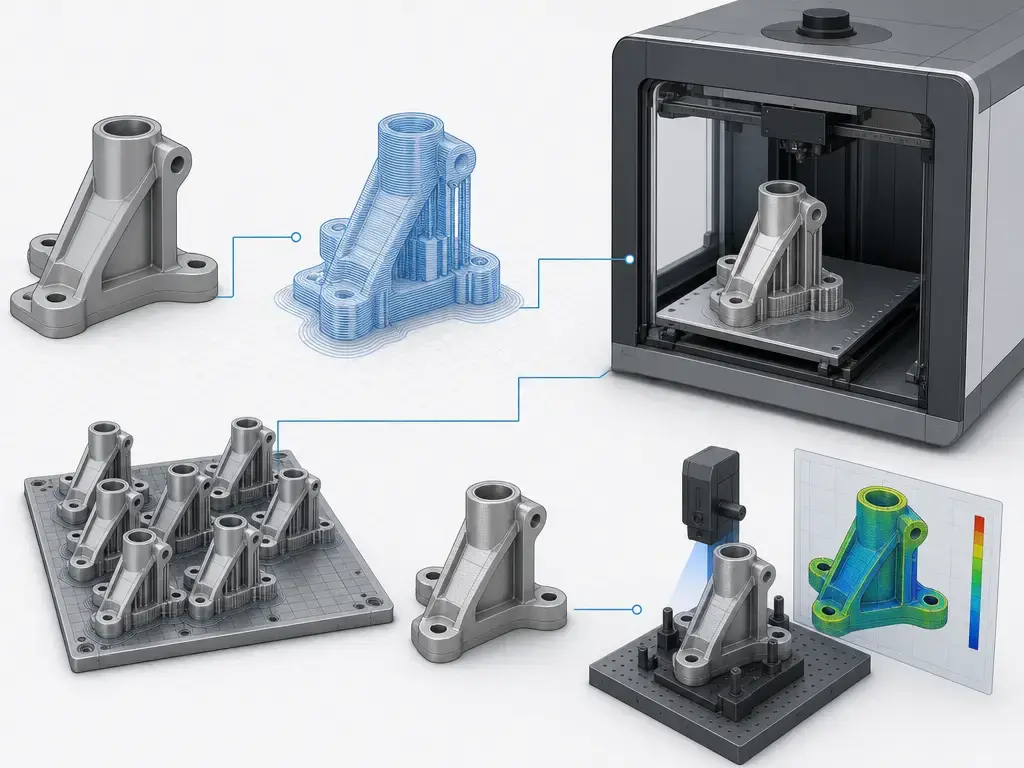
Build logging is where material traceability becomes part traceability. NIST states that AM data from a single build is essential for establishing part traceability, and its later integration work emphasizes that AM records have to connect product, material, and machine domains. [8] [10] In practical source tracking, the key question is not just which material was used, but which material state was used for which geometry, on which machine, under which parameter set, with which operator actions, and with which deviations. A supplier COA or COC can identify an input, but it does not show by itself how that input was transformed during the build. That is why build ID, machine ID, parameter set, monitoring records, nested position, and coupon relationships matter alongside the material record. [8] [10] [16]
Post-processing and inspection extend the same record chain after the machine stops. Heat treatment, curing, depowdering, support removal, cleaning, machining, coating, sterilization, or other finishing steps can all change the delivered state of the part. Inspection then links that state to acceptance evidence such as dimensional results, coupon tests, non-destructive evaluation, visual examination, nonconformance records, and final disposition. NIST frames traceability information as necessary to verify and validate an AM part throughout design-to-product transformations, so release is not just the last signature; it is the decision that the documented route and the evidence match the defined requirements. [12]
Minimum linked identifiers for one shipped AM part:
- Supplier lot / batch / heat reference.
- Internal material ID.
- Storage container ID.
- Machine ID.
- Build ID.
- Part / serial ID.
- Post-process traveler ID.
- Inspection report ID.
- Disposition / release record ID.
A compact workflow view helps show where the links must stay intact. NIST’s data-format work describes six AM data phases, including design, build, machine-specific build planning, post-processed part, and qualified part, which is why the table below follows the part through the main production checkpoints. [11] [12]
| Stage | Minimum linked record | Why it matters | Common failure if missing |
|---|---|---|---|
| incoming receipt | Supplier certs, received lot, accepted container ID | Establishes the starting identity and acceptance basis | Unclear origin or certificate mismatch |
| storage/issue | Storage location, opening/conditioning history, issue transaction | Preserves material state before use | Material state cannot be tied to the build |
| build | Machine ID, build ID, parameter set, nesting or part position | Connects the transformation step to the material and geometry | Part cannot be tied to a specific machine event |
| post-process | Traveler, equipment, cycle record, operator record | Shows how the built state changed before inspection | Returned certificates are detached from the part genealogy |
| inspection/release | Inspection report, nonconformance record, final disposition | Supports the release decision with evidence | Shipped part lacks defensible acceptance evidence |
Digital thread, file control, and production records
File revision control is necessary, but it is not the same as a digital thread. A controlled CAD model, build file, or slicing profile can show what was intended, while production records show what actually happened. NIST emphasizes that single-build data is essential for part traceability and that integrated AM operations depend on linking product, material, and machine information. [8] [10]
Digital-thread elements that must stay linked:
- File revision.
- Build ID.
- Machine ID.
- Parameter set.
- Operator/action record.
- Post-processing record.
- Inspection record.
- Disposition/release record.
NIST’s data-format work describes six AM data phases: design; build; design with build plan; design with machine-specific build plan; post-processed part; qualified part. Its systems-integration work adds that traceability information is needed to verify and validate a part throughout design-to-product transformations. [11] [12] In practice, that means the digital thread has to bridge the file revision, approved build plan, material issue, machine execution record, monitoring or log files, post-processing records, inspection results, and final disposition. If any one of those links is weak, the audit trail can look complete on paper while remaining technically fragile in use. [8] [10] [12]
3MF can help package identifiers, but it is not the whole traceability system. ISO/IEC 25422:2025 gave the 3MF specification suite formal ISO/IEC status on June 6, 2025, and the 3MF Consortium lists Production Extension v1.1.2 as updated on February 27, 2025. That Production Extension requires a UUID on the root build element and UUIDs for build items to support tracking across 3MF packages. Auditable traceability, however, usually spans MES, ERP, and QMS records, machine logs, operator actions, post-process travelers, and inspection files alongside any file-format identifiers. [13] [14] [15]
Process-specific risks and common failure points
Metal powder workflows create traceability risk because the material state can change after receipt. Virgin powder may be opened, recovered, sieved, blended, transferred between containers, or reused in later builds. ASTM ISO/ASTM52907-19 includes specific requirements for used metallic powders, and ISO/ASTM 52928:2024 focuses on lifecycle control of virgin and used powders. [5] [6] The weak point is often not the original supplier certificate, but the internal container genealogy after handling. If a site cannot show which used-powder fraction or blend entered a given build, containment can widen quickly. [6]
Common failure points:
- metal powder reuse and mixing
- multi-part builds
- subcontracted post-processing
- legacy ERP/MES/QMS gaps
- weak file-version control
- consumer RFID/spool systems versus audit-grade systems
Multi-part builds add another frequent failure mode because several part numbers, serial numbers, coupons, and customer orders can share one machine event and one material issue. Subcontracted post-processing can create a similar break when heat treatment, machining, cleaning, or coating records come back as detached certificates rather than records tied to the original build and part identifiers. Older enterprise systems can also split the same genealogy across separate databases, making recovery slow and error-prone even when every department believes it has the record. [12]
Consumer and prosumer automation is a limited contrast case, not an industrial baseline. As manufacturer-reported examples, Formlabs describes lot-number and COC/COA material documentation for some resin workflows, and Bambu Lab says its AMS 2 Pro uses RFID to auto-match drying settings for official filaments. Those features may help identification and workflow automation, but they do not by themselves establish audit-grade traceability across receipt, storage, build, post-processing, inspection, and release. [16] [18]
How to assess a traceability system
Assess a traceability system by testing whether records are complete, recoverable, auditable, and useful for containment. The first practical test is part-to-build linkage: can a released serial part be traced back to the build, machine, parameter set, material issue, supplier record, post-processing route, inspection evidence, and final disposition without manual reconstruction? ISO/ASTM 52920 places AM-specific requirements inside broader quality-management practice rather than outside it, so the review should cover interfaces to purchasing, inventory, manufacturing execution, inspection, nonconformance, and release systems as well as AM-specific records. It should also check whether product, material, and machine data remain integrated, consistent with NIST’s guidance. [4] [10] [12]
Internal KPIs such as record-retrieval time, missing-link rate, or containment review time can still be useful inside one organization. No reliable figure found in accessible primary or official sources for a universal industry-wide AM traceability KPI. A qualitative review remains valid if it tests whether the system supports verification and validation across design-to-product transformations and whether it can close the path from shipped part back to controlled material state and forward to other affected products. [12]
Standards and current market context
The standards stack is layered, not single-purpose. ISO/ASTM 52900:2021 remains the vocabulary backbone for AM terminology and was confirmed in 2025. ISO/ASTM 52920:2023 frames qualification principles and quality-assurance requirements for industrial AM processes and production sites across the AM technologies defined in ISO/ASTM 52900. ISO 22095:2020 provides broader chain-of-custody terminology across sectors, and ISO reported on March 20, 2026, that ISO 22095-2 and ISO 22095-3 had been published to extend that framework. For metallic powders, ASTM ISO/ASTM52907-19 is powder-specific, while ISO/ASTM 52928:2024 supplements it with lifecycle control for virgin and used powders. [1] [3] [4] [5] [6]
Current market context also includes file-format standardization and emerging research, but neither should be mistaken for a default industrial solution. 3MF now has ISO/IEC status through ISO/IEC 25422:2025, and the 3MF Production Extension v1.1.2 was updated on February 27, 2025. Separately, a 2025 research paper reported 98.7% machine-identification accuracy across 1,050 parts made on 21 printers using deep learning from photographs, and a 2023 study on blockchain-based AM part records described traceable, tamper-proof digital documentation as an emerging approach. Those are useful developments, but they complement rather than replace the broader production record stack. [13] [14] [19] [20]
FAQ
What is material traceability in additive manufacturing?
Material traceability in additive manufacturing is the documented continuity that links a part or build to the material identity, handling history, processing route, inspection evidence, and release decision behind it. ISO/ASTM 52900 provides the vocabulary backbone for AM terminology, while ISO/ASTM 52920 places traceability inside quality-assurance requirements for industrial AM processes and production sites. Chain of custody is related but broader: ISO 22095 applies across materials and products and should not be treated as the same thing as internal AM genealogy. [1] [2] [4]
How does additive manufacturing material traceability work in practice?
In practice, additive manufacturing material traceability starts with supplier lot or batch receipt, then follows internal storage, handling, issue to the build, machine execution, post-processing, inspection, and release. For metal powders, ASTM ISO/ASTM52907-19 covers documentation, traceability, packaging, storage, and used-powder requirements. NIST adds that single-build data is essential for part traceability and that AM records need to connect product, material, and machine domains so the part can be verified through design-to-product transformations. [5] [8] [10] [12]
What records should stay linked to one shipped AM part?
At minimum, keep these identifiers linked: supplier lot, batch, or heat reference; internal material ID; storage container ID; machine ID; build ID; part or serial ID; post-process traveler ID; inspection report ID; and disposition or release record ID. The point is to keep supplier records, internal genealogy, and release evidence connected instead of scattering them across separate systems. If any one of those links breaks, containment, auditability, and release review become much weaker. [8] [10] [12]
Is material traceability the same as chain of custody or certification?
No. Chain of custody is a broader cross-sector model for documenting control and transfer, and ISO 22095 states that chain of custody alone does not substantiate claims about materials or products. Certification, qualification, and compliance are broader again because they require defined requirements, evidence, review, and acceptance decisions. ISO/ASTM 52920 adds AM-specific requirements alongside wider quality-management-system standards; it does not replace them. [2] [4]
Expert: How should reused metal powder be traced?
A virgin supplier lot is not enough once powder has been opened, recovered, sieved, blended, transferred, or reused. ASTM ISO/ASTM52907-19 already includes specific requirements for used metallic powders, and ISO/ASTM 52928:2024 supplements that by focusing on powder lifecycle management and the control of virgin and used powders. At a high level, the record should preserve container genealogy and show which material state entered which build. Unsupported refresh ratios or reuse limits should not be invented. [5] [6]
Expert: Can 3MF files or RFID spools provide full audit-grade traceability on their own?
Usually no. 3MF can help package identifiers, and the Production Extension requires a root build UUID plus UUIDs for build items for tracking across 3MF packages. RFID-based spool systems can also help identification or workflow automation; for example, Bambu Lab says its AMS 2 Pro uses RFID to auto-match drying settings for official filaments. But NIST’s work makes clear that real AM traceability has to integrate product, material, and machine records across the broader digital thread, including build, post-process, inspection, and release evidence. [10] [13] [14] [15] [18]
Sources
-
ISO/ASTM 52900:2021 — Additive manufacturing — General principles — Fundamentals and vocabulary. Standard; Edition 2, 2021-11; confirmed 2025. https://www.iso.org/standard/74514.html
-
ISO 22095:2020 — Chain of custody — General terminology and models. Standard; Edition 1, 2020-10. https://www.iso.org/standard/72532.html
-
ISO — New ISO standards bring clarity to chain of custody. Official documentation; 2026-03-20. https://www.iso.org/contents/news/2026/03/new-iso-standards-bring-clarity.html
-
ISO/ASTM 52920:2023 — Additive manufacturing — Qualification principles — Requirements for industrial additive manufacturing processes and production sites. Standard; Edition 1, 2023-06. https://www.iso.org/standard/76911.html
-
ASTM ISO/ASTM52907-19 / F3382-19 — Additive manufacturing — Feedstock materials — Methods to characterize metallic powders. Standard; active, last updated 2019-12-10. https://store.astm.org/f3382-19.html
-
ISO/ASTM 52928:2024 — Additive manufacturing of metals — Feedstock materials — Powder life cycle management. Standard; Edition 1, 2024-05. https://www.iso.org/standard/78527.html
-
NIST — Metrological Traceability: Frequently Asked Questions and NIST Policy. Official documentation / technical note; current NIST page. https://www.nist.gov/metrology/metrological-traceability
-
NIST — Towards an Integrated Data Schema Design for Additive Manufacturing: Conceptual Modeling. Scientific / official publication; 2015. https://www.nist.gov/publications/towards-integrated-data-schema-design-additive-manufacturing-conceptual-modeling
-
NIST — Towards a Digital Thread and Data Package for Metals Additive Manufacturing. Scientific / official publication; 2017. https://www.nist.gov/publications/towards-digital-thread-and-data-package-metals-additive-manufacturing
-
NIST — Additive Manufacturing Data Integration and Recommended Practice. Official documentation; 2023. https://www.nist.gov/publications/additive-manufacturing-data-integration-and-recommended-practice
-
NIST — Data Formats in Additive Manufacturing. Official documentation; 2023. https://www.nist.gov/publications/data-formats-additive-manufacturing
-
NIST — Systems Integration for Additive Manufacturing. Official documentation; updated 2025-03-26. https://www.nist.gov/programs-projects/systems-integration-additive-manufacturing
-
ISO/IEC 25422:2025 — Information technology — 3D Manufacturing Format (3MF) specification suite. Standard; 2025-06, published 2025-06-06. https://www.iso.org/standard/90283.html
-
3MF Consortium — Specification page. Official documentation; Production Extension v1.1.2 listed as updated 2025-02-27. https://3mf.io/spec/
-
3MF Production Extension v1.1.2 PDF. Official documentation; 2025. https://3mf.io/wp-content/uploads/sites/55/2025/02/3MF_Production_Extension_v1_1_2.pdf
-
Formlabs — Regulatory Affairs and Quality Assurance for Medical 3D Printing. Manufacturer-reported example; page accessed 2026. https://formlabs.com/industries/medical/raqa/
-
Bambu Lab — AMS 2 Pro. Manufacturer-reported example; page accessed 2026. https://us.store.bambulab.com/products/ams-2-pro
-
Additive manufacturing source identification from photographs using deep learning. Scientific paper; 2025. https://www.nature.com/articles/s44334-025-00031-2
-
Blockchain-based quality management for a digital additive manufacturing part record. Scientific paper; 2023. https://www.sciencedirect.com/science/article/pii/S2452414X23000900