

Summary
ISO/ASTM 52915 is the AMF standard: ISO/ASTM 52915:2020, Specification for additive manufacturing file format (AMF) Version 1.2, Edition 3, published in March 2020 with 27 pages. [1] If you arrived here from the malformed query family “MF file format standard,” the key point is simple: ISO/ASTM 52915 defines AMF, while the 3MF file format standard now has separate international status as ISO/IEC 25422:2025, published on June 6, 2025. [1] [6] [7]
ISO/ASTM 52915 covers file-format representation and exchange for additive manufacturing: preparation, display, and transmission of AMF data, with XML-schema-based interoperability support. [1] It does not, by itself, guarantee data integrity, digital signing, encryption, or certification. [1] Certification is a separate conformity-assessment activity that ISO describes as written assurance from an independent third party, and ISO states that it does not itself provide certification or conformity assessment. [15]
Is ISO/ASTM 52915 the 3MF standard?
ISO/ASTM 52915 defines the additive manufacturing file format, AMF, and the current ISO catalog identifies ISO/ASTM 52915:2020 as AMF Version 1.2. [1] It is not the 3MF standard. The 3MF file format standard now has its own ISO/IEC identity as ISO/IEC 25422:2025, listed by ISO as Edition 1 and by the IEC webstore as published on June 6, 2025. [6] [7] In practical terms, a citation to ISO/ASTM 52915 is a citation to AMF scope, AMF interchange requirements, and AMF structure, not to the 3MF specification suite. [1]
The confusion is understandable because both formats sit in the same workflow neighborhood. NIST describes data formats as integral to additive manufacturing and discusses six lifecycle phases, from design through qualified part status. [14] That shared context makes AMF and 3MF sound interchangeable in casual discussion, but they are governed through different document families and should be cited separately in contracts, software requirements, procurement language, and compliance documentation. [1] [6]
Historical lineage in one short note
The AMF lineage predates the current 2020 ISO/ASTM edition. ASTM F2915-11, published in 2011, is an early AMF specification, and its store summary presents AMF as a response to STL-era limits such as the lack of support for color, texture, material, substructure, and related properties. [4] That history is useful as context, but not as proof that every later AMF detail was already fixed in 2011. [4]
On the ISO path, the first listed ISO edition is ISO/ASTM 52915:2013, Standard specification for additive manufacturing file format (AMF) Version 1.1, Edition 1, published in June 2013 with 15 pages. [2] The 2013 edition was revised by ISO/ASTM 52915:2016, and the 2020 ISO page lists that 2016 edition as the withdrawn predecessor to ISO/ASTM 52915:2020. [1] [2]
What ISO/ASTM 52915 actually defines
Scope and workflow role
ISO/ASTM 52915 defines AMF as an interchange format for additive manufacturing and specifies requirements for the preparation, display, and transmission of AMF data. [1] Here, interoperability means systems can interpret the structured data in a standards-compliant way, not merely open a file without an error. [1] That is why the ISO abstract ties AMF to XML-schema-backed exchange rather than to any single printer brand or machine-control dialect. [1]
The same abstract states that a W3C XML Schema Definition for AMF is available from ISO and ASTM, with an implementation guide in Annex A. [1] Accessible preview pages also describe AMF as technology-independent and not specific to any one manufacturing process or technique. [5] This is a data representation and exchange standard, not a standard for printer motion control, toolpath execution, or process qualification. [1] [5] The standard also states that it does not specify explicit mechanisms for data integrity, electronic signatures, or encryption. [1]
What the standard covers / does not cover
- Covers: additive manufacturing interchange requirements for preparation, display, and transmission of AMF data. [1]
- Covers: XML-schema-based structure intended to support standards-compliant interoperability. [1]
- Does not cover: printer motion control, toolpath execution, or machine-specific build commands. [1] [5]
- Does not cover: process qualification, part certification, or explicit mechanisms for data integrity, electronic signatures, and encryption. [1] [15]
What can be said about AMF’s structure from accessible sources
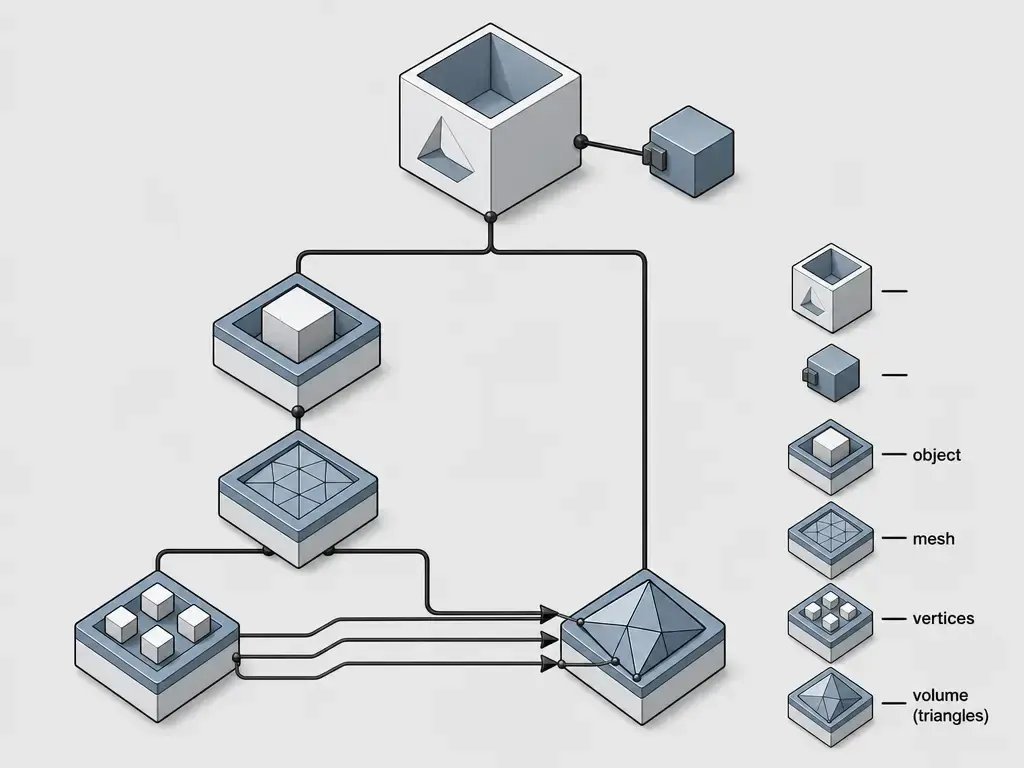
From the accessible preview material, AMF uses a root element, <amf>, which can carry a unit attribute. The preview lists unit choices including millimeter, inch, foot, meter, and micron, and states that millimeters are assumed if the attribute is omitted. [5] Inside that root, the preview identifies five top-level element types: <object>, <material>, <texture>, <constellation>, and <metadata>. [5] This is a limited, source-bounded structural summary, not a full AMF feature inventory. [5]
The same preview gives a compact geometry path. A top-level <object> contains a <mesh>, and that <mesh> contains <vertices> and <volume>. [5] Triangles reference previously defined vertices through <v1>, <v2>, and <v3>, and the preview says the vertices must follow the right-hand rule so they appear counter-clockwise from the outside. [5] It also states that geometry should describe only the final target structure, not support structure. [5] That is enough to show how AMF organizes mesh-based model content, but not enough to justify broader claims about every optional AMF capability. [5]
ISO/ASTM 52915 vs 3MF
A useful comparison separates governance, document identity, workflow role, package model, and integrity handling. ISO/ASTM 52915 is the AMF specification for additive-manufacturing file exchange. [1] By contrast, ISO/IEC 25422:2025 is the international-standard identity for the 3MF specification suite, while the technical details of specific 3MF components are maintained in the suite’s core and extension documents. [6] [8] [10]
| Topic | ISO/ASTM 52915 (AMF) | 3MF suite/core | Why it matters |
|---|---|---|---|
| Governing path | ISO/ASTM additive manufacturing standard. [1] | ISO/IEC suite identity with consortium-maintained component specifications. [6] [8] [10] | Requirements should name the correct standards family. |
| Exact document family | ISO/ASTM 52915:2020, AMF Version 1.2. [1] | ISO/IEC 25422:2025 specifies the 3MF suite; the core specification is a component within that suite. [6] [10] | AMF and 3MF are not interchangeable citations. |
| Intended role in workflow | Interchange for preparation, display, and transmission of AMF data. [1] | XML-based 3D model/package conventions aimed at interoperable 3MF content exchange. [9] [10] | Both are exchange-oriented, but through different documents and assumptions. |
| Technical container model | XML-schema-based AMF structure. [1] [5] | OPC-based package with XML parts in a ZIP archive. [10] | Parser, validator, and archival expectations differ. |
| Security / integrity coverage | Explicit integrity, signatures, and encryption mechanisms are outside scope. [1] | Core/package features include digital signatures; protected content points to OPC; Secure Content is also surfaced as a separate extension. [8] [10] | “File integrity” claims need format-specific wording. |
| Conformance vs certification posture | Conformance to AMF rules is not the same as certification. [1] [15] | Conformance to 3MF rules is not the same as certification. [10] [15] | Certification is a separate third-party activity. |
The table is descriptive, not a ranking. In practice, the engineering question is narrower: which format family is required, which exact document is being cited, and what software is expected to parse or validate it. [1] [6] [10] For AMF, that means ISO/ASTM 52915. For 3MF, that means the suite identity ISO/IEC 25422:2025 plus whatever suite component or extension is actually relevant to the workflow. [1] [6] [8]
That distinction also matters for certification language. A file can conform to a format specification without being “certified” in ISO’s sense of the term. [15] In the reviewed official sources, no authoritative ISO/ASTM 52915-specific certification program was identified. [1] [15]
How 3MF works in practice
Public-facing consortium material describes 3MF as an XML-based file format for transferring full-fidelity 3D models and associated metadata for additive manufacturing, and the core specification then defines how that package is structured. [9] [10] In practice, the 3MF additive manufacturing file format is a package rather than a single flat model description. The core specification describes 3MF as a set of XML conventions built on the Open Packaging Conventions model, and it requires a ZIP archive as the physical package. [10] Within that package, the 3D Model part is required, while core properties, digital-signature origin/signatures/certificates, PrintTicket parts, and thumbnails are optional. [10] By default, 3MF documents must not reference resources outside the package unless an extension explicitly allows that. [10] Microsoft’s implementation documentation describes the same basic idea as required and optional parts linked by defined relationships. [13]
At the standards level, ISO/IEC 25422:2025 defines 3MF as a suite: the suite changes when components are added or removed, not merely when one component receives a new edition. [6] The consortium’s specification index currently lists components such as Beam Lattice, Materials and Properties, Production, Secure Content, Slice, and Volumetric. [8] Around that specification set, lib3mf provides reading, writing, conversion, and validation tools, while the 3mf-samples repository provides implementation guidance, sample files, and conformance tests. [11] [12] A cautious vendor example is Prusa’s documentation, which describes 3MF project files as snapshots containing objects, settings, modifiers, and parameters, and also notes that 3MF archives can carry items such as thumbnails, color, and texture. This is vendor workflow practice, not normative 3MF definition. [16]
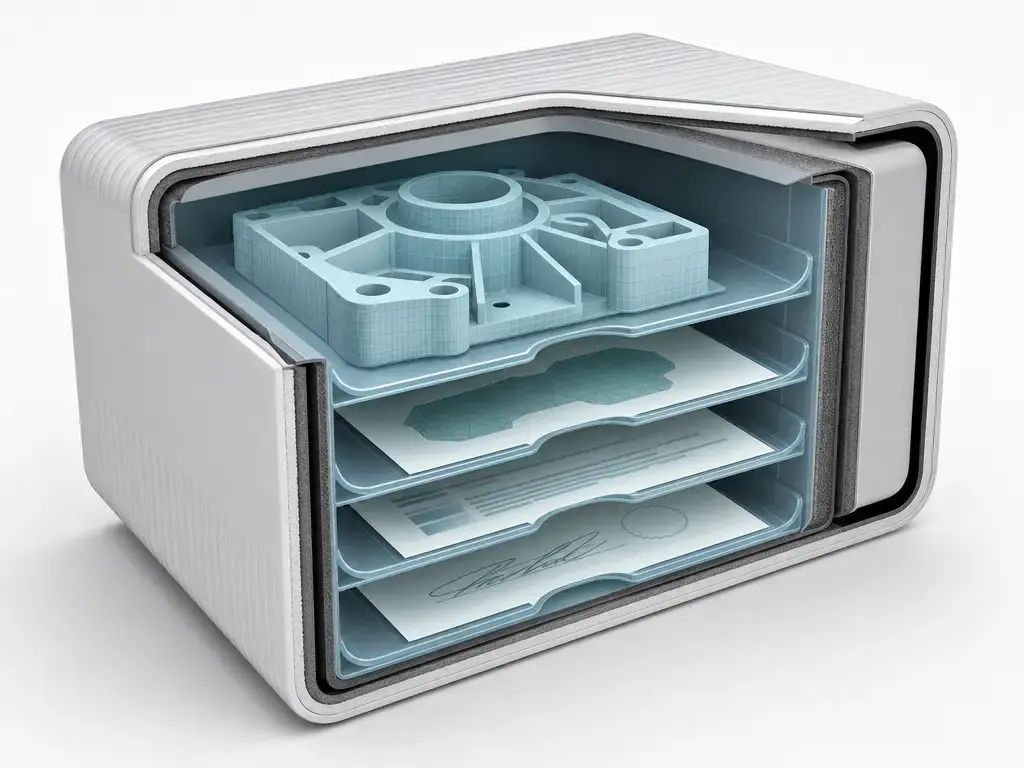
Conformance, certification, and 3D file integrity are not the same thing
standard: a published reference document; specification: the technical requirements in that document; conformance: meeting those requirements; certification: written assurance from an independent third party; integrity: evidence that data has not changed in an unintended or unauthorized way.
A standard can exist without a certification program attached to it. ISO says certification is the provision by an independent body of written assurance that a product, process, service, or system meets specified requirements, and ISO also says it does not itself provide certification or conformity assessment. [15] That matters for file format certification claims: saying that software writes files conforming to ISO/ASTM 52915 is not the same as saying ISO certified the software, the file, or the workflow. [1] [15]
Validity, preservation, and integrity answer different questions. A schema-valid AMF file or a package-valid 3MF file may have the expected formal structure while still omitting metadata a downstream process expects. [1] [10] A conversion may preserve geometry while losing settings, thumbnails, or provenance fields. [10] [16] In that narrower sense, 3D file integrity is about detecting or preventing unintended change or tampering, not about general file quality or guaranteed print success. [1] [10]
What file integrity can mean in AM workflows
- Hash comparison to detect whether a stored or transferred file changed.
- Signature verification to detect alteration and connect a package to a signer.
- Metadata-preservation checks during format conversion or software handoff.
- Access-control or protected-content handling for sensitive model packages.
- Audit-trail checks linking a file version to build, inspection, or release records.
Applied symmetrically, AMF and 3MF have different integrity postures. ISO/ASTM 52915 explicitly excludes mechanisms for data integrity, electronic signatures, and encryption, so those controls have to come from surrounding systems or procedures. [1] The 3MF core specification says 3MF documents may contain digital signatures that can verify a document has not been tampered with since signing, and it says protected content relies on OPC rather than on a separate mechanism defined by the core itself. [10] The suite page also lists Secure Content Extension v1.0.2 separately as an encryption-focused extension. [8] Tools remain tools: lib3mf validation and 3mf-samples conformance tests are useful for implementation, but they are not certification. [11] [12]
Standards status note as of June 7, 2026
As of June 7, 2026, ISO/ASTM 52915:2020 remains the current AMF reference in the ISO catalog, and the page states that the publication was last reviewed and confirmed in 2026. [1] ISO’s stage-code reference identifies 90.93 as “International Standard confirmed,” which is the current-status line shown on the catalog page. [1] [3] For 3MF, the official international-standard identity is ISO/IEC 25422:2025, with ISO listing publication in June 2025 and the IEC webstore giving the exact publication date as June 6, 2025. [6] [7] The 3MF consortium specification index still shows older “ISO/IEC DIS 25422” wording in its introductory copy, but the official ISO/IEC status governs. [6] [8]
What ISO/ASTM 52915 matters for in real workflows
In practice, ISO/ASTM 52915 matters most at handoff points: export from design software, transfer into preparation tools, archival of exchange files, and procurement language that specifically asks for AMF. [1] Its value is clarity about what an AMF file is supposed to represent and how that exchange should be structured. [1]
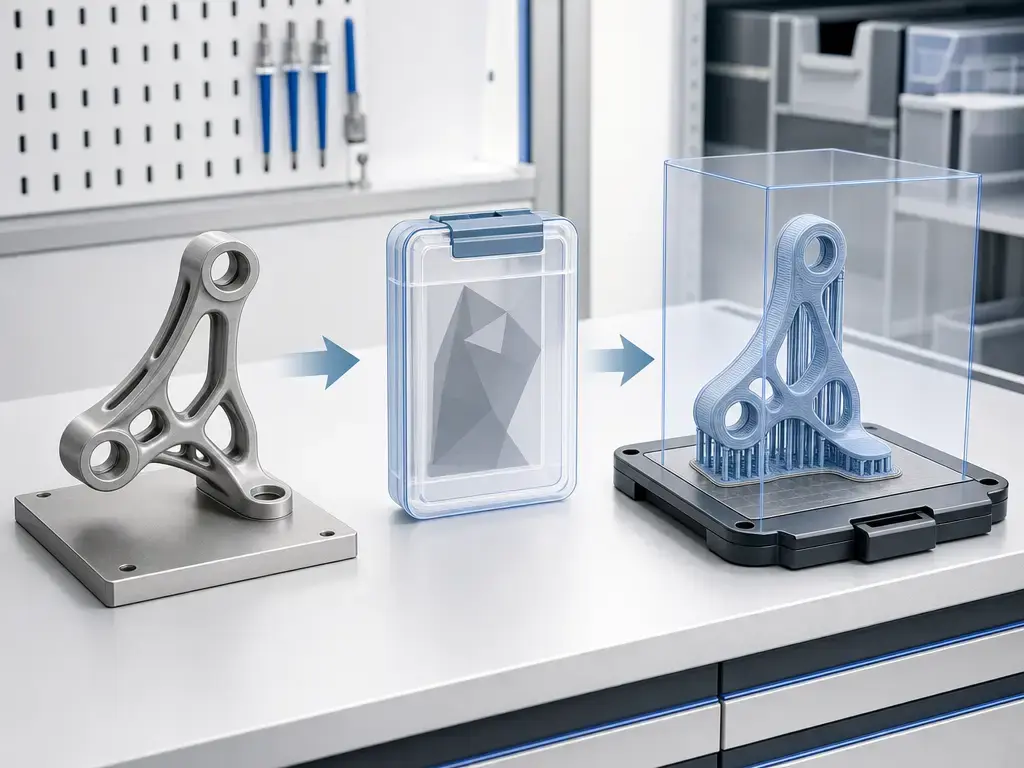
It is also a reminder to normalize vague “MF file format standard” searches into the right document family. A reference to AMF does not, by itself, prove security, tamper evidence, process qualification, or certification, and it should not be used as shorthand for 3MF, which has separate status under ISO/IEC 25422:2025. [1] [6] If a workflow really needs signatures, protected content, preservation checks, or third-party assurance, those requirements have to be named separately. [10] [15] That is the practical value and the practical limit of ISO/ASTM 52915. [1]
FAQ
What is ISO/ASTM 52915?
ISO/ASTM 52915:2020 is the AMF standard: Specification for additive manufacturing file format (AMF) Version 1.2. The ISO catalog lists it as Edition 3, published in March 2020, and describes it as an interchange format for additive manufacturing data used for preparation, display, and transmission. [1]
Is ISO/ASTM 52915 the same as the 3MF file format standard?
No. ISO/ASTM 52915 identifies AMF, while the 3MF file format standard has separate international status as ISO/IEC 25422:2025. [1] [6]
Is 3MF an ISO standard now?
Yes. ISO lists ISO/IEC 25422:2025 as the international-standard identity for the 3MF specification suite, and the IEC webstore gives the publication date as June 6, 2025. [6] [7] That suite-level status is separate from consortium component versions such as the core specification and extensions. [6] [8]
What does ISO/ASTM 52915 say about data integrity, signatures, or encryption?
ISO/ASTM 52915 explicitly states that it does not specify explicit mechanisms for ensuring data integrity, electronic signatures, and encryption. [1]
Is there an ISO/ASTM 52915 certification program?
In the reviewed official sources, no authoritative ISO/ASTM 52915-specific certification program was identified. [1] [15] If the question is how many such programs exist, no reliable figure found. [1] [15]
Expert FAQ — Does 3MF core itself support digital signatures, or is that only in extensions?
3MF core/package features can include digital signatures and related certificate parts, and the core specification says signatures can be used to verify that a 3MF document has not been tampered with since signing. [10] Protected content in core points to OPC mechanisms, while Secure Content is also surfaced separately in the suite as Secure Content Extension v1.0.2. [8] [10]
Expert FAQ — Are AMF and 3MF exchange formats or machine-instruction standards?
They are primarily exchange and representation formats, not machine motion-control standards. AMF is described as technology-independent and not specific to one manufacturing process or technique. [5] 3MF core defines a document/package format for 3D model content and related parts, even though optional components can carry some job-related information such as PrintTicket content. [10] NIST’s lifecycle discussion is a useful reminder that these formats sit within a larger manufacturing data chain rather than replacing it. [14]
Related on 3D Mag
Sources
- ISO official catalog — ISO/ASTM 52915:2020
- ISO official catalog — ISO/ASTM 52915:2013
- ISO official stage-code reference
- ASTM store — ASTM F2915-11
- Preview sample of ISO/ASTM 52915:2020
- ISO official catalog — ISO/IEC 25422:2025
- IEC webstore — ISO/IEC 25422:2025
- 3MF Consortium specification index
- 3MF Consortium homepage
- 3MF Core Specification v1.3.0 PDF
- lib3mf GitHub
- 3mf-samples GitHub
- Microsoft Learn — Generate a 3D Manufacturing Format package
- NIST — Data Formats in Additive Manufacturing
- ISO — Conformity assessment
- Prusa Knowledge Base — Saving projects as 3MF