
Summary
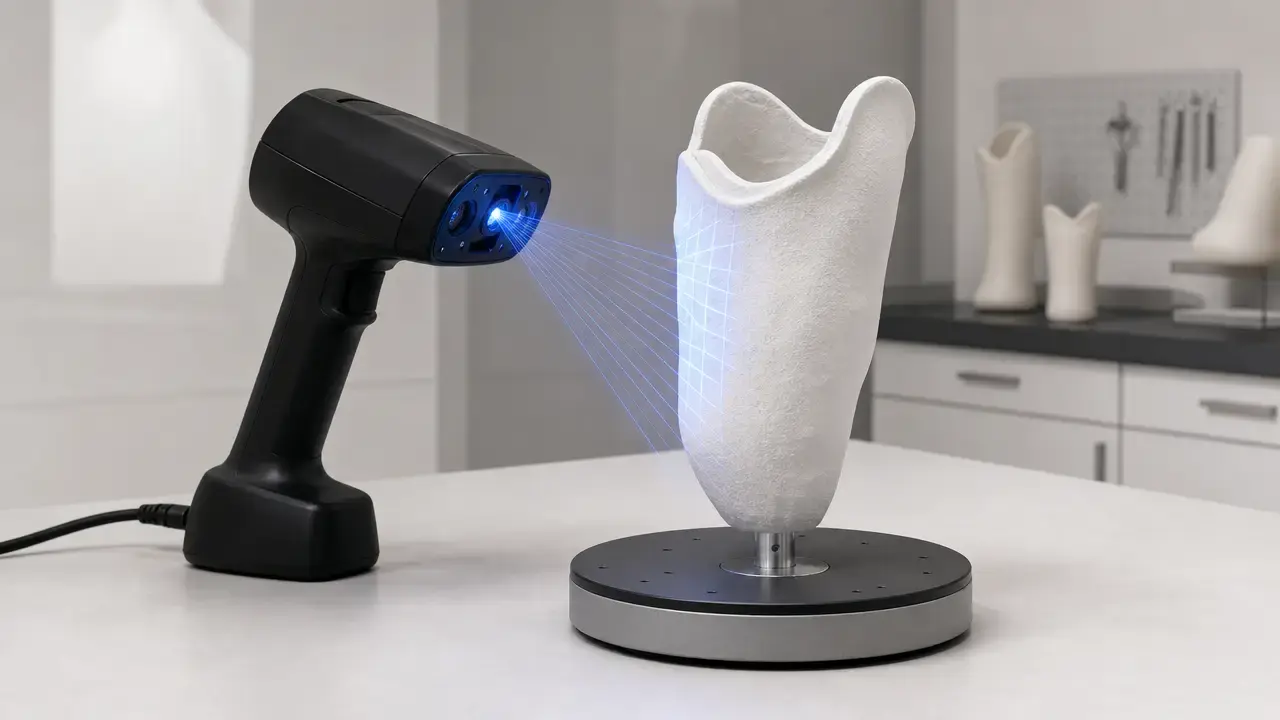
“Artec Spider II: the best 3D scanner for prosthetics and orthotics” is too broad to stand as a flat claim. A narrower conclusion is easier to support: Spider II looks unusually strong for fine-detail, close-range geometry capture. Artec rates it at up to 0.05 mm accuracy and 0.05 mm resolution, with 3D accuracy over distance listed as 0.05 mm + 0.3 mm/m. Its tradeoff is scale: the scanner works within a short 0.19–0.3 m working distance and a relatively small 128 × 104 mm to 171 × 152 mm field of view, so its strengths are not the same as being the easiest choice for every clinic workflow. NIST’s structured-light cautions matter here as well, because a single accuracy number does not fully describe performance across different geometries, distances, and surfaces. [1] [17] [18]
- Best use cases: fine-detail scans of residual-limb models, existing sockets, plaster positives, and small orthotic or prosthetic components where close-range detail matters more than broad area coverage. [1]
- When another scanner may fit better: Eva, Leo, Medixa, or H2 may be more practical for larger body areas, faster broad coverage, or more mobile scanning workflows. [7] [8] [9] [10] [11]
- Evidence caveat: no reliable Spider II-specific peer-reviewed O&P validation figure was found in this research pass; adjacent evidence exists for Artec Eva residual-limb models, and spec-sheet numbers alone do not predict socket outcome. [12] [17] [18]
Historical background: from plaster casting to digital O&P workflows
In prosthetics and orthotics, plaster and fiberglass casting remained standard for a long time because they produced a physical shape that clinicians could modify directly. Digital capture entered the field not because casting was suddenly obsolete, but because scanning can reduce mess, preserve geometry as a reusable file, and fit more cleanly into CAD/CAM workflows. That practical appeal appears even in vendor case material: one Artec case study reports body-part scans in roughly 2–5 minutes versus 11 minutes for a plaster cast, along with at least 30% time savings and casting-material costs above $50. Those numbers are best read as a manufacturer-reported workflow example, not an independent benchmark. [5]
The technical interest was never just speed. Shape and volume matter because the residual limb and socket design process are both geometry-sensitive. In a 2017 study of ten residual-limb models with volumes from 885 to 4399 ml, the Artec Eva showed a mean percentage error of 1.4%, intra-rater reliability of 0.5%, inter-rater reliability of 0.7%, and average RMSE values of 0.23–0.65 mm relative to a criterion scanner. That is useful evidence for structured-light measurement of residual-limb models, but it is not Spider II-specific and it was based on models rather than live clinical socket fitting. Independent mechanics context matters too: a 2024 cast-rectification study examined 44 transtibial residual-limb casts and reported a 6.02% volume change in the region from mid-patella to 25% of cast length, showing how meaningful downstream rectification can be even when the starting scan or cast is accurate. [12] [13]
A compact timeline helps: first capture the limb or cast, then rectify or modify shape according to clinical intent, then fabricate and test the device. Those stages are distinct enough that the evidence base should not be blurred together. A 2022 systematic review on 3D-printed transtibial sockets screened 1,023 unique studies and included 12, with failure data for 15 3D-printed sockets and 26 laminated sockets. That underscores that structural validation belongs to fabrication and testing, not merely to scanning. Spider II itself is also relatively new in this field context: Artec launched it on September 9, 2024, so it does not yet have a long trail of O&P-specific peer-reviewed clinical evidence. [14] [2]
Technical principles: what Spider II captures
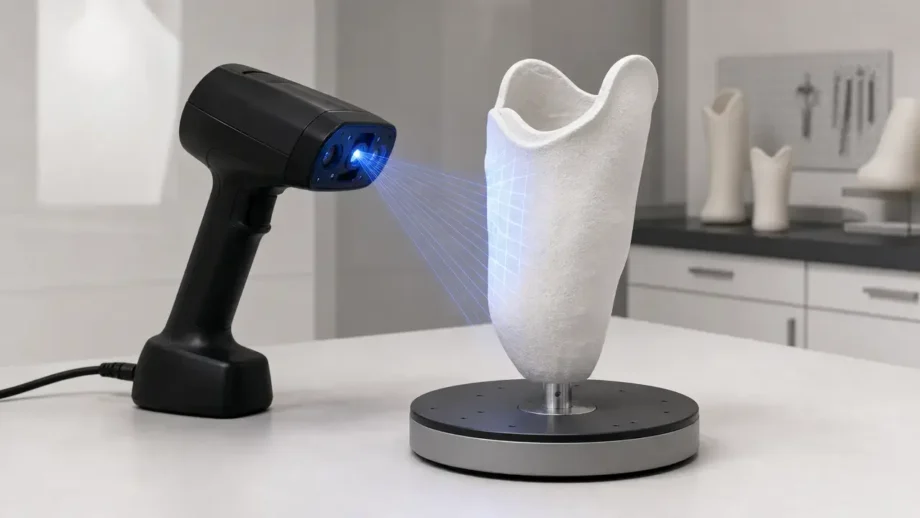
The Artec Spider II prosthetics 3D scanner is a handheld structured-light system built for close-range detail capture. Artec lists a 450 nm LED structured-light source, white LED texture illumination at CRI > 95 and 4000 K, 5 MP texture resolution, 24 bpp color, and a capture workflow rated up to 30 fps with data acquisition up to 8 million points per second. Its geometry envelope defines its role: a 0.19–0.3 m working distance, 128 × 104 mm field of view at the closest range, 171 × 152 mm at the furthest range, 110 mm depth of field, and a 1,800 cm³ volume capture zone. In O&P terms, that points to a detail-first scanner better suited to localized anatomy, socket surfaces, and positive models than to fast broad capture of an entire limb or torso. [1]
On the software side, Spider II is tied to Artec Studio 19 or later. Artec’s documentation describes Geometry + Texture as the default mode for most cases and a basic scan flow of Preview, then Record, then Stop. The quick-start guidance also recommends calibration before each scanning session for highest output quality and says recalibration can take under five minutes. Those headline numbers depend on operating discipline: close-range tracking, distance control, and calibration are part of the measurement system, not optional extras. [3] [4]
Definitions box
- Point cloud: a set of measured 3D points sampled from the object surface.
- Mesh: a polygon surface built from scan data so it can be cleaned, measured, exported, or used downstream in CAD.
- STL / OBJ / PLY: common mesh formats; STL is usually geometry-only, while OBJ and PLY can also carry color or texture information depending on export settings.
- Scan-to-CAD: using scan data as reference geometry for later modeling, comparison, rectification, or design work.
- Texture / color markers: captured surface color information that can help visual review and, in some workflows, improve tracking.
- Target-free tracking: tracking that relies on natural geometry and/or texture instead of adhesive scan markers. [1] [3]
Artec Spider II for a socket fitting scan
A socket fitting scan is not the same as socket fitting. What Spider II can contribute is a detailed digital record of a residual limb, a plaster positive, or an existing socket that then enters a broader O&P process. Artec’s color capture and documented Geometry + Texture workflow may help preserve visual markings or surface context, but neither the scanner nor the software replaces clinical prescription, rectification, test fitting, or follow-up. The strongest peer-reviewed residual-limb measurement figures in this source set apply to Artec Eva on residual-limb models, not to Spider II in live socket-fitting clinics. [1] [3] [12]
A compact workflow in this context looks like this:
- patient preparation and posture decision
- scanner warm-up/calibration
- geometry + texture capture
- review for holes/noise
- mesh fusion and cleanup
- export to O&P CAD/CAM
- clinician rectification
- test socket or verification
That sequence matches Artec’s documented Preview → Record → Stop capture flow, its session-by-session calibration guidance, and the broader reality that scan capture is only one stage in a longer chain. It applies whether the clinic scans the residual limb directly, scans a plaster cast, or scans an existing prosthetic socket as a reference object. Vendor case material suggests fast capture can be practical in orthotics 3D scanning and prosthetic workflows, but those timing figures remain illustrative rather than universal. [3] [4] [5]
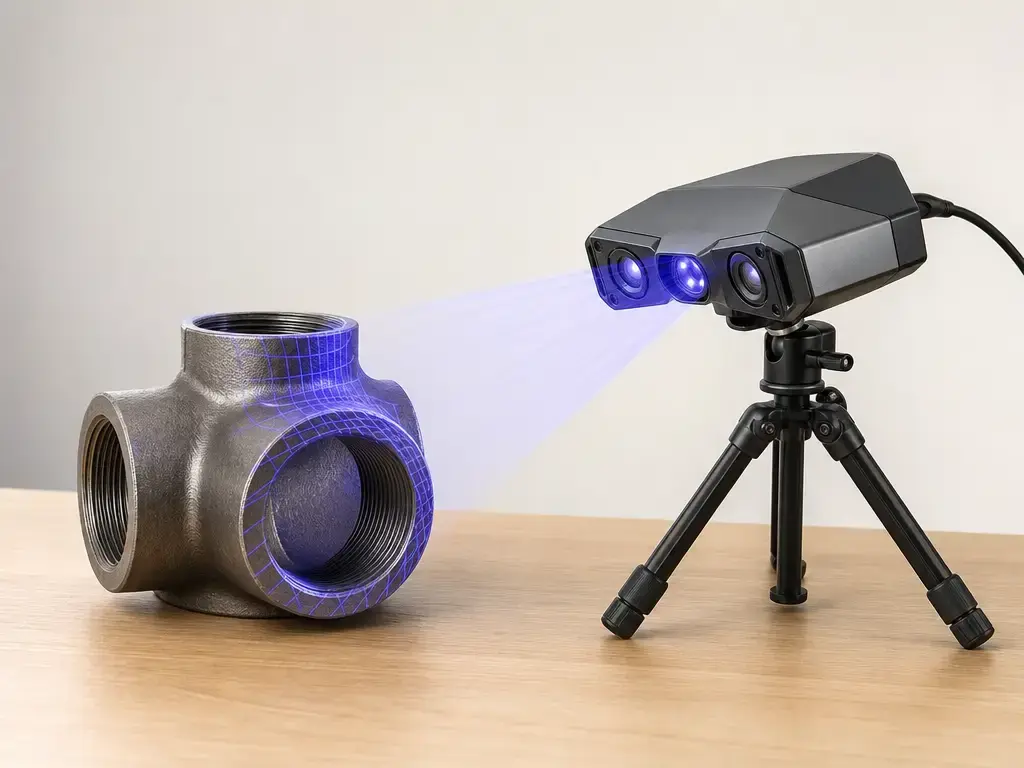
Spider II is most useful at the geometry-preservation stage. If a scan contains holes, tracking breaks, or noisy areas, those problems can carry forward into mesh fusion and later rectification. That is why operator review still matters before export. The cast-rectification literature reinforces the point: even when the starting geometry is well captured, clinicians may intentionally alter shape in ways that materially change socket mechanics. In the 44-cast transtibial study, the reported 6.02% volume change from mid-patella to 25% of cast length shows why a high-detail scan is useful, but not decisive by itself, in a residual-limb scan workflow. [13]
Types of 3D scanners used in prosthetics and orthotics
The phrase “3D scanner for prosthetics” covers several device classes, which is why the broader claim “3D scanner for prosthetics and orthotics” resists a single winner. In practice, clinics and labs encounter at least these categories:
- handheld structured-light scanners
- handheld hybrid scanners
- O&P-specific body scanners
- smartphone / photogrammetry / LiDAR systems
- desktop scanners for casts or small parts
These categories differ not just in price or brand, but in capture area, working distance, mobility, and how much cleanup or downstream correction is required. [1] [8] [9] [10] [11]
Spider II sits at the close-range, detail-focused end of the handheld structured-light group, with a 0.19–0.3 m working distance and a 128 × 104 mm to 171 × 152 mm field of view. Eva is another handheld structured-light option, but with lower headline detail numbers at up to 0.1 mm accuracy and 0.2 mm resolution. Leo stays in the Artec family while shifting toward larger-volume, computer-free scanning, with up to 0.1 mm accuracy, 0.2 mm resolution, and a 160,000 cm³ volume capture zone. [1] [7] [8] [9] [10] [11]
Performance metrics that matter more than “best”
The most useful scanner metrics in O&P are not just the headline accuracy number. Accuracy is closeness to a reference value under stated conditions. Resolution is the level of detail the scanner can separate. Working distance is the operating standoff between scanner and object. Field of view is the area seen at once. Data acquisition speed and fps describe how quickly data is captured, not how fast the whole appointment becomes. Volumetric or distance-related accuracy describes how error grows across larger extents. Repeatability is consistency across repeated captures. Motion tolerance is a practical workflow question about how well the system keeps tracking when the subject or operator moves. None of the compared manufacturer pages provides a single directly comparable clinical motion-tolerance score, which is one reason the phrase “best 3D scanner for prosthetics and orthotics” is weaker than it first sounds. [1] [7] [8] [9] [11] [17] [18]
Spider II’s spec sheet makes the most sense when its numbers are read together rather than one by one. Up to 0.05 mm accuracy and 0.05 mm resolution are strong local-detail claims, but they belong to a scanner with a 1,800 cm³ volume capture zone and a distance-accuracy term of 0.05 mm + 0.3 mm/m. That combination is very different from the priorities behind Leo’s 160,000 cm³ volume capture zone or H2’s body-scale maximum fields of view. Likewise, Medixa’s body-oriented white-light and infrared fields of view say more about workflow scale than about tiny local surface detail. The scanner that looks strongest for a fine socket edge, a deep contour, or a plaster positive is not automatically the most efficient for a full lower-limb or torso session. [1] [8] [9] [11]
Artec Eva remains a relevant comparator because its headline numbers, up to 0.1 mm accuracy and 0.2 mm resolution, are lower than Spider II’s on paper but still strong enough for many larger-area workflows. Leo adds mobility by scanning without a computer, which matters when cables and workstation logistics are the bottleneck rather than local detail. Medixa emphasizes O&P-specific presets and large capture areas, while H2 offers white-light and IR modes with manufacturer-listed maximum fields of view of 420 × 440 mm and 780 × 900 mm. H2 also lists manufacturer volumetric-accuracy figures, but those are not identical in meaning to Artec’s “accuracy over distance” figure, so direct ranking still needs caution. [7] [8] [9] [10] [11]
Metrology and standards callout
NIST’s 2019 review stated that, at the time of writing, there were no international documentary standards for structured-light scanners and noted that VDI/VDE 2634 Parts 2 and 3 were being used for some systems. The same paper also warned that accuracy varies with artifact location and distance from the scanner, so a single value may be inadequate for end users. That caution remains relevant even though Artec later announced, on November 20, 2025, a Spider II 2026 edition described as VDI/VDE-compliant. Such verification is about scanner metrology; it is not the same as proving residual-limb comfort, socket fit, or long-term clinical success. ISO 10328 sits in a different part of the chain, because it specifies static and cyclic strength tests for lower-limb prostheses and explicitly warns that it is not a guide for selecting a specific prosthetic device for an individual prescription. [17] [18] [19] [15]
The table below is therefore a workflow table, not a universal ranking. It mixes manufacturer-stated metrics from different product families, and one Medixa line is left explicitly caveated because the page lists “Accuracy RMS < 0.3” without a unit. [1] [9] [11]
| Scanner / class | Key sourced metric | Practical O&P implication | Evidence caveat |
|---|---|---|---|
| Spider II / close-range handheld structured-light | 0.05 mm accuracy; 0.05 mm resolution; 1,800 cm³ capture zone. [1] | Strong fit for fine-detail scans of sockets, positives, and localized anatomy. | Manufacturer-stated numbers; short working distance and small FOV can slow larger body-area workflows. [1] [18] |
| Eva / handheld structured-light | 0.1 mm accuracy; 0.2 mm resolution. [7] | Broader-area Artec workflow when ultimate local detail is not the main bottleneck. | Lower headline detail than Spider II on spec sheet; still not a direct predictor of socket outcome. [7] [18] |
| Leo / tetherless handheld structured-light | 0.1 mm accuracy; 0.2 mm resolution; 160,000 cm³ capture zone; no computer required for scanning. [8] | Easier movement around larger anatomy and less cable friction in clinic. | Larger-scene convenience does not mean finer local detail than Spider II. [8] |
Applications in prosthetics and orthotics
High-detail scanning helps most in digitization tasks where preserving geometry matters. That includes prosthetic socket design references, scanning positive models, digitizing existing sockets for modification, residual limb monitoring, orthotic-device archiving, foot orthoses, and related scan-to-CAD workflows. In that sense, Spider II’s strengths are easiest to understand when the goal is faithful capture of a surface that will later be inspected, archived, compared, or modified. Artec’s O&P case material also shows why clinics value digital capture at all: once a mesh exists, it can be reviewed, stored, and routed into downstream design software instead of being locked in a single physical cast. [3] [5]
Digitization, however, is not the same as therapeutic success. The Eva residual-limb-model study supports the idea that structured-light scanning can measure model shape and volume credibly in an adjacent Artec context, but it does not settle Spider II-specific clinical socket questions. The cast-rectification study shows why geometry preservation matters, because a 6.02% volume change in a key transtibial region is large enough to matter downstream. And the 3D-printed socket review reminds us that once a model becomes a fabricated prosthetic socket, structural performance becomes a separate evidence problem. Adjacent applications such as cranial and torso scanning are relevant as examples of body scanning, but they do not by themselves prove suitability for residual-limb comfort or fit verification. [12] [13] [14]
Limitations and risks in clinical use
Spider II’s limitations are not disqualifying, but they are real. Its short 0.19–0.3 m working distance, 128 × 104 mm to 171 × 152 mm field of view, and 110 mm depth of field mean more repositioning on larger anatomy than with wider-area scanners. Its wired workflow also matters: Artec lists Thunderbolt 4 host compatibility, Windows 10 x64 or Windows 11 support, and a recommended RTX 4070 8 GB-class GPU, so this is not a standalone grab-and-go device in the way some body-oriented systems are. The scanner itself is light at 0.95 kg, but the total clinic setup still includes power and a capable computer. [1]
Patient motion is another practical limit. No clean, comparable clinical motion-tolerance figure is published across these products, so clinics should treat it as a workflow variable rather than a settled metric. A scanner can have strong bench numbers and still struggle if the subject shifts, soft tissue moves, or the operator repeatedly loses optimal distance. The biological side matters just as much: the residual limb is not a fixed mechanical artifact, and unloaded external geometry is not identical to the loaded geometry experienced inside a socket. The 44-cast rectification study is a useful reminder that clinically meaningful shape changes are often introduced downstream, because the captured form is only the beginning of the design decision, not its endpoint. [13]
Surface behavior and operator skill also matter. NIST’s structured-light review specifically discusses how performance can vary with location, distance, and challenging features such as deep, dark, and shiny areas. That does not mean Spider II is uniquely weak on such surfaces, only that optical-scanning caveats do not disappear when a product page lists strong nominal accuracy. Add calibration discipline, software cleanup, export choices, and clinician training, and it becomes clear why no direct proof of final socket fit or comfort can be inferred from the scanner alone. In short, NIST’s caveat is the right reminder here: a single accuracy value does not describe every anatomy position, surface, or clinical setup. [4] [17] [18]
Current research and market context
The evidence picture is mixed in a predictable way. Peer-reviewed measurement evidence exists for Artec Eva on residual-limb models, independent shape-mechanics evidence exists for cast rectification in transtibial socket workflows, and structural testing literature exists for fabricated sockets. What is harder to find is a Spider II-specific peer-reviewed O&P validation paper that turns the manufacturer’s hardware specifications into a direct clinical statement. Market positioning, meanwhile, is active: Eva remains the established larger-area Artec comparator, Leo the larger-volume cable-free Artec option, Medixa is explicitly positioned for O&P workflows, and H2 remains a large-field hybrid handheld alternative. Artec also announced on November 20, 2025, that a Spider II 2026 edition would be VDI/VDE-compliant, which is relevant metrology news but still not the same as peer-reviewed clinical prosthetics evidence. [7] [8] [9] [10] [11] [12] [13] [19]
What is actually validated?
- Spider II-specific peer-reviewed O&P validation: no reliable figure found in this research pass.
- Adjacent evidence: Eva has model-based residual-limb validation, and independent cast-rectification work shows meaningful geometry change during socket-shape modification. [12] [13]
- Structural testing: ISO 10328 and the socket-fabrication literature address the strength-testing side of the process, not scanner choice alone. [14] [15]
That is the main market-context takeaway for an Artec Spider II prosthetics 3D scanner discussion. The scanner may be strong for certain O&P tasks, but the public evidence stack is still much deeper for generic scanner metrology and adjacent workflow studies than for Spider II-specific clinical socket outcomes. [12] [17] [18]
Verdict: is Artec Spider II the best 3D scanner for prosthetics and orthotics?
The phrase “Artec Spider II: the best 3D scanner for prosthetics and orthotics” is defensible only in a narrow sense. Best for fine-detail geometry capture: yes, likely. If the task is close-range capture of a socket surface, a positive model, or localized residual-limb geometry, the combination of manufacturer-stated 0.05 mm accuracy, 0.05 mm resolution, short working distance, and small field of view gives Spider II a strong detail-first case. [1]
Best all-around O&P workflow: not proven. Clinics that prioritize broader coverage, easier movement, or body-scale presets may find Eva, Leo, Medixa, or H2 more practical even if Spider II looks stronger on local-detail specifications. Leo, for example, removes the computer from the scanning step; Medixa is positioned specifically for O&P body scanning; H2 offers large white-light and IR fields of view; and Eva remains a simpler Artec comparator for broader-area work. NIST’s metrology cautions are the reason this remains workflow-dependent rather than absolute: geometry, distance, and surface conditions all affect what the numbers mean in practice. [7] [8] [9] [10] [11] [17] [18]
Clinically validated for socket fit: no reliable Spider II-specific figure was found in this research pass. The best adjacent evidence here is Eva-based and model-based, not Spider II-specific and not equivalent to live clinical socket comfort. That does not make Spider II unsuitable; it means the current public evidence supports a narrower conclusion than the headline implies. The decisive but qualified answer is this: Spider II is probably one of the strongest detail scanners an O&P team could choose, but it is not proven to be the single best overall clinic scanner or a stand-alone predictor of socket fit. [12] [13]
FAQ
What is the best 3D scanner for prosthetics and orthotics?
There is no universal best. Spider II looks strongest when fine local geometry matters most, while Leo, Medixa, H2, or Eva can make more sense when a clinic values larger capture area, freer movement, or body-oriented workflow simplicity. [1] [7] [8] [9] [10] [11]
Is Artec Spider II good for prosthetic socket fitting?
It can be a strong candidate for high-detail scanning in a prosthetic socket workflow, but scanning is only one part of fitting. No reliable Spider II-specific peer-reviewed O&P fit figure was found in this research pass, and adjacent Eva evidence was model-based rather than a direct Spider II socket-outcome study. [1] [12]
How does a socket fitting scan work?
A clinician captures the residual limb, cast, or existing socket, reviews the scan for holes or noise, fuses and cleans the mesh, exports it to downstream O&P CAD/CAM, and then performs rectification, testing, and verification later in the process. Artec’s documented Spider II flow is Preview → Record → Stop, with calibration recommended before sessions. [3] [4]
How do you do orthotics 3D scanning with Artec Spider II?
Warm up and calibrate the scanner, use the default Geometry + Texture workflow, capture the needed surface at the correct distance, inspect the result, then export the mesh for later design work. The scanner helps digitize geometry; it does not replace clinical design decisions. [1] [3] [4]
What is the difference between accuracy, resolution, and volumetric accuracy in structured-light scanning?
Accuracy is how close the measured geometry is to a reference. Resolution is how much detail the system can separate. Volumetric or distance-related accuracy describes how error behaves across a larger span, which is why Spider II’s 0.05 mm + 0.3 mm/m figure and H2’s mode-specific volumetric-accuracy figures are not the same kind of statement as local resolution. [1] [11] [18]
Why can a scanner with excellent spec-sheet numbers still produce a poor socket outcome?
Because socket outcome also depends on posture, tissue behavior, loaded versus unloaded limb shape, surface conditions, operator technique, rectification choices, and later fabrication and testing. NIST’s core warning still applies: accuracy varies with location and distance, so one published number cannot summarize every clinical situation. [13] [17] [18]
Related on 3D Mag
- Artec Spider II: the best 3D scanner for car parts
- Artec Spider II: the best 3D scanner for scan-to-CAD
- Artec Jet: the best 3D scanner for shipbuilding and vessel refit
Sources
- Artec Spider II product specifications. https://www.artec3d.com/portable-3d-scanners/artec-spider
- Artec Spider II launch press release. https://www.artec3d.com/news/artec-spider-II-press-release
- Artec Studio 19 manual. https://docs.artec-group.com/as/19/en/_downloads/35f218829bc49574e3693c60a64cc83c/Manual-19-EN.pdf
- Artec Spider II Quick Start Guide. https://docs.artec-group.com/spiderII/Quick%20Start%20Guide/1.0%20Artec%20Spider%20II%20Quick%20Start%20Guide.pdf
- Artec O&P case study: Eva and Spider. https://www.artec3d.com/cases/creating-optimal-orthotics-and-prosthetics-artec-eva-and-spider
- Artec Thomas More O&P / AI case study. https://www.artec3d.com/cases/thomas-more-automating-prosthetic-customization
- Artec Eva product specifications. https://www.artec3d.com/portable-3d-scanners/artec-eva
- Artec Leo product specifications. https://www.artec3d.com/portable-3d-scanners/artec-leo
- EinScan Medixa product specifications. https://www.shining3d.com/professional-solutions/all-in-one-3d-scanner/einscan-medixa
- EinScan Medixa user documentation. https://docs.shining3d.com/einscan-medixa/1.0.0/en-us/device-introduction/
- EinScan H2 specifications. https://www.einscan.com/handheld-3d-scanner/einscan-h/einscan-h2-specs/
- Validity and reliability of a novel 3D scanner for assessment of the shape and volume of amputees’ residual limb models. https://pmc.ncbi.nlm.nih.gov/articles/PMC5590959/
- Shape Analysis of Prosthetic Socket Rectification Procedure for Transtibial Amputees. https://www.mdpi.com/2673-1592/6/1/13
- 3D printed transtibial prosthetic sockets: A systematic review. https://journals.plos.org/plosone/article?id=10.1371%2Fjournal.pone.0275161
- ISO 10328:2016 – Prosthetics — Structural testing of lower-limb prostheses — Requirements and test methods. https://www.iso.org/standard/70205.html
- ISO/ASTM 52900:2021 – Additive manufacturing — General principles — Fundamentals and vocabulary. https://www.iso.org/standard/74514.html
- NIST: Sources of Errors in Structured Light 3D Scanners. https://www.nist.gov/publications/sources-errors-structured-light-3d-scanners
- NIST PDF: Sources of Errors in Structured Light 3D Scanners. https://tsapps.nist.gov/publication/get_pdf.cfm?pub_id=927473
- Introducing Artec Spider II 2026: Certified metrology performance for professional demands. https://www.artec3d.com/news/artec-spider-ii-2026