
Summary
Annealing PLA is a controlled post-print heat treatment for material-extrusion parts. The usual goal is better heat resistance and, in some cases, improved stiffness or other test-specific mechanical properties without fully melting the part. The tradeoff is often warping, shrinkage, and dimensional drift. [2] [6] [8] [9] [10] [11] [16]
That tradeoff is why there is no universal annealing recipe for all PLA. Ordinary PLA can soften around 60 °C in practical use, while heat-treatable products such as HTPLA, Tough Pro PLA+, and NatureWorks 3D850 or 3D870 follow product-specific temperatures and test conditions rather than one generic rule for the whole PLA family. Research also shows that higher crystallinity can come with lower ductility or more distortion if the schedule, geometry, or heating uniformity is wrong. [6] [7] [8] [9] [10] [11] [16]
Annealing PLA: What it means in 3D printing
In standards-aligned language, these parts are made by material extrusion, the additive-manufacturing process family that builds three-dimensional structures layer by layer. FDM and FFF are common shop terms for this filament-based process, but material extrusion is the broader term used by ISO/ASTM and NIST. [1] [2]
In that context, annealing PLA means heating a finished PLA print after fabrication so the polymer structure can relax and usually become more crystalline while staying below full melting. That is different from trying to re-melt or re-form the part. It also does not erase the build history created during printing, because layer-by-layer deposition leaves directional welds and thermal history that still influence how the part behaves under load. [6] [12] [19]
A printed PLA part can look solid yet still behave anisotropically. NIST’s weld-formation work ties interlayer performance to polymer diffusion and thermal history during printing, which is a useful reminder that annealing can change polymer state without turning a printed part into isotropic bulk plastic. Below melting also does not mean dimensionally safe, because PLA can lose shape well before it reaches its melt region. [6] [19]
Annealing PLA vs melting, drying, and resin post-curing
- Annealing: controlled heating of a finished print. [6] [12]
- Drying: moisture removal from filament before or during printing. [7]
- Post-curing: a photopolymer-resin step, not a filament annealing step.
- Sintering/remelting: different processes, not covered here.
That distinction matters because annealing is a deliberate post-print heat treatment, not a catch-all term for warming plastic. In PLA printing, the target is usually better thermal performance or stress relaxation, while accepting that geometry can still change during the cycle. [1] [2] [6]
Technical principles: Tg, crystallization, and heat deflection
Annealing behavior in PLA is mainly governed by Tg, Tm, and cold crystallization. Tg is the glass transition range where an amorphous polymer shifts from glassy and rigid toward a softer, more mobile state. For PLA used in 3D printing, that region is commonly around the mid-50s to mid-60s °C depending on grade: Prusa cites 65 °C for PLA, NatureWorks 3D850 lists 55-60 °C, and Liao et al. reported 60 °C for the PLA 4043D used in their study. Tm is the melt region, not the annealing target, and Liao et al. reported about 150 °C for that study material. When a printed part is heated above Tg but below Tm, chain mobility increases and cold crystallization can occur, producing a more semi-crystalline structure from a more amorphous starting state. In Liao et al., cold crystallization appeared around 100 °C, with study-specific δ-form crystallites changing to α-form after heat treatment. Thin samples in that same study distorted severely after 120 °C for 10 minutes, which is a practical reminder that collapse can occur well below Tm in thin or unsupported geometry. [6] [11] [12] [13] [16]
HDT and Vicat are different metrics from Tg. ASTM D648-18 defines HDT as a deflection test under flexural load, and Intertek’s test summary notes common loads of 0.45 MPa or 1.80 MPa, a 2 °C/min heating rate, and deflection thresholds of 0.25 mm for ASTM or 0.32 mm and 0.34 mm for the ISO variants. ASTM D1525-17 covers Vicat softening temperature, which is an indentation-based softening test. Tg does not equal HDT, and HDT does not equal a guaranteed safe service temperature. These metrics answer different questions, and all of them remain method-dependent. [3] [4] [5]
Historical background: annealing as a materials term
Here, annealing is best understood as an inherited materials-processing term adapted to material-extrusion printing. ISO/ASTM 52900:2021 provides the current vocabulary boundary for additive manufacturing, while NIST’s material-extrusion description anchors the layer-by-layer printing context in which the term is being used. For PLA prints, annealing keeps its core meaning: a deliberate thermal treatment intended to change material state or relieve internal stress after fabrication, not a synonym for generic heating. [1] [2]
How to anneal PLA prints: workflow and temperature ranges
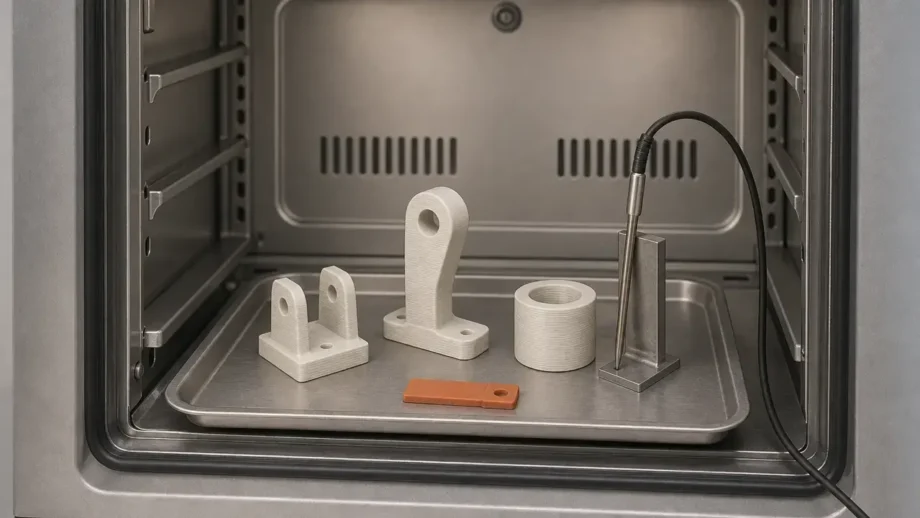
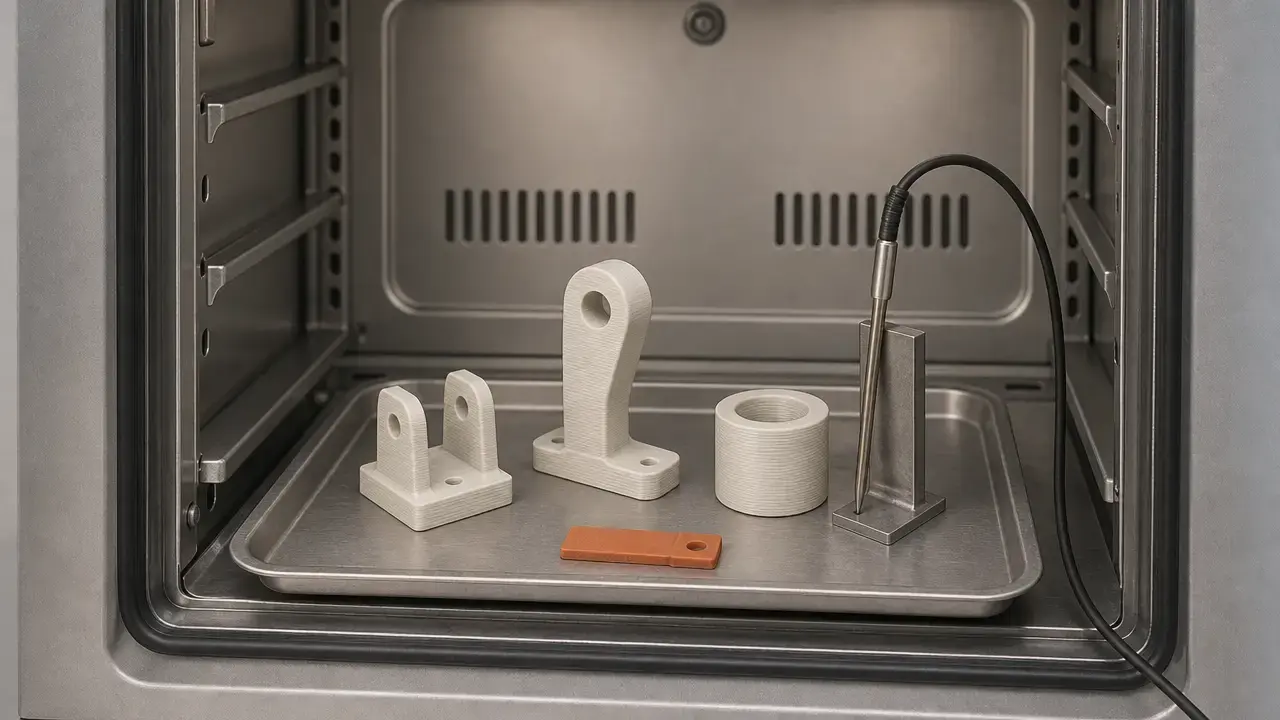
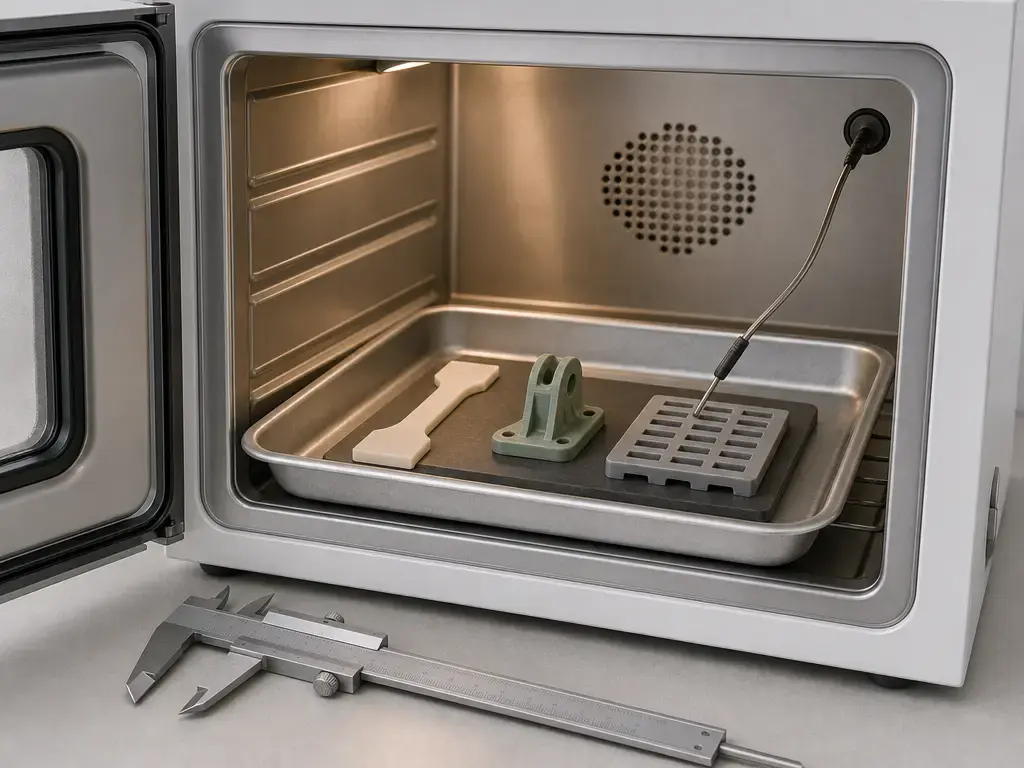
No universal recipe exists for all PLA, so the safest approach is to treat annealing as a controlled experiment. A practical, source-backed sequence is: print a sacrificial coupon or test part in the same filament and orientation as the real part; measure key dimensions before heating; use a controlled oven or chamber and verify the actual temperature rather than trusting the dial; support thin, large, or tolerance-critical parts with a flat support or fixture where appropriate; cool gradually with minimal handling; and measure again after cooling. That test-first mindset matches Prusa’s practical annealing work, which used 560 prism samples sized 80 × 10 × 4 mm across 70, 90, 110, 130, 150, and 170 °C and still found meaningful dimensional change. [5] [6] [9]
Variables that change the result include filament grade or formulation, wall thickness, infill, print orientation, oven accuracy or hot spots, support medium or fixture, and cooling rate. [6] [8] [9] [10] [11] [17] [18]
Temperature and time have to match the exact material. For ordinary PLA, practical tests and studies span a wide range, including low-temperature long-duration schedules and shorter, hotter schedules, but even Prusa saw dimensional change at 70 °C and Liao et al. reported severe distortion in thin samples at 120 °C for 10 minutes. In Shbanah et al., specimens held at 55, 65, and 80 °C under a long schedule showed no measurable size difference by caliper, while 95 °C caused deformation. For HTPLA, Protopasta advises 95-120 °C and usually about 10 minutes until the material changes. For 3D-Fuel Tough Pro PLA+, the guidance is 110-120 °C and roughly 20 minutes for a 0.125 in, or about 3.18 mm, wall thickness. NatureWorks lists product-specific annealing ranges of 110-120 °C for 3D870 and 80-130 °C for 3D850, with published HDT results tied to 100% infill and defined annealing schedules. Kahya et al. studied 70-110 °C and 40-200 minutes, while Birosz et al. explored an on-printer 100 °C “lazy annealing” approach for 1, 2.5, and 4 hours. None of those numbers should be treated as universal PLA guidance. If a kitchen oven is used, independent verification with a separate thermometer or data logger is a best practice, and it should not be treated as food-safe or contamination-free. [6] [8] [9] [10] [11] [12] [14] [17] [18]
What changes after annealing?
| possible benefit | possible downside | what controls it | source example |
|---|---|---|---|
| Better heat resistance. | Distortion during the cycle. | Temperature, soak time, part thickness, and support. | Prusa practical tests; Protopasta HTPLA; NatureWorks 3D850 and 3D870. [6] [8] [10] [11] |
| Higher stiffness or modulus in some test contexts. | Lower ductility or a more brittle feel. | Crystallinity, schedule, and formulation. | Liao et al.; Ghasemkhani et al. [12] [16] |
| Strength gains in a specific test setup. | Different metrics can move in different directions. | Metric used, print orientation, infill, and whether heating is in-process or post-process. | Tamașag et al.; Kahya et al.; Birosz et al. [15] [17] [18] |
| Better fit in warm use if the geometry survives. | Shrinkage, Z-growth, or warping. | Geometry, oven uniformity, residual stress, and cooling rate. | Prusa; 3D-Fuel; Shbanah et al. [6] [9] [14] |
The consistent pattern is that annealing can improve thermal behavior more reliably than it preserves original dimensions. That is why measuring before and after the cycle is essential for parts with any fit requirement. [6] [9] [12]
Ordinary PLA vs HTPLA vs PLA+ vs high-heat PLA
Not all PLA-family filaments respond the same way to heat treatment. Ordinary PLA is the baseline case in many academic studies and maker experiments, but vendor labels such as HTPLA, PLA+, and Tough PLA+ are not standardized material classes. They are brand- or formulation-specific products, so their published annealing windows are evidence for those products, not for all PLA. That distinction matters because standard PLA may distort quickly, while heat-treatable grades are formulated to crystallize more predictably. [6] [8] [9] [10] [11] [12]
NatureWorks 3D850 and 3D870 show why datasheet conditions need careful reading. Their HDT values are tied to printed parts at 100% infill and specific annealing schedules, not to every printer, geometry, or slicer setup. Likewise, 3D-Fuel’s Tough Pro PLA+ guidance ties timing to wall thickness, and Protopasta frames HTPLA as a material intended to be heat-treated after printing. These are useful references, but they remain product-specific. [8] [9] [10] [11]
| Material class | Typical annealing evidence to cite | Main benefit | Main risk |
|---|---|---|---|
| Ordinary PLA | Academic studies at 55-120 °C and Prusa practical tests. [6] [12] [14] | Possible heat-resistance and stiffness gains. | Warping, shrinkage, and inconsistent response across geometries. |
| HTPLA / high-heat PLA | Protopasta HTPLA and NatureWorks 3D850 or 3D870. [8] [10] [11] | Designed for more predictable crystallization and higher thermal performance. | Datasheet conditions may not match the user’s part or printer. |
| PLA+ / Tough PLA+ | 3D-Fuel Tough Pro PLA+ guidance. [9] | Formulation-specific toughness and heat-resistance gains. | Geometry-dependent distortion and brand-to-brand variability. |
Does annealing PLA make prints stronger?
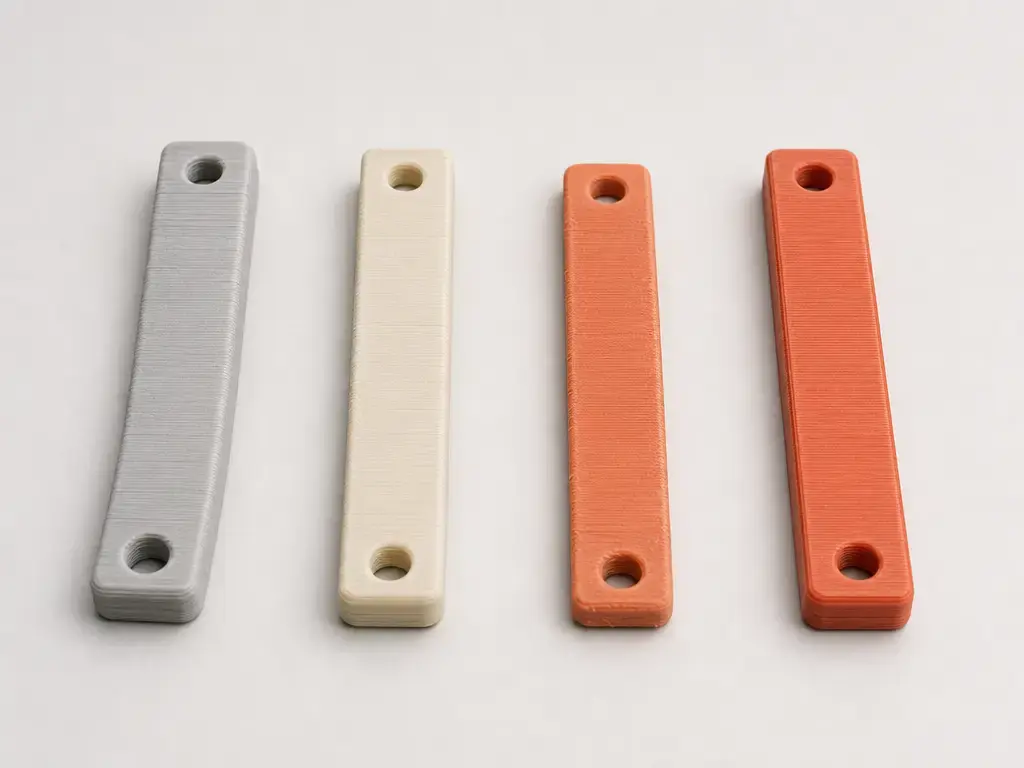
Sometimes, but only in a metric-specific sense. Annealing can increase stiffness, heat resistance, or a particular strength value in a defined test, but it can also reduce ductility or distort the part. For one universal strength increase figure for annealed PLA prints, no reliable figure found. [12] [15] [16] [17] [18] [19]
The main reason is that “stronger” can mean tensile strength, flexural strength, compressive strength, impact resistance, storage modulus, hardness, or interlayer behavior, and those do not always move together. Liao et al. showed that a 120 °C for 10 minute treatment could change structure without changing porosity, yet thin samples still distorted badly, so a property gain in one metric does not mean a better functional part overall. Ghasemkhani et al. compared 2 hour schedules at 75, 110, and 130 °C and framed the result as a competition between crystallization and chain diffusion or interlayer bonding, with excessive temperatures able to reduce ductility. Kahya et al. studied 70-110 °C and 40-200 minutes and reported 90 °C for 120 minutes as the most influential condition within that study for combined mechanical-property improvements. Those findings are useful, but they remain schedule- and test-specific. [12] [16] [17]
It is also worth separating post-process annealing from in-process heating. Tamașag et al. reported about a 12.5% tensile-strength increase with 80 °C hot-air heating during printing under fixed settings including 0.3 mm layer height, 20% cubic infill, 215 °C print temperature, and 50 mm/s speed, but that is not the same process as putting a finished part in an oven. NIST’s weld-formation work also warns against overinterpreting these results: annealing does not erase weak original interlayer bonding or all anisotropy created during printing. [15] [19]
Dimensional stability, shrinkage, and warping
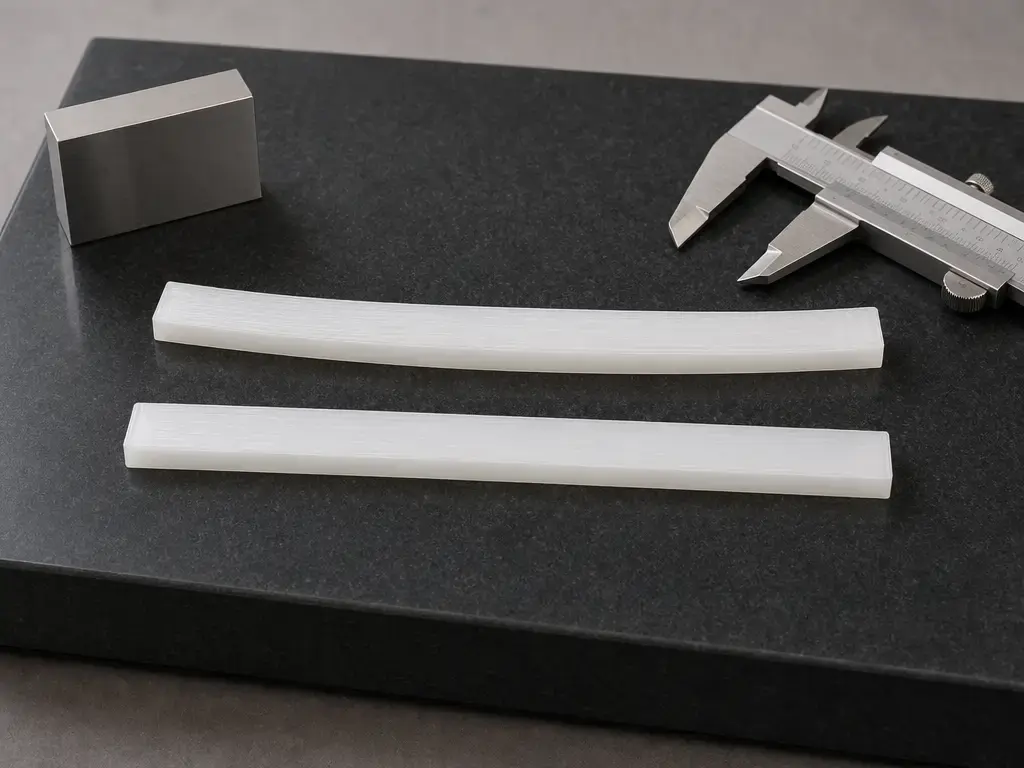
Dimensional instability is the main practical cost of annealing PLA. As the polymer relaxes and becomes more crystalline, the part can shrink, grow in a different axis, bow, or lose symmetry. Prusa’s test pieces shrank most in X, changed less in Y, and showed Z-axis growth, with noticeable dimensional change already at 70 °C and collapse at 170 °C. Liao et al. saw severe distortion in thin samples after 120 °C for 10 minutes, while Shbanah et al. found that a much longer schedule at 55, 65, and 80 °C showed no measurable size difference by caliper in that study, but 95 °C caused deformation. These results are not contradictory; they show that residual stress relief, crystallization, geometry, and heating history all interact. Infill, print orientation, wall thickness, and uneven oven airflow can change which part of the geometry moves first. [6] [9] [12] [14] [17] [18]
If fit matters, validate with a test coupon, scale only after measurement, and use fixtures or supports where appropriate. Avoid tight-tolerance assemblies unless the same filament, geometry, orientation, and schedule have already been verified on sacrificial parts. Datasheet values from high-heat grades are helpful, but they still come from specific printed-part conditions that may not match a real bracket, housing, or jig. [9] [10] [11]
When annealing PLA makes sense
Annealing PLA makes the most sense when a part needs better heat tolerance than as-printed PLA can offer and some dimensional drift is acceptable. Good candidates include simple brackets, hooks, jigs, fixtures, educational demos, and parts exposed to mild heat after validation. It is especially reasonable when the filament was designed for post-treatment, such as HTPLA or a high-heat PLA grade with published annealing guidance. It is a poor choice for tight-tolerance assemblies, safety-critical parts, or parts with unverified service temperatures, because the same schedules that improve thermal performance can still distort thin or complex geometry. [8] [9] [10] [11] [12] [17] [18]
Limitations and failure modes
The common failure modes are straightforward: deformation, embrittlement, loss of fit, uneven crystallization, oven hot spots, surface-finish loss, and support marks. Ordinary PLA can change dimensions at relatively low annealing temperatures, and thin parts may distort at schedules that look moderate on paper. Even high-heat or HTPLA products still require the right geometry and thermal control. Anecdotal success with one brand or one shape should not be read as proof that the same schedule will work for another part. [6] [8] [10] [12] [14] [18]
The deeper limitation is that annealing improves only what heat treatment can realistically change. It does not reliably repair poor print settings, voids, or all anisotropy. NIST’s weld-formation work ties interlayer performance to diffusion and thermal history during printing, so a poorly bonded part usually needs better print parameters or different orientation, not just an oven cycle. Published high-heat PLA numbers also come with important constraints, such as 100% infill and specific annealing schedules for the NatureWorks examples. Experimental alternatives such as on-printer lazy annealing are useful research directions, but they are not a universal fix for real-world print defects. [10] [11] [18] [19]
Current research and market context
Recent research continues to point toward optimization rather than a single recipe. Liao et al. provided a widely cited reference point with 120 °C for 10 minutes and cold crystallization around 100 °C, but also showed that thin printed parts can deform badly. Ghasemkhani et al. compared 2 hour schedules at 75, 110, and 130 °C and emphasized the balance between crystallization and bonding effects. Kahya et al. widened the practical window by studying 70-110 °C and 40-200 minutes, highlighting 90 °C for 120 minutes within that test program. [12] [16] [17]
The same nuance applies to market claims. Protopasta, 3D-Fuel, and NatureWorks all provide useful product guidance, but those numbers only become meaningful when read together with test method, infill, orientation, annealing condition, and geometry. Research is also exploring alternatives to simple oven post-processing, including in-process hot-air heating and on-printer lazy annealing. Tamașag et al. reported about a 12.5% tensile-strength increase with 80 °C in-process heating under fixed print settings, and Birosz et al. studied 100 °C on-printer heating for 1, 2.5, and 4 hours. These are promising directions, but they are not the same as a general home-user oven workflow. [15] [18]
Practical takeaways for annealing PLA
Annealing PLA can help material-extrusion parts tolerate more heat, but only if you test first, verify the real temperature, measure shrinkage, and choose the filament intentionally. There is no universal oven recipe, and annealing does not undo weak original layer bonding or bad geometry. [2] [5] [6] [8] [9] [10] [11] [12] [19]
FAQ
What is annealing PLA?
Annealing PLA is a post-print heat treatment for material-extrusion parts in which a finished PLA print is heated above its softening region but below full melting so the polymer structure can relax and usually become more crystalline. The usual goals are better heat resistance and, in some cases, higher stiffness or other test-specific property gains. The main risk is that the same cycle can also change dimensions or warp the part. [2] [6] [12]
How do you anneal PLA prints without warping them?
You reduce the risk rather than eliminate it. Start with a sacrificial coupon, measure it before heating, verify the actual chamber temperature with a separate thermometer or data logger, and support thin or asymmetric parts so they heat evenly. Then cool the part gradually and measure again. Geometry, wall thickness, and hot spots matter as much as the nominal setpoint, which is why one successful schedule on one part does not automatically transfer to another. [5] [6] [8] [9]
Does annealing PLA make 3D prints stronger?
Sometimes, but the answer depends on the metric. Some studies report gains in stiffness, tensile strength, flexural strength, or heat resistance under defined schedules, while others show reduced ductility or obvious distortion. In-process heating and post-process oven annealing are also not equivalent, so their numbers should not be mixed casually. For a single universal “annealing makes PLA X% stronger” claim, no reliable figure found. [12] [15] [16] [17] [19]
What temperature should I anneal PLA 3D prints at?
There is no universal temperature. Ordinary PLA examples in the source set range from long, lower-temperature schedules around 55-80 °C to hotter schedules near 120 °C, and those can produce very different dimensional outcomes. Product-specific guidance is narrower: Protopasta HTPLA uses 95-120 °C, 3D-Fuel Tough Pro PLA+ uses 110-120 °C, NatureWorks 3D870 lists 110-120 °C, and NatureWorks 3D850 lists 80-130 °C. The right setpoint depends on the exact formulation, geometry, and tolerance for shrinkage. [8] [9] [10] [11] [12] [14] [17]
How long should PLA be annealed?
Time depends on wall thickness, part mass, and the material being annealed. Protopasta says HTPLA often changes in about 10 minutes, while 3D-Fuel estimates around 20 minutes for a 0.125 in, or about 3.18 mm, wall thickness in Tough Pro PLA+. Research examples are much broader, including 40-200 minute studies, 15 hour low-temperature schedules, and on-printer 1, 2.5, or 4 hour trials at 100 °C. There is no one dwell time that covers all PLA prints. [8] [9] [14] [17] [18]
What is the difference between HDT, Vicat, and Tg after annealing?
Tg is the glass transition region where PLA loses rigidity and chain mobility rises. HDT, under ASTM D648-18, is a deflection-under-load test, and common summaries use 0.45 MPa or 1.80 MPa loads with a 2 °C/min heating rate. Vicat, under ASTM D1525-17, is an indentation-based softening test. None of these numbers is a simple synonym for safe service temperature, and all of them have to be read in their test context. [3] [4] [5] [6] [11]
Can I anneal PLA in a kitchen oven?
Many people do, but the caution matters more than the convenience. Household ovens can have hot spots, overshoot, and poor temperature uniformity, which can warp PLA even when the setpoint looks reasonable. If you use one, verify the real temperature independently and keep expectations conservative. Also, do not assume a kitchen oven used for filament parts is food-safe or contamination-free. A dedicated chamber is easier to control. [5] [6] [8] [9]
Sources
- ISO/ASTM 52900:2021 catalogue page — https://www.iso.org/standard/74514.html
- NIST: Material extrusion — https://www.nist.gov/additive-manufacturing/research-areas/technologies/material-extrusion
- ASTM D648-18 — https://store.astm.org/d0648-18.html
- ASTM D1525-17 — https://store.astm.org/d1525-17.html
- Intertek: Heat deflection temperature / ASTM D648 explainer — https://www.intertek.com/polymers-plastics/testlopedia/heat-deflection-temperature-astm-d648/
- Prusa blog: How to improve your 3D prints with annealing — https://blog.prusa3d.com/ja/howtoimproveyour3dprintswithannealing_31088/
- Prusa Knowledge Base: PLA — https://cdn.help.prusa3d.com/article/pla_2062?product=mk3s
- Protopasta HTPLA page — https://proto-pasta.com/pages/high-temp-pla
- 3D-Fuel: How To Anneal Tough Pro PLA+ — https://support.3dfuel.com/hc/en-us/articles/360001260633-How-To-Anneal-Tough-Pro-PLA-High-Temp
- NatureWorks Ingeo 3D870 TDS — https://www.natureworksllc.com/~/media/files/natureworks/technical-documents/technical-data-sheets/technicaldatasheet_3d870_monofilament_pdf.pdf
- NatureWorks Ingeo 3D850 TDS — https://www.natureworksllc.com/~/media/files/natureworks/technical-documents/technical-data-sheets/technicaldatasheet_3d850_monofilament_pdf.pdf
- Liao et al. (2019) — https://www.mdpi.com/2073-4360/11/9/1487
- Liao et al. record / PMC access point — https://pmc.ncbi.nlm.nih.gov/articles/PMC6781044/
- Shbanah et al. (2023) — https://www.mdpi.com/2073-4360/15/6/1587
- Tamașag et al. (2023) — https://www.mdpi.com/2073-4360/15/10/2367
- Ghasemkhani et al. (2024) — https://www.sciencedirect.com/science/article/abs/pii/S2352492824012479
- Kahya et al. (2025) — https://www.sciencedirect.com/science/article/pii/S0142941825000492
- Birosz et al. (2024) — https://link.springer.com/article/10.1007/s40964-024-00732-8
- NIST: Weld formation during material extrusion additive manufacturing — https://www.nist.gov/publications/weld-formation-during-material-extrusion-additive-manufacturing