
Summary
Water washable resin is a vat photopolymerization material formulated so uncured surface residue can be cleaned with water, or with water as an approved wash medium, instead of making isopropyl alcohol the default rinse liquid. The process itself does not change: liquid photopolymer in a vat is selectively cured by light-activated polymerization, even when hobby users casually call the printer “SLA.” [SRC-02]
The wash medium changes, but the hazard profile does not. NIOSH says uncured desktop vat-photopolymerization resin contains acrylates and other chemicals that can cause asthma or dermatitis, and it recommends ventilation, gloves, ultraviolet-light eye protection, frequent glove changes, and replacing PPE that contacts uncured resin or solvents. [SRC-06] EPA guidance also says household hazardous waste should not be poured down drains, on the ground, or into storm sewers, and a water-washable resin SDS can still carry skin-irritation, serious-eye-damage, skin-sensitization, and aquatic-hazard statements. [SRC-07] [SRC-08] [SRC-12]
Key takeaways:
- Water washing changes cleanup, not the underlying curing physics. [SRC-02]
- Water-washable does not mean non-toxic. [SRC-06] [SRC-12]
- Contaminated wash water does not belong in household drains. [SRC-07] [SRC-08] [SRC-14]
- PPE and ventilation still matter. [SRC-06]
At a Glance — Water Washable Resin vs Standard Resin
Water washable resin vs standard resin is mainly a post-processing difference. You are still handling uncured resin either way, and post-curing still matters either way. What changes is the default wash medium and, sometimes, how much routine IPA handling your workflow involves. [SRC-06] [SRC-11] [SRC-14]
| Aspect | Water-washable resin | Standard resin | What to remember |
|---|---|---|---|
| Wash medium | Water is often allowed; one current Anycubic TDS also allows ethanol or IPA for that SKU. [SRC-11] | Maker-approved solvent or wash solution is typical; IPA remains a common vendor recommendation. [SRC-14] | Check the exact TDS/SDS for the resin you bought. |
| Waste stream | Resin-contaminated water. [SRC-11] [SRC-14] | Resin-contaminated solvent. [SRC-14] | Neither belongs in drains. [SRC-07] [SRC-08] |
| Safety | Uncured acrylate hazards still apply. [SRC-06] | Uncured acrylate hazards still apply, plus solvent-handling concerns in many workflows. [SRC-06] [SRC-14] | PPE and ventilation are for both. |
| Post-cure | Still required after washing and drying. [SRC-10] [SRC-11] | Still required after washing and drying. [SRC-14] | Dry before cure. |
A fair summary is this: water-washable resin may reduce some routine flammable-solvent handling because IPA has odor and flammability drawbacks in wash workflows, but it does not make uncured resin harmless or remove waste-handling duties. [SRC-06] [SRC-14]
Terminology You’ll See
The umbrella term is vat photopolymerization. ISO/ASTM 52900:2021, published in November 2021 and listed by ISO as confirmed in 2025, is the current vocabulary standard for this terminology. [SRC-01] Its definition of vat photopolymerization is the process in which liquid photopolymer in a vat is selectively cured by light-activated polymerization. [SRC-02] NIST describes the same idea in plainer language as curing liquid photopolymer resin with ultraviolet light to form solid structures. [SRC-09]
That is why “SLA” is best treated as consumer shorthand, not the full technical category. In hobby use, people often say SLA even when the machine is an LCD/MSLA or DLP-style vat printer. For this article, the practical boundary is simple: if a light source is selectively curing a liquid resin in a vat, the cleanup and safety logic belongs to the same vat-photopolymerization family. [SRC-02] [SRC-09]
Useful shop-floor terms:
- Liquid resin: the uncured photopolymer in the bottle or vat.
- Freshly printed part: the object right off the printer, before final post-processing; many users call this the green part.
- Washed part: the print after surface residue has been removed.
- Post-cured part: the print after the UV cure is completed.
- Contaminated wash water: rinse water that now contains resin residue and should not be treated like clean water. [SRC-11] [SRC-14]
Why Some Resins Are Water-Washable
Water washable resin is not magic resin. In practice, it means the formulation is intended to let uncured surface residue come off with water instead of requiring IPA as the default wash liquid. That convenience applies to cleanup, not to the cured part becoming water-soluble or environmentally benign. Once rinse water has contacted uncured resin, it is contaminated wash water, not ordinary water. [SRC-11] [SRC-14]
Manufacturer wording helps here, but only as an example. Anycubic describes one product as a “hydrophilic group-modified light-curing resin,” and its TDS lists hydrophilic groups among the main components. [SRC-10] [SRC-11] That supports a limited conclusion: some formulations are engineered so water can remove uncured residue more effectively. It does not justify broad claims that all water-washable resins use the same chemistry or that cured parts are water-safe. [SRC-10] [SRC-11]
How to Clean Water Washable Resin Prints
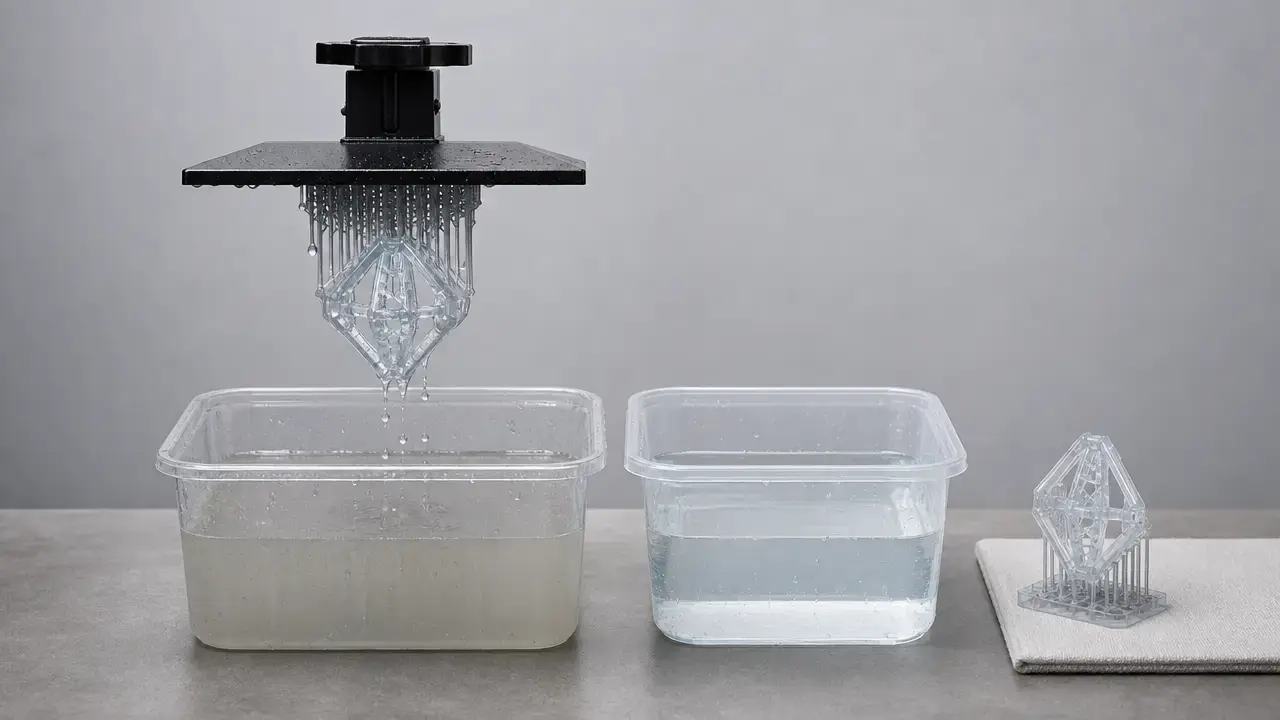
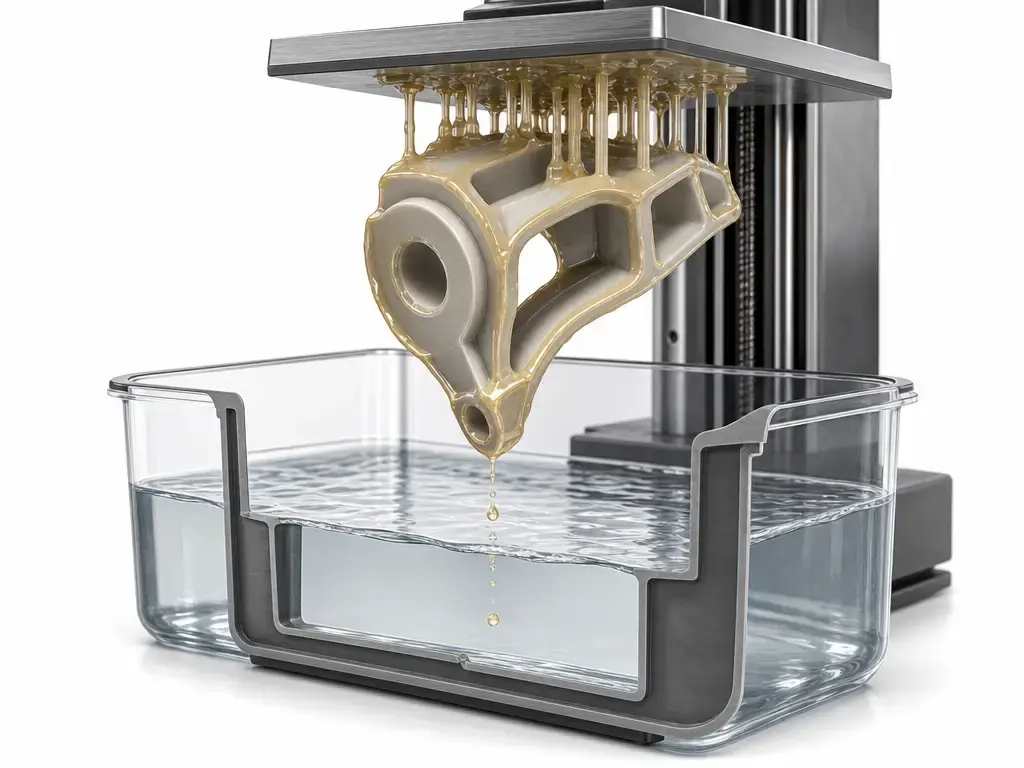
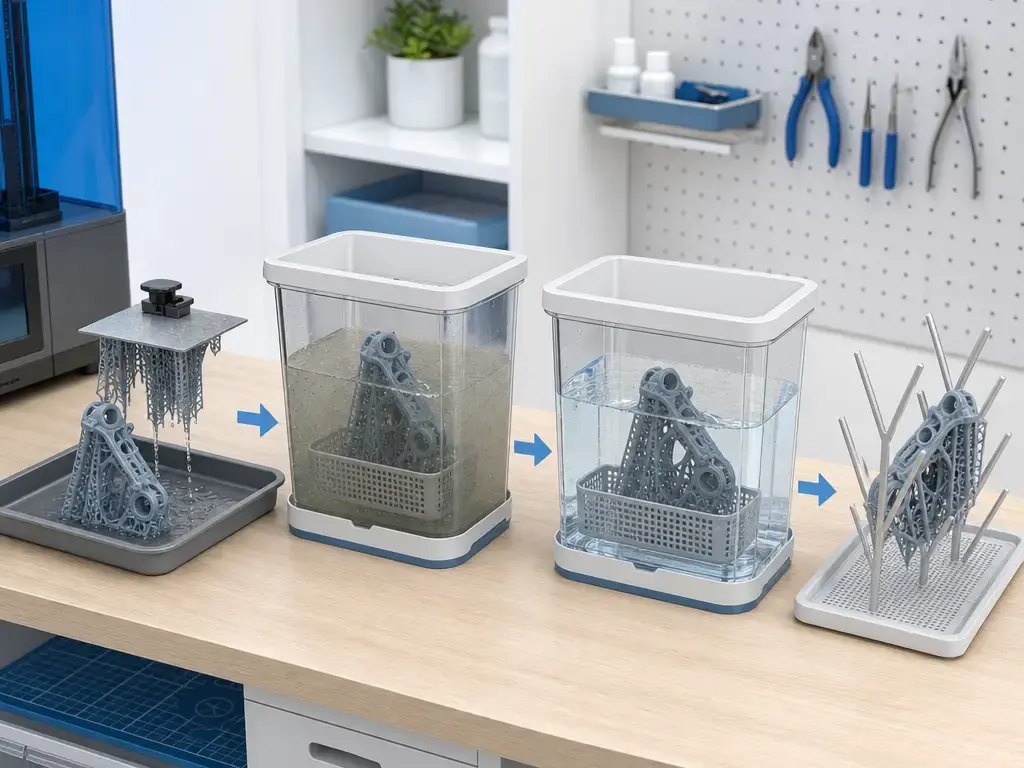
A practical workflow uses a dirty bath first and a cleaner bath second. Let the part drip briefly before washing, then use the first bath for bulk residue removal and the second for a cleaner finish. Agitation helps because fresh liquid needs to reach recesses, holes, and support marks. As the first bath loads up with resin, its cleaning power drops, so replacement should be based on results, not a fixed calendar. NIOSH still treats a freshly printed part as an exposure source during handling, so gloves, eye protection, and ventilation remain part of the job. [SRC-06]
There is no universal rinse time. Anycubic’s current TDS says water, ethanol, or IPA can be used and gives a wash duration of at least 3 minutes. [SRC-11] The current product page is internally inconsistent: one post-processing block says at least 3 minutes, while another says water washing should be “Medium ≥5 min.” [SRC-10] That is why rinse time should be treated as resin- and geometry-specific. Wash until visible residue is gone, and avoid long soaking just because it feels safer; the same TDS warns not to leave uncured prints in cleaning agent for a prolonged period. [SRC-11]
- Let the print drain briefly.
- Remove the build plate or part carefully.
- First wash in the dirtier bath.
- Second wash in the cleaner bath.
- Spot-clean recesses, holes, and fine details.
- Dry fully, inside and out.
- UV post-cure.
Drying Before Cure
Drying is not a cosmetic extra between washing and curing. If water stays in channels, under flat faces, or in support scars, UV exposure can leave residue trapped in place or produce patchy surface results. For water-washable resin, the goal is simple: get visible liquid off the exterior and out of any pockets before cure begins. [SRC-10] [SRC-11]
Anycubic is explicit about this for its product. The product page says to dry models by air-drying, blow-drying, or using a drying chamber to prevent water absorption and cracking, and the TDS says models made with that water-washable resin are prone to absorbing moisture from the air, which may degrade performance or cause cracking, so they should be dried thoroughly inside and out and cured promptly. [SRC-10] [SRC-11] That is manufacturer-specific guidance, not a universal law for every brand, but it is a strong reason not to rush damp parts into the cure station. [SRC-10] [SRC-11]
How to Cure Water Washable Resin
Cure only after washing is complete and the part is dry. NIOSH notes that curing with ultraviolet light and heat can generate particles and gases that should not be breathed in, and it still recommends ventilation, gloves, ultraviolet-light eye protection, and replacing PPE that has contacted uncured resin or solvents. [SRC-06] The cure step is part of the same safety workflow, not the point where precautions stop. [SRC-06]
Vendor cure numbers are examples, not universal settings. On Anycubic’s current product page, one water-washable resin example lists 405 nm, 18–30 °C, 25,000–30,000 µW/cm², and 3 minutes. [SRC-10] Use those only as maker guidance for that SKU. Overcuring can make thin features and sharp edges more brittle, so more UV is not automatically better. Follow the resin maker’s profile for the exact SKU and color, especially on hollow or delicate parts. [SRC-10] [SRC-11]
Supports — Remove Before or After Full Cure?
Support removal is workflow-dependent, but many users remove supports after washing and partial drying, then do the final cure afterward. The reason is practical: supports are often easier to trim before the part reaches its final brittle state, and that can reduce scarring. Even then, partially cured parts still belong in the resin-handling category, so NIOSH-style PPE and ventilation still apply. [SRC-06] If your resin maker gives a specific support-removal sequence, follow that instead of general habit. [SRC-10] [SRC-11]
Hollow Prints — Drain, Flush, Dry, Cure Internally
Hollow prints need drain holes and internal flushing. If a cavity is sealed with uncured resin still inside, you have trapped a long-term leak and contamination source. Flush the interior until the liquid leaving the part no longer shows obvious resin, then dry the inside as seriously as the outside. The same uncured-resin exposure logic applies to what is hidden inside the model, not just what you can see on the surface. [SRC-06]
After flushing, give the interior time and airflow to dry, and provide internal UV access where feasible through openings or access holes. This matters even more with water-washable resins because pooled water is easy to miss in enclosed spaces, and Anycubic’s drying guidance specifically warns to dry models thoroughly inside and out before prompt curing. [SRC-11] If you cannot reasonably flush, dry, and cure the cavity, do not permanently seal it. An open cavity is safer than a hidden reservoir of uncured resin or trapped wash water. [SRC-06] [SRC-11]
Vat Cleanup and Resin Recovery
Before the next print, inspect the vat for cured flecks, failed-support fragments, or other debris. Prusa’s resin-tank-cleaning procedure works by curing a single layer across the entire build area so debris is captured and lifted out, and it notes that leftover cured bits in the tank can cause failed prints or even damage the display. [SRC-16] Even if your printer does not have that exact feature, the principle carries over: do not run fresh prints over unknown debris. [SRC-16]
Water Washable Resin Water Disposal
Do not pour contaminated wash water into a sink, toilet, storm drain, onto soil, or into a septic system. EPA says improper household-hazardous-waste disposal can include pouring material down the drain, on the ground, or into storm sewers, and its March 9, 2026 demolition guidance says EPA strongly recommends that you not pour household hazardous waste down the drain, on the ground, or into storm sewers. [SRC-07] [SRC-08] Formlabs states the same rule more directly for resin workflows: water and solvents contaminated with alcohol and liquid resin should never be poured down your sink drain. [SRC-14]
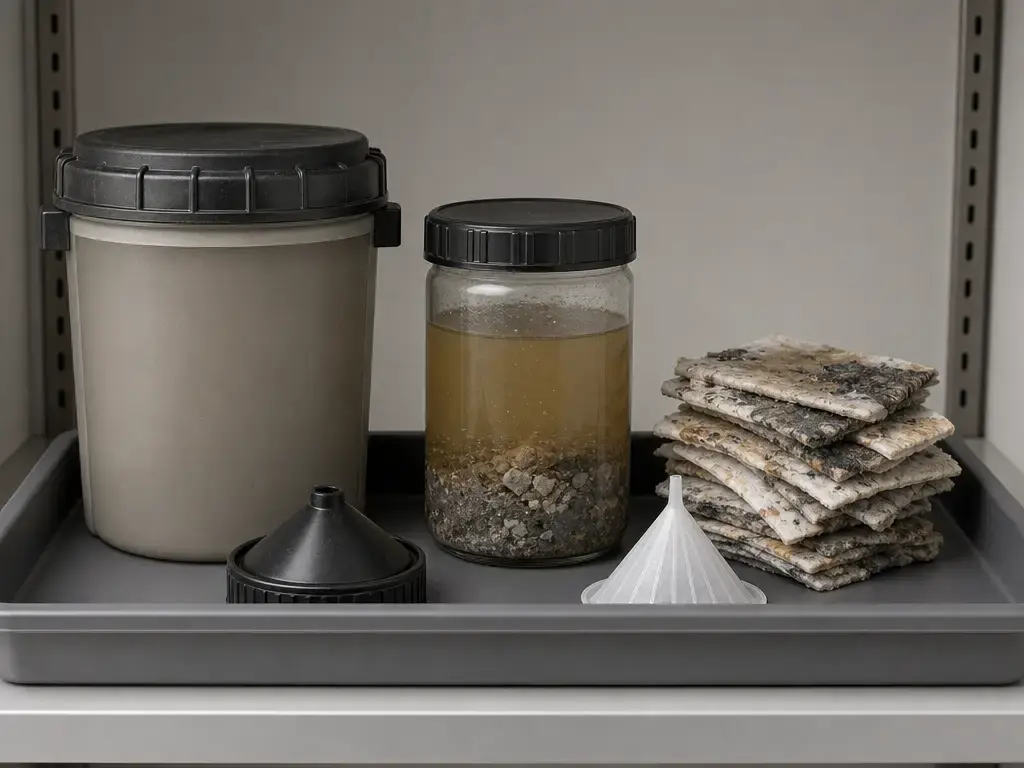
What you can do is contain it. Keep the wash liquid in a closed, labeled container away from light, allow solids to settle where appropriate, and cure visible resin solids where feasible before moving to the next disposal step. Anycubic’s TDS and product page both warn not to discharge wastewater into drains and describe settling and sunlight-curing of resin solids as a handling step before disposal as solid plastic waste. [SRC-10] [SRC-11] Treat that as pre-disposal processing only, not as universal permission to pour the remaining liquid away. Elegoo’s SDS is similarly conservative: it says not to allow the product to reach the sewage system, ground water, or water courses, and warns of danger to drinking water if even small quantities leak into the ground. [SRC-12]
The endpoint depends on local rules and the latest SDS/TDS for your exact SKU and color. EPA explicitly tells users to check with local environmental, health, or solid-waste agencies for management options in their area, and SDS/TDS language can differ by manufacturer and revision. [SRC-07] [SRC-08] For water-washable resin water disposal, the safe rule is containment first, local authority second, and no sink-disposal shortcuts. [SRC-07] [SRC-08] [SRC-14]
Performance Metrics That Matter
TDS numbers only make sense when tied to the exact resin, color, print settings, and post-cure conditions. For example, Anycubic’s current TDS for one water-washable SKU lists viscosity at 190–230 mPa·s at 25 °C, density at 1.07–1.09 g/cm³, tensile strength at 38–43 MPa, and elongation at break at 18–22%. [SRC-11] Phrozen’s current product page for one Rapid Black variant lists density at 1.11 g/cm³, viscosity at 120 cP, surface hardness at 76 Shore D, tensile stress at break at 15 MPa, and elongation at break at 18%. [SRC-13] These are examples, not category-wide benchmarks. Values are only meaningfully comparable when resin SKU or color, specimen preparation, orientation, post-cure protocol, and test method line up. [SRC-03] [SRC-04] [SRC-05]
ASTM references in a TDS are test methods, not a certification stamp for your printed part. ASTM D638 is a tensile test method, and ASTM says tensile properties vary with specimen preparation, testing speed, and environment. [SRC-03] ASTM D790 covers flexural properties in three-point bending for rectangular plastic specimens, but no reliable category-level flexural benchmark should be assumed from water-washable resin marketing alone. [SRC-04] ASTM D2196 covers apparent viscosity and non-Newtonian behavior with a rotational viscometer over a shear-rate range of 0.1 s⁻¹ to 50 s⁻¹ in a 600 mL low-form Griffin beaker, which is why viscosity numbers also depend on method context. [SRC-05]
Useful metrics to watch:
- Viscosity.
- Density.
- Tensile strength.
- Elongation at break.
- Hardness.
- Impact or toughness, when reported.
- Shrinkage.
- Exposure and post-cure settings. [SRC-10] [SRC-11] [SRC-13]
Limitations and Common Failure Modes
Sticky prints usually mean residue survived the wash. Common causes are dirty rinse water, too little agitation, resin trapped in recesses or cavities, or a model that went to cure before it was actually clean. Anycubic also warns not to leave uncured prints in cleaning agent for a prolonged period, which is a useful reminder that extra soaking is not the same as better cleaning. [SRC-11]
White or chalky residue after cure often points to under-drying or leftover wash liquid on the surface. This is especially common on matte surfaces, in shallow channels, or inside hollow parts where water clings longer than expected. The fix is usually better rinsing, better drying, and a more controlled cure, not immediately blaming the resin bottle. [SRC-10] [SRC-11]
Cracking is usually a workflow problem before it is a category verdict. Trapped resin, trapped water, long soaking, or aggressive curing can all contribute, and some formulations are less forgiving than others. Anycubic’s TDS says its own water-washable resin may absorb moisture from the air, degrade performance, or crack if not dried thoroughly and cured promptly, but that should be read as manufacturer guidance for that formulation, not proof that every water-washable resin behaves the same way. [SRC-11]
Troubleshooting checklist:
- Rewash if the part still feels slimy or tacky.
- Replace dirty wash water sooner.
- Check cavities and holes for trapped resin.
- Dry longer before curing, especially on hollow parts.
- Shorten soak time if fine features are softening.
- Reduce cure intensity or time if whitening or brittleness gets worse.
- Recheck the latest maker guidance for the exact SKU and color. [SRC-10] [SRC-11]
Safety Reality Check
Low odor is not low hazard. NIOSH says uncured vat-photopolymerization resin contains acrylates and other chemicals that can cause asthma or dermatitis, and it recommends ventilation, gloves that protect against acrylates and IPA, ultraviolet-light eye protection, frequent glove changes, and immediate replacement of PPE that contacts uncured resin or solvents. [SRC-06]
A water-washable SDS makes the same point from another angle. Elegoo’s water-washable resin SDS, revised April 6, 2022, lists H315 for skin irritation, H318 for serious eye damage, H317 for allergic skin reaction, and H412 for harmful to aquatic life with long lasting effects. [SRC-12] Those hazard statements apply to that specific SDS, not every bottle on the market, but they are enough to show why “water washable” should never be read as “non-toxic.” [SRC-12]
Spill cleanup stays within normal resin discipline: wear gloves, wipe up the liquid, and treat contaminated consumables as resin-contaminated until they are cured or disposed of according to local rules. Prusa’s spill guidance says a paper towel with IPA can be used for cleanup and recommends curing resin-soaked paper towels in a curing chamber or direct sunlight before treating them as plastic waste. [SRC-15]
Current Research
Recent research is narrower than hobby marketing language often suggests. A 2024 Scientific Reports paper studied a water-washable temporary crown and bridge resin in dentistry, not a generic desktop miniatures resin. It compared water, detergent, and alcohol washing at 5, 10, 20, and 30 minutes, and reported degree-of-conversion values of 49.58 ± 4.06% for water, 49.44 ± 4.20% for detergent, and 44.89 ± 2.21% for alcohol, with the water group peaking at 53.94 ± 1.40% at 20 minutes and the alcohol group dropping to 42.42 ± 2.21% at 30 minutes. [SRC-17] That is useful process evidence for that dental resin and protocol, not a universal wash-time rule for hobby prints. [SRC-17]
A separate 2025 Results in Materials study looked at Kevlar-powder-reinforced water-washable resin composites for jewelry applications, not off-the-shelf consumer bottles. The abstract reports tensile strength up 43.87%, hardness up 18.1%, modulus up 24.84%, toughness up 45.72%, and water absorption down 8.08% within that experimental set. [SRC-18] Those are research-composite results, so they should not be generalized to ordinary hobby resin unless the formulation and print conditions also change. [SRC-18]
Practical Buying and Setup Checklist
Start with the TDS and SDS, not the product headline. One current Anycubic water-washable product page lists a wavelength range of 365–405 nm and current documentation that allows water, ethanol, or IPA as washing media, while NIOSH safety guidance still drives the PPE and ventilation plan and EPA guidance should shape the wastewater plan. [SRC-06] [SRC-07] [SRC-10] [SRC-11]
Checklist:
- Verify printer wavelength compatibility.
- Confirm which wash media the maker actually allows.
- Look for cure parameters, not just print settings.
- Read the SDS for irritation, sensitization, and aquatic-hazard language.
- Plan a contained wash-water workflow before the first print.
- Treat ASTM references as test methods, not performance guarantees.
- Check the latest SDS/TDS for the exact SKU and color; if the revision is not visible, treat it as revision unknown. [SRC-03] [SRC-05] [SRC-10] [SRC-11] [SRC-12]
FAQ
Does water washable resin need IPA?
Not always. Some water-washable resins are designed so water can be the default wash liquid, and one current Anycubic TDS explicitly allows water, ethanol, or IPA for that SKU. [SRC-11] That said, “does water washable resin need IPA” is still a product-by-product question, not a category rule. Read the latest TDS for the exact resin and color you own. [SRC-10] [SRC-11]
Can you wash water washable resin with IPA?
Usually yes, if the maker allows it. Anycubic’s current TDS and product literature both list IPA as an allowed wash option for one water-washable resin. [SRC-10] [SRC-11] If you do use IPA, it becomes resin-contaminated solvent and needs the same conservative disposal mindset as contaminated wash water. It still does not belong in a sink drain. [SRC-08] [SRC-14]
Is water washable resin non-toxic or safer than standard resin?
No. Water-washable does not mean non-toxic, and it does not remove uncured acrylate hazards. NIOSH still recommends ventilation, gloves, ultraviolet-light eye protection, and replacing contaminated PPE when handling desktop vat-photopolymerization resin. [SRC-06] A water-washable resin SDS can still carry irritation, sensitization, eye-damage, and aquatic-hazard statements. [SRC-12] The narrow safety advantage is only that some workflows may involve less routine IPA handling, not that the resin itself becomes casual-contact safe. [SRC-06] [SRC-14]
Can you pour water washable resin down the drain?
No. EPA says household hazardous waste should not be poured down the drain, on the ground, or into storm sewers, and Formlabs says water and solvents contaminated with alcohol and liquid resin should never be poured down a sink drain. [SRC-07] [SRC-08] [SRC-14] If the water touched uncured resin, it is contaminated wash water, not ordinary wastewater. [SRC-11] [SRC-12]
How do you dispose of contaminated wash water?
Keep it contained, let solids settle where appropriate, cure visible resin solids where feasible, and then follow local waste authority guidance plus the latest SDS/TDS for your exact resin. [SRC-07] [SRC-08] [SRC-10] [SRC-11] Do not turn settling, filtering, or curing into a claim that the remaining liquid is universally drain-safe. It is not safe to make that assumption without local official guidance. [SRC-08] [SRC-12] [SRC-14]
Why are my prints sticky or chalky after curing?
Usually because washing, drying, or curing was off. Sticky parts often still have resin residue on or inside them, while chalky residue often points to leftover wash liquid or damp surfaces going into cure. [SRC-10] [SRC-11] Revisit rinse quality, drying time, and cure intensity before you conclude the bottle is bad. [SRC-10] [SRC-11]
Expert: How should you read toughness or strength claims in a resin TDS?
Read them as method-specific comparison data, not universal truth. ASTM D638 is a tensile test method, and ASTM says tensile properties vary with specimen preparation, speed, and environment. [SRC-03] ASTM D2196 shows the same issue for viscosity: the number depends on the measurement setup and shear behavior. [SRC-05] So a resin’s “toughness” or “strength” claim only becomes comparable when the resin variant, specimen prep, orientation, post-cure protocol, and test method all match. [SRC-03] [SRC-04] [SRC-05]
Bottom Line
Water washable resin is a sensible choice when you want simpler cleanup and less dependence on IPA in routine rinsing. Its main advantage is logistical: for compatible formulations, water can be an approved wash medium, while the printing process itself remains ordinary vat photopolymerization. [SRC-02] [SRC-10] [SRC-11]
The tradeoff is straightforward. Water washable resin does not remove uncured-resin hazards, it does not eliminate PPE or ventilation, and it does not make contaminated wash water drain-safe. Less IPA can be a workflow benefit, but you still need disciplined washing, full drying, proper curing, and conservative waste handling. [SRC-06] [SRC-08] [SRC-14]
Related on 3D Mag
Sources
Citations in the body use the [[SRC-##]](#sources) format.
- SRC-01 — ISO/ASTM 52900:2021 publisher page
- SRC-02 — EN ISO/ASTM 52900:2021 preview text with vat photopolymerization definition
- SRC-03 — ASTM D638 catalog page
- SRC-04 — ASTM D790 catalog page
- SRC-05 — ASTM D2196 catalog page
- SRC-06 — NIOSH/CDC Safe Desktop Vat Photopolymerization 3-D Printing
- SRC-07 — EPA Household Hazardous Waste (HHW)
- SRC-08 — EPA Household Hazardous Waste and Demolition
- SRC-09 — NIST Vat Photopolymerization overview
- SRC-10 — Anycubic Water-Wash Resin 2.0 product page
- SRC-11 — Anycubic Water-Wash Resin 2.0 TDS PDF
- SRC-12 — Elegoo Water Washable Photopolymer Resin SDS PDF
- SRC-13 — Phrozen Standard Water-Washable Resin product page
- SRC-14 — Formlabs Alternate Wash Solutions
- SRC-15 — Prusa Flooded/spilled resin guidance
- SRC-16 — Prusa Resin Tank Cleaning SL1/SL1S
- SRC-17 — Scientific Reports 2024 dental water-washable temporary crown and bridge resin study
- SRC-18 — Results in Materials 2025 Kevlar-reinforced water-washable resin composite study