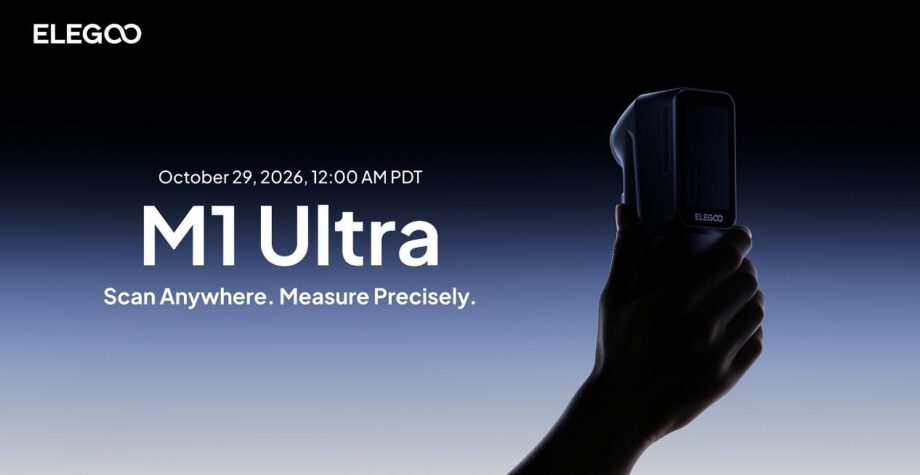
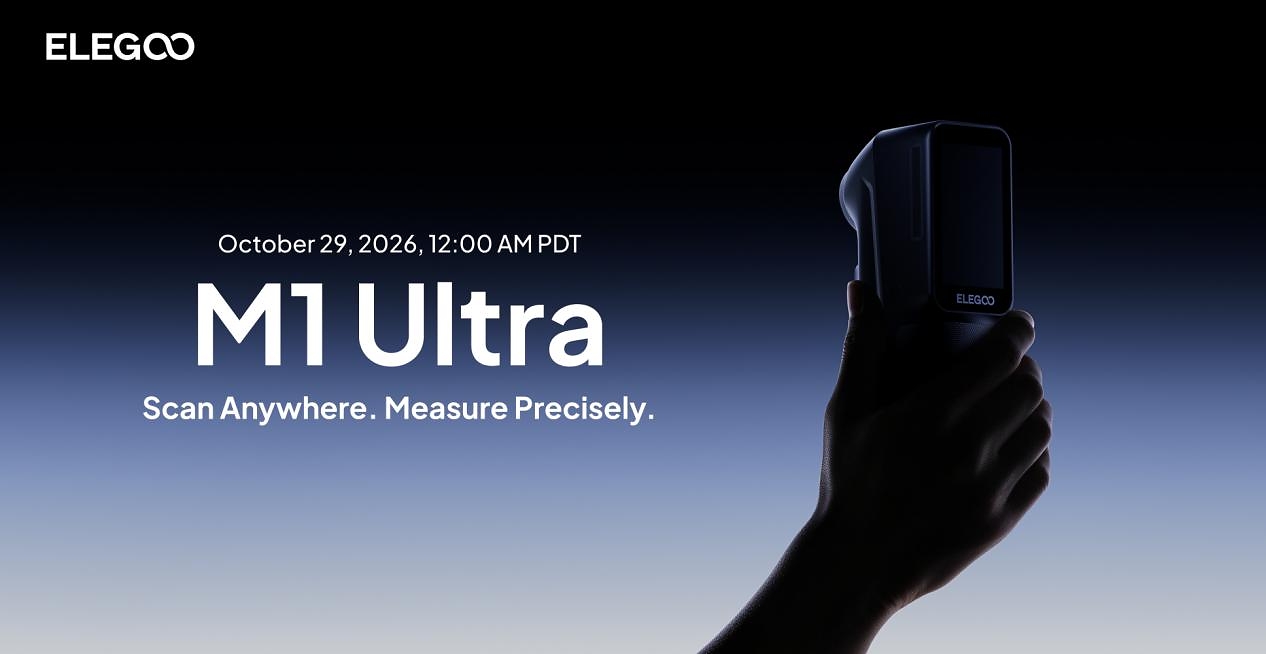

Elegoo, the Shenzhen-based manufacturer best known for its consumer 3D printers, is preparing to launch its first 3D scanner.
Named the M1 Ultra, this handheld device is scheduled for release on October 29, 2026, and takes the company beyond fabrication into the world of digitization.
According to Elegoo, the scanner is designed to link three stages of the making process: capturing a real-world object, modeling it digitally and 3D printing it. The company lists customization, reverse engineering, digital archiving, and education among its intended use cases, and is targeting engineers and experienced hobbyists alongside creators.
What do we know about the Elegoo M1 Ultra?
The M1 Ultra combines two capture methods, blue laser and infrared structured light, so users can switch between modes depending on the size and surface of their object. Readers unfamiliar with the difference can find an overview in our guide to 3D scanner types.
The scanner is also capable of operating without tracking markers, which helps on parts where applying stickers is impractical. Elegoo describes its accuracy as “metrology-grade”, although the official specifications haven’t been published online yet.
Much of the current marketing material focuses on ease of use. An integrated touchscreen displays a live preview of the scan and provides access to settings, while wireless connectivity and a swappable battery mean the device is not tethered to a computer during capture.
Processing is handled by Elegoo’s own ELEGOO SCAN software, which offers guided setup, tracking assistance and automated processing intended to reduce the manual work involved in producing a finished 3D model.
Ahead of launch, the M1 Ultra made its European debut at Maker Faire Rome 2026 and SPIEL Essen 2026, where visitors were given a first look at the scanner. Pricing and the remaining specifications will be confirmed on launch day via Elegoo’s product page.
Another new entry in the accessible market
To date, Elegoo says it has sold millions of products in more than 150 countries, and reported revenue of over $300 million in 2025. So, it’s been hugely successful in the consumer 3D printing market. But it’s not the only desktop 3D printer manufacturer moving into this space. Bambu Lab is also entering the 3D scanning industry with its S1, due in November. Together, the two announcements point to a growing trend of companies bringing handheld 3D scanning to a much wider audience.
Industry leaders like Artec 3D are also seeking to address this market with Artec Studio Lite, a photogrammetry software that turns photos and video taken on a smartphone into 3D models using AI. With this approach, users don’t need any scanning hardware at all.
Then again, accessible tools might lower the barrier to entry, but professional applications place far greater demands on both the scanning and software side of things. The wireless, 0.1 mm accuracy Artec Leo, for example, has a proven track record of capturing objects for reverse engineering and inspection – applications often beyond consumer technology. Let’s see how these newcomers fare!