
Verdict: Which Printer Wins for Which Buyer
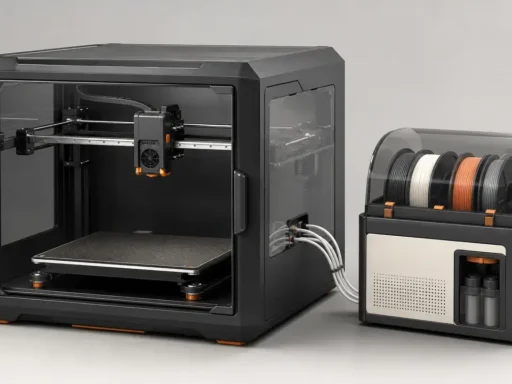
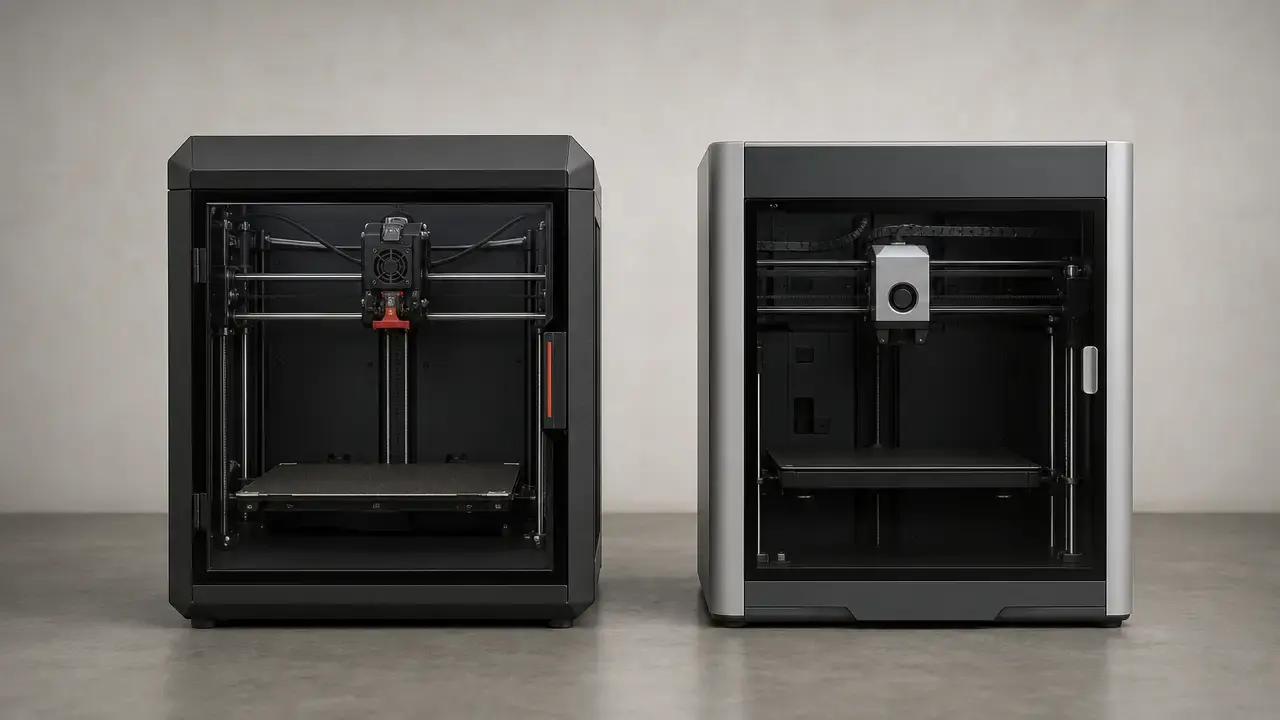
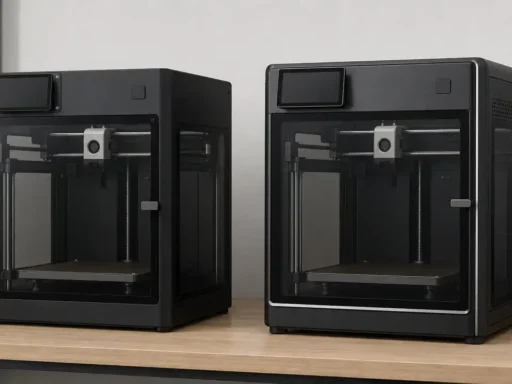
For most buyers comparing bambu h2s vs h2d, the H2S is the better default if you want simpler large-format single-nozzle printing at a lower entry price. [6] [7] [9]
The H2S has the larger nominal single-nozzle build volume at 340 × 320 × 340 mm³, and the official US H2 series page showed a lower from-price of $1,249 when checked on July 28, 2026. [7] [9] That makes it the cleaner fit for users who mostly print one material at a time and do not want to pay for a second nozzle they may rarely use. [6] [9]
The H2D is the better choice when your workflow depends on dual-nozzle planning, support material, mixed-material jobs, or the broader fabrication path that includes 10 W and 40 W laser options. [7] [8] The same US H2 series page showed the H2D from $1,999 on July 28, 2026, so the gap is meaningful if your work does not need those extra capabilities. [7]
Side-by-Side Specs Table
Vendor spec sheets are useful for a first pass, but they describe maxima and supported configurations rather than guaranteed part quality in every material and geometry. [8] [9] For bambu lab h2d vs h2s, the most important differences are build volume, nozzle count, thermal envelope, laser-module range, AMS workflow boundaries, and how carefully you interpret vendor-stated motion and flow numbers. [7] [8] [9]
| Spec | Bambu H2S | Bambu H2D | Why it matters |
|---|---|---|---|
| Build volume | 340 × 320 × 340 mm³. [9] | 325 × 320 × 325 mm³ single-nozzle; 300 × 320 × 325 mm³ dual-nozzle; 350 × 320 × 325 mm³ total two-nozzle reach. [8] | H2S has the larger nominal single-nozzle envelope; H2D changes with nozzle mode. |
| Nozzle count | Single nozzle. [7] | Dual nozzle. [7] | This changes support and material-switching strategy. |
| Max nozzle temperature | 350 °C. [9] | 350 °C. [8] | Shared high-temperature ceiling. |
| Bed / chamber temperature | 120 °C bed; 65 °C active chamber heating. [9] | 120 °C bed; 65 °C active chamber heating. [8] | Thermal capability is similar. |
| Max speed / acceleration | 1000 mm/s; 20,000 mm/s². [9] | 1000 mm/s; 20,000 mm/s². [8] | Motion limits are not the same as real print speed. |
| Standard / high-flow hotend flow | 40 mm³/s standard; 65 mm³/s optional high-flow under Bambu ABS test parameters at 280 °C. [9] | 40 mm³/s standard; 65 mm³/s optional high-flow under Bambu ABS test parameters at 280 °C. [8] | Flow often limits throughput before motion does. |
| Laser options | 10 W 455 nm only. [9] [13] | 10 W / 40 W 455 nm. [8] | H2D has the broader upgrade path. |
| Weight | 30 kg; H2S Laser Edition 30.5 kg. [9] | 31 kg. [8] | Mostly relevant for setup and bench load. |
| AMS compatibility | First-generation AMS plug-and-play; no AMS drying support; AMS lite not supported; up to 4 AMS 2 Pro and 8 AMS HT totaling 12 units and 24 filament slots. [13] | AMS 2 Pro, AMS, and AMS HT are listed as compatible on the US H2 series page; exact slot and color totals were not verified in the reviewed official H2D source set used here. [7] | Ecosystem fit affects multicolor and multi-material planning. |
| Vision Encoder status | Sold separately; below 50 µm motion accuracy wording. [10] | Sold separately; 5 µm optical measurement resolution and distance-independent 50 µm motion accuracy wording. [11] | Motion-calibration claims are not whole-part accuracy guarantees. |
Both machines list the same physical dimensions of 492 × 514 × 626 mm³, while net weight differs slightly at 30 kg for H2S, 30.5 kg for H2S Laser Edition, and 31 kg for H2D. [8] [9] If you are comparing purchase cost, keep in mind that this article uses official US series-page from-prices rather than every bundle or product-page price presentation, and live store pricing should be rechecked on publication day. [7]
Historical Background: Why the H2S Exists Beside the H2D
Bambu Lab launched the H2D first on March 25, 2025, and positioned it as the broader all-in-one H-series platform with multiple configurations and launch MSRPs ranging from $1,899 for the base H2D to $3,499 for the H2D Laser Full Combo 40 W. [5] Bambu Lab then launched the H2S on August 26, 2025, as the streamlined single-nozzle branch of the same H-series idea. [6]
That chronology matters because the H2S is not a retrofit path into the H2D. [6] [13] This is product segmentation: one machine simplifies the toolhead and keeps a bigger nominal single-nozzle envelope, while the other keeps the more feature-dense dual-nozzle and broader fabrication role. [6] [8] [9]
What Actually Differs Between the H2S and H2D
FDM in Bambu’s terms, MEX in standards terms
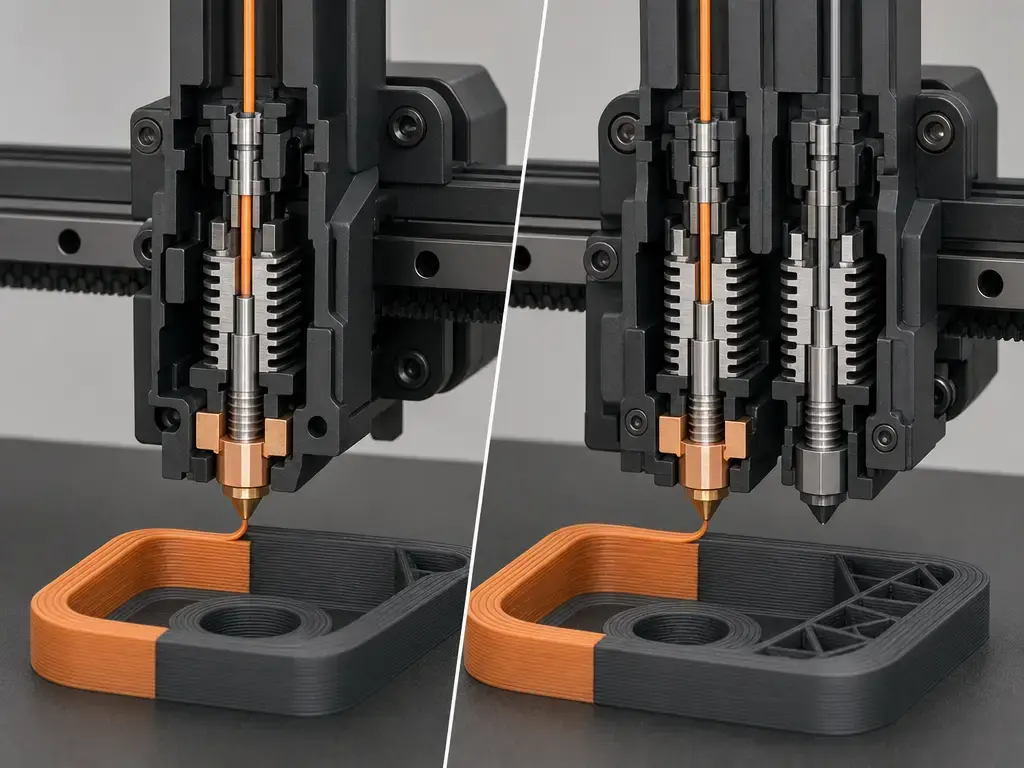
Bambu describes these printers as Fused Deposition Modeling systems, while ISO/ASTM 52900:2021 places this process family under material extrusion, or MEX. [1] In the standard’s wording, material extrusion is an additive manufacturing process in which material is selectively dispensed through a nozzle or orifice. [1] That keeps the comparison grounded: the process class is the same, but the toolhead philosophy and workflow design differ within that MEX category. [1]
Single-nozzle + AMS versus dual-nozzle printing
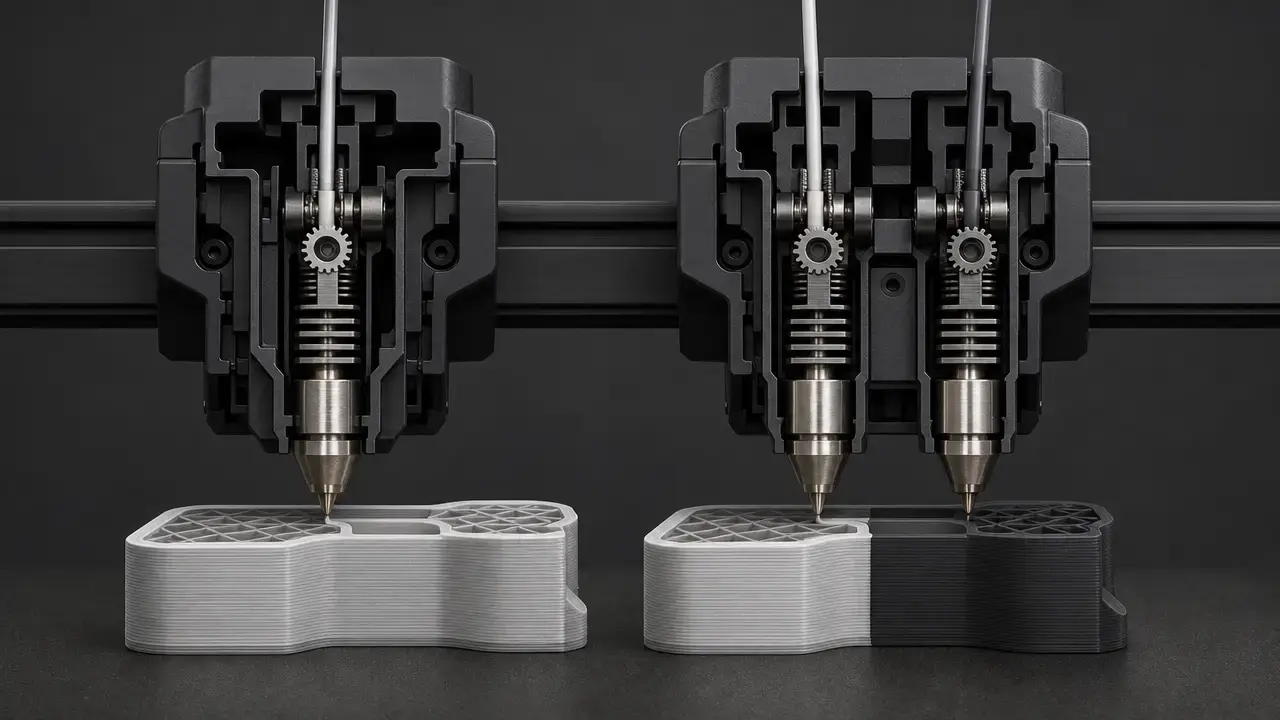
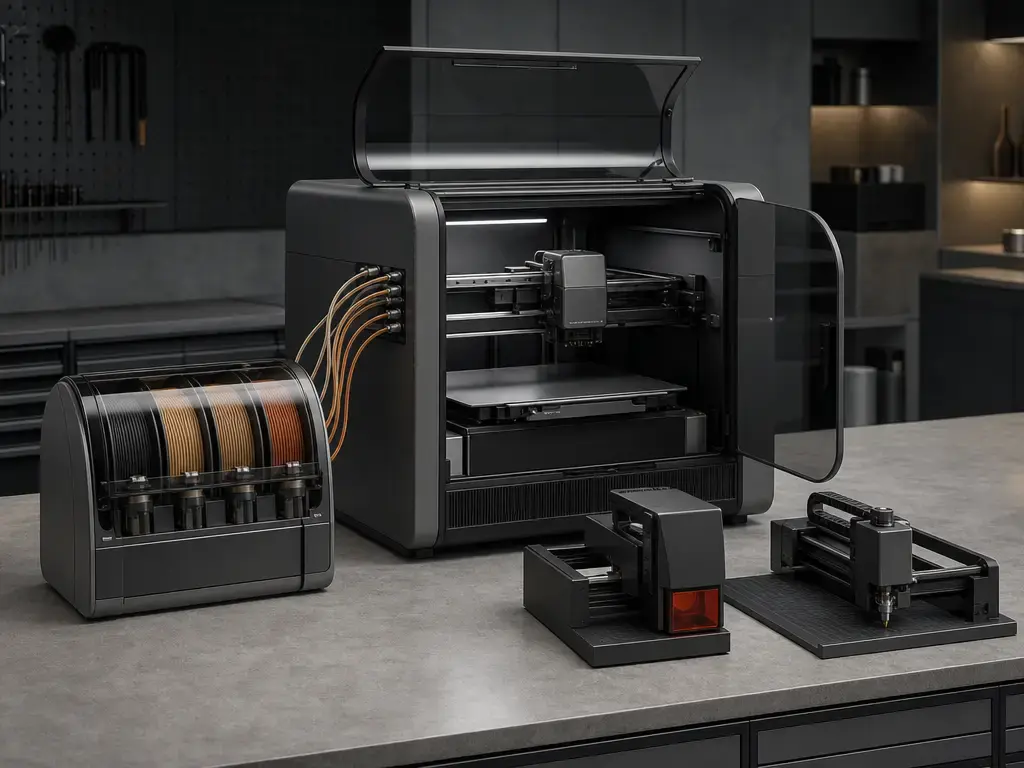
The H2S uses one nozzle and relies on filament switching through the AMS path for multicolor or multi-material changes. [13] Bambu’s H2S FAQ says the first-generation AMS is plug-and-play compatible for multicolor printing, but AMS drying is not supported, AMS lite is not supported, and the H2S can connect up to 4 AMS 2 Pro and 8 AMS HT units for a total of 12 units and 24 filament slots. [13] The same FAQ also says the H2S cannot be upgraded into an H2D. [13]
The H2D changes the planning model because the second nozzle creates a smaller dual-nozzle build intersection of 300 × 320 × 325 mm³ and a separate total two-nozzle reach of 350 × 320 × 325 mm³. [8] In plain language, that 350 mm figure is not a simple single-nozzle cuboid you can use in every mode. [8] The tradeoff is that a second nozzle can keep one material or support material ready without turning every change into a feed-system swap. [1] [8]
- Choose H2S if… you mainly want larger single-material parts, simpler planning, and the lower H-series entry point. [7] [9]
- Choose H2D if… you regularly need dedicated support material, true two-nozzle planning, or the broader laser-module range. [8]
Print Quality, Speed, and Accuracy Claims in Practice
Motion limits versus real throughput
Bambu states 1000 mm/s maximum toolhead speed and 20,000 mm/s² maximum acceleration for both platforms. [8] [9] These are motion maxima, not a promise that either machine sustains 1000 mm/s in ordinary printing. [8] [9] In practice, throughput is usually constrained by extrusion rate, nozzle size, cooling, material behavior, layer time, and part geometry. [8] [9] That is why the vendor-stated hotend flow numbers are often more useful than the headline motion number: both machines are listed at 40 mm³/s for the standard hotend and 65 mm³/s for the optional high-flow hotend under Bambu ABS test parameters at 280 °C. [8] [9]
Accuracy, repeatability, resolution, and the Vision Encoder claim
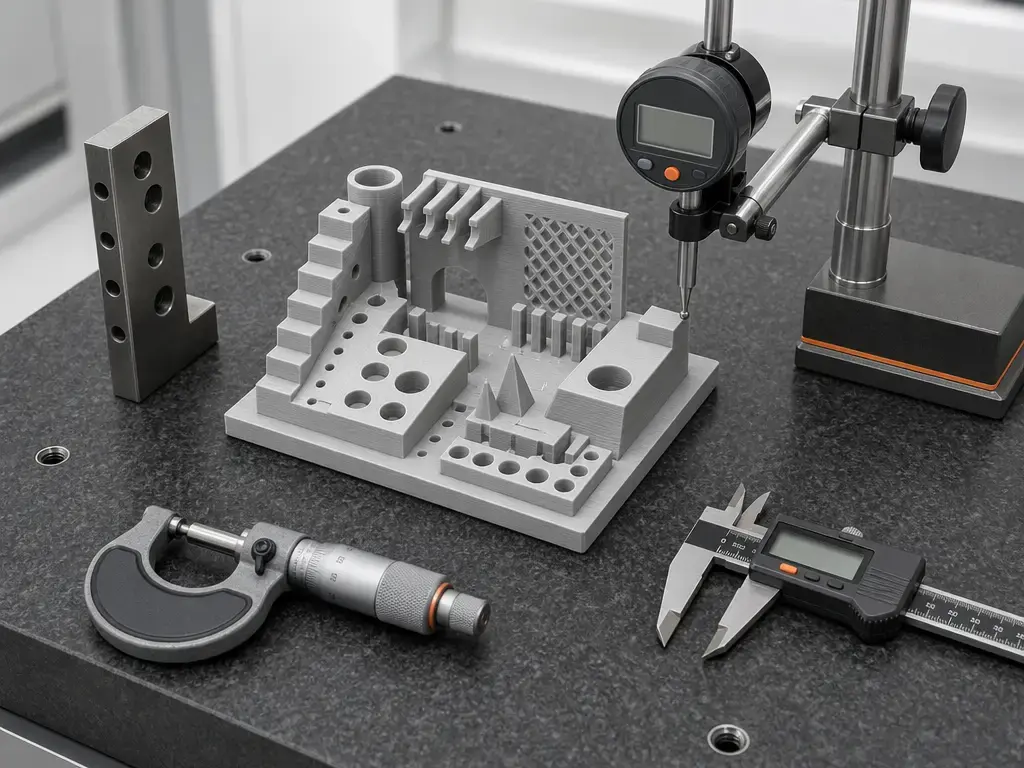
The Vision Encoder claims need careful wording. [10] [11] On H2D, Bambu says the optional Vision Encoder uses 5 µm optical measurement resolution to help deliver distance-independent 50 µm motion accuracy across the workspace. [11] On H2S, Bambu says the optional Vision Encoder enables distance-independent motion accuracy below 50 µm. [10] Bambu’s standalone Vision Encoder product page also describes it as a calibration tool for motion accuracy rather than a standards-based certification of whole-part dimensional tolerance. [12]
Motion accuracy, dimensional accuracy, repeatability, measurement resolution, and layer height are related but not identical concepts. [2] [3] A machine can move precisely in XY and still produce a part that varies dimensionally because of shrinkage, chamber conditions, support strategy, extrusion behavior, or geometry-specific deformation. [2] [3] No reliable independent whole-part accuracy benchmark was found in the reviewed source set. [2] [3]
ISO/ASTM 52902:2023 is the more appropriate standards reference for geometric-capability assessment because it describes test geometries used to quantitatively assess the geometric performance of an AM system rather than relying on a single marketing number. [2] The NIST additive manufacturing test artifact is useful background for the same reason: it was proposed to evaluate machine and process capabilities and limitations through measured features, not by inferring tolerance from one accessory claim. [3]
Thermal and flow capability in context
Thermally, both machines list a 350 °C nozzle, 120 °C heatbed, and 65 °C active chamber heating. [8] [9] Combined with the vendor-stated 40 mm³/s standard-flow and 65 mm³/s optional high-flow hotend figures, that puts both machines in a serious prosumer engineering-filament class on paper. [8] [9] But those numbers are capability ceilings and test-condition figures, not proof that every engineering filament or every geometry will behave equally well in real use. [8] [9]
Materials, AMS, and Support-Material Workflows
Thermal capability and filament-path compatibility answer different questions. [9] [13] A printer can have a hot nozzle and an actively heated chamber yet still impose practical limits on which AMS path, drying behavior, or material-routing method makes sense in daily use. [9] [13] On the H2S specifically, Bambu says first-generation AMS is plug-and-play, AMS drying is unsupported there, AMS lite is unsupported, and the machine cannot be upgraded into an H2D later. [13]
That is why H2S plus AMS should not be treated as the same workflow as a dual-nozzle machine. [8] [13] AMS swapping is still a feed-and-change process through one nozzle, while a second nozzle can hold a separate support or secondary material ready at the toolhead. [1] [8]
Material-handling questions before buying
- Which materials do you actually need to run most often? [9] [13]
- Do you need AMS drying, or only filament switching? [13]
- Is soluble or breakaway support a normal part of your workflow rather than an occasional experiment? [1] [8]
- Will abrasive, brittle, soft, or high-performance filaments create path or handling constraints in daily use? [9] [13]
If those questions point toward dedicated support material or more persistent multi-material jobs, the H2D becomes more attractive. [8] If they point toward straightforward single-material printing with occasional color changes, the H2S is usually the simpler fit. [9] [13]
Laser, Cutting, and Plotting: When the H2D Has the Clearer Upgrade Path
Laser compatibility is one of the clearest separations between the machines. [8] [13] Bambu’s H2S FAQ says the H2S supports 10 W laser and cutting, but not 40 W laser. [13] Bambu’s H2D technical specifications list 10 W and 40 W 455 nm laser options, with stated power figures of 10 W ± 1 W and 40 W ± 2 W. [8] If laser capability matters to your purchase decision, the H2D has the broader official path. [8] [13]
The module work areas differ as well. [8] [9] Bambu lists a 10 W engraving area of 310 × 260 mm² for H2S and 310 × 270 mm² for H2D, while H2D also lists a 40 W engraving area of 310 × 250 mm². [8] [9] For cutting, Bambu lists 297.5 × 300 mm² on H2S and 300 × 285 mm² on H2D, with a 300 × 255 mm² drawing area, a 50 gf to 600 gf blade pressure range, and 0.5 mm maximum cutting thickness. [8] [9] These are compatibility and envelope figures, not operating recipes. [8] [9]
Bambu classifies the laser module itself as Class 4 and says the printer plus laser module operate as a Class 1 laser product only when protections are complete and working properly. [8] FDA guidance says Class IV products present immediate skin and eye hazards from direct or reflected exposure and may also present a fire hazard. [4] So the enclosure class should not be read as meaning laser use is risk-free or that ventilation, fire, material, and maintenance concerns disappear. [4] [8]
Who Should Buy Which: Three Buyer Profiles
If you mainly print large single-material parts such as housings, fixtures, prototype enclosures, or large cosplay shells, the H2S is the better fit. [9] Its nominal 340 × 320 × 340 mm³ build volume is larger than the H2D’s single-nozzle figure, and the single-nozzle planning model keeps the workflow simpler. [8] [9] Pick: H2S.
If your work frequently depends on support material, mixed materials, or jobs where keeping a second filament ready at the toolhead has real value, the H2D is the better fit. [8] Its dual-nozzle build intersection of 300 × 320 × 325 mm³ and separate 350 × 320 × 325 mm³ total two-nozzle reach exist because the second nozzle changes placement and switching logic. [8] This is the case where extra complexity is functional rather than theoretical. [8] Pick: H2D.
If you run a small studio, makerspace, or mixed-use shop and want a broader fabrication platform that may expand into laser work or cutting, the H2D has the clearer official upgrade path. [8] [13] The H2S still makes sense when printing is the core job, but once 40 W laser support or persistent two-nozzle workflow matters, the H2D is the more complete fit. [8] Pick: H2D.
Limitations and Risks Before You Buy
The biggest limitation in any H2S vs H2D comparison is that much of the public data is vendor-stated. [7] [8] [9] The official US H2 series page showed from-prices of $1,999 for H2D and $1,249 for H2S on July 28, 2026, but live pricing, bundles, and accessory presentation can change, so those numbers should be rechecked on publication day. [7] The Vision Encoder figures are also motion-calibration claims rather than independently standardized whole-part tolerance guarantees. [10] [11] Because no independently standardized whole-part accuracy benchmark was found in the reviewed source set, buyers should not treat vendor motion claims as guaranteed printed-part tolerances. [2] [3]
The second limitation is ecosystem fit. [7] [13] H2S has clear boundaries: AMS drying is unsupported on first-generation AMS, AMS lite is unsupported, and there is no H2S-to-H2D upgrade path. [13] On the laser side, the Class 1 system wording is conditional, while the module itself remains Class 4 and FDA’s general hazard framing still applies. [4] [8]
Current Market Context and Price Check
For bambu h2s vs h2d, it helps to separate launch MSRP from current official US price signals. [5] [6] Bambu launched the H2D on March 25, 2025, with MSRPs of $1,899 for H2D, $2,199 for H2D AMS Combo, $2,799 for H2D Laser Full Combo 10 W, and $3,499 for H2D Laser Full Combo 40 W. [5] Bambu launched the H2S later on August 26, 2025, as the simpler single-nozzle H-series branch. [6]
For current buying context, the official US H2 series page listed H2D from $1,999 USD and H2S from $1,249 USD when checked on July 28, 2026. [7] Those figures are best treated as same-day official series-page signals rather than permanent price promises. [7] If you are reading later than July 28, 2026, re-check the same US page before buying, because a launch MSRP comparison and a live store comparison are not the same thing. [5] [7]
FAQ
Which should I buy, H2S or H2D?
Buy the H2S if your main job is larger single-material printing and you want the simpler, lower-entry H-series option. [7] [9] Buy the H2D if you expect the second nozzle, support-material workflow, or broader laser path to be part of regular use rather than occasional experimentation. [8] Current US pricing should always be rechecked before purchase. [7]
Does H2S really have a bigger build volume?
Yes, for the nominal single-nozzle volume. [8] [9] Bambu lists the H2S at 340 × 320 × 340 mm³, while the H2D has three figures: 325 × 320 × 325 mm³ in single-nozzle mode, 300 × 320 × 325 mm³ in dual-nozzle mode, and 350 × 320 × 325 mm³ as total two-nozzle reach. [8] [9] The answer changes depending on which H2D mode you mean. [8]
Is the H2D mainly worth it for the second nozzle?
Mostly, yes. [8] The second nozzle is the feature that changes planning the most because it affects supports, material handling, and usable build geometry in dual-nozzle work. [1] [8] The H2D also adds the broader fabrication path, including official 40 W laser support, so it is not only about dual-material printing. [8]
Can the H2S use the 40 W laser?
No. [13] Bambu’s H2S FAQ says the H2S supports 10 W laser and cutting only, while the H2D is the machine that officially supports both 10 W and 40 W 455 nm laser options. [8] [13]
Does the Vision Encoder guarantee part accuracy?
No. [10] [11] Bambu’s wording is about motion accuracy calibration: H2D is described with 5 µm optical measurement resolution and distance-independent 50 µm motion accuracy, while H2S is described as below 50 µm motion accuracy with the optional Vision Encoder. [10] [11] That is not the same as a blanket guarantee of printed-part tolerance across all geometries and materials, which is why standards-based geometric-capability methods such as ISO/ASTM 52902:2023 are the better benchmark reference. [2]
How many AMS slots or colors does H2D support?
No reliable figure found in the reviewed official source set used for this article. [7] The official US H2 series page does list the H2D as compatible with AMS 2 Pro, AMS, and AMS HT, but an exact H2D slot or color total was not verified here from a current official H2D FAQ or manual on publication day. [7]
Are these printers good for engineering filaments?
They are capable on paper because both list a 350 °C nozzle, 120 °C bed, and 65 °C active chamber heating. [8] [9] But vendor-stated thermal capability is not the same as universal compatibility or guaranteed results. [8] [9] The better question is whether your specific filament, geometry, nozzle choice, and support strategy fit the machine’s thermal and extrusion limits. [8] [9]
Related on 3D Mag
- Bambu A1 vs A1 Mini: Which 3D Printer to Buy
- Bambu Lab P1S vs P2S: Key Differences Explained
- Bambu Lab A1 vs P1S: Which 3D Printer Wins?
Sources
- ISO/ASTM 52900:2021, Additive manufacturing — General principles — Fundamentals and vocabulary. https://cdn.standards.iteh.ai/samples/74514/57d795b6267a427899d7b351598bece2/ISO-ASTM-52900-2021.pdf
- ISO/ASTM 52902:2023, Additive manufacturing — Test artefacts — Geometric capability assessment of additive manufacturing systems. https://www.iso.org/standard/79683.html
- NIST, An Additive Manufacturing Test Artifact. https://www.nist.gov/publications/additive-manufacturing-test-artifact
- FDA, Frequently Asked Questions About Lasers. https://www.fda.gov/radiation-emitting-products/laser-products-and-instruments/frequently-asked-questions-about-lasers
- Bambu Lab Blog, Bambu Lab Launches H2D to Rethink Personal Manufacturing. https://blog.bambulab.com/bambu-lab-launches-h2d-to-rethink-personal-manufacturing/
- Bambu Lab Blog, H2S the Ultimate Single-Nozzle 3D Printer Now Bigger Than Ever. https://blog.bambulab.com/h2s-the-ultimate-single-nozzle-3d-printer-now-bigger-than-ever/
- Bambu Lab, H2 Series page (US). https://bambulab.com/en-us/series/h2
- Bambu Lab, H2D Technical Specifications. https://bambulab.com/uk/h2d/tech-specs
- Bambu Lab, H2S support / buying guide with technical specifications. https://bambulab.com/en/support/buying-guide?id=1013579805858963456&page=1
- Bambu Lab US Store, H2S product page. https://us.store.bambulab.com/en/products/h2s?from=home_page_3dprinter
- Bambu Lab, H2D product page. https://bambulab.com/hu/h2d
- Bambu Lab US Store, Vision Encoder product page. https://us.store.bambulab.com/products/vision-encoder?id=601545719002021889%5C%5C%5C
- Bambu Lab, H2S FAQ. https://bambulab.com/nl-nl/h2s/faq