
Summary
“FDA approval for 3D printing” is not a standalone FDA category. For medical devices, FDA regulates the finished product and its intended use under existing device frameworks, whether the product is printed, machined, or molded. A 3D-printed implant, guide, instrument, anatomical model, or software-linked output can fall into different classifications and evidence burdens. For manufacturers subject to 21 CFR Part 820, the current quality-system framework is QMSR, which became effective on February 2, 2026. 3D printing also appears in drug and biologic contexts, but medical devices are the main case here. [3] [13] [1]
Quick answer and key definitions
FDA approval for 3D printing is shorthand, not a regulatory category. FDA’s public overview says 3D printing is a type of additive manufacturing and that the terms are often used interchangeably, while its December 2017 guidance describes additive manufacturing as building an object by sequentially building 2D layers and joining each to the layer below. What FDA regulates is the specific medical product, its intended use, its classification, and the evidence needed for that use. Devices made by 3D printing are generally subject to the same regulatory requirements as comparable devices made by other manufacturing processes. [1] [2] [3]
The phrase “FDA certified 3D printing” is misleading for medical devices. Registration and listing do not mean a device or facility has been approved, cleared, or otherwise authorized, and FDA says it does not issue device registration certificates or certify registration information. For finished device manufacturers subject to Part 820, the current quality-system regime is QMSR, effective February 2, 2026, and FDA stopped using QSIT on that same date. [11] [12] [13]
- Clearance: FDA marketing authorization through the 510(k) pathway for device types that use that pathway. [3]
- Approval: FDA marketing authorization through PMA for certain high-risk devices. [3]
- De Novo authorization: FDA marketing authorization for certain novel low- to moderate-risk device types without a legally marketed predicate. [9]
- Exemption: A device type may be exempt from premarket notification, while other controls can still apply. [3] [16]
- Registration/listing: Establishments register and list devices with FDA; that is not product approval, clearance, or certification. [11] [12]
- ISO 13485 certification: A third-party quality-management certification; it is not FDA marketing authorization. [13]
The practical starting point is not the printer brand or the process label. It is the device’s intended medical purpose, risk classification, production setting, software role, and manufacturing evidence. [3] [16]
How FDA actually regulates medical 3D printing
FDA regulates the product, not the printing method by itself. A printed medical device is reviewed according to its intended use, technological characteristics, and risk profile, and devices made with 3D printing are generally subject to the same applicable requirements as devices made with other manufacturing methods. Classification and intended use drive what comes next. [3] [16]
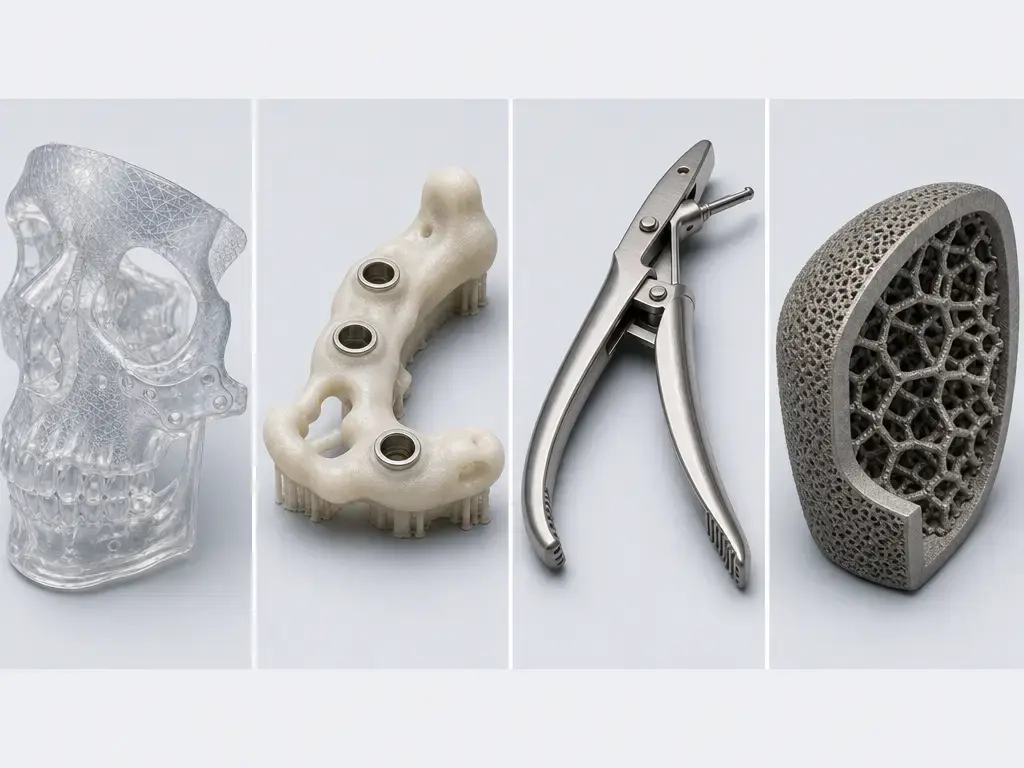
In practice, FDA for 3D printing still means ordinary device law applied to a specific product. FDA lists orthopedic and cranial implants, surgical instruments, dental restorations such as crowns, and external prosthetics as examples of medical devices produced by 3D printing. Most Class I devices are exempt from premarket notification, most Class II devices require 510(k) clearance, and most Class III devices require PMA approval. If there is no legally marketed predicate, the De Novo pathway can apply when general controls alone, or general plus special controls, can provide reasonable assurance of safety and effectiveness. FDA’s product universe includes over 6,000 device types, which is why small changes in indication, anatomy, contact profile, or intended user can change the analysis. 3D printing also appears in drug and biologic contexts, but that is a separate discussion. [1] [3] [9] [17]
A printed anatomical model for planning, a reusable instrument, a patient-matched guide, and a load-bearing implant do not present the same risks. Depending on the product, FDA may focus on imaging inputs, design controls, software, material controls, cleaning, sterilization, mechanical testing, labeling, or postmarket duties. Point-of-care production does not erase that device-centered logic; it adds questions about who the manufacturer is and who carries the quality and release responsibilities. [4] [6] [7]
What FDA may require depending on device type.
- Premarket submission, such as 510(k), De Novo, or PMA. [3] [9]
- Design controls or technical documentation supporting intended use and risk classification. [4] [16]
- Process, software, cleaning, packaging, or sterilization validation where relevant. [4] [20] [21]
- Labeling that defines indications, limitations, and user responsibilities. [4]
- Post-processing controls for heat treatment, curing, machining, depowdering, or inspection. [4]
- Postmarket obligations such as complaint handling, corrections, removals, and adverse event reporting. [3] [13]
What “FDA approval for 3D printing” really means
FDA approval for 3D printing usually refers to one of several different statuses that should be kept separate. First is authorized product status: a specific product may be exempt, 510(k)-cleared, De Novo authorized, or PMA-approved. Second is establishment registration: a business tells FDA that it performs device-related activities. Third is device listing: the establishment lists the devices it makes or distributes, and if a device needs clearance or approval, FDA says it can be listed only after that decision. Fourth is inspection or QMS compliance: the manufacturer is responsible for meeting applicable quality-system requirements and may be inspected. Fifth is ISO certification: ISO 13485 certification is issued by a third-party certification body, not by FDA. [10] [11] [12] [13]
That is why “FDA certified” wording is imprecise when applied broadly to a 3D printing operation. FDA states that registration and listing do not denote approval, clearance, or authorization, and that FDA does not issue registration certificates or certify registration information. QMSR is now the current FDA quality-system framework for finished device manufacturers subject to Part 820, and it incorporates ISO 13485:2016 by reference. That alignment matters for quality expectations, but it does not convert ISO certification into FDA marketing authorization. [11] [12] [13]
Product types that should not be conflated
The organizing principle is intended use, not “3D printing” as a single bucket. FDA’s own process description makes clear that medical 3D printing can include design, software workflow, material controls, and testing, and that the exact steps depend on device complexity. A software-led planning output, an anatomical model, a surgical guide, and an implant may all involve AM, but they do not carry the same evidence burden. [4] [20]
| Product bucket | Likely regulatory posture | Main evidence focus | Common misunderstanding |
|---|---|---|---|
| Software / segmentation / planning output | May be regulated as a software function, depending on claims and clinical use. [20] | Algorithm performance, image handling, output generation, workflow controls, and software validation. [20] | Assuming the printed object is the only regulated output. [20] |
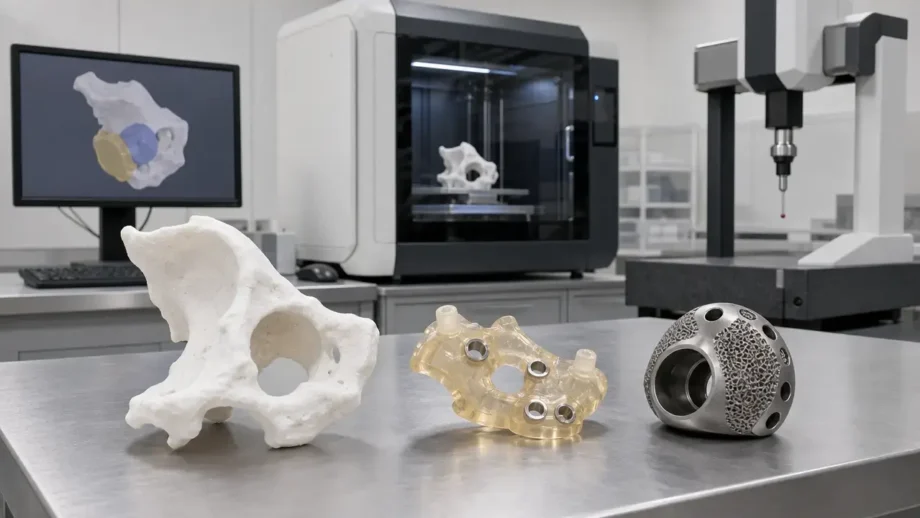
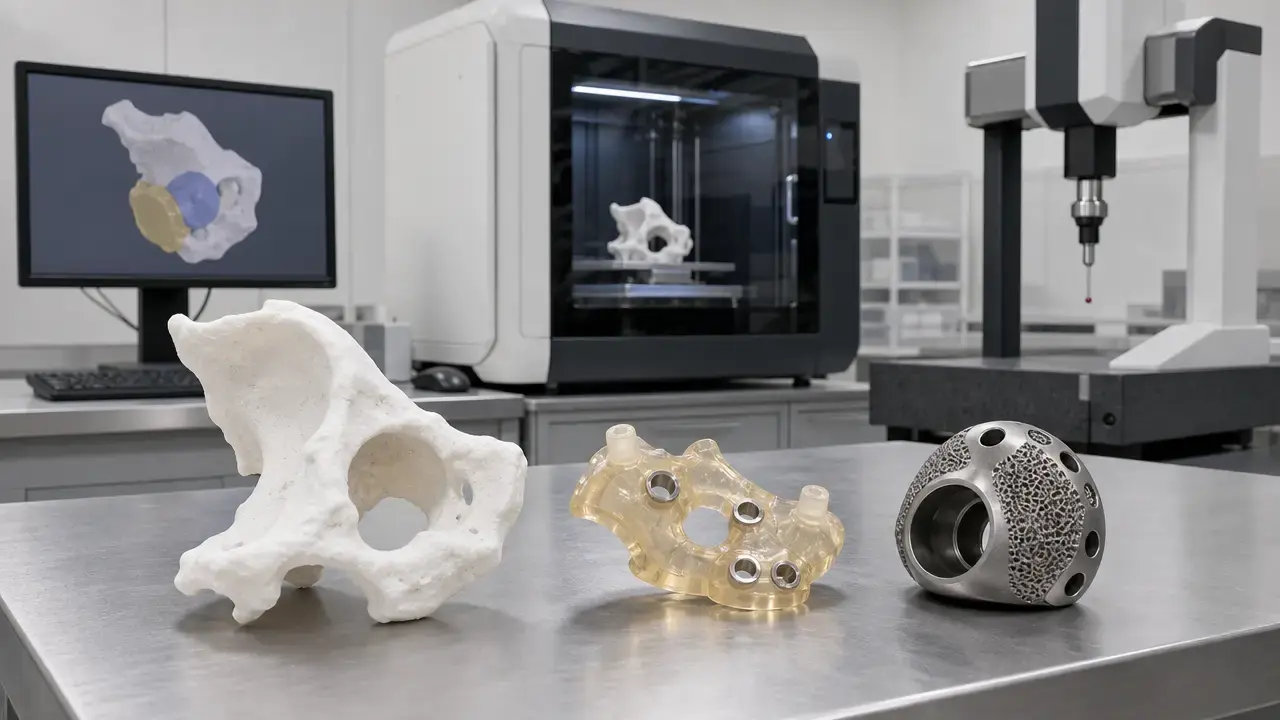
| Anatomical model | May be a regulated model or part of a broader planning workflow, depending on claims. [4] [24] | Imaging input, segmentation, geometric fidelity, labeling, and stated use limits. [4] | Treating every model as equivalent to a surgical guide. [4] |
| Surgical guide or instrument | Often reviewed as a procedure-enabling device or accessory. [4] [23] | Fit, mechanical performance, cleaning or sterilization, and manufacturing repeatability. [4] | Assuming patient matching removes the need for verification. [4] |
| Implantable or patient-matched implant | Generally higher scrutiny when implanted, load-bearing, long-term, or anatomy-specific. [3] [5] | Material state, fatigue or strength, surface condition, sterility, and design controls. [4] [19] | Thinking the printer platform alone establishes safety. [3] [4] |
Software and image-processing tools should be evaluated separately from the printed object. FDA’s software validation guidance applies both to medical device software and to software used to design, develop, or manufacture medical devices. Public database examples show this split: IRIS 1.0 System was cleared under K182643 with decision date February 22, 2019, product code LLZ; VSP SYSTEM was cleared under K120956 with decision date December 12, 2012, classification product code DZJ and subsequent product code LLZ; and Acorn 3D Software / Acorn 3DP Model was cleared under K252103 with decision date December 2, 2025, product code QIH with subsequent product code LLZ. These are decisions on named products with defined indications and classifications, not blanket approvals of “3D printing.” [20] [22] [23] [24]
Printed models, guides, instruments, and implants also differ in the testing that matters most. A model may turn on image-to-geometry fidelity. A guide adds fit, trajectory control, cleaning, and sterilization questions. A reusable instrument adds durability and reprocessing. An implant shifts attention toward the final material state, surface condition, fatigue, fixation, wear, and sterility. For engineering and regulatory planning, keep three evidence layers separate: software-function validation, manufacturing validation, and final-device verification. A validated segmentation workflow does not automatically validate powder removal, post-cure, or sterilization, and a stable production process does not prove that every patient-specific design meets its clinical requirements. [4] [19] [20]
Workflow and validation by product type and AM process
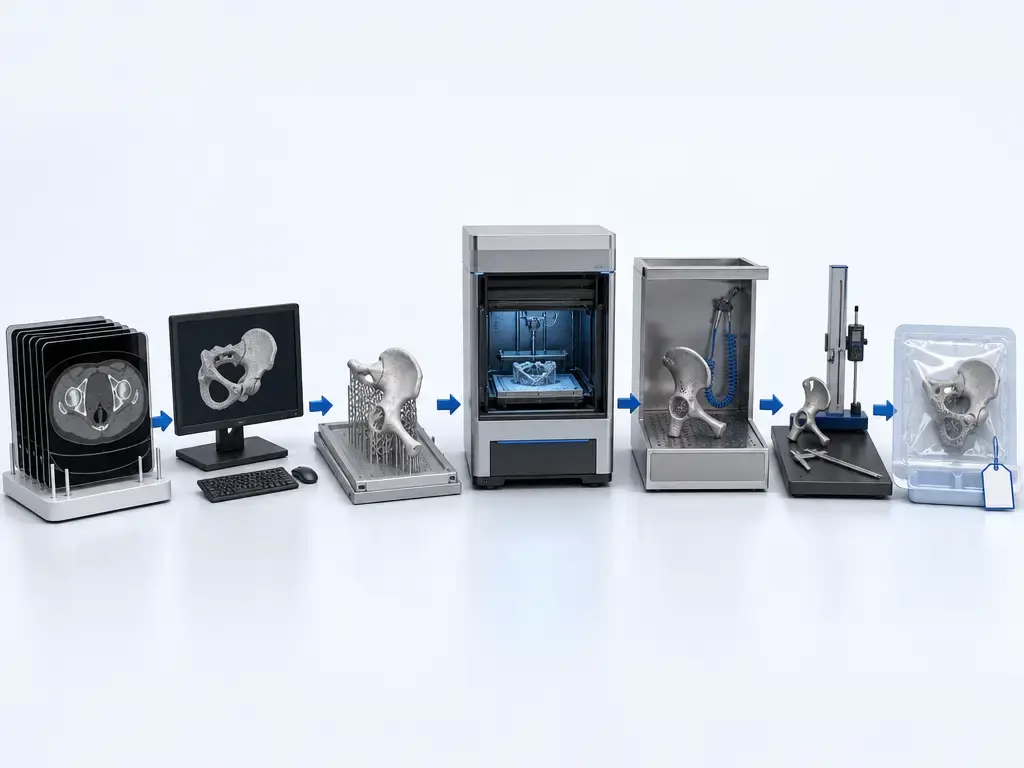
FDA’s main AM guidance remains the December 2017 guidance on technical considerations for additive manufactured medical devices, and FDA’s public process page describes medical 3D printing as a multi-step workflow rather than a single printer event. FDA also notes that the number of steps depends on device complexity and that it typically clears or approves finished devices, not materials for general manufacturing use, with a limited dental caveat for certain engineered materials cleared for specific intended uses as devices. [2] [4]
- Design inputs / imaging inputs
- Segmentation or model generation where applicable
- Build prep / supports / orientation
- Printing
- Post-processing
- Inspection / testing
- Release and traceability
The first validation boundary is the translation of clinical or engineering intent into controlled design inputs. For patient-specific work, that may begin with CT, MRI, optical scan, or intraoral scan data, followed by segmentation or model generation. Because FDA’s software validation guidance covers software used to design, develop, or manufacture devices, the validation question can reach beyond software that is itself the marketed medical function. Dimensional accuracy should therefore be tied to a defined specification, a measurement method, a build orientation, and an acceptance criterion. A generic printer-specification claim is not enough for a guide sleeve, an occlusal surface, a porous implant feature, or an anatomical model boundary. [4] [20]
The manufacturing boundary starts when the printable file becomes a controlled build. Build preparation can affect support contact, anisotropy, heat history, resin drainage, powder removal, and surface accessibility. Printing then leads into post-processing steps such as washing, curing, heat treatment, depowdering, machining, polishing, cleaning, packaging, or sterilization if the device is supplied sterile. Mechanical performance should be interpreted by product type, material, orientation, and post-processing state. Biocompatibility is assessed on the final finished device form, including sterilization if applicable, and in light of the device’s contact profile. For metal powder bed fusion in critical applications such as implants, FDA recognizes ISO/ASTM 52904, which reflects the need to control process characteristics as well as nominal geometry. [4] [19] [21] [27]
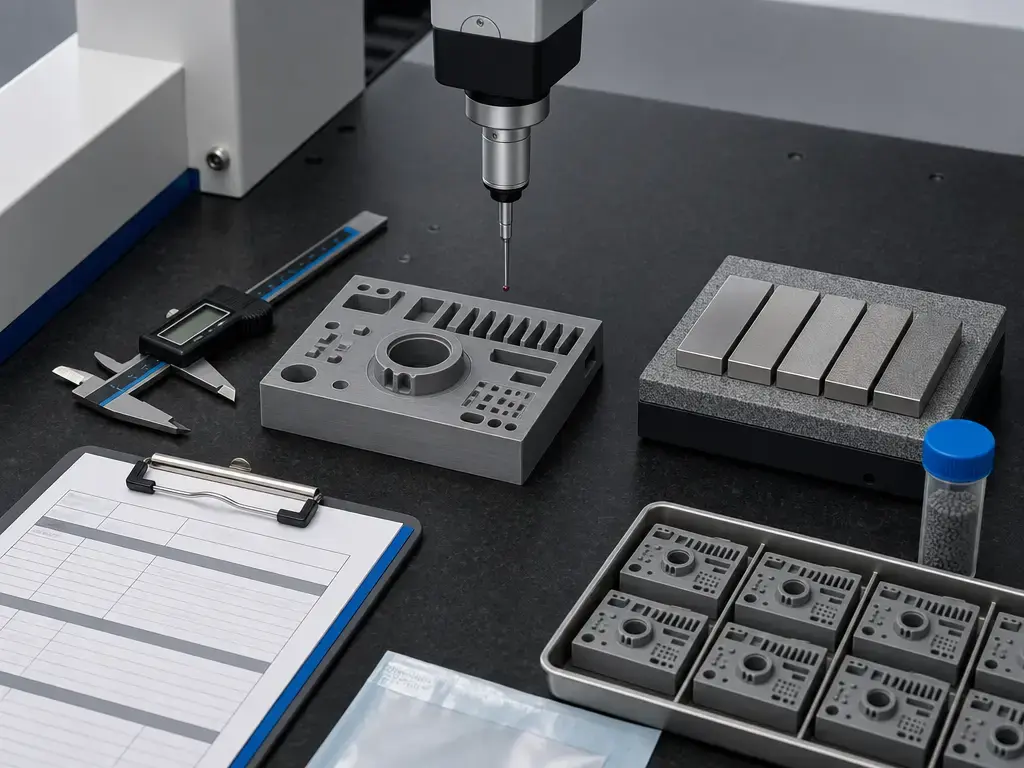
Release controls close the loop. Inspection may include dimensional checks, material verification, surface assessment, mechanical testing, cleanliness, packaging integrity, or sterility evidence when relevant. Traceability should connect each released unit to the build, lot, software version, material batch, post-processing route, and acceptance record. Printer calibration supports equipment control, but it is not the same as demonstrating that the full process consistently produces a device within defined specifications. [4] [19]
Performance and evidence: what changes when the process changes
AM is not a separate legal pathway, but manufacturing-process changes can still matter. Moving from one AM process to another, changing orientation, modifying layer thickness, swapping materials, changing heat treatment, or adding machining can affect dimensions, surface state, residuals, material properties, and clinical performance. For a 510(k) 3D printed device, that can change the scope of testing and comparability even when the high-level product type is unchanged. [3] [4]
The key question is not whether the device “became 3D printed.” It is whether the changed process could alter the device in ways that matter for safety or effectiveness. A dimensional change should be judged against device specifications, not a printer data sheet. A material or post-processing change can shift the need for mechanical, chemical, cleaning, packaging, or aging evidence. If the device contacts the patient, FDA’s biocompatibility framework applies to the final finished state rather than to raw material claims alone. [4] [19]
This does not predict an FDA decision, and it is not legal advice. It is the practical reason quality systems, standards, and disciplined change evaluation matter in medical additive manufacturing. [3] [13]
Standards and quality systems after February 2, 2026
FDA-recognized consensus standards can support submissions, but they do not create automatic clearance, approval, or certification. FDA’s standards program says conformance is voluntary unless a standard is incorporated by reference into regulation, and manufacturers may submit declarations of conformity to recognized standards. When used appropriately, those declarations may reduce the amount of supporting testing documentation typically needed in a premarket submission. [18]
AM-specific standards are useful, but they are often supplemental rather than sufficient by themselves. FDA’s recognized standards database includes ISO/ASTM 52901, first edition 2017-08, with FDA date of entry June 7, 2018; ISO/ASTM 52910-18, with FDA date of entry January 14, 2019; and ISO/ASTM 52904, first edition 2019-08, with FDA date of entry June 7, 2021. For some products, cross-cutting standards for risk management, software lifecycle, biocompatibility, or sterilization will matter more than an AM-specific standard. [25] [26] [27] [29] [30] [31]
The present-tense quality-system framework is QMSR. FDA says the QMSR final rule was issued on January 31, 2024, became effective on February 2, 2026, and revised 21 CFR Part 820 now incorporates ISO 13485:2016 by reference. FDA also says QSIT was withdrawn on February 2, 2026, and a new inspection process was implemented. That is regulatory alignment, not a statement that an ISO 13485 certificate equals FDA product authorization. [13] [14]
Standards domains that matter beyond AM.
- Risk management: FDA recognizes ISO 14971, third edition 2019-12, with FDA date of entry December 23, 2019. [29]
- Software lifecycle: FDA recognizes IEC 62304 Edition 1.1, 2015-06 consolidated version. [30]
- Biocompatibility: FDA’s current recognition entry for ISO 10993-1 is the sixth edition 2025-11, recognition number 2-313, partial recognition, with FDA date of entry May 25, 2026. [31]
- Sterilization/reprocessing if applicable: Use the standards and validation approach that fits the device’s sterile delivery state, reuse profile, and packaging configuration. [18] [21]
Patient-matched, custom device, and point-of-care are not the same thing
A patient-matched device is not automatically a custom-exempt device. FDA’s 3D-printing materials state that patient-matched devices do not automatically meet the custom device exemption requirements. A patient-matched cranial plate, dental restoration, guide, or implant can still move through ordinary regulatory pathways when it fits an established device type and is made within validated design and manufacturing limits. [5] [3]
The custom device exemption is narrower than everyday engineering usage suggests. FDA’s custom-device guidance explains the statutory phrase “5 units per year of a particular device type,” which is one reason “custom” should not be used casually as a synonym for patient-specific. The regulatory question is not whether every unit is geometrically unique; it is whether the product actually fits the legal conditions for the exemption. [8]
Point-of-care 3D printing adds a different question: who is the manufacturer? FDA’s point-of-care document is a discussion paper for public comment, not guidance. In that paper, FDA outlines major scenarios including a healthcare facility using a medical device production system, a traditional manufacturer co-located at or near the healthcare facility, and a healthcare facility assuming traditional-manufacturer responsibilities. FDA also states that a healthcare facility may choose to assume all responsibilities of a traditional manufacturer. That is why point-of-care oversight remains policy-sensitive, especially around process control, release authority, records, complaints, and quality obligations. [6] [7]
Common misconceptions and how to verify a claim
Several recurring claims create confusion in medical 3D printing. “All medical 3D printing needs approval” is too broad because some device types may be exempt while others require 510(k), De Novo, or PMA. “A biocompatible resin is FDA approved” is usually wrong because FDA typically clears or approves finished devices, not materials for general manufacturing use. “Patient-specific means custom-exempt” is unreliable because FDA says patient-matched devices do not automatically meet the custom device exemption. And a claim that a 3D printing operation is “FDA certified” misstates registration, listing, inspection, or ISO status as if it were product authorization. [4] [5] [11] [12]
A listed record is not a catch-all for every software version, printer, site, post-processing route, or indication, and recognized standards do not by themselves create legal marketing status. A process change can therefore affect whether a prior regulatory claim still matches the actual product being made. [10] [18]
How to check an FDA claim.
- Search the 510(k), De Novo, or PMA record. [10] [11]
- Check product classification and intended use. [16] [17]
- Distinguish the device authorization record from the registration/listing record. [10] [11]
- Check whether cited standards are FDA-recognized and relevant to the actual product and process. [18]
Practical reading of vendor and hospital claims
For buyers, founders, and hospital teams, the useful question is not whether a company says “FDA approved” in general terms. It is what specific product record supports the exact device and intended use being sold. FDA states that registration and listing do not denote product approval, clearance, or authorization, so a strong claim should identify the device name, regulatory pathway, indications, and scope of the authorized workflow. [10] [11] [12]
For due diligence in FDA for 3D printing, ask whether the claim covers the whole workflow being deployed: imaging, segmentation, design rules, printer, material, post-processing, inspection, labeling, and release responsibility. QMSR is now the current FDA quality-system regime for manufacturers subject to Part 820, and recognized standards remain supportive tools rather than substitutes for product-specific evidence. [13] [18]
FAQ
Is FDA approval required for 3D printing?
Not for 3D printing as a manufacturing method by itself. FDA regulates the finished medical product and its intended use under existing device frameworks. Most Class I devices are exempt from premarket notification, most Class II devices require 510(k) clearance, and most Class III devices require PMA approval. [3]
What does FDA approval for 3D printing actually mean in medical devices?
Usually it means that a specific 3D-printed or 3D-printing-related product has a status that fits its device type: exempt, 510(k)-cleared, De Novo authorized, or PMA-approved. It does not mean FDA has broadly approved a printer, material, or workflow for all medical uses. [3] [9]
What is “FDA certified 3D printing”?
It is not a formal FDA status for medical devices. FDA says registration and listing do not denote approval, clearance, or authorization, and FDA does not issue device registration certificates or certify registration information. If a vendor uses the phrase, ask what exact product record or quality claim it is actually referring to. [11] [12]
Can software for segmentation, planning, or anatomical modeling have a different regulatory posture from the printed output?
Yes. FDA’s software validation guidance applies both to medical device software and to software used to design, develop, or manufacture devices, which means software validation, manufacturing validation, and final-output verification are separate evidence layers. Public 510(k) examples such as IRIS, VSP SYSTEM, and Acorn 3D illustrate that distinction. [20] [22] [23] [24]
Does a patient-matched device qualify for the custom device exemption?
Not automatically. FDA says patient-matched devices do not automatically meet the custom device exemption requirements, and the custom-device guidance interprets the statutory phrase “5 units per year of a particular device type.” Patient-matched and custom-exempt are different regulatory concepts. [5] [8]
Do process changes affect FDA approval for 3D printing claims?
They can. Changes to AM process, orientation, materials, post-processing, or sterilization can change what evidence is still applicable, because printing is only one part of the regulated workflow and biocompatibility is assessed on the final finished device state. [4] [19]
Can hospitals legally do point-of-care 3D printing under FDA rules today?
FDA’s 2021 point-of-care paper is a discussion paper, not guidance. The practical issue is which scenario applies and who is treated as the manufacturer, because FDA describes situations where a healthcare facility may use an MDPS, work with a nearby traditional manufacturer, or assume all traditional-manufacturer responsibilities itself. [6] [7]
Related on 3D Mag
Sources
Place article citations after sentence-ending punctuation in the format [[n]](#sources).
-
FDA — 3D Printing of Medical Devices
https://www.fda.gov/medical-devices/products-and-medical-procedures/3d-printing-medical-devices -
FDA — Technical Considerations for Additive Manufactured Medical Devices
https://www.fda.gov/regulatory-information/search-fda-guidance-documents/technical-considerations-additive-manufactured-medical-devices -
FDA — FDA’s Role in 3D Printing
https://www.fda.gov/medical-devices/3d-printing-medical-devices/fdas-role-3d-printing -
FDA — Process of 3D Printing Medical Devices
https://www.fda.gov/medical-devices/3d-printing-medical-devices/process-3d-printing-medical-devices -
FDA — Medical Applications of 3D Printing
https://www.fda.gov/medical-devices/3d-printing-medical-devices/medical-applications-3d-printing -
FDA — 3D Printing Medical Devices at the Point of Care: Discussion Paper
https://www.fda.gov/medical-devices/3d-printing-medical-devices/3d-printing-medical-devices-point-care-discussion-paper -
FDA PDF — Discussion Paper: 3D Printing Medical Devices at the Point of Care
https://www.fda.gov/media/154729/download -
FDA — Custom Device Exemption
https://www.fda.gov/regulatory-information/search-fda-guidance-documents/custom-device-exemption -
FDA — De Novo Classification Request
https://www.fda.gov/medical-devices/premarket-submissions-selecting-and-preparing-correct-submission/de-novo-classification-request -
FDA — How to Register and List
https://www.fda.gov/medical-devices/device-registration-and-listing/how-register-and-list -
FDA — Are There FDA Registered or FDA Certified Medical Devices?
https://www.fda.gov/medical-devices/consumers-medical-devices/are-there-fda-registered-or-fda-certified-medical-devices-how-do-i-know-what-fda-approved -
FDA — Important Reminders about Registration and Listing
https://www.fda.gov/medical-devices/device-registration-and-listing/important-reminders-about-registration-and-listing -
FDA — Quality Management System Regulation (QMSR)
https://www.fda.gov/medical-devices/postmarket-requirements-devices/quality-management-system-regulation-qmsr -
FDA — Quality Management System Regulation Frequently Asked Questions
https://www.fda.gov/medical-devices/quality-management-system-regulation-qmsr/quality-management-system-regulation-frequently-asked-questions -
FDA — How to Study and Market Your Device
https://www.fda.gov/medical-devices/device-advice-comprehensive-regulatory-assistance/how-study-and-market-your-device -
FDA — Classify Your Medical Device
https://www.fda.gov/medical-devices/overview-device-regulation/classify-your-medical-device -
FDA — Products and Medical Procedures
https://www.fda.gov/medical-devices/products-and-medical-procedures -
FDA — Division of Standards and Conformity Assessment
https://www.fda.gov/medical-devices/premarket-submissions-selecting-and-preparing-correct-submission/division-standards-and-conformity-assessment -
FDA — Basics of Biocompatibility: Information Needed for Assessment by the FDA
https://www.fda.gov/medical-devices/biocompatibility-assessment-resource-center/basics-biocompatibility-information-needed-assessment-fda -
FDA — General Principles of Software Validation
https://www.fda.gov/regulatory-information/search-fda-guidance-documents/general-principles-software-validation -
FDA — Sterilization for Medical Devices
https://www.fda.gov/medical-devices/general-hospital-devices-and-supplies/sterilization-medical-devices -
FDA 510(k) database — IRIS 1.0 System (K182643)
https://www.accessdata.fda.gov/scripts/cdrh/cfdocs/cfpmn/pmn.cfm?id=K182643 -
FDA 510(k) database — VSP SYSTEM (K120956)
https://www.accessdata.fda.gov/scripts/cdrh/cfdocs/cfpmn/pmn.cfm?id=K120956 -
FDA 510(k) database — Acorn 3D Software / Acorn 3DP Model (K252103)
https://www.accessdata.fda.gov/scripts/cdrh/cfdocs/cfpmn/pmn.cfm?ID=K252103 -
FDA standards database — ISO/ASTM 52901
https://www.accessdata.fda.gov/scripts/cdrh/cfdocs/cfStandards/detail.cfm?standard__identification_no=36814 -
FDA standards database — ISO/ASTM 52910-18
https://www.accessdata.fda.gov/scripts/cdrh/cfdocs/cfStandards/detail.cfm?standard__identification_no=38250 -
FDA standards database — ISO/ASTM 52904
https://www.accessdata.fda.gov/scripts/cdrh/cfdocs/cfStandards/detail.cfm?standard__identification_no=42174 -
ISO — ISO/ASTM 52900:2021
https://www.iso.org/standard/74514.html -
FDA standards database — ISO 14971
https://www.accessdata.fda.gov/scripts/cdrh/cfdocs/cfStandards/detail.cfm?standard__identification_no=41349 -
FDA standards database — IEC 62304
https://www.accessdata.fda.gov/scripts/cdrh/cfdocs/cfStandards/detail.cfm?standard__identification_no=38829 -
FDA standards database — ISO 10993-1 current recognition entry
https://www.accessdata.fda.gov/scripts/cdrh/cfdocs/cfStandards/detail.cfm?standard__identification_no=47116