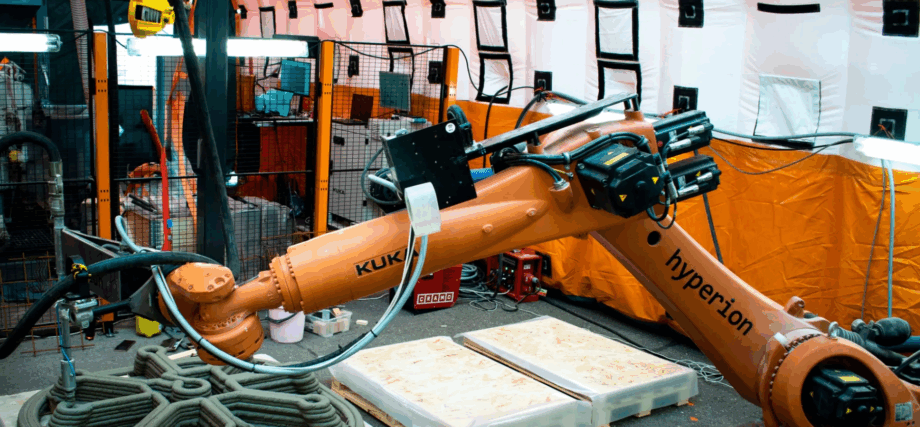
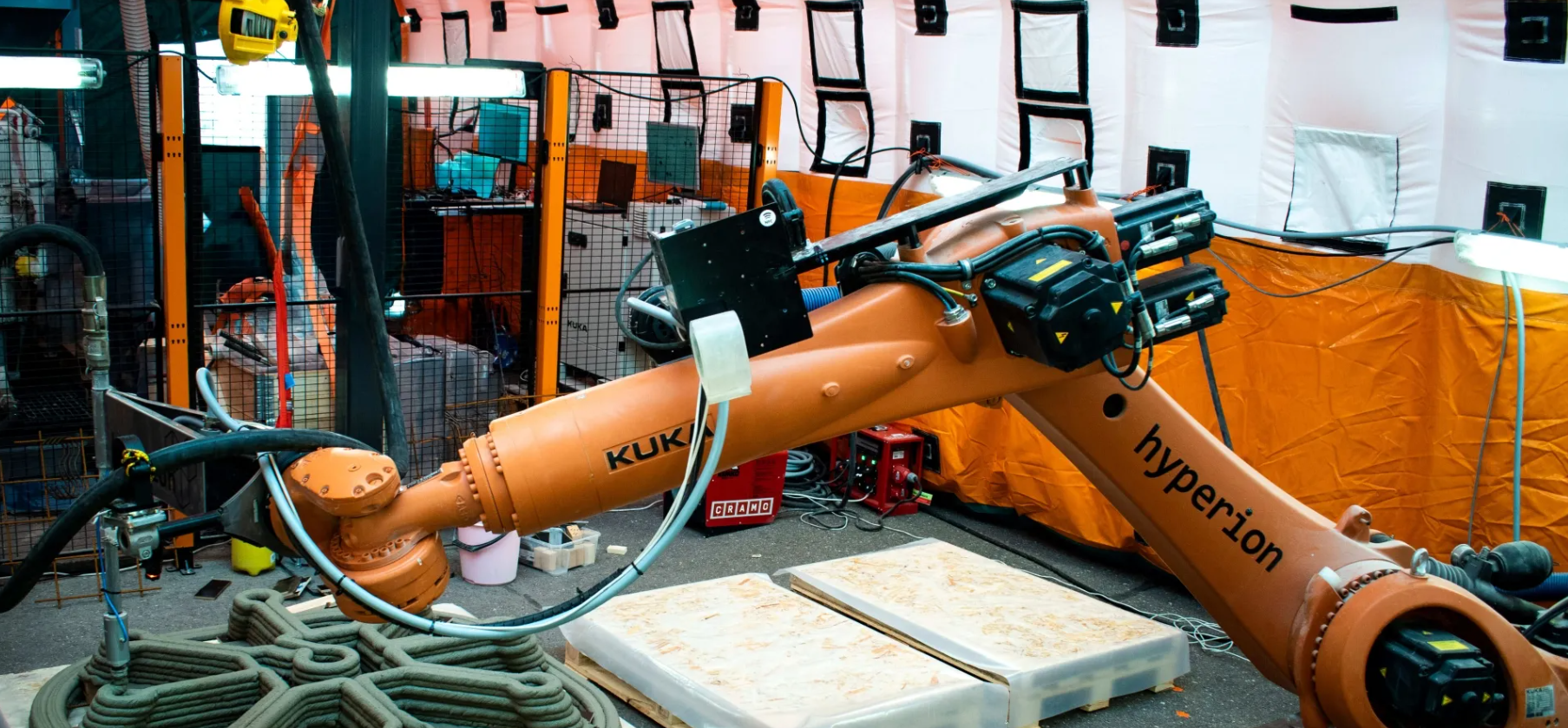

The UK’s first full testing of 3D printed electricity substation foundations has shown results called by researchers and industry partners both “encouraging” and “well beyond expectations,” New Civil Engineer reports. This validation was carried out by Hyperion Robotics, National Grid, and the University of Sheffield, examining small, medium, and large printed foundations that were produced with less concrete than conventionally created equivalents.
In the controlled conditions of a laboratory, the printed units outperformed the existing standards. According to Hyperion Robotics, small foundations showed “an eightfold safety margin against the test criteria,” while medium and large versions achieved capacities “around three times higher than expected.” All designs also succeeded in on-site overturning tests at National Grid’s Yorkshire Green facility, supported by contractor Murphy.
The programme consisted of two full-scale tests at the University of Sheffield’s Integrated Civil and Infrastructure Research Centre (ICAIR). One of the tests assessed tension, while the other evaluated overturning moment. These two tests we then followed by a full-scale validation in real ground conditions. The partners note that these on-site trials were necessary to ensure the foundations behave predictably across the varied geology found in England and Wales.
One key benefit that emerges from the trials is material efficiency. Hyperion mentioned that the printed foundations were made with 56% less concrete, a reduction essential for cutting carbon in grid construction, especially in light of concrete’s significant contribution to global emissions.
Initial rollout will focus on non-critical structures such as lighting column foundations, with future trials targeting assets critical for safety, such as post insulators and circuit breakers. According to Hyperion, these printed units are also “four times stronger” than traditional methods, which could transform how utility foundations are made – if replicated in further studies.